
Psalms 49:13

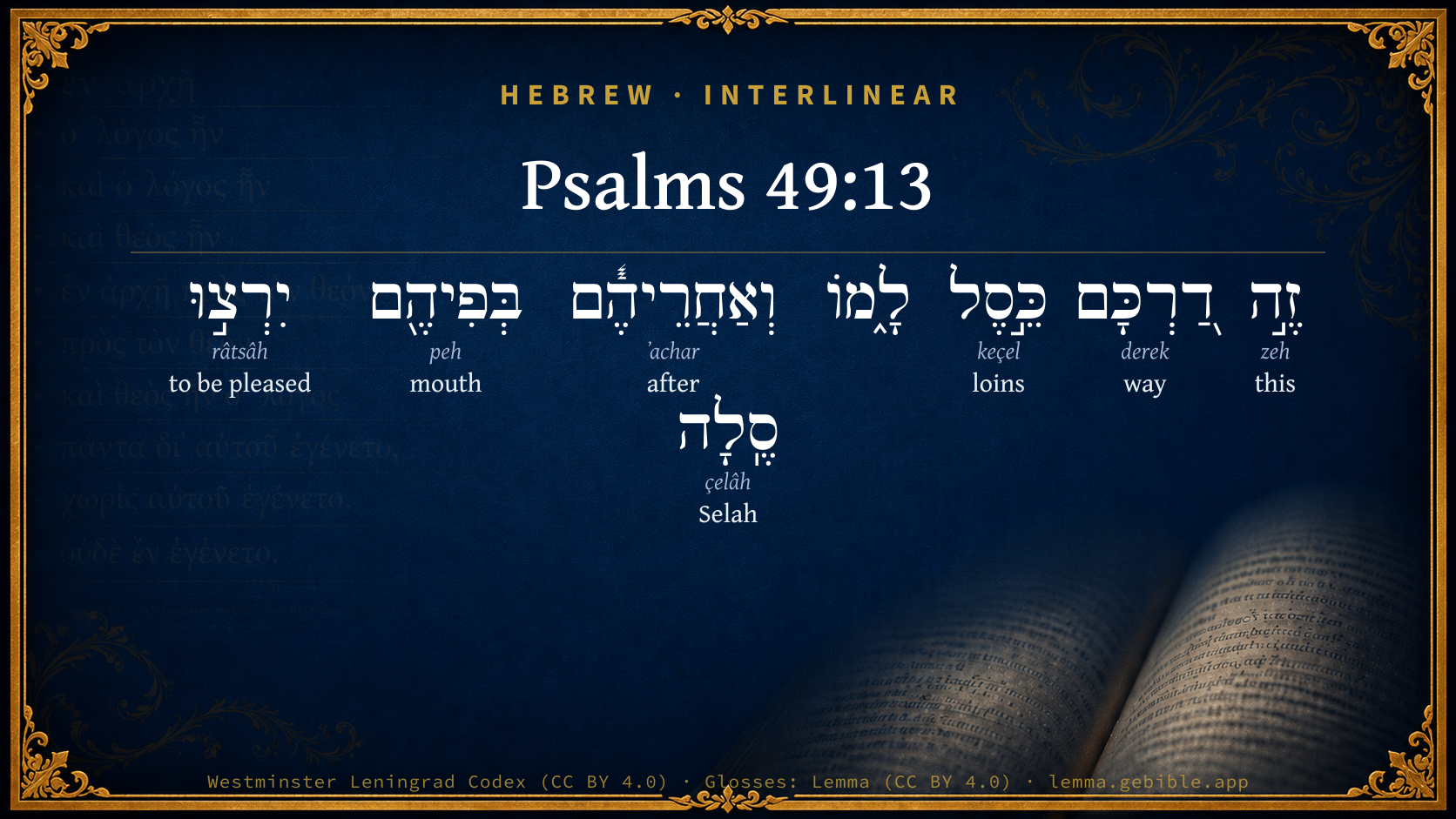
Hebrew (Westminster Leningrad Codex) Psalms 49:13 appears in the Hebrew Old Testament. The text above is from the Westminster Leningrad Codex. Each word links to its Strong’s number, a concise gloss, and parsing drawn from the Open Scriptures Hebrew Bible morphology. Click any word for its full Brown-Driver-Briggs (BDB) entry.
Download image
Cite this verse

Psalms 49:13 (World English Bible). Public Domain. Lemma interlinear Bible study tool, https://lemma.gebible.app/v/psalms/49/13.

Show BibTeX & RIS
BibTeX
RIS
English Translation
This is the destiny of those who are foolish, And of those who approve their sayings. Selah.
World English Bible · Public Domain
Download a study sheet

One document with this verse’s original text, its word-by-word gloss line, the meaning frame, cross-references with their text, attributed commentary, and full source and license credits — printable, and it pastes into notes with its structure intact.

This verse Autodidact and up

Study sheet (.html) Plain text (.txt)

A passage Seminary Student

Up to 50 verses in one chapter. A passage sheet keeps up to 6 commentary sources and 12 cross-references per verse, in the order this page ranks them, and says so on the sheet whenever that leaves anything out. Ask for a single verse and you get the Autodidact verse sheet above.

Everything on this page stays free to read, with no account — the sheet is a download of what is already on screen, not access to it.

Want to remove ads? Support Godless Engineer
Compare translations 3

The same verse in 3 English versions, stacked beneath the original-language interlinear above. Click any original word for its lexicon entry.

Each is an independent rendering of the whole verse — the interlinear is not word-aligned to these translations.

Highlighted words mark where these versions differ — a whole-verse word diff, not a word-by-word alignment.

  • World English Bible Public Domain
    This is the destiny of those who are foolish, And of those who approve their sayings. Selah.
  • King James Version Public Domain
    This their way is their folly: yet their posterity approve their sayings. Selah.
  • unfoldingWord Literal Text CC BY-SA 4.0
    This, their way, folly to them, but after them, they delight in their mouths. Selah

unfoldingWord Literal Text — © unfoldingWord, licensed CC BY-SA 4.0. Word-aligned USFM3 via Door43 (git.door43.org/unfoldingWord/en_ult).

Versions to compare (up to 4)

3 of 4 selected

Show all 18 translations

Every available English version of this verse, each an independent rendering of the whole verse.

  • World English Bible Public Domain
    This is the destiny of those who are foolish, And of those who approve their sayings. Selah.
  • Berean Standard Bible Public Domain
    This is the fate of the self-confident and their followers who endorse their sayings. Selah
  • Majority Standard Bible Public Domain
    This is the fate of the foolish and their followers who endorse their sayings. Selah
  • King James Version Public Domain
    This their way is their folly: yet their posterity approve their sayings. Selah.
  • American Standard Version (1901) Public Domain
    This their way is their folly: Yet after them men approve their sayings. Selah
  • Revised Version (1885) Public Domain
    This their way is their folly: yet after them men approve their sayings. Selah
  • Geneva Bible (1599) Public Domain
    This their way vttereth their foolishnes: yet their posteritie delite in their talke. Selah.
  • Douay-Rheims (1899) Public Domain
    And man when he was in honour did not understand; he is compared to senseless beasts, and is become like to them.
  • Young's Literal Translation Public Domain
    This their way `is' folly for them, And their posterity with their sayings are pleased. Selah.
  • Literal Standard Version CC BY-SA 4.0
    This their way [is] folly for them, || And their posterity are pleased with their sayings. Selah.
  • Unlocked Literal Bible CC BY-SA 4.0
    This, their way, is their folly; yet after them, men approve of their sayings. Selah
  • unfoldingWord Literal Text CC BY-SA 4.0
    This, their way, folly to them, but after them, they delight in their mouths. Selah
  • Darby Bible Public Domain
    This their way is their folly, yet they that come after them delight in their sayings. Selah.
  • World Messianic Bible Public Domain
    This is the destiny of those who are foolish, and of those who approve their sayings. Selah.
  • Webster's Bible Public Domain
    \\49:12\\Nevertheless man being in honor abideth not: he is like the beasts that perish.
  • Free Bible Version CC BY-SA 4.0
    This is the way of foolish people, yet those who come after them think they were clever! Selah.
  • Bible in Basic English Public Domain
    This is the way of the foolish; their silver is for those who come after them, and their children get the pleasure of their gold. (Selah.)
  • JPS Tanakh (1917) Public Domain
    (49-14) This is the way of them that are foolish, and of those who after them approve their sayings. Selah

Literal Standard Version (2020), Covenant Press — licensed CC BY-SA 4.0. Text via the HelloAO Bible API (eBible.org). Unlocked Literal Bible (unfoldingWord) — licensed CC BY-SA 4.0. Text via the HelloAO Bible API (eBible.org). unfoldingWord Literal Text — © unfoldingWord, licensed CC BY-SA 4.0. Word-aligned USFM3 via Door43 (git.door43.org/unfoldingWord/en_ult). Free Bible Version, Dr. Jonathan Gallagher — licensed CC BY-SA 4.0. Text via the HelloAO Bible API (eBible.org).

Word by word

More ways to search: Search by grammar → Find every occurrence → Compare this word →

Practice this passage: Drill this verse → Learn its vocabulary →

About this verse

These counts appear in no published source. They are computed here, from the morphology-tagged text and Lemma’s own curated glosses. What Lemma adds →

8
words
7
distinct lemmas
Wisdom
section

Notable vocabulary

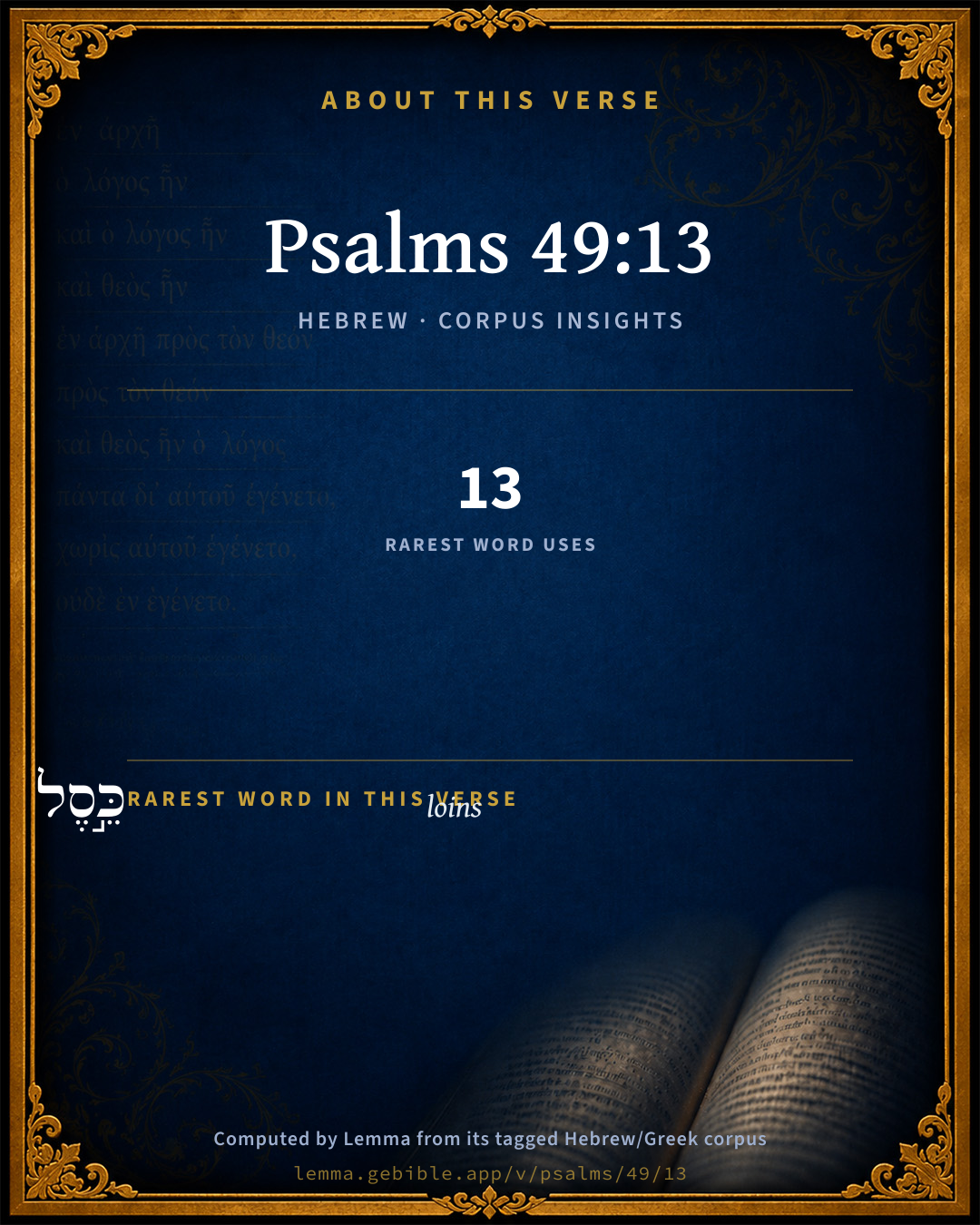
The rarest word here is כֵּ֣סֶל loins H3689 — appearing just 13 times in the whole Hebrew Bible.

Shared distinctive vocabulary

כֵּ֣סֶל loins H3689 occurs in 13 verses of the Hebrew Bible. Also found in:

Grammatical profile

  • 1 verb
  • 3 nouns
  • 1 pronoun
  • 2 prepositions
  • 1 particle

Verb forms

  • יִרְצ֣וּ Qal · Imperfect

Hebrew & Septuagint length

In English translation the verse runs 17 words from the Hebrew and 16 from the Septuagint (LXX English) — closely comparable.

A rough comparison of the two English renderings, which tokenize alike — not a word-level alignment.

Word counts can differ between the Hebrew and the Greek without any difference in meaning — e.g. the Hebrew direct-object marker אֵת has no separate Greek word, and Greek often adds the article ὁ.

Cross-references

5

Topical passages linked to Psalms 49:13 in the Treasury of Scripture Knowledge — connected by theme and wording, ordered by reader-vote popularity; previews shown in the World English Bible.

  • Luke 12:20 "But God said to him, 'You foolish one, tonight your soul is required of you. The things which you have prepared--whose will they be?'
  • 1 Corinthians 3:19 For the wisdom of this world is foolishness with God. For it is written, "He has taken the wise in their craftiness."
  • Luke 16:27–28 "He said, 'I ask you therefore, father, that you would send him to my father's house;
  • Jeremiah 44:17 But we will certainly perform every word that is gone forth out of our mouth, to burn incense to the queen of the sky, and to pour out drink-offerings to her, as we have done, we and our fathers, our kings and our princes, in the cities of Judah, and in the streets of Jerusalem; for then had we plenty of food, and were well, and saw no evil.
  • Luke 11:47–48 Woe to you! For you build the tombs of the prophets, and your fathers killed them.

Cross-references courtesy of OpenBible.info (CC BY 4.0).

Hebrew and Greek witnesses Masoretic Hebrew ↔ Greek Septuagint

The same verse in the two great witnesses to the Old Testament, shown verse-for-verse.

You’re reading Greek Psalm 48 (Hebrew Psalm 49). The Septuagint counts the superscription, so verse numbers can differ from the Hebrew — chapter-level alignment, not verse-by-verse. Numbering follows Rahlfs.

These are two independent witnesses, not word-aligned to each other, and the Septuagint is shown in lemma (dictionary) form.

Hebrew Psalms 49:13 Masoretic · Westminster Leningrad Codex

זֶ֣ה דַ֭רְכָּם כֵּ֣סֶל לָ֑מוֹ וְאַחֲרֵיהֶ֓ם בְּפִיהֶ֖ם יִרְצ֣וּ סֶֽלָה

This is the destiny of those who are foolish, And of those who approve their sayings. Selah.

World English Bible · Public Domain

Greek LXX Greek Psalm 48:13 Septuagint · lemma form

καί ἄνθρωπος ἐν τιμή εἰμί οὐ συνἵημι παρα συνβάλλω ὁ κτῆνος ὁ ἀνόητος καί ὁμοιόω αὐτός

This their way is an offense to them: yet afterwards men will commend their sayings. Pause.

LXX2012 (modern English Septuagint) · Public Domain

On this verse, Keil & Delitzsch discusses the Septuagint’s reading. Read the note in Commentary ↓

Hebrew: Westminster Leningrad Codex (CC BY 4.0). Greek: Septuagint (public domain); English from LXX2012 (modern English Septuagint) (Public Domain). How the Septuagint differs from the Hebrew →

Commentary

Notes on Psalms 49:13 from classic Christian and Jewish commentators (each source and its license shown beneath its notes). The classic Christian expositions comment on the surrounding passage and are grouped to its opening verse, so a note may address several verses; the Jewish commentaries on the Tanakh (Rashi and others) are per-verse, so they appear only where the commentator wrote on this verse.

Lemma curates 59 commentaries, every one of them public domain or Creative Commons licensed, each selected and text-cleaned for this edition rather than reprinted as found. About our sources →

Trapp's Complete Commentary

John Trapp

Psa 49:13 This their way [is] their folly: yet their posterity approve their sayings. Selah.

Ver. 13. This their way is their folly] This their fond conceit of an immortality is an egregious folly, fully confuted by every day’s experience; for the longest lived person dies at last, as did (beside the antediluvian patriarchs) Joannes de Ternporibus, armour bearer to Charles the Great, who died A.D. 1139, aged three hundred sixty-one years (Asted’s Chronol. 475). So the old man of Bengala, in the East Indies, who was three hundred and thirty-five years old when he came to the Portugals, from whom, for his miraculous age, he received a yearly stipend till he died (Naucler. Purehas. Pilg., p. 481). He that lived in our days till one hundred and fifty years, or thereabouts, yielded at length to nature; and yet men dote and dream still of an immortality. The first doom that ever was denouneed was death, "Thou shalt surely die"; and the first doubt that ever was made was concerning death, "Ye shall not surely die"; ever since which time there is something of the spawn of that old serpent left in our natures, prompting us to doubt of that whereof there is the greatest certainty; and although every man granteth that he shall die, yet there is scarce any man that futureth not his death, and thinketh that he may live yet, and yet, and so long: this is folly in a high degree, and we should be sensible of it, labouring to become neither fond of life nor afraid of death. &&&Longevity-Long lived men

Yet their posterity approve their sayings. Selah] Heb. delight in their mouth, are as wise as their ancestors, tread in their track, take up their inward thoughts, Psa 49:11, observe the same lying vanities, and so forsake their own mercies, Jon 2:8. Selah, q.d. O wonderful, for, see the issue of their folly.

John Trapp, A Commentary or Exposition upon All the Books of the Old and New Testament (1647–1656) — public domain. Text from a community e-Sword module.

The Biblical Illustrator

Joseph S. Exell

Psa_49:13

This their way is their folly.

The folly of sin

There can be no greater evidence of the degeneracy of mankind than their fond pursuits after the things which are light and momentary, and their wilful neglect of those which are of the greatest value and concern.

1. It is egregious folly to rely upon false principles, to build upon tottering and deceitful foundations; and yet so doth every vicious person. He discards all principles of right reason and understanding, and steers himself only by those which are apparently false, and have no other bottom than his own deluded fancy.

2. Then it is a high piece of folly to take up and content ourselves with small things, when we may be more welcome to greater, to strive for petty matters, and in the meantime to neglect those of moment, to aim only at base and unworthy ends, when we have high and noble ones to busy ourselves about; and yet this every sinner is apparently guilty of, and thereby betrays his folly. Children and fools pick straws, and tie knots on bulrushes, entertain themselves with trifles and inpertinences, and we may gravely smile at these their follies, and think we can do no less when we take notice of them. But, alas! their sport is our earnest, and their childish toys and rattles are but emblems of mens serious employments and businesses.

3. He in the accounts of all intelligent persons is no other than a fool, who being left to his liberty and choice, chooses sensual and earthly delights before those that are spiritual and intellectual; and this is the guise of all sinners. Thus the intemperate and luxurious person most vainly esteems the pleasures of the taste and the delights of the palate above the more noble relishes of Divine and heavenly joys, which are the repast of the blessed, and the food of angels. The lascivious person unreasonably values the transitory emotions of his lust and lewd desires before the greater and more cherishing flames of Divine love. The covetous hugs his gold and silver, and broods over his bags with a mighty pleasure, preferring this before that other more generous and noble one of doing good with his wealth, of relieving some poor and comfortless widow, of succouring some fatherless child, of cheering the heart of some good man who is fallen into poverty, and is ready to perish. I appeal to any wise man, whether this be not a greater and more substantial pleasure than the other, whether this will not create a more lasting comfort in a mans mind. And the same is to be said of all the pleasures which accompany the performance of good and holy actions: they are solid and durable, they are real and substantial, because indeed they are spiritual and Divine. But silly birds will fly to painted grapes; deluded sinners prosecute those delights which are false and counterfeit: they hunt after mere shadows, than which there cannot be a greater evidence of their folly.

4. Is it not folly to mind those things only which are present, and to have no eye at all to futurity? Do not sinners merit for this strange improvidence and stupidity to be reckoned among idiots? Nay, do they not deserve for this to be ranged among brute beasts, who mind only what is directly before them, but have no sense of that which is to come? Opposite unto which is the posture of the prudent man, who, Janus-like, is double-faced; he not only entertains his eyes with things that are past and present, but he looks forward to what is future, and dwells on the thoughts of those great things which are to be hereafter. By faith, which is founded on infallible revelation, he expects future treasures, riches, honours and delights; and on this persuasion and hope he despises this vain world, and is resolved never to dote on its gaudy and glittering follies. Not that he bids adieu to society, and turns religion into melancholy and solitude, but he lets not this world gain any great portion of his affections, or divert him from thinking of and preparing for that future state in the other life.

5. Can it be deemed any other than folly and madness to take great pains to purchase the eternal torments of hell, and to fit oneself for the devil? It was complained of at Rome in the days of Nero, and other bloody emperors, that death itself was grown costly, and criminals could not be executed without large fees; but hardened sinners buy their death and damnation at a very dear rate, and yet are never heard to complain of it, which argues their prodigious madness and stupidity.

6. What title but that of fool ought to be fastened upon him who, pretending to eternal happiness hereafter, never uses those means which are proportioned to that great end? If the intemperate man knew where a club of the debauched were met together to fill themselves with wine and empty themselves of their reasons and understandings, and knew withal that their reckoning at last must be every mans blood, and the shot must be paid with their lives, would he not, think you, refrain from that meeting, and be persuaded not to be their comrade for that time? And this very person knows right well that luxury and drunkenness are awarded with no less than everlasting burnings, if the writings of the holy apostles be authentic, as certainly they are. What greater frenzy, then, can men labour under than to be guilty of the commission of sin in such circumstances, when they are convinced that they do amiss, and know that they take the wrong way to happiness, and see beforehand the unavoidable penalty of their misdoings?

7. Is not he to be esteemed a fool or a madman who glories in his shame, and boasts of that which is a real disgrace and reproach to him? Boasting at best is a loud indication of folly, but this is the grossest sort of folly to brag of that which really debaseth us to be proud of that which renders us vile and abominable. He is a fool indeed that makes a mock of sin.

8. It is the utmost degree of folly and frenzy to be confident and secure in the midst of the greatest dangers, and to be wholly unconcerned in that condition which is like to prove most perilous and destructive. This is the case of refractory sinners, and is as great a testimony of folly as can be produced. (J. Edwards, D. D.)

Yet their posterity approve their sayings.--

Disregarded signals

The question is sometimes discussed as to whether it were better to have lived in the first ages of the world, or in these later times. For some reasons, perhaps, it would have been better to have lived in the earlier ages, but we who live in the ends of the world have opportunity to profit by the experience of those who have gone before us. They tried a variety of experiments, and we may be guided by the results which often cost them so much.

I. Let us note and illustrate the fact affirmed by our text. Mr. Romanes, who has specially studied the minds of animals, says that we may infer intelligence in an animal whenever we see it able to profit by its own experience. But is it not the sign of a higher intelligence, the sign of human intelligence, that we are able to profit by the experience of others? Just as when a ship is lost, if it be possible some signal is placed on the fatal spot to apprise other vessels of the danger and to direct them into safe channels, so the merchant, the general, the statesman, consult the signals held forth by history that they may not make shipwreck of fortune, fame, or greatness. And yet our text accusing men of disregarding the lessons of history is painfully true. Whilst as a general rule men are anxious to profit by the experience of their ancestors on questions touching social or material interests, they are not nearly so scrupulous to profit by the moral page of history. Baxter tells how he once saw a man driving a flock of lambs, and something meeting and hindering them, one of the lambs leaped on the wall of a bridge and fell over into the river; whereupon the rest of the flock one by one leaped after it and were nearly all drowned. Thus we men often act blindly, madly.

II. We inquire into the reasons of this strange conduct. How is it men allow themselves in courses which have manifestly proved fatal to their predecessors?

1. Men blind themselves to the lessons of history by persuading themselves that variations of time and circumstance will prevent in their case the disastrous consequences which happened to others. No error could be greater than this, none more disastrous. What are circumstances to us? Absolutely nothing in comparison to the principle involved in the act, and whatever may be the surface variations the underlying principle will not fail to assert itself; and lust, pride, greed, vanity, materialism, ambition, thoughtlessness, will produce the fruit of misery and shame and ruin in any body, in any age, and in any place.

2. Men blind themselves to the lessons of history by presuming on their cleverness. It is manifest that specific sinful courses have proved the ruin of myriads, but we to-day meditating the same courses expect to come safely through by virtue of our acuteness. We form the fatal fancy that men perish not because they are wicked, but because they are weak; not because they are sinners, but because they are simpletons. In some parts of the Tyrol where the shooting has been severe, the birds of passage are said to deflect from their usual line of flight so that they may avoid the dangerous districts; but we persist in crossing dangerous places although we know countless numbers have fallen victims to the fowler, and this we do from one generation to another. Darwin tells us that animals learn from experience, imitating each others caution, and no animal can be caught long in the same kind of trap. But man is far less cautious. The devil keeps on using a few old traps smelling of the blood of ruined generations, and he has little need either to hide his traps or to change them; the same old baits--thirty pieces of silver, a wedge of gold, a rag of purple, a pretty face, a bottle, are abundantly and sorrowfully successful one age after another. If there is any acuteness about us, let us show it by letting evil things alone.

3. Men blind themselves to the lessons of history by presuming on their strength. I know where to draw the line, where to pull up, where to put my foot down; they will find no weakness in me. Men forget that once committed to a downward course they soon acquire a momentum not to be broken, not to be controlled. Some time ago the papers told us about a Californian stage-driver who was dying, and who in his delirium kept on exclaiming, I am on the down-grade, and I cant reach the brake. Many a soul to-day is swinging down the dizzy steep and cannot stop. History teems with warnings. And you need not go to remote days for awakening, convincing examples. This their way is their folly, yet their posterity fellow in their steps. Oh I do not join them. Join the noble procession that moves upward, and with them shine as the stars for ever and ever. (W. L. Watkinson.)

Refusing to learn by experience

The power of learning by experience is the special prerogative of man.

1. Birds are endowed with that wondrous thing which we call instinct, about which we know as much when we have so labelled it as we did before; but with all their instinct they have but little power of learning from their own experience. There is no historian amongst them--Done to tell them of the past. So they travel round the same circle, and the last nest of a bird in the millennium shall be the same as the first in Paradise. The lark has never learnt to add one single bar to his carol. As the first did sing when he first broke the stillness of morning, so the last shall warble to the silent night. This power of taking other mens failures and making them the lamp to guide our feet is reserved for man.

2. It is only when men use this power that it is profitable. The inhabitants of this island began with mud hovels, and they ended with marble palaces! There is Stonehenge, and there is also Westminster Abbey, and what is the cause of the difference?--each generation learning from the other. The wonderful implements for conquering the earth which are now used by agriculturalists are the result of past experience; and the marvellous skill of the medical profession is owing to its members bringing into practice their own knowledge, enriched with that of past ages in respect to medical science. Look at the power which is now possessed of navigating the seas, by means of steam and the mariners compass, to that which the ancients possessed. From the rock where one ship is split to pieces is plucked the flower safety for others who have to pass that dangerous way.

3. Multitudes fail to use this power of learning from experience in regard to the best, or spiritual things. They ignore past history, and despise the teachings of experience. Though it be proved that a certain way was a foolish one, yet they pursue it. When a young man goes on the path of pleasure you may show him a massive volume filled with the names of young men who have ruined their health by pursuing this path; another volume containing the names of those who have blasted the hope of thousands; and yet another, of those whom this path brought to despondency and they went on the sea of life, no one knows where; but despite of this they will pursue the same road. When the silly moth comes about the flame, how you would like to tell it how many thousands of moths have been killed in the same way; and if it had ears and speech how you would be surprised if it replied to your warning by saying, Ah! but I am going to try an experiment as to whether I possess fire-proof wings. (C. Vince.)

The Biblical Illustrator, edited by Joseph S. Exell (c. 1880s–1900s) — public domain. Text from a community e-Sword module.

Keil & Delitzsch

C. F. Keil & F. Delitzsch

(Heb.: 49:14-21) Second part of the discourse, of equal compass with the first. Those who are thought to be immortal are laid low in Hades; whilst, on the other hand, those who cleave to God can hope to be redeemed by Him out of Hades. Olshausen complains on this passage that the expression is abrupt, rugged, and in part altogether obscure. The fault, however, lies not, as he thinks, in a serious corruption of the text, but in the style, designedly adopted, of Psalms like this of a gloomy turn. זה דרכּם refers back to Psa 49:13, which is the proper mashal of the Psalm: this is their way or walk (דּרך as in Psa 37:5, cf. Hag 1:5). Close upon this follows כּסל למו (their way), of those (cf. Psa 69:4) who possess self-confidence; כּסל signifies confidence both in a good and bad sense, self-confidence, impudence, and even (Ecc 7:25) in general, folly. The attributive clause is continued in Psa 49:14: and of those who after them (i.e., when they have spoken, as Hitzig takes it), or in a more universal sense: after or behind them (i.e., treading in their footsteps), have pleasure in their mouth, i.e., their haughty, insolent, rash words (cf. Jdg 9:38). If the meaning were "and after them go those who," etc., then one would expect to find a verb in connection with אחריהם (cf. Job 21:33). As a collateral definition, "after them = after their death," it would, however, without any reason, exclude the idea of the assent given by their contemporaries. It is therefore to be explained according to Job 29:22, or more universally according to Deu 12:30. It may seem remarkable that the music here strikes in forte; but music can on its part, in mournfully shrill tones, also bewail the folly of the world.

Psa 49:14, so full of eschatological meaning, now describes what becomes of the departed. The subject of שׁתּוּ (as in Psa 73:9, where it is Milra, for שׁתוּ) is not, as perhaps in the case of ἀπαιτοῦσιν, Luk 12:20, higher powers that are not named; but שׁוּת (here שׁתת), as in Psa 3:7, Hos 6:11; Isa 22:7, is used in a semi-passive sense: like a herd of sheep they lay themselves down or they are made to lie down לשׁאול (thus it is pointed by Ben-Asher; whereas Ben-Naphtali points לשׁאול, with a silent Sheb), to Hades = down into Hades (cf. Psa 88:7), so that they are shut up in it like sheep in their fold. And who is the shepherd there who rules these sheep with his rod? מות ירעם. Not the good Shepherd (Psa 23:1), whose pasture is the land of the living, but Death, into whose power they have fallen irrecoverably, shall pasture them. Death is personified, as in Job 18:14, as the king of terrors. The modus consecutivus, ויּרדּוּ, now expresses the fact that will be realized in the future, which is the reverse side of that other fact. After the night of affliction has swiftly passed away, there breaks forth, for the upright, a morning; and in this morning they find themselves to be lords over these their oppressors, like conquerors, who put their feet upon the necks of the vanquished (the lxx well renders it by κατακυριεύσουσιν). Thus shall it be with the upright, whilst the rich at their feet beneath, in the ground, are utterly destroyed. לבּקר has Rebia magnum, ישׁרים has Asla-Legarme; accordingly the former word does not belong to what follows (in the morning, then vanishes...), but to what precedes. צוּר or ציר (as in Isa 45:16) signifies a form or image, just as צוּרה (Arab. tsûrat) is generally used; properly, that which is pressed in or pressed out, i.e., primarily something moulded or fashioned by the pressure of the hand (as in the case of the potter, יצר) or by means of some instrument that impresses and cuts the material. Here the word is used to denote materiality or corporeity, including the whole outward appearance (φαντασία, Act 25:23). The לו which refers to this, shows that וצוּרם is not a contraction of וצוּרתם (vid., on Psa 27:5). Their materiality, their whole outward form belonging to this present state of being, becomes (falls away) לבלּות שׁאול. The Lamed is used in the same way as in היה לבער, Isa 6:13; and שׁאול is subject, like, e.g., the noun that follows the infinitive in Psa 68:19; Job 34:22. The same idea is obtained if it is rendered: and their form Hades is ready to consume (consumturus est); but the order of the words, though not making this rendering impossible (cf. Psa 32:9, so far as עדיו there means "its cheek"), is, however, less favourable to it (cf. Pro 19:8; Est 3:11). בּלּה was the most appropriate word for the slow, but sure and entire, consuming away (Job 13:28) of the dead body which is gnawed or destroyed in the grave, this gate of the lower world. To this is added מזּבל לו as a negative definition of the effect: so that there no longer remains to it, i.e., to the pompous external nature of the ungodly, any dwelling-place, and in general any place whatever; for whatever they had in and about themselves is destroyed, so that they wander to and fro as bare shadows in the dreary waste of Hades. To them, who thought to have built houses for eternity and called great districts of country after their own names, there remains no longer any זבל of this corporeal nature, inasmuch as Hades gradually and surely destroys it; it is for ever freed from its solid and dazzling shell, it wastes away lonesome in the grave, it perishes leaving no trace behind. Hupfeld's interpretation is substantially the same, and that of Jerome even is similar: et figura eorum conteretur in infero post habitaculum suum; and Symmachus: τὸ δὲ κρατερὸν αὐτῶν παλαιώσει ᾴδης ἀπὸ τῆς οἰκήσεως τῆς ἐντίμου αὐτῶν.

Other expositors, it is true, solve the riddle of the half-verse in a totally different way. Mendelssohn refers צוּרם to the upright: whose being lasts longer than the grave (survives it), hence it cannot be a habitation (eternal dwelling) to it; and adds, "the poet could not speak more clearly of the resurrection (immortality)."

(Note: In the fragments of a commentary to his translation of Psalms, contributed by David Friedlnder.)

A modern Jewish Christian, Isr. Pick, looked upon in Jerusalem as dead, sees here a prediction of the breaking through of the realm of the dead by the risen One: "Their Rock is there, to break through the realm of the dead, that it may no longer serve Him as an abode."

(Note: In a fugitive paper of the so-called Amen Congregation, which noo unhappily exists no longer, in Mnchen-Gladbach.)

Von Hofmann's interpretation (last of all in his Schriftbeweis ii. 2, 499, 2nd edition) lays claim to a more detailed consideration, because it has been sought to maintain it against all objections. By the morning he understands the end of the state or condition of death both of the righteous and of the ungodly. "In the state of death have they both alike found themselves: but now the dominion of death is at an end, and the dominion of the righteous beings." But those who have, according to Psa 49:15, died are only the ungodly, not the righteous as well. Hofmann then goes on to explain: their bodily form succumbs to the destruction of the lower world, so that it no longer has any abode; which is said to convey the thought, that the ungodly, "by means of the destruction of the lower world, to which their corporeal nature in common with themselves becomes subject, lose its last gloomy abode, but thereby lose their corporeal nature itself, which has now no longer any continuance:" "their existence becomes henceforth one absolutely devoid of possessions and of space, ["the exact opposite of the time when they possessed houses built for eternity, and broad tracts of country bore their name."] But even according to the teaching of the Old Testament concerning the last things, in the period after the Exile, the resurrection includes the righteous and the unrighteous (Dan 12:2); and according to the teaching of the New Testament, the damned, after Death and Hades are cast into the lake of fire, receive another זבול, viz., Gehenna, which stands in just the same relation to Hades as the transformed world does to the old heavens and the old earth. The thought discovered in Psa 49:15, therefore, will not bear being put to the proof. There is, however, this further consideration, that nothing whatever is known in any other part of the Old Testament of such a destruction of Shel; and לבלּות found in the Psalm before us would be a most inappropriate word to express it, instead of which it ought to have been לכלּות; for the figurative language in Psa 102:27; Isa 51:6, is worthless as a justification of this word, which signifies a gradual wearing out and using up or consuming, and must not, in opposition to the usage of the language, be explained according to עב and בּלי. For this reason we refrain from making this passage a locus classicus in favour of an eschatological conception which cannot be supported by any other passage in the Old Testament. On the other side, however, the meaning of לבּקר is limited if it be understood only of the morning which dawns upon the righteous one after the night of affliction, as Kurtz does. What is, in fact, meant is a morning which not merely for individuals, but for all the upright, will be the end of oppression and the dawn of dominion: the ungodly are totally destroyed, and they (the upright) now triumph above their graves. In these words is expressed, in the manner of the Old Testament, the end of all time. Even according to Old Testament conception human history closes with the victory of good over evil. So far Psa 49:15 is really a "riddle" of the last great day; expressed in New Testament language, of the resurrection morn, in which οἱ ἅγιοι τὸν κόσμον κρινοῦσι (Co1 6:2).

With אך, in Psa 49:16 (used here adversatively, as e.g., in Job 13:15, and as אכן is more frequently used), the poet contrasts the totally different lot that awaits him with the lot of the rich who are satisfied in themselves and unmindful of God. אך belongs logically to נפשׁי, but (as is moreover frequently the case with רק, גּם, and אף) is, notwithstanding this relation to the following member of the sentence, placed at the head of the sentence: yet Elohim will redeem my soul out of the hand of Shel (Psa 89:49; Hos 13:14). In what sense the poet means this redemption to be understood is shown by the allusion to the history of Enoch (Gen 5:24) contained in כּי יקּחני. Bttcher shrewdly remarks, that this line of the verse is all the more expressive by reason of its relative shortness. Its meaning cannot be: He will take me under His protection; for לקח does not mean this. The true parallels are Psa 73:24, Gen 5:24. The removals of Enoch and Elijah were, as it were, fingerposts which pointed forward beyond the cheerless idea they possessed of the way of all men, into the depth of Hades. Glancing at these, the poet, who here speaks in the name of all upright sufferers, gives expression to the hope, that God will wrest him out of the power of Sheפl and take him to Himself. It is a hope that possesses not direct word of God upon which it could rest; it is not until later on that it receives the support of divine promise, and is for the present only a "bold flight" of faith. Now can we, for this very reason, attempt to define in what way the poet conceived of this redemption and this taking to Himself. In this matter he himself has no fully developed knowledge; the substance of his hope is only a dim inkling of what may be. This dimness that is only gradually lighted up, which lies over the last things in the Old Testament, is the result of a divine plan of education, in accordance with which the hope of eternal life was gradually to mature, and to be born as it were out of this wrestling faith itself. This faith is expressed in Psa 49:16; and the music accompanies his confidence in cheerful and rejoicing strains.

After this, in Psa 49:17, there is a return from the lyric strain to the gnomic and didactic. It must not, with Mendelssohn, be rendered: let it (my soul) not be afraid; but, since the psalmist begins after the manner of a discourse: fear thou not. The increasing כבוד, i.e., might, abundance, and outward show (all these combined, from כּבד, grave esse), of the prosperous oppressor is not to make the saint afraid: he must after all die, and cannot take hence with him הכּל, the all = anything whatever (cf. לכּל, for anything whatever, Jer 13:7). כּי, Psa 49:17, like ἐάν, puts a supposable case; כּי, Psa 49:18, is confirmatory; and כּי, Psa 49:19, is concessive, in the sense of גּם־כּי, according to Ew. 362, b: even though he blessed his soul during his life, i.e., called it fortunate, and flattered it by cherished voluptuousness (cf. Deu 29:18, התבּרך בּנפשׁו, and the soliloquy of the rich man in Luk 12:19), and though they praise thee, O rich man, because thou dost enjoy thyself (Luk 16:25), wishing themselves equally fortunate, still it (the soul of such an one) will be obliged to come or pass עד־דּור אבותיו. There is no necessity for taking the noun דּור here in the rare signification dwelling (Arabic dâr, synonym of Menzı̂l), and it appears the most natural way to supply נפשׁו as the subject to תּבוא (Hofmann, Kurtz, and others), seeing that one would expect to find אבותיך in the case of תבוא being a form of address. And there is then no need, in order to support the synallage, which is at any rate inelegant, to suppose that the suffix יו-takes its rise from the formula אל־אבתיו (נאסף) בּוא, and is, in spite of the unsuitable grammatical connection, retained, just as יחדּו and כּלּם, without regard to the suffixes, signify "together" and "all together" (Bttcher). Certainly the poet delights in difficulties of style, of which quite sufficient remain to him without adding this to the list. It is also not clear whether Psa 49:20 is intended to be taken as a relative clause intimately attached to אבותיו, or as an independent clause. The latter is admissible, and therefore to be preferred: there are the proud rich men together with their fathers buried in darkness for ever, without ever again seeing the light of a life which is not a mere shadowy life.

The didactic discourse now closes with the same proverb as the first part, Psa 49:13. But instead of בּל־ילין the expression here used is ולא יבין, which is co-ordinate with בּיקר as a second attributive definition of the subject (Ew. 351, b): a man in glory and who has no understanding, viz., does not distinguish between that which is perishable and that which is imperishable, between time and eternity. The proverb is here more precisely expressed. The gloomy prospect of the future does not belong to the rich man as such, but to the worldly and carnally minded rich man.

Keil & Delitzsch — Biblical Commentary on the Old Testament (1861–1891) — public domain (CC PDM 1.0). Text via the HelloAO Bible API. (Old Testament only.)

J. A. Alexander on Psalms

Joseph Addison Alexander

14. (Psa 49:13). This (is) their course; (such is) their folly; and (yet) after them (men) will delight in what they say. Selah. Their way or course means not only their behaviour, but their fate or destiny. See above, on Psa 1:6. Such is their folly; literally folly (is) to them, they have folly, they are fools. The noun means originally hope or expectation; then an overweening confidence, a fond or foolish hope; then folly, but not without a special reference to this specific form of it. The term is peculiarly appropriate to those who had just been described as confidently looking for a permanent enjoyment of their present pleasures, when about to be deprived of them for ever. After them may refer to those who follow them in time, their successors or descendants. But as a similar expression elsewhere denotes those who follow in the sense of imitating or adhering to a leader (Exo 23:2, 2Sa 2:10), it is best to retain this meaning in the case before us. They who follow them, their imitators, their adherents, will delight in their mouth, approve of what they say, adopt their principles, and act upon their maxims. The general meaning of the verse, as thus explained, is that notwithstanding the gross folly of such sinners, as proved by the end to which it brings them, they will still find some to walk in their footsteps, and to share their ruin. Against this propagated and perpetuated folly there is a tacit but emphatic protest in the meditative pause which follows, and in the Selah which denotes it.

Joseph Addison Alexander, The Psalms Translated and Explained (1850) — public domain. Text from a community e-Sword module.

Tyndale Open Study Notes

Tyndale Open Resources

49:13-15 The teachers of false wisdom cannot rescue themselves from death. Only God has that power.

Tyndale Open Study Notes — © Tyndale Open Resources, licensed CC BY-SA 4.0. Text via the HelloAO Bible API.

Geneva Bible (1599)

Geneva Bible translators

They speak and do the same thing that their fathers did.

Geneva Bible (1599) marginal notes — public domain. Text via Bolls.life.

Jamieson, Fausset & Brown

Robert Jamieson, A. R. Fausset & David Brown

Though their way is folly, others follow the same course of life.

Jamieson, Fausset & Brown — Commentary Critical and Explanatory on the Whole Bible (1871) — public domain (CC PDM 1.0). Text via the HelloAO Bible API.

Adam Clarke's Commentary

Verse 13. Their posterity approve their sayings.] Go the same way; adopt their maxims.

Adam Clarke's Commentary on the Bible (1810–1826) — public domain. Text from a community e-Sword/MySword module.

John Calvin's Commentaries

13 This their way is foolishness As this verse has been variously rendered, I shall briefly, before giving my own sense of it, state the views which have been taken by others. As the Hebrew word כסל, kesel, which I have translated foolishness, occasionally means the kidneys, some refine upon the term, and consider it to be here taken for fat; as if this imagination of theirs were, so to speak, fat which stupified and rendered their senses obtuse. But this reading is too forced to bear examination. Others read, This their way is their folly; that is, the reason why they pursue such a line of conduct is, that they are destitute of sound judgment; for, were they not utterly devoid of it, and did they possess one spark of intelligence, would they not reflect upon the end for which they were created, and direct their minds to higher objects? I rather conceive the Psalmist simply to mean, that the event proves them to be wholly destitute of wisdom, in placing their happiness upon earthly objects, and brands them, notwithstanding all the pretensions they make to foresight and shrewdness, with ridicule and contempt. And this he states, to show in a more aggravated light the madness of their posterity, who will not be instructed by the fate of their predecessors. The last clause of the verse has also been variously rendered, and I may state the views which have been taken of it by others. The Hebrew verb רצה, ratsah, which I have translated to acquiesce, they render, to walk, and the noun פי, phi, translated mouth or sayings, they take to mean a measure, thus understanding the Psalmist to say, that the children walked by the same rule with their fathers; and they change the letter ב, beth, into כ, caph, the mark of similitude which is sufficiently common in the Hebrew language. This view of the passage comes near to the proper meaning of it. Some conceive that there is an allusion to the beasts of the field; but this is improbable. It seems best to understand with others that the word mouth denotes principles or sayings; and the verb רצה, ratsah, may be taken in its more ordinary and most generally received sense, which implies consent or complacency. I have therefore translated it to acquiesce. The boasted confidence of the ungodly proving vain in the issue, and exposing them justly to ridicule, it argues a monstrous infatuation in their posterity, with this example before their eyes, to set their affections upon the same trifles, and to feel and express themselves exactly in the same manner as those who went before them. If men reflect at all upon the judgments which God executes in the world, we might expect that they would particularly consider his dealings with their immediate predecessors, and when, wholly insensible to the lessons which should be learned from their fate, they precipitate themselves into the same courses, this convincingly demonstrates their brutish folly.

John Calvin's Commentaries (1540-1563) — public domain. Text from the Calvin Translation Society English edition (1840s-50s) via the Christian Classics Ethereal Library (ccel.org). Calvin's coverage is partial (roughly two-thirds of the Bible); uncommented books and verses are honest gaps, never fabricated. The 19th-century editor's footnotes and remarks are omitted so the notes are faithfully Calvin's own voice.

Ellicott's Commentary for English Readers

(13) This their way—i.e., the folly mentioned in the (amended) preceding verse, and described in Psa_49:11.

Is their folly—i.e., is a way of folly.

A Bible Commentary for English Readers, edited by Charles John Ellicott (1878–1897) — public domain. Text from a community e-Sword module.

The Cambridge Bible for Schools and Colleges

gen. ed. J. J. S. Perowne

13. A difficult verse. The best rendering appears to be:

This is the way of them that are self-confident,

And of their followers who [lit. those who after them] approve their sayings.

The verse sums up the preceding verses, like Job_18:21; Job_20:29. So it fares with these self-confident fools and their deluded followers (Psa_73:10; Job_21:33). Then, after an interlude, the fate of the wicked is more fully described in Psa_49:14, in contrast with the hope of the godly, Psa_49:15.

The word kçṣel denotes the stupid self-confidence which is characteristic of the ‘fool’ (k’sîl, Psa_49:10). Cp. Job_31:24. Aquila and Jerome render run instead of approve. The difference is simply one of vocalisation, and in their day the text had no written vowels. With this reading we might render: And of those who run after them at their beck.

13–15. The fate of the godless rich man is further described, and contrasted with the Psalmist’s confidence.

The Cambridge Bible for Schools and Colleges (gen. ed. J. J. S. Perowne; Cambridge University Press, 1878–1918) — public domain. Text from a community e-Sword module.

John Gill's Exposition

This their way is their folly,.... This their last end becoming like the beasts that perish, which is the issue and event of all their confidence, ambition, and honour, shows the folly of their lives and conduct: or this their course of life, in trusting to their riches; boasting of their wealth; pleasing themselves with the thoughts of the continuance of their houses and dwelling places to all generations; and calling their lands after their own names; all proclaim their folly. Or, as some render the words, "this their way is their hope" or "confidence" (b); they place all their hope and confidence in their riches and honour, which is but a vain hope and a foolish confidence;

yet their posterity approve their sayings; they are of the same sentiments with their fathers; they say the same things, and do the same actions; tread in their steps, and follow the same track; though there have been such innumerable instances of the vanity and inconstancy of all worldly riches and grandeur.

Selah; on this word; see Gill on Psa 3:2.

(b) "est fiducia ipsorum", Cocceius, Gejerus; "stolida fiducia vel spes", Michaelis.

John Gill's Exposition of the Whole Bible (1746–1763) — public domain (CC PDM 1.0). Text via the HelloAO Bible API.

Albert Barnes' Notes on the Bible

This their way is their folly - This might be rendered, “This is their way or course of life. It is their folly;” or, such is their folly. On the word “way,” see the notes at Psa 1:6. The idea is, that it is folly for a man to cherish these hopes; to feel that wealth is of so much importance; to imagine that it can deliver from the grave; to suppose that he can perpetuate his own name, and secure his possessions in his own family upon the earth. And yet the world is still full of people as foolish as were those in the time of the psalmist; people who will not be admonished by the suggestions of reason, or by the experience of 6,000 years in the past. This is one thing in which the world makes no progress - in which it learns nothing from the experience of the past; and as the beaver under the influence of instinct builds his house and his home now in the same way that the first beaver did his, and as the brutes all act in the same manner from generation to generation, accumulating no knowledge, and making no advances from the experience of the past, so it is with people in their desire to grow rich. On other points the world accumulates knowledge, and profits from experience, garnering up the lessons taught by past experiment and observation, and thus becoming wiser in all other respects; but in regard to the desire of wealth, it makes no progress, gains no knowledge, derives no advantage, from the generations of fools that have lived and died in past ages. They now engage in the pursuit of gold with the same zeal, and the same expectation and hope which were evinced in the first ages of the world, and “as if” their own superior skill and wisdom could set at nought all the lessons taught by the past.

Yet their posterity - The coming generation is as confident and as foolish as the one that went before.

Approve their sayings - Margin, “delight in their mouth.” That is, they delight or take pleasure in what proceeds from their mouth; in what they say; in their views of things. They adopt “their” principles, and act on “their” maxims; and, attaching the same importance to wealth which “they” did, seek as “they” sought to perpetuate their names upon the earth.

Albert Barnes' Notes on the Bible (1834–1885) — public domain. Text from a community e-Sword/MySword module.

Matthew Poole's English Annotations

This their way, i.e. their counsel and contrivance to immortalize themselves.

Is their folly; though to themselves and some otters it seem to be wisdom, yet in truth it is apparent folly and madness. For they neither obtain that immortal name which they seek and hope for; nor, if they do, doth it yield them any comfort or benefit. Their sayings, Heb. their mouth, i.e. their counsels and suggestions, which they gave them concerning these matters. The mouth is oft put for the words which come out of it, as Num 35:30; Job 7:11.

Matthew Poole's English Annotations on the Holy Bible (1683–1685) — public domain. Text from a community e-Sword/MySword module.

The Treasury of David

Charles H. Spurgeon

Ver. 13. Their vain confidences are not casual aberrations from the path of wisdom, but their way, their usual and regular course; their whole life is regulated by such principles. Their life path is essential folly. They are fools ingrain. From first to last brutishness is their characteristic, grovelling stupidity the leading trait of their conduct. Yet their posterity approve their sayings. Those who follow them in descent follow them in folly, quote their worldly maxims, and accept their mad career as the most prudent mode of life. Why do they not see by their father's failure their father's folly? No, the race transmits its weakness. Grace is not hereditary, but sordid worldliness goes from generation to generation. The race of fools never dies out. No need of missionaries to teach men to be earthworms, they crawl naturally to the dust. Selah. Well may the minstrel pause, and bid us muse upon the deep seated madness of the sons of Adam. Take occasion, reader, to reflect upon thine own.

Ver. 13. This their way is their folly: yet their posterity approve their sayings. Master Baxter speaks very well of this in his "Saints Everlasting Rest, "which is a very choice book. The gentry teach their children to follow pleasure, and the commonalty their children to follow profit, and young ones are ready to follow old ones. This their way is their folly. The very heathens condemn this, and yet Christians mind it not. Crates the philosopher said, that if possible he might, he would willingly mount to the highest place of the city, and there cry aloud in this manner, "What mean you, my masters, and whither run you headlong? carking and caring all that ever you can, to gather goods and make riches as you do, whiles in the meantime you make little or no reckoning at all of your children, unto whom you are to leave all your riches? Do not most care more for the wealth of their children's outward man, than for the health of their inward man?" J. Votier's Survey of Effectual Calling, 1652.

Ver. 13. This their way is their folly. The folly of man seldom appears more than in being very busy about nothing, in making a great cry where there is little wool; like that empty fellow that showed himself to Alexanderhaving spent much time, and taken much pains at it beforehandand boasted that he could throw a pea through a little hole, expecting a great reward; but the king gave him only a bushel of peas, for a recompense suitable to his diligent negligence, or his busy idleness. Things that are vain and empty are unworthy of our care and industry. The man that by hard labour and hazard of his life did climb up to the top of the steeple to set an egg on end, was deservedly the object of pity and laughter. We shall think him little better than mad that should make as great a fire for the roasting of an egg as for the roasting of an ox. George Swinnock.

Ver. 13. Their folly: yet their posterity approve. Dr. Leifchild, in his "Remarkable Facts, "records the following incident, of a person of property, who had been accustomed regularly to attend his ministry, but who had always manifested a covetous disposition: "I was sent for to offer to him the consolation of religion as he lay upon his dying bed. What was my surprise, after having conversed and prayed with him, to find that he was unwilling to take my hand, muttering that he knew that he had not done what was right in reference to the support and furtherance of religion, but intended to amend in that respect. He then requested me to say what I thought would become of him. How could I reply, but by exhorting him to repent, and relinquishing all further thoughts of a worldly nature, to betake himself to the sacrifice and mediation of the Son of God for pardon, safety, and salvation in that world which he was to all appearance soon about to enter. He gazed at me with a look of disappointment. Upon a hint being given me to inquire into his thought at that moment, I questioned him very pointedly, and to my astonishment and horror, he reluctantly disclosed to me the fact that while thus seemingly about to breathe his last, his hands were under the bed clothes grasping the keys of his cabinet and treasures, lest they should be taken from him! Soon after he departed this life, and there was, alas! reason to fear that, together with his property, he had transmitted somewhat of his fatal passion to those who survived him. It was distressing to me to reflect that a hearer of mine should quit this world with his fingers stiffened in death around the keys of his treasures. How strong, how terrible, was the ruling passion in the death of this man!"

Ver. 13. Selah. See "Treasury of David, "Vol. I, pp. 25, 29, 346, 382; and Vol. II., pp. 249-252.

Ver. 13.

1. In secular things men imitate the wisdom of others.

2. In spiritual things they imitate their folly. G. R.

Psalms 49:14*

Charles H. Spurgeon's The Treasury of David (1869–1885) — public domain. Psalms only. Text from a community e-Sword/MySword module.

Whedon's Commentary on the Bible

Daniel D. Whedon

13. Learning no higher wisdom by observation, their posterity eulogize the example of their fathers and perpetuate their folly.

Daniel D. Whedon (gen. ed.), Commentary on the Old and New Testaments (1874–1909) — public domain. Text from a community e-Sword module.

The Pulpit Commentary

This their way is their folly; or, their vain conceit (Kay). By "their way" must be understood the course of conduct described in vers. 7-12. Yet their posterity approve their sayings. Their descendants, or those who come after them, notwithstanding the foolishness of their course, adopt their principles and delight in them.

The Pulpit Commentary (1880–1919), ed. H.D.M. Spence-Jones & Joseph S. Exell — public domain. Text from a community e-Sword module.

John Wesley's Explanatory Notes

Way - Their contrivance to immortalize themselves.

John Wesley, Explanatory Notes Upon the Whole Bible (1754–1765) — public domain. Text via the GEBible commentary corpus.

Rashi

Rabbi Shlomo Yitzchaki (Rashi)

in his glory Heb. ביקר, an expression of glory and majesty.

he is compared Heb. נמשל, an expression of a parable (משל).

silenced Heb. נדמו, an expression of silence.

Rashi on the Tanakh — English translations: “The Judaica Press complete Tanach with Rashi, translated by A. J. Rosenberg” (CC BY 4.0); “Pentateuch with Rashi's commentary by M. Rosenbaum and A.M. Silbermann, 1929-1934” (public domain); “The Metsudah Tanach series, Lakewood, N.J” (CC BY 4.0); and “The Book of Joshua, Metsudah Publications, 1997” (CC BY 4.0). Text via Sefaria.

Lesson kit

Teaching starters — assembled from the data on this page, not authored interpretation. Every prompt links to the verse data it draws on. Edit before teaching.

Psalms, in the Wisdom, opens this verse with 8 words (7 distinct Hebrew lemmas). Its most distinctive word is keçel (“loins”). A historical commentator’s framing appears above. Read the whole chapter for the surrounding context.

Discussion questions

  1. How does “loins” (keçel) shape what this verse is saying?
  2. How does Leviticus 3:4, which shares the word «loins», read alongside this verse?
  3. These translations render this verse differently. What is at stake in choosing one wording over another?
  4. «יִרְצ֣וּ» is a Qal Imperfect verb. How does that grammatical form shape the action described?
  5. Compare how Trapp's Complete Commentary and The Biblical Illustrator read this verse. Where do they agree or differ?

Things to notice

Reading settings

Reading text

Shown beneath each verse's original-language words.

Old Testament
Old Testament edition

Read the OT as the Masoretic Hebrew (MT) or the Greek Septuagint (LXX).

English shown for the Greek Septuagint (in the Hebrew ↔ Greek comparison).

Comparing translations? Open the Compare panel on any verse page to stack up to four side by side.