
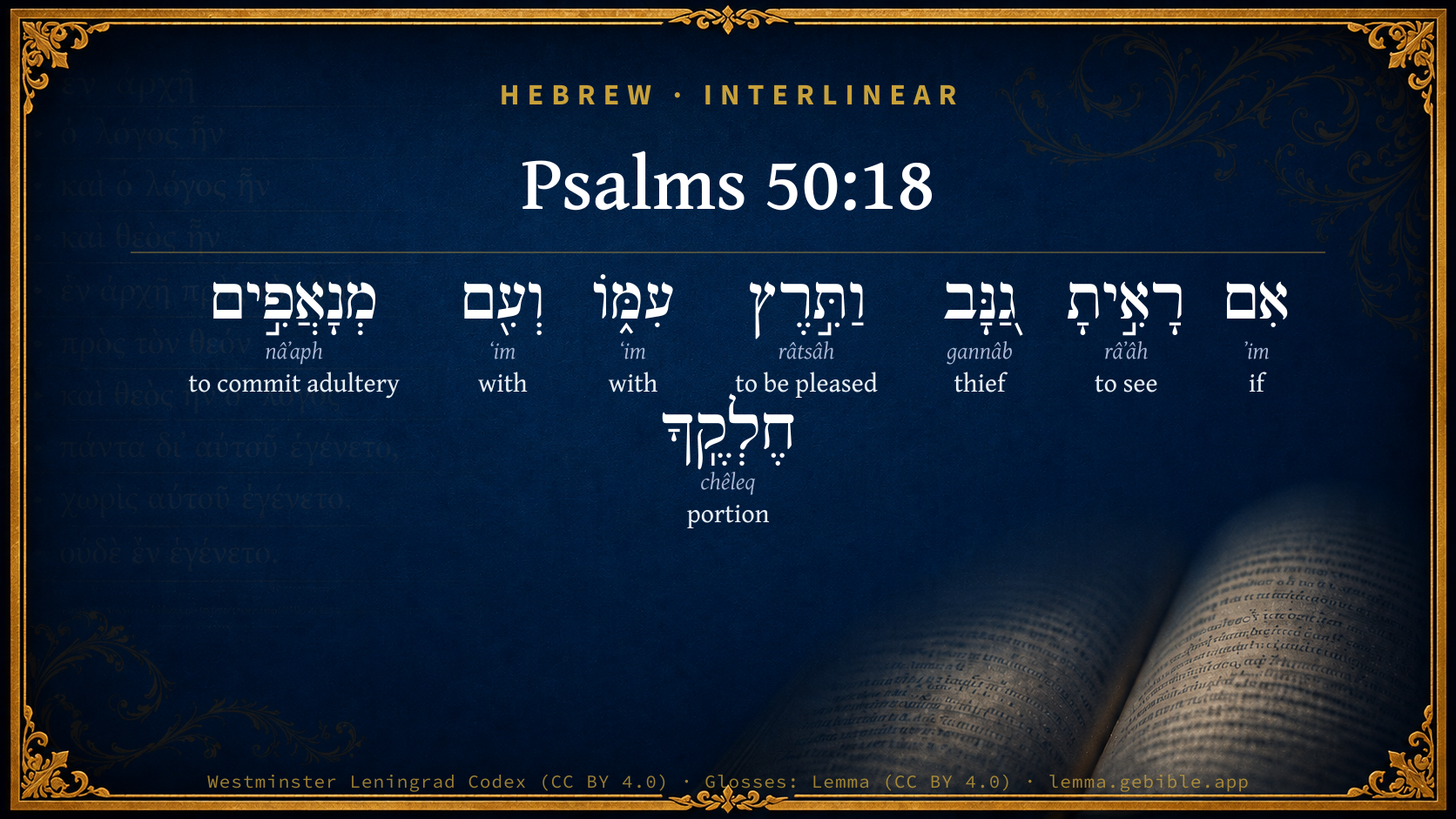
Psalms 50:18

Hebrew (Westminster Leningrad Codex) Psalms 50:18 appears in the Hebrew Old Testament. The text above is from the Westminster Leningrad Codex. Each word links to its Strong’s number, a concise gloss, and parsing drawn from the Open Scriptures Hebrew Bible morphology. Click any word for its full Brown-Driver-Briggs (BDB) entry.
Download image
Cite this verse

Psalms 50:18 (World English Bible). Public Domain. Lemma interlinear Bible study tool, https://lemma.gebible.app/v/psalms/50/18.

Show BibTeX & RIS
BibTeX
RIS
English Translation
When you saw a thief, you consented with him, And have participated with adulterers.
World English Bible · Public Domain
Download a study sheet

One document with this verse’s original text, its word-by-word gloss line, the meaning frame, cross-references with their text, attributed commentary, and full source and license credits — printable, and it pastes into notes with its structure intact.

This verse Autodidact and up

Study sheet (.html) Plain text (.txt)

A passage Seminary Student

Up to 50 verses in one chapter. A passage sheet keeps up to 6 commentary sources and 12 cross-references per verse, in the order this page ranks them, and says so on the sheet whenever that leaves anything out. Ask for a single verse and you get the Autodidact verse sheet above.

Everything on this page stays free to read, with no account — the sheet is a download of what is already on screen, not access to it.

Want to remove ads? Support Godless Engineer
Compare translations 3

The same verse in 3 English versions, stacked beneath the original-language interlinear above. Click any original word for its lexicon entry.

Each is an independent rendering of the whole verse — the interlinear is not word-aligned to these translations.

Highlighted words mark where these versions differ — a whole-verse word diff, not a word-by-word alignment.

  • World English Bible Public Domain
    When you saw a thief, you consented with him, And have participated with adulterers.
  • King James Version Public Domain
    When thou sawest a thief, then thou consentedst with him, and hast been partaker with adulterers.
  • unfoldingWord Literal Text CC BY-SA 4.0
    When you see a thief, you approve of him, and you partake with adulterers.

unfoldingWord Literal Text — © unfoldingWord, licensed CC BY-SA 4.0. Word-aligned USFM3 via Door43 (git.door43.org/unfoldingWord/en_ult).

Versions to compare (up to 4)

3 of 4 selected

Show all 18 translations

Every available English version of this verse, each an independent rendering of the whole verse.

  • World English Bible Public Domain
    When you saw a thief, you consented with him, And have participated with adulterers.
  • Berean Standard Bible Public Domain
    When you see a thief, you befriend him, and throw in your lot with adulterers.
  • Majority Standard Bible Public Domain
    When you see a thief, you befriend him, and throw in your lot with adulterers.
  • King James Version Public Domain
    When thou sawest a thief, then thou consentedst with him, and hast been partaker with adulterers.
  • American Standard Version (1901) Public Domain
    When thou sawest a thief, thou consentedst with him, And hast been partaker with adulterers.
  • Revised Version (1885) Public Domain
    When thou sawest a thief, thou consentedst with him, and hast been partaker with adulterers.
  • Geneva Bible (1599) Public Domain
    For when thou seest a thiefe, thou runnest with him, and thou art partaker with the adulterers.
  • Douay-Rheims (1899) Public Domain
    If thou didst see a thief thou didst run with him: and with adulterers thou hast been a partaker.
  • Young's Literal Translation Public Domain
    If thou hast seen a thief, Then thou art pleased with him, And with adulterers `is' thy portion.
  • Literal Standard Version CC BY-SA 4.0
    If you have seen a thief, || Then you are pleased with him, || And your portion [is] with adulterers.
  • Unlocked Literal Bible CC BY-SA 4.0
    When you see a thief, you agree with him; you participate with those who commit adultery.
  • unfoldingWord Literal Text CC BY-SA 4.0
    When you see a thief, you approve of him, and you partake with adulterers.
  • Darby Bible Public Domain
    When thou sawest a thief, thou didst take pleasure in him, and thy portion was with adulterers;
  • World Messianic Bible Public Domain
    When you saw a thief, you consented with him, and have participated with adulterers.
  • Webster's Bible Public Domain
    When thou sawest a thief, then thou consentedst with him, and hast been partaker with adulterers.
  • Free Bible Version CC BY-SA 4.0
    When you see people stealing, you admire them; you associate with adulterers.
  • Bible in Basic English Public Domain
    When you saw a thief, you were in agreement with him, and you were joined with those who took other men's wives.
  • JPS Tanakh (1917) Public Domain
    When thou sawest a thief, thou hadst company with him, and with adulterers was thy portion.

Literal Standard Version (2020), Covenant Press — licensed CC BY-SA 4.0. Text via the HelloAO Bible API (eBible.org). Unlocked Literal Bible (unfoldingWord) — licensed CC BY-SA 4.0. Text via the HelloAO Bible API (eBible.org). unfoldingWord Literal Text — © unfoldingWord, licensed CC BY-SA 4.0. Word-aligned USFM3 via Door43 (git.door43.org/unfoldingWord/en_ult). Free Bible Version, Dr. Jonathan Gallagher — licensed CC BY-SA 4.0. Text via the HelloAO Bible API (eBible.org).

Word by word

More ways to search: Search by grammar → Find every occurrence → Compare this word →

Practice this passage: Drill this verse → Learn its vocabulary →

About this verse

These counts appear in no published source. They are computed here, from the morphology-tagged text and Lemma’s own curated glosses. What Lemma adds →

8
words
7
distinct lemmas
Wisdom
section

Notable vocabulary

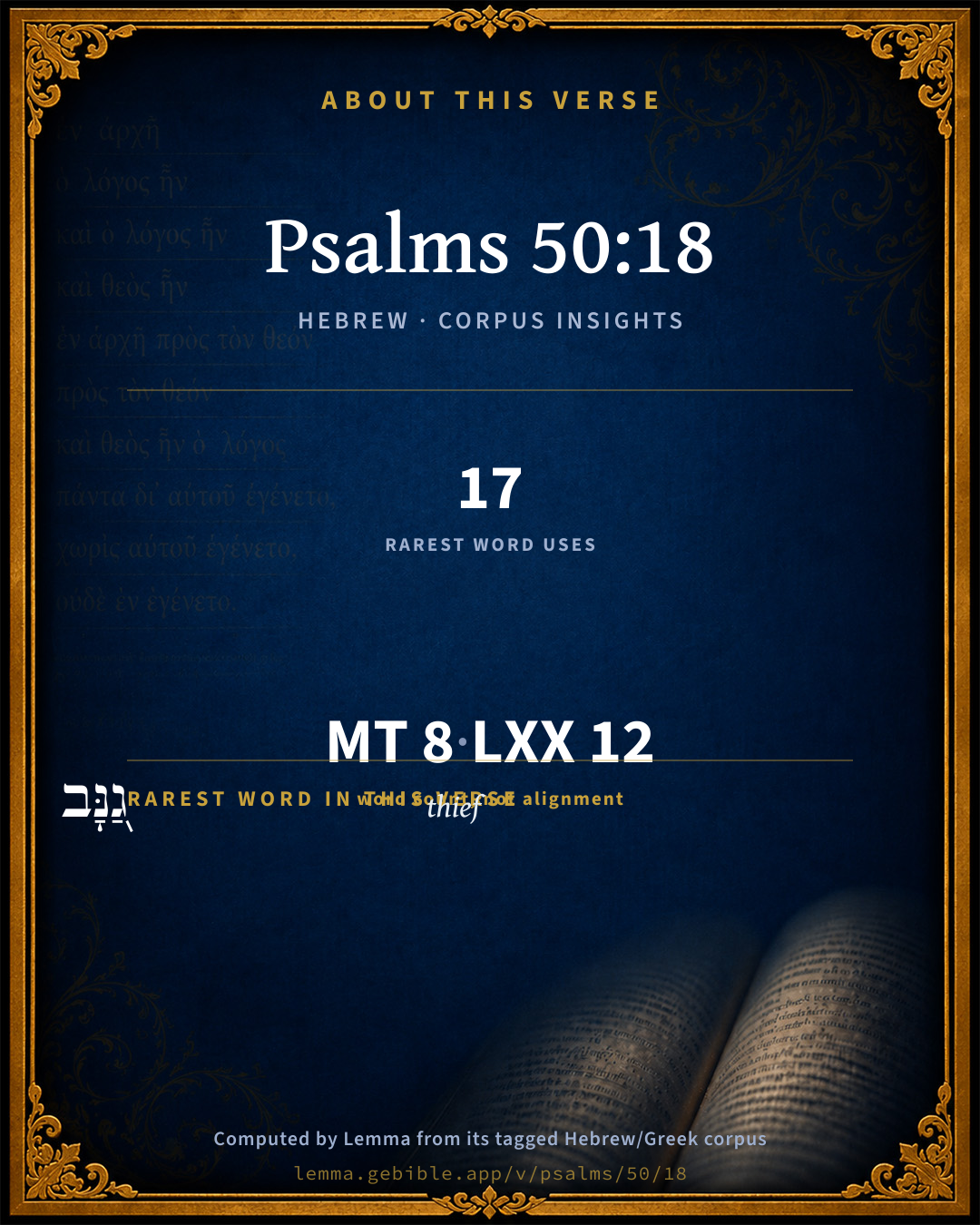
The rarest word here is גַ֭נָּב thief H1590 — appearing just 17 times in the whole Hebrew Bible.

Shared distinctive vocabulary

גַ֭נָּב thief H1590 occurs in 17 verses of the Hebrew Bible. Also found in:

Grammatical profile

  • 3 verbs
  • 2 nouns
  • 2 prepositions
  • 1 conjunction

Verb forms

  • רָאִ֣יתָ Qal · Perfect
  • וַתִּ֣רֶץ Qal · Sequential Imperfect
  • מְנָאֲפִ֣ים Piel · Participle Active

Repetition

A word recurs within this verse — often emphatic in Hebrew:

  • עִמּ֑וֹ with H5973 ×2

Hebrew & Septuagint length

In English translation the verse runs 14 words from the Hebrew and 18 from the Septuagint (LXX English) — closely comparable.

A rough comparison of the two English renderings, which tokenize alike — not a word-level alignment.

Word counts can differ between the Hebrew and the Greek without any difference in meaning — e.g. the Hebrew direct-object marker אֵת has no separate Greek word, and Greek often adds the article ὁ.

In the original languages it is 8 Hebrew tokens and 12 Greek tokens — but the two are counted differently (Hebrew bundles its prefixes and suffixes into one token; the Greek is in lemma form), so that isn’t a like-for-like length.

Cross-references

13

Topical passages linked to Psalms 50:18 in the Treasury of Scripture Knowledge — connected by theme and wording, ordered by reader-vote popularity; previews shown in the World English Bible.

  • Romans 1:32 who, knowing the ordinance of God, that those who practice such things are worthy of death, not only do the same, but also approve of those who practice them.
  • 1 Timothy 5:22 Lay hands hastily on no one, neither be a participant in other men's sins. Keep yourself pure.
  • Hebrews 13:4 Let marriage be held in honor among all, and let the bed be undefiled: but God will judge the sexually immoral and adulterers.
  • Leviticus 20:10 "'The man who commits adultery with another man's wife, even he who commits adultery with his neighbor's wife, the adulterer and the adulteress shall surely be put to death.
  • Job 31:9–11 "If my heart has been enticed to a woman, And I have laid wait at my neighbor's door;
  • Proverbs 1:10–19 My son, if sinners entice you, don't consent.
  • Proverbs 2:16–19 To deliver you from the strange woman, Even from the foreigner who flatters with her words;
  • Proverbs 7:19–23 For my husband isn't at home. He has gone on a long journey.
  • Isaiah 5:23 Who acquit the guilty for a bribe, But deny justice for the innocent!
  • Jeremiah 5:8–9 They were as fed horses roaming at large; everyone neighed after his neighbor's wife.
  • Micah 7:3 Their hands are on that which is evil to do it diligently. The ruler and judge ask for a bribe; And the powerful man dictates the evil desire of his soul. Thus they conspire together.
  • Matthew 23:30 and say, 'If we had lived in the days of our fathers, we wouldn't have been partakers with them in the blood of the prophets.'
  • Ephesians 5:11–13 Have no fellowship with the unfruitful works of darkness, but rather even reprove them.

Cross-references courtesy of OpenBible.info (CC BY 4.0).

Hebrew and Greek witnesses Masoretic Hebrew ↔ Greek Septuagint

The same verse in the two great witnesses to the Old Testament, shown verse-for-verse.

You’re reading Greek Psalm 49 (Hebrew Psalm 50). The Septuagint counts the superscription, so verse numbers can differ from the Hebrew — chapter-level alignment, not verse-by-verse. Numbering follows Rahlfs.

These are two independent witnesses, not word-aligned to each other, and the Septuagint is shown in lemma (dictionary) form.

Hebrew Psalms 50:18 Masoretic · Westminster Leningrad Codex

אִם רָאִ֣יתָ גַ֭נָּב וַתִּ֣רֶץ עִמּ֑וֹ וְעִ֖ם מְנָאֲפִ֣ים חֶלְקֶֽךָ

When you saw a thief, you consented with him, And have participated with adulterers.

World English Bible · Public Domain

Greek LXX Greek Psalm 49:18 Septuagint · lemma form

εἰ θεωρέω κλέπτης συντρέχω αὐτός καί μετά μοιχός ὁ μερίς σύ τίθημι

If you saw a thief, you ran along with him, and have cast in your lot with adulterers.

LXX2012 (modern English Septuagint) · Public Domain

On this verse, The Cambridge Bible for Schools and Colleges discusses the Septuagint’s reading. Read the note in Commentary ↓

Hebrew: Westminster Leningrad Codex (CC BY 4.0). Greek: Septuagint (public domain); English from LXX2012 (modern English Septuagint) (Public Domain). How the Septuagint differs from the Hebrew →

Commentary

Notes on Psalms 50:18 from classic Christian and Jewish commentators (each source and its license shown beneath its notes). The classic Christian expositions comment on the surrounding passage and are grouped to its opening verse, so a note may address several verses; the Jewish commentaries on the Tanakh (Rashi and others) are per-verse, so they appear only where the commentator wrote on this verse.

Lemma curates 59 commentaries, every one of them public domain or Creative Commons licensed, each selected and text-cleaned for this edition rather than reprinted as found. About our sources →

Trapp's Complete Commentary

John Trapp

Psa 50:18 When thou sawest a thief, then thou consentedst with him, and hast been partaker with adulterers.

Ver. 18. When thou sawest a thief, then thou consentedst with him] Mala opera hic memorata sunt in secreto, saith Kimchi. These evils hereafter mentioned are secretly acted by those that pretended to better things, {see Eph 5:12} and, therefore, heaven and earth are called to witness against them, Psa 50:4. See Jer 20:2-7 Servi ut taceant iumenta loquentur, the very beasts have a verdict to pass upon secret sinners, as the ass upon Balaam, and those horses upon Cardinal Angelot, who was so basely covetous that by a secret way he used to go into his own stable, and steal the oats from them (Pontan. lib. de Prin.).

And hast been partaker with the adulterers] 1. In thy desire, supposing thyself with them. 2. In thy filthy acts, though closely carried; as the Popish priests, whose rule is, Si non caste, lumen caute.

John Trapp, A Commentary or Exposition upon All the Books of the Old and New Testament (1647–1656) — public domain. Text from a community e-Sword module.

Joseph Benson's Commentary

Psa 50:18-20. When thou sawest a thief — Instead of reproving him, and witnessing against him, as those should do that declare God’s statutes, or that profess his religion; thou consentedst with him — Didst approve of his practices, and desire to share in the profits of his iniquitous proceedings. Or, thou didst run with, him, as תרצ עמו, tiretz gnimmo, may be rendered. Thou didst readily and eagerly associate thyself with him in his unrighteous actions. Thou didst yield to his motions, and that with great complacency and earnestness. And hast been partaker with adulterers — By joining with them in their lewd and filthy practices. “In this and the two following verses,” says Dr. Dodd, “are represented the notorious vices of the synagogue, (the Jewish Church,) which was extremely corrupt in the time of Christ.” Thou givest thy mouth to evil — To sinful or mischievous speeches. Thou hast an unbridled tongue, and castest off all restraints of God’s law, and of thy own conscience, and givest thy tongue liberty to speak what thou pleasest, though it be very offensive and dishonourable to God, and injurious to thy neighbour, or to thy own soul. And thy tongue frameth deceit — Uttereth lies or fair words, wherewith to deceive and circumvent those who deal with thee. Thou sittest and speakest against thy brother — Thou sittest in the seat of the scornful to deride and backbite others, even those whom thou oughtest to respect and show kindness to, thy own relations, thy very brother: and this, not through inadvertency, or upon some sudden and great provocation, but it is thy constant and deliberate practice. This, the word תשׁב, teesheb, thou sittest, or continuest, implies. And thou art not only guilty of backbiting, or speaking evil of them when they are absent, and making known to others the follies or faults with which they are justly chargeable; but thou accusest them of things of which they are innocent. Thou slanderest even thine own mother’s son — And takest away his good name, which is better than all riches, yea, than life itself: and this in opposition to any express and often repeated commands.

Joseph Benson's Commentary on the Old and New Testaments (1811–1818) — public domain. Text from a community e-Sword module.

J. A. Alexander on Psalms

Joseph Addison Alexander

3. (Psa 50:18) Our God shall come—and let him not be silent—fire before him shall devour, and around him it shall be tempestuous exceedingly. The future in the first clause may be rendered he is coming, as if the sound of his voice and the light of his glory had preceded his actual appearance. The imagery is borrowed from the giving of the law at Sinai, Exo 19:16; Exo 20:18. Consuming fire is a common emblem of God's vindicatory justice (Deu 32:22, 2Th 1:8), and of God himself considered as a righteous God (Deu 4:24; Deu 9:3, Heb 12:29).

4. (Psa 50:18) He will call to the heavens above and to the earth, to judge his people. The future, as before, describes an act just about to be performed. It might even be translated, he is calling. The compound preposition, from over, is used adverbially in the sense of above. See for example Gen 1:7. The strict sense, from, above, would here be inappropriate, since God is re presented not as speaking from heaven, much less from above it, but as appearing upon earth, and visibly coming out of Zion. In our idiom these words would naturally mean that he summons heaven and earth to sit in judgment on his people. But according to Hebrew usage, the last clause may refer to the remoter antecedent, the subject of the principal verb, and be translated, so that he may judge his people. The heavens and earth, put for the whole creation, are summoned not as judges but as witnesses, as appears from ver. 6 below. See Deut. iv. 26, xxx. 19, xxxi. 28, and compare Isa 1:2.

11. (Psa 50:18) I know every bird of the hills, and the population of the field (is) with me, i.e. in my presence, under my inspection, and within my reach. The past tense of the verb suggests not merely that it is so now, but that it has been so from the beginning. This is no newly acquired knowledge or authority, but such as are involved in the very relation between creature and creator. Population, literally movement, motion, i. e. animal motion, and by a natural metonymy that which lives and moves.

18. (Psa 50:18) If thou sawest a thief, thou consentedst with him, and with adulterers (has been) thy portion. The first clause conveys far more than the simple idea of consent. The expression if thou sawest implies great eagerness and an instinctive drawing towards the thief as a congenial spirit. The second verb in Hebrew denotes a cordial and complacent acquiescence. Thy portion or participation, common interest, communion. These particular sins are mentioned with reference to their prohibition in the seventh and eighth commandments (Exo 20:14-15).

Joseph Addison Alexander, The Psalms Translated and Explained (1850) — public domain. Text from a community e-Sword module.

Geneva Bible (1599)

Geneva Bible translators

He showeth what are the fruits of them that contemn God’s word.

Geneva Bible (1599) marginal notes — public domain. Text via Bolls.life.

Adam Clarke's Commentary

Verse 18. When thou sawest a thief] Rapine, adulteries, and adulterous divines, were common among the Jews in our Lord's time. The Gospels give full proof of this.

Adam Clarke's Commentary on the Bible (1810–1826) — public domain. Text from a community e-Sword/MySword module.

Ellicott's Commentary for English Readers

(18) Thou consentedst with him—i.e., hast pleasure in. (Comp. Job_34:9.)

A Bible Commentary for English Readers, edited by Charles John Ellicott (1878–1897) — public domain. Text from a community e-Sword module.

The Cambridge Bible for Schools and Colleges

gen. ed. J. J. S. Perowne

18. then thou consentedst with him] The original is stronger: thou didst delight thyself with him, didst gladly associate with him. Cf. Job_34:9. R.V. omits then. The LXX vocalises the consonants differently and renders, thou didst run along with him (cp. Pro_1:16): but the Massoretic reading is preferable.

and hast been partaker &c.] Lit., and thy portion was with adulterers: thou didst make common cause with them, condoning and sharing their sin.

The Cambridge Bible for Schools and Colleges (gen. ed. J. J. S. Perowne; Cambridge University Press, 1878–1918) — public domain. Text from a community e-Sword module.

John Gill's Exposition

Thou givest thy mouth to evil,.... To speak evil things against Christ, his doctrines, ordinances, ministers and people; and to deliver out evil doctrines, pernicious to the souls of men;

and thy tongue frameth deceit; puts and joins together deceitful words in a very artful manner, by which simple and unstable minds are beguiled.

John Gill's Exposition of the Whole Bible (1746–1763) — public domain (CC PDM 1.0). Text via the HelloAO Bible API.

Albert Barnes' Notes on the Bible

When thou sawest a thief - When you have seen or found one who was intending to commit theft, then (instead of rebuking or exposing him) you have been willing to act with him, and to divide the profits. The words “when thou sawest” would seem to imply readiness and willingness to engage with them, as “at first sight.” Whenever there was an opportunity to share in the results of theft, they were ready to engage in it. The main “point” in this is, that they were willing to do so even when observing the outward duties of religion, and when professing to be the true worshippers of God. A similar sentiment occurs in Rom 2:21. See the notes at that passage.

Then thou consentedst with him - literally, Thou didst delight in him, or hadst pleasure in him. He was a man after thine own heart. Thou wast at once on good terms with him.

And hast been partaker with adulterers - Margin, as in Hebrew, “thy portion was with adulterers.” This was a common vice among the Jewish people. See the notes at Rom 2:22. The idea here is, that they were associated in practice with adulterers; they were guilty of that crime as others were. The point of the remark here is, that they did this under the cloak of piety, and when they were scrupulous and faithful in offering sacrifices, and in performing all the external rites of religion.

Albert Barnes' Notes on the Bible (1834–1885) — public domain. Text from a community e-Sword/MySword module.

Matthew Poole's English Annotations

Sawest; or, didst observe, or consider; when he came into thy presence and company, and thou didst understand and consider his ways, and his success and impunity, and he invited thee to a participation of his profit.

Thou consentedst with him; or, as many render it, then didst run with him; thou didst readily and greedily associate thyself with him in his unrighteous courses. Thou didst yield to his motions, and that with great complacency and diligence.

Partaker with adulterers, by joining with them in their lewd and filthy practices.

Matthew Poole's English Annotations on the Holy Bible (1683–1685) — public domain. Text from a community e-Sword/MySword module.

The Treasury of David

Charles H. Spurgeon

Ver. 18. When thou sawest a thief, then thou consentedst with him. Moral honesty cannot be absent where true grace is present. Those who excuse others in trickery are guilty themselves; those who use others to do unjust actions for them are doubly so. If a man be ever so religious, if his own actions do not rebuke dishonesty, he is an accomplice with thieves. If we can acquiesce in anything which is not upright, we are not upright ourselves, and our religion is a lie. And hast been partaker with adulterers. One by one the moral precepts are thus broken by the sinners in Zion. Under the cloak of piety, unclean livers conceal themselves. We may do this by smiling at unchaste jests, listening to indelicate expressions, and conniving at licentious behaviour in our presence; and if we thus act, how dare we preach, or lead public prayer, or wear the Christian name? See how the Lord lays righteousness to the plummet. How plainly all this declares that without holiness no man shall see the Lord! No amount of ceremonial or theological accuracy can cover dishonesty and fornication: these filthy things must be either purged from us by the blood of Jesus, or they will kindle a fire in God's anger which will burn even to the lowest hell.

Ver. 18. When thou sawest a thief, then thou consentedst with him; or didst run with him. This was literally true of the Scribes and Pharisees; they devoured widow's houses, and robbed them of their substance, under a pretext of long prayers; they consented to the deeds of Barabbas, a robber, when they preferred him to Jesus Christ; and they joined with the thieves on the cross in reviling him; and, in a spiritual sense, they stole away the word of the Lord, every man from his neighbour; took away the key of knowledge from the people, and put false glosses upon the sacred writings. John Gill.

Ver. 18. Thou consentedst with him; became his accomplice. Sunetreces. LXX, i.e., you helped him to carry off his booty and to make his escape. Samuel Horsley.

Ver. 18. Thou consentedst with him. Or, thou runnest along with him. Hast been partaker with; namely, thou art his companion; a term taken from commerce of merchants, or from banquets made after the ancient manner, to which divers did contribute, and had their shares therein. John Diodati.

Ver. 18. (last clause). To give entertainment to them we know to be dissolute, is to communicate with their sins. Thomas Adams.

Charles H. Spurgeon's The Treasury of David (1869–1885) — public domain. Psalms only. Text from a community e-Sword/MySword module.

Whedon's Commentary on the Bible

Daniel D. Whedon

18. Thou consentedst—A charge of complicity and participation with civil wrongs and personal vices. These things they did covertly.

Daniel D. Whedon (gen. ed.), Commentary on the Old and New Testaments (1874–1909) — public domain. Text from a community e-Sword module.

The Pulpit Commentary

When thou sawest a thief, then thou consentedst unto him. God tests his professed, but really disobedient, servants by the second table of the Decalogue, and finds them wanting. If they do not themselves actually rob, they give their consent, they become accessories before the fact, to robbery. They probably participate in the gains. And hast been partaker with adulterers; rather, and with adulterers is thy portion; i.e. thou hast thrown in thy lot with them, hast adopted their principles, hast set at nought the seventh no less than the eighth commandment.

The Pulpit Commentary (1880–1919), ed. H.D.M. Spence-Jones & Joseph S. Exell — public domain. Text from a community e-Sword module.

unfoldingWord translationNotes

Door43 World Missions Community

you agree with him

Possible meanings are 1) that they approve of the thief's actions. AT: "you approve or him" or 2) that they join the thief in their actions. AT: "you join him" (See: Idiom)

You give your mouth to evil

God speaks of a person speaking evil things as if that person's mouth is a messenger whom the person sends to do evil things. AT: "You are always saying evil things" (See: Metaphor and Synecdoche)

your tongue expresses deceit

The word "tongue" represents the person who is speaking. AT: "you are always telling lies" (See: Synecdoche)

You sit and speak against your brother; you slander your own mother's son

These two phrases have the same meaning but use different words. God accuses them of speaking falsely against members of their own family. (See: Parallelism)

You sit and speak

To "sit and speak" against someone implies that this person deliberately thinks of bad things to say about someone. AT: "You always think of ways to speak" (See: Idiom and Assumed Knowledge and Implicit Information)

translationWords

adultery

tongue

deceive

brother

slander

unfoldingWord translationNotes — © Distant Shores Media and the Door43 World Missions Community, licensed CC BY-SA 4.0. Source: git.door43.org/Door43/en_tn.

Rashi

Rabbi Shlomo Yitzchaki (Rashi)

you agreed You agreed to go with him.

Rashi on the Tanakh — English translations: “The Judaica Press complete Tanach with Rashi, translated by A. J. Rosenberg” (CC BY 4.0); “Pentateuch with Rashi's commentary by M. Rosenbaum and A.M. Silbermann, 1929-1934” (public domain); “The Metsudah Tanach series, Lakewood, N.J” (CC BY 4.0); and “The Book of Joshua, Metsudah Publications, 1997” (CC BY 4.0). Text via Sefaria.

Lesson kit

Teaching starters — assembled from the data on this page, not authored interpretation. Every prompt links to the verse data it draws on. Edit before teaching.

Psalms, in the Wisdom, opens this verse with 8 words (7 distinct Hebrew lemmas). Its most distinctive word is gannâb (“thief”). A historical commentator’s framing appears above. Read the whole chapter for the surrounding context.

Discussion questions

  1. The word gannâb carries the sense “thief.” How does it shape the verse?
  2. Exodus 22:2 shares the word «thief» with this verse. How do the two illuminate each other?
  3. “with” occurs 2× in this one verse. What is the effect of the repetition?
  4. These translations render this verse differently; the difference is in the English rendering, not the original. What questions does that raise?
  5. The verb «רָאִ֣יתָ» is Qal Perfect. How does its form color the action?
  6. Reading how Trapp's Complete Commentary and Joseph Benson's Commentary read this verse, where do the two commentators agree and where do they part?

Things to notice

Reading settings

Reading text

Shown beneath each verse's original-language words.

Old Testament
Old Testament edition

Read the OT as the Masoretic Hebrew (MT) or the Greek Septuagint (LXX).

English shown for the Greek Septuagint (in the Hebrew ↔ Greek comparison).

Comparing translations? Open the Compare panel on any verse page to stack up to four side by side.