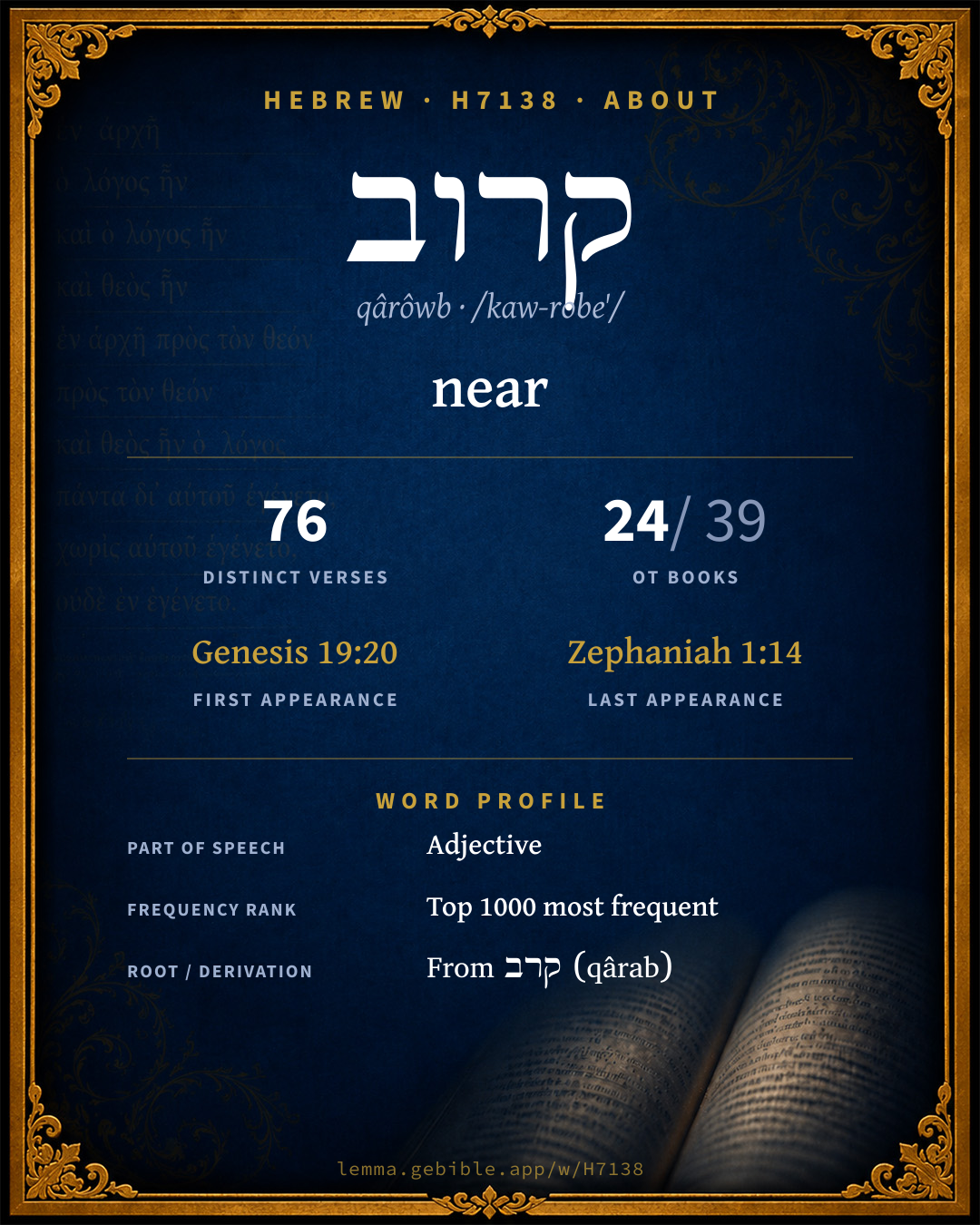
קָרֹב
near
‘near’ is one of 4 main senses fuller range ↓
Full lexicon entry — Brown-Driver-Briggs (BDB)
From Brown-Driver-Briggs (BDB)
Where this word appears
See every Absolute-state word in the Hebrew Bible →
Grammar key — what these labels mean
Part of speech
- Adjective
- A word that describes or qualifies a noun.
Stem
- Qal
- The basic, simple active stem — the plain form of the verb (“he wrote”).
Form
- Infinitive Absolute
- An unbound verbal noun, often intensifying or standing in for a finite verb.
State
- Absolute
- The independent form of a noun, not bound to a following word.
- Construct
- A noun bound to a following noun in a possessive / “of” relationship (the construct chain).
Gender
- Masculine
- Grammatically masculine.
- Feminine
- Grammatically feminine.
Number
- Singular
- One.
- Plural
- More than one (in Hebrew, generally three or more).
Every verse where H7138 appears in the Book of Exodus — 3 distinct verses. Click any verse to open its interlinear word-by-word view. Verse text shown in the World English Bible for context — . Each verse’s Hebrew form is shown with its reference; the English is not keyword-highlighted, since the data carries no word-level English alignment. Use “Compare translations” on any verse to read it across multiple English versions. This concordance covers the Hebrew Bible; Septuagint (Greek Old Testament) occurrences are not indexed here.
Exodus
- Exodus 12:4 הַ/קָּרֹ֥ב ptcl def.art + Adjective Adjective ms and if the household be too little for a lamb, then he and his neighbor next to his house shall take one according to the number of the souls; according to what everyone can eat you shall make your count for the lamb.
- Exodus 13:17 קָר֖וֹב adj Adjective ms It happened, when Pharaoh had let the people go, that God didn't lead them by the way of the land of the Philistines, although that was near; for God said, "Lest perhaps the people change their minds when they see war, and they return to Egypt;"
- Exodus 32:27 קְרֹבֽ/וֹ adj Adjective ms cs + sfx pers 3ms He said to them, "Thus says Yahweh, the God of Israel, 'Every man put his sword on his thigh, and go back and forth from gate to gate throughout the camp, and every man kill his brother, and every man his companion, and every man his neighbor."
About this entry
At a glance — auto-summarized from this page’s data, not written by a person. Every figure links to its source below. This summary describes the numbers; it doesn’t interpret them.
The Hebrew adjective קרוב centers on the idea of “near.” Its meaning spans more than one sense — see its full sense range. Spanning 76 verses in 24 books, it ranks among the moderately common words of the Hebrew Bible. Its earliest occurrence is Genesis 19:20. Related forms include קרב, קרב and קרב. For the data behind this summary, explore the sense tree and the renderings breakdown below.
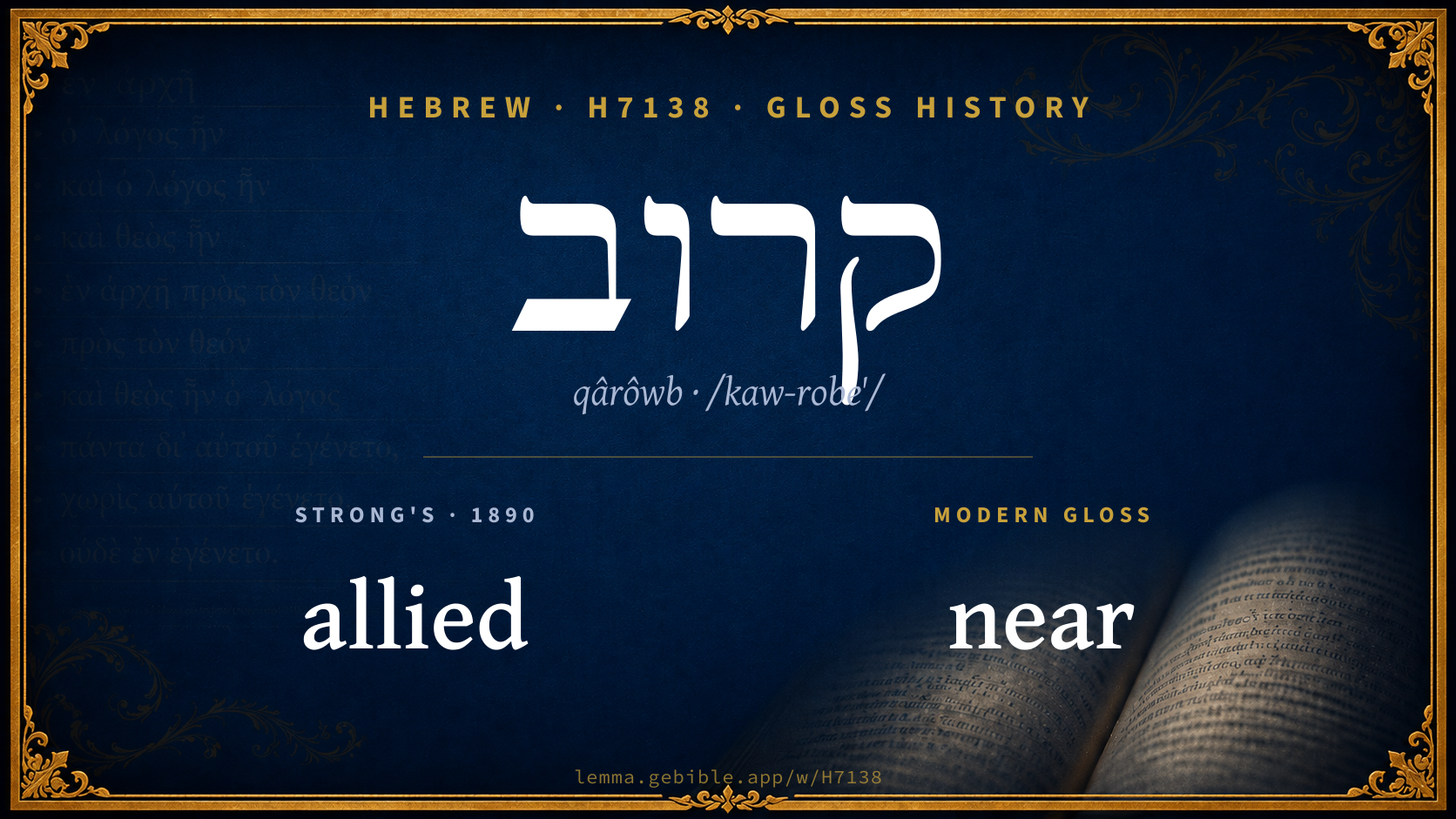
Gloss history
Strong's 1890 vs modern scholarship
About this word
Strong's H7138 catalogs a Hebrew word from the Hebrew Old Testament.
These counts are not copied from any lexicon or concordance. They are computed here, from the morphology-tagged Hebrew Old Testament. What Lemma adds →
- 76
- distinct verses
- The word appears in 76 distinct verses.
- 24 / 39
- OT books
- The word appears in 24 of 39 Old Testament books.
- #514
- by frequency
- Top 1000 most frequent Hebrew words (rank 514 of 8,640 Hebrew words by occurrence).
View all 76 occurrences in the concordance →
Most concentrated in
- Ezekiel 10 verses 13%
- Psalms 9 verses 12%
- Deuteronomy 8 verses 11%
By section of the Old Testament
By traditional corpus
Conventional, traditional groupings — biblical authorship is debated, so this is a traditional corpus grouping, not an authorship claim. Each share is this word’s portion of its verses in that division of the Hebrew canon. Each figure is a share of the word’s 76 distinct verses.
- Prophets (Nevi'im) 34 verses · 45%
- Writings (Ketuvim) 23 verses · 30%
- Torah (Pentateuch) 19 verses · 25%
How translations render this word
Counts come from each version’s own published word-to-Strong’s tagging or interlinear alignment — an approximate guide to how each version renders this word, not a word-level alignment the data otherwise carries. Because each total is that version’s own tagged count, the per-version totals vary from one another and need not match the appearance or distinct-verse counts above. These counts may also differ from a printed concordance because Lemma counts each distinctly tagged rendering and does not collapse phrase taggings into a single head-word total. This is a fixed set of word-tagged versions (KJV, ASV, BSB, ULT) and does not change with the reading translation you choose elsewhere. Each version’s license is shown beside its name below (and on Sources).
- King James Version: Is near 19×, Is at hand 4×, Is nigh 4×
- American Standard Version: Is near 17×, Are near 4×, Is at hand 4×
- Berean Standard Bible: Is near 15×, Near 13×, Nearest 4×
- unfoldingWord Literal Text: Is near 24×, Near 19×, Nearest 4×
King James Version Public Domain
Renders H7138 across 78 tagged occurrences — most commonly:
Plus other, less common renderings. Plus 29 renderings that appear only once — usually multi-word phrases or single function words the recovered tagging swept in, not distinct renderings.
American Standard Version Public Domain
Renders H7138 across 79 tagged occurrences — most commonly:
Plus 43 renderings that appear only once — usually multi-word phrases or single function words the recovered tagging swept in, not distinct renderings.
Berean Standard Bible Public Domain
Renders H7138 across 74 tagged occurrences — most commonly:
Plus 27 renderings that appear only once — usually multi-word phrases or single function words the recovered tagging swept in, not distinct renderings. Not rendered by a distinct English word in 3 further occurrences.
unfoldingWord Literal Text CC BY-SA 4.0
Renders H7138 across 81 tagged occurrences — most commonly:
Plus 22 renderings that appear only once — usually multi-word phrases or single function words the recovered tagging swept in, not distinct renderings.
10 senses and sub-senses in the full BDB
What do BDB’s symbols mean?
BDB uses these scholarly abbreviations:
| Symbol | Meaning |
|---|---|
| 𝔊 | the Septuagint (the ancient Greek translation, LXX) |
| 𝔙 | the Vulgate (the Latin translation) |
| 𝔖 | the Syriac version (the Peshitta) |
| 𝔗 | the Targum (the Aramaic translation) |
| ψ | the Psalms |
| √ | root (the underlying root or stem) |
| ‖ | parallel passage (a synonymous or contrasted parallel) |
| † | the dagger: every passage where the word occurs is cited |
The 10 senses and sub-senses the full Brown-Driver-Briggs lexicon distinguishes for this word, in lexicon order (not ranked by frequency), with BDB’s own verbatim wording and sub-sense lettering. Shown in Hebrew script with BDB’s own scholarly abbreviations. The condensed entry is in the Lexicon Entry tab. See also the Forms in the corpus table below.
- 1. of city Gn 19:20 (+ לָנוּם שָׁ֫מָּה), Je 48:24, הַקּ׳ Dt 21:3 the nearest (+ אֶל), cf. (of elders) v 6; of land 1 K 8:46 = 2 Ch 6:36; road Ex 13:17; = contiguous, כֶּרֶם 1 K 21:2 (+ אֵצֶל בֵּיתִי). e.g. Genesis 19:20
- 2. of pers.:
- a. + אֶל pers. Gn 45:10; Dt 13:8; 22:2 Jos 9:16; 1 Ch 12:41 (van d. H. v 40); הַקּ׳ אֶל Ex 12:4 the nearest to; c. sf. קְרֹבוֹ Ex 32:27, i.e. his neighbour. e.g. Genesis 45:10
- b. abs. (opp. or + רחוק, often = near and far, i.e. all without distinction), Ez 6:12; Is 57:19; Pr 27:10; pl. Is 33:13; Je 25:26; Dn 9:7; Est 9:20; Ez 22:5; ק׳ of distress, personif., 22:12.—Ez 23:5, 12 Co Berthol read קְרוּאִים famous; Toy רַבִּים (cf. Je 39:13); Hpt in Toy Krae conj. קְרוֹדִים (Assyrian ḳurâdu, warrior). e.g. Ezekiel 6:12
- c. of near relationship, + אֶל pers. 2 S 19:43; Lv 21:2, 3; 25:25 (all H), Nu 27:11 (P); ל pers. Ne 13:4; Ru 2:20; + מִן comp. 3:12; of intimacy, קְרֹבוֹ ψ 15:3 (‖ רֵעֵהוּ), קְרוֹבַי Jb 19:14 (‖ מְיֻדָּעַי), ψ 38:12 (‖ אֹהֲבַי וְרֵעַי); near, in office, Est 1:14. e.g. 2 Samuel 19:43
- d. near to י׳, עַם קְרֹבוֹ ψ 148:14 (Rie Bae קְרֹבָו the people of those near him). e.g. Psalms 148:14
- e. near to י׳ in ceremon. function, c. אֶל Ez 43:19, c. ל 42:13, sf. Lv 10:3. e.g. Ezekiel 43:19
- f. of God (י׳), + אֶל pers. Dt 4:7; 30:14; ל pers. ψ 34:19; 145:18; abs. Je 12:2; Is 50:3; 55:6 ψ 119:151; אֱלֹהֵי מִקָּרֹב Je 23:23 a God from near by (opp. א׳ מֵרָחוֹק); ק׳ of צֶדֶק י׳ Is 51:5, יֶשַׁע י׳ ψ 85:10 (+ ל pers.);—ק׳ שִׁמְךָ ψ 75:2, read קֹרְאֵי בְּשׁ׳ Dy Che Gr Dr, cf. Bae 𝔊 𝔖 Du. e.g. Deuteronomy 4:7
- g. of word, + אֶל pers. Dt 30:14; prayer, + אֶל־י׳ 1 K 8:59. e.g. Deuteronomy 30:14
- 3. of time: ק׳ יוֹם אֵידָם Dt 32:35; especially of יוֹם י׳ Zp 1:7, 14(×2); Ez 30:3 (perhaps del. as 𝔊 Co Krae), v 3 Is 13:6; Ob 15; Jo 1:15; 2:1; 4:14, cf. Ez 7:7; + inf. ק׳ אֵיד־מוֹאָב לָבוֹא Je 48:16, cf. Is 13:22; 56:1; מְחִתָּה ק׳ Pr 10:14 imminent ruin; מִקָּרוֹב Dt 32:17 recently, so Ez 11:3 𝔊 𝔙 Co Siegf Berthol (for MT †בְּקָרוֹב); Ez 7:8 soon; Jb 20:5 of the briefest.—אוֹר ק׳ מִפְּנֵי חֹשֶׁךְ Jb 17:12 is dub.; Thes (my) light is near to (prope abest a, as Arabic قَرِبَ مِن, but not proven in Heb.) darkness; Di light (they say) is near (breaking away) from darkness, will soon leave it behind; Bu אוֹר קְרוֹבָם פֶּן־יֶחְשַׁךְ the light of their intimate friend shall not (?) grow dark. e.g. Deuteronomy 32:35
Senses from the full Brown-Driver-Briggs lexicon (Brown, Driver, Briggs; Oxford 1906 — public domain), digitized via Sefaria, supplemented by the OpenScriptures HebrewLexicon (CC BY 4.0). Full attribution on Sources.
Word origin
adj. near;—abs. קָרֹב Ex 12:4 +; -וֹב 2 S 19:43 +; pl. קְרֹבִים 1 K 8:59, קְרוֹבִים Is 33:13 +; fpl. קְרֹבוֹת Ez 22:5, etc.;—near (often opp. רָחוֹק):
— Brown-Driver-Briggs (Oxford 1906, public domain), digitized via Sefaria, supplemented by the OpenScriptures HebrewLexicon (CC BY 4.0). See Sources.
Derived from קרב (qârab) (H7126) — to approach.
Jastrow Dictionary
A second Hebrew/Aramaic lexicon for comparison, covering Aramaic and post-biblical (Talmudic, Targumic, Midrashic) usage that the biblical-Hebrew BDB does not. Matched by lemma rather than by Strong’s number, so a lemma may carry more than one Jastrow headword (shown separately below), and the entries cover usage well beyond the Bible.
קֵרוּב
- , v. קֵירוּב
קָרוֹב I
- near; related, relative. Y. Ber. IX, 13ᵃ top (ref. to Deut. IV, 7) ק׳ בכל מיני קריבות (God is) near in every way of nearness (at all times, in all places, in sympathy &c.). Snh. 9ᵃ נמצא … ק׳ וכ׳ if it appears that one of the witnesses is a near relative (of the defendant) or disqualified. Ib.ᵇ אדם ק׳ אצל עצמו ואין וכ׳ every man is considered a relation to himself, and none can incriminate himself. Ib. 10ᵃ אדם ק׳ … ואינו ק׳ אצל ממונו a man cannot testify against himself, but he is not a relative to (disqualified to testify against) his property. Ib. III, 4 היה ק׳ ונתרחק if a person was a relation (by marriage, so as to be disqualified), and became a stranger again. B. Mets. 39ᵃ שבוי … מורידין ק׳ וכ׳ if a person has been carried off captive, they (the court) appoint a relative to manage his estate. Ib. ק׳ מחמת ק׳ an indirect relative (e.g. one’s step-brother’s step-brother); a. v. fr.—Pl. קְרוֹבִים, קְרוֹבִין. Gitt. 14ᵇ ק׳ למלכות connected with royalty, influential. Snh. III, 4 ואלו הן הק׳ the following are considered relatives (disqualified to act as judges or witnesses); a. fr.—Sabb. 152ᵃ ק׳ נעשו רחוקים near objects have become distant (my senses are dull from old age).—[Tanḥ. B’shall. 18 ועברה קרובים; Y. Taan. II, 66ᵃ top שהגיע לקרובין, v. קָרוּכִין.]—Fem. קְרוֹבָה. Y. Ber. l. c. ע"ז נראית ק׳ ואינה וכ׳ the idol is apparently near, but in fact distant. Esth. R. to III, 1 Haman reflected in his heart אם אסתר … קְרוֹבָתִי if Esther is a Jewess, she is my relative. Meg. 14ᵇ חולדה קְרוֹבַת וכ׳ Huldah was a relative of Jeremiah’s; a. fr.—Pl. קְרוֹבוֹת. Gen. R. s. 18 נשא … מקְרוֹבוֹתָיו וכ׳ if a man marries one of his relatives, of him it is said ‘bone of my bones’ (Gen. II, 23). Lev. R. s. 18 רחוקות נעשו ק׳ ק׳ וכ׳ distant objects have become near (things that I could discern at a distance must be brought near me), near objects have become distant, v. supra; a. fr. e.g. Deuteronomy 4:7
קָרוֹב II
- (קְרֵב Pa. 3) leader in prayer, hymnologist, reader. Lev. R. s. 30 קרוב ופייטן Ar. (ed., a. Pesik. Ul’ḳaḥ. p. 179ᵃ פייטן ודרשן) hymnologist and poet; Cant. R. to III, 6 קָרֵיבוֹי ופייטויי. Y. Ber. I, 3ᶜ bot. [read:] ר׳ … הוה סמיך לק׳ וכ׳ R. Z. (in his prayer of the section Modim) kept pace with the reader in order to bow simultaneously with him at the beginning and at the end. Lev. R. s. 19; Cant. R. to V, 11 ר׳ אלכסנדרי ק׳ R. A. the hymnologist.—[In liturgy קרובות (not קרובץ): the poetical insertions, on special occasions, in the Prayer of Benedictions.]
A Dictionary of the Targumim, the Talmud Babli and Yerushalmi, and the Midrashic Literature (Marcus Jastrow; London, Luzac, 1903) — Public Domain. Digitized via Sefaria. Digitized via Sefaria. Full attribution on Sources.
Forms in the corpus
The 50 distinct written forms H7138 takes in the Hebrew Bible, most frequent first — each parse links to that state’s occurrences in the concordance. Hebrew forms include their vowel points and cantillation, so a single lemma takes many written forms.
Same root — word family
Other BDB entries built from the same root as H7138, grouped by Strong’s listed origin. These share a root / origin per the lexicon — not necessarily a shared meaning. Each links to that word’s own entry.
Derives from
Shares the same root
- קרב qᵉrêb H7127 to approach
- קרב qᵉrâb H7128 battle
- קרב qereb H7130 midst
- קרב qârêb H7131 near
- קרבה qᵉrâbâh H7132 approach
- קרבן qorbân H7133 offering
Compare all same-root words → Showing 4 of 8 — not the complete family. They share a root, not necessarily a meaning.
Septuagint verse parallels
This word appears in 69 verses that also exist in the Greek Old Testament (Septuagint), out of the 76 Hebrew verses it occurs in. You can read those verses in Greek by switching the Old Testament edition to the Septuagint.
Read these verses in the Septuagint
- Genesis 19:20
- Exodus 12:4
- Leviticus 10:3
- Numbers 24:17
- Deuteronomy 4:7
- Joshua 9:16
- Ruth 2:20
- 2 Samuel 19:42
- 1 Kings 8:46
- 1 Chronicles 12:40
- 2 Chronicles 6:36
- Esther 1:14
This is a verse-level parallel only — the same verses exist in both the Hebrew and Greek Old Testaments. No word-level Hebrew↔Greek correspondence is claimed: the data carries no such alignment, so no Greek word is shown as this Hebrew word’s translation. Coverage is not total — the Septuagint omits the deuterocanon and renumbers the Psalms, so some Hebrew verses have no direct Greek parallel.