
Ezekiel 30:3

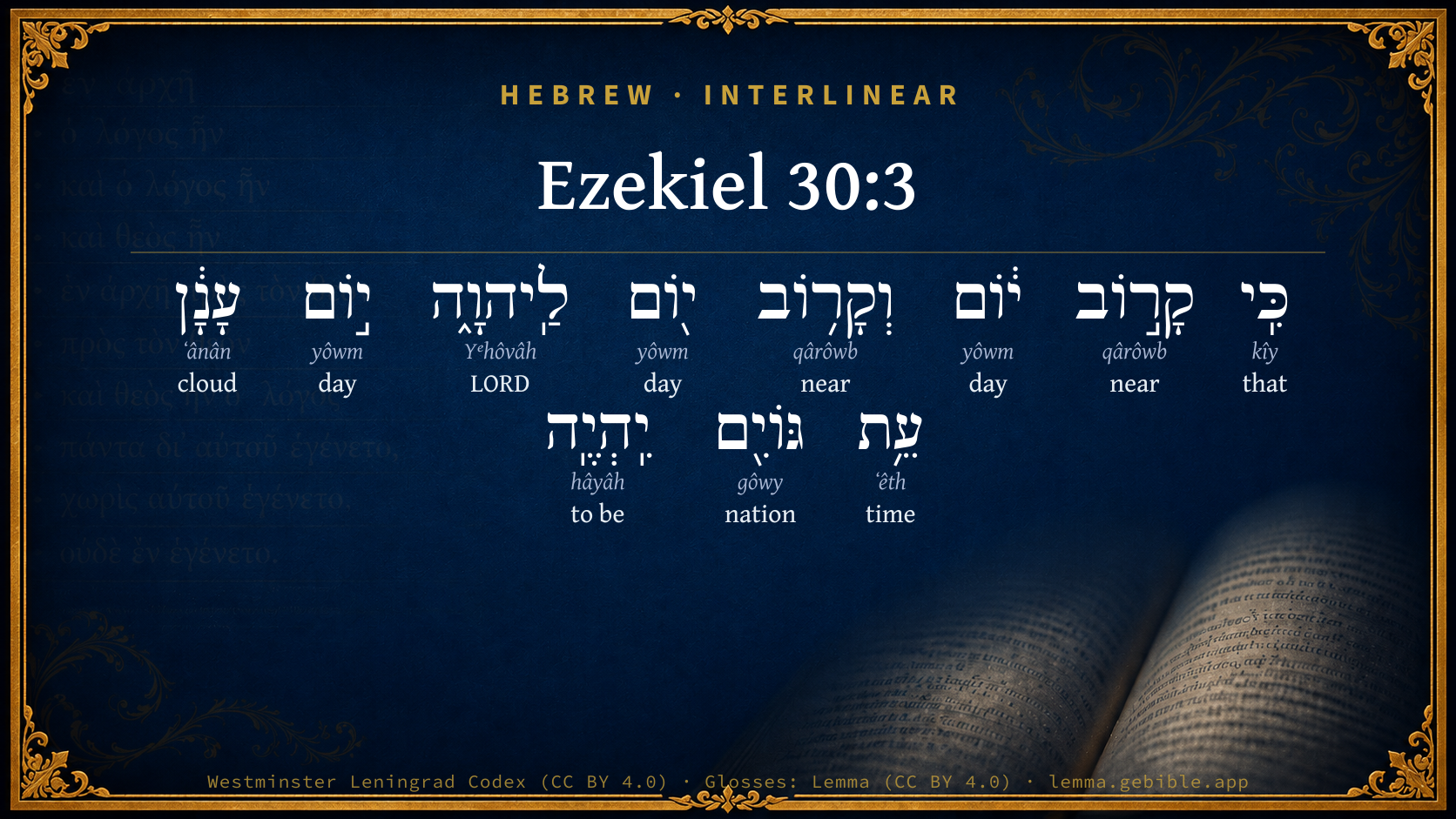
Hebrew (Westminster Leningrad Codex) Ezekiel 30:3 appears in the Hebrew Old Testament. The text above is from the Westminster Leningrad Codex. Each word links to its Strong’s number, a concise gloss, and parsing drawn from the Open Scriptures Hebrew Bible morphology. Click any word for its full Brown-Driver-Briggs (BDB) entry.
Download image
Cite this verse

Ezekiel 30:3 (World English Bible). Public Domain. Lemma interlinear Bible study tool, https://lemma.gebible.app/v/ezekiel/30/3.

Show BibTeX & RIS
BibTeX
RIS
English Translation
For the day is near, even the day of Yahweh is near; it shall be a day of clouds, a time of the nations.
World English Bible · Public Domain
Download a study sheet

One document with this verse’s original text, its word-by-word gloss line, the meaning frame, cross-references with their text, attributed commentary, and full source and license credits — printable, and it pastes into notes with its structure intact.

This verse Autodidact and up

Study sheet (.html) Plain text (.txt)

A passage Seminary Student

Up to 50 verses in one chapter. A passage sheet keeps up to 6 commentary sources and 12 cross-references per verse, in the order this page ranks them, and says so on the sheet whenever that leaves anything out. Ask for a single verse and you get the Autodidact verse sheet above.

Everything on this page stays free to read, with no account — the sheet is a download of what is already on screen, not access to it.

Want to remove ads? Support Godless Engineer
Compare translations 3

The same verse in 3 English versions, stacked beneath the original-language interlinear above. Click any original word for its lexicon entry.

Each is an independent rendering of the whole verse — the interlinear is not word-aligned to these translations.

Highlighted words mark where these versions differ — a whole-verse word diff, not a word-by-word alignment.

  • World English Bible Public Domain
    For the day is near, even the day of Yahweh is near; it shall be a day of clouds, a time of the nations.
  • King James Version Public Domain
    For the day is near, even the day of the LORD is near, a cloudy day; it shall be the time of the heathen.
  • unfoldingWord Literal Text CC BY-SA 4.0
    The day is near. The day is near for Yahweh. It will be a day of clouds, a time of doom for nations.

unfoldingWord Literal Text — © unfoldingWord, licensed CC BY-SA 4.0. Word-aligned USFM3 via Door43 (git.door43.org/unfoldingWord/en_ult).

Versions to compare (up to 4)

3 of 4 selected

Show all 18 translations

Every available English version of this verse, each an independent rendering of the whole verse.

  • World English Bible Public Domain
    For the day is near, even the day of Yahweh is near; it shall be a day of clouds, a time of the nations.
  • Berean Standard Bible Public Domain
    For the day is near, the Day of the LORD is near. It will be a day of clouds, a time of doom for the nations.
  • Majority Standard Bible Public Domain
    For the day is near, the Day of the LORD is near. It will be a day of clouds, a time of doom for the nations.
  • King James Version Public Domain
    For the day is near, even the day of the LORD is near, a cloudy day; it shall be the time of the heathen.
  • American Standard Version (1901) Public Domain
    For the day is near, even the day of Jehovah is near; it shall be a day of clouds, a time of the nations.
  • Revised Version (1885) Public Domain
    For the day is near, even the day of the LORD is near, a day of clouds; it shall be the time of the heathen.
  • Geneva Bible (1599) Public Domain
    For the day is neere, and the day of the Lord is at hand, a cloudie day, and it shall be the time of the heathen.
  • Douay-Rheims (1899) Public Domain
    For the day is near, yea the day of the Lord is near: a cloudy day, it shall be the time of the nations.
  • Young's Literal Translation Public Domain
    For near `is' a day, near `is' a day to Jehovah! A day of clouds, the time of nations it is.
  • Literal Standard Version CC BY-SA 4.0
    For a day [is] near, a day [is] near to YHWH! It is a time of cloud [over] the nations.
  • Unlocked Literal Bible CC BY-SA 4.0
    The day is near. The day is near for Yahweh. It will be a day of clouds, a time of doom for nations.
  • unfoldingWord Literal Text CC BY-SA 4.0
    The day is near. The day is near for Yahweh. It will be a day of clouds, a time of doom for nations.
  • Darby Bible Public Domain
    For the day is at hand, yea, the day of Jehovah is at hand, a day of clouds; it shall be the time of the nations.
  • World Messianic Bible Public Domain
    For the day is near, even the LORD’s day is near. It will be a day of clouds, a time of the nations.
  • Webster's Bible Public Domain
    For the day is near, even the day of the LORD is near, a cloudy day; it shall be the time of the heathen.
  • Free Bible Version CC BY-SA 4.0
    The day is soon coming—the Day of the Lord is near. It will be a gloomy, cloudy day, a time of judgment for the nations.
  • Bible in Basic English Public Domain
    For the day is near, the day of the Lord is near, a day of cloud; it will be the time of the nations.
  • JPS Tanakh (1917) Public Domain
    For the day is near, even the day of the LORD is near, a day of clouds, it shall be the time of the nations.

Literal Standard Version (2020), Covenant Press — licensed CC BY-SA 4.0. Text via the HelloAO Bible API (eBible.org). Unlocked Literal Bible (unfoldingWord) — licensed CC BY-SA 4.0. Text via the HelloAO Bible API (eBible.org). unfoldingWord Literal Text — © unfoldingWord, licensed CC BY-SA 4.0. Word-aligned USFM3 via Door43 (git.door43.org/unfoldingWord/en_ult). Free Bible Version, Dr. Jonathan Gallagher — licensed CC BY-SA 4.0. Text via the HelloAO Bible API (eBible.org).

Word by word

More ways to search: Search by grammar → Find every occurrence → Compare this word →

Practice this passage: Drill this verse → Learn its vocabulary →

About this verse

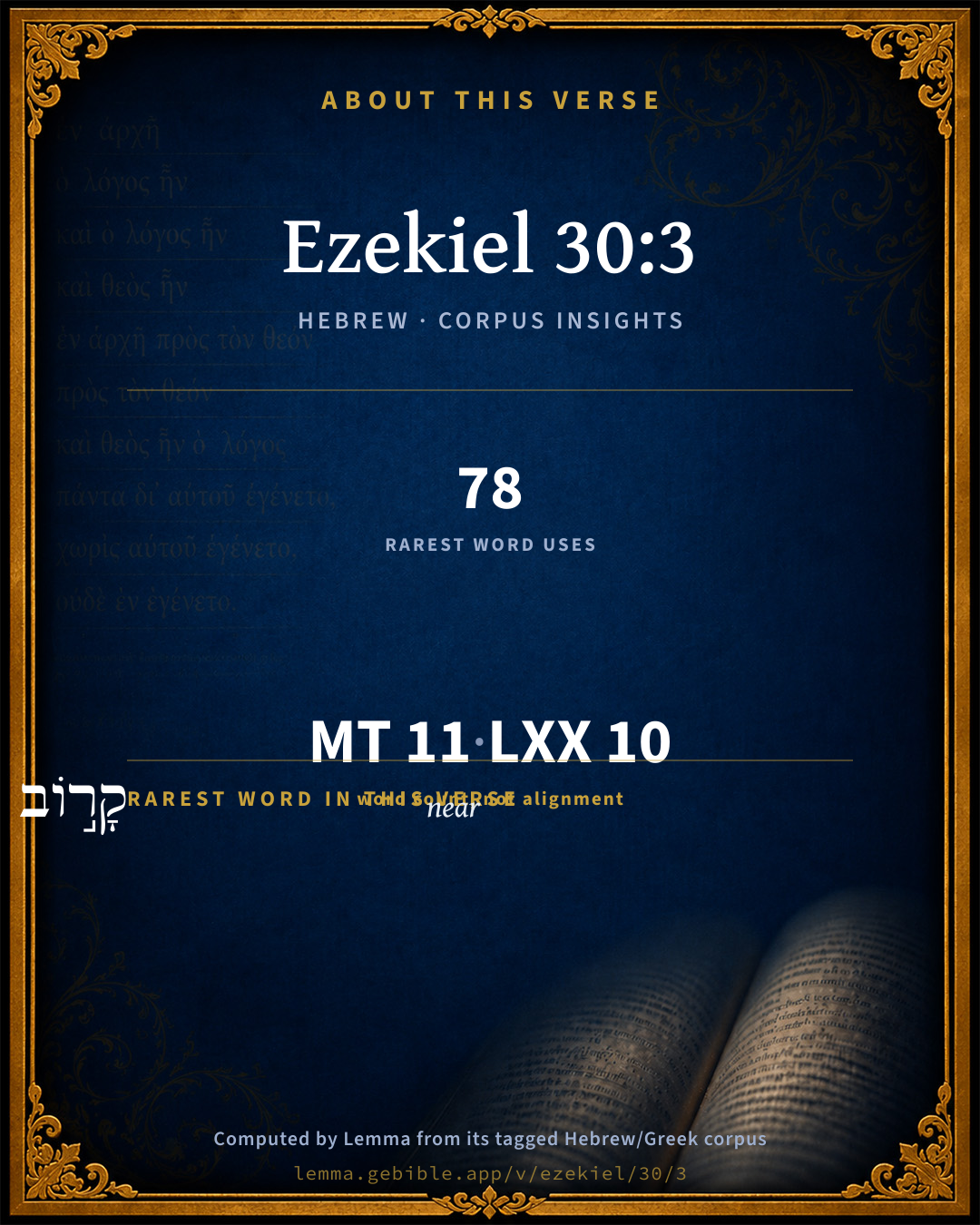
These counts appear in no published source. They are computed here, from the morphology-tagged text and Lemma’s own curated glosses. What Lemma adds →

11
words
8
distinct lemmas
Prophets
section

Grammatical profile

  • 1 verb
  • 7 nouns
  • 2 adjectives
  • 1 conjunction

Verb forms

  • יִֽהְיֶֽה Qal · Imperfect

Repetition

Words recur within this verse — often emphatic in Hebrew:

  • י֔וֹם day H3117 ×3
  • קָר֣וֹב near H7138 ×2

Hebrew & Septuagint length

In English translation the verse runs 24 words from the Hebrew and 20 from the Septuagint (LXX English) — closely comparable.

A rough comparison of the two English renderings, which tokenize alike — not a word-level alignment.

Word counts can differ between the Hebrew and the Greek without any difference in meaning — e.g. the Hebrew direct-object marker אֵת has no separate Greek word, and Greek often adds the article ὁ.

In the original languages it is 11 Hebrew tokens and 10 Greek tokens — but the two are counted differently (Hebrew bundles its prefixes and suffixes into one token; the Greek is in lemma form), so that isn’t a like-for-like length.

Cross-references

30

Topical passages linked to Ezekiel 30:3 in the Treasury of Scripture Knowledge — connected by theme and wording, ordered by reader-vote popularity; previews shown in the World English Bible.

  • Obadiah 1:15 For the day of Yahweh is near all the nations! As you have done, it will be done to you. Your deeds will return upon your own head.
  • Joel 2:1–2 Blow you the trumpet in Zion, And sound an alarm in my holy mountain! Let all the inhabitants of the land tremble, For the day of Yahweh comes, For it is close at hand:
  • Isaiah 24:21–23 It shall happen in that day, that Yahweh will punish the host of the high ones on high, and the kings of the earth on the earth.
  • Ezekiel 7:7 Your doom is come to you, inhabitant of the land: the time is come, the day is near, [a day of] tumult, and not [of] joyful shouting, on the mountains.
  • Ezekiel 7:12 The time is come, the day draws near: don't let the buyer rejoice, nor the seller mourn; for wrath is on all the multitude of it.
  • Ezekiel 30:18 At Tehaphnehes also the day shall withdraw itself, when I shall break there the yokes of Egypt, and the pride of her power shall cease in her: as for her, a cloud shall cover her, and her daughters shall go into captivity.
  • Ezekiel 34:12 As a shepherd seeks out his flock in the day that he is among his sheep that are scattered abroad, so will I seek out my sheep; and I will deliver them out of all places where they have been scattered in the cloudy and dark day.
  • Joel 1:15 Alas for the day! For the day of Yahweh is at hand, And it will come as destruction from the Almighty.
  • Zephaniah 1:14 The great day of Yahweh is near. It is near, and hurries greatly, the voice of the day of Yahweh. The mighty man cries there bitterly.
  • Psalms 110:6 He will judge among the nations. He will heap up dead bodies. He will crush the ruler of the whole earth.
  • Ezekiel 32:7 When I shall extinguish you, I will cover the heavens, and make the stars of it dark; I will cover the sun with a cloud, and the moon shall not give its light.
  • Amos 5:16–20 Therefore thus says Yahweh, the God of hosts, the Lord: "Wailing will be in all the broad ways; And they will say in all the streets, 'Alas! Alas!' And they will call the farmer to mourning, And those who are skillful in lamentation to wailing.
  • Zephaniah 1:7 Be silent at the presence of the Lord Yahweh, for the day of Yahweh is at hand. For Yahweh has prepared a sacrifice. He has consecrated his guests.
  • Zechariah 14:3–19 Then Yahweh will go out and fight against those nations, as when he fought in the day of battle.
  • Exodus 14:20 It came between the camp of Egypt and the camp of Israel; and there was the cloud and the darkness, yet gave it light by night: and the one didn't come near the other all the night.
  • Exodus 14:24 It happened in the morning watch, that Yahweh looked out on the host of the Egyptians through the pillar of fire and of cloud, and confused the Egyptian army.
  • Psalms 37:13 The Lord will laugh at him, For he sees that his day is coming.
  • Psalms 149:7–9 To execute vengeance on the nations, And punishments on the peoples;
  • Isaiah 19:1 The burden of Egypt. Behold, Yahweh rides on a swift cloud, and comes to Egypt: and the idols of Egypt shall tremble at his presence; and the heart of Egypt shall melt in the midst of it.
  • Isaiah 34:2–17 For Yahweh has indignation against all the nations, and wrath against all their host: he has utterly destroyed them, he has delivered them to the slaughter.
  • Jeremiah 25:15–29 For thus says Yahweh, the God of Israel, to me: take this cup of the wine of wrath at my hand, and cause all the nations, to whom I send you, to drink it.
  • Ezekiel 7:19 They shall cast their silver in the streets, and their gold shall be as an unclean thing; their silver and their gold shall not be able to deliver them in the day of the wrath of Yahweh: they shall not satisfy their souls, neither fill their bowels; because it has been the stumbling block of their iniquity.
  • Ezekiel 29:12 I will make the land of Egypt a desolation in the midst of the countries that are desolate; and her cities among the cities that are laid waste shall be a desolation forty years; and I will scatter the Egyptians among the nations, and will disperse them through the countries.
  • Joel 3:11–14 Hurry and come, all you surrounding nations, And gather yourselves together." Cause your mighty ones to come down there, Yahweh.
  • Zephaniah 3:6–7 I have cut off nations. Their battlements are desolate. I have made their streets waste, so that no one passes by. Their cities are destroyed, so that there is no man, so that there is no inhabitant.
  • Matthew 24:33 Even so you also, when you see all these things, know that it is near, even at the doors.
  • Philippians 4:5 Let your gentleness be known to all men. The Lord is at hand.
  • James 5:9 Don't grumble, brothers, against one another, so that you won't be judged. Behold, the judge stands at the door.
  • Revelation 6:17 for the great day of his wrath has come; and who is able to stand?"
  • Revelation 19:13–21 He is clothed in a garment sprinkled with blood. His name is called "The Word of God."

Cross-references courtesy of OpenBible.info (CC BY 4.0).

Hebrew and Greek witnesses Masoretic Hebrew ↔ Greek Septuagint

The same verse in the two great witnesses to the Old Testament, shown verse-for-verse.

These are two independent witnesses, not word-aligned to each other, and the Septuagint is shown in lemma (dictionary) form.

Hebrew Ezekiel 30:3 Masoretic · Westminster Leningrad Codex

כִּֽי קָר֣וֹב י֔וֹם וְקָר֥וֹב י֖וֹם לַֽיהוָ֑ה י֣וֹם עָנָ֔ן עֵ֥ת גּוֹיִ֖ם יִֽהְיֶֽה

For the day is near, even the day of Yahweh is near; it shall be a day of clouds, a time of the nations.

World English Bible · Public Domain

Greek LXX Ezekiel 30:3 Septuagint · lemma form

ὅτι ἐγγύς ὁ ἡμέρα ὁ κύριος ἡμέρα πέρας ἔθνος εἰμί

For the day of the Lord is near, a day of cloud; it shall be the end of the nations.

LXX2012 (modern English Septuagint) · Public Domain

Hebrew: Westminster Leningrad Codex (CC BY 4.0). Greek: Septuagint (public domain); English from LXX2012 (modern English Septuagint) (Public Domain). How the Septuagint differs from the Hebrew →

Targum (Aramaic paraphrase)

1

The Targum is the ancient Jewish Aramaic paraphrase of the Hebrew Scriptures — an interpretive translation, not the Hebrew text itself. Onkelos (literal) and Pseudo-Jonathan (expansive) render the Torah, and Jonathan the Prophets. Coverage is partial: where no permissively-licensed English translation exists for a verse, only the Aramaic is shown. This is verse-level text, not a word-by-word alignment to the Hebrew.

  1. Targum Jonathan Prophets (Joshua–Malachi)
    אֲרֵי קָרִיב יוֹמָא וְקָרִיב יוֹמָא דַעֲתִיד לְמֵיתֵי מִן קֳדָם יְיָ יוֹם עַנַן זִיעַ תְּבַר עַמְמַיָא יְהֵי:

    (no public-domain English translation for this verse)

    Targum Jonathan — Aramaic: “Mikraot Gedolot” (public domain). English: “Sefaria Community Translation” (CC0 1.0 (public-domain dedication)); “London "Chaldee Paraphrase," 1871” (public domain). Text via Sefaria.

Commentary

Notes on Ezekiel 30:3 from classic Christian and Jewish commentators (each source and its license shown beneath its notes). The classic Christian expositions comment on the surrounding passage and are grouped to its opening verse, so a note may address several verses; the Jewish commentaries on the Tanakh (Rashi and others) are per-verse, so they appear only where the commentator wrote on this verse.

Lemma curates 59 commentaries, every one of them public domain or Creative Commons licensed, each selected and text-cleaned for this edition rather than reprinted as found. About our sources →

Trapp's Complete Commentary

John Trapp

Eze 30:3 For the day [is] near, even the day of the LORD [is] near, a cloudy day; it shall be the time of the heathen.

Ver. 3. A cloudy day.] Heb., A day of a cloud, which was rarely seen in Egypt.

John Trapp, A Commentary or Exposition upon All the Books of the Old and New Testament (1647–1656) — public domain. Text from a community e-Sword module.

Jamieson, Fausset & Brown

Robert Jamieson, A. R. Fausset & David Brown

the time of the heathen--namely, for taking vengeance on them. The judgment on Egypt is the beginning of a world-wide judgment on all the heathen enemies of God (Joe 1:15; Joe 2:1-2; Joel 3:1-21; Oba 1:15).

Jamieson, Fausset & Brown — Commentary Critical and Explanatory on the Whole Bible (1871) — public domain (CC PDM 1.0). Text via the HelloAO Bible API.

Ellicott's Commentary for English Readers

(3) The time of the heathen.—The judgment upon Egypt is but an individual instance, and is symbolic of general judgment upon all merely worldly power. Her fall is one step in the general overthrow of whatever exalts and opposes itself to God. Very similar to Eze_30:2-3 are the prophecies in Isa_13:6; Isa_13:9; Joe_1:13; Joe_1:15; Joe_2:2; Oba_1:15; Zep_1:7; Zep_1:14.

A Bible Commentary for English Readers, edited by Charles John Ellicott (1878–1897) — public domain. Text from a community e-Sword module.

The Cambridge Bible for Schools and Colleges

gen. ed. J. J. S. Perowne

3. the day is near] The “day” of the Lord is never in the prophets a mere calamity or judgment from God. It is the time of Jehovah’s final interposition in the world to do judgment, to chastise evil, and give the crowning victory to his own cause. This day has a universal bearing: particularly, it falls in terror and calamity upon the heathen, the foes of Jehovah’s kingdom, but also upon the sinners in Zion, those who are at ease and settled on their lees (Zep_1:12), on the proud and the oppressors of the poor (Isa_2:12). The presentiment of this day is common to all the prophets, and the knowledge of it exists among the people (Amo_5:18). The feeling of its nearness, however, was awakened in various ways: either by great convulsions among the nations or calamities, in which Jehovah was so visibly operating that his final interposition seemed at hand (Isaiah 13; Zep_1:7; Joe_2:1); or, by a moral condition of the world which it was felt he must intervene to chastise and put an end to (Isaiah 2, 3). Naturally the convulsions or calamities which awakened the presentiment of the nearness of the day passed over and the day was deferred, but this does not justify the supposition that the prophets mean merely a great calamity or judgment by the day of the Lord.

the time of the heathen] the nations, the foes of Jehovah’s kingdom and people, when Jehovah shall be revealed to them and they shall be judged. Isaiah 2, 3, Isa_13:22; Jer_27:7; Eze_7:7; Eze_22:3.

The Cambridge Bible for Schools and Colleges (gen. ed. J. J. S. Perowne; Cambridge University Press, 1878–1918) — public domain. Text from a community e-Sword module.

John Gill's Exposition

For the day is near,.... The day of Egypt's destruction, the time fixed for it:

even the day of the Lord is near; the day appointed by him, and in which he would make himself known by the judgments he executed: Kimchi observes, that, the same year this prophecy was delivered, Egypt was given into the hands of the king of Babylon:

a cloudy day; or; "a day of cloud" (e); which was seldom seen in Egypt in a literal sense, rarely having any rain, their country being watered by the Nile; but now, in a figurative sense, the clouds would gather thick and black, and threaten with a horrible tempest of divine wrath, and of ruin and destruction:

it shall be the time of the Heathen: both when the Heathen nation of the Chaldeans should distress and conquer others; and when Heathen nations, as the Egyptians, Ethiopians, and others, should be destroyed by them. The Targum is,

"it shall be the time of the breaking or destruction of the people.''

(e) "dies nubis", V. L. Pagniaus, Montanus, Cocceius, Starckius.

John Gill's Exposition of the Whole Bible (1746–1763) — public domain (CC PDM 1.0). Text via the HelloAO Bible API.

Albert Barnes' Notes on the Bible

The time of the pagan - The time when the pagan (Egyptians) shall be judged.

Albert Barnes' Notes on the Bible (1834–1885) — public domain. Text from a community e-Sword/MySword module.

Matthew Poole's English Annotations

The day; the time of such distresses, as never the like known by you.

Near; it will begin in your overthrow in the Cyrenian and Libyan deserts in very little time next it will continue in your civil war, and finally end in the Babylonish conquest: some two years, and you shall be miserably routed in the deserts of Libya; immediately after the civil war for eleven years together shall waste you; and then Nebuchadrezzar’s forces will be upon you; so that, whereas there may be about sixteen or eighteen years between the prophecy and its fulfilling, here is thirteen or fourteen of them taken up with sorrows and afflictions, forerunners of the last.

The day of the Lord; of the Lord’s sore displeasure against Egypt and its allies.

Near; within two years, as is said.

A cloudy day; a dark day, so times of trouble are called, whereas prosperity is a day of light. Troubles, like violent storms, are black.

Of the heathen; of the Egyptians to be wasted, and of the Babylonians to waste them; the day of pride, cruelty, and revenges to the one, the day of falling, spoil, and destruction to the other.

Matthew Poole's English Annotations on the Holy Bible (1683–1685) — public domain. Text from a community e-Sword/MySword module.

The Pulpit Commentary

The day of the Lord. Here, as everywhere, (see note on Eze_13:5) the words stand for any time in which the Divine judgments manifest themselves in the world"s history. Of it Ezekiel says, following in the footsteps of Joel, (Joe_2:2) that it shall be a day of cloud, i.e. of darkness and trouble; a day of the heathen, i.e. a time in which the heathen who had exulted in the punishment of Israel should know that the Lord was their Judge also, that he had his "day" appointed for them.

The Pulpit Commentary (1880–1919), ed. H.D.M. Spence-Jones & Joseph S. Exell — public domain. Text from a community e-Sword module.

John Wesley's Explanatory Notes

A cloudy day - So times of trouble are called. Of the heathen - The time when God will reckon with the Heathens.

John Wesley, Explanatory Notes Upon the Whole Bible (1754–1765) — public domain. Text via the GEBible commentary corpus.

Scofield Reference Notes

C. I. Scofield

the day of the Lord Day (of Jehovah) (See Scofield "Isa 2:12").

The Scofield Reference Bible (1917 edition), notes by C. I. Scofield — public domain. Text from a community e-Sword module.

Rashi

Rabbi Shlomo Yitzchaki (Rashi)

the time of the nations The time of the destruction of the nations.

Rashi on the Tanakh — English translations: “The Judaica Press complete Tanach with Rashi, translated by A. J. Rosenberg” (CC BY 4.0); “Pentateuch with Rashi's commentary by M. Rosenbaum and A.M. Silbermann, 1929-1934” (public domain); “The Metsudah Tanach series, Lakewood, N.J” (CC BY 4.0); and “The Book of Joshua, Metsudah Publications, 1997” (CC BY 4.0). Text via Sefaria.

Lesson kit

Teaching starters — assembled from the data on this page, not authored interpretation. Every prompt links to the verse data it draws on. Edit before teaching.

Ezekiel, in the Prophets, opens this verse with 11 words (8 distinct Hebrew lemmas). Its most distinctive word is qârôwb (“near”). A historical commentator’s framing appears above. Read the whole chapter for the surrounding context.

Discussion questions

  1. How does “near” (qârôwb) shape what this verse is saying?
  2. How does Obadiah 1:15, which shares this passage’s theme, read alongside this verse?
  3. What does the repetition of “day” (3× in this one verse) do in this verse?
  4. These translations render this verse differently. What is at stake in choosing one wording over another?
  5. «יִֽהְיֶֽה» is a Qal Imperfect verb. How does that grammatical form shape the action described?
  6. Compare how Trapp's Complete Commentary and Jamieson, Fausset & Brown read this verse. Where do they agree or differ?

Things to notice

Reading settings

Reading text

Shown beneath each verse's original-language words.

Old Testament
Old Testament edition

Read the OT as the Masoretic Hebrew (MT) or the Greek Septuagint (LXX).

English shown for the Greek Septuagint (in the Hebrew ↔ Greek comparison).

Comparing translations? Open the Compare panel on any verse page to stack up to four side by side.