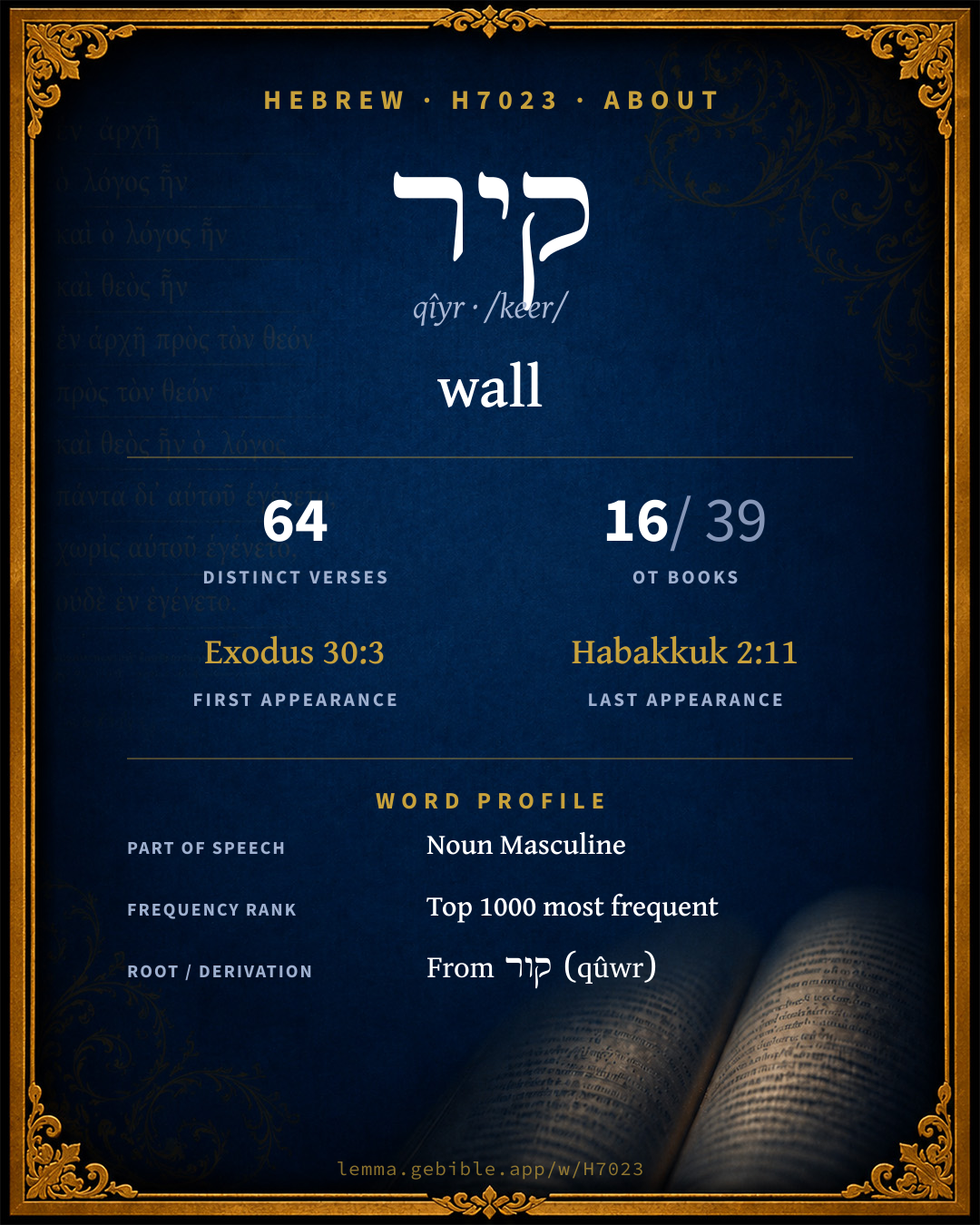
קִיר
wall
‘wall’ is one of 3 main senses fuller range ↓
Full lexicon entry — Brown-Driver-Briggs (BDB)
From Brown-Driver-Briggs (BDB)
Where this word appears
See every Absolute-state word in the Hebrew Bible →
Grammar key — what these labels mean
Part of speech
- Noun
- A naming word — a person, place, thing, or idea.
Noun type
- Common
- A common noun — a general class of person, place, or thing (“king,” “city,” “water”), not a specific name.
State
- Absolute
- The independent form of a noun, not bound to a following word.
- Construct
- A noun bound to a following noun in a possessive / “of” relationship (the construct chain).
Gender
- Masculine
- Grammatically masculine.
Number
- Singular
- One.
- Plural
- More than one (in Hebrew, generally three or more).
Every verse where H7023 appears in the Book of Ezekiel — 22 distinct verses. Click any verse to open its interlinear word-by-word view. Verse text shown in the World English Bible for context — . Each verse’s Hebrew form is shown with its reference; the English is not keyword-highlighted, since the data carries no word-level English alignment. Use “Compare translations” on any verse to read it across multiple English versions. This concordance covers the Hebrew Bible; Septuagint (Greek Old Testament) occurrences are not indexed here.
Ezekiel
- Ezekiel 4:3 קִ֣יר n c ms cs Take for yourself an iron pan, and set it for a wall of iron between you and the city: and set your face toward it, and it shall be besieged, and you shall lay siege against it. This shall be a sign to the house of Israel.
- Ezekiel 8:7 בַּ/קִּֽיר prep det + n c ms He brought me to the door of the court; and when I looked, behold, a hole in the wall.
- Ezekiel 8:8 בַ/קִּ֑יר בַּ/קִּ֔יר prep det + n c ms prep det + n c ms Then said he to me, Son of man, dig now in the wall: and when I had dug in the wall, behold, a door.
- Ezekiel 8:10 הַ/קִּ֖יר ptcl def.art + n c ms So I went in and saw; and see, every form of creeping things, and abominable animals, and all the idols of the house of Israel, portrayed on the wall round about.
- Ezekiel 12:5 בַ/קִּ֑יר prep det + n c ms Dig you through the wall in their sight, and carry out thereby.
- Ezekiel 12:7 בַ/קִּ֖יר prep det + n c ms I did so as I was commanded: I brought forth my stuff by day, as stuff for removing, and in the even I dug through the wall with my hand; I brought it forth in the dark, and bore it on my shoulder in their sight.
- Ezekiel 12:12 בַּ/קִּ֥יר prep det + n c ms The prince who is among them shall bear on his shoulder in the dark, and shall go forth: they shall dig through the wall to carry out thereby: he shall cover his face, because he shall not see the land with his eyes.
- Ezekiel 13:12 הַ/קִּ֑יר ptcl def.art + n c ms Behold, when the wall is fallen, shall it not be said to you, Where is the daubing with which you have daubed it?
- Ezekiel 13:14 הַ/קִּ֨יר ptcl def.art + n c ms So will I break down the wall that you have daubed with whitewash, and bring it down to the ground, so that the foundation of it shall be uncovered; and it shall fall, and you shall be consumed in the midst of it: and you shall know that I am Yahweh.
- Ezekiel 13:15 בַּ/קִּ֔יר הַ/קִּ֔יר prep det + n c ms ptcl def.art + n c ms Thus will I accomplish my wrath on the wall, and on those who have daubed it with whitewash; and I will tell you, The wall is no more, neither those who daubed it;
- Ezekiel 23:14 הַ/קִּ֔יר ptcl def.art + n c ms She increased her prostitution; for she saw men portrayed on the wall, the images of the Chaldeans portrayed with vermilion,
- Ezekiel 33:30 הַ/קִּיר֔וֹת ptcl def.art + n c mp As for you, son of man, the children of your people talk of you by the walls and in the doors of the houses, and speak one to another, everyone to his brother, saying, Please come and hear what is the word that comes forth from Yahweh.
- Ezekiel 41:5 קִֽיר n c ms cs Then he measured the wall of the house, six cubits; and the breadth of every side-chamber, four cubits, round about the house on every side.
- Ezekiel 41:6 בַּ/קִּ֨יר בְּ/קִ֥יר prep det + n c ms prep + n c ms cs The side-chambers were in three stories, one over another, and thirty in order; and they entered into the wall which belonged to the house for the side-chambers round about, that they might have hold [therein], and not have hold in the wall of the house.
- Ezekiel 41:9 הַ/קִּ֧יר ptcl def.art + n c ms The thickness of the wall, which was for the side-chambers, on the outside, was five cubits: and that which was left was the place of the side-chambers that belonged to the house.
- Ezekiel 41:12 וְ/קִ֧יר conj + n c ms cs The building that was before the separate place at the side toward the west was seventy cubits broad; and the wall of the building was five cubits thick round about, and the length of it ninety cubits.
- Ezekiel 41:13 וְ/קִ֣ירוֹתֶ֔י/הָ conj + n c mp cs + sfx pers 3fs So he measured the house, one hundred cubits long; and the separate place, and the building, with the walls of it, one hundred cubits long;
- Ezekiel 41:17 הַ/קִּ֨יר ptcl def.art + n c ms to [the space] above the door, even to the inner house, and outside, and by all the wall round about inside and outside, by measure.
- Ezekiel 41:20 וְ/קִ֖יר conj + n c ms cs from the ground to above the door were cherubim and palm trees made: thus was the wall of the temple.
- Ezekiel 41:22 וְ/קִֽירֹתָ֖י/ו conj + n c mp cs + sfx pers 3ms The altar was of wood, three cubits high, and the length of it two cubits; and the corners of it, and the length of it, and the walls of it, were of wood: and he said to me, This is the table that is before Yahweh.
- Ezekiel 41:25 לַ/קִּיר֑וֹת prep det + n c mp There were made on them, on the doors of the temple, cherubim and palm trees, like as were made on the walls; and there was a threshold of wood on the face of the porch outside.
- Ezekiel 43:8 וְ/הַ/קִּ֖יר conj + ptcl def.art + n c ms in their setting of their threshold by my threshold, and their door-post beside my door-post, and there was [but] the wall between me and them; and they have defiled my holy name by their abominations which they have committed: therefore I have consumed them in my anger.
About this entry
At a glance — auto-summarized from this page’s data, not written by a person. Every figure links to its source below. This summary describes the numbers; it doesn’t interpret them.
At its core, קיר (qîyr) means “wall.” It first appears in Exodus 30:3. It turns up in 64 verses across 16 books, a moderately common footprint. The word gravitates to Ezekiel (34%), then 1 Kings and 1 Samuel. Not a single-sense word: explore its full sense range. Each statement above links to its evidence; the full detail follows below.
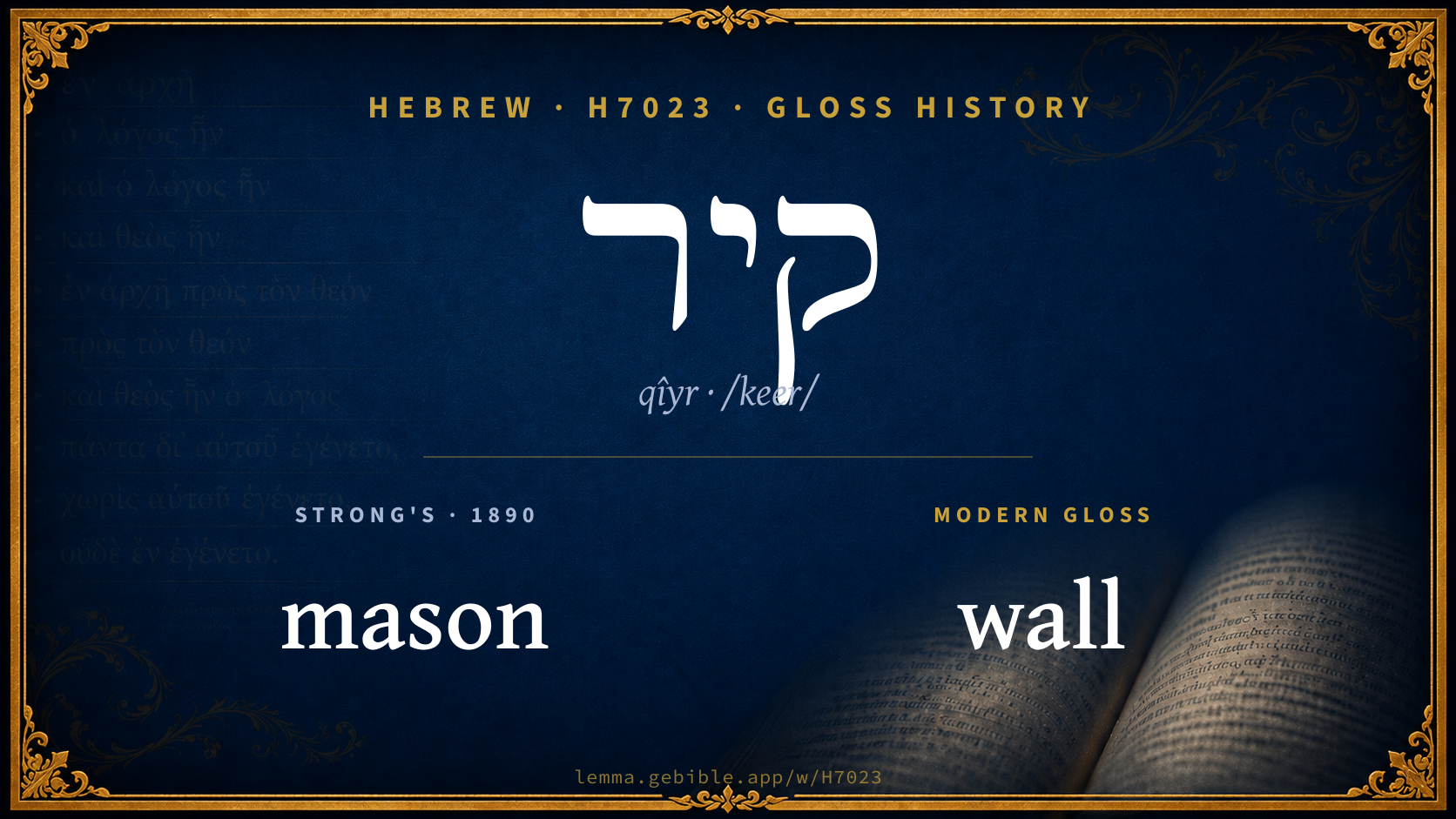
Gloss history
Strong's 1890 vs modern scholarship
About this word
Strong's H7023 catalogs a Hebrew word from the Hebrew Old Testament.
These counts are not copied from any lexicon or concordance. They are computed here, from the morphology-tagged Hebrew Old Testament. What Lemma adds →
- 64
- distinct verses
- The word appears in 64 distinct verses.
- 16 / 39
- OT books
- The word appears in 16 of 39 Old Testament books.
- #536
- by frequency
- Top 1000 most frequent Hebrew words (rank 536 of 8,640 Hebrew words by occurrence).
View all 64 occurrences in the concordance →
By section of the Old Testament
By traditional corpus
Conventional, traditional groupings — biblical authorship is debated, so this is a traditional corpus grouping, not an authorship claim. Each share is this word’s portion of its verses in that division of the Hebrew canon. Each figure is a share of the word’s 64 distinct verses.
- Prophets (Nevi'im) 50 verses · 78%
- Torah (Pentateuch) 8 verses · 13%
- Writings (Ketuvim) 6 verses · 9%
How translations render this word
Counts come from each version’s own published word-to-Strong’s tagging or interlinear alignment — an approximate guide to how each version renders this word, not a word-level alignment the data otherwise carries. Because each total is that version’s own tagged count, the per-version totals vary from one another and need not match the appearance or distinct-verse counts above. These counts may also differ from a printed concordance because Lemma counts each distinctly tagged rendering and does not collapse phrase taggings into a single head-word total. This is a fixed set of word-tagged versions (KJV, ASV, BSB, ULT) and does not change with the reading translation you choose elsewhere. Each version’s license is shown beside its name below (and on Sources).
BDB lists this Strong’s number as 3 distinct words (homographs). Each count above pools all of them and is not split by sense — see the Senses section below. A low-frequency rendering may belong to a different one of those words, not the primary meaning.
- King James Version†: Wall 29×, Walls 10×, Against the wall 8×
- American Standard Version†: Wall 27×, Walls 10×, Against the wall 3×
- Berean Standard Bible†: Wall 30×, Walls 12×, Through the wall 5×
- unfoldingWord Literal Text†: Wall 35×, Walls 8×, Walls of 7×
King James Version Public Domain
Renders H7023 across 74† tagged occurrences — most commonly:
Plus 21 renderings that appear only once — usually multi-word phrases or single function words the recovered tagging swept in, not distinct renderings.
American Standard Version Public Domain
Renders H7023 across 71† tagged occurrences — most commonly:
Plus 21 renderings that appear only once — usually multi-word phrases or single function words the recovered tagging swept in, not distinct renderings. Not rendered by a distinct English word in 3 further occurrences.
Berean Standard Bible Public Domain
Renders H7023 across 63† tagged occurrences — most commonly:
Plus 11 renderings that appear only once — usually multi-word phrases or single function words the recovered tagging swept in, not distinct renderings. Not rendered by a distinct English word in 11 further occurrences.
unfoldingWord Literal Text CC BY-SA 4.0
Renders H7023 across 76† tagged occurrences — most commonly:
Plus 8 renderings that appear only once — usually multi-word phrases or single function words the recovered tagging swept in, not distinct renderings.
13 senses and sub-senses in the full BDB
What do BDB’s symbols mean?
BDB uses these scholarly abbreviations:
| Symbol | Meaning |
|---|---|
| 𝔊 | the Septuagint (the ancient Greek translation, LXX) |
| 𝔙 | the Vulgate (the Latin translation) |
| 𝔖 | the Syriac version (the Peshitta) |
| 𝔗 | the Targum (the Aramaic translation) |
| ψ | the Psalms |
| √ | root (the underlying root or stem) |
| ‖ | parallel passage (a synonymous or contrasted parallel) |
| † | the dagger: every passage where the word occurs is cited |
The 13 senses and sub-senses the full Brown-Driver-Briggs lexicon distinguishes for this word, in lexicon order (not ranked by frequency), with BDB’s own verbatim wording and sub-sense lettering. Shown in Hebrew script with BDB’s own scholarly abbreviations. The condensed entry is in the Lexicon Entry tab. See also the Forms in the corpus table below.
קיר I
- 1. usually of house or chamber:
- a. inner surface, Am 5:19; 1 S 18:11 + 9 times, + (of temple) 1 K 6:15a + v 15b (but read קוֹרוֹת beams, with 𝔊 The Kit Benz), v 16, 27(×2) + 6 times e.g. Amos 5:19
- b. outer surface, 2 K 9:33; Ez 33:30; Is 59:10 (in sim.); so זֶרֶם קִיר Is 25:4 (but Lo Kn Gr Di Du CheHpt. al. read קֹר; JP PetersJBL xi (1892), 46 proposes בָּרָד [as 28:2]); of temple 1 K 6:5(×2), 6, cf. Ez 41:6(×2). e.g. 2 Kings 9:33
- c. both inner and outer v 17, 20, 25. e.g. Ezekiel 41:17
- d. indeterminate, 12:5, 7, 12; 23:14. e.g. Ezekiel 12:5
- e. thickness specified, Ez 41:5, 9, 12, 13 (of Ezekiel’s temple). e.g. Ezekiel 41:5
- f. as enclosing, 2 K 4:10 (of עֲלִיָּה, q.v.); as separating Ez 43:8. e.g. 2 Kings 4:10
- 2. wall of (temple-)court Ez 8:7, 8(×2) (in vision); of vineyard Nu 22:25(×2) (J), of city 35:4 (P), cf. ק׳ חַחוֹמָה Jos 2:15 (JE) the (upper) surface of the wall. e.g. Ezekiel 8:7
- 3. more gen., 1 K 5:13, and (in phr. מַשְׁתִּין בְּקִיר) 1 S 25:22, 34; 1 K 14:10; 16:11; 21:21; 2 K 9:8; in fig. Ez 13:12, 14 (appar. fem., but city Jerus. prob. in mind, cf. AlbrZAW xvi (1896), 85 Köii. 2, 175), v 15(×2) (‖ חַיִץ v 10), ק׳ נָטוּי ψ 62:4; אֶבֶן ק׳ 2 S 5:11 = ק׳ 1 Ch 14:1, cf. Hb 2:11 (fig.); קִיר בַּרְזֶל Ez 4:3 (symbol.).—Is 22:5 is dub.: usually wall (so even Du CheHpt Marti), but ref. not clear; Ew CheComm. iii. קִיר; Klo Brd WklAlttest. Unters. 177 קוֹעַ, so WMMHast DB kir, but v. Drlb. koa. e.g. 1 Kings 5:13
- 4. of flat side of altar Ez 41:22; Ex 30:3; 37:26; Lv 1:15; 5:9 (all P). e.g. Ezekiel 41:22
- 5. קִירוֹת לִבִּי Je 4:19 walls of my heart (as seat of pain). e.g. Jeremiah 4:19
קיר II in n.pr.loc. of Moabite cities (cf. קר = city MI 11, 12, 24, pl. קרן l
- 1. ק׳ מוֹאָב Is 15:1, poss. Rabba, S. of Arnon, v. BuhlGeogr. 270. e.g. Isaiah 15:1
- 2. ק׳ חֶ֫רֶשׂ Je 48:31, 36, ק׳ חָ֑רֶשׂ Is 16:11 = ק׳ חֲרֶ֫שֶׂת Is 16:7, ק׳ חֲרָ֑שֶׂת 2 K 3:25 (Gi ק׳ חֲרָ֑שֶׁת), perhaps Kerak, S. of Rabba, v. Buhl ib., and cp. (on Kerak) PalmarDes. of Ex. ii. 472 DowlingPEQ Oct. 1896, 327, especially Mauss in de LuynesVoyage à la Mer Morte (1864), ii. 106 ff., iii (Atlas, ad fin.), 13 pl.. e.g. Jeremiah 48:31
קיר III ק׳ orig. house of Aramaic Am 9
Senses from the full Brown-Driver-Briggs lexicon (Brown, Driver, Briggs; Oxford 1906 — public domain), digitized via Sefaria, supplemented by the OpenScriptures HebrewLexicon (CC BY 4.0). Full attribution on Sources.
Word origin
I. n.m.ψ 62:4 wall (√ unknown);—abs. ק׳ Nu 22:25; +, קִר Is 22:5; cstr. קִיר 1 K 6:5 +; pl. קִירוֹת 1 K 6:16 +, cstr. id., v 5 +; sf. קִירֹתָיו Ex 30:3 +, etc.;—wall, especially as flat surface:
II. in n.pr.loc. of Moabite cities (cf. קר = city MI 11, 12, 24, pl. קרן l:29);—𝔊 usually om., or reads τὸ τεῖχος;—
III. n.pr.terr. et gent. ק׳ orig. house of Aramaic Am 9:7; קִ֫ירָה as place of exile Am 1:5; 2 K 16:9 (𝔊 τὴν πόλιν); קִיר as people in Assyrian army Is 22:6 (v 5 vid. i. קִיר ad fin.).—Location dub., v. conspectus of older views Dr Am 1:5; plausible is some tribe in S. Babylonia, E. of Tigris WklAT Unters. 178, cf. HalRÉJ; xi. 60;—WMMHast. DB kir everywhere del., or em. קוֹעַ, but v. i. קִיר 3.
— Brown-Driver-Briggs (Oxford 1906, public domain), digitized via Sefaria, supplemented by the OpenScriptures HebrewLexicon (CC BY 4.0). See Sources.
Derived from קור (qûwr) (H6979) — to dig.
Jastrow Dictionary
A second Hebrew/Aramaic lexicon for comparison, covering Aramaic and post-biblical (Talmudic, Targumic, Midrashic) usage that the biblical-Hebrew BDB does not. Matched by lemma rather than by Strong’s number, so a lemma may carry more than one Jastrow headword (shown separately below), and the entries cover usage well beyond the Bible.
קִיר I
- c. (b. h.; [surrounding, enclosure,]
- 1. wall, recess, chamber. R. Hash. 16ᵇ; Snh. 109ᵃ, v. נָטָה. Y. Ber. IV, 8ᵇ bot. (ref. to Is. XXXVIII, 2) באיזה ק׳ נשא עיניו to what wall did he direct his eyes? בקִירָהּ של רחב to the wall of Rahab’s house (ref. to Josh. II, 15); ib. בקירה של שונמית to the ḳir (chamber) of the Shunamite; השונמית ק׳ אחת וכ׳ the Shunamite made one chamber for Elisha &c.; Bab. Ber. 10ᵇ. Zeb. 65ᵃ ק׳ העליון the upper portion of the side of the altar; ק׳ הכבש the masonry of the ascent to the altar; a. fr.—Pl. קִירוֹת. Y. Ber. l. c. בק׳ בה"מ וכ׳ he directed his eyes to the walls of the Temple; בק׳ לבו וכ׳ to the recesses of his own heart he directed his eyes; Bab. ib. l. c. התפלל מק׳ לבו he prayed out of the recesses &c.—2) rim, border of mats, (v. גְּדָנְפָא). Succ. 20ᵇ e.g. Isaiah 38:2
קִיר II
- (or קוּר), Pa. קַיֵּיר (sec. verb of קרר) to cool. Ab. Zar. 38ᵇ וקַיְּירֵי מבינתא וכ׳ (Ms. M. וקרירי) and they cool (the body) from the hair of the head to &c.
קיר
- , Targ. II Esth. III, 8 some ed., v. קִירָא
A Dictionary of the Targumim, the Talmud Babli and Yerushalmi, and the Midrashic Literature (Marcus Jastrow; London, Luzac, 1903) — Public Domain. Digitized via Sefaria. Digitized via Sefaria. Full attribution on Sources.
Forms in the corpus
The 52 distinct written forms H7023 takes in the Hebrew Bible, most frequent first — each parse links to that state’s occurrences in the concordance. Hebrew forms include their vowel points and cantillation, so a single lemma takes many written forms.
Same root — word family
Other BDB entries built from the same root as H7023, grouped by Strong’s listed origin. These share a root / origin per the lexicon — not necessarily a shared meaning. Each links to that word’s own entry.
Derives from
Shares the same root
Proper names from this root
People and places named from this root — a name, not an additional meaning of the word.
Compare all same-root words → Showing 4 of 8 — not the complete family. 3 of the same-root words are proper names (people or places). They share a root, not necessarily a meaning.
Septuagint verse parallels
This word appears in 62 verses that also exist in the Greek Old Testament (Septuagint), out of the 64 Hebrew verses it occurs in. You can read those verses in Greek by switching the Old Testament edition to the Septuagint.
Read these verses in the Septuagint
- Exodus 30:3
- Leviticus 1:15
- Numbers 22:25
- Joshua 2:15
- 1 Samuel 18:11
- 2 Samuel 5:11
- 1 Kings 6:5
- 2 Kings 4:10
- 1 Chronicles 14:1
- 2 Chronicles 3:7
- Psalms 62:3
- Isaiah 22:5
This is a verse-level parallel only — the same verses exist in both the Hebrew and Greek Old Testaments. No word-level Hebrew↔Greek correspondence is claimed: the data carries no such alignment, so no Greek word is shown as this Hebrew word’s translation. Coverage is not total — the Septuagint omits the deuterocanon and renumbers the Psalms, so some Hebrew verses have no direct Greek parallel.