
Ezekiel 12:5

Hebrew (Westminster Leningrad Codex) Ezekiel 12:5 appears in the Hebrew Old Testament. The text above is from the Westminster Leningrad Codex. Each word links to its Strong’s number, a concise gloss, and parsing drawn from the Open Scriptures Hebrew Bible morphology. Click any word for its full Brown-Driver-Briggs (BDB) entry.
Download image
Cite this verse

Ezekiel 12:5 (World English Bible). Public Domain. Lemma interlinear Bible study tool, https://lemma.gebible.app/v/ezekiel/12/5.

Show BibTeX & RIS
BibTeX
RIS
English Translation
Dig you through the wall in their sight, and carry out thereby.
World English Bible · Public Domain
Download a study sheet

One document with this verse’s original text, its word-by-word gloss line, the meaning frame, cross-references with their text, attributed commentary, and full source and license credits — printable, and it pastes into notes with its structure intact.

This verse Autodidact and up

Study sheet (.html) Plain text (.txt)

A passage Seminary Student

Up to 50 verses in one chapter. A passage sheet keeps up to 6 commentary sources and 12 cross-references per verse, in the order this page ranks them, and says so on the sheet whenever that leaves anything out. Ask for a single verse and you get the Autodidact verse sheet above.

Everything on this page stays free to read, with no account — the sheet is a download of what is already on screen, not access to it.

Want to remove ads? Support Godless Engineer
Compare translations 3

The same verse in 3 English versions, stacked beneath the original-language interlinear above. Click any original word for its lexicon entry.

Each is an independent rendering of the whole verse — the interlinear is not word-aligned to these translations.

Highlighted words mark where these versions differ — a whole-verse word diff, not a word-by-word alignment.

  • World English Bible Public Domain
    Dig you through the wall in their sight, and carry out thereby.
  • King James Version Public Domain
    Dig thou through the wall in their sight, and carry out thereby.
  • unfoldingWord Literal Text CC BY-SA 4.0
    Dig a hole through the wall in their sight, and go out through it.

unfoldingWord Literal Text — © unfoldingWord, licensed CC BY-SA 4.0. Word-aligned USFM3 via Door43 (git.door43.org/unfoldingWord/en_ult).

Versions to compare (up to 4)

3 of 4 selected

Show all 18 translations

Every available English version of this verse, each an independent rendering of the whole verse.

  • World English Bible Public Domain
    Dig you through the wall in their sight, and carry out thereby.
  • Berean Standard Bible Public Domain
    As they watch, dig through the wall and carry your belongings out through it.
  • Majority Standard Bible Public Domain
    As they watch, dig through the wall and carry your belongings out through it.
  • King James Version Public Domain
    Dig thou through the wall in their sight, and carry out thereby.
  • American Standard Version (1901) Public Domain
    Dig thou through the wall in their sight, and carry out thereby.
  • Revised Version (1885) Public Domain
    Dig thou through the wall in their sight, and carry out thereby.
  • Geneva Bible (1599) Public Domain
    Dig thou through the wall in their sight, and cary out thereby.
  • Douay-Rheims (1899) Public Domain
    Dig thee a way through the wall before their eyes: and thou shalt go forth through it.
  • Young's Literal Translation Public Domain
    Before their eyes dig for thee through the wall, and thou hast brought forth by it.
  • Literal Standard Version CC BY-SA 4.0
    You dig through the wall before their eyes, and you have brought forth by it.
  • Unlocked Literal Bible CC BY-SA 4.0
    Dig a hole through the wall in their sight, and go out through it.
  • unfoldingWord Literal Text CC BY-SA 4.0
    Dig a hole through the wall in their sight, and go out through it.
  • Darby Bible Public Domain
    Dig thou through the wall in their sight, and carry out thereby.
  • World Messianic Bible Public Domain
    Dig through the wall in their sight, and carry your baggage out that way.
  • Webster's Bible Public Domain
    Dig thou through the wall in their sight, and carry out thereby.
  • Free Bible Version CC BY-SA 4.0
    While they go on watching, knock down part of the wall of your house and take your belongings out through the hole.
  • Bible in Basic English Public Domain
    Make a hole in the wall, before their eyes, and go out through it.
  • JPS Tanakh (1917) Public Domain
    Dig thou through the wall in their sight, and carry out thereby.

Literal Standard Version (2020), Covenant Press — licensed CC BY-SA 4.0. Text via the HelloAO Bible API (eBible.org). Unlocked Literal Bible (unfoldingWord) — licensed CC BY-SA 4.0. Text via the HelloAO Bible API (eBible.org). unfoldingWord Literal Text — © unfoldingWord, licensed CC BY-SA 4.0. Word-aligned USFM3 via Door43 (git.door43.org/unfoldingWord/en_ult). Free Bible Version, Dr. Jonathan Gallagher — licensed CC BY-SA 4.0. Text via the HelloAO Bible API (eBible.org).

Word by word

More ways to search: Search by grammar → Find every occurrence → Compare this word →

Practice this passage: Drill this verse → Learn its vocabulary →

חֲתָר
châthar
H2864
“dig”
Verb, Qal, Imperative, 2nd Person, Masculine, Singular
Part of Speech
Verb
Stem
Qal
Form
Imperative
Person
2nd Person
Gender
Masculine
Number
Singular
Full BDB Definition

Origin: a primitive root

TWOT: 783

to dig, row - (Qal) - to dig (into houses - of burglary) - to row (in water)
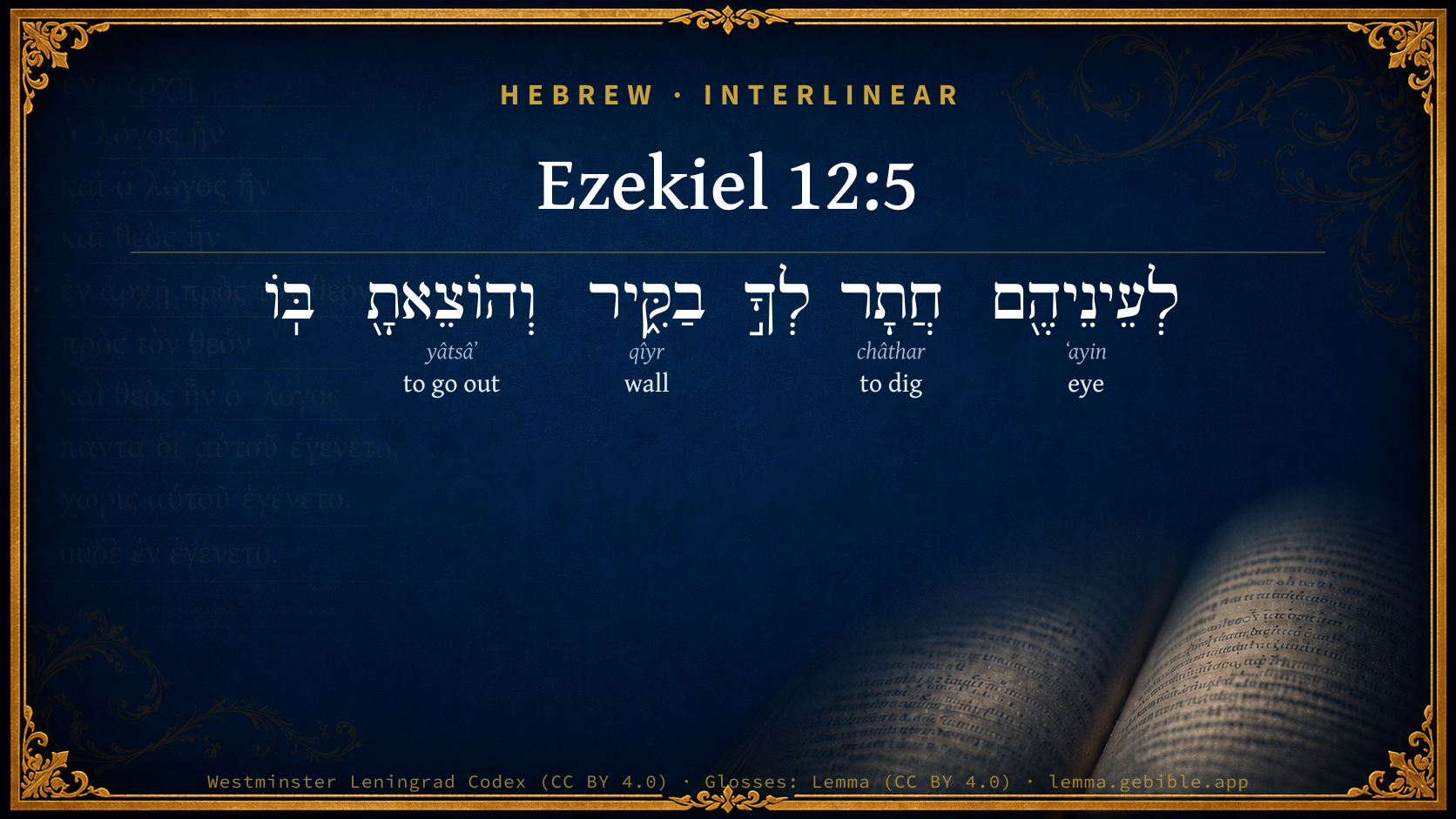
  1. לְעֵינֵיהֶ֖ם ʻayin H5869 “to/for · eyes · their” Preposition + Noun, Common, Both, Dual, Construct + Suffix, Personal, 3rd Person, Masculine, Plural
  2. בַקִּ֑יר qîyr H7023 “in/at the · wall” Preposition, Determined + Noun, Common, Masculine, Singular, Absolute
  3. וְהוֹצֵאתָ֖ yâtsâʼ H3318 “and · to go out” Conjunction + Verb, Hiphil, Sequential Perfect, 2nd Person, Masculine, Singular

About this verse

These counts appear in no published source. They are computed here, from the morphology-tagged text and Lemma’s own curated glosses. What Lemma adds →

6
words
4
distinct lemmas
Prophets
section

Notable vocabulary

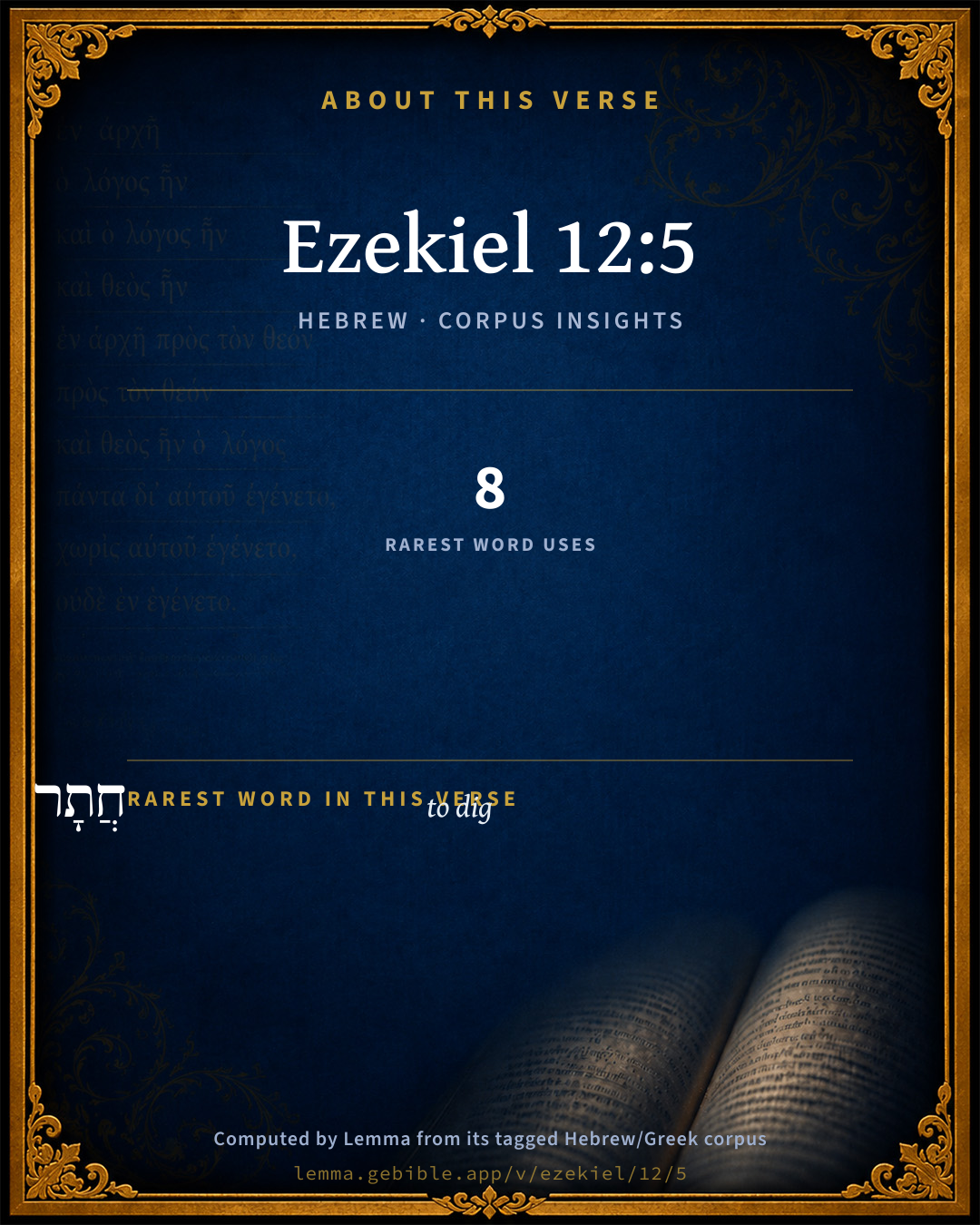
The rarest word here is חֲתָר to dig H2864 — appearing just 8 times in the whole Hebrew Bible.

Shared distinctive vocabulary

חֲתָר to dig H2864 occurs in 7 verses of the Hebrew Bible. Also found in:

Grammatical profile

  • 2 verbs
  • 2 nouns
  • 2 prepositions

Verb forms

  • חֲתָר Qal · Imperative
  • וְהוֹצֵאתָ֖ Hiphil · Sequential Perfect

Hebrew & Septuagint length

In English translation the verse runs 12 words from the Hebrew and 18 from the Septuagint (LXX English) — the Septuagint runs noticeably longer here. See the side-by-side →

A rough comparison of the two English renderings, which tokenize alike — not a word-level alignment.

Word counts can differ between the Hebrew and the Greek without any difference in meaning — e.g. the Hebrew direct-object marker אֵת has no separate Greek word, and Greek often adds the article ὁ.

Cross-references

2

Topical passages linked to Ezekiel 12:5 in the Treasury of Scripture Knowledge — connected by theme and wording, ordered by reader-vote popularity; previews shown in the World English Bible.

  • 2 Kings 25:4 Then a breach was made in the city, and all the men of war [fled] by night by the way of the gate between the two walls, which was by the king's garden (now the Chaldeans were against the city round about); and [the king] went by the way of the Arabah.
  • Jeremiah 39:2–4 in the eleventh year of Zedekiah, in the fourth month, the ninth day of the month, a breach was made in the city),

Cross-references courtesy of OpenBible.info (CC BY 4.0).

Hebrew and Greek witnesses Masoretic Hebrew ↔ Greek Septuagint

The same verse in the two great witnesses to the Old Testament, shown verse-for-verse.

Here the Septuagint runs noticeably longer than the Hebrew — LXX2012 (modern English Septuagint) 18 words vs World English Bible 12. A rough length comparison of the two English translations, not a word-level alignment — read both below.

These are two independent witnesses, not word-aligned to each other, and the Septuagint is shown in lemma (dictionary) form.

Hebrew Ezekiel 12:5 Masoretic · Westminster Leningrad Codex

לְעֵינֵיהֶ֖ם חֲתָר לְךָ֣ בַקִּ֑יר וְהוֹצֵאתָ֖ בּֽוֹ

Dig you through the wall in their sight, and carry out thereby.

World English Bible · Public Domain

Greek LXX Ezekiel 12:5 Septuagint · lemma form

ἐνώπιον αὐτός διαὀρύσσω σεαυτοῦ εἰς ὁ τοῖχος καί δια ἐκἔρχομαι διά αὐτός

Dig for yourself into the wall of the house, and you shall pass through it in their sight:

LXX2012 (modern English Septuagint) · Public Domain

On this verse, John Gill's Exposition discusses the Septuagint’s reading. Read the note in Commentary ↓

Hebrew: Westminster Leningrad Codex (CC BY 4.0). Greek: Septuagint (public domain); English from LXX2012 (modern English Septuagint) (Public Domain). How the Septuagint differs from the Hebrew →

Targum (Aramaic paraphrase)

1

The Targum is the ancient Jewish Aramaic paraphrase of the Hebrew Scriptures — an interpretive translation, not the Hebrew text itself. Onkelos (literal) and Pseudo-Jonathan (expansive) render the Torah, and Jonathan the Prophets. Coverage is partial: where no permissively-licensed English translation exists for a verse, only the Aramaic is shown. This is verse-level text, not a word-by-word alignment to the Hebrew.

  1. Targum Jonathan Prophets (Joshua–Malachi)
    לְעֵינֵיהוֹן חֲתַּר לָךְ בְּכוּתְלָא וְתִפּוֹק בֵּיהּ:

    (no public-domain English translation for this verse)

    Targum Jonathan — Aramaic: “Mikraot Gedolot” (public domain). English: “Sefaria Community Translation” (CC0 1.0 (public-domain dedication)); “London "Chaldee Paraphrase," 1871” (public domain). Text via Sefaria.

Commentary

Notes on Ezekiel 12:5 from classic Christian and Jewish commentators (each source and its license shown beneath its notes). The classic Christian expositions comment on the surrounding passage and are grouped to its opening verse, so a note may address several verses; the Jewish commentaries on the Tanakh (Rashi and others) are per-verse, so they appear only where the commentator wrote on this verse.

Lemma curates 59 commentaries, every one of them public domain or Creative Commons licensed, each selected and text-cleaned for this edition rather than reprinted as found. About our sources →

Trapp's Complete Commentary

John Trapp

Eze 12:5 Dig thou through the wall in their sight, and carry out thereby.

Ver. 5. Dig through the wall.] Make any shift. Necessitas magnum telum. He that digged Mortimer’s hole, as they call it, at Nottingham Castle, earned his liberty dearly. God might have said to the prophet at once, Get thee gone out of thy country - how sad a thing that is Ovid when banished setteth forth in many elegant elegies, sed cuncta per partes digerit - but he must do it piecemeal and by degrees, that it may the more affect them.

John Trapp, A Commentary or Exposition upon All the Books of the Old and New Testament (1647–1656) — public domain. Text from a community e-Sword module.

Tyndale Open Study Notes

Tyndale Open Resources

12:5-7 Ezekiel was to dig a hole through the wall as though sneaking out of a besieged city without being noticed, as Zedekiah later attempted to do (2 Kgs 25:4).

Tyndale Open Study Notes — © Tyndale Open Resources, licensed CC BY-SA 4.0. Text via the HelloAO Bible API.

Jamieson, Fausset & Brown

Robert Jamieson, A. R. Fausset & David Brown

Dig--as Zedekiah was to escape like one digging through a wall, furtively to effect an escape (Eze 12:12).

carry out--namely, "thy stuff" (Eze 12:4).

thereby--by the opening in the wall. Zedekiah escaped "by the gate betwixt the two walls" (Jer 39:4).

Jamieson, Fausset & Brown — Commentary Critical and Explanatory on the Whole Bible (1871) — public domain (CC PDM 1.0). Text via the HelloAO Bible API.

Adam Clarke's Commentary

Verse 5. Dig thou through the wall] This refers to the manner in which Zedekiah and his family would escape from the city. They escaped by night through a breach in the wall. See Jer 39:2-4; and 2Kg 25:4.

Adam Clarke's Commentary on the Bible (1810–1826) — public domain. Text from a community e-Sword/MySword module.

John Calvin's Commentaries

Ezekiel is verbose in this narration. But in the beginning of the book we said, that because the teacher was sent to men very slow and stupid, he therefore used a rough style. We added also, that he had acquired it partly from the custom of the region in which he dwelt. For the people declined by degrees from the polish of their language, and hence it happens that the Prophet’s diction is not quite pure, but is intermixed with something foreign. As to the subject itself there is no ambiguity, since God repeats that he should dig through a wall, and bring out his vessels by himself before their eyes Here follows another part of the vision, namely, that there should be no free egress but that the Jews would desire to depart by stealth. First, therefore, it is shown to the Prophet, that the Jews who when secure at Jerusalem boasted that all was well with them, should be exiles; then, that it would not be in their power to go forth when they wished, unless perhaps they stealthily escaped the hands of the enemy through their hiding-place, as thieves escape by digging through a wall. Then the application will follow, but yet it was worth while to state what God intended by this vision. Afterwards everything is embraced. In their sight, says he, thou shalt bear upon thy shoulder, that is, thou shalt be prepared and girt for a journey as a traveler, and this shall be done in the day-time: but in darkness, says he, thou shalt bring them forth: after thy vessels have been prepared, wait for the evening: in the darkness afterwards thou shalt go forth. Here he shows what I have already touched upon, when necessity expelled the Jews from their country, that their departure would not be free, because they would be well off if’ they could snatch themselves away from the sight of their enemies in hiding-places and the darkness of the night.

He adds, thou shalt hide thy face, and the clause, neither shalt thou look upon the earth, means the same thing. Anxiety and trembling is marked by this phrase, as when he says, thou shalt hide thy face, it signifies that the Jews should be so perplexed that they should fear every event which happened. For those who fear everything veil their faces, as is well known. But this trembling is better expressed when he says, thou shaft not look upon the earth. For those who are in haste do not dare to bend down their eyes the least in either one direction or another, but are carried along to the place to which they are going, and press forward with their eyes, because they cannot hasten with their feet as quickly as they desire. Hence they seize their way, as it were, with their eyes. This is the reason why God says, thou shalt not look upon the earth, because I have set thee, says he, for a sign to the house of Israel. Here God meets the petulance of those who otherwise would laugh at what the Prophet was doing: what do you mean by that fictitious emigration? why do you not rest at home? why do you here frighten us with an empty spectacle? God, therefore, that the Jews should not obstinately despise what he shows them, adds, that the Prophet was a sign or a wonder to the house of Israel The word wonder is here taken in its genuine sense, though sometimes it has an unfavorable meaning. We say that anything portentous is disagreeable: but a “portent” properly designates any sign of the future. When therefore men predict what is hidden, it is called a portent. And this is the meaning of Isaiah, (Isaiah 8:18,) where he says, Behold me, and the children whom God has given me, for signs and wonders. He puts אתות, athoth, “signs,” in the first place, then מופתים, mophthim, “portents.” Here the Prophet speaks in the singular: I have given thee for a wonder. But since Isaiah treats of the rest of the faithful, he then uses signs and portents; since Isaiah seems to imply something more, namely, that the people were so stupid that they so feared and abhorred God’s servants, as if they had met, with a prodigy. Here, therefore, the depravity of the people is to be marked, because when they saw any pious and sincere worshipper of God they turned away their eyes as from a formidable prodigy. But now the Prophet speaks simply, that he had been placed for a prodigy to the house of Israel: because in truth this action was a presage of that future captivity which the Jews did not fear for themselves, and which was also incredible to the Israelites; whence that penitence and weariness of which I have spoken. But I do not object if any think that the Prophet speaks of a portent, because the Israelites were struck with astonishment; but the former sense is far more apposite. In this way then God distinguishes the action of the Prophet from all empty spectacles, and so vindicates his servant from all opprobrium. Meanwhile he signifies that although the Prophet was despised, yet that he would be true, and at the same time the avenger of contempt. It follows —

John Calvin's Commentaries (1540-1563) — public domain. Text from the Calvin Translation Society English edition (1840s-50s) via the Christian Classics Ethereal Library (ccel.org). Calvin's coverage is partial (roughly two-thirds of the Bible); uncommented books and verses are honest gaps, never fabricated. The 19th-century editor's footnotes and remarks are omitted so the notes are faithfully Calvin's own voice.

Ellicott's Commentary for English Readers

(5) Dig thou through the wall.—This is a sub sequent action, as shown by Eze_12:7. The wall was probably of adobe, sun-dried brick, the common building material of the country, and there was, therefore, no great difficulty in digging through it; but this way of entering the house indicates something of stealth and secrecy. He was to carry forth his goods openly through his door during the day, and then to re-enter at evening, and secretly to carry forth those things which he would not otherwise be allowed to take away.

A Bible Commentary for English Readers, edited by Charles John Ellicott (1878–1897) — public domain. Text from a community e-Sword module.

The Cambridge Bible for Schools and Colleges

gen. ed. J. J. S. Perowne

5. Dig through the wall] Naturally the “wall” is not the wall of his house, but the city wall. He brought out his articles of flight by day, making them ready for the night-time when he was to escape through the wall. It is absurd to suppose, as is usually done, that he carried his things back into the house, and digged through the wall of his house in the evening. This would mar the action and be ridiculous. The “wall” is the city wall. The question whether Tel Abib was a walled place is of no importance, because the actions were probably not actually performed.

The Cambridge Bible for Schools and Colleges (gen. ed. J. J. S. Perowne; Cambridge University Press, 1878–1918) — public domain. Text from a community e-Sword module.

John Gill's Exposition

In their sight shall thou bear it upon thy shoulders,.... The bundle, packed up for his use and service, carried out through the wall dug by him. The Septuagint and Vulgate Latin versions render it, as if he himself was to be carried out upon the shoulders of another, thus: "in their sight, upon the shoulders, thou shall be carried"; but the former sense is best:

and carry it forth in the twilight; signifying the same as before:

thou shall cover thy face, that thou see not the ground; or "land"; not the land of Israel, but the land of Chaldea, where the prophet was: this shows that great shame and confusion which should attend the king of Judah when he fled, and great fear and terror also; and likewise his regard to his eyes being put out by the king of Babylon; so that he saw not the land into which he was carried captive, Jer 52:11;

for I have set thee for a sign unto the house of Israel; to show unto them by deeds, as well as by words, what should befall them; see Isa 8:18.

John Gill's Exposition of the Whole Bible (1746–1763) — public domain (CC PDM 1.0). Text via the HelloAO Bible API.

Matthew Poole's English Annotations

Come not through the door, but, as one who knows there is a watch and guard upon the door, get to some back part of thy house, and dig there, Eze 12:7, thyself, either to make the greater haste, or to keep all secret; for all will be little enough for them that must act what thou dost represent.

Thereby; through the hole thou hast dug.

Matthew Poole's English Annotations on the Holy Bible (1683–1685) — public domain. Text from a community e-Sword/MySword module.

Whedon's Commentary on the Bible

Daniel D. Whedon

5, 6. Dig thou through the wall… and carry it [LXX., go] forth in the twilight — Or, darkness (Gen_15:17). They dare not attempt to leave the city by one of the gates, because of the watchfulness of the besieging army, but must attempt to break a way through the wall at a point less carefully guarded.

Thou shalt cover thy face… for I have set thee for a sign — Or, portent. (See Eze_12:11.) Representing the people, he carries out with him the provisions and other articles necessary for a hasty flight, and representing Prince Zedekiah, he goes forth with his face covered in shame and sorrow (Eze_12:12; Eze_24:17; 2Sa_15:30). There may also be a veiled prophecy that Zedekiah’s eyes are to be put out in the strange statement that he shall not see the ground (literally, land).

Daniel D. Whedon (gen. ed.), Commentary on the Old and New Testaments (1874–1909) — public domain. Text from a community e-Sword module.

John Wesley's Explanatory Notes

Dig - Come not through the door, but as one who knows there is a guard upon the door, get to some back part of thy house, and dig there thyself, either to make the greater haste, or to keep all secret; for all will be little enough for them that must act what thou dost represent. Carry out - Through the hole thou hast dug.

John Wesley, Explanatory Notes Upon the Whole Bible (1754–1765) — public domain. Text via the GEBible commentary corpus.

Rashi

Rabbi Shlomo Yitzchaki (Rashi)

dig for yourself in the wall Symbolic of Zedekiah, who [later] went out through a tunnel [leading into] a cave, for he was afraid to go out in the open because of the Chaldeans.

Rashi on the Tanakh — English translations: “The Judaica Press complete Tanach with Rashi, translated by A. J. Rosenberg” (CC BY 4.0); “Pentateuch with Rashi's commentary by M. Rosenbaum and A.M. Silbermann, 1929-1934” (public domain); “The Metsudah Tanach series, Lakewood, N.J” (CC BY 4.0); and “The Book of Joshua, Metsudah Publications, 1997” (CC BY 4.0). Text via Sefaria.

Lesson kit

Teaching starters — assembled from the data on this page, not authored interpretation. Every prompt links to the verse data it draws on. Edit before teaching.

Ezekiel, in the Prophets, opens this verse with 6 words (4 distinct Hebrew lemmas). Its most distinctive word is châthar (“to dig”). The Greek Septuagint runs longer here. A historical commentator’s framing appears above. Read the whole chapter for the surrounding context.

Discussion questions

  1. The word châthar carries the sense “to dig.” How does it shape the verse?
  2. How does Job 24:16, which shares the word «to dig», read alongside this verse?
  3. The Septuagint runs longer here than the Hebrew. What might account for the difference?
  4. The translations on this page render this verse differently — a whole-verse word diff, not a word-by-word alignment. What might account for the different wordings?
  5. «חֲתָר» is a Qal Imperative verb. How does that grammatical form shape the action described?
  6. Compare how Trapp's Complete Commentary and Tyndale Open Study Notes read this verse. Where do they agree or differ?

Things to notice

Reading settings

Reading text

Shown beneath each verse's original-language words.

Old Testament
Old Testament edition

Read the OT as the Masoretic Hebrew (MT) or the Greek Septuagint (LXX).

English shown for the Greek Septuagint (in the Hebrew ↔ Greek comparison).

Comparing translations? Open the Compare panel on any verse page to stack up to four side by side.