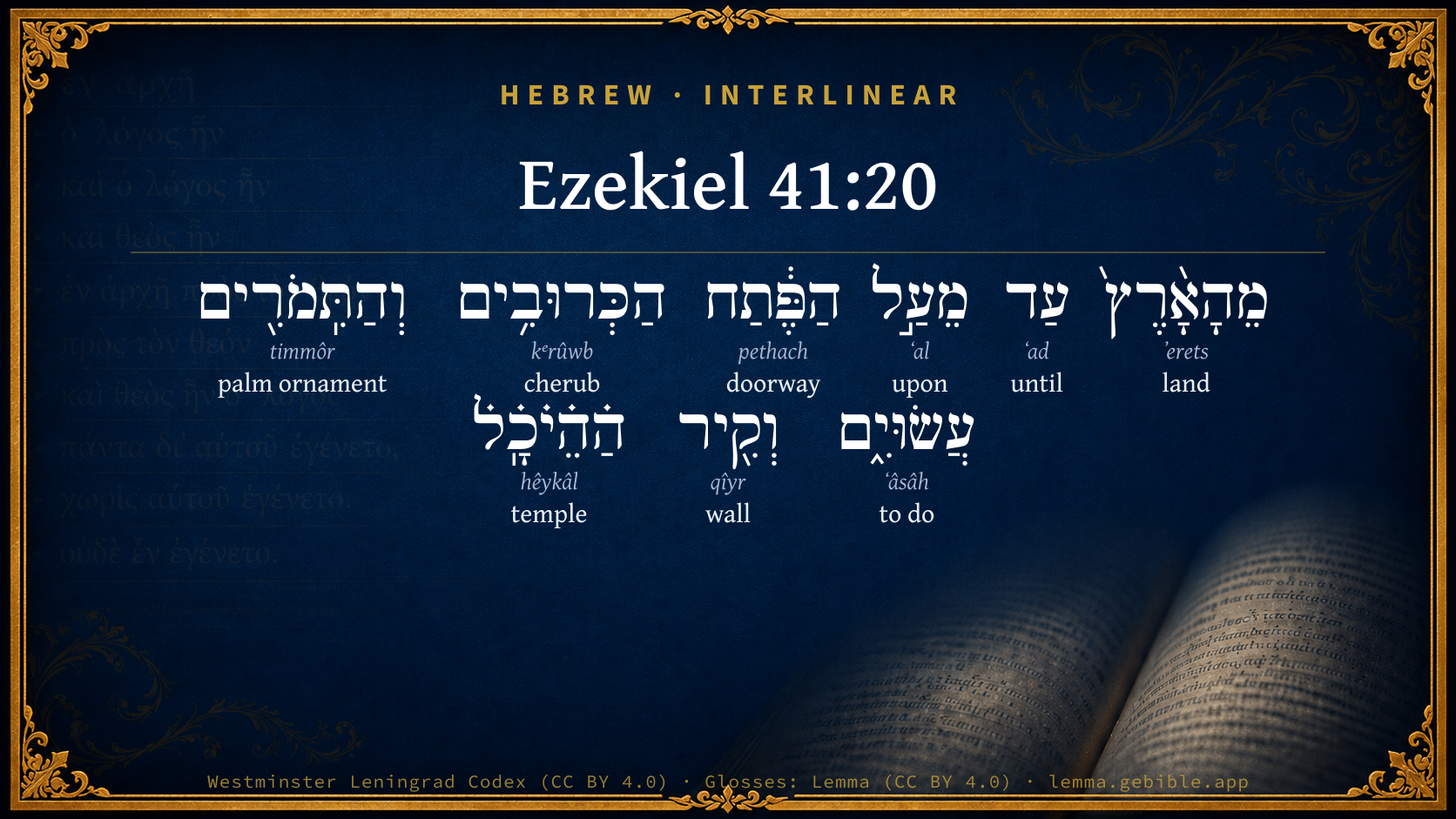
Ezekiel 41:20

Hebrew (Westminster Leningrad Codex) Ezekiel 41:20 appears in the Hebrew Old Testament. The text above is from the Westminster Leningrad Codex. Each word links to its Strong’s number, a concise gloss, and parsing drawn from the Open Scriptures Hebrew Bible morphology. Click any word for its full Brown-Driver-Briggs (BDB) entry.
Download image
Cite this verse

Ezekiel 41:20 (World English Bible). Public Domain. Lemma interlinear Bible study tool, https://lemma.gebible.app/v/ezekiel/41/20.

Show BibTeX & RIS
BibTeX
RIS
English Translation
from the ground to above the door were cherubim and palm trees made: thus was the wall of the temple.
World English Bible · Public Domain
Download a study sheet

One document with this verse’s original text, its word-by-word gloss line, the meaning frame, cross-references with their text, attributed commentary, and full source and license credits — printable, and it pastes into notes with its structure intact.

This verse Autodidact and up

Study sheet (.html) Plain text (.txt)

A passage Seminary Student

Up to 50 verses in one chapter. A passage sheet keeps up to 6 commentary sources and 12 cross-references per verse, in the order this page ranks them, and says so on the sheet whenever that leaves anything out. Ask for a single verse and you get the Autodidact verse sheet above.

Everything on this page stays free to read, with no account — the sheet is a download of what is already on screen, not access to it.

Want to remove ads? Support Godless Engineer
Compare translations 3

The same verse in 3 English versions, stacked beneath the original-language interlinear above. Click any original word for its lexicon entry.

Each is an independent rendering of the whole verse — the interlinear is not word-aligned to these translations.

Highlighted words mark where these versions differ — a whole-verse word diff, not a word-by-word alignment.

  • World English Bible Public Domain
    from the ground to above the door were cherubim and palm trees made: thus was the wall of the temple.
  • King James Version Public Domain
    From the ground unto above the door were cherubims and palm trees made, and on the wall of the temple.
  • unfoldingWord Literal Text CC BY-SA 4.0
    From the ground to above the doorway, cherubim and palm trees were carved on the outer wall of the house.

unfoldingWord Literal Text — © unfoldingWord, licensed CC BY-SA 4.0. Word-aligned USFM3 via Door43 (git.door43.org/unfoldingWord/en_ult).

Versions to compare (up to 4)

3 of 4 selected

Show all 18 translations

Every available English version of this verse, each an independent rendering of the whole verse.

  • World English Bible Public Domain
    from the ground to above the door were cherubim and palm trees made: thus was the wall of the temple.
  • Berean Standard Bible Public Domain
    Cherubim and palm trees were carved on the wall of the outer sanctuary from the floor to the space above the entrance.
  • Majority Standard Bible Public Domain
    Cherubim and palm trees were carved on the wall of the outer sanctuary from the floor to the space above the entrance.
  • King James Version Public Domain
    From the ground unto above the door were cherubims and palm trees made, and on the wall of the temple.
  • American Standard Version (1901) Public Domain
    from the ground unto above the door were cherubim and palm-trees made: thus was the wall of the temple.
  • Revised Version (1885) Public Domain
    from the ground unto above the door were cherubim and palm trees made: thus was the wall of the temple.
  • Geneva Bible (1599) Public Domain
    From the grounde vnto aboue the doore were Cherubims and palme trees made as in the wall of the Temple.
  • Douay-Rheims (1899) Public Domain
    From the ground even to the upper parts of the gate, were cherubims and palm trees wrought in the wall of the temple.
  • Young's Literal Translation Public Domain
    from the earth unto above the opening `are' the cherubs and the palm-trees made, and `on' the wall of the temple.
  • Literal Standard Version CC BY-SA 4.0
    From the earth to above the opening the cherubim and the palm-trees [were] made, and [on] the wall of the temple.
  • Unlocked Literal Bible CC BY-SA 4.0
    From the ground to above the doorway, cherubim and palm trees were carved on the outer wall of the house.
  • unfoldingWord Literal Text CC BY-SA 4.0
    From the ground to above the doorway, cherubim and palm trees were carved on the outer wall of the house.
  • Darby Bible Public Domain
    From the ground unto above the entry were the cherubim and the palm-trees made, and [on] the wall of the temple.
  • World Messianic Bible Public Domain
    Cherubim and palm trees were made from the ground to above the door. The wall of the temple was like this.
  • Webster's Bible Public Domain
    From the ground to above the door were cherubim and palm-trees made, and on the wall of the temple.
  • Free Bible Version CC BY-SA 4.0
    Designs of cherubim and palm trees were carved on the Temple wall from the floor up to the space above the doorway.
  • Bible in Basic English Public Domain
    From earth level up to the windows there were winged ones and palm-trees pictured on the wall.
  • JPS Tanakh (1917) Public Domain
    From the ground unto above the door were cherubim and palm-trees made; and so on the wall of the temple.

Literal Standard Version (2020), Covenant Press — licensed CC BY-SA 4.0. Text via the HelloAO Bible API (eBible.org). Unlocked Literal Bible (unfoldingWord) — licensed CC BY-SA 4.0. Text via the HelloAO Bible API (eBible.org). unfoldingWord Literal Text — © unfoldingWord, licensed CC BY-SA 4.0. Word-aligned USFM3 via Door43 (git.door43.org/unfoldingWord/en_ult). Free Bible Version, Dr. Jonathan Gallagher — licensed CC BY-SA 4.0. Text via the HelloAO Bible API (eBible.org).

Word by word

More ways to search: Search by grammar → Find every occurrence → Compare this word →

Practice this passage: Drill this verse → Learn its vocabulary →

וְהַתִּֽמֹרִ֖ים
timmôr
H8561
“and · the · palm ornaments”
Conjunction + Particle, Definite Article + Noun, Common, Feminine, Plural, Absolute
Part of Speech
Conjunction + Particle + Noun
Type
Common
Gender
Feminine
Number
Plural
State
Absolute
Full BDB Definition

Origin: from the same root as H8558

TWOT: 2523c

palm tree figure (as ornament)
  1. מֵהָאָ֨רֶץ֙ ʼerets H776 “from · the · land” Preposition + Particle, Definite Article + Noun, Common, Both, Singular, Absolute
  2. עַד ʻad H5704 “until” Preposition
  3. מֵעַ֣ל ʻal H5921 “from · upon” Preposition + Preposition
  4. הַפֶּ֔תַח pethach H6607 “the · doorway” Particle, Definite Article + Noun, Common, Masculine, Singular, Absolute
  5. הַכְּרוּבִ֥ים kᵉrûwb H3742 “the · cherubim” Particle, Definite Article + Noun, Common, Masculine, Plural, Absolute
  6. עֲשׂוּיִ֑ם ʻâsâh H6213 “done” Verb, Qal, Participle Passive, Masculine, Plural, Absolute
  7. וְקִ֖יר qîyr H7023 “and · wall of” Conjunction + Noun, Common, Masculine, Singular, Construct
  8. הַׄהֵׄיׄכָֽׄלׄ hêykâl H1964 “the · temple” Particle, Definite Article + Noun, Common, Masculine, Singular, Absolute

About this verse

These counts appear in no published source. They are computed here, from the morphology-tagged text and Lemma’s own curated glosses. What Lemma adds →

9
words
9
distinct lemmas
Prophets
section

Notable vocabulary

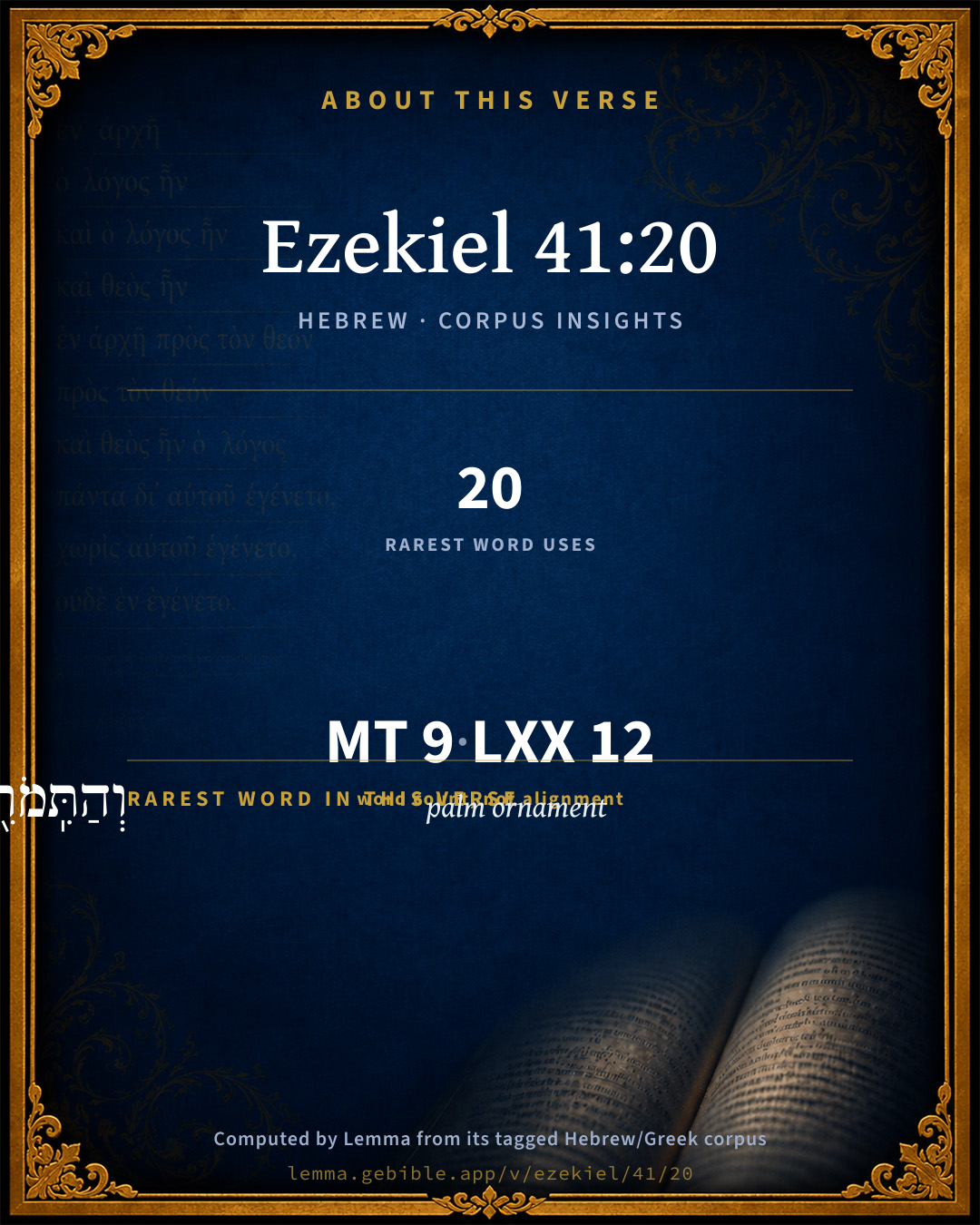
The rarest word here is וְהַתִּֽמֹרִ֖ים palm ornament H8561 — appearing just 20 times in the whole Hebrew Bible.

Shared distinctive vocabulary

וְהַתִּֽמֹרִ֖ים palm ornament H8561 occurs in 16 verses of the Hebrew Bible. Also found in:

Grammatical profile

  • 1 verb
  • 6 nouns
  • 2 prepositions

Verb forms

  • עֲשׂוּיִ֑ם Qal · Participle Passive

Hebrew & Septuagint length

In English translation the verse runs 20 words from the Hebrew and 11 from the Septuagint (LXX English) — the Septuagint runs noticeably shorter here. See the side-by-side →

A rough comparison of the two English renderings, which tokenize alike — not a word-level alignment.

Word counts can differ between the Hebrew and the Greek without any difference in meaning — e.g. the Hebrew direct-object marker אֵת has no separate Greek word, and Greek often adds the article ὁ.

In the original languages it is 9 Hebrew tokens and 12 Greek tokens — but the two are counted differently (Hebrew bundles its prefixes and suffixes into one token; the Greek is in lemma form), so that isn’t a like-for-like length.

Cross-references

1

Topical passages linked to Ezekiel 41:20 in the Treasury of Scripture Knowledge — connected by theme and wording, ordered by reader-vote popularity; previews shown in the World English Bible.

  • Ezekiel 41:18 It was made with cherubim and palm trees; and a palm tree was between cherub and cherub, and every cherub had two faces;

Cross-references courtesy of OpenBible.info (CC BY 4.0).

Hebrew and Greek witnesses Masoretic Hebrew ↔ Greek Septuagint

The same verse in the two great witnesses to the Old Testament, shown verse-for-verse.

Here the Septuagint runs noticeably shorter than the Hebrew — LXX2012 (modern English Septuagint) 11 words vs World English Bible 20. A rough length comparison of the two English translations, not a word-level alignment — read both below.

These are two independent witnesses, not word-aligned to each other, and the Septuagint is shown in lemma (dictionary) form.

Hebrew Ezekiel 41:20 Masoretic · Westminster Leningrad Codex

מֵהָאָ֨רֶץ֙ עַד מֵעַ֣ל הַפֶּ֔תַח הַכְּרוּבִ֥ים וְהַתִּֽמֹרִ֖ים עֲשׂוּיִ֑ם וְקִ֖יר הַׄהֵׄיׄכָֽׄלׄ

from the ground to above the door were cherubim and palm trees made: thus was the wall of the temple.

World English Bible · Public Domain

Greek LXX Ezekiel 41:20 Septuagint · lemma form

ἐκ ὁ ἔδαφος ἕως ὁ φάτνωμα ὁ χερουβείμ καί ὁ φοῖνιξ διαγλύφω

From the floor to the ceiling were cherubs and palm-trees carved.

LXX2012 (modern English Septuagint) · Public Domain

On this verse, John Gill's Exposition discusses the Septuagint’s reading. Read the note in Commentary ↓

Hebrew: Westminster Leningrad Codex (CC BY 4.0). Greek: Septuagint (public domain); English from LXX2012 (modern English Septuagint) (Public Domain). How the Septuagint differs from the Hebrew →

Targum (Aramaic paraphrase)

1

The Targum is the ancient Jewish Aramaic paraphrase of the Hebrew Scriptures — an interpretive translation, not the Hebrew text itself. Onkelos (literal) and Pseudo-Jonathan (expansive) render the Torah, and Jonathan the Prophets. Coverage is partial: where no permissively-licensed English translation exists for a verse, only the Aramaic is shown. This is verse-level text, not a word-by-word alignment to the Hebrew.

  1. Targum Jonathan Prophets (Joshua–Malachi)
    מֵאַרְעָא עַד לְעֵלָא מִתַּרְעָא כְּרוּבִין וְכוּתְרָן גְלִיפָן וְכֵן לְכָתְלָא דְהֵיכָלָא:

    (no public-domain English translation for this verse)

    Targum Jonathan — Aramaic: “Mikraot Gedolot” (public domain). English: “Sefaria Community Translation” (CC0 1.0 (public-domain dedication)); “London "Chaldee Paraphrase," 1871” (public domain). Text via Sefaria.

Commentary

Notes on Ezekiel 41:20 from classic Christian and Jewish commentators (each source and its license shown beneath its notes). The classic Christian expositions comment on the surrounding passage and are grouped to its opening verse, so a note may address several verses; the Jewish commentaries on the Tanakh (Rashi and others) are per-verse, so they appear only where the commentator wrote on this verse.

Lemma curates 59 commentaries, every one of them public domain or Creative Commons licensed, each selected and text-cleaned for this edition rather than reprinted as found. About our sources →

Trapp's Complete Commentary

John Trapp

Eze 41:20 From the ground unto above the door [were] cherubims and palm trees made, and [on] the wall of the temple.

Ver. 20. And on the wall of the temple.] Yet this is no warrant for the use of pictures in our churches, whether for worship, as Papists, or for ornaments only, as Lutherans. At a consultation held not many years since at Hamburg by Lutheran ministers, concerning the cause and cure of Germany’s calamities, they concluded it was because their images were not adorned enough, which, therefore, they would procure done. {a} A sad business!

{a} Mr Burroughs on Hos., vol. i. p. 465.

John Trapp, A Commentary or Exposition upon All the Books of the Old and New Testament (1647–1656) — public domain. Text from a community e-Sword module.

Adam Clarke's Commentary

Verse 20. From the ground unto above the door] The temple was thirty cubits high, 1Kg 6:2, the gate was fourteen cubits, Eze 40:48. The palm trees and the cherubim were the same height as the gate or door. The windows were above the door.

Adam Clarke's Commentary on the Bible (1810–1826) — public domain. Text from a community e-Sword/MySword module.

Ellicott's Commentary for English Readers

(20) Unto above the door.—The height of the door is nowhere mentioned, and therefore there is nothing to determine how high up the carving was carried; but as it is said that it was also “upon the wall of the Temple,” we may assume that the whole interior wall was ceiled with carved wood as in Solomon’s Temple.

A Bible Commentary for English Readers, edited by Charles John Ellicott (1878–1897) — public domain. Text from a community e-Sword module.

The Cambridge Bible for Schools and Colleges

gen. ed. J. J. S. Perowne

20. The prophet is to be conceived as standing in the holy place, and when he speaks of the “door” he evidently refers to the end walls and not to the side walls. It remains obscure whether it be the “door” of the holiest or that of the holy place to which he refers.

and on the wall … temple] The word “temple” is marked as suspicious by dots over it, and is omitted in some MSS. and in the ancient versions. The clause is to be connected with Eze_41:21.

The Cambridge Bible for Schools and Colleges (gen. ed. J. J. S. Perowne; Cambridge University Press, 1878–1918) — public domain. Text from a community e-Sword module.

John Gill's Exposition

From the ground unto above the door,.... From the floor of the holy of holies to above the door of it to the east, where was the entrance into it; or from thence to the cieling, as the Septuagint version: "were cherubim and palm trees made"; either in rows one above another, quite up to the place mentioned; or they were made so large, that each cherub and palm tree reached from the ground to above the door, or to the cieling:

and on the wall of the temple: that is, they were not only thus placed in the holiest of all; but in the temple, or holy place on the wall of it all around; and shows, that in the state of the church in the latter day, which this part of the building represents more especially, will be great numbers of Gospel ministers, who will faithfully and uprightly preach it to men; see Dan 12:4.

John Gill's Exposition of the Whole Bible (1746–1763) — public domain (CC PDM 1.0). Text via the HelloAO Bible API.

Matthew Poole's English Annotations

The door: some think it is the great east gate; I think rather here, is an enallage, or change of number, door for doors, and that every porch was so beautified: see Eze 40:16,22,26,34. These beautiful sculptures were round about the walls of the temple, and oracle too, though not expressed here.

Matthew Poole's English Annotations on the Holy Bible (1683–1685) — public domain. Text from a community e-Sword/MySword module.

Whedon's Commentary on the Bible

Daniel D. Whedon

20, 21. Read, “And as for the wall of the temple, the doorposts were squared; and in front of the sanctuary was the appearance as the appearance of an altar of wood, three cubits high,” etc. (Compare Exo_30:1, and 1Ki_7:48.)

Daniel D. Whedon (gen. ed.), Commentary on the Old and New Testaments (1874–1909) — public domain. Text from a community e-Sword module.

Rashi

Rabbi Shlomo Yitzchaki (Rashi)

and on the wall of the Temple And so on the wall of the Temple.

Rashi on the Tanakh — English translations: “The Judaica Press complete Tanach with Rashi, translated by A. J. Rosenberg” (CC BY 4.0); “Pentateuch with Rashi's commentary by M. Rosenbaum and A.M. Silbermann, 1929-1934” (public domain); “The Metsudah Tanach series, Lakewood, N.J” (CC BY 4.0); and “The Book of Joshua, Metsudah Publications, 1997” (CC BY 4.0). Text via Sefaria.

Lesson kit

Teaching starters — assembled from the data on this page, not authored interpretation. Every prompt links to the verse data it draws on. Edit before teaching.

Ezekiel, in the Prophets, opens this verse with 9 words (9 distinct Hebrew lemmas). Its most distinctive word is timmôr (“palm ornament”). The Greek Septuagint runs shorter here. A historical commentator’s framing appears above. Read the whole chapter for the surrounding context.

Discussion questions

  1. The word timmôr carries the sense “palm ornament.” How does it shape the verse?
  2. 1 Kings 6:29 shares the word «palm ornament» with this verse. How do the two illuminate each other?
  3. Compared with the Hebrew, the Septuagint runs shorter here. What questions does that raise?
  4. These translations render this verse differently. What is at stake in choosing one wording over another?
  5. The verb «עֲשׂוּיִ֑ם» is Qal Participle Passive. How does its form color the action?
  6. Reading how Trapp's Complete Commentary and Adam Clarke's Commentary read this verse, where do the two commentators agree and where do they part?

Things to notice

Reading settings

Reading text

Shown beneath each verse's original-language words.

Old Testament
Old Testament edition

Read the OT as the Masoretic Hebrew (MT) or the Greek Septuagint (LXX).

English shown for the Greek Septuagint (in the Hebrew ↔ Greek comparison).

Comparing translations? Open the Compare panel on any verse page to stack up to four side by side.