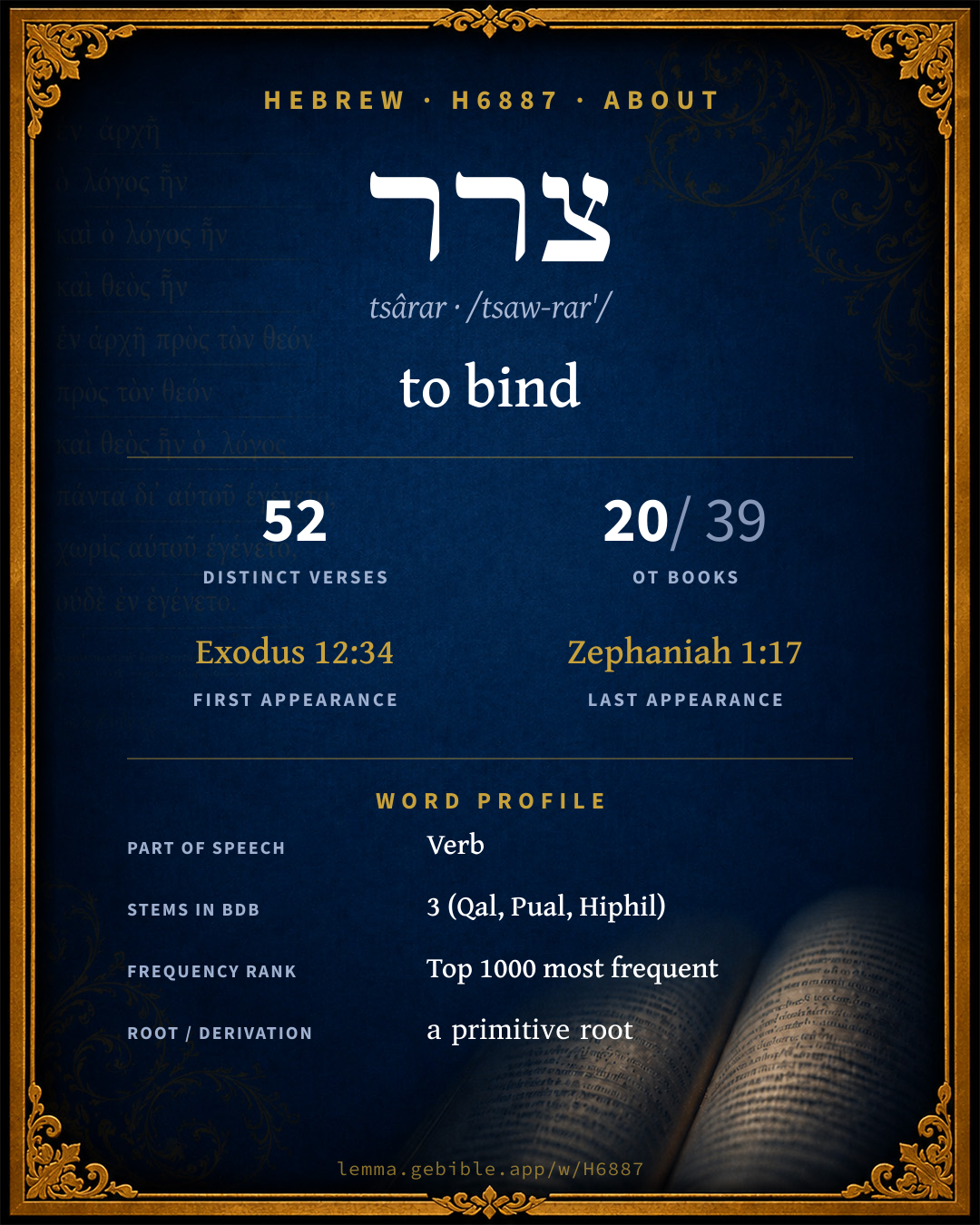
צָרַר
to bind
also: be narrow, be in distress, make narrow, cause distress fuller range ↓
Full lexicon entry — Brown-Driver-Briggs (BDB)
From Brown-Driver-Briggs (BDB)
Where this word appears
See every Qal verb in the Hebrew Bible →
Grammar key — what these labels mean
Part of speech
- Verb
- An action or state-of-being word.
- Adjective
- A word that describes or qualifies a noun.
Stem
- Qal
- The basic, simple active stem — the plain form of the verb (“he wrote”).
- Hiphil
- The causative active stem (“he caused / brought about”). Here: ‘suffer distress’
- Pual
- The passive counterpart of the Piel. Here: ‘pl.’
Form
- Perfect
- A completed action or state — Hebrew marks aspect (completeness) more than strict tense (“he wrote”).
- Participle Active
- A verbal adjective expressing ongoing or characteristic action (“writing / one who writes”).
- Sequential Perfect
- A perfect with prefixed waw continuing a preceding imperfect or command (waw-consecutive perfect).
- Infinitive Construct
- A bound verbal noun, frequently with prepositions (“to write / in writing”).
- Participle Passive
- A verbal adjective expressing action received (“written”).
- Sequential Imperfect
- An imperfect with prefixed waw — the standard past-narrative form (waw-consecutive imperfect).
- Imperfect
- An incomplete, ongoing, or future action (“he will / would write”).
- Infinitive Absolute
- An unbound verbal noun, often intensifying or standing in for a finite verb.
- Imperative
- A direct command (“write!”).
State
- Construct
- A noun bound to a following noun in a possessive / “of” relationship (the construct chain).
- Absolute
- The independent form of a noun, not bound to a following word.
Person
- 3rd Person
- The one spoken about (“he / she / it / they”).
- 1st Person
- The speaker (“I / we”).
- 2nd Person
- The one addressed (“you”).
Gender
- Masculine
- Grammatically masculine.
- Common
- Either gender — not distinguished for this form.
- Feminine
- Grammatically feminine.
Number
- Singular
- One.
- Plural
- More than one (in Hebrew, generally three or more).
Grammatical forms 24 distinct
- Verb, Qal, Participle Active, Masculine, Plural, Construct 13 times (25%)
- Verb, Qal, Perfect, 3rd Person, Masculine, Singular 6 times (11%)
- Verb, Qal, Participle Active, Masculine, Singular, Construct 5 times (9%)
- Verb, Hiphil, Sequential Perfect, 1st Person, Common, Singular 2 times (4%)
- Verb, Hiphil, Sequential Perfect, 3rd Person, Masculine, Singular 2 times (4%)
- Verb, Qal, Infinitive Construct 2 times (4%)
- Verb, Hiphil, Participle Active, Feminine, Singular, Absolute 2 times (4%)
- Verb, Qal, Perfect, 3rd Person, Common, Plural 2 times (4%)
+16 more forms (19 occurrences)
Parsed forms decoded from the imported morphology (morphhb / Westminster Leningrad Codex — WLC text public domain, morphhb tagging CC BY 4.0), counted across 53 parsed occurrences — not distinct verses.
Every verse where H6887 appears — 52 distinct verses across 20 books. Click any verse to open its interlinear word-by-word view. Verse text shown in the World English Bible for context — . Each verse’s Hebrew form is shown with its reference; the English is not keyword-highlighted, since the data carries no word-level English alignment. Use “Compare translations” on any verse to read it across multiple English versions. This concordance covers the Hebrew Bible; Septuagint (Greek Old Testament) occurrences are not indexed here.
Exodus 2 verses
- Exodus 12:34 צְרֻרֹ֥ת Qal ptcp.pass fp The people took their dough before it was leavened, their kneading-troughs being bound up in their clothes on their shoulders.
- Exodus 23:22 צֹרְרֶֽי/ךָ Qal ptcp.act mp cs + sfx pers 2ms But if you indeed listen to his voice, and do all that I speak, then I will be an enemy to your enemies, and an adversary to your adversaries.
Leviticus 1 verse
Numbers 4 verses
- Numbers 10:9 הַ/צֹּרֵ֣ר ptcl def.art + Qal ptcp.act ms When you go to war in your land against the adversary who oppresses you, then you shall sound an alarm with the trumpets; and you shall be remembered before Yahweh your God, and you shall be saved from your enemies.
- Numbers 25:17 צָר֖וֹר Qal inf.abs Vex the Midianites, and strike them;
- Numbers 25:18 צֹרְרִ֥ים Qal ptcp.act mp for they vex you with their wiles, with which they have deceived you in the matter of Peor, and in the matter of Cozbi, the daughter of the prince of Midian, their sister, who was slain on the day of the plague in the matter of Peor.
- Numbers 33:55 וְ/צָרֲר֣וּ conj + Qal wpf 3cp But if you will not drive out the inhabitants of the land from before you, then shall those who you let remain of them be as pricks in your eyes, and as thorns in your sides, and they shall vex you in the land in which you dwell.
Deuteronomy 2 verses
- Deuteronomy 14:25 וְ/צַרְתָּ֤ conj + Qal wpf 2ms then shall you turn it into money, and bind up the money in your hand, and shall go to the place which Yahweh your God shall choose:
- Deuteronomy 28:52 וְ/הֵצַ֨ר וְ/הֵצַ֤ר conj + Hiphil wpf 3ms conj + Hiphil wpf 3ms They shall besiege you in all your gates, until your high and fortified walls come down, in which you trusted, throughout all your land; and they shall besiege you in all your gates throughout all your land, which Yahweh your God has given you.
Joshua 1 verse
1 Samuel 2 verses
- 1 Samuel 25:29 צְרוּרָ֣ה Qal ptcp.pass fs Though men be risen up to pursue you, and to seek your soul, yet the soul of my lord shall be bound in the bundle of life with Yahweh your God; and the souls of your enemies, them shall he sling out, as from the hollow of a sling.
- 1 Samuel 28:15 צַר Qal pf 3ms Samuel said to Saul, Why have you disquieted me, to bring me up? Saul answered, I am sore distressed; for the Philistines make war against me, and God is departed from me, and answers me no more, neither by prophets, nor by dreams: therefore I have called you, that you may make known to me what I shall do.
2 Samuel 2 verses
- 2 Samuel 1:26 צַר Qal pf 3ms I am distressed for you, my brother Jonathan: Very pleasant have you been to me: Your love to me was wonderful, Passing the love of women.
- 2 Samuel 20:3 צְרֻר֛וֹת Qal ptcp.pass fp David came to his house at Jerusalem; and the king took the ten women his concubines, whom he had left to keep the house, and put them in custody, and provided them with sustenance, but didn't go in to them. So they were shut up to the day of their death, living in widowhood.
1 Kings 1 verse
2 Kings 1 verse
2 Chronicles 2 verses
Esther 4 verses
- Esther 3:10 צֹרֵ֥ר Qal ptcp.act ms cs The king took his ring from his hand, and gave it to Haman the son of Hammedatha the Agagite, the Jews' enemy.
- Esther 8:1 צֹרֵ֣ר Qal ptcp.act ms cs On that day did the king Ahasuerus give the house of Haman the Jews' enemy to Esther the queen. Mordecai came before the king; for Esther had told what he was to her.
- Esther 9:10 צֹרֵ֥ר Qal ptcp.act ms cs the ten sons of Haman the son of Hammedatha, the Jew's enemy, killed they; but they didn't lay their hand on the spoil.
- Esther 9:24 צֹרֵר֙ Qal ptcp.act ms cs because Haman the son of Hammedatha, the Agagite, the enemy of all the Jews, had plotted against the Jews to destroy them, and had cast Pur, that is the lot, to consume them, and to destroy them;
Job 1 verse
Psalms 16 verses
- Psalms 6:7 צוֹרְרָֽ/י Qal ptcp.act mp cs + sfx pers 1cs My eye wastes away because of grief; It grows old because of all my adversaries.
- Psalms 7:4 צוֹרְרִ֣/י Qal ptcp.act ms cs + sfx pers 1cs If I have rewarded evil to him who was at peace with me (Yes, I have delivered him who without cause was my adversary),
- Psalms 7:6 צוֹרְרָ֑/י Qal ptcp.act mp cs + sfx pers 1cs Arise, Yahweh, in your anger. Lift up yourself against the rage of my adversaries. Awake for me. You have commanded judgment.
- Psalms 8:2 צוֹרְרֶ֑י/ךָ Qal ptcp.act mp cs + sfx pers 2ms From the lips of babes and infants you have established strength, Because of your adversaries, that you might silence the enemy and the avenger.
- Psalms 10:5 צ֝וֹרְרָ֗י/ו Qal ptcp.act mp cs + sfx pers 3ms His ways are prosperous at all times; He is haughty, and your laws are far from his sight: As for all his adversaries, he sneers at them.
- Psalms 23:5 צֹרְרָ֑/י Qal ptcp.act mp cs + sfx pers 1cs You prepare a table before me in the presence of my enemies. You anoint my head with oil. My cup runs over.
- Psalms 31:9 צַ֫ר Qal pf 3ms Have mercy on me, Yahweh, for I am in distress. My eye, my soul, and my body waste away with grief.
- Psalms 31:11 צֹרְרַ֨/י Qal ptcp.act mp cs + sfx pers 1cs Because of all my adversaries I have become utterly contemptible to my neighbors, A fear to my acquaintances. Those who saw me on the street fled from me.
- Psalms 42:10 צוֹרְרָ֑/י Qal ptcp.act mp cs + sfx pers 1cs As with a sword in my bones, my adversaries reproach me, While they continually ask me, "Where is your God?"
- Psalms 69:17 צַר Qal pf 3ms Don't hide your face from your servant, For I am in distress. Answer me speedily!
- Psalms 69:19 צוֹרְרָֽ/י Qal ptcp.act mp cs + sfx pers 1cs You know my reproach, my shame, and my dishonor. My adversaries are all before you.
- Psalms 74:4 צֹ֭רְרֶי/ךָ Qal ptcp.act mp cs + sfx pers 2ms Your adversaries have roared in the midst of your assembly. They have set up their standards as signs.
- Psalms 74:23 צֹרְרֶ֑י/ךָ Qal ptcp.act mp cs + sfx pers 2ms Don't forget the voice of your adversaries. The tumult of those who rise up against you ascends continually.
- Psalms 129:1 צְרָר֣וּ/נִי Qal pf 3cp + sfx pers 1cs Many times they have afflicted me from my youth up. Let Israel now say,
- Psalms 129:2 צְרָר֣וּ/נִי Qal pf 3cp + sfx pers 1cs Many times they have afflicted me from my youth up, Yet they have not prevailed against me.
- Psalms 143:12 צֹרֲרֵ֣י Qal ptcp.act mp cs In your loving kindness, cut off my enemies, And destroy all those who afflict my soul, For I am your servant.
Proverbs 2 verses
- Proverbs 26:8 כִּ/צְר֣וֹר prep + Qal inf.cs As one who binds a stone in a sling, So is he who gives honor to a fool.
- Proverbs 30:4 צָֽרַר Qal pf 3ms Who has ascended up into heaven, and descended? Who has gathered the wind in his fists? Who has bound the waters in his garment? Who has established all the ends of the earth? What is his name, and what is his son's name, if you know?
Isaiah 3 verses
- Isaiah 8:16 צ֖וֹר Qal impv 2ms Bind up the testimony, seal the law among my disciples.
- Isaiah 11:13 יָצֹ֥ר Qal impf 3ms The envy also of Ephraim shall depart, and those who vex Judah shall be cut off: Ephraim shall not envy Judah, and Judah shall not vex Ephraim.
- Isaiah 28:20 צָ֖רָה Qal pf 3fs For the bed is shorter than that a man can stretch himself on it; and the covering narrower than that he can wrap himself in it.
Jeremiah 3 verses
- Jeremiah 10:18 וַ/הֲצֵר֥וֹתִי conj + Hiphil wpf 1cs For thus says Yahweh, Behold, I will sling out the inhabitants of the land at this time, and will distress them, that they may feel [it].
- Jeremiah 48:41 מְצֵרָֽה Hiphil ptcp.act fs Kerioth is taken, and the strongholds are seized, and the heart of the mighty men of Moab at that day shall be as the heart of a woman in her pangs.
- Jeremiah 49:22 מְצֵרָֽה Hiphil ptcp.act fs Behold, he shall come up and fly as the eagle, and spread out his wings against Bozrah: and the heart of the mighty men of Edom at that day shall be as the heart of a woman in her pangs.
Lamentations 1 verse
Hosea 2 verses
Amos 1 verse
Zephaniah 1 verse
About this entry
At a glance — auto-summarized from this page’s data, not written by a person. Every figure links to its source below. This summary describes the numbers; it doesn’t interpret them.
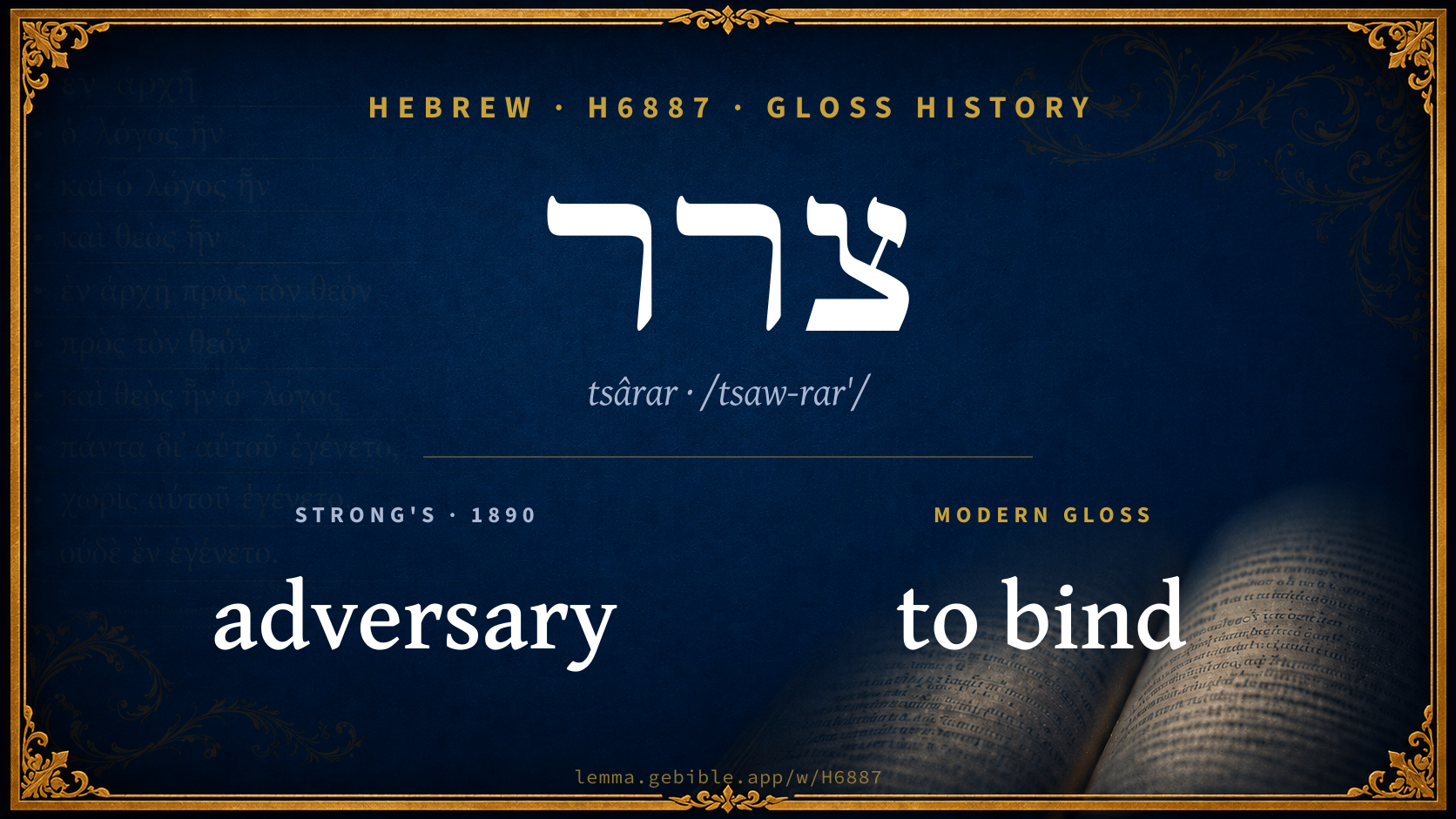
At its core, צרר (tsârar) means “to bind.” Where the King James Version says “enemies,” newer translations reach for “adversaries” (unfoldingWord Literal Text); the renderings breakdown has the detail. It appears 52 verses across 20 books of the Hebrew Bible, among its moderately common vocabulary. The word gravitates to Psalms (31%), then Numbers and Esther. Across 3 stems, its meaning turns on the binyan (Qal, Pual). Each statement above links to its evidence; the full detail follows below.
Gloss history
Strong's 1890 vs modern scholarship
About this word
Strong's H6887 catalogs a Hebrew word from the Hebrew Old Testament.
These counts are not copied from any lexicon or concordance. They are computed here, from the morphology-tagged Hebrew Old Testament. What Lemma adds →
- 52
- distinct verses
- The word appears in 52 distinct verses.
- 20 / 39
- OT books
- The word appears in 20 of 39 Old Testament books.
- #709
- by frequency
- Top 1000 most frequent Hebrew words (rank 709 of 8,640 Hebrew words by occurrence).
View all 52 occurrences in the concordance →
By section of the Old Testament
By traditional corpus
Conventional, traditional groupings — biblical authorship is debated, so this is a traditional corpus grouping, not an authorship claim. Each share is this word’s portion of its verses in that division of the Hebrew canon. Each figure is a share of the word’s 52 distinct verses.
- Writings (Ketuvim) 26 verses · 50%
- Prophets (Nevi'im) 17 verses · 33%
- Torah (Pentateuch) 9 verses · 17%
How translations render this word
Counts come from each version’s own published word-to-Strong’s tagging or interlinear alignment — an approximate guide to how each version renders this word, not a word-level alignment the data otherwise carries. Because each total is that version’s own tagged count, the per-version totals vary from one another and need not match the appearance or distinct-verse counts above. These counts may also differ from a printed concordance because Lemma counts each distinctly tagged rendering and does not collapse phrase taggings into a single head-word total. This is a fixed set of word-tagged versions (KJV, ASV, BSB, ULT) and does not change with the reading translation you choose elsewhere. Each version’s license is shown beside its name below (and on Sources).
BDB lists this Strong’s number as 4 distinct words (homographs). Each count above pools all of them and is not split by sense — see the Senses section below. A low-frequency rendering may belong to a different one of those words, not the primary meaning.
- King James Version†: Enemies 5×, Enemy 4×, Adversaries 2×
- American Standard Version†: Adversaries 5×, ' enemy 2×, All mine adversaries 2×
- Berean Standard Bible†: Enemies 4×, Enemy 4×, Foes 4×
- unfoldingWord Literal Text†: Adversaries 7×, Adversary of 4×, Enemies 2×
King James Version Public Domain
Renders H6887 across 57† tagged occurrences — most commonly:
Plus 32 renderings that appear only once — usually multi-word phrases or single function words the recovered tagging swept in, not distinct renderings. Not rendered by a distinct English word in 1 further occurrence.
American Standard Version Public Domain
Renders H6887 across 58† tagged occurrences — most commonly:
Plus 35 renderings that appear only once — usually multi-word phrases or single function words the recovered tagging swept in, not distinct renderings.
Berean Standard Bible Public Domain
Renders H6887 across 53† tagged occurrences — most commonly:
Plus 27 renderings that appear only once — usually multi-word phrases or single function words the recovered tagging swept in, not distinct renderings.
unfoldingWord Literal Text CC BY-SA 4.0
Renders H6887 across 55† tagged occurrences — most commonly:
Plus 32 renderings that appear only once — usually multi-word phrases or single function words the recovered tagging swept in, not distinct renderings.
9 senses and sub-senses in the full BDB
Hebrew verbs can shift meaning by stem (binyan): Qal is the basic action, Niphal is often passive or reflexive, Piel often intensifies or makes it factitive, and Hiphil is typically causative. The senses below are grouped under the stem BDB assigns to each. This entry also uses Pual (the passive of Piel).
What do BDB’s symbols mean?
BDB uses these scholarly abbreviations:
| Symbol | Meaning |
|---|---|
| 𝔊 | the Septuagint (the ancient Greek translation, LXX) |
| 𝔙 | the Vulgate (the Latin translation) |
| 𝔖 | the Syriac version (the Peshitta) |
| 𝔗 | the Targum (the Aramaic translation) |
| ψ | the Psalms |
| √ | root (the underlying root or stem) |
| ‖ | parallel passage (a synonymous or contrasted parallel) |
| † | the dagger: every passage where the word occurs is cited |
The 9 senses and sub-senses the full Brown-Driver-Briggs lexicon distinguishes for this word, in lexicon order (not ranked by frequency), with BDB’s own verbatim wording and sub-sense lettering. Shown in Hebrew script with BDB’s own scholarly abbreviations. The condensed entry is in the Lexicon Entry tab. See also the Forms in the corpus table below.
צרר I bind, tie up, be restricted, narrow, scant, cramped (NH id.
- A. trans.:
Qal
- Pf. 3 ms. צָרַר Ho 4:19; Pr 30:4; Imv. צוֹר Is 8:16; Inf. cstr. צְרוֹר Pr 26:8 (?); Pt. act. צֹרֵר Jb 26:8; pass. צָרוּר Ho 13:12, f. צְרוּרָה 1 S 25:29; fpl. צְרֻרֹת Ex 12:34; 2 S 20:3;—bind or tie up, of kneading-troughs Ex 12:34 (E); fig. of a life preserved by י׳, נֶפֶשׁ צְרוּרָה בִּצְרוֹר הַחַיִּים 1 S 25:29; of preserving prophetic teaching Is 8:16; of retention of guilt Ho 13:12; of י׳’s binding waters in (a garment of) cloud Pr 30:4 Jb 26:8; = shut up 2 S 20:3;—צָרַר רוּחַ אֹתָהּ בִּכְנָפֶיהָ Ho 4:19 (si vera l.) pregn., the wind hath wrapped her up in its wings, to carry her off; כִּצְרוֹר אֶבֶן Pr 26:8 like the tying up of a stone, but unintellig. in context (v. Toy). e.g. Hosea 4:19
Pual
- Pt. pl. מְצֹרָרִים Jos 9:4 tied up (mended by tying), of old wine-skins. e.g. Joshua 9:4
- B. intrans.:
Qal
- Pf. 3 fs. צָ֫רָה Is 28:20; Impf. 3 ms. יֵצַר Pr 4:12, יֵ֫צֶר לוֹ Jb 20:22, וַיֵּ֫צֶר Gn 32:8 +, 2 fs. תֵּצְרִי Is 49:19;—be scant, cramped; of scanty bed-covering Is 28:20 (in fig.); of land too small for (מִן) its people Is 49:19 + Jos 19:47 (for וַיֵּצֵא) DrExpos. Jan. 1887, 59 Benn, cf. 𝔊; of steps = be cramped, or impeded, Pr 4:12; Jb 18:7 (both in fig.); especially impers. c. ל pers., וַיֵּצֶר לוֹ Gn 32:8 and it was narrow for him = he was in straits, distress, so Ju 2:15; 2 S 13:2; Jb 20:22, also 3 fs. וַתֵּ֫צֶר לְ Ju 10:9; 1 S 30:6 (v. Dr).* e.g. Isaiah 28:20
Hiphil
- Pf. 3 ms. וְהֵצַר Dt 28:52, 52 consec.; 1 s. וַהֲצֵרֹתִי Je 10:18; Zp 1:17; Impf. 3 ms. יָצַר־לוֹ 1 K 8:37 = 2 Ch 6:28, וַיָּ֫צַר 2 Ch 28:20; 3 mpl. וַיָּצֵרוּ Ne 9:27; Inf. cstr. הָצֵר 2 Ch 28:22; 33:12;—make narrow for, press hard upon, cause distress to, c. ל pers., Je 10:18 (subj. י׳), Zp 1:17 (subj. id.); Dt 28:52(×2); 1 K 8:37 = 2 Ch 6:28; Ne 9:27 (all subj. foe), 2 Ch 28:20 (subj. TP); Indef. subj. 2 Ch 28:22 (but read כִּי אִם לִצָרָה לוֹ, and join to v 21, opp. לְעֶזְרָה לוֹ, 𝔊 Kit BuhlLex), 33:12. e.g. Deuteronomy 28:52
צרר II denom.
Hiphil
- suffer distress (specif. of travail, cf. Je 4:31; 49:24);—Pt. לֵב אִשָּׁה מְצֵרָה (in sim.) Je 48:41; 49:22. e.g. Jeremiah 4:31
צרר III shew hostility toward, vex (NH צַר foe
Qal
- Pf. 3 pl. וְצָֽרֲרוּ Nu 33:55 consec., sf. צְרָרוּנִי ψ 129:1, 2; Impf. 3 ms. יָצֹר Is 11:13; Inf. abs. צָרוֹר Nu 25:17; Pt. act. צֹרֵר 10:9, pl. sf. צֹרֲרַי ψ 31:12 +, etc.;—shew hostility toward, treat with enmity, vex, harass, c. acc. pers. Is 11:13; Nu 10:9; 25:17; once c. ל pers. v 18; also pt. as subst. (cstr. or c. sf.) vexer, harasser, Am 5:12; Is 11:13; Ex 23:22 (E), ψ 6:8; 7:5, 7; 8:3; 10:5; 23:5; 31:12; 42:11; 69:20; 74:4, 23; 143:12; Est 3:10; 8:1; 9:10, 24.—Lv 18:18 v. [צָרַר] sub ii. צָרָה, infr. e.g. Numbers 33:55
צרר IV denom. make a rival-wife
Qal
- Inf. cstr. לִצְרֹר Lv 18:18 to make [her] a rival-wife (LagGGN, 1882, 406 Dr-WhLv Baen Lv). e.g. Leviticus 18:18
Senses from the full Brown-Driver-Briggs lexicon (Brown, Driver, Briggs; Oxford 1906 — public domain), digitized via Sefaria, supplemented by the OpenScriptures HebrewLexicon (CC BY 4.0). Full attribution on Sources.
Word origin
I. vb. bind, tie up, be restricted, narrow, scant, cramped (NH id.; Arabic صَرَّ bind, tie up; so Aramaic צְרַר, ܨܰܪ );—
III. vb. shew hostility toward, vex (NH צַר foe; Arabic ضَرَّ harm, damage, Sab. צֿר war, foe MordtmHim. Inschr. 60. 71 SabDenkm 24 CIS iv. 174, 1. 6 HomChrest. 125; Ethiopic ፀረረ be hostile, in der. spec. and deriv.; Assyrian ṣarâru, be hostile, ṣarru, foe; Arabic ضَرَّةٌ, Assyrian ṣirritu, Syriac ܥܰܪܬܳܐ, all = rival-wife, so (? Heb. infl.) 𝔗 צָרָא 1 S 1:6; v. especially Lag Deceased Wife’s Sister, GGN, 1882, No. 13; = Mi. 125 ff. Dr 1 S 1:6);—
IV. vb. denom. make a rival-wife;—
— Brown-Driver-Briggs (Oxford 1906, public domain), digitized via Sefaria, supplemented by the OpenScriptures HebrewLexicon (CC BY 4.0). See Sources.
Origin: a primitive root
Jastrow Dictionary
A second Hebrew/Aramaic lexicon for comparison, covering Aramaic and post-biblical (Talmudic, Targumic, Midrashic) usage that the biblical-Hebrew BDB does not. Matched by lemma rather than by Strong’s number, so a lemma may carry more than one Jastrow headword (shown separately below), and the entries cover usage well beyond the Bible.
צָרַר
- (cmp. preced. wds.) to contract, shrivel, have a rough surface. —Part. pass. (צָרוּר) צָרוּד rough, harsh (of sound). R. Hash. 27ᵇ צרוד Ar. a. Rashi to Ḥull. 36ᵃ (ed. צרור).
צָרַר I
- v. צוּר II)
- 1. to surround, wrap, tie up. Ḥull. VIII, 2 צוֹרֵר אדם בשר וכ׳ one may tie up meat and cheese in one sheet. Ber. 23ᵇ צורר אדם תפיליו וכ׳ a man may tie up his T’fillin with his money &c.; לא יָצוֹר he must not do so. Tosef. Shebi. I, 9 צורר he may bandage (a fig-tree when the bark is peeled off). Cant. R. to I, 7 אני צוֹרְרָהּ לך בכנפיך I (the Lord) will tie this up in thy lap (reverential expression for, my lap), i.e. I shall remember and visit this act upon thee; a. fr.—Part. pass. צָרוּר; f. צְרוּרָה &c. Gen. R. s. 14 (ref. to ויצר, Zech. XII, 1) מלמד שנפשו של אדם צ׳ בקרבו וכ׳ this teaches that the soul of man is tied up within him (love of life is a natural instinct), or else, when trouble comes upon him, he would detach it and cast it away. Sabb. V, 2 יוצאות צְרוּרוֹת may be let out (on the Sabbath) with their udders tied up. R. Hash. 22ᵇ מאתים זוז צְרוּרִין וכ׳ two hundred Zuz are tied up in my cloak; a. fr. e.g. Zechariah 12:1
- 2. (neut. verb) [to be narrow,] to cause distress; Part. צַר; imperf. יֵצַר (with ל־, or sub. ל־) to be distressed; to worry. Gen. R. s. 76 (ref. to Gen. XXXII, 8) ויירא … וַיֵּצֶר לו וכ׳ he was afraid, lest he slay, he was distressed, lest he be slain; Tanḥ. Vayishl. 4. Yeb. 63ᵇ אל תֵּצַר צרת וכ׳, v. צָרָה II; a. e. e.g. Genesis 32:8
- 1. to be distressed, worry, feel sorry. Pesik. R. s. 3 אע"פ שה׳ הקדים וכ׳ although he (Joseph) grieved over it, yet he (Jacob) placed Ephraim before Menasseh. Ib. היה יוסף מֵיצֵר וכ׳ Joseph grieved over it exceedingly. R. Hash. II, 9 ומצאו … מיצר R. A. found him grieving; ib. 25ᵃ מי מיצר ר"ע מיצר וכ׳ which of them was grieving? was it R. A. or R. Joshua? Ib. הלך … שהוא מיצר R. A. found R. J. in distress. Cant. R. to VIII, 6 יוצאי … מְצִירִין בהם travellers suffer through them (the rains; Yalk. Is. 333 מצערים); a. fr.
- 2. to distress, oppress, persecute. Lam. R. to I, 5 כל מי שבא לְהָצֵר וכ׳ whoever is designated to persecute Israel, is first made a chief; Gitt. 56ᵇ כל המיצר וכ׳; Snh. 104ᵇ. Mekh. B’shall. s. 5 כל המצָרִים (המְצָרִין) להם וכ׳ all that are to distress them in the future; a. fr.
- 3. to narrow, close. Y. Taan. III, 66ᵈ (ref. to Job XXXVI, 19) אם סדרתה … מֵיצַר פיך when thou orderest thy prayer, do not narrow thy mouth (be timid in thy demands), but ‘open thy mouth wide, and I shall fill it’ (Ps. LXXXI, 11). Yalk. Job 927 והֵצַרְתִּיו (not והצרתי) and I closed him up. e.g. Job 36:19
- to become distressing, be painful. Ruth R. to I, 7 הוּצָרָה עליהם הדרך וכ׳ travelling was painful to them, because they walked barefoot.
- to be tied up, gathered. Sabb. 107ᵇ נ׳ הדם אע"פ וכ׳ if (in consequence of a blow) blood is gathered (and congealed), though no bleeding took place; Ḥull. 46ᵇ. Y. Sabb. VII, 10ᶜ top; a. e.—Gen. R. s. 46 משנ׳ דמו when man’s blood is tied up (runs slowly, in advanced age); Yalk. ib. 80.
צְרַר
- , to tie up, enclose. Perf. צַר; impf. יְצַר, יְצוּר. Targ. Prov. XXX, 4. Targ. Ez. V, 3. Targ. Y. Lev. XVI, 4 יֵצֶר (O. ייסר; h. text יחגר); a. fr.—[Targ. Prov. XXIII, 5, v. צְדַד.]—Part. צָרֵיר, צָרֵר. Targ. Job XXVI, 8; a. e.—Part. pass. צְרִיר. Targ. Ex. XII, 34 (Y. II קטיר). Targ. Y. Deut. XIV, 25. Targ. Ps. LXXVIII, 13; a. e.—Lev. R. s. 6 צוֹר הדין קניא בידך hold this staff in thy closed hand (Ned. 25ᵃ נקוט). Ber. 23ᵃ, a. e. למֵיצַר, v. צוּר II ch.
צָרַר II
- to be rough, v. צָרַד.—Denom. צְרוֹר II.
צְרַר ²
- Pa. part. pass. מְצַרַר; pl. מְצַרְרִין wrinkled, hard. Targ. Josh. IX, 4 (h. text מְצֹרָרִים).
צְרָר
- = h. צְרוֹר I, bundle; money-bag, purse. Targ. Prov. VII, 20. Targ. O. Gen. XLII, 35 (ed. Vien. צְרִיר).—Pl. צְרָרִין, צְרָרֵי. Ib.—Bets. 15ᵃ צ׳ דפשיטי bags filled with money (if made of mixed webs). B. Bath. 174ᵃ אימר צ׳ אתפסיה (not אתפסוה) I may say, the father, when he borrowed the money, gave the creditor bundles (of valuables) as security. Ib.ᵇ חיישינן לצ׳ we take into consideration the possibility of security’s being deposited with the creditor. Ib. אי לאו דאתפסיה צ׳ מעיקרא וכ׳ (not דאתפסה) unless he had secured him by a deposit, he (the guarantor) would not have assumed the guaranty. Keth. 107ᵃ אימא צ׳ אתפסה I may say, he (the husband on going away) left a deposit with her (his wife, with which to support herself). Ib.ᵇ צ׳ לקטנה לא מתפיס no money is likely to be deposited with a minor; a. e.
A Dictionary of the Targumim, the Talmud Babli and Yerushalmi, and the Midrashic Literature (Marcus Jastrow; London, Luzac, 1903) — Public Domain. Digitized via Sefaria. Digitized via Sefaria. Full attribution on Sources.
Forms in the corpus
The 45 distinct written forms H6887 takes in the Hebrew Bible, most frequent first — each parse links to that stem’s occurrences in the concordance. Hebrew forms include their vowel points and cantillation, so a single lemma takes many written forms.
Same root — word family
Other BDB entries built from the same root as H6887, grouped by Strong’s listed origin. These share a root / origin per the lexicon — not necessarily a shared meaning. Each links to that word’s own entry.
Derived from this word
Proper names from this root
People and places named from this root — a name, not an additional meaning of the word.
Compare all same-root words → 1 of the same-root words is a proper name (a person or place). They share a root, not necessarily a meaning.
Septuagint verse parallels
This word appears in 47 verses that also exist in the Greek Old Testament (Septuagint), out of the 52 Hebrew verses it occurs in. You can read those verses in Greek by switching the Old Testament edition to the Septuagint.
Read these verses in the Septuagint
- Exodus 12:34
- Leviticus 18:18
- Numbers 10:9
- Deuteronomy 14:25
- Joshua 9:4
- 1 Samuel 25:29
- 2 Samuel 1:26
- 1 Kings 8:37
- 2 Kings 5:23
- 2 Chronicles 28:22
- Esther 3:10
- Job 26:8
This is a verse-level parallel only — the same verses exist in both the Hebrew and Greek Old Testaments. No word-level Hebrew↔Greek correspondence is claimed: the data carries no such alignment, so no Greek word is shown as this Hebrew word’s translation. Coverage is not total — the Septuagint omits the deuterocanon and renumbers the Psalms, so some Hebrew verses have no direct Greek parallel.