Psalms 143:12

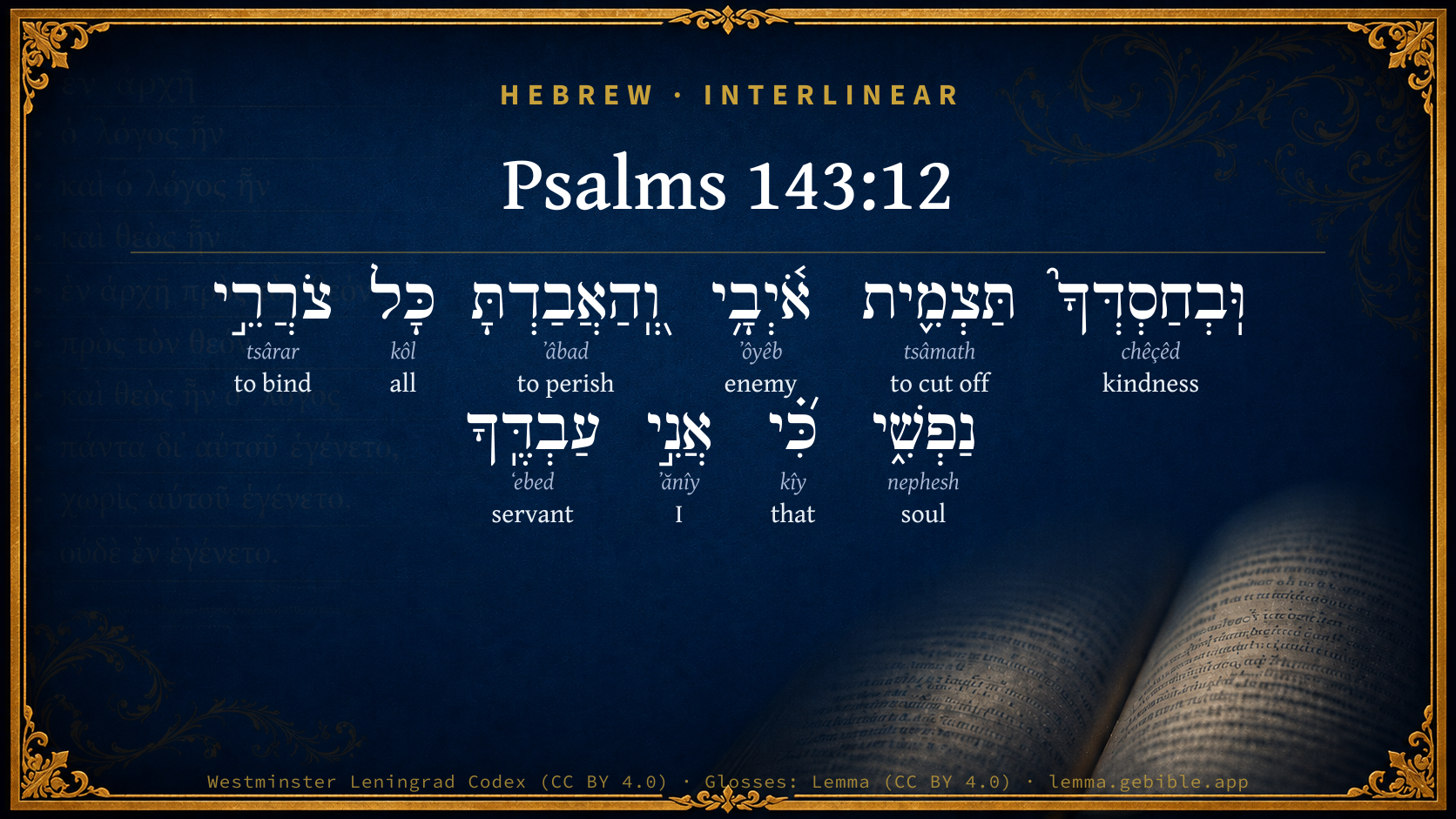
Hebrew (Westminster Leningrad Codex) Psalms 143:12 appears in the Hebrew Old Testament. The text above is from the Westminster Leningrad Codex. Each word links to its Strong’s number, a concise gloss, and parsing drawn from the Open Scriptures Hebrew Bible morphology. Click any word for its full Brown-Driver-Briggs (BDB) entry.
Download image
Cite this verse

Psalms 143:12 (World English Bible). Public Domain. Lemma interlinear Bible study tool, https://lemma.gebible.app/v/psalms/143/12.

Show BibTeX & RIS
BibTeX
RIS
English Translation
In your loving kindness, cut off my enemies, And destroy all those who afflict my soul, For I am your servant.
World English Bible · Public Domain
Download a study sheet

One document with this verse’s original text, its word-by-word gloss line, the meaning frame, cross-references with their text, attributed commentary, and full source and license credits — printable, and it pastes into notes with its structure intact.

This verse Autodidact and up

Study sheet (.html) Plain text (.txt)

A passage Seminary Student

Up to 50 verses in one chapter. A passage sheet keeps up to 6 commentary sources and 12 cross-references per verse, in the order this page ranks them, and says so on the sheet whenever that leaves anything out. Ask for a single verse and you get the Autodidact verse sheet above.

Everything on this page stays free to read, with no account — the sheet is a download of what is already on screen, not access to it.

Want to remove ads? Support Godless Engineer
Compare translations 3

The same verse in 3 English versions, stacked beneath the original-language interlinear above. Click any original word for its lexicon entry.

Each is an independent rendering of the whole verse — the interlinear is not word-aligned to these translations.

Highlighted words mark where these versions differ — a whole-verse word diff, not a word-by-word alignment.

  • World English Bible Public Domain
    In your loving kindness, cut off my enemies, And destroy all those who afflict my soul, For I am your servant.
  • King James Version Public Domain
    And of thy mercy cut off mine enemies, and destroy all them that afflict my soul: for I am thy servant.
  • unfoldingWord Literal Text CC BY-SA 4.0
    And in your covenant faithfulness may you destroy my enemies and exterminate all the adversaries of my soul, for I am your servant.

unfoldingWord Literal Text — © unfoldingWord, licensed CC BY-SA 4.0. Word-aligned USFM3 via Door43 (git.door43.org/unfoldingWord/en_ult).

Versions to compare (up to 4)

3 of 4 selected

Show all 17 translations

Every available English version of this verse, each an independent rendering of the whole verse.

  • World English Bible Public Domain
    In your loving kindness, cut off my enemies, And destroy all those who afflict my soul, For I am your servant.
  • Berean Standard Bible Public Domain
    And in Your loving devotion, cut off my enemies. Destroy all who afflict me, for I am Your servant.
  • Majority Standard Bible Public Domain
    And in Your loving devotion, cut off my enemies. Destroy all who afflict me, for I am Your servant.
  • King James Version Public Domain
    And of thy mercy cut off mine enemies, and destroy all them that afflict my soul: for I am thy servant.
  • American Standard Version (1901) Public Domain
    And in thy lovingkindness cut off mine enemies, And destroy all them that afflict my soul; For I am thy servant. Psalm 144 `A Psalm' of David.
  • Revised Version (1885) Public Domain
    And in thy lovingkindness cut off mine enemies, and destroy all them that afflict my soul; for I am thy servant.
  • Geneva Bible (1599) Public Domain
    And for thy mercy slay mine enemies, and destroy all them that oppresse my soule: for I am thy seruant.
  • Young's Literal Translation Public Domain
    And in Thy kindness cuttest off mine enemies, And hast destroyed all the adversaries of my soul, For I `am' Thy servant!
  • Literal Standard Version CC BY-SA 4.0
    And in Your kindness cut off my enemies, || And have destroyed all the adversaries of my soul, || For I [am] Your servant!
  • Unlocked Literal Bible CC BY-SA 4.0
    In your covenant faithfulness cut off my enemies and destroy all the enemies of my life, for I am your servant.
  • unfoldingWord Literal Text CC BY-SA 4.0
    And in your covenant faithfulness may you destroy my enemies and exterminate all the adversaries of my soul, for I am your servant.
  • Darby Bible Public Domain
    And in thy loving-kindness cut off mine enemies, and destroy all them that oppress my soul: for I am thy servant.
  • World Messianic Bible Public Domain
    In your loving kindness, cut off my enemies, and destroy all those who afflict my soul, for I am your servant.
  • Webster's Bible Public Domain
    And of thy mercy cut off my enemies, and destroy all them that afflict my soul: for I am thy servant.
  • Free Bible Version CC BY-SA 4.0
    In your trustworthy love, get rid of those who hate me, destroy all my enemies, for I am your servant.
  • Bible in Basic English Public Domain
    And in your mercy put an end to my haters, and send destruction on all those who are against my soul; for I am your servant.
  • JPS Tanakh (1917) Public Domain
    And in Thy mercy cut off mine enemies, and destroy all them that harass my soul; for I am Thy servant.

Literal Standard Version (2020), Covenant Press — licensed CC BY-SA 4.0. Text via the HelloAO Bible API (eBible.org). Unlocked Literal Bible (unfoldingWord) — licensed CC BY-SA 4.0. Text via the HelloAO Bible API (eBible.org). unfoldingWord Literal Text — © unfoldingWord, licensed CC BY-SA 4.0. Word-aligned USFM3 via Door43 (git.door43.org/unfoldingWord/en_ult). Free Bible Version, Dr. Jonathan Gallagher — licensed CC BY-SA 4.0. Text via the HelloAO Bible API (eBible.org).

Word by word

More ways to search: Search by grammar → Find every occurrence → Compare this word →

Practice this passage: Drill this verse → Learn its vocabulary →

תַּצְמִ֪ית
tsâmath
H6789
“to cut off”
Verb, Hiphil, Imperfect, 2nd Person, Masculine, Singular
Part of Speech
Verb
Stem
Hiphil
Form
Imperfect
Person
2nd Person
Gender
Masculine
Number
Singular
Full BDB Definition

Origin: a primitive root

TWOT: 1932

to put an end to, cut off, destroy, exterminate, extirpate - (Qal) to put an end to, terminate - (Niphal) to be ended, be annihilated, be exterminated - (Piel) to put an end to - (Pilel) to be exterminated, be annihilated - (Hiphil) to exterminate, annihilate
  1. וּֽבְחַסְדְּךָ֮ chêçêd H2617 “and · in/at · kindness · your” Conjunction + Preposition + Noun, Common, Masculine, Singular, Construct + Suffix, Personal, 2nd Person, Masculine, Singular
  2. אֹ֫יְבָ֥י ʼôyêb H341 “enemy · me” Verb, Qal, Participle Active, Masculine, Plural, Construct + Suffix, Personal, 1st Person, Common, Singular
  3. וְֽ֭הַאֲבַדְתָּ ʼâbad H6 “and · to perish” Conjunction + Verb, Hiphil, Sequential Perfect, 2nd Person, Masculine, Singular
  4. כָּל kôl H3605 “all of” Noun, Common, Masculine, Singular, Construct
  5. צֹרֲרֵ֣י tsârar H6887 “binding” Verb, Qal, Participle Active, Masculine, Plural, Construct
  6. נַפְשִׁ֑י nephesh H5315 “soul · my” Noun, Common, Both, Singular, Construct + Suffix, Personal, 1st Person, Common, Singular
  7. כִּ֝֗י kîy H3588 “that” Conjunction
  8. אֲנִ֣י ʼănîy H589 “I” Pronoun, Personal, 1st Person, Common, Singular
  9. עַבְדֶּֽךָ ʻebed H5650 “servant · your” Noun, Common, Masculine, Singular, Construct + Suffix, Personal, 2nd Person, Masculine, Singular

About this verse

These counts appear in no published source. They are computed here, from the morphology-tagged text and Lemma’s own curated glosses. What Lemma adds →

10
words
10
distinct lemmas
Wisdom
section

Notable vocabulary

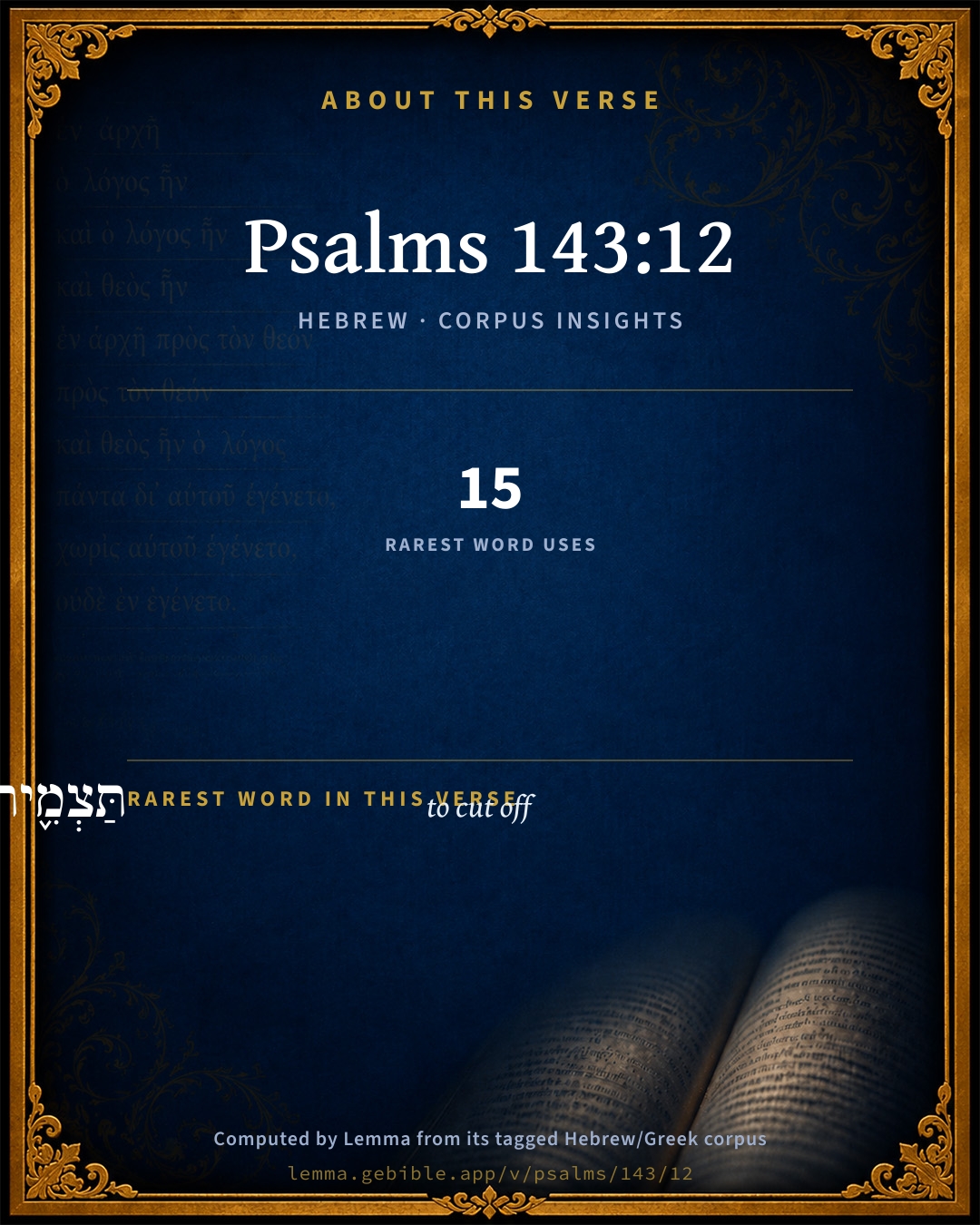
The rarest word here is תַּצְמִ֪ית to cut off H6789 — appearing just 15 times in the whole Hebrew Bible.

Shared distinctive vocabulary

תַּצְמִ֪ית to cut off H6789 occurs in 14 verses of the Hebrew Bible. Also found in:

Grammatical profile

  • 4 verbs
  • 4 nouns
  • 1 pronoun
  • 1 conjunction

Verb forms

  • תַּצְמִ֪ית Hiphil · Imperfect
  • אֹ֫יְבָ֥י Qal · Participle Active
  • וְֽ֭הַאֲבַדְתָּ Hiphil · Sequential Perfect
  • צֹרֲרֵ֣י Qal · Participle Active

Hebrew & Septuagint length

In English translation the verse runs 21 words from the Hebrew and 23 from the Septuagint (LXX English) — closely comparable.

A rough comparison of the two English renderings, which tokenize alike — not a word-level alignment.

Word counts can differ between the Hebrew and the Greek without any difference in meaning — e.g. the Hebrew direct-object marker אֵת has no separate Greek word, and Greek often adds the article ὁ.

Cross-references

9

Topical passages linked to Psalms 143:12 in the Treasury of Scripture Knowledge — connected by theme and wording, ordered by reader-vote popularity; previews shown in the World English Bible.

  • Psalms 54:5 He will repay the evil to my enemies. Destroy them in your truth.
  • Psalms 116:16 Yahweh, truly I am your servant. I am your servant, the son of your handmaid. You have freed me from my chains.
  • Psalms 119:94 I am yours. Save me, for I have sought your precepts.
  • 1 Samuel 24:12–15 Yahweh judge between me and you, and Yahweh avenge me of you; but my hand shall not be on you.
  • 1 Samuel 25:29 Though men be risen up to pursue you, and to seek your soul, yet the soul of my lord shall be bound in the bundle of life with Yahweh your God; and the souls of your enemies, them shall he sling out, as from the hollow of a sling.
  • 1 Samuel 26:10 David said, As Yahweh lives, Yahweh will strike him; or his day shall come to die; or he shall go down into battle and perish.
  • Psalms 52:5 God will likewise destroy you forever. He will take you up, and pluck you out of your tent, And root you out of the land of the living. Selah.
  • Psalms 55:23 But you, God, will bring them down into the pit of destruction. Bloodthirsty and deceitful men shall not live out half their days, But I will trust in you.
  • Psalms 136:15–20 But overthrew Pharaoh and his host in the Red Sea; For his loving kindness endures forever:

Cross-references courtesy of OpenBible.info (CC BY 4.0).

Hebrew and Greek witnesses Masoretic Hebrew ↔ Greek Septuagint

The same verse in the two great witnesses to the Old Testament, shown verse-for-verse.

You’re reading Greek Psalm 142 (Hebrew Psalm 143). The Septuagint counts the superscription, so verse numbers can differ from the Hebrew — chapter-level alignment, not verse-by-verse. Numbering follows Rahlfs.

These are two independent witnesses, not word-aligned to each other, and the Septuagint is shown in lemma (dictionary) form.

Hebrew Psalms 143:12 Masoretic · Westminster Leningrad Codex

וּֽבְחַסְדְּךָ֮ תַּצְמִ֪ית אֹ֫יְבָ֥י וְֽ֭הַאֲבַדְתָּ כָּל צֹרֲרֵ֣י נַפְשִׁ֑י כִּ֝֗י אֲנִ֣י עַבְדֶּֽךָ

In your loving kindness, cut off my enemies, And destroy all those who afflict my soul, For I am your servant.

World English Bible · Public Domain

Greek LXX Greek Psalm 142:12 Septuagint · lemma form

καί ἐν ὁ ἔλεος σύ ἐκὀλεθρεύω ὁ ἐχθρός ἐγώ καί ἀποὀλλύω πᾶς ὁ θλίβω ὁ ψυχή ἐγώ ὅτι δοῦλος σύ εἰμί ἐγώ

And in your mercy you will destroy my enemies, and will destroy all those that afflict my soul; for I am your servant.

LXX2012 (modern English Septuagint) · Public Domain

On this verse, John Gill's Exposition discusses the Septuagint’s reading. Read the note in Commentary ↓

Hebrew: Westminster Leningrad Codex (CC BY 4.0). Greek: Septuagint (public domain); English from LXX2012 (modern English Septuagint) (Public Domain). How the Septuagint differs from the Hebrew →

Commentary

Notes on Psalms 143:12 from classic Christian and Jewish commentators (each source and its license shown beneath its notes). The classic Christian expositions comment on the surrounding passage and are grouped to its opening verse, so a note may address several verses; the Jewish commentaries on the Tanakh (Rashi and others) are per-verse, so they appear only where the commentator wrote on this verse.

Lemma curates 59 commentaries, every one of them public domain or Creative Commons licensed, each selected and text-cleaned for this edition rather than reprinted as found. About our sources →

Trapp's Complete Commentary

John Trapp

Psa 143:12 And of thy mercy cut off mine enemies, and destroy all them that afflict my soul: for I [am] thy servant.

Ver. 12. Cut off mine enemies] Because not so much mine as thine; and those also implacable and irrecoverable. Elsewhere he saith, Slay them not, lest my people forget. {See Trapp on "Psa 59:11"}

For I am thy servant] See Psa 116:16, {See Trapp on "Psa 116:16"}

John Trapp, A Commentary or Exposition upon All the Books of the Old and New Testament (1647–1656) — public domain. Text from a community e-Sword module.

J. A. Alexander on Psalms

Joseph Addison Alexander

12. (Psa 143:12) And in thy mercy thou wilt destroy my enemies and cause to perish all that vex my soul; for I (am) thy servant. With the first clause compare Psa 31:16; Psa 18:40. Some find here an allusion to the promise in Deuteronomy 24. Vexers, adversaries, persecutors of my soul. Thy servant, not merely a believer, but a chosen instrument; not merely one of thy people, but their chief and representative, and as such entitled to deliverance both for their sake and my own. In these two verses, the form of direct petition is insensibly exchanged for that of confident anticipation.

Joseph Addison Alexander, The Psalms Translated and Explained (1850) — public domain. Text from a community e-Sword module.

Tyndale Open Study Notes

Tyndale Open Resources

143:12 A prayer for vindication and renewal of life concludes the psalm.

Tyndale Open Study Notes — © Tyndale Open Resources, licensed CC BY-SA 4.0. Text via the HelloAO Bible API.

Geneva Bible (1599)

Geneva Bible translators

Which shall be a sign of thy Fatherly kindness toward me.

Resigning myself wholly unto thee, and trusting in thy protection.

Geneva Bible (1599) marginal notes — public domain. Text via Bolls.life.

Adam Clarke's Commentary

Verse 12. And of thy mercy] To me and the kingdom.

Cut off mine enemies] Who, if they succeed, will destroy the very form of godliness. The steps he has already taken show that even morality shall have no countenance, if Absalom reign.

I am thy servant.] Whoever is disloyal to me, I will love and serve thee.

For a full explanation of this Psalm, as applied to penitents, see the analysis.

ANALYSIS OF THE HUNDRED AND FORTY-THIRD PSALM

David, being driven from Jerusalem by his son Absalom, wisely calls to mind his sin, as being the cause of it.

This Psalm has four parts: -

I. A prayer for remission of sin, grounded on God's promise, Ps 143:1; not on his own worthiness, Ps 143:2.

II. A narration of the sad state of his affairs, Ps 143:3-4.

III. The comfort he received in his sad condition, and whence, Ps 143:5-6.

IV. His petition, containing many particulars and reasons, Ps 143:7-12.

I. He prays for audience: "Hear my prayer, O Lord," c. He does not plainly express the matter he prayed for but it may be gathered from the context that it was for remission of sin.

1. "In thy faithfulness," c. Thou art a faithful God, and hast promised to pardon the penitent. I am a penitent have mercy on me.

2. "And in thy righteousness," c. Which here signifies mercy, loving-kindness.

This sense appears more plainly from the next verse.

1. "And enter not into judgment," c. Call me not to a strict account at the bar of thy justice. This he deprecates so that Justitia in the former verse could not be taken for that justice.

2. "For in thy sight," c. Not I, nor any other man: pardon me, then, for the sake of thy mercy and promise, not my merits.

II. And now he enters upon the narration of his sad condition.

1. "For the enemy hath persecuted," &c. My son Absalom seeks my life: but it was Satan who enticed me to adultery and homicide.

2. "He hath smitten," &c. Humbled me made me a lover of earth, vile in thy sight.

3. "He hath made me to dwell," c. After Satan had entangled me with earthly pleasures, I was in spiritual darkness, and saw not the way of life, any more than those who have been long dead.

The effect this darkness produced was fear and consternation.

1. "Therefore is my spirit," &c. I suffered a kind of swoon in my soul I was ready to faint when I considered thy holiness and my impurity.

2. "My heart within me," c. Far from comfort in heavy trouble.

III. In this sadness of heart and mind, -

1. "I remember the days of old," &c. Thy past kindness to me and to others.

2. "I meditate," &c. I did not slightly run them over, but pondered on them.

And I derived great profit from my meditation for,

1. "I stretch forth my hands," c. I began earnestly to pray to thee.

2. "My soul thirsteth," &c. After thy righteousness, as the dry land wanting water. For as the earth without rain has no consistence, but is pulverized so the soul not moistened with the grace of God falls on the right and left hand into temptation, and brings forth no fruit to God's glory.

IV. The sad case in which David was, upon a sense of God's indignation, makes him seek out a remedy.

1. "Hear me speedily," c. And his reason for this is the sad condition in which he was till God was pacified for his sin.

2. "Hide not thy face," &c. Thy presence, thy favour.

His next petition resembles the former in substance.

1. "Cause me to hear," &c. Thy pardoning mercy out of thy word it is thy Spirit which must work with it to save me.

2. "In the morning," c. Betimes, speedily, quickly, &c.

3. His reason: "For in thee do I trust," &c. I did not let go my hold even in my extremity but still hoped against hope.

His third petition is -

1. "Cause me to know," c. The psalmist. being truly penitent, fears to relapse into his pardoned sin, and prays to God for grace and direction.

2. His reason: "For I lift up my soul," &c. My purpose, to serve thee.

His fourth petition is -

1. "Deliver me, O Lord," &c. From the devil and all his temptations.

2. His reason: "I flee unto thee," &c. From them.

His fifth petition resembles his third.

1. "Teach me to do thy will," &c. Both by an active and passive obedience may I know thy will perfectly in adversity, to submit to it in prosperity, to do it without pride or presumption.

2. His reason: "For thou art my God." Who hast promised me thy help; and from whom all my good proceeds, being and well-being.

His sixth petition: "Thy Spirit is good." Not mine. Let then thy good Spirit instruct and lead me in the right way.

His seventh petition is -

1. "Quicken me, O Lord," c. Restore life justify me fully.

2. "For thy name's sake." Not my merits, but thy mercy, and the glory that will accrue to thy name in pardoning a penitent soul.

3. He goes on: "For thy righteousness' sake," c. Freedom he desires but still at the hands of God's infinite mercy.

His last petition is for the destruction of Satan's kingdom.

1. "Of thy mercy cut off mine enemies," c.

2. His reason: "For I am thy servant," c. A follower one under thy patronage and protection one of thy family honoured with the dignity of being thy servant, and well contented and pleased to perform my duty and service.

Adam Clarke's Commentary on the Bible (1810–1826) — public domain. Text from a community e-Sword/MySword module.

John Calvin's Commentaries

12. And in thy mercy, etc. In this verse he repeats for the fifth or sixth time that he looked for life only of God’s free mercy. Whatever severity may appear on the part of God when he destroys the wicked, David affirms that the vengeance taken upon them would be a proof of fatherly mercy to him. Indeed these two things often meet together — the severity and the goodness of God; for in stretching out his hand to deliver his own people, he directs the thunder of his indignation against their enemies. In short, he comes forth armed for the deliverance of his people, as he says in Isaiah,

“The day of vengeance is in mine heart, and this is the year of my redemption.” (Isaiah 63:4.)

In calling himself The servant of God, he by no means boasts of his services, but rather commends the grace of God, to whom he owed this privilege. This is not an honor to be got by our own struggles or exertions — to be reckoned among God’s servants; it depends upon his free choice, by which he condescends before we are born to take us into the number and rank of his followers, as David elsewhere declares still more explicitly —

“I am thy servant, truly I am thy servant, and the son of thine handmaid.” (Psalm 116:16.)

This is equivalent to making himself God’s client, and committing his life to his protection.

John Calvin's Commentaries (1540-1563) — public domain. Text from the Calvin Translation Society English edition (1840s-50s) via the Christian Classics Ethereal Library (ccel.org). Calvin's coverage is partial (roughly two-thirds of the Bible); uncommented books and verses are honest gaps, never fabricated. The 19th-century editor's footnotes and remarks are omitted so the notes are faithfully Calvin's own voice.

Ellicott's Commentary for English Readers

(12) Comp. Pss. xviii, 40, 54:7.

A Bible Commentary for English Readers, edited by Charles John Ellicott (1878–1897) — public domain. Text from a community e-Sword module.

The Cambridge Bible for Schools and Colleges

gen. ed. J. J. S. Perowne

12. And in thy lovingkindness wilt thou cut off my enemies,

And destroy all them that distress my soul,

For I am thy servant.

The prayer for ‘life’ is characteristic of Psalms 119 : see note on p. 705: cp. Psa_138:7. The plea for thy name’s sake is found in Psa_25:11, and often elsewhere. With thou wilt bring my soul out of distress cp. Psa_142:7.

12. Cp. Psa_54:5, “Cut them [my enemies] off in thy truth”; Psa_94:23. Such a prayer breathes the spirit of the Old Testament and not of the Gospel. It is a harsh and discordant conclusion to a Psalm full of humble penitence, patient resignation, and persevering faith. But the enemies who are relentlessly persecuting Jehovah’s servant to the death are the enemies of Jehovah; they are traitors to His kingdom who have forfeited their right to live; they give no quarter and deserve none themselves; if they triumph, Jehovah’s faithfulness to His promises would seem to have failed and his lovingkindness to have been exhausted or defeated (Psa_77:8-9). For such hardened and impenitent offenders nothing remains but extermination.

for I am thy servant] And therefore entitled to claim Thy protection. Cp. Psa_143:2; Psa_86:2; Psa_86:4; Psa_86:16; Psa_119:17, and often.

The Cambridge Bible for Schools and Colleges (gen. ed. J. J. S. Perowne; Cambridge University Press, 1878–1918) — public domain. Text from a community e-Sword module.

John Gill's Exposition

And of thy mercy cut off mine enemies,.... Which, though an act of vindictive justice, and terrible righteousness to them, would be an act of grace and mercy to him, who thereby would be delivered from them: or, "for thy grace" (b); for the sake of it, for the honour of it, do this; those being, as Cocceius thinks, despisers of the grace of God;

and destroy all them that afflict my soul; by their persecutions, reproaches, and blasphemies. These clauses, with those in Psa 143:11, are read in the future tense, "thou shalt quicken--bring out--cut off--destroy", in the Septuagint, Vulgate Latin, and Arabic versions; and so may be considered as a prophecy of what would be the case of David and his enemies, or of the Messiah and his, here typified; as well as a prayer for those things;

for I am thy servant; by creation, by redemption and grace; and by office, being set upon the throne for the service of God and his people, and therefore pleads for his protection and help; and the rather, as he was the servant of God; and not they, his enemies, as Kimchi observes.

(b) "propter misericordiam tuam", Pagninus; "propter benignitatem tuam", Musculus, Junius & Tremellius, Piscator; "pergratiam tuam", Cocceius, Gejerus, Michaelis.

Next: Psalms Chapter 144

John Gill's Exposition of the Whole Bible (1746–1763) — public domain (CC PDM 1.0). Text via the HelloAO Bible API.

Albert Barnes' Notes on the Bible

And of thy mercy ... - Thy mercy to me; thy mercy to the world. The destruction of the wicked is a favor to the universe; just as the arrest and punishment of a robber or a pirate is a mercy to society, to mankind; just as every prison is a display of “mercy” as well as of “justice” - mercy to society at large; justice to the offenders.

And destroy all them that afflict my soul - Cut them off; render them powerless to do mischief.

For I am thy servant - Not as a matter of private feeling - not for personal revenge - but because I am in thy service, and it is only by being delivered from these dangers that I can honor thee as I would. It is thine own cause, and I ask that they may be cut off “in order” that the service which I might render thee may be unembarrassed.

Albert Barnes' Notes on the Bible (1834–1885) — public domain. Text from a community e-Sword/MySword module.

Matthew Poole's English Annotations

Of thy mercy; out of thy mercy to me, whose life they seek.

Matthew Poole's English Annotations on the Holy Bible (1683–1685) — public domain. Text from a community e-Sword/MySword module.

The Treasury of David

Charles H. Spurgeon

Ver. 12. And of thy mercy cut off mine enemies, and destroy all them that afflict my soul. He believes that it will be so, and thus prophesies the event; for the words may be read as a declaration, and it is better so to understand them. We could not pray just so with our Christian light; but under Old Testament arrangements the spirit of it was congruous to the law. It is a petition which justice sanctions, but the spirit of love is not at home in presenting it. We, as Christians, turn the petition to spiritual use only. Yet David was of so generous a mind, and dealt so tenderly with Saul, that he could hardly have meant all that his words are made in our version to say. For I am lay servant; and therefore I hope that my Master will protect me in his service, and grant me victory while I fight his battles. It is a warrior's prayer, and smells of the dust and smoke of battle. It was heard, and therefore it was not asking amiss. Still there is a more excellent way.

Ver. 12. Of thy mercy cut off mine enemies. He desireth God to slay his enemies in his mercy, when rather their destruction was a work of his justice? I answer, that the destruction of the wicked is a mercy to the church. As God showed great mercy and kindness to his church by the death of Pharaoh, Sennacherib, Herod, and other troublers thereof. Archibald Symson.

Ver. 12. Cut off mine enemies, etc. When you find these imprecations to be prophecies of events which the Psalmist himself could not understand; but were to be fulfilled in persons whom the Psalmist could not know, as they were to live in distant future ages, for instance, Judas, and the Romans, and leaders of the Jewish nation, who would make these imprecations proofs of a revengeful spirit? James Bennet (1774-1862), in "Lectures on the Acts of the Apostles", 1847.

Ver. 12. I am thy servant. David the king professes himself one of God's pensioners. Paul, when he would blaze his coat of arms, and set forth his best heraldry, he doth not call himself Paul, an Hebrew of the Hebrews, or Paul of the tribe of Benjamin, but Paul "a servant of Christ": Ro 1:1. Theodosius thought it a greater dignity to be God's servant than to be an emperor. Christ Himself, who is equal with his Father, yet is not ashamed of the title servant: Isa 53:11. Every servant of God is a son, every subject a prince: it is more honour to serve God than to have kings to serve us: the angels in heaven are servants to the saints. Thomas Watson.

Ver. 12.

1. To the Master: "I am thy servant."

2. For the servant: he seeks protection because he belongs to his master.

Meditations And Disqvisitions Upon The Three last Psalms of David Pss. 102., 130., 143.. By Sr. Richard Baker, Knight, London, ...1639. The above is scarce, but will be found in Mr. Higham's Reprint of Sir R. Baker on the Psalms.]

A Sacred Septenarie, Or, A Godly And Fruitfull Exposition on the Seven Psalms Of Repentance... by Mr. Archibald Symson... London, 1638 4to., contains an Exposition of this Psalm, pp.

276-308. There is an Exposition of Psalm 143., in Vol. 1., pp. 35-66, Of "Sermons chiefly designed for the Use of Families, by John Fawcett, A.M. 2 Vols. 8vo, second edition, Carlisle; 1818."

Charles H. Spurgeon's The Treasury of David (1869–1885) — public domain. Psalms only. Text from a community e-Sword/MySword module.

Whedon's Commentary on the Bible

Daniel D. Whedon

12. I am thy servant—The petition of this and the preceding verse is now rested on the basis given in the last clause. It is not righteous—as the word is used in this psalm—that God fail to protect one who takes refuge with him, or that he leave his own servant to be the victim of his enemies. So, like many others, this psalm, with all its pains and struggles, ends in the calm and restful quietude of faith.

Daniel D. Whedon (gen. ed.), Commentary on the Old and New Testaments (1874–1909) — public domain. Text from a community e-Sword module.

The Pulpit Commentary

And of thy mercy cut off mine enemies. In thy goodness towards me, remove those enemies whose conduct towards me has been described in vers. 3, 4. And destroy all them that afflict my soul. This is David"s ordinary prayer with respect to his enemies, whom be counts as God"s adversaries, and the persecutors of faithful Israel. (see Psa_5:10 Psa_7:9 Psa_10:15 Psa_28:4, 5 35:4-6, 8, etc.) For I am thy servant. Entitled, therefore, to thy special care and protection. (comp. Psa_27:9 Psa_69:17 Psa_86:2, Psa_86:4, 16 116:16, etc.)

The Pulpit Commentary (1880–1919), ed. H.D.M. Spence-Jones & Joseph S. Exell — public domain. Text from a community e-Sword module.

Lesson kit

Teaching starters — assembled from the data on this page, not authored interpretation. Every prompt links to the verse data it draws on. Edit before teaching.

Psalms, in the Wisdom, opens this verse with 10 words (10 distinct Hebrew lemmas). Its most distinctive word is tsâmath (“to cut off”). A historical commentator’s framing appears above. Read the whole chapter for the surrounding context.

Discussion questions

  1. The word tsâmath carries the sense “to cut off.” How does it shape the verse?
  2. How does 2 Samuel 22:41, which shares the word «to cut off», read alongside this verse?
  3. These translations render this verse differently. What is at stake in choosing one wording over another?
  4. «תַּצְמִ֪ית» is a Hiphil Imperfect verb. How does that grammatical form shape the action described?
  5. Compare how Trapp's Complete Commentary and J. A. Alexander on Psalms read this verse. Where do they agree or differ?

Things to notice

Reading settings

Reading text

Shown beneath each verse's original-language words.

Old Testament
Old Testament edition

Read the OT as the Masoretic Hebrew (MT) or the Greek Septuagint (LXX).

English shown for the Greek Septuagint (in the Hebrew ↔ Greek comparison).

Comparing translations? Open the Compare panel on any verse page to stack up to four side by side.