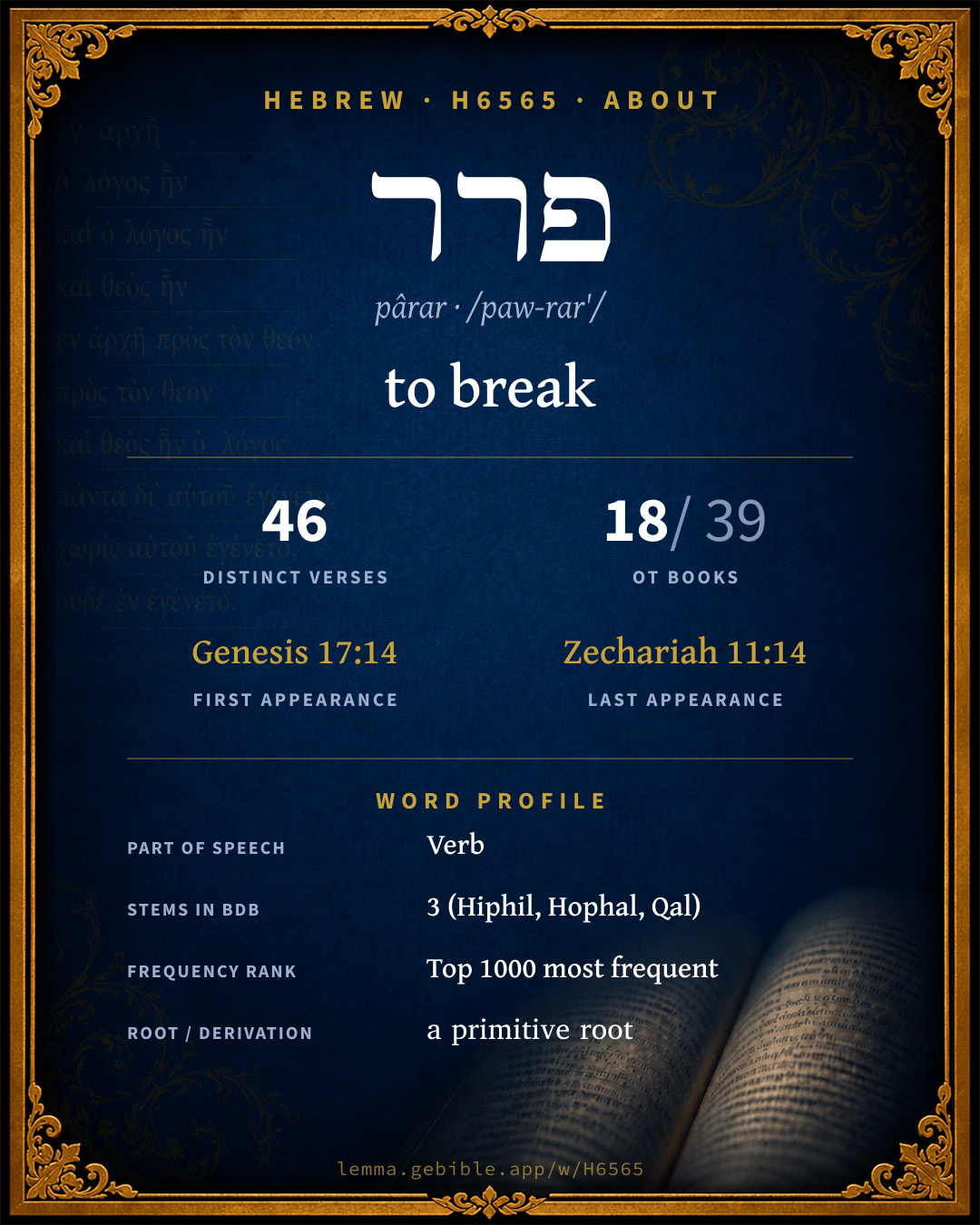
פָּרַר
to break
‘to break’ is one of 4 main senses fuller range ↓
Full lexicon entry — Brown-Driver-Briggs (BDB)
From Brown-Driver-Briggs (BDB)
Where this word appears
See every Hiphil verb in the Hebrew Bible →
Grammar key — what these labels mean
Part of speech
- Verb
- An action or state-of-being word.
Stem
- Hiphil
- The causative active stem (“he caused / brought about”). Here: ‘break’
- Hophal
- The passive counterpart of the Hiphil (“he was caused to…”). Here: ‘be frustrated’
- Pilpel
- A reduplicated intensive stem of two-letter or hollow roots.
- Qal
- The basic, simple active stem — the plain form of the verb (“he wrote”).
- Hithpolel
- The reflexive counterpart of the Polel.
Form
- Infinitive Construct
- A bound verbal noun, frequently with prepositions (“to write / in writing”).
- Perfect
- A completed action or state — Hebrew marks aspect (completeness) more than strict tense (“he wrote”).
- Sequential Perfect
- A perfect with prefixed waw continuing a preceding imperfect or command (waw-consecutive perfect).
- Infinitive Absolute
- An unbound verbal noun, often intensifying or standing in for a finite verb.
- Imperfect
- An incomplete, ongoing, or future action (“he will / would write”).
- Participle Active
- A verbal adjective expressing ongoing or characteristic action (“writing / one who writes”).
- Sequential Imperfect
- An imperfect with prefixed waw — the standard past-narrative form (waw-consecutive imperfect).
- Imperative
- A direct command (“write!”).
- Jussive
- A third- or second-person volitional form expressing wish or command (“let him write”).
State
- Absolute
- The independent form of a noun, not bound to a following word.
Person
- 3rd Person
- The one spoken about (“he / she / it / they”).
- 2nd Person
- The one addressed (“you”).
- 1st Person
- The speaker (“I / we”).
Gender
- Common
- Either gender — not distinguished for this form.
- Masculine
- Grammatically masculine.
- Feminine
- Grammatically feminine.
Number
- Plural
- More than one (in Hebrew, generally three or more).
- Singular
- One.
Grammatical forms 22 distinct
- Verb, Hiphil, Infinitive Construct 9 times (18%)
- Verb, Hiphil, Perfect, 3rd Person, Masculine, Singular 6 times (12%)
- Verb, Hiphil, Perfect, 3rd Person, Common, Plural 4 times (8%)
- Verb, Hiphil, Imperfect, 3rd Person, Masculine, Singular 4 times (8%)
- Verb, Hiphil, Sequential Perfect, 3rd Person, Masculine, Singular 3 times (6%)
- Verb, Hiphil, Infinitive Absolute 3 times (6%)
- Verb, Hiphil, Imperative, 2nd Person, Masculine, Singular 3 times (6%)
- Verb, Hiphil, Imperfect, 2nd Person, Masculine, Singular 2 times (4%)
+14 more forms (16 occurrences)
Parsed forms decoded from the imported morphology (morphhb / Westminster Leningrad Codex — WLC text public domain, morphhb tagging CC BY 4.0), counted across 50 parsed occurrences — not distinct verses.
Every verse where H6565 appears — 46 distinct verses across 18 books. Click any verse to open its interlinear word-by-word view. Verse text shown in the World English Bible for context — . Each verse’s Hebrew form is shown with its reference; the English is not keyword-highlighted, since the data carries no word-level English alignment. Use “Compare translations” on any verse to read it across multiple English versions. This concordance covers the Hebrew Bible; Septuagint (Greek Old Testament) occurrences are not indexed here.
Genesis 1 verse
Leviticus 2 verses
- Leviticus 26:15 לְ/הַפְרְ/כֶ֖ם prep + Hiphil inf.cs + sfx pers 2mp and if you shall reject my statutes, and if your soul abhors my ordinances, so that you will not do all my commandments, but break my covenant;
- Leviticus 26:44 לְ/הָפֵ֥ר prep + Hiphil inf.cs Yet for all that, when they are in the land of their enemies, I will not reject them, neither will I abhor them, to destroy them utterly, and to break my covenant with them; for I am Yahweh their God;
Numbers 5 verses
- Numbers 15:31 הֵפַ֑ר Hiphil pf 3ms Because he has despised the word of Yahweh, and has broken his commandment, that soul shall utterly be cut off; his iniquity shall be on him.
- Numbers 30:8 וְ/הֵפֵ֗ר conj + Hiphil wpf 3ms But if her husband disallow her in the day that he hears it, then he shall make void her vow which is on her, and the rash utterance of her lips, with which she has bound her soul: and Yahweh will forgive her.
- Numbers 30:12 הָפֵר֩ יָפֵ֨ר הֲפֵרָ֔/ם Hiphil inf.abs Hiphil impf 3ms Hiphil pf 3ms + sfx pers 3mp But if her husband made them null and void in the day that he heard them, then whatever proceeded out of her lips concerning her vows, or concerning the bond of her soul, shall not stand: her husband has made them void; and Yahweh will forgive her.
- Numbers 30:13 יְפֵרֶֽ/נּוּ Hiphil impf 3ms + sfx pers 3ms Every vow, and every binding oath to afflict the soul, her husband may establish it, or her husband may make it void.
- Numbers 30:15 הָפֵ֥ר יָפֵ֛ר Hiphil inf.abs Hiphil impf 3ms But if he shall make them null and void after that he has heard them, then he shall bear her iniquity.
Deuteronomy 2 verses
- Deuteronomy 31:16 וְ/הֵפֵר֙ conj + Hiphil wpf 3ms Yahweh said to Moses, Behold, you shall sleep with your fathers; and this people will rise up, and play the prostitute after the strange gods of the land, where they go to be among them, and will forsake me, and break my covenant which I have made with them.
- Deuteronomy 31:20 וְ/הֵפֵ֖ר conj + Hiphil wpf 3ms For when I shall have brought them into the land which I swore to their fathers, flowing with milk and honey, and they shall have eaten and filled themselves, and grown fat; then will they turn to other gods, and serve them, and despise me, and break my covenant.
Judges 1 verse
2 Samuel 2 verses
- 2 Samuel 15:34 וְ/הֵפַרְתָּ֣ה conj + Hiphil pf 2ms but if you return to the city, and tell Absalom, I will be your servant, O king; as I have been your father's servant in time past, so will I now be your servant; then will you defeat for me the counsel of Ahithophel.
- 2 Samuel 17:14 לְ/הָפֵ֞ר prep + Hiphil inf.cs Absalom and all the men of Israel said, The counsel of Hushai the Archite is better than the counsel of Ahithophel. For Yahweh had ordained to defeat the good counsel of Ahithophel, to the intent that Yahweh might bring evil on Absalom.
1 Kings 1 verse
2 Chronicles 1 verse
Ezra 2 verses
- Ezra 4:5 לְ/הָפֵ֣ר prep + Hiphil inf.cs and hired counselors against them, to frustrate their purpose, all the days of Cyrus king of Persia, even until the reign of Darius king of Persia.
- Ezra 9:14 לְ/הָפֵ֣ר prep + Hiphil inf.cs shall we again break your commandments, and join in affinity with the peoples that do these abominations? would not you be angry with us until you had consumed us, so that there should be no remnant, nor any to escape?
Nehemiah 1 verse
Job 4 verses
- Job 5:12 מֵ֭פֵר Hiphil ptcp.act ms He frustrates the devices of the crafty, So that their hands can't perform their enterprise.
- Job 15:4 תָּפֵ֣ר Hiphil impf 2ms Yes, you do away with fear, And hinder devotion before God.
- Job 16:12 וַֽ/יְפַרְפְּרֵ֗/נִי conj + Pilpel wimpf 3ms + sfx pers 1cs I was at ease, and he broke me apart. Yes, he has taken me by the neck, and dashed me to pieces. He has also set me up for his target.
- Job 40:8 תָּפֵ֣ר Hiphil impf 2ms Will you even annul my judgment? Will you condemn me, that you may be justified?
Psalms 3 verses
- Psalms 74:13 פוֹרַ֣רְתָּ Poel pf 2ms You divided the sea by your strength. You broke the heads of the sea monsters in the waters.
- Psalms 85:4 וְ/הָפֵ֖ר conj + Hiphil impv 2ms Turn us, God of our salvation, And cause your indignation toward us to cease.
- Psalms 119:126 הֵ֝פֵ֗רוּ Hiphil pf 3cp It is time to act, Yahweh, For they break your law.
Proverbs 1 verse
Ecclesiastes 1 verse
Isaiah 6 verses
- Isaiah 8:10 וְ/תֻפָ֑ר conj + Hophal impf 3fs Take counsel together, and it shall be brought to nothing; speak the word, and it shall not stand: for God is with us.
- Isaiah 14:27 יָפֵ֑ר Hiphil impf 3ms For Yahweh of Hosts has purposed, and who shall annul it? and his hand is stretched out, and who shall turn it back?
- Isaiah 24:5 הֵפֵ֖רוּ Hiphil pf 3cp The earth also is polluted under the inhabitants of it; because they have transgressed the laws, violated the statutes, broken the everlasting covenant.
- Isaiah 24:19 פּ֤וֹר הִֽתְפּוֹרְרָה֙ Qal inf.abs Hithpolel pf 3fs The earth is utterly broken, the earth is torn apart, the earth is shaken violently.
- Isaiah 33:8 הֵפֵ֤ר Hiphil pf 3ms The highways lie waste, the wayfaring man ceases: [the enemy] has broken the covenant, he has despised the cities, he doesn't regard man.
- Isaiah 44:25 מֵפֵר֙ Hiphil ptcp.act ms who frustrates the signs of the liars, and makes diviners mad; who turns wise men backward, and makes their knowledge foolish;
Jeremiah 5 verses
- Jeremiah 11:10 הֵפֵ֤רוּ Hiphil pf 3cp They are turned back to the iniquities of their forefathers, who refused to hear my words; and they are gone after other gods to serve them: the house of Israel and the house of Judah have broken my covenant which I made with their fathers.
- Jeremiah 14:21 תָּפֵ֥ר Hiphil juss 2ms Do not abhor [us], for your name's sake; do not disgrace the throne of your glory: remember, don't break your covenant with us.
- Jeremiah 31:32 הֵפֵ֣רוּ Hiphil pf 3cp not according to the covenant that I made with their fathers in the day that I took them by the hand to bring them out of the land of Egypt; which my covenant they broke, although I was a husband to them, says Yahweh.
- Jeremiah 33:20 תָּפֵ֨רוּ֙ Hiphil impf 2mp Thus says Yahweh: If you can break my covenant of the day, and my covenant of the night, so that there shall not be day and night in their season;
- Jeremiah 33:21 תֻפַר֙ Hophal impf 3fs then may also my covenant be broken with David my servant, that he shall not have a son to reign on his throne; and with the Levites the priests, my ministers.
Ezekiel 5 verses
- Ezekiel 16:59 לְ/הָפֵ֥ר prep + Hiphil inf.cs For thus says the Lord Yahweh: I will also deal with you as you have done, who have despised the oath in breaking the covenant.
- Ezekiel 17:15 וְ/הֵפֵ֥ר conj + Hiphil pf 3ms But he rebelled against him in sending his ambassadors into Egypt, that they might give him horses and much people. Shall he prosper? shall he escape who does such things? shall he break the covenant, and yet escape?
- Ezekiel 17:16 הֵפֵ֖ר Hiphil pf 3ms As I live, says the Lord Yahweh, surely in the place where the king dwells who made him king, whose oath he despised, and whose covenant he broke, even with him in the midst of Babylon he shall die.
- Ezekiel 17:18 לְ/הָפֵ֣ר prep + Hiphil inf.cs For he has despised the oath by breaking the covenant; and behold, he had given his hand, and yet has done all these things; he shall not escape.
- Ezekiel 44:7 וַ/יָּפֵ֨רוּ֙ conj + Hiphil wimpf 3mp in that you have brought in foreigners, uncircumcised in heart and uncircumcised in flesh, to be in my sanctuary, to profane it, even my house, when you offer my bread, the fat and the blood, and they have broken my covenant, [to add] to all your abominations.
Zechariah 3 verses
- Zechariah 11:10 לְ/הָפֵיר֙ prep + Hiphil inf.cs I took my staff Favor, and cut it apart, that I might break my covenant that I had made with all the peoples.
- Zechariah 11:11 וַ/תֻּפַ֖ר conj + Hophal wimpf 3fs It was broken in that day; and thus the poor of the flock that listened to me knew that it was the word of Yahweh.
- Zechariah 11:14 לְ/הָפֵר֙ prep + Hiphil inf.cs Then I cut apart my other staff, even Union, that I might break the brotherhood between Judah and Israel.
About this entry
At a glance — auto-summarized from this page’s data, not written by a person. Every figure links to its source below. This summary describes the numbers; it doesn’t interpret them.
פרר (pârar) is a Hebrew verb most often rendered “to break.” It first appears in Genesis 17:14. With 46 verses in 18 books, it is a moderately common word in the Hebrew Bible. Across 3 stems, its meaning turns on the binyan (Hiphil, Hophal). It clusters with פר, פרור and פרפר under a shared root. The sections below give every sense, occurrence, and version rendering.
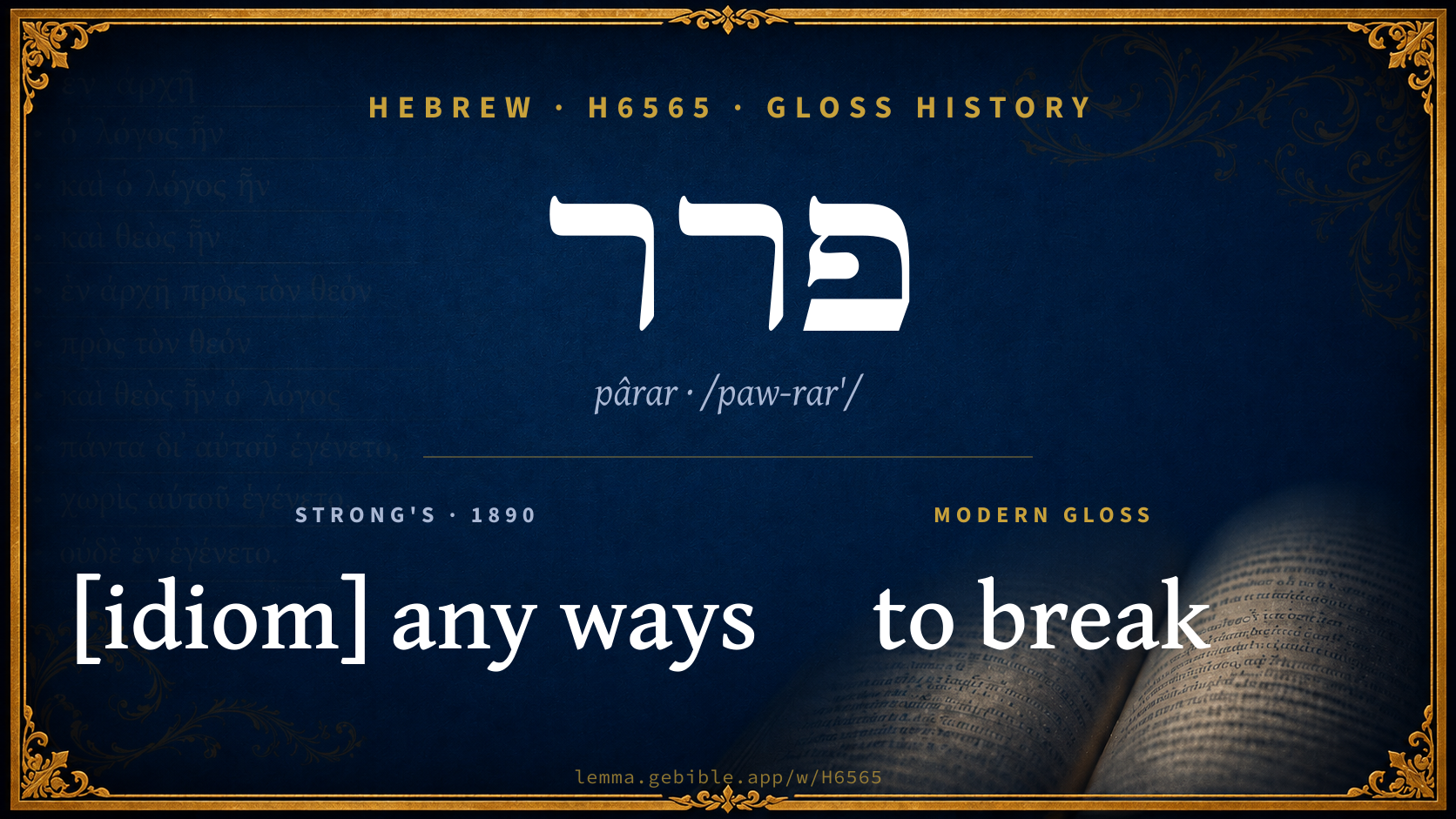
Gloss history
Strong's 1890 vs modern scholarship
About this word
Strong's H6565 catalogs a Hebrew word from the Hebrew Old Testament.
These counts are not copied from any lexicon or concordance. They are computed here, from the morphology-tagged Hebrew Old Testament. What Lemma adds →
- 46
- distinct verses
- The word appears in 46 distinct verses.
- 18 / 39
- OT books
- The word appears in 18 of 39 Old Testament books.
- #739
- by frequency
- Top 1000 most frequent Hebrew words (rank 739 of 8,640 Hebrew words by occurrence).
View all 46 occurrences in the concordance →
By section of the Old Testament
By traditional corpus
Conventional, traditional groupings — biblical authorship is debated, so this is a traditional corpus grouping, not an authorship claim. Each share is this word’s portion of its verses in that division of the Hebrew canon. Each figure is a share of the word’s 46 distinct verses.
- Prophets (Nevi'im) 23 verses · 50%
- Writings (Ketuvim) 13 verses · 28%
- Torah (Pentateuch) 10 verses · 22%
How translations render this word
Counts come from each version’s own published word-to-Strong’s tagging or interlinear alignment — an approximate guide to how each version renders this word, not a word-level alignment the data otherwise carries. Because each total is that version’s own tagged count, the per-version totals vary from one another and need not match the appearance or distinct-verse counts above. These counts may also differ from a printed concordance because Lemma counts each distinctly tagged rendering and does not collapse phrase taggings into a single head-word total. This is a fixed set of word-tagged versions (KJV, ASV, BSB, ULT) and does not change with the reading translation you choose elsewhere. Each version’s license is shown beside its name below (and on Sources).
BDB lists this Strong’s number as 3 distinct words (homographs). Each count above pools all of them and is not split by sense — see the Senses section below. A low-frequency rendering may belong to a different one of those words, not the primary meaning.
- King James Version†: Break 8×, Breaking 2×, He hath broken 2×
- American Standard Version†: Break 6×, Breaking 2×, I might break 2×
- Berean Standard Bible†: Break 8×, Breaking 3×, Broken 2×
- unfoldingWord Literal Text†: Break 8×, Breaking 4×, Broke 3×
King James Version Public Domain
Renders H6565 across 51† tagged occurrences — most commonly:
Plus 37 renderings that appear only once — usually multi-word phrases or single function words the recovered tagging swept in, not distinct renderings.
American Standard Version Public Domain
Renders H6565 across 49† tagged occurrences — most commonly:
Plus 37 renderings that appear only once — usually multi-word phrases or single function words the recovered tagging swept in, not distinct renderings.
Berean Standard Bible Public Domain
Renders H6565 across 47† tagged occurrences — most commonly:
Plus 32 renderings that appear only once — usually multi-word phrases or single function words the recovered tagging swept in, not distinct renderings. Not rendered by a distinct English word in 3 further occurrences.
unfoldingWord Literal Text CC BY-SA 4.0
Renders H6565 across 53† tagged occurrences — most commonly:
Plus 24 renderings that appear only once — usually multi-word phrases or single function words the recovered tagging swept in, not distinct renderings.
16 senses and sub-senses in the full BDB
Hebrew verbs can shift meaning by stem (binyan): Qal is the basic action, Niphal is often passive or reflexive, Piel often intensifies or makes it factitive, and Hiphil is typically causative. The senses below are grouped under the stem BDB assigns to each. This entry also uses Hophal (the passive of Hiphil).
What do BDB’s symbols mean?
BDB uses these scholarly abbreviations:
| Symbol | Meaning |
|---|---|
| 𝔊 | the Septuagint (the ancient Greek translation, LXX) |
| 𝔙 | the Vulgate (the Latin translation) |
| 𝔖 | the Syriac version (the Peshitta) |
| 𝔗 | the Targum (the Aramaic translation) |
| ψ | the Psalms |
| √ | root (the underlying root or stem) |
| ‖ | parallel passage (a synonymous or contrasted parallel) |
| † | the dagger: every passage where the word occurs is cited |
The 16 senses and sub-senses the full Brown-Driver-Briggs lexicon distinguishes for this word, in lexicon order (not ranked by frequency), with BDB’s own verbatim wording and sub-sense lettering. Shown in Hebrew script with BDB’s own scholarly abbreviations. The condensed entry is in the Lexicon Entry tab. See also the Forms in the corpus table below.
פרר I
Hiphil
- break, frustrate (NH Pi. crumble; J.Aram פְּרַר; Assyrian parâru, destroy; ii. shatter; Liḥy. והפרו destroy, DHMEpigr. Denkm., No. 21, 7);—Pf. 3 ms. הֵפֵר Is 33:8 +, הֵפַ֑ר Gn 17:14 Nu 15:31; also metaplastic form הֵפִיר Ez 17:19 ψ 33:10 (Ges§ 67 v); 2 ms. וְהֵפַרְתָּ֫ה 2 S 15:34, etc.; Impf. 3 ms. יָפֵר Nu 30:13 +, וַיָּ֫פֶר Ne 4:9, etc.; also 1 s. אָפִיר ψ 89:34 (Gesl.c.); Imv. ms. הָפֵר 2 Ch 16:3 ψ 85:5, הָפֵ֫רָה 1 K 15:19; Inf. abs>. הָפֵר Pr 15:22 +; cstr. לְהָפֵר 2 S 17:14 +, לְהָפֵיר Zc 11:10, sf. לְהַפְרְכֶם Lv 26:15 (Ges§ 67 dd); Pt. מֵפֵר Is 44:25 Jb 5:12;— e.g. Isaiah 33:8
- 1. break, violate, especially c. acc. בְּרִית:
- a. of י׳ Ju 2:1 Je 14:21 Lv 26:44 Zc 11:10. e.g. Judges 2:1
- b. of men violating covenant with י׳ Je 11:10; 31:32 Dt 31:16, 20 Lv 26:15 Ez 44:7 Gn 17:14 Is 24:5, Je 33:20 Ez 16:59. e.g. Jeremiah 11:10
- c. of men breaking compact, league (with men), Is 33:8 1 K 15:19 = 2 Ch 16:3, Ez 17:15, 16, 18, 19. e.g. Isaiah 33:8
- d. of destroying the אַחֲוָה between Judah and Israel Zc 11:14. e.g. Zechariah 11:14
- e. of breaking י׳’s מִצְוָה Nu 15:31 Ezr 9:14, תּוֹרָה ψ 119:126. e.g. Numbers 15:31
- 2. frustrate, make ineffectual:
- a. counsel (עֵצָה) 2 S 15:34; 17:14 Ezr 4:5; י׳ subj. Ne 4:9 ψ 33:10; of man frustrating י׳’s counsel Is 14:27, so, c. acc. מִשְׁפָּט Jb 40:8; c. acc. מַחֲשָׁבוֹת in gen., of men Pr 15:22, י׳ subj. Jb 5:12, so, c. acc. אֹתוֹת Is 44:25. e.g. 2 Samuel 15:34
- b. make vow (נֶדֶר) ineffectual, annul it Nu 30:9, 14 (opp. הֵקִים), v 13, also (Impf. + Inf. abs.) v 13, 16. e.g. Numbers 30:9
- c. of annulling (godly) fear Jb 15:4; חַסְדִּי לֹא אָפִיר מֵעִמּוֹ ψ 89:34 read prob. אָסִיר Ol Che Bae al.; הָפֵר בַּעַסְךָ 85:4 (read הָסֵר 𝔊 Bi Che). e.g. Job 15:4
- d. וְתָפֵר הָאֲבִיּוֹנָה Ec 12:5 is dub.: De Wild al. fails (to excite [?וְתֻפַר Hoph. is made ineffectual]); Ew bursts (Siegf וְתֻפַר); but caper-berry not dehiscent (PostFlora of Syriac 106 ff. M’Lean-DyerEncy. Bib. 696); PostLetter, July 28, 1901 breaks up (by shrivelling), fig. of failing sexual power; Aq from פרה bear fruit (cf. GFMJBL x (1891), 60); PerlesAnal. 30 וְתִפְרַח. e.g. Ecclesiastes 12:5
Hophal
- Impf.
- 1. be frustrated, 3 fs. וְתֻפָ֑ר Is 8:10 (of עֵצָה). e.g. Isaiah 8:10
- 2. be broken, of covenant, 3 fs. תֻּפַר Je 33:21; וַתֻּפַר Zc 11:11; so Is 28:18 (read וְתֻפַר for וְכֻפַּר, v. כ׳). Phip. Impf. 3 ms. sf. וַיְפַרְפְּרֵנִי Jb 16:12 he hath shattered me. e.g. Jeremiah 33:21
פרר II split, divide (so ψ 74
Qal
- Inf. abs. + Hithpōʿ. Pf. 3 fs. פּוֹר הִתְפּוֹרְרָה אֶרֶץ Is 24:19 split or cracked through is the earth (CheHeb. Hpt.. פרוק התפרקה). Pōʿ. Pf. 2 ms. פּוֹרַרְתָּ ψ 74:13 thou [י׳] didst divide the sea. e.g. Isaiah 24:19
פרר III (√ of foll.
Senses from the full Brown-Driver-Briggs lexicon (Brown, Driver, Briggs; Oxford 1906 — public domain), digitized via Sefaria, supplemented by the OpenScriptures HebrewLexicon (CC BY 4.0). Full attribution on Sources.
Word origin
II. vb. split, divide (so ψ 74:13 seems to require [but √ פור SS is possible], cf. Arabic فَرْفَرَ split, tear, rend; perhaps = I.; > BuhlLex. shake, quake, citing Arabic فَرْفَرَ shake, Aramaic אִתְפַּרְפַּר, ܦܰܪܦܰܪ, cf. NH פִּרְפֵּר);—
I. (√ of foll.; cf. NH פַּר, פָּרָה = BH; Arabic فُرَارٌ young of ewe, cow, or goat; Syriac ܦܰܪܬܳܐ ewe (cf. NöZMG xi (1886), 734), and so Assyrian parru, according to Jen and ZimZA iii. 202).
— Brown-Driver-Briggs (Oxford 1906, public domain), digitized via Sefaria, supplemented by the OpenScriptures HebrewLexicon (CC BY 4.0). See Sources.
Origin: a primitive root
Jastrow Dictionary
A second Hebrew/Aramaic lexicon for comparison, covering Aramaic and post-biblical (Talmudic, Targumic, Midrashic) usage that the biblical-Hebrew BDB does not. Matched by lemma rather than by Strong’s number, so a lemma may carry more than one Jastrow headword (shown separately below), and the entries cover usage well beyond the Bible.
פָּרַר
- (b. h.) to break.
- to crumble. Pes. 10ᵇ דרכו של תינוק לפָרֵר it is a child’s way to crumble bread (and leave it on the ground). Ib. II, 1 מְפָרֵר וזורה וכ׳ he may crumble (the leavened bread) and cast it to the wind; a. fr.—Tosef. Shebi. VI, 29 מְפָרְרִין, v. פָּרַר.
- to break, destroy; to thwart. Ab. III, 11 המֵפֵר בריתו וכ׳ he that breaks the Abrahamitic covenant (omits or effaces circumcision, v. מָשַׁךְ). Gen. R. s. 98 (play on פֹּרָת, Gen. XLIX, 22) בן שה׳ לאחיו the son that broke (faith) with his brothers; ib. שהֵפֵירוּ לו אחיו to whom his brothers were faithless; ib. שה׳ לאדונתו, v. אֲדוֹנָה. Gen. R. s. 16 (play on פְּרָת, Gen. II, 14) פרת שהֵפֵירָה והצירה לבניו Edom (Rome) is called P’rath, because she broke faith with, and distressed his (God’s) children (Var. לפניו); שאני עתיד להָפֵר לה because I (the Lord) shall in the end thwart her plans; Yalk. ib. 22; a. fr.—Esp. to make void; to disallow a vow (Num. XXX, 2-16). Ned. X, 1 אביה ובעלה מְפִירִין וכ׳ both her father and her husband must declare her vow void; ה׳ האב וכ׳ if only the father protested, and the husband did not. Ib. 2 הבעל מֵפֵר בבגר וכ׳ in the case of an adult the husband has the right of disallowing, but not the father. Ib. 4 אינו יכול להָפֵר he has no power to disallow her vows. Ib. 5 יָפֵר he has the power &c. Ib. 72ᵃ, a. e. אין הבעל מֵיפֵר בקודמין the husband cannot invalidate vows made before marriage. Ib. XI, 12 (90ᵇ) יָפֵר (ל)חלקי he may invalidate her vow for his share (as far as it concerns him). Ib. 7 איני יודע שוש מפירין I did not know that there are invalidating powers (vested in the husband); a. v. fr.—Part. pass. מוּפָר; pl. מוּפָרִין. Ib. X, 1 אינו מ׳ her vow is not made void. Ib. 4 כל נדרים … הרי הן מ׳ whatever vows thou mayest have made in my house, shall be void. Ib. 77ᵇ מ׳ ליכי thy vow is void; a. fr. e.g. Genesis 49:22
פֶּרֶר
- , v. פֶּרֶד I
A Dictionary of the Targumim, the Talmud Babli and Yerushalmi, and the Midrashic Literature (Marcus Jastrow; London, Luzac, 1903) — Public Domain. Digitized via Sefaria. Digitized via Sefaria. Full attribution on Sources.
Forms in the corpus
The 45 distinct written forms H6565 takes in the Hebrew Bible, most frequent first — each parse links to that stem’s occurrences in the concordance. Hebrew forms include their vowel points and cantillation, so a single lemma takes many written forms.
Same root — word family
Other BDB entries built from the same root as H6565, grouped by Strong’s listed origin. These share a root / origin per the lexicon — not necessarily a shared meaning. Each links to that word’s own entry.
Derived from this word
Proper names from this root
People and places named from this root — a name, not an additional meaning of the word.
Compare all same-root words → 1 of the same-root words is a proper name (a person or place). They share a root, not necessarily a meaning.
Septuagint verse parallels
This word appears in 43 verses that also exist in the Greek Old Testament (Septuagint), out of the 46 Hebrew verses it occurs in. You can read those verses in Greek by switching the Old Testament edition to the Septuagint.
Read these verses in the Septuagint
- Genesis 17:14
- Leviticus 26:15
- Numbers 15:31
- Deuteronomy 31:16
- Judges 2:1
- 2 Samuel 15:34
- 1 Kings 15:19
- 2 Chronicles 16:3
- Ezra 4:5
- Job 5:12
- Psalms 85:4
- Proverbs 15:22
This is a verse-level parallel only — the same verses exist in both the Hebrew and Greek Old Testaments. No word-level Hebrew↔Greek correspondence is claimed: the data carries no such alignment, so no Greek word is shown as this Hebrew word’s translation. Coverage is not total — the Septuagint omits the deuterocanon and renumbers the Psalms, so some Hebrew verses have no direct Greek parallel.