
Psalms 85:4

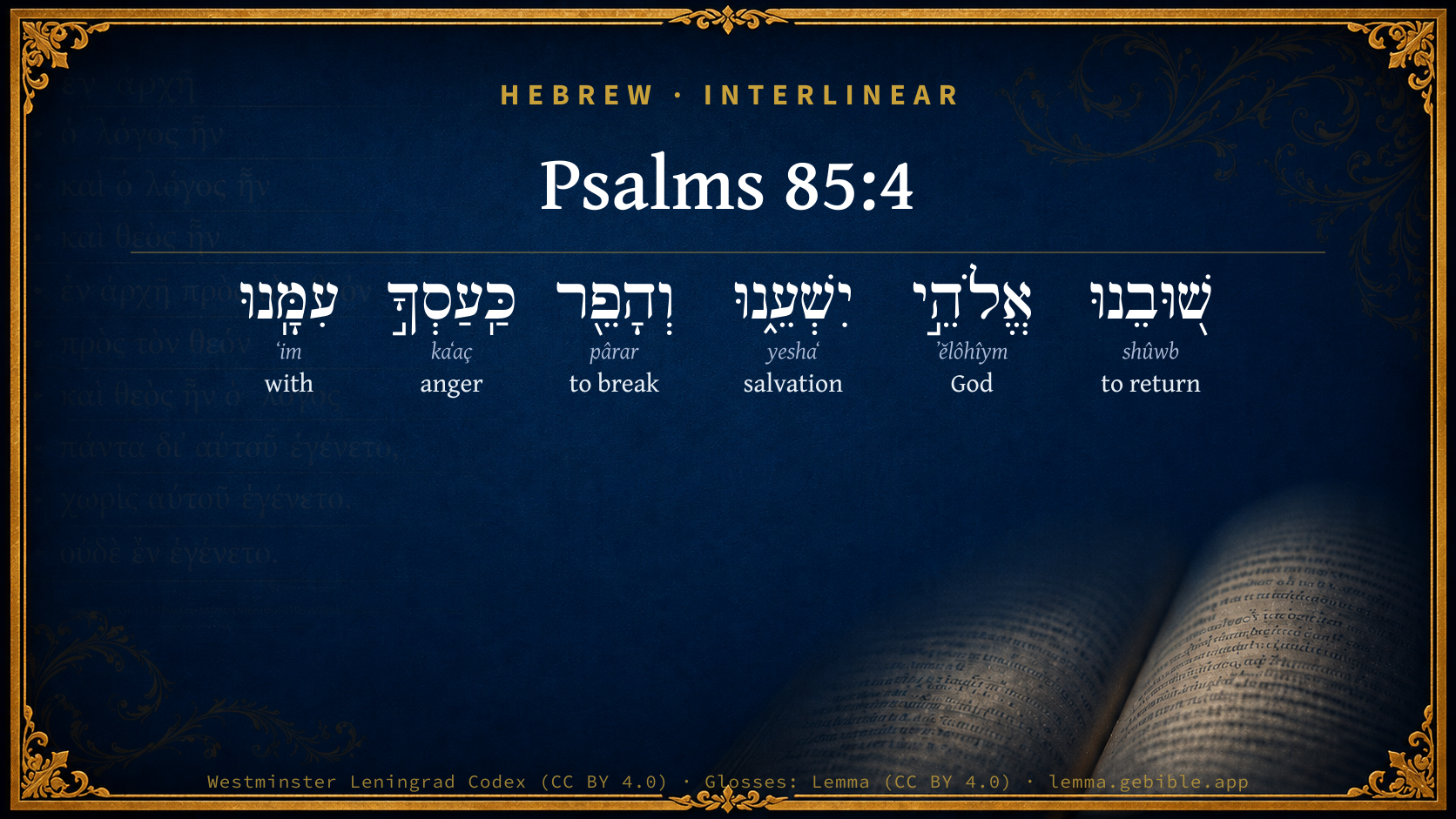
Hebrew (Westminster Leningrad Codex) Psalms 85:4 appears in the Hebrew Old Testament. The text above is from the Westminster Leningrad Codex. Each word links to its Strong’s number, a concise gloss, and parsing drawn from the Open Scriptures Hebrew Bible morphology. Click any word for its full Brown-Driver-Briggs (BDB) entry.
Download image
Cite this verse

Psalms 85:4 (World English Bible). Public Domain. Lemma interlinear Bible study tool, https://lemma.gebible.app/v/psalms/85/4.

Show BibTeX & RIS
BibTeX
RIS
English Translation
Turn us, God of our salvation, And cause your indignation toward us to cease.
World English Bible · Public Domain
Download a study sheet

One document with this verse’s original text, its word-by-word gloss line, the meaning frame, cross-references with their text, attributed commentary, and full source and license credits — printable, and it pastes into notes with its structure intact.

This verse Autodidact and up

Study sheet (.html) Plain text (.txt)

A passage Seminary Student

Up to 50 verses in one chapter. A passage sheet keeps up to 6 commentary sources and 12 cross-references per verse, in the order this page ranks them, and says so on the sheet whenever that leaves anything out. Ask for a single verse and you get the Autodidact verse sheet above.

Everything on this page stays free to read, with no account — the sheet is a download of what is already on screen, not access to it.

Want to remove ads? Support Godless Engineer
Compare translations 3

The same verse in 3 English versions, stacked beneath the original-language interlinear above. Click any original word for its lexicon entry.

Each is an independent rendering of the whole verse — the interlinear is not word-aligned to these translations.

Highlighted words mark where these versions differ — a whole-verse word diff, not a word-by-word alignment.

  • World English Bible Public Domain
    Turn us, God of our salvation, And cause your indignation toward us to cease.
  • King James Version Public Domain
    Turn us, O God of our salvation, and cause thine anger toward us to cease.
  • unfoldingWord Literal Text CC BY-SA 4.0
    Restore us, God of our salvation, and break up your vexation with us.

unfoldingWord Literal Text — © unfoldingWord, licensed CC BY-SA 4.0. Word-aligned USFM3 via Door43 (git.door43.org/unfoldingWord/en_ult).

Versions to compare (up to 4)

3 of 4 selected

Show all 18 translations

Every available English version of this verse, each an independent rendering of the whole verse.

  • World English Bible Public Domain
    Turn us, God of our salvation, And cause your indignation toward us to cease.
  • Berean Standard Bible Public Domain
    Restore us, O God of our salvation, and put away Your displeasure toward us.
  • Majority Standard Bible Public Domain
    Restore us, O God of our salvation, and put away Your displeasure toward us.
  • King James Version Public Domain
    Turn us, O God of our salvation, and cause thine anger toward us to cease.
  • American Standard Version (1901) Public Domain
    Turn us, O God of our salvation, And cause thine indignation toward us to cease.
  • Revised Version (1885) Public Domain
    Turn us, O God of our salvation, and cause thine indignation toward us to cease.
  • Geneva Bible (1599) Public Domain
    Turne vs, O God of our saluation, and release thine anger toward vs.
  • Douay-Rheims (1899) Public Domain
    Thou hast mitigated all thy anger: thou best turned away from the wrath of thy indignation.
  • Young's Literal Translation Public Domain
    Turn back `to' us, O God of our salvation, And make void Thine anger with us.
  • Literal Standard Version CC BY-SA 4.0
    Turn back [to] us, O God of our salvation, || And make void Your anger with us.
  • Unlocked Literal Bible CC BY-SA 4.0
    Restore us, God of our salvation, and let go of your displeasure with us.
  • unfoldingWord Literal Text CC BY-SA 4.0
    Restore us, God of our salvation, and break up your vexation with us.
  • Darby Bible Public Domain
    Bring us back, O God of our salvation, and cause thine indignation toward us to cease.
  • World Messianic Bible Public Domain
    Turn us, God of our salvation, and cause your indignation toward us to cease.
  • Webster's Bible Public Domain
    \\85:3\\Thou hast taken away all thy wrath; thou hast turned thyself from the fierceness of thy anger.
  • Free Bible Version CC BY-SA 4.0
    Bring us back to you, God of our salvation! Take away your anger towards us.
  • Bible in Basic English Public Domain
    Come back to us, O God of our salvation, and be angry with us no longer.
  • JPS Tanakh (1917) Public Domain
    (85-5) Restore us, O God of our salvation, and cause Thine indignation toward us to cease.

Literal Standard Version (2020), Covenant Press — licensed CC BY-SA 4.0. Text via the HelloAO Bible API (eBible.org). Unlocked Literal Bible (unfoldingWord) — licensed CC BY-SA 4.0. Text via the HelloAO Bible API (eBible.org). unfoldingWord Literal Text — © unfoldingWord, licensed CC BY-SA 4.0. Word-aligned USFM3 via Door43 (git.door43.org/unfoldingWord/en_ult). Free Bible Version, Dr. Jonathan Gallagher — licensed CC BY-SA 4.0. Text via the HelloAO Bible API (eBible.org).

Word by word

More ways to search: Search by grammar → Find every occurrence → Compare this word →

Practice this passage: Drill this verse → Learn its vocabulary →

About this verse

These counts appear in no published source. They are computed here, from the morphology-tagged text and Lemma’s own curated glosses. What Lemma adds →

6
words
6
distinct lemmas
Wisdom
section

Notable vocabulary

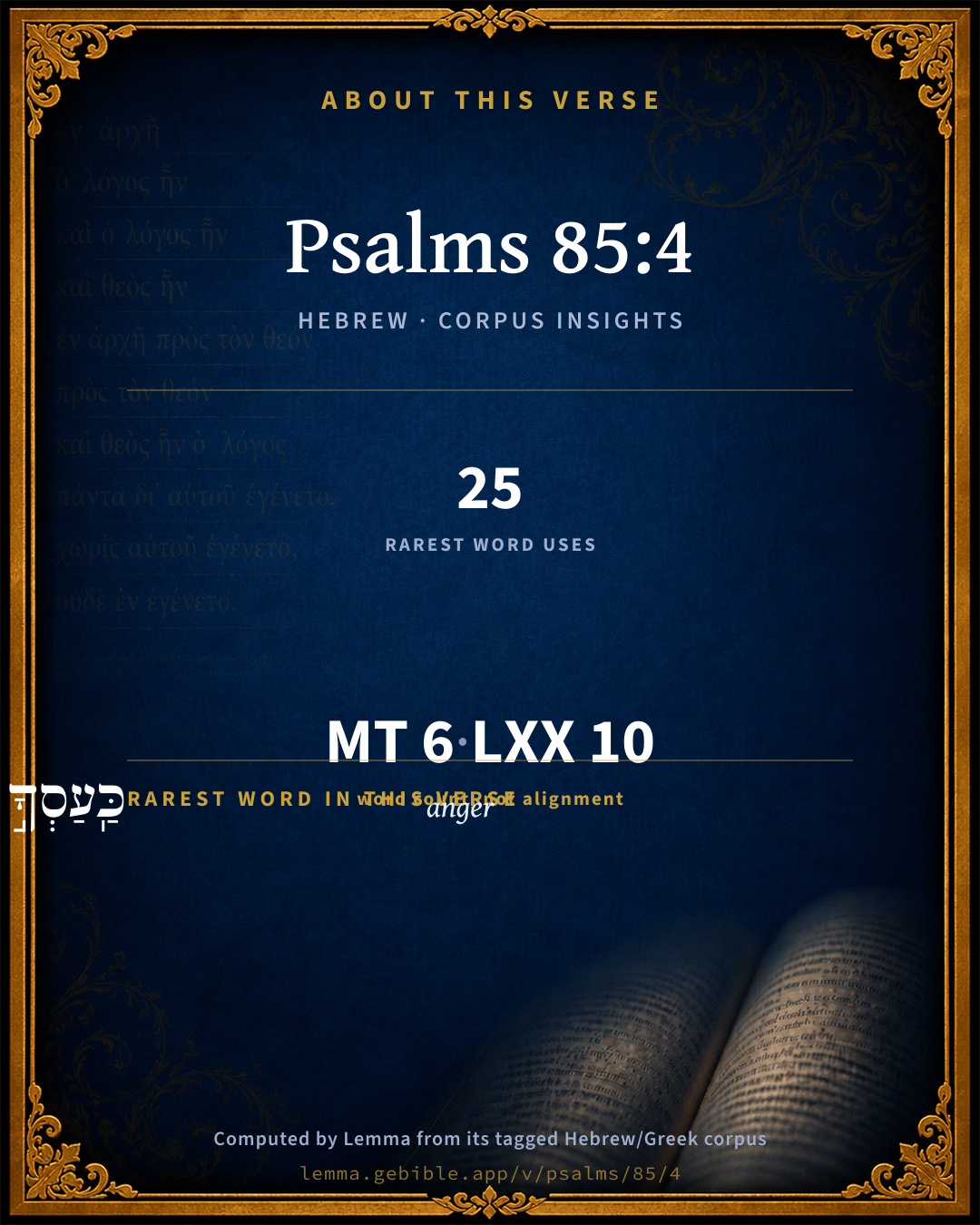
The rarest word here is כַּֽעַסְךָ֣ anger H3708 — appearing just 25 times in the whole Hebrew Bible.

Shared distinctive vocabulary

כַּֽעַסְךָ֣ anger H3708 occurs in 25 verses of the Hebrew Bible. Also found in:

Grammatical profile

  • 2 verbs
  • 3 nouns
  • 1 preposition

Verb forms

  • שׁ֭וּבֵנוּ Qal · Imperative
  • וְהָפֵ֖ר Hiphil · Imperative

Hebrew & Septuagint length

In English translation the verse runs 14 words from the Hebrew and 14 from the Septuagint (LXX English) — the same length.

A rough comparison of the two English renderings, which tokenize alike — not a word-level alignment.

Word counts can differ between the Hebrew and the Greek without any difference in meaning — e.g. the Hebrew direct-object marker אֵת has no separate Greek word, and Greek often adds the article ὁ.

In the original languages it is 6 Hebrew tokens and 10 Greek tokens — but the two are counted differently (Hebrew bundles its prefixes and suffixes into one token; the Greek is in lemma form), so that isn’t a like-for-like length.

Cross-references

14

Topical passages linked to Psalms 85:4 in the Treasury of Scripture Knowledge — connected by theme and wording, ordered by reader-vote popularity; previews shown in the World English Bible.

  • Psalms 80:3 Turn us again, God. Cause your face to shine, And we will be saved.
  • Lamentations 5:21 Turn you us to you, Yahweh, and we shall be turned; Renew our days as of old.
  • Psalms 80:7 Turn us again, God of hosts. Cause your face to shine, And we will be saved.
  • Micah 7:7 But as for me, I will look to Yahweh. I will wait for the God of my salvation. My God will hear me.
  • Psalms 25:2 My God, I have trusted in you, Don't let me be shamed. Don't let my enemies triumph over me.
  • Psalms 27:1 Yahweh is my light and my salvation. Whom shall I fear? Yahweh is the strength of my life. Of whom shall I be afraid?
  • Psalms 80:19 Turn us again, Yahweh God of hosts. Cause your face to shine, and we will be saved.
  • Micah 7:18–20 Who is a God like you, who pardons iniquity, And passes over the disobedience of the remnant of his heritage? He doesn't retain his anger forever, Because he delights in loving kindness.
  • Malachi 4:6 He will turn the hearts of the fathers to the children, and the hearts of the children to their fathers, lest I come and strike the earth with a curse."
  • Jeremiah 31:18 I have surely heard Ephraim bemoaning himself [thus], You have chastised me, and I was chastised, as a calf unaccustomed [to the yoke]: turn you me, and I shall be turned; for you are Yahweh my God.
  • Daniel 9:16 Lord, according to all your righteousness, let your anger and please let your wrath be turned away from your city Jerusalem, your holy mountain; because for our sins, and for the iniquities of our fathers, Jerusalem and your people are become a reproach to all who are round about us.
  • Psalms 78:38 But he, being merciful, forgave iniquity, and didn't destroy them. Yes, many times he turned his anger away, And didn't stir up all his wrath.
  • Isaiah 10:25 For yet a very little while, and the indignation [against you] shall be accomplished, and my anger [shall be directed] to his destruction.
  • John 4:22 You worship that which you don't know. We worship that which we know; for salvation is from the Jews.

Cross-references courtesy of OpenBible.info (CC BY 4.0).

Hebrew and Greek witnesses Masoretic Hebrew ↔ Greek Septuagint

The same verse in the two great witnesses to the Old Testament, shown verse-for-verse.

You’re reading Greek Psalm 84 (Hebrew Psalm 85). The Septuagint counts the superscription, so verse numbers can differ from the Hebrew — chapter-level alignment, not verse-by-verse. Numbering follows Rahlfs.

These are two independent witnesses, not word-aligned to each other, and the Septuagint is shown in lemma (dictionary) form.

Hebrew Psalms 85:4 Masoretic · Westminster Leningrad Codex

שׁ֭וּבֵנוּ אֱלֹהֵ֣י יִשְׁעֵ֑נוּ וְהָפֵ֖ר כַּֽעַסְךָ֣ עִמָּֽנוּ

Turn us, God of our salvation, And cause your indignation toward us to cease.

World English Bible · Public Domain

Greek LXX Greek Psalm 84:4 Septuagint · lemma form

καταπαύω πᾶς ὁ ὀργή σύ ἀποστρέφω ἀπό ὀργή θυμός σύ

Turn us, O God of our salvation, and turn your anger away from us.

LXX2012 (modern English Septuagint) · Public Domain

Hebrew: Westminster Leningrad Codex (CC BY 4.0). Greek: Septuagint (public domain); English from LXX2012 (modern English Septuagint) (Public Domain). How the Septuagint differs from the Hebrew →

Commentary

Notes on Psalms 85:4 from classic Christian and Jewish commentators (each source and its license shown beneath its notes). The classic Christian expositions comment on the surrounding passage and are grouped to its opening verse, so a note may address several verses; the Jewish commentaries on the Tanakh (Rashi and others) are per-verse, so they appear only where the commentator wrote on this verse.

Lemma curates 59 commentaries, every one of them public domain or Creative Commons licensed, each selected and text-cleaned for this edition rather than reprinted as found. About our sources →

Trapp's Complete Commentary

John Trapp

Psa 85:4 Turn us, O God of our salvation, and cause thine anger toward us to cease.

Ver. 4. Turn us, O God of our salvation] Turn us, and we shall be turned; do as thou ever hast done, for thou art Jehovah, thou changest not, but art yesterday, today, and the same for ever.

And cause thine anger, &c.] Labefacta iram tuam erga nos.

John Trapp, A Commentary or Exposition upon All the Books of the Old and New Testament (1647–1656) — public domain. Text from a community e-Sword module.

Joseph Benson's Commentary

Psa 85:4. Turn us, O God of our salvation — That is, either, 1st, Convert us. As thou hast brought back our bodies to thy land, so bring back our hearts to thyself, from whom many of them are to this day alienated. Or rather, restore us to our former tranquillity, and free us from the troubles which we yet groan under from our malicious neighbours and enemies. And cause thine anger toward us to cease — He prudently endeavours to get the root and cause of their continued miseries removed, namely, God’s anger procured by their sins.

Joseph Benson's Commentary on the Old and New Testaments (1811–1818) — public domain. Text from a community e-Sword module.

Whedon's Commentary on the Bible

Daniel D. Whedon

4. Turn us—Lead us back. The spiritual sense of convert is implied, of which the literal restoration was a symbol. Having confessed the favour of God to his land, the psalmist also confesses (Psa_85:4-7) the utter inability of the nation to re-collect itself, and revive its polity, without the specific leadership of God. The natural shrinking of the human heart from great trials discovers itself in these plaintive outcries, like “Lord, save us: we perish,” (Mat_8:25;) but faith resumes her sway, (Psa_85:8,) and serenely conducts us to the close.

Daniel D. Whedon (gen. ed.), Commentary on the Old and New Testaments (1874–1909) — public domain. Text from a community e-Sword module.

J. A. Alexander on Psalms

Joseph Addison Alexander

5. (Psa 85:4) Return to us, 0 God of our salvation, and cease thine anger towards us. The recollection of former mercies is here followed by a prayer for their renewal. "As thou hast had pity on thy people heretofore, so have pity on them now." Return to us, revisit us again in mercy. See above, on Psa 85:1, and on Psa 14:7. The verb in the last clause means to annul or nullify, put an end to, cause to cease. It occurs above, Psa 33:10. The word translated anger is one which properly expresses a mixed feeling of grief and indignation. See above, on Psa 6:6.

Joseph Addison Alexander, The Psalms Translated and Explained (1850) — public domain. Text from a community e-Sword module.

Adam Clarke's Commentary

Verse 4. Turn us, O God of our salvation] Thou hast turned our captivity; now convert our souls. And they find a reason for their prayer in an attribute of their God; the God of their salvation. And as his work was to save, they beg that his anger towards them might cease. The Israelites were not restored from their captivity all at once. A few returned with Zerubbabel; some more with Ezra and Nehemiah; but a great number still remained in Babylonia, Media, Assyria, Egypt, and other parts. The request of the psalmist is, to have a complete restoration of all the Israelites from all places of their dispersion.

Adam Clarke's Commentary on the Bible (1810–1826) — public domain. Text from a community e-Sword/MySword module.

John Calvin's Commentaries

4 Turn us, O God of our salvation! The faithful now make a practical application to themselves, in their present circumstances, of what they had rehearsed before concerning God’s paternal tenderness towards his people whom he had redeemed. And they attribute to him, by whom they desire to be restored to their former state, the appellation, O God of our salvation! to encourage themselves, even in the most desperate circumstances, in the hope of being delivered by the power of God. Although to the eye of sense and reason there may be no apparent ground to hope favourably as to our condition, it becomes us to believe that our salvation rests secure in his hand, and that, whenever he pleases, he can easily and readily find the means of bringing salvation to us. God’s anger being the cause and origin of all calamities, the faithful beseech him to remove it. This order demands our special attention; for so effeminate and faint-hearted in bearing adversity are we, that no sooner does God begin to smite us with his little finger, than we entreat him, with groaning and lamentable cries, to spare us. But we forget to plead, what should chiefly engage our thoughts, that he would deliver us from guilt and condemnation; and we forget this because we are reluctant to descend into our own hearts and to examine ourselves.

John Calvin's Commentaries (1540-1563) — public domain. Text from the Calvin Translation Society English edition (1840s-50s) via the Christian Classics Ethereal Library (ccel.org). Calvin's coverage is partial (roughly two-thirds of the Bible); uncommented books and verses are honest gaps, never fabricated. The 19th-century editor's footnotes and remarks are omitted so the notes are faithfully Calvin's own voice.

Ellicott's Commentary for English Readers

(4) Turn us.—Here equivalent to restore us once more. If, the poet felt, the captivity had taught its lesson, why, on the restoration, did not complete freedom from misfortune ensue? It is this which supplies the motive of his song.

A Bible Commentary for English Readers, edited by Charles John Ellicott (1878–1897) — public domain. Text from a community e-Sword module.

The Cambridge Bible for Schools and Colleges

gen. ed. J. J. S. Perowne

4. Turn us] I.e. Restore us. Cp. Psa_80:3. For R.V. marg. Turn to us, cp. Isa_63:17; but the rendering of the text is preferable.

cause thine anger &c.] Lit. break off thine indignation with us: cease to be provoked with us. The cognate verb is constantly used of Israel’s ‘provocation’ of Jehovah (e.g. Jer_7:18 ff.).

4–7. Yet in spite of forgiveness and restoration, much is still lacking. Oh that God would wholly withdraw His wrath, and gladden His people with a full salvation! Cp. the prayer of Psa_126:4.

The Cambridge Bible for Schools and Colleges (gen. ed. J. J. S. Perowne; Cambridge University Press, 1878–1918) — public domain. Text from a community e-Sword module.

John Gill's Exposition

Turn us, O God of our salvation,.... Who appointed it in his purposes, contrived it in council, secured it in covenant, and sent his Son to effect it; the prayer to him is for converting grace, either at first, for first conversion is his work, and his only; or after backslidings, for he it is that restores the souls of his people; and perhaps it is a prayer of the Jews, for their conversion in the latter day; when sensible of sin, and seeking after the Messiah they have rejected, when the Lord will turn them to himself, and turn away iniquity from them, and they shall be saved, Hos 3:5,

and cause thine anger towards us to cease: the manifest tokens of which are now upon them, being scattered up and down in the world, and made a proverb, a taunt, and a jeer; but will be removed, and cease, when they shall be converted.

John Gill's Exposition of the Whole Bible (1746–1763) — public domain (CC PDM 1.0). Text via the HelloAO Bible API.

Albert Barnes' Notes on the Bible

Turn us, O God of our salvation - The God from whom salvation must come, and on whom we are dependent for it. The prayer here is, “turn us;” turn us from our sins; bring us to repentance; make us willing to forsake every evil way; and enable us to do it. This is the proper spirit always in prayer. The first thing is not that he would take away his wrath, but that he would dispose us to forsake our sins, and to turn to himself; that we may be led to abandon that which has brought his displeasure upon us, and then that he will cause his anger toward us to cease. We have no authority for asking God to turn away his judgments unless we are willing to forsake our sins; and in all cases we can hope for the divine interposition and mercy, when the judgments of God are upon us, only as we are willing to turn from our iniquities.

And cause thine anger toward us to cease - The word used here, and rendered “cause to cease” - פרר pârar - means properly to break; then, to violate; and then, to annul, or to bring to an end. The idea here is, that if they were turned from sin, the cause of his anger would be removed, and would cease of course. Compare Psa 80:3.

Albert Barnes' Notes on the Bible (1834–1885) — public domain. Text from a community e-Sword/MySword module.

Matthew Poole's English Annotations

Turn us; either,

1. Convert us. As thou hast brought back our bodies to thy land, so bring back our hearts to thyself, from whom many of them to this day are alienated. Or rather,

2. Restore us to our former tranquillity, and free us from the troubles which we yet groan under from our malicious neighbours and enemies; for this best suits with the following clause of the verse, which commonly explains the former.

Cause thine anger toward us to cease; he prudently endeavours to take away the root and cause of their continued miseries, to wit, God’s anger procured by their sins.

Matthew Poole's English Annotations on the Holy Bible (1683–1685) — public domain. Text from a community e-Sword/MySword module.

The Treasury of David

Charles H. Spurgeon

Ver. 4. Turn us, O God of our salvation. This was the main business. Could the erring tribes be rendered penitent all would be well. It is not that God needs turning from his anger so much as that we need turning from our sin; here is the hinge of the whole matter. Our trials frequently arise out of our sins, they will not go till the sins go. We need to be turned from our sins, but only God can turn us: God the Saviour must put his hand to the work: it is indeed a main part of our salvation. Conversion is the dawn of salvation. To turn a heart to God is as difficult as to make the world revolve upon its axis. Yet when a man learns to pray for conversion there is hope for him, he who turns to prayer is beginning to turn from sin. It is a very blessed sight to see a whole people turn unto their God; may the Lord so send forth his converting grace on our land that we may live to see the people flocking to the loving worship of God as the doves to their cotes.

And cause thine anger toward us to cease. Make an end of it. Let it no longer burn. When sinners cease to rebel, the Lord ceases to be angry with them; when they return to him he returns to them; yea, he is first in the reconciliation, and turns them when otherwise they would never turn of themselves. May all those who are now enduring the hidings of Jehovah's face seek with deep earnestness to be turned anew unto the Lord, for so shall all their despondencies come to an end. Thus the sweet singer asks for his nation priceless blessings, and quotes the best of arguments. Because the God of Israel has been so rich in favour in bygone years, therefore he is entreated to reform and restore his backsliding nation.

Ver. 4. Cause thine anger toward us to cease. The phrase, break thine indignation towards us, (that is, wherewith thou art angry with us, in order that it may cease of itself,)comprehends the abolition of the signs and the effects of anger. The word drk, for this is the root to be taken, properly denotes a breaking by means of notches and gaps, as when the edge of anything is broken by many notches and gaps, and it is made utterly worn and useless. Indignation, so long as it is vigorous and spreads its effects, has an edge, which smites and pierces; but it is considered blunt and broken, when it ceases to exert itself, and produces evils no longer, this they affirm of the anger of God. Venema.

Ver. 4.

I. In what salvation consists.

1. In the removal of God's enmity from us.

2. In the removal of our enmity to him. II. By whom it is accomplished. By the God of salvation.

1. He causes his anger toward us to cease, and

2. Our anger toward him. III. How is it obtained? By prayer: "Turn us, "etc.

Psalms 85:5*

Charles H. Spurgeon's The Treasury of David (1869–1885) — public domain. Psalms only. Text from a community e-Sword/MySword module.

The Pulpit Commentary

Vers. 4-7. The prayer. Two things are prayed for first, that God will turn the hearts of his people wholly towards himself (ver. 4); and secondly, that he will complete his work of deliverance by removing the traces, that still exist, of his past anger (vers. 5-7). Israel is still in a state of great distress and weakness, suffering from the natural consequences of its sins, which keep it depressed and sad.

Turn us, O God of our salvation. Thou art turned to us (ver. 1); let us also be turned to thee. We cannot turn of our own mere wish to turn; we need thy helping grace. (comp. Psa_80:3, Psa_80:7, Psa_80:19) And cause thine anger toward us to cease. Verbally, this contradicts ver. 3, whence it has been supposed by some to come from the mouth of another speaker. But really there is no contradiction, if we understand, both here and in the next verse, by God"s anger, the effects of his anger, which were still continuing. (comp. Ezr_3:12, 13 4:4-24 9:2-15 Neh_1:3 Neh_2:17 Neh_4:1-22 Neh_5:1-19)

The Pulpit Commentary (1880–1919), ed. H.D.M. Spence-Jones & Joseph S. Exell — public domain. Text from a community e-Sword module.

John Wesley's Explanatory Notes

Turn us - Restore us to our former tranquillity, and free us from the troubles which we yet groan under.

John Wesley, Explanatory Notes Upon the Whole Bible (1754–1765) — public domain. Text via the GEBible commentary corpus.

Keil & Delitzsch

C. F. Keil & F. Delitzsch

The poet now prays God to manifest anew the loving-kindness He has shown formerly. In the sense of "restore us again," שׁוּבנוּ does not form any bond of connection between this and the preceding strophe; but it does it, according to Ges. 121, 4, it is intended in the sense of (אלינוּ) שׁוּב לנוּ, turn again to us. The poet prays that God would manifest Himself anew to His people as He has done in former days. Thus the transition from the retrospective perfects to the petition is, in the presence of the existing extremity, adequately brought about. Assuming the post-exilic origin of the Psalm, we see from this strophe that it was composed at a period in which the distance between the temporal and spiritual condition of Israel and the national restoration, promised together with the termination of the Exile, made itself distinctly felt. On עמּנוּ (in relation to and bearing towards us) beside כּעסך, cf. Job 10:17, and also on הפר, Psa 89:34. In the question in Psa 89:6 reminding God of His love and of His promise, משׁך has the signification of constant endless continuing or pursuing, as in Psa 36:11. The expression in Psa 85:7 is like Psa 71:20, cf. Psa 80:19; שׁוּב is here the representative of rursus, Ges. 142. ישׁעך from ישׁע, like קצפּך in Psa 38:2, has ĕ (cf. the inflexion of פּרי and חק) instead of the ı̆ in אלהי ישׁענוּ. Here at the close of the strophe the prayer turns back inferentially to this attribute of God.

Keil & Delitzsch — Biblical Commentary on the Old Testament (1861–1891) — public domain (CC PDM 1.0). Text via the HelloAO Bible API. (Old Testament only.)

Lesson kit

Teaching starters — assembled from the data on this page, not authored interpretation. Every prompt links to the verse data it draws on. Edit before teaching.

Psalms, in the Wisdom, opens this verse with 6 words (6 distinct Hebrew lemmas). Its most distinctive word is kaʻaç (“anger”). A historical commentator’s framing appears above. Read the whole chapter for the surrounding context.

Discussion questions

  1. What does “anger” (kaʻaç) contribute to the verse as a whole?
  2. How does Deuteronomy 32:19, which shares the word «anger», read alongside this verse?
  3. These translations render this verse differently; the difference is in the English rendering, not the original. What questions does that raise?
  4. «שׁ֭וּבֵנוּ» is a Qal Imperative verb. How does that grammatical form shape the action described?
  5. Compare how Trapp's Complete Commentary and Joseph Benson's Commentary read this verse. Where do they agree or differ?

Things to notice

Reading settings

Reading text

Shown beneath each verse's original-language words.

Old Testament
Old Testament edition

Read the OT as the Masoretic Hebrew (MT) or the Greek Septuagint (LXX).

English shown for the Greek Septuagint (in the Hebrew ↔ Greek comparison).

Comparing translations? Open the Compare panel on any verse page to stack up to four side by side.