Zechariah 11:10

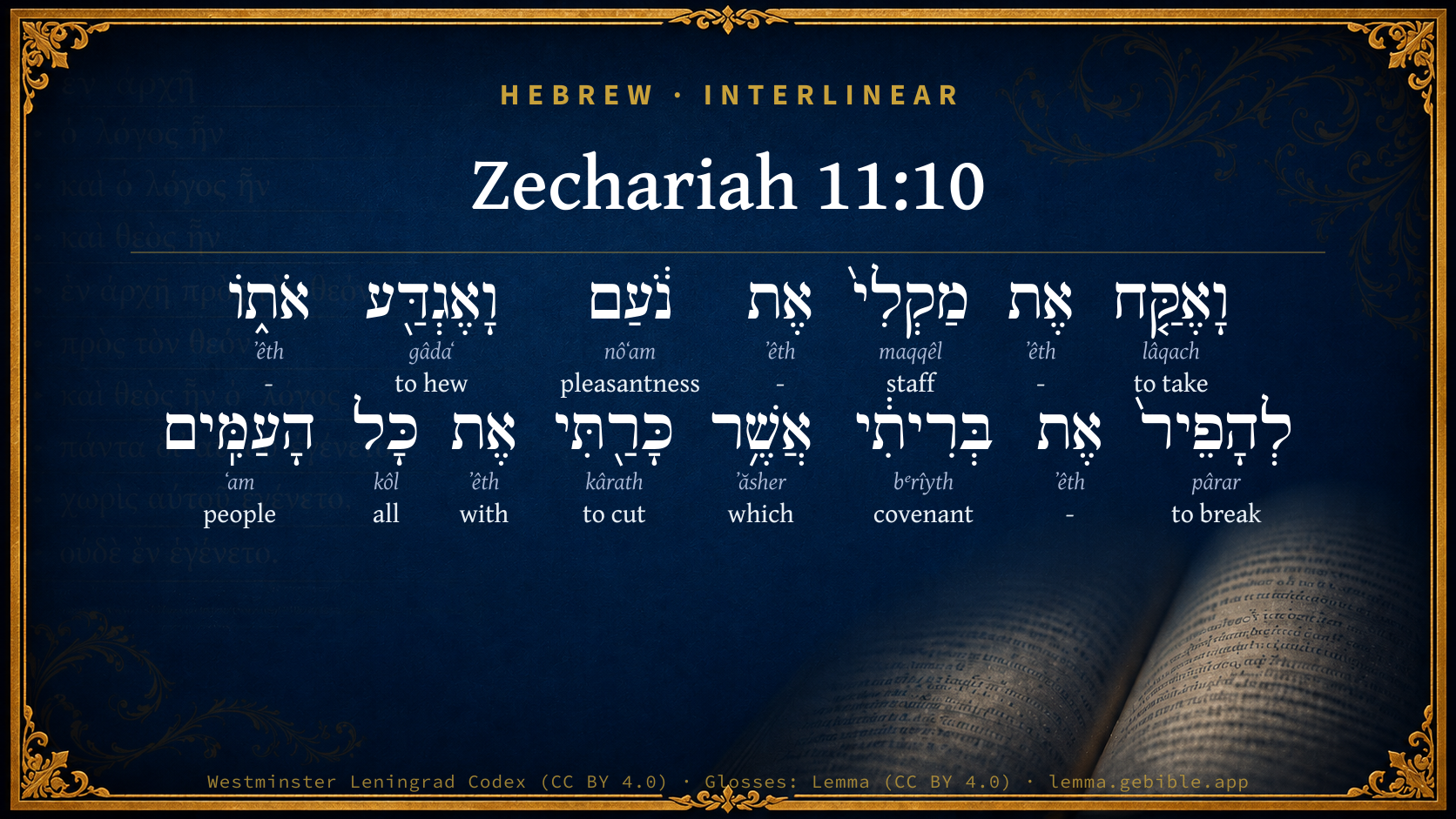
Hebrew (Westminster Leningrad Codex) Zechariah 11:10 appears in the Hebrew Old Testament. The text above is from the Westminster Leningrad Codex. Each word links to its Strong’s number, a concise gloss, and parsing drawn from the Open Scriptures Hebrew Bible morphology. Click any word for its full Brown-Driver-Briggs (BDB) entry.
Download image
Cite this verse

Zechariah 11:10 (World English Bible). Public Domain. Lemma interlinear Bible study tool, https://lemma.gebible.app/v/zechariah/11/10.

Show BibTeX & RIS
BibTeX
RIS
English Translation
I took my staff Favor, and cut it apart, that I might break my covenant that I had made with all the peoples.
World English Bible · Public Domain
Download a study sheet

One document with this verse’s original text, its word-by-word gloss line, the meaning frame, cross-references with their text, attributed commentary, and full source and license credits — printable, and it pastes into notes with its structure intact.

This verse Autodidact and up

Study sheet (.html) Plain text (.txt)

A passage Seminary Student

Up to 50 verses in one chapter. A passage sheet keeps up to 6 commentary sources and 12 cross-references per verse, in the order this page ranks them, and says so on the sheet whenever that leaves anything out. Ask for a single verse and you get the Autodidact verse sheet above.

Everything on this page stays free to read, with no account — the sheet is a download of what is already on screen, not access to it.

Want to remove ads? Support Godless Engineer
Compare translations 3

The same verse in 3 English versions, stacked beneath the original-language interlinear above. Click any original word for its lexicon entry.

Each is an independent rendering of the whole verse — the interlinear is not word-aligned to these translations.

Highlighted words mark where these versions differ — a whole-verse word diff, not a word-by-word alignment.

  • World English Bible Public Domain
    I took my staff Favor, and cut it apart, that I might break my covenant that I had made with all the peoples.
  • King James Version Public Domain
    And I took my staff, even Beauty, and cut it asunder, that I might break my covenant which I had made with all the people.
  • unfoldingWord Literal Text CC BY-SA 4.0
    So I took my staff “Favor” and broke it to break the covenant that I had made with all of my tribes.

unfoldingWord Literal Text — © unfoldingWord, licensed CC BY-SA 4.0. Word-aligned USFM3 via Door43 (git.door43.org/unfoldingWord/en_ult).

Versions to compare (up to 4)

3 of 4 selected

Show all 18 translations

Every available English version of this verse, each an independent rendering of the whole verse.

  • World English Bible Public Domain
    I took my staff Favor, and cut it apart, that I might break my covenant that I had made with all the peoples.
  • Berean Standard Bible Public Domain
    Next I took my staff called Favor and cut it in two, revoking the covenant I had made with all the nations.
  • Majority Standard Bible Public Domain
    Next I took my staff called Favor and cut it in two, revoking the covenant I had made with all the nations.
  • King James Version Public Domain
    And I took my staff, even Beauty, and cut it asunder, that I might break my covenant which I had made with all the people.
  • American Standard Version (1901) Public Domain
    And I took my staff Beauty, and cut it asunder, that I might break my covenant which I had made with all the peoples.
  • Revised Version (1885) Public Domain
    And I took my staff Beauty, and cut it asunder, that I might break my covenant which I had made with all the peoples.
  • Geneva Bible (1599) Public Domain
    And I tooke my staffe, euen Beautie, and brake it, that I might disanull my couenant, which I had made with all people.
  • Douay-Rheims (1899) Public Domain
    And I took my rod that was called Beauty, and I cut it asunder to make void my covenant, which I had made with all people.
  • Young's Literal Translation Public Domain
    And I take My staff Pleasantness, and cut it asunder, to make void My covenant that I had made with all the peoples:
  • Literal Standard Version CC BY-SA 4.0
    And I take my staff Pleasantness, and cut it apart, to make void my covenant that I had made with all the peoples:
  • Unlocked Literal Bible CC BY-SA 4.0
    So I took my staff “Favor” and broke it to break the covenant that I had made with all of my tribes.
  • unfoldingWord Literal Text CC BY-SA 4.0
    So I took my staff “Favor” and broke it to break the covenant that I had made with all of my tribes.
  • Darby Bible Public Domain
    And I took my staff, Beauty, and cut it asunder, that I might break my covenant which I had made with all the peoples.
  • World Messianic Bible Public Domain
    I took my staff Favor and cut it apart, that I might break my covenant that I had made with all the peoples.
  • Webster's Bible Public Domain
    And I took my staff, even Beauty, and cut it asunder, that I might break my covenant which I had made with all the people.
  • Free Bible Version CC BY-SA 4.0
    Then I took my staff called Grace and broke it, breaking the agreement I had made with all the peoples.
  • Bible in Basic English Public Domain
    And I took my rod Beautiful, cutting it in two, so that the Lord's agreement, which he had made with all the peoples, might be broken.
  • JPS Tanakh (1917) Public Domain
    And I took my staff Graciousness, and cut it asunder, 'that I might break My covenant which I had made with all the peoples.'

Literal Standard Version (2020), Covenant Press — licensed CC BY-SA 4.0. Text via the HelloAO Bible API (eBible.org). Unlocked Literal Bible (unfoldingWord) — licensed CC BY-SA 4.0. Text via the HelloAO Bible API (eBible.org). unfoldingWord Literal Text — © unfoldingWord, licensed CC BY-SA 4.0. Word-aligned USFM3 via Door43 (git.door43.org/unfoldingWord/en_ult). Free Bible Version, Dr. Jonathan Gallagher — licensed CC BY-SA 4.0. Text via the HelloAO Bible API (eBible.org).

Word by word

More ways to search: Search by grammar → Find every occurrence → Compare this word →

Practice this passage: Drill this verse → Learn its vocabulary →

נֹ֔עַם
nôʻam
H5278
“pleasantness”
Noun, Common, Masculine, Singular, Absolute
Part of Speech
Noun
Type
Common
Gender
Masculine
Number
Singular
State
Absolute
Full BDB Definition

Origin: from H5276

TWOT: 1384a

kindness, pleasantness, delightfulness, beauty, favour - delightfulness - symbolic name of one of two staves - pleasantness
  1. וָאֶקַּ֤ח lâqach H3947 “and · to take” Conjunction + Verb, Qal, Sequential Imperfect, 1st Person, Common, Singular
  2. אֶת ʼêth H853 “-” Particle, Direct Object
  3. מַקְלִי֙ maqqêl H4731 “staff · my” Noun, Common, Masculine, Singular, Construct + Suffix, Personal, 1st Person, Common, Singular
  4. אֶת ʼêth H853 “-” Particle, Direct Object
  5. וָאֶגְדַּ֖ע gâdaʻ H1438 “and · to hew” Conjunction + Verb, Qal, Sequential Imperfect, 1st Person, Common, Singular
  6. אֹת֑וֹ ʼêth H853 “- · him” Particle, Direct Object + Suffix, Personal, 3rd Person, Masculine, Singular
  7. לְהָפֵיר֙ pârar H6565 “to break” Preposition + Verb, Hiphil, Infinitive Construct
  8. אֶת ʼêth H853 “-” Particle, Direct Object
  9. בְּרִיתִ֔י bᵉrîyth H1285 “covenant · my” Noun, Common, Feminine, Singular, Construct + Suffix, Personal, 1st Person, Common, Singular
  10. אֲשֶׁ֥ר ʼăsher H834 “which” Particle, Relative
  11. כָּרַ֖תִּי kârath H3772 “to cut” Verb, Qal, Perfect, 1st Person, Common, Singular
  12. אֶת ʼêth H854 “with” Preposition
  13. כָּל kôl H3605 “all of” Noun, Common, Masculine, Singular, Construct
  14. הָעַמִּֽים ʻam H5971 “the · peoples” Particle, Definite Article + Noun, Common, Masculine, Plural, Absolute

About this verse

These counts appear in no published source. They are computed here, from the morphology-tagged text and Lemma’s own curated glosses. What Lemma adds →

15
words
12
distinct lemmas
Prophets
section

Notable vocabulary

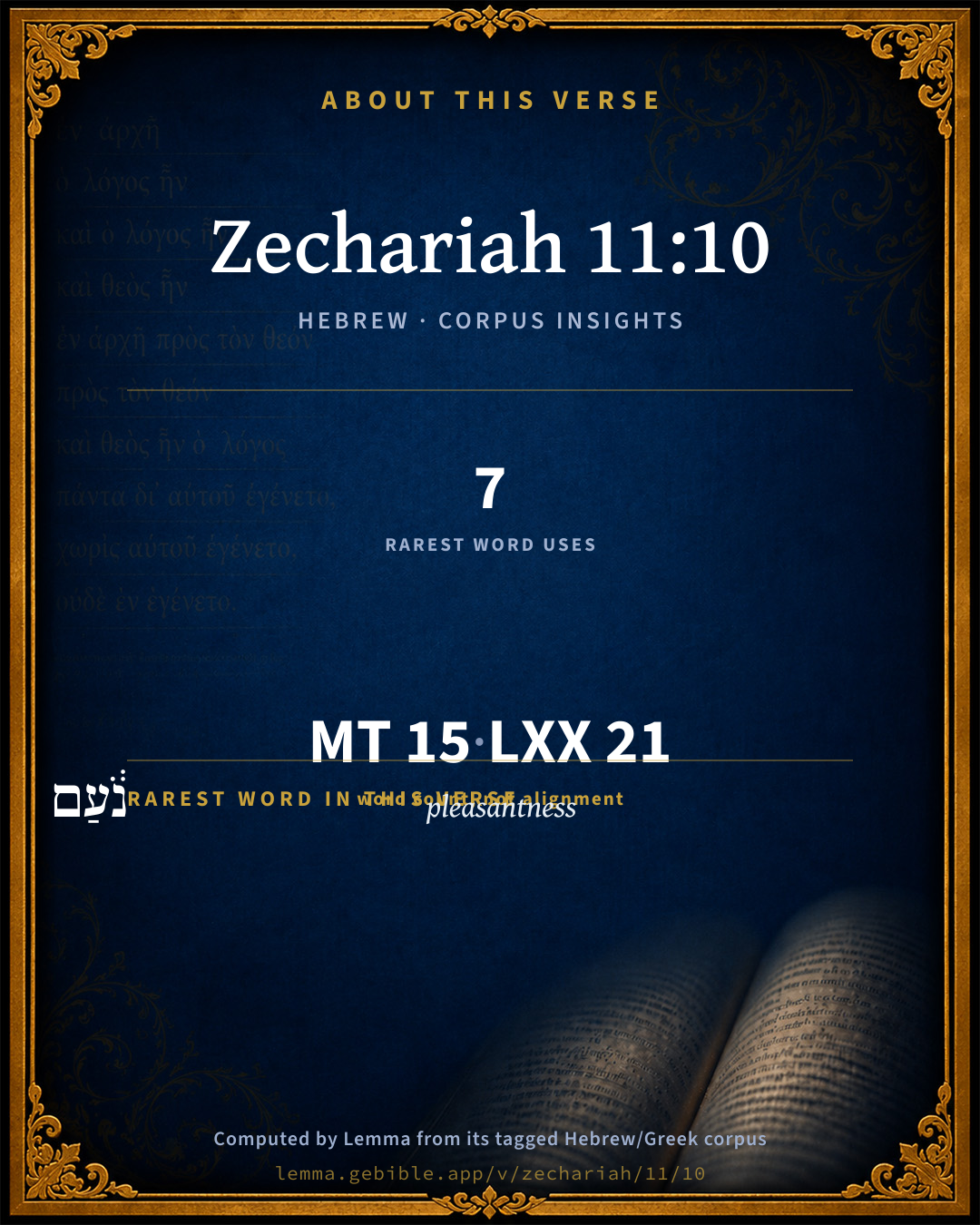
The rarest word here is נֹ֔עַם pleasantness H5278 — appearing just 7 times in the whole Hebrew Bible.

Shared distinctive vocabulary

נֹ֔עַם pleasantness H5278 occurs in 7 verses of the Hebrew Bible. Also found in:

Grammatical profile

  • 4 verbs
  • 5 nouns
  • 1 preposition
  • 5 particles

Verb forms

  • וָאֶקַּ֤ח Qal · Sequential Imperfect
  • וָאֶגְדַּ֖ע Qal · Sequential Imperfect
  • לְהָפֵיר֙ Hiphil · Infinitive Construct
  • כָּרַ֖תִּי Qal · Perfect

Hebrew & Septuagint length

In English translation the verse runs 23 words from the Hebrew and 24 from the Septuagint (LXX English) — closely comparable.

A rough comparison of the two English renderings, which tokenize alike — not a word-level alignment.

Word counts can differ between the Hebrew and the Greek without any difference in meaning — e.g. the Hebrew direct-object marker אֵת has no separate Greek word, and Greek often adds the article ὁ.

In the original languages it is 15 Hebrew tokens and 21 Greek tokens — but the two are counted differently (Hebrew bundles its prefixes and suffixes into one token; the Greek is in lemma form), so that isn’t a like-for-like length.

Cross-references

20

Topical passages linked to Zechariah 11:10 in the Treasury of Scripture Knowledge — connected by theme and wording, ordered by reader-vote popularity; previews shown in the World English Bible.

  • Zechariah 11:7 So I fed the flock of slaughter, especially the oppressed of the flock. I took for myself two staffs. The one I called "Favor," and the other I called "Union," and I fed the flock.
  • Psalms 89:39 You have renounced the covenant of your servant. You have defiled his crown in the dust.
  • Jeremiah 14:21 Do not abhor [us], for your name's sake; do not disgrace the throne of your glory: remember, don't break your covenant with us.
  • Jeremiah 31:31–32 Behold, the days come, says Yahweh, that I will make a new covenant with the house of Israel, and with the house of Judah:
  • Hebrews 8:8–13 For finding fault with them, he said, "Behold, the days come," says the Lord, "That I will make a new covenant with the house of Israel and with the house of Judah;
  • 1 Samuel 2:30 Therefore Yahweh, the God of Israel, says, I said indeed that your house, and the house of your father, should walk before me forever: but now Yahweh says, Be it far from me; for those who honor me I will honor, and those who despise me shall be lightly esteemed.
  • Psalms 90:17 Let the favor of the Lord our God be on us; Establish the work of our hands for us; Yes, establish the work of our hands.
  • Luke 21:5–6 As some were talking about the temple and how it was decorated with beautiful stones and gifts, he said,
  • Hebrews 7:17–22 for it is testified, "You are a priest forever, According to the order of Melchizedek."
  • Hosea 1:9 He said, "Call his name Lo-Ammi; for you are not my people, and I will not be yours.
  • Luke 21:32 Most assuredly I tell you, this generation will not pass away until all things are accomplished.
  • Acts 6:13–14 and set up false witnesses who said, "This man never stops speaking blasphemous words against this holy place and the law.
  • Romans 9:3–5 For I could wish that I myself were accursed from Christ for my brothers' sake, my relatives according to the flesh,
  • Numbers 14:34 After the number of the days in which you spied out the land, even forty days, for every day a year, shall you bear your iniquities, even forty years, and you shall know my alienation.
  • Psalms 50:2 Out of Zion, the perfection of beauty, God shines forth.
  • Ezekiel 7:20–22 As for the beauty of his ornament, he set it in majesty; but they made the images of their abominations [and] their detestable things therein: therefore have I made it to them as an unclean thing.
  • Ezekiel 16:59–61 For thus says the Lord Yahweh: I will also deal with you as you have done, who have despised the oath in breaking the covenant.
  • Ezekiel 24:21 Speak to the house of Israel, Thus says the Lord Yahweh: Behold, I will profane my sanctuary, the pride of your power, the desire of your eyes, and that which your soul pities; and your sons and your daughters whom you have left behind shall fall by the sword.
  • Daniel 9:26 After the sixty-two weeks the Anointed One shall be cut off, and shall have nothing: and the people of the prince who shall come shall destroy the city and the sanctuary; and the end of it shall be with a flood, and even to the end shall be war; desolations are determined.
  • Galatians 3:16–18 Now the promises were spoken to Abraham and to his seed. He doesn't say, "To seeds," as of many, but as of one, "To your seed," which is Christ.

Cross-references courtesy of OpenBible.info (CC BY 4.0).

Hebrew and Greek witnesses Masoretic Hebrew ↔ Greek Septuagint

The same verse in the two great witnesses to the Old Testament, shown verse-for-verse.

These are two independent witnesses, not word-aligned to each other, and the Septuagint is shown in lemma (dictionary) form.

Hebrew Zechariah 11:10 Masoretic · Westminster Leningrad Codex

וָאֶקַּ֤ח אֶת מַקְלִי֙ אֶת נֹ֔עַם וָאֶגְדַּ֖ע אֹת֑וֹ לְהָפֵיר֙ אֶת בְּרִיתִ֔י אֲשֶׁ֥ר כָּרַ֖תִּי אֶת כָּל הָעַמִּֽים

I took my staff Favor, and cut it apart, that I might break my covenant that I had made with all the peoples.

World English Bible · Public Domain

Greek LXX Zechariah 11:10 Septuagint · lemma form

καί λαμβάνω ὁ ῥάβδος ἐγώ ὁ καλός καί ἀποῥίπτω αὐτός ὁ διασκεδάζω ὁ διαθήκη ἐγώ ὅς διατίθημι πρός πᾶς ὁ λαός

And I will take my beautiful staff, and cast it away, that I may break my covenant which I made with all the people.

LXX2012 (modern English Septuagint) · Public Domain

Hebrew: Westminster Leningrad Codex (CC BY 4.0). Greek: Septuagint (public domain); English from LXX2012 (modern English Septuagint) (Public Domain). How the Septuagint differs from the Hebrew →

Targum (Aramaic paraphrase)

1

The Targum is the ancient Jewish Aramaic paraphrase of the Hebrew Scriptures — an interpretive translation, not the Hebrew text itself. Onkelos (literal) and Pseudo-Jonathan (expansive) render the Torah, and Jonathan the Prophets. Coverage is partial: where no permissively-licensed English translation exists for a verse, only the Aramaic is shown. This is verse-level text, not a word-by-word alignment to the Hebrew.

  1. Targum Jonathan Prophets (Joshua–Malachi)
    וְאַיְתֵיתִי יַת סַנְחֶרִיב מַלְכָּא דְאַתּוּר עַל מַלְכָּא דְיִשְׂרָאֵל וְאַגְלֵיתִי יָתֵיהּ עַל דִי אַשְׁנִיאוּ קַיָמָא דִגְזָרֵית עִמְהוֹן דְלָא לְמִפְלַח לְטַעֲוָתָא בְּכֵן גְלוֹ בֵּינֵי עַמְמַיָא:

    (no public-domain English translation for this verse)

    Targum Jonathan — Aramaic: “Mikraot Gedolot” (public domain). English: “Sefaria Community Translation” (CC0 1.0 (public-domain dedication)); “London "Chaldee Paraphrase," 1871” (public domain). Text via Sefaria.

Commentary

Notes on Zechariah 11:10 from classic Christian and Jewish commentators (each source and its license shown beneath its notes). The classic Christian expositions comment on the surrounding passage and are grouped to its opening verse, so a note may address several verses; the Jewish commentaries on the Tanakh (Rashi and others) are per-verse, so they appear only where the commentator wrote on this verse.

Lemma curates 59 commentaries, every one of them public domain or Creative Commons licensed, each selected and text-cleaned for this edition rather than reprinted as found. About our sources →

Trapp's Complete Commentary

John Trapp

Zec 11:10 And I took my staff, [even] Beauty, and cut it asunder, that I might break my covenant which I had made with all the people.

Ver. 10. And I took my staff, even Beauty, and cut it asunder] In token that he had cast off his office of shepherd, he breaks his staff, the ensign and instrument of his office; and this in token that he had broke

his covenant which he had made with all the people] i.e. with all the tribes of Israel, which were as so many different peoples, over whom God had reigned (but now rejected), and in whom he delighted more than in all the nations of the world besides. The saints are called all things, Col 1:20, because they are of more worth than a world of wicked men, Heb 11:38. And the Jews have a saying, that those 70 souls that went with Jacob into Egypt were as much as all the 70 nations in the world. What great account God once made of them above others, see Isa 43:3-4 Deu 33:29. But now, behold, they are discarded and discovenanted:

I have broken my covenant,] and in Zec 11:11 it was broken in that day that is, in the day that they put themselves out of my precincts, I put them out of my protection. That peace that I had granted to my people, that they should be no more molested by any strange nation (which was verified from the time of the Maccabees till a little before the coming of Christ), shall now be forfeited. The glory is departed, the Beauty broken in pieces, the golden head of the picture, religion, defaced, and good order banished; all things out of order both in Church and State (for so they were at the time when Christ "came to his own, and his own received him not": he found them in Dothan, that is, in defection, as Joseph found his brethren); therefore he now disowns and disavows them as much as once he did when they had made a golden calf. "Thy people, which thou broughtest out of the land of Egypt, have corrupted themselves," saith God to Moses, Exo 32:7, upon whom he now fathereth them, as if he had never been in covenant with them. Danaeus upon this text concludeth that the Jews are now strangers from the covenant of God; and that this is hereby confirmed, for that they are without baptism, the seal of the covenant.

John Trapp, A Commentary or Exposition upon All the Books of the Old and New Testament (1647–1656) — public domain. Text from a community e-Sword module.

Albert Barnes' Notes on the Bible

And I took my staff Beauty, and cut it asunder - Not, as aforetime, did He chasten His people, retaining His relation to them: for such chastening is an austere form of love. By breaking the staff of His tender love, He signified that this relation was at an end.

That I might dissolve My covenant which I had made with all the people - Rather, “with all the peoples,” that is, with all nations. Often as it is said of Israel, that they brake the covenant of God Lev 26:15; Deu 31:16, Deu 31:20; Isa 24:5; Jer 11:10; Jer 31:32; Eze 16:59; Eze 44:7, it is spoken of God, only to deny that He would break it (Lev 26:44; Jdg 2:1, and, strongly, Jer 33:20-21), or in prayer that He would not Jer 14:21. Here it is not absolutely the covenant with His whole people, which He brake; it is rather, so to speak, a covenant with the nations in favor of Israel, allowing thus much and forbidding more, with regard to His people. So God had said of the times of Christ; “In that day I will make a covenant for them with the beasts of the field and with the fowls of the heaven, and with the creeping things of the ground” (Hos 2:18, (20, Hebrew)); and, “I will make with them a covenant of peace, and will cause the evil beasts to cease out of the land” Eze 34:25; and in Job “thou shalt be in league with the stones of the field, and the beasts of’ the field shall be at peace with thee” Job 5:23. This covenant He willed to annihilate. He would no more interpose, as He had before said, “I will not deliver from their hand” Zec 11:6. whoever would might do, what they would, as the Romans first, and well nigh all nations since, have inflicted on the Jews, what they willed; and Mohammedans too have requited to them their contumely to Jesus.

Albert Barnes' Notes on the Bible (1834–1885) — public domain. Text from a community e-Sword/MySword module.

The Biblical Illustrator

Joseph S. Exell

Zec_11:10-14

So they weighed for my price thirty pieces of silver

The goodly price of Jesus

Satans dealings with the human family may be truthfully described as one gigantic system of bribery and corruption.

He has bribes of all sorts, and of different kinds and characters, and he knows how to apply them. He takes care to suit his bribe to the person who is being bribed. With some of us wealth is no particular object. But even while we spurn that bribe we are open to others. Before one man Satan puts the possibility of revelling in pleasure, before another a dream of ambition, before another literary distinction, before another domestic happiness. This system of bribery and corruption was fully shown when Satan entered the lists against the Saviour of the world. When the Son of God, made man, stood before the tempter in the wilderness, it was after this fashion that he dared to proceed. On that occasion Satan presented to the view of our blessed Master the very highest bribe that was ever offered. Of all the assaults which he made on our blessed Lord, this seems to have been the least successful. On other occasions he was very subtle; he approached our Lord very cautiously, but he made no headway; on each occasion he was met with wisdom and firmness. Satan is very frugal with his bribes. What is all his bribery and corruption for? How comes it to pass that Satan thus exerts his malignant skill in endeavouring to gain an influence over us? Satans prime object is, to carry out his rebellious purposes in the very face of the everlasting purposes of Jehovah. We, Christians, believe that in the end God will manifest His own wisdom by triumphing completely over Satans malignant skill, but that for the time being appearances are otherwise. There is no class of persons in human history for whom we feel a greater contempt than for traitors. We all despise a traitor. Who is there that can have any respect for a man like Judas Iscariot? And yet the sin that Judas committed is the sin that is being committed by the slaves of Satan still. We have not, indeed, the power of doing what Judas did. But as it is possible for us to crucify our Lord afresh, so it is possible to betray Him afresh into the hands of His enemies. How can this be done? This nature of ours, what is it? It is a citadel of the living God; it should be an abode of the Eternal Spirit. Every one of you belongs to God. If we refuse to recognise His right it is simply because we are already in our own hearts traitors against His love. The Lord is aware of his enticements. So He says to us: If it seem good unto you, give Me My price. If you are going to barter My rights for that which Satan offers you; if you are going to play the part of a base and perfidious traitor, make up your mind what your bargain is to be; look your own act in the face. If men and women were to sit down and ask themselves the question: What price have I accepted for Jesus; for how great a consideration have I agreed with Satan to make over my soul to his influences, and to live the life that he would have me lead? they would soon repent of their bribe. Little do you think that when you are selling the rights of Jesus you are actually selling your own interests. The man that sells Jesus sells his own soul, and there is no man that makes so bad a bargain as the man who accepts the devils bribes for the betrayal of Jesus. Look at this miserable man Judas. Can you fancy how he crept down that dark street? He felt already as if he were standing on the very verge of hell. The bargain was struck. And what a bargain it was! It did not seem much to get for Jesus--thirty pieces of silver. Then the end for Judas. It is the way the devils bribe will always end. He makes you fair promises; he takes you by the hand; he pleads with you; he lays all tempting things before you; but behind them all he has got the hangmans rope ready, and the scaffold is prepared, and the awful moment of doom is drawing nearer and nearer. By and by come the agonies of remorse, the terrors of despair, and the awful horrors of a lost eternity. (W. Hay Aitken, M. A.)

A model spiritual teacher

Why these words should have been referred to by Matthew, and applied to Christ and Judas, I cannot explain. They may fairly be employed to illustrate a model spiritual teacher in relation to secular acknowledgments of His teachings.

I. He leaves the secular acknowledgment to the free choice of those to whom His services have been rendered. And I said unto them, If ye think good, give Me My price; and if not, forbear. He does not exact anything, nor does he even suggest any amount.

II. His spiritual services are sometimes shamefully underrated. So they weighed for My price thirty pieces of silver. Thirty shekels. An amount in our money of about £3, 2s. 6d. This was the price they put on His services, just the price paid to a bond servant (Exo_31:1-18).

1. Do not determine the real worth of a spiritual teacher by the amount of his stipend.

2. Deplore the inappreciativeness of the world of the highest services.

III. His independent soul repudiates inadequate secular acknowledgments, And the Lord said unto me, Cast it unto the potter: a goodly price that I was prised at of them. And I took the thirty pieces of silver, and east them to the potter in the house of the Lord. He felt the insult of being offered such a miserable sum. Cut it unto the potter, a proverbial expression, meaning, throw it to the temple potter. The most suitable person to whom to cast the despicable sum, plying the trade, as he did, in the polluted valley of Hinnom, because it furnished him with the most suitable clay. A true teacher would starve rather than accept such a miserable acknowledgment for his services. Your money perish with you! (Homilist.)

Mean treatment of an old prophet by his people

Here is an old Jewish prophet honourably putting himself in the hands of his congregation, who is dismissing himself with thirty pieces of silver.

I. An old prophets manly offer to his congregation. If you think good, give me my price. If you are weary of me, pay me off and discharge me. If you be willing to continue me longer in your service, I will continue; or turn me off without wages--I am content. His spirit is

(1) pathetic,

(2) submissive,

(3) magnanimous.

II. The Churchs miserable acceptance of his offer. So they weighed for my price thirty pieces of silver. They accepted the offer--

1. Immediately. They took no time for consideration. The money was ready for dismissal.

2. Despicably. Thirty shekels.

3. Dishonourably. Dismissing an old pastor with such a paltry sum. Parting with the man of God with a sham testimonial. An old prophet, after a long service of usefulness, cast upon the world with thirty pieces of silver.

4. Studiously mean. They weighed thirty pieces of silver. They shamefully put the lowest possible value on his ministry. See the extreme want of appreciation of good pastoral service. Zechariahs ministry was Divine. What wretchedness of dealing with the prophetic shepherd of Israel. Salary is no test of a good ministry. Some of the best are badly paid: The geniuses are frequently unworthily recognised by their congregations. Jonathan Edwards was too poor to get paper to pen down his superhuman thoughts in the ministry.

III. The prophets manly disdain of his peoples meanness. And the Lord said unto me, Cast it unto the potter, etc. The act was--

1. Divine. And the Lord said unto me.

2. Manfully done.

3. A proof of their meanness.

IV. An old prophet robbed of his just claim.

1. Scriptural claim. Thou shalt not muzzle the ox that treadeth the corn.

2. Social. For the workman is worthy of his hire.

3. Equitable. Every class of, people have power to claim their due, why not the ministry?

4. Divine. Even so hath the Lord ordained that they which preach the Gospel should live of the Gospel. Who goeth a warfare any time at his own charges? And who planteth a vineyard and eateth not of the fruit, etc. It is nothing but right for the ministry to get and have their due, for the credit of the Church and the good of their successors. Honesty is virtue everywhere. Conclusion--God frequently punishes publicly mean churches by presenting them with shepherds of extreme barbarity and cruelty. Meanness will be punished. (J. Morlais Jones.)

The price of our redemption

The exact agreement of this prophecy with the event it predicts would be sufficient to render this chapter more than ordinarily interesting. But it has a still greater claim on our regard, since it contains the passage which I have chosen as the subject of this discourse, than which no prophecy is more clear, no prediction more close and circumstantial. To whichever prophet or to what particular book the passage before us may be attributed, its circumstantial and prophetic description of an extraordinary event connected with mans redemption cannot be denied. How trifling was the sum for which Judas sold his immortal soul. What could be his motive we at this distant hour can scarcely conceive. It has been said to have been avarice. But the sum of two or three pounds is surely too small a temptation even for the most covetous of mankind to betray and deliver to certain death his kindest friend and benefactor. The Gospel expressly tells us the crime originated at the instigation of Satan. Mans salvation was bought with a price. What that price was, let the service of the Church at this season describe. Not even for a moment can a sincere disciple of Christ forget the words of the Apostle: Ye are not your own, for ye are bought with a price; therefore glorify God in your body, and in your spirit, which are Gods. (John Nance, D. D.)

The Biblical Illustrator, edited by Joseph S. Exell (c. 1880s–1900s) — public domain. Text from a community e-Sword module.

Joseph Benson's Commentary

Zec 11:10-11. And I took my staff, even Beauty — Or, pleasantness, or delight. See note on Zec 11:7 : emblematical, as of God’s favour, gentleness, or kindness to his people, and of the honour and privilege which they possessed in his oracles, instituted worship, and temple; so especially of God’s covenant with them, and all the blessings of it. And cut it asunder — To signify that, as they had rejected God and his favour, and refused to comply with the terms of his covenant, so that God had now annulled it, and rendered it utterly void. That I might break my covenant — This, in some measure, illustrates what is meant by the staff Beauty. While it was unbroken, the covenant between God and the Jews was whole and unbroken. And it is to be observed, Christ calls it his covenant, for he was the mediator of it: namely, to bring us to God in repentance, faith, and holy obedience; and to reconcile God to us in mercy and grace. Which I had made with all the people — Hebrew, כל עמים, literally, all people, that is, all the tribes of Israel; and all other people that, by being proselyted to their religion, were incorporated into their nation. The Jewish Church is thus represented as being now stripped of all its glory, its crown profaned and cast to the ground, and all its honour laid in the dust, God being departed from it, and resolved no more to own it for his church. When Christ told the Jews that the kingdom of God should be taken from them, and given to another people, then he broke the staff of Beauty, Mat 21:43. And it was broken in that day, though Jerusalem and the Jewish people were spared yet forty years longer; and though the great men did not, or would not, understand Christ’s words uttered on that occasion as a divine sentence, but thought to put it by with a cold, God forbid, Luk 20:16. Yet the poor of the flock, that waited upon him — Namely, who knew the Messiah, believed in him, observed his doctrine, miracles, and life, and obeyed him; who understood with what authority he spoke, and could distinguish the voice of their shepherd from that of a stranger; knew that he was the word of the Lord — Saw and acknowledged God in all this, trembled at his word, and were confident that it would not fall to the ground.

Joseph Benson's Commentary on the Old and New Testaments (1811–1818) — public domain. Text from a community e-Sword module.

Tyndale Open Study Notes

Tyndale Open Resources

11:10 Unlike Ezekiel, who dramatized the reunification of the Hebrew kingdoms (Ezek 37:15-19), Zechariah dramatized the division by cutting the staffs in two (see also Zech 11:14). The cutting of the staffs indicated the broken covenant bond between God and his people (11:11) and the broken bond of unity between the kingdoms of Judah and Israel (11:14). • A covenant between the Lord and all the nations is otherwise unknown. Zechariah might actually have been proclaiming the dissolution of the covenant binding Israel to God as his people (cp. Hos 1:6-9; see study note on Zech 13:9).

Tyndale Open Study Notes — © Tyndale Open Resources, licensed CC BY-SA 4.0. Text via the HelloAO Bible API.

Jamieson, Fausset & Brown

Robert Jamieson, A. R. Fausset & David Brown

covenant which I made with all the people--The covenant made with the whole nation is to hold good no more except to the elect remnant. This is the force of the clause, not as MAURER, and others translate. The covenant which I made with all the nations (not to hurt My elect people, Hos 2:18). But the Hebrew is the term for the elect people (Ammim), not that for the Gentile nations (Goiim). The Hebrew plural expresses the great numbers of the Israelite people formerly (Kg1 4:20). The article is, in the Hebrew, all the or those peoples. His cutting asunder the staff "Beauty," implies the setting aside of the outward symbols of the Jews distinguishing excellency above the Gentiles (see on Zac 11:7) as God's own people.

Jamieson, Fausset & Brown — Commentary Critical and Explanatory on the Whole Bible (1871) — public domain (CC PDM 1.0). Text via the HelloAO Bible API.

Adam Clarke's Commentary

Verse 10. I took my staff - Beauty, and cut it asunder] And thus I showed that I determined no longer to preserve them in their free and glorious state. And thus I brake my covenant with them, which they had broken on their part already.

Adam Clarke's Commentary on the Bible (1810–1826) — public domain. Text from a community e-Sword/MySword module.

John Calvin's Commentaries

He confirms the same truth, but a metaphor is introduced: for he says, that when he freed himself from the office of a shepherd, he broke the two rods, even Beauty and Gathering. He speaks of the first staff, because things were in a confusion in Judea, before the people were wholly cut off; for the dispersion did not immediately take place, so that there was no sort of social state among the Jews; but social order was so deranged, that it was sufficiently evident that they were not ruled by God. By degrees the purity of doctrine was corrupted, and a flood of errors crept in; superstition gained great strength. When things were in this state of confusion, the pastoral staff was broken, which is called, Beauty. This verse then contains no more than an explanation of the last: and hence also he says, That broken might be the covenant which I had made, that is, that it might be now quite evident that this people are not ruled by my hand and authority.

Some interpreters extend to the whole world what is here said of nations, and think that the same thing is meant by Zechariah as that which is said in Hosea 2:1, -that the Lord made a covenant with the beasts of the earth and the birds of heaven, that no harm should happen to his people; but the comparison is not suitable. It is then probable, that God here speaks only of the posterity of Abraham; nor is it to be wondered at that they are called nations, for even so Moses says,

“Nations from thee shall be born,” (Genesis 17:6.)

and this was done for the purpose of setting forth the greatness of God’s favor; for the ten tribes were as so many nations among whom God reigned. It seemed incredible, that from one man, not only a numerous family, but many nations should proceed. The real meaning then seems to be, that God testified that he would no longer be the leader of that people; for when order was trodden under foot, the covenant of God was made void. Why indeed was that covenant continued, and what was its design, except to keep things aright, in a fit and suitable condition? Thus in the church, God regards order, so that nothing should be done rashly, according to every man’s humor. This then was the beginning of that dispersion, which at length followed when the people had fallen off from the order which God had appointed.

John Calvin's Commentaries (1540-1563) — public domain. Text from the Calvin Translation Society English edition (1840s-50s) via the Christian Classics Ethereal Library (ccel.org). Calvin's coverage is partial (roughly two-thirds of the Bible); uncommented books and verses are honest gaps, never fabricated. The 19th-century editor's footnotes and remarks are omitted so the notes are faithfully Calvin's own voice.

Ellicott's Commentary for English Readers

(10) The people rejected Him; therefore He broke His staff “Favour,” and so annulled the covenant He had made with the nations in behalf of His people. This was fulfilled at the close of the glorious Maccabean period, when the nation became corrupted, and as a consequence was harassed by the nations on every side. This verse is the converse of Eze_34:25-28.

People.—Better, nations. (Comp. Zec_12:6.)

A Bible Commentary for English Readers, edited by Charles John Ellicott (1878–1897) — public domain. Text from a community e-Sword module.

The Cambridge Bible for Schools and Colleges

gen. ed. J. J. S. Perowne

10. the people] Lit. the peoples. This may mean either (1) the nations of the earth, in which case the sense will be that the prosperity which the shepherd on assuming office had guaranteed to the flock, and of which his staff “Beauty” was the symbol, was assured to them by a covenant, so to speak, into which he had entered with all nations not to molest them (comp. Hos_2:18; Job_5:23): or (2) the tribes of Israel, in which sense the word is used Deu_33:3; Hos_10:14.

The Cambridge Bible for Schools and Colleges (gen. ed. J. J. S. Perowne; Cambridge University Press, 1878–1918) — public domain. Text from a community e-Sword module.

John Gill's Exposition

And I took my staff, even Beauty, and cut it asunder,.... Signifying that he dropped his pastoral care of them: the Gospel indeed, which is meant by the staff "Beauty", cannot be made void; it will have its designed effect; it is the everlasting Gospel, and will endure; its blessings, promises, doctrines, ordinances, and ministers, shall continue, till all the elect are gathered in, even unto the second coming of Christ: but then it may be removed from one place to another; it may be taken from one people, and given to another; and which is generally owing to contempt of it, unfruitfulness under it, and indifference to it; and this is the case here, it designs the taking away of the Gospel from the Jews, who despised it, and the carrying of it into the Gentile world; see Mat 21:43,

that I might break my covenant which I had made with all the people; not the covenant of works, that was made with all mankind in Adam; that was broke, not by the Lord, but by man; and was broke before the Gospel was published; nor the covenant of grace, for this was not made with all the people, nor can it be broken; but the Mosaic economy, the Sinai covenant, called the old covenant, which gradually vanished away: it was of right abolished at the death of Christ; when the Gospel was entirely removed, it more appeared to be so; and this was thoroughly done at the destruction of the city and temple. The last clause may be rendered, "which" covenant "I have made with all the people"; the Gentiles, having promised and given orders to send the Gospel unto them, which was accordingly done.

John Gill's Exposition of the Whole Bible (1746–1763) — public domain (CC PDM 1.0). Text via the HelloAO Bible API.

Haydock's Catholic Bible Commentary

All people. Hereupon all fell upon the Jews.

George Leo Haydock (1774–1849), Haydock's Catholic Family Bible and Commentary, 1859 edition — public domain. Excludes Psalms (Douay-Rheims chapter numbering differs from Protestant) and Deuterocanonical books (Catholic canon only).

Matthew Poole's English Annotations

And I took my staff, even Beauty; which I gave that name to, which was the beauty and glory of them, the covenant of God with all the blessings of it, his presence with them, his love to them, and his protection of them, and his blessing on them.

That I might break my covenant; signify and declare that they had rejected God and his favour, and refused his covenant, and that now God would hold it for nulled, and not obligatory to him. This somewhat illustrates the staff Beauty, which while unbroken the covenant between God and the Jews was whole and unbroken; and it is to be noted, Christ calls it his covenant, for he was the Mediator of it, to bring us to God in duty and holy walking, and to reconcile God to us in mercy and grace, which is the most beautiful and sweetest object we can see.

Which I had made with all the people: here again

all the people, that is, the generality, in distinction to the poor and meek, the little remnant, with whom the covenant stood firm, though the body of the nation were rejected and cast off, for God nor Christ have either of them ever cast away his people whom he foreknew, Rom 11:1,2.

Matthew Poole's English Annotations on the Holy Bible (1683–1685) — public domain. Text from a community e-Sword/MySword module.

The Pulpit Commentary

Cut it asunder. The breaking of the staff "Beauty" indicates that God withdraws his grace and protection; he will no longer shield the people from the attack of foes, as the following words express. My covenant which I had made with all the people; rather, with all the peoples. God calls the restriction which he had laid on foreign nations to prevent them from afflicting Israel, "a covenant." Similar "covenants," i.e. restraints imposed by God, are found in Job_5:23 Hos_2:18 Eze_34:25, etc. The restraint being removed, there ensued war, exile, the destruction of the kingdom and theocracy, the subjection of Israel to Gentile nations.

The Pulpit Commentary (1880–1919), ed. H.D.M. Spence-Jones & Joseph S. Exell — public domain. Text from a community e-Sword module.

John Wesley's Explanatory Notes

Even beauty - Which was the beauty and glory of them, the covenant of God, with all the blessings of it. That I might break - Declare it null. Christ calls it his covenant, for he was the mediator of it.

John Wesley, Explanatory Notes Upon the Whole Bible (1754–1765) — public domain. Text via the GEBible commentary corpus.

unfoldingWord translationNotes

Door43 World Missions Community

the covenant was broken

This can be stated in active form. AT: "the covenant ended" (See: Active or Passive)

knew that Yahweh had spoken

It is implied that those watching knew Yahweh was giving them a message through the breaking of the staff. AT: "knew that Yahweh had given them a message" (See: Assumed Knowledge and Implicit Information)

thirty pieces of silver

It is implied that this was very little pay for the shepherd. AT: "only thirty pieces of silver" (See: Assumed Knowledge and Implicit Information)

thirty pieces

"30 pieces" (See: Numbers)

translationWords

staff

favor

covenant

tribe

good

silver

unfoldingWord translationNotes — © Distant Shores Media and the Door43 World Missions Community, licensed CC BY-SA 4.0. Source: git.door43.org/Door43/en_tn.

Rashi

Rabbi Shlomo Yitzchaki (Rashi)

And I took My [first] staff, [called] Pleasantness I broke the power of the kings of Israel in the days of Jehoahaz the son of Jehu - to the extent that the king of Aram destroyed them and made them like dust to trample (II Kings 13:7) - and in the days of Hoshea the son of Elah, when I delivered them into the hands of Sennacherib and he exiled them (ibid. 17:6).

to nullify My covenant that I [had] formed with all the peoples To show them that because they betrayed Me, I nullified My covenant that I formed with all the peoples concerning them, that the [peoples] not harm them. For, on that condition I gave them the Torah, that if they keep it, they will be free from the kingdoms; that no nation or tongue shall rule over them. And do not be surprised if Scripture speaks of their salvation from the hands of the enemy as forming a covenant with the enemy, for we find a similar verse (Hosea 2:20): “And I will make a covenant for them on that day with the beasts of the field, etc.”

Rashi on the Tanakh — English translations: “The Judaica Press complete Tanach with Rashi, translated by A. J. Rosenberg” (CC BY 4.0); “Pentateuch with Rashi's commentary by M. Rosenbaum and A.M. Silbermann, 1929-1934” (public domain); “The Metsudah Tanach series, Lakewood, N.J” (CC BY 4.0); and “The Book of Joshua, Metsudah Publications, 1997” (CC BY 4.0). Text via Sefaria.

Lesson kit

Teaching starters — assembled from the data on this page, not authored interpretation. Every prompt links to the verse data it draws on. Edit before teaching.

Zechariah, in the Prophets, opens this verse with 15 words (12 distinct Hebrew lemmas). Its most distinctive word is nôʻam (“pleasantness”). A historical commentator’s framing appears above. Read the whole chapter for the surrounding context.

Discussion questions

  1. What does “pleasantness” (nôʻam) contribute to the verse as a whole?
  2. Psalms 27:4 shares the word «pleasantness» with this verse. How do the two illuminate each other?
  3. These translations render this verse differently. What is at stake in choosing one wording over another?
  4. The verb «וָאֶקַּ֤ח» is Qal Sequential Imperfect. How does its form color the action?
  5. Reading how Trapp's Complete Commentary and Albert Barnes' Notes on the Bible read this verse, where do the two commentators agree and where do they part?

Things to notice

Reading settings

Reading text

Shown beneath each verse's original-language words.

Old Testament
Old Testament edition

Read the OT as the Masoretic Hebrew (MT) or the Greek Septuagint (LXX).

English shown for the Greek Septuagint (in the Hebrew ↔ Greek comparison).

Comparing translations? Open the Compare panel on any verse page to stack up to four side by side.