

Job 5:12

Hebrew (Westminster Leningrad Codex) Job 5:12 appears in the Hebrew Old Testament. The text above is from the Westminster Leningrad Codex. Each word links to its Strong’s number, a concise gloss, and parsing drawn from the Open Scriptures Hebrew Bible morphology. Click any word for its full Brown-Driver-Briggs (BDB) entry.
Download image
Cite this verse

Job 5:12 (World English Bible). Public Domain. Lemma interlinear Bible study tool, https://lemma.gebible.app/v/job/5/12.

Show BibTeX & RIS
BibTeX
RIS
English Translation
He frustrates the devices of the crafty, So that their hands can't perform their enterprise.
World English Bible · Public Domain
Highlights
  • 1 first appearance in the Hebrew Bible
Full analysis ↓
Download a study sheet

One document with this verse’s original text, its word-by-word gloss line, the meaning frame, cross-references with their text, attributed commentary, and full source and license credits — printable, and it pastes into notes with its structure intact.

This verse Autodidact and up

Study sheet (.html) Plain text (.txt)

A passage Seminary Student

Up to 50 verses in one chapter. A passage sheet keeps up to 6 commentary sources and 12 cross-references per verse, in the order this page ranks them, and says so on the sheet whenever that leaves anything out. Ask for a single verse and you get the Autodidact verse sheet above.

Everything on this page stays free to read, with no account — the sheet is a download of what is already on screen, not access to it.

Want to remove ads? Support Godless Engineer
Compare translations 3

The same verse in 3 English versions, stacked beneath the original-language interlinear above. Click any original word for its lexicon entry.

Each is an independent rendering of the whole verse — the interlinear is not word-aligned to these translations.

Highlighted words mark where these versions differ — a whole-verse word diff, not a word-by-word alignment.

  • World English Bible Public Domain
    He frustrates the devices of the crafty, So that their hands can't perform their enterprise.
  • King James Version Public Domain
    He disappointeth the devices of the crafty, so that their hands cannot perform their enterprise.
  • unfoldingWord Literal Text CC BY-SA 4.0
    frustrating the plans of the crafty, and their hands do not accomplish an initiative,

unfoldingWord Literal Text — © unfoldingWord, licensed CC BY-SA 4.0. Word-aligned USFM3 via Door43 (git.door43.org/unfoldingWord/en_ult).

Versions to compare (up to 4)

3 of 4 selected

Show all 18 translations

Every available English version of this verse, each an independent rendering of the whole verse.

  • World English Bible Public Domain
    He frustrates the devices of the crafty, So that their hands can't perform their enterprise.
  • Berean Standard Bible Public Domain
    He thwarts the schemes of the crafty, so that their hands find no success.
  • Majority Standard Bible Public Domain
    He thwarts the schemes of the crafty, so that their hands find no success.
  • King James Version Public Domain
    He disappointeth the devices of the crafty, so that their hands cannot perform their enterprise.
  • American Standard Version (1901) Public Domain
    He frustrateth the devices of the crafty, So that their hands cannot perform their enterprise.
  • Revised Version (1885) Public Domain
    He frustrateth the devices of the crafty, so that their hands cannot perform their enterprise.
  • Geneva Bible (1599) Public Domain
    He scattereth the deuices of the craftie: so that their handes can not accomplish that which they doe enterprise.
  • Douay-Rheims (1899) Public Domain
    Who bringeth to nought the designs of the malignant, so that their hands cannot accomplish what they had begun:
  • Young's Literal Translation Public Domain
    Making void thoughts of the subtile, And their hands do not execute wisdom.
  • Literal Standard Version CC BY-SA 4.0
    Making void thoughts of the cunning, || And their hands do not execute wisdom.
  • Unlocked Literal Bible CC BY-SA 4.0
    He breaks the plans of the crafty people, so that their hands cannot achieve success.
  • unfoldingWord Literal Text CC BY-SA 4.0
    frustrating the plans of the crafty, and their hands do not accomplish an initiative,
  • Darby Bible Public Domain
    He disappointeth the devices of the crafty, and their hands carry not out the enterprise.
  • World Messianic Bible Public Domain
    He frustrates the plans of the crafty, so that their hands can’t perform their enterprise.
  • Webster's Bible Public Domain
    He disappointeth the devices of the crafty, so that their hands cannot perform their enterprise.
  • Free Bible Version CC BY-SA 4.0
    He frustrates the plans of the cunning so that they are unsuccessful.
  • Bible in Basic English Public Domain
    Who makes the designs of the wise go wrong, so that they are unable to give effect to their purposes.
  • JPS Tanakh (1917) Public Domain
    He frustrateth the devices of the crafty, so that their hands can perform nothing substantial.

Literal Standard Version (2020), Covenant Press — licensed CC BY-SA 4.0. Text via the HelloAO Bible API (eBible.org). Unlocked Literal Bible (unfoldingWord) — licensed CC BY-SA 4.0. Text via the HelloAO Bible API (eBible.org). unfoldingWord Literal Text — © unfoldingWord, licensed CC BY-SA 4.0. Word-aligned USFM3 via Door43 (git.door43.org/unfoldingWord/en_ult). Free Bible Version, Dr. Jonathan Gallagher — licensed CC BY-SA 4.0. Text via the HelloAO Bible API (eBible.org).

Word by word

More ways to search: Search by grammar → Find every occurrence → Compare this word →

Practice this passage: Drill this verse → Learn its vocabulary →

About this verse

These counts appear in no published source. They are computed here, from the morphology-tagged text and Lemma’s own curated glosses. What Lemma adds →

7
words
7
distinct lemmas
Wisdom
section

Notable vocabulary

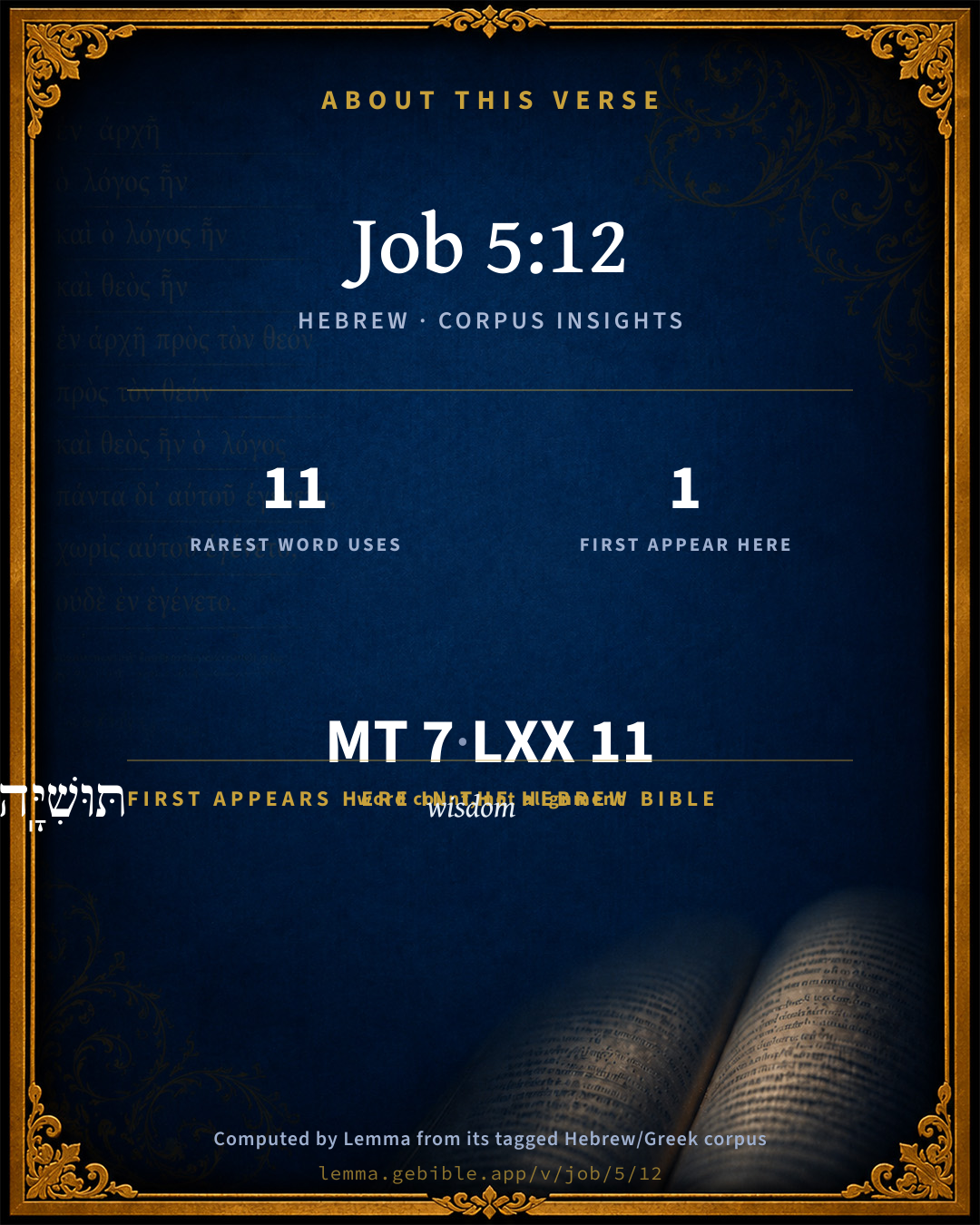
The rarest word here is עֲרוּמִ֑ים crafty H6175 — appearing just 11 times in the whole Hebrew Bible.

First appearance in Scripture

This word makes its first canonical appearance in the Hebrew Bible here:

  • תּוּשִׁיָּֽה wisdom H8454

Shared distinctive vocabulary

עֲרוּמִ֑ים crafty H6175 occurs in 11 verses of the Hebrew Bible. Also found in:

Grammatical profile

  • 2 verbs
  • 3 nouns
  • 1 adjective
  • 1 particle

Verb forms

  • מֵ֭פֵר Hiphil · Participle Active
  • תַעֲשֶׂ֥ינָה Qal · Imperfect

Hebrew & Septuagint length

In English translation the verse runs 15 words from the Hebrew and 14 from the Septuagint (LXX English) — closely comparable.

A rough comparison of the two English renderings, which tokenize alike — not a word-level alignment.

Word counts can differ between the Hebrew and the Greek without any difference in meaning — e.g. the Hebrew direct-object marker אֵת has no separate Greek word, and Greek often adds the article ὁ.

In the original languages it is 7 Hebrew tokens and 11 Greek tokens — but the two are counted differently (Hebrew bundles its prefixes and suffixes into one token; the Greek is in lemma form), so that isn’t a like-for-like length.

Cross-references

11

Topical passages linked to Job 5:12 in the Treasury of Scripture Knowledge — connected by theme and wording, ordered by reader-vote popularity; previews shown in the World English Bible.

  • Psalms 21:11 For they intended evil against you. They plotted evil against you which cannot succeed.
  • Psalms 33:10–11 Yahweh brings the counsel of the nations to nothing. He makes the thoughts of the peoples to be of no effect.
  • Isaiah 8:10 Take counsel together, and it shall be brought to nothing; speak the word, and it shall not stand: for God is with us.
  • Proverbs 21:30 There is no wisdom nor understanding Nor counsel against Yahweh.
  • Psalms 37:17 For the arms of the wicked shall be broken, But Yahweh upholds the righteous.
  • Isaiah 37:36 The angel of Yahweh went forth, and struck in the camp of the Assyrians one hundred and eighty-five thousand; and when men arose early in the morning, behold, these were all dead bodies.
  • Acts 12:11 When Peter had come to himself, he said, "Now I truly know that the Lord has sent out his angel and delivered me out of the hand of Herod, and from everything the Jewish people were expecting."
  • Nehemiah 4:15 It happened, when our enemies heard that it was known to us, and God had brought their counsel to nothing, that we returned all of us to the wall, everyone to his work.
  • Job 12:16–17 With him is strength and wisdom; The deceived and the deceiver are his.
  • Acts 23:12–22 When it was day, some of the Jews banded together, and bound themselves under a curse, saying that they would neither eat nor drink until they had killed Paul.
  • Isaiah 19:3 The spirit of Egypt shall fail in the midst of it; and I will destroy the counsel of it: and they shall seek to the idols, and to the charmers, and to those who have familiar spirits, and to the wizards.

Cross-references courtesy of OpenBible.info (CC BY 4.0).

Hebrew and Greek witnesses Masoretic Hebrew ↔ Greek Septuagint

The same verse in the two great witnesses to the Old Testament, shown verse-for-verse.

These are two independent witnesses, not word-aligned to each other, and the Septuagint is shown in lemma (dictionary) form.

Hebrew Job 5:12 Masoretic · Westminster Leningrad Codex

מֵ֭פֵר מַחְשְׁב֣וֹת עֲרוּמִ֑ים וְֽלֹא תַעֲשֶׂ֥ינָה יְ֝דֵיהֶ֗ם תּוּשִׁיָּֽה

He frustrates the devices of the crafty, So that their hands can't perform their enterprise.

World English Bible · Public Domain

Greek LXX Job 5:12 Septuagint · lemma form

διαἀλλάσσω βουλή πανοῦργος καί οὐ μή ποιέω ὁ χείρ αὐτός ἀληθής

frustrating the counsels of the crafty, and their hands shall not perform the truth:

LXX2012 (modern English Septuagint) · Public Domain

On this verse, Albert Barnes' Notes on the Bible discusses the Septuagint’s reading. Read the note in Commentary ↓

Hebrew: Westminster Leningrad Codex (CC BY 4.0). Greek: Septuagint (public domain); English from LXX2012 (modern English Septuagint) (Public Domain). How the Septuagint differs from the Hebrew →

Commentary

Notes on Job 5:12 from classic Christian and Jewish commentators (each source and its license shown beneath its notes). The classic Christian expositions comment on the surrounding passage and are grouped to its opening verse, so a note may address several verses; the Jewish commentaries on the Tanakh (Rashi and others) are per-verse, so they appear only where the commentator wrote on this verse.

Lemma curates 59 commentaries, every one of them public domain or Creative Commons licensed, each selected and text-cleaned for this edition rather than reprinted as found. About our sources →

Trapp's Complete Commentary

John Trapp

Job 5:12 He disappointeth the devices of the crafty, so that their hands cannot perform [their] enterprise.

Ver. 12. He disappointeth the devices of the crafty] He vacateth and rendereth ineffectual the curious contrivances of the world’s wizards, full of serpentine subtilty, and so setteth his people in safety by out plotting their enemies; served he not Pharaoh so (who dealt craftily with our fathers, κατασοφισαμενος, saith Stephen, Act 7:19)? and Saul, that subtle tyrant? and Herod, that crafty fox? Luk 13:32; and all the primitive and modern persecutors, to whom the old dragon had lent his seven heads to plot, and his ten horns to push against the people of God, but all to no purpose? God disappointed the devices of those malignants: so the Vulgate rendereth this text, which the Chaldee appropriateth to Pharaoh and his counsellors, who said, Come, and let us deal wisely; when as (in laying hard tasks upon the Israelites to keep them from increasing) they never dealt more foolishly; for who knows not that your labouring men have the most and the lustiest children.

So that their hands cannot perform their enterprise] They could not give their plots an actual being or subsistence. Their hands bring nothing soundly to pass, so Broughton rendereth it. Others thus, Their hands cannot perform their wisdom; that is, execute what they had projected. Perceive ye how we prevail nothing? said the Pharisees, Joh 12:19. Nomine Christianorum deleto qui Romp evertebant; the name of Christians being erased who Romp has destroyed. so those cruel crafties of the primitive times sounded the triumph beforehand, and engraved the victory upon the pillars of marble; but the Church may still sing as of old, "They are brought down and fallen; but we are risen, and stand upright." Charles V and the French king had covenanted the utter extirpation of the Lutheran faction throughout their dominions; but God found them other employment, and gave his Church a happy halcyon. And who knows not how God hath hitherto helped us of this nation against the power and policy of earth and of hell?

John Trapp, A Commentary or Exposition upon All the Books of the Old and New Testament (1647–1656) — public domain. Text from a community e-Sword module.

The Biblical Illustrator

Joseph S. Exell

Job_5:12

He disappointeth the devices of the crafty.

The disappointment of the crafty

The word crafty may mean prudent, but usually it denotes such as are wickedly cunning. The meaning of the text is, that with how much art and subtilty soever wicked men may lay their plots and ill designs, there is a God who both can and frequently doth disappoint and baffle them, make them vain, and of none effect.

I. When may we suppose the disappointments of crafty mens devices to be from God? That is, as the extraordinary effects of His particular and special providence. Reference need not be made to such as are miraculous.

1. When a disappointment shall be brought about in a way evidently strange, surprising, and unusual.

2. The hand of God is in those disappointments which involve men either in those very mischiefs which they had prepared for others, or at least in others, for their grievousness and soreness, not unlike them.

3. When the devices of wicked men shall luckily meet with a disappointment, just at that very time, when they are ripe and ready for execution.

4. When good men, at the very time of their praying for their enemys disappointment, shall obtain their desire.

5. When a great number of unexpected accidents shall, as it were, conspire to begin, carry on, and at last consummate any notable disappointment.

II. How eminently Gods hand appeared in the deliverances of this nation. Which we this day, Nov. 5, commemorate.

III. Practical inferences. Gods deliverances should--

1. Discourage the crafty from forming any more schemes.

2. Encourage us, in all our straits and difficulties, to place our hope and confidence in God.

3. To make our earnest prayers to God for help in our time of need.

4. Since God has done such wonderful things for us, we must be sure not to forget to glorify Him. (Sir Wm. Dawes, Bart. , D. D.)

The designing projects of ambitious men defeated

1. It hath been a matter of fatal experience that there always were, in all ages of the world, devices of wicked men, and designs of mischief; and it is consistent with the wisdom and goodness of God to suffer designing men to carry on their ambitious projects with a probable show of success.

(1) Possibly to exercise the prudence and courage of the innocent, and virtuous, when their designs are laid very deep.

(2) To discover the inveterate malice and secret cruelty of those mens tempers, who, under the calm, mild, and endearing names of religion, and the public good, do stick to no villainies to push on their black designs.

(3) Perhaps that God may manifest His particular and vigilant care of His Church, even reduced to extremities.

2. These devices have been, by the good providence of God, miraculously defeated. They have been vain, not only in respect of others against whom they were levelled, but also mischievous to those that contrived them.

3. The natural result of these particulars is to praise God, and we, being delivered, ought to glorify Him. (Tho. Whincop, D. D.)

The Biblical Illustrator, edited by Joseph S. Exell (c. 1880s–1900s) — public domain. Text from a community e-Sword module.

Joseph Benson's Commentary

Job 5:12. He disappointeth the devices of the crafty — On the contrary, he defeats the craftiest designs of evil and subtle men to exalt themselves. They may place a great deal of confidence in their own abilities, and, without any regard to the overruling hand of Providence, may imagine that their good or bad success in the world depends wholly on their own wisdom and efforts: they may form deep and secret designs; and, to the utmost stretch of their knowledge and foresight, may contrive and project measures which will have the most plausible appearance of accomplishing their purpose. But after all this dexterous management, should the Almighty once interpose, and throw an obstacle in their way, all their crafty devices are frustrated, and their promising expectations vanish away. So that their hands cannot perform their enterprise — Hebrew, תושׁיה, tushijah, a word of an extensive meaning, implying that which is solid and substantial, or which is wise, good, and virtuous. Instead of executing any thing of moment, any thing advantageous or praiseworthy; instead of having the satisfaction of seeing a prosperous event of their best-formed counsels, they quickly perceive with what weak hands they have been labouring, and that all their aspiring attempts are vain and fruitless.

Joseph Benson's Commentary on the Old and New Testaments (1811–1818) — public domain. Text from a community e-Sword module.

Jamieson, Fausset & Brown

Robert Jamieson, A. R. Fausset & David Brown

enterprise--literally, "realization." The Hebrew combines in the one word the two ideas, wisdom and happiness, "enduring existence" being the etymological and philosophical root of the combined notion [UMBREIT].

Jamieson, Fausset & Brown — Commentary Critical and Explanatory on the Whole Bible (1871) — public domain (CC PDM 1.0). Text via the HelloAO Bible API.

Adam Clarke's Commentary

Verse 12. He disappointeth the devices of the crafty] All these sayings refer to God's particular providence, by which he is ever working for the good, and counterworking the plots of the wicked. And as various as are the contingent, capricious, and malevolent acts of men, so varied are his providential interferences; disappointing the devices, snares, and plots of the crafty, so that their plans being confounded, and their machinery broken in pieces, their hands cannot perform their enterprises.

Adam Clarke's Commentary on the Bible (1810–1826) — public domain. Text from a community e-Sword/MySword module.

Ellicott's Commentary for English Readers

(12) So that their hands cannot perform their enterprise.—Or, so that their hands can do-nothing that is sound or of worth, can accomplish nothing effectual.

A Bible Commentary for English Readers, edited by Charles John Ellicott (1878–1897) — public domain. Text from a community e-Sword module.

The Cambridge Bible for Schools and Colleges

gen. ed. J. J. S. Perowne

12–16. Job_5:10-11 describe how the stream of God’s goodness acts when it moves directly, bearing up upon it the humble and those that mourn towards safety or salvation. These verses describe how the stream moves when it meets with obstacles, such as craft and evil.

he disappointeth] The same word is rendered, he frustrateth, Isa_44:25.

their enterprise] A difficult word to translate. It is a technical term of the Hebrew Wisdom or Philosophy, and, except in Isa_28:29, Mic_6:9, occurs only in Job and Proverbs. It seems to mean that which is essential. Hence it is said of a state or action when it corresponds to the idea; and conversely of thought when it corresponds to the reality, as ch. Job_11:6, Job_12:16. It is used here in the former sense (cf. ch. Job_6:13), and the words mean, their hands perform nothing effectual (Sept. true), or nothing to purpose.

The Cambridge Bible for Schools and Colleges (gen. ed. J. J. S. Perowne; Cambridge University Press, 1878–1918) — public domain. Text from a community e-Sword module.

John Gill's Exposition

He disappointeth the devices of the crafty,.... Or, "it disappointeth"; that is, the rain, as some Jewish commentators (m) interpret it, and the whole paragraph to this sense; the rain coming upon the earth makes it fruitful, and causes it to produce a plentiful crop, whereby the schemes of crafty men are disappointed, who in a time of drought withhold the corn, and enhance the price of it, and distress the poor; and this in order to make a penny of them, according to Amo 8:4; but through the rain falling are not able to gain their end, but are obliged to bring out their corn, and sell it at a low price, and so are taken in their own craftiness; their counsel becomes brutish, and they are brought into bad circumstances themselves, and the poor saved from being ground and oppressed by them, and have hope for the future of plenty of provisions, to the confusion and astonishment of their oppressors: but the Targum interprets this of the Egyptians cunningly devising mischief against the Israelites, without success; and not amiss, since that affair might be well known to Eliphaz, and he might have it in view: the fact was this, a new king of Egypt, after the death of Joseph, observing the great increase of the people of Israel in his dominions, and fearing, in case of a war, they should join the enemy, and get out of the land by such an opportunity, calls his nobles, courtiers, and counsellors together, to form some wise schemes how to diminish them, Exo 1:8; and the first was to set taskmasters over them, and afflict them with hard bondage, but this succeeded not, Exo 1:11; for the more they were afflicted the more they multiplied and grew; another decree was, to order the midwives to kill the male children of the Israelites, and save alive the females, Exo 1:15; but the midwives, fearing God, obeyed not the order, and the people still multiplied, Exo 1:17; and then a third project was formed, to cast every son born to the Israelites into the river, and drown them, Exo 1:22; but notwithstanding this they were preserved, as Moses, Exo 2:10, and doubtless many others; the people increased so, that they went out of Egypt six hundred thousand men, Exo 12:37; this was a recent thing, it may be in the times of Eliphaz, and which he might easily call to mind: and he might also have respect to a more remote case, that of the builders of Babel, who devised a scheme to build a tower, whose top should reach to heaven, and secure them from a dispersion of them throughout the earth, Gen 11:1; when God descended in the display of his power and providence, confounded their language, so that they were obliged to desist from their enterprise, and were scattered throughout the earth, which by their scheme they thought to have prevented: this may be applied to wicked crafty men in common, who devise schemes to commit sin, and gratify their lusts, to get for themselves riches and honour, and to do mischief to others, which God in his providence breaks, frustrates, and makes of none effect; and to false teachers, that walk in craftiness, lie in wait to deceive, and make use of cunningly devised fables, coin new doctrines, invent new forms of worship, and appoint new ordinances, and contrive different ways and methods of salvation; all which is foolishness with God, and to such persons Job 5:13 is applied by the Apostle Paul, Co1 3:19, and this may likewise respect wicked princes and potentates, with their counsellors and wise politicians, who in former, as well as in later times, have formed designs against their neighbours, and to the hurt of the interest of true religion particularly; but have been baffled and confounded by Divine Providence, of which, as there were many instances in Israel of old, so in our British Isles of late:

so that their hands cannot perform their enterprise; what their heads have contrived, what they have resolved and determined upon, and what they have began to effect, but could not go on with; or, "bring it soundly to pass", as Mr. Broughton renders it; that is, could not complete it, or bring it to perfection; and indeed not able to do "any thing" (n), as some translate the word, not anything of what they devised and contrived: it signifies "that which is", which has a being and substance, and solidity in it (o), but nothing of this kind could be done; it is sometimes rendered "wisdom", and "sound wisdom", Pro 2:7; and so it is here by some (p), and may signify, that though their counsels were deeply laid, and wisely formed, according to the best rules of wisdom and prudence, they yet are not able to bring them to pass; which shows the infinitely superior wisdom of God, and his overruling providence, and which therefore must be a great encouragement to seek unto him, and leave every cause and case with him.

(m) Aben Ezra, Jarchi, & R. Simeon Bar Tzemach. (n) "quicquam", Pagninus, Vatablus, Drusius, Junius & Tremellius, Piscator; "quicquam rei", Cocceius, Michaelis; so Kimchi in Sepher Shorash, rad. (o) "Consistentiam", Montanus; "nihil solidi", Tigurine version. (p) "Sapientiam", Schmidt; so Aben Ezra & Syr. ver. "astu", Codurcus.

John Gill's Exposition of the Whole Bible (1746–1763) — public domain (CC PDM 1.0). Text via the HelloAO Bible API.

Albert Barnes' Notes on the Bible

He disappointeth the devices of the crafty - He foils them in their schemes, or makes their plans vain. This too was the result of close observation on the part of Eliphaz. He had seen instances where the plans of crafty, designing, and artful people had been defeated, and where the straightforward had been prospered and honored. Such cases led him to believe that God was the friend of virtue, and was worthy of entire confidence.

So that their hands - So that they. The hands are the instruments by which we accomplish our plans.

Their enterprise - Margin, Or, “anything.” Hebrew תשׁיה tûshı̂yâh. This word properly means uprightness from ישׁע yâsha‛; then help, deliverance, Job 6:13; then purpose, undertaking, enterprise, that is, what one wishes to set up or establish. Gesenius. This is its meaning here. Vulgate, “Their hands cannot finish (implere) what they had begun.” Septuagint, “Their hands cannot perform that which is true” - ὰληθές alēthes. The Chaldee Paraphrase refers this to the defeat of the purposes of the Egyptians: “Who made vain the thoughts of the Egyptians, who acted wisely (or cunningly - דחכימו) that they might do evil to Israel, but their hands did not perform the work of their wisdom Job 5:13, who took the wise men of Pharaoh in their own wisdom, and the counsel of their perverse astrologers he made to return upon them.” The general sense is, that artful and designing men - people who work in the dark, and who form secret purposes of evil, are disappointed and foiled. Eliphaz probably had seen instances of this, and he now attributes it to God as rendering him worthy of the confidence of people. It is still true. The crafty and the designing are often foiled in such a manner as to show that it is wholly of God. He exposes their designs in this way, and shows that he is the friend of the sincere and the honest; and in doing this, he shows that he is worthy the confidence of his people.

Albert Barnes' Notes on the Bible (1834–1885) — public domain. Text from a community e-Sword/MySword module.

Matthew Poole's English Annotations

Of the crafty; such as are cunning to work evil, and to cover it with fair pretences, as hypocrites use to do, and as Job’s friends charged him with doing: God breaks the hopes and designs of such men; as he hath now blasted thy expectation, and taken away thy outward happiness, which was the thing thou didst design in taking up the profession of religion.

Their enterprise; or, any thing; or, what is solid or substantial; or, wisdom, i.e. their wise counsel or crafty design. They cannot execute their cunning contrivances.

Matthew Poole's English Annotations on the Holy Bible (1683–1685) — public domain. Text from a community e-Sword/MySword module.

Whedon's Commentary on the Bible

Daniel D. Whedon

12. Crafty — From ערם, to spin, twist. Furst cites three Hebrew words expressive of cunning or evil thought, (he might have added pathal, froward, Job_5:13,) whose roots give the same idea of spinning. However men may work in the dark, spinning their evil devices, God “breaks them to pieces,” (disappointeth,) מפר.

Enterprise — תושׁיה, toushiyyah. The root of the word indicates being, substance, that which is. See note on Job_6:13. It stands in contrast with און, evil, which signifies, also, emptiness, nothingness, which is its root idea. The wicked can accomplish nothing substantial.

Daniel D. Whedon (gen. ed.), Commentary on the Old and New Testaments (1874–1909) — public domain. Text from a community e-Sword module.

The Pulpit Commentary

He disappointeth the devices of the crafty; or, frustrateth makes them of no effect. (comp. Psa_33:10 Isa_8:10) Some suppose Eliphaz to insinuate here that Job"s apparent wisdom has not been true wisdom, but cunning or craft, and that therefore God has brought it to nought. But to us it rather seems that he enunciates a general sentiment, and a true one. He is giving examples of the "marvellous things" which God does (ver. 9), and naturally enumerates among them his victories over the craft and cunning of his adversaries. (comp. Isa_44:25) So that their hands cannot perform their enterprise; literally, and their hands accomplish nothing solid. No substantial result is effected by all their scheming.

The Pulpit Commentary (1880–1919), ed. H.D.M. Spence-Jones & Joseph S. Exell — public domain. Text from a community e-Sword module.

Keil & Delitzsch

C. F. Keil & F. Delitzsch

12 Who bringeth to nought the devices of the crafty,

So that their hands cannot accomplish anything;

13 Who catcheth the wise in their craftiness;

And the counsel of the cunning is thrown down.

14 By day they run into darkness,

And grope in the noon-day as in the night.

15 He rescueth from the sword, that from their mouth,

And from the hand of the strong, the needy.

16 Hope ariseth for the weak,

And folly shall close its mouth.

All these attributes are chosen designedly: God brings down all haughtiness, and takes compassion on those who need it. The noun תּוּשׁיּה, coined by the Chokma, and out of Job and Proverbs found only in Mic 6:9; Isa 28:29, and even there in gnomical connection, is formed from ישׁ, essentia, and signifies as it were essentialitas, realitas: it denotes, in relation to all visible things, the truly existing, the real, the objective; true wisdom (i.e., knowledge resting on an objective actual basis), true prosperity, real profiting and accomplishing. It is meant that they accomplish nothing that has actual duration and advantage. Job 5:13 cannot be better translated than by Paul, Co1 3:19, who here deviates from the lxx. With נמהרה, God's seizure, which prevents the contemplated achievement, is to be thought of. He pours forth over the worldly wise what the prophets call the spirit of deep sleep (תּרדּמה) and of dizziness (עועים). On the other hand, He helps the poor. In מפיהם מחרב the second מן is local: from the sword which proceeds from their mouth (comp. Psa 64:4; Psa 57:5, and other passages). Bttch. translates: without sword, i.e., instrument of power (comp. Job 9:15; Job 21:9); but מן with חרב leads one to expect that that from which one is rescued is to be described (comp. Job 5:20). Ewald corrects מחרב, which Olsh. thinks acute: it is, however, unhebraic, according to our present knowledge of the usage of the language; for the passives of חרב are used of cities, countries, and peoples, but not of individual men. Olsh., in his hesitancy, arrives at no opinion. But the text is sound and beautiful. עלתה with pathetic unaccented ah (Ges. 80, rem. 2, f), from עולה = עולה, as Ps. 92:16 Chethib.

Keil & Delitzsch — Biblical Commentary on the Old Testament (1861–1891) — public domain (CC PDM 1.0). Text via the HelloAO Bible API. (Old Testament only.)

Rashi

Rabbi Shlomo Yitzchaki (Rashi)

so that their hands do not carry out their plans The counsel that they planned to perform.

Rashi on the Tanakh — English translations: “The Judaica Press complete Tanach with Rashi, translated by A. J. Rosenberg” (CC BY 4.0); “Pentateuch with Rashi's commentary by M. Rosenbaum and A.M. Silbermann, 1929-1934” (public domain); “The Metsudah Tanach series, Lakewood, N.J” (CC BY 4.0); and “The Book of Joshua, Metsudah Publications, 1997” (CC BY 4.0). Text via Sefaria.

Lesson kit

Teaching starters — assembled from the data on this page, not authored interpretation. Every prompt links to the verse data it draws on. Edit before teaching.

Job, in the Wisdom, opens this verse with 7 words (7 distinct Hebrew lemmas). Its most distinctive word is ʻârûwm (“crafty”). A historical commentator’s framing appears above. Read the whole chapter for the surrounding context.

Discussion questions

  1. How does “crafty” (ʻârûwm) shape what this verse is saying?
  2. This is the first place “wisdom” appears in Scripture (first appears here). What does its debut here establish?
  3. How does Genesis 3:1, which shares the word «crafty», read alongside this verse?
  4. These translations render this verse differently; the difference is in the English rendering, not the original. What questions does that raise?
  5. «מֵ֭פֵר» is a Hiphil Participle Active verb. How does that grammatical form shape the action described?
  6. Compare how Trapp's Complete Commentary and The Biblical Illustrator read this verse. Where do they agree or differ?

Things to notice

Reading settings

Reading text

Shown beneath each verse's original-language words.

Old Testament
Old Testament edition

Read the OT as the Masoretic Hebrew (MT) or the Greek Septuagint (LXX).

English shown for the Greek Septuagint (in the Hebrew ↔ Greek comparison).

Comparing translations? Open the Compare panel on any verse page to stack up to four side by side.