Ezekiel 16:59

Hebrew (Westminster Leningrad Codex) Ezekiel 16:59 appears in the Hebrew Old Testament. The text above is from the Westminster Leningrad Codex. Each word links to its Strong’s number, a concise gloss, and parsing drawn from the Open Scriptures Hebrew Bible morphology. Click any word for its full Brown-Driver-Briggs (BDB) entry.
Download image
Cite this verse

Ezekiel 16:59 (World English Bible). Public Domain. Lemma interlinear Bible study tool, https://lemma.gebible.app/v/ezekiel/16/59.

Show BibTeX & RIS
BibTeX
RIS
English Translation
For thus says the Lord Yahweh: I will also deal with you as you have done, who have despised the oath in breaking the covenant.
World English Bible · Public Domain
Download a study sheet

One document with this verse’s original text, its word-by-word gloss line, the meaning frame, cross-references with their text, attributed commentary, and full source and license credits — printable, and it pastes into notes with its structure intact.

This verse Autodidact and up

Study sheet (.html) Plain text (.txt)

A passage Seminary Student

Up to 50 verses in one chapter. A passage sheet keeps up to 6 commentary sources and 12 cross-references per verse, in the order this page ranks them, and says so on the sheet whenever that leaves anything out. Ask for a single verse and you get the Autodidact verse sheet above.

Everything on this page stays free to read, with no account — the sheet is a download of what is already on screen, not access to it.

Want to remove ads? Support Godless Engineer
Compare translations 3

The same verse in 3 English versions, stacked beneath the original-language interlinear above. Click any original word for its lexicon entry.

Each is an independent rendering of the whole verse — the interlinear is not word-aligned to these translations.

Highlighted words mark where these versions differ — a whole-verse word diff, not a word-by-word alignment.

  • World English Bible Public Domain
    For thus says the Lord Yahweh: I will also deal with you as you have done, who have despised the oath in breaking the covenant.
  • King James Version Public Domain
    For thus saith the Lord GOD; I will even deal with thee as thou hast done, which hast despised the oath in breaking the covenant.
  • unfoldingWord Literal Text CC BY-SA 4.0
    The Lord Yahweh says this: I will deal with you as you deserve, you who have despised your oath by breaking the covenant.

unfoldingWord Literal Text — © unfoldingWord, licensed CC BY-SA 4.0. Word-aligned USFM3 via Door43 (git.door43.org/unfoldingWord/en_ult).

Versions to compare (up to 4)

3 of 4 selected

Show all 18 translations

Every available English version of this verse, each an independent rendering of the whole verse.

  • World English Bible Public Domain
    For thus says the Lord Yahweh: I will also deal with you as you have done, who have despised the oath in breaking the covenant.
  • Berean Standard Bible Public Domain
    For this is what the Lord GOD says: I will deal with you according to your deeds, since you have despised the oath by breaking the covenant.
  • Majority Standard Bible Public Domain
    For this is what the Lord GOD says: I will deal with you according to your deeds, since you have despised the oath by breaking the covenant.
  • King James Version Public Domain
    For thus saith the Lord GOD; I will even deal with thee as thou hast done, which hast despised the oath in breaking the covenant.
  • American Standard Version (1901) Public Domain
    For thus saith the Lord Jehovah: I will also deal with thee as thou hast done, who hast despised the oath in breaking the covenant.
  • Revised Version (1885) Public Domain
    For thus saith the Lord GOD: I will even deal with thee as thou hast done, which hast despised the oath in breaking the covenant.
  • Geneva Bible (1599) Public Domain
    For thus saith the Lord God, I might euen deale with thee, as thou hast done: when thou didest despise the othe, in breaking the couenant.
  • Douay-Rheims (1899) Public Domain
    For thus saith the Lord God: I will deal with thee, as thou hast despised the oath, in breaking the covenant:
  • Young's Literal Translation Public Domain
    For thus said the Lord Jehovah: I have dealt with thee as thou hast done, In that thou hast despised an oath -- to break covenant.
  • Literal Standard Version CC BY-SA 4.0
    For thus said Lord YHWH: I have dealt with you as you have done, || In that you have despised an oath—to break covenant.
  • Unlocked Literal Bible CC BY-SA 4.0
    The Lord Yahweh says this: I will deal with you as you deserve, you who have despised your oath by breaking the covenant.
  • unfoldingWord Literal Text CC BY-SA 4.0
    The Lord Yahweh says this: I will deal with you as you deserve, you who have despised your oath by breaking the covenant.
  • Darby Bible Public Domain
    For thus saith the Lord Jehovah: I will even deal with thee as thou hast done, who hast despised the oath, and broken the covenant.
  • World Messianic Bible Public Domain
    “‘For the Lord GOD says: “I will also deal with you as you have done, who have despised the oath in breaking the covenant.
  • Webster's Bible Public Domain
    For thus saith the Lord GOD; I will even deal with thee as thou hast done, who hast despised the oath in breaking the covenant.
  • Free Bible Version CC BY-SA 4.0
    This is what the Lord God says: I'm going to punish you according to your sins, because you treated the promise you made with contempt by breaking the agreement.
  • Bible in Basic English Public Domain
    For this is what the Lord has said: I will do to you as you have done, you who, putting the oath on one side, have let the agreement be broken.
  • JPS Tanakh (1917) Public Domain
    For thus saith the Lord GOD: I will even deal with thee as thou hast done, who hast despised the oath in breaking the covenant.

Literal Standard Version (2020), Covenant Press — licensed CC BY-SA 4.0. Text via the HelloAO Bible API (eBible.org). Unlocked Literal Bible (unfoldingWord) — licensed CC BY-SA 4.0. Text via the HelloAO Bible API (eBible.org). unfoldingWord Literal Text — © unfoldingWord, licensed CC BY-SA 4.0. Word-aligned USFM3 via Door43 (git.door43.org/unfoldingWord/en_ult). Free Bible Version, Dr. Jonathan Gallagher — licensed CC BY-SA 4.0. Text via the HelloAO Bible API (eBible.org).

Word by word

More ways to search: Search by grammar → Find every occurrence → Compare this word →

Practice this passage: Drill this verse → Learn its vocabulary →

אָלָ֖ה
ʼâlâh
H423
“oath”
Noun, Common, Feminine, Singular, Absolute
Part of Speech
Noun
Type
Common
Gender
Feminine
Number
Singular
State
Absolute
Full BDB Definition

Origin: from H422

TWOT: 91a

oath - oath of covenant - curse - from God - from men - execration
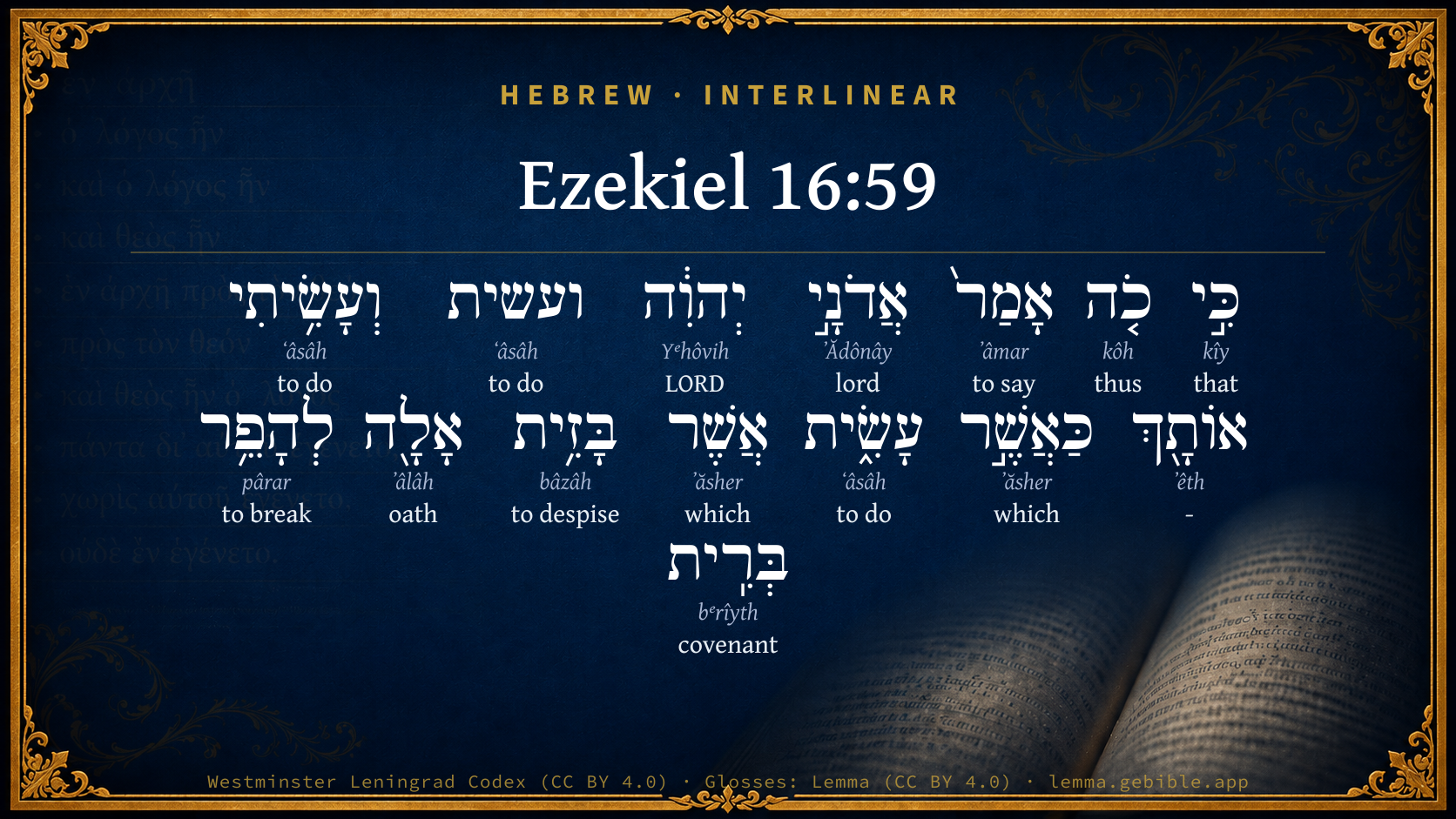
  1. כִּ֣י kîy H3588 “that” Conjunction
  2. כֹ֤ה kôh H3541 “thus” Adverb
  3. אָמַר֙ ʼâmar H559 “to say” Verb, Qal, Perfect, 3rd Person, Masculine, Singular
  4. אֲדֹנָ֣י ʼĂdônây H136 “Lord · my” Noun, Common, Masculine, Plural, Construct + Suffix, Personal, 1st Person, Common, Singular
  5. יְהוִ֔ה Yᵉhôvih H3069 “LORD” Noun, Proper
  6. ועשית ʻâsâh H6213 “and · to do” Conjunction + Verb, Qal, Sequential Perfect, 2nd Person, Feminine, Singular
  7. וְעָשִׂ֥יתִי ʻâsâh H6213 “and · to do” Conjunction + Verb, Qal, Sequential Perfect, 1st Person, Common, Singular
  8. אוֹתָ֖ךְ ʼêth H853 “- · you” Particle, Direct Object + Suffix, Personal, 2nd Person, Feminine, Singular
  9. כַּאֲשֶׁ֣ר ʼăsher H834 “like/as · which” Preposition + Particle, Relative
  10. עָשִׂ֑ית ʻâsâh H6213 “to do” Verb, Qal, Perfect, 2nd Person, Feminine, Singular
  11. אֲשֶׁר ʼăsher H834 “which” Particle, Relative
  12. בָּזִ֥ית bâzâh H959 “to despise” Verb, Qal, Perfect, 2nd Person, Feminine, Singular
  13. לְהָפֵ֥ר pârar H6565 “to break” Preposition + Verb, Hiphil, Infinitive Construct
  14. בְּרִֽית bᵉrîyth H1285 “covenant” Noun, Common, Feminine, Singular, Absolute

About this verse

These counts appear in no published source. They are computed here, from the morphology-tagged text and Lemma’s own curated glosses. What Lemma adds →

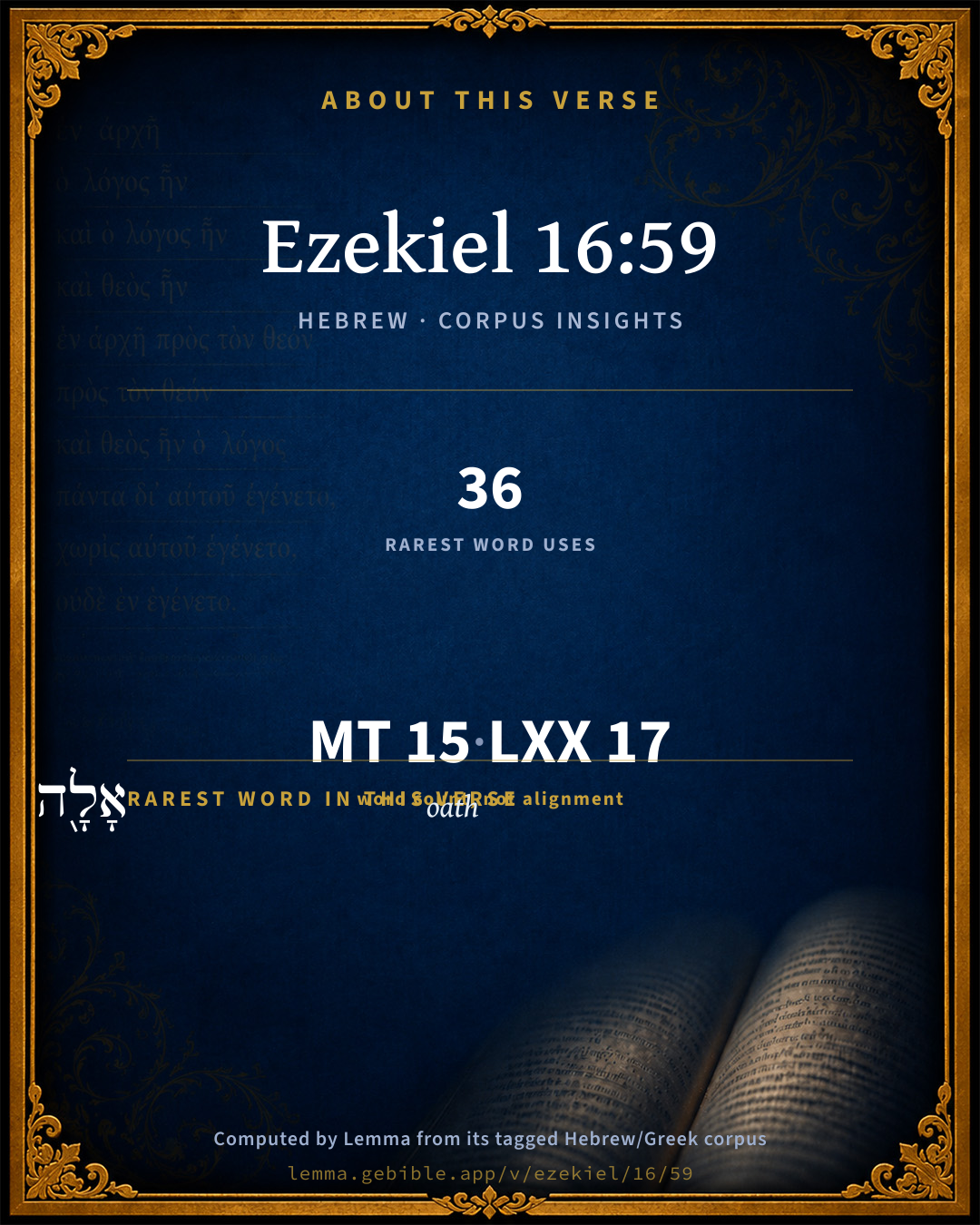
15
words
12
distinct lemmas
Prophets
section

Shared distinctive vocabulary

אָלָ֖ה oath H423 occurs in 32 verses of the Hebrew Bible. Also found in:

Grammatical profile

  • 6 verbs
  • 4 nouns
  • 1 conjunction
  • 1 adverb
  • 3 particles

Verb forms

  • אָמַר֙ Qal · Perfect
  • ועשית Qal · Sequential Perfect
  • וְעָשִׂ֥יתִי Qal · Sequential Perfect
  • עָשִׂ֑ית Qal · Perfect
  • בָּזִ֥ית Qal · Perfect
  • לְהָפֵ֥ר Hiphil · Infinitive Construct

Repetition

Words recur within this verse — often emphatic in Hebrew:

  • ועשית to do H6213 ×3
  • כַּאֲשֶׁ֣ר which H834 ×2

Hebrew & Septuagint length

In English translation the verse runs 25 words from the Hebrew and 26 from the Septuagint (LXX English) — closely comparable.

A rough comparison of the two English renderings, which tokenize alike — not a word-level alignment.

Word counts can differ between the Hebrew and the Greek without any difference in meaning — e.g. the Hebrew direct-object marker אֵת has no separate Greek word, and Greek often adds the article ὁ.

In the original languages it is 15 Hebrew tokens and 17 Greek tokens — but the two are counted differently (Hebrew bundles its prefixes and suffixes into one token; the Greek is in lemma form), so that isn’t a like-for-like length.

Cross-references

16

Topical passages linked to Ezekiel 16:59 in the Treasury of Scripture Knowledge — connected by theme and wording, ordered by reader-vote popularity; previews shown in the World English Bible.

  • Isaiah 24:5 The earth also is polluted under the inhabitants of it; because they have transgressed the laws, violated the statutes, broken the everlasting covenant.
  • Ezekiel 17:19 Therefore thus says the Lord Yahweh: As I live, surely my oath that he has despised, and my covenant that he has broken, I will even bring it on his own head.
  • Exodus 24:1–8 He said to Moses, "Come up to Yahweh, you, and Aaron, Nadab, and Abihu, and seventy of the elders of Israel; and worship from a distance.
  • Deuteronomy 29:10–15 You stand this day all of you before Yahweh your God; your heads, your tribes, your elders, and your officers, even all the men of Israel,
  • Deuteronomy 29:25 Then men shall say, Because they forsook the covenant of Yahweh, the God of their fathers, which he made with them when he brought them forth out of the land of Egypt,
  • 2 Chronicles 34:31–32 The king stood in his place, and made a covenant before Yahweh, to walk after Yahweh, and to keep his commandments, and his testimonies, and his statutes, with all his heart, and with all his soul, to perform the words of the covenant that were written in this book.
  • Isaiah 3:11 Woe to the wicked! Disaster is upon them; For the deeds of his hands will be paid back to him.
  • Jeremiah 2:19 Your own wickedness shall correct you, and your backsliding shall reprove you: know therefore and see that it is an evil thing and a bitter, that you have forsaken Yahweh your God, and that my fear is not in you, says the Lord, Yahweh of Hosts.
  • Jeremiah 22:9 Then they shall answer, Because they forsook the covenant of Yahweh their God, and worshiped other gods, and served them.
  • Jeremiah 31:32 not according to the covenant that I made with their fathers in the day that I took them by the hand to bring them out of the land of Egypt; which my covenant they broke, although I was a husband to them, says Yahweh.
  • Ezekiel 7:4 My eye shall not spare you, neither will I have pity; but I will bring your ways on you, and your abominations shall be in the midst of you: and you shall know that I am Yahweh.
  • Ezekiel 7:8–9 Now will I shortly pour out my wrath on you, and accomplish my anger against you, and will judge you according to your ways; and I will bring on you all your abominations.
  • Ezekiel 14:4 Therefore speak to them, and tell them, Thus says the Lord Yahweh: Every man of the house of Israel who takes his idols into his heart, and puts the stumbling block of his iniquity before his face, and comes to the prophet; I Yahweh will answer him therein according to the multitude of his idols;
  • Ezekiel 17:13–16 and he took of the seed royal, and made a covenant with him; he also brought him under an oath, and took away the mighty of the land;
  • Matthew 7:1–2 "Don't judge, so that you won't be judged.
  • Romans 2:8–9 but to those who are self-seeking, and don't obey the truth, but obey unrighteousness, will be wrath and indignation,

Cross-references courtesy of OpenBible.info (CC BY 4.0).

Hebrew and Greek witnesses Masoretic Hebrew ↔ Greek Septuagint

The same verse in the two great witnesses to the Old Testament, shown verse-for-verse.

These are two independent witnesses, not word-aligned to each other, and the Septuagint is shown in lemma (dictionary) form.

Hebrew Ezekiel 16:59 Masoretic · Westminster Leningrad Codex

כִּ֣י כֹ֤ה אָמַר֙ אֲדֹנָ֣י יְהוִ֔ה ועשית וְעָשִׂ֥יתִי אוֹתָ֖ךְ כַּאֲשֶׁ֣ר עָשִׂ֑ית אֲשֶׁר בָּזִ֥ית אָלָ֖ה לְהָפֵ֥ר בְּרִֽית

For thus says the Lord Yahweh: I will also deal with you as you have done, who have despised the oath in breaking the covenant.

World English Bible · Public Domain

Greek LXX Ezekiel 16:59 Septuagint · lemma form

ὅδε λέγω κύριος καί ποιέω ἐν σύ καθώς ποιέω ὡς ἀτιμόω οὗτος ὁ παραβαίνω ὁ διαθήκη ἐγώ

Thus says the Lord; I will even do to you as you have done, as you have dealt shamefully in these things to transgress my covenant.

LXX2012 (modern English Septuagint) · Public Domain

Hebrew: Westminster Leningrad Codex (CC BY 4.0). Greek: Septuagint (public domain); English from LXX2012 (modern English Septuagint) (Public Domain). How the Septuagint differs from the Hebrew →

Targum (Aramaic paraphrase)

1

The Targum is the ancient Jewish Aramaic paraphrase of the Hebrew Scriptures — an interpretive translation, not the Hebrew text itself. Onkelos (literal) and Pseudo-Jonathan (expansive) render the Torah, and Jonathan the Prophets. Coverage is partial: where no permissively-licensed English translation exists for a verse, only the Aramaic is shown. This is verse-level text, not a word-by-word alignment to the Hebrew.

  1. Targum Jonathan Prophets (Joshua–Malachi)
    אֲרֵי כִּדְנַן אֲמַר יְיָ אֱלֹהִים וְאִתְפְּרַע מִנִיךְ כְּמָא דַעֲבַדְתְּ דִבְסַרְתְּ עַל מוֹמֵי לְאַשְׁנָאָה קְיָם:

    (no public-domain English translation for this verse)

    Targum Jonathan — Aramaic: “Mikraot Gedolot” (public domain). English: “Sefaria Community Translation” (CC0 1.0 (public-domain dedication)); “London "Chaldee Paraphrase," 1871” (public domain). Text via Sefaria.

Commentary

Notes on Ezekiel 16:59 from classic Christian and Jewish commentators (each source and its license shown beneath its notes). The classic Christian expositions comment on the surrounding passage and are grouped to its opening verse, so a note may address several verses; the Jewish commentaries on the Tanakh (Rashi and others) are per-verse, so they appear only where the commentator wrote on this verse.

Lemma curates 59 commentaries, every one of them public domain or Creative Commons licensed, each selected and text-cleaned for this edition rather than reprinted as found. About our sources →

Trapp's Complete Commentary

John Trapp

Eze 16:59 For thus saith the Lord GOD; I will even deal with thee as thou hast done, which hast despised the oath in breaking the covenant.

Ver. 59. I will even deal with thee.] I will avenge upon thee the quarrel of my covenant. {Lev 26:25}

John Trapp, A Commentary or Exposition upon All the Books of the Old and New Testament (1647–1656) — public domain. Text from a community e-Sword module.

Tyndale Open Study Notes

Tyndale Open Resources

16:59-63 Jerusalem’s sins were serious and had to be judged, but judgment was not God’s last word on Jerusalem. She had been comprehensively breaking God’s covenant and deserved the consequence of death, but God would remember the covenant he had made with her in the beginning. God’s purposes for his people cannot be derailed even by their sin, for his covenant commitment is everlasting (Ps 136). God’s forgiveness of her sins would finally bring Jerusalem to repentance.

Tyndale Open Study Notes — © Tyndale Open Resources, licensed CC BY-SA 4.0. Text via the HelloAO Bible API.

Geneva Bible (1599)

Geneva Bible translators

When thou brakest the covenant which was made between thee and me, as verse 8.

Geneva Bible (1599) marginal notes — public domain. Text via Bolls.life.

Jamieson, Fausset & Brown

Robert Jamieson, A. R. Fausset & David Brown

the oath--the covenant between God and Israel (Deu 29:12, Deu 29:14). As thou hast despised it, so will I despise thee. No covenant is one-sided; where Israel broke faith, God's promise of favor ceased.

Jamieson, Fausset & Brown — Commentary Critical and Explanatory on the Whole Bible (1871) — public domain (CC PDM 1.0). Text via the HelloAO Bible API.

John Calvin's Commentaries

Here, also, God meets the false objection by which the Jews might strive with him; for whatever they were, yet God had entered into covenant with them. They might, therefore, fly to this refuge, that God had bound himself in covenant with them, since he had adopted Abraham with his seed. Although they had provoked God’s anger a thousand times, yet this exception remained, that God ought to stand to his agreement, and not to look at what they had deserved by their ingratitude, but rather to be consistent with his promises. Now, therefore, he returns to this cavil, and says that he is free to break the covenant since they have done so first. I will do, says he, to thee as thou has done. We see, therefore, that the calumny is here repelled by which the Jews could obliquely defame God, as they were accustomed to do, as if he had rendered his covenant void. He says, then, that in agreement it is customary for a person, when deceived, no longer to be necessarily bound to a perfidious breaker of agreements; for covenanting requires mutual faith: but the Jews had violated their agreement, and reduced it to nothing. Hence, through their perfidy and wickedness, God had acquired the liberty of rejecting them, and of no longer reckoning them among his people. Hence, as in the last verse, he said that the Jews paid a just penalty; so now, he adds specially, that he could not be condemned for bad faith in departing from his agreement, because he had to deal with traitors and covenant-breakers who had rendered void their agreement: for there is no covenant when either party declines it. I will do, therefore, to thee as you has done, namely, because you have despised an oath, so as to render the covenant void Here God enlarges upon the crime of revolt, because the Jews had not only dissipated the covenant, but had despised an oath. אלה, aleh, signifies both an oath and a curse; (Deuteronomy 27;) hence some think that the Prophet here looks to the curses by which the law was sanctioned, which I willingly adopt. But we must remark what I have already said, that their criminality is increased, because the Jews had not only acted falsely, but had also set at naught that solemn oath by which they had bound themselves. For as God promised that he would be their God, so Moses stipulated in his name that the people should remain obedient to him, and they all answered, Amen; (Leviticus 26.) A punishment was announced, and such as ought to have terrified them. For the Jews then to neglect this covenant as a mere trifle, was the act of brutal stupidity. Whence we see that their crime was doubled, when the Prophet accuses them of not only being truce-breakers, but also of wantonly deriding God, and of treating their own solemn oath, by which they had bound themselves, as a childish action. It follows —

John Calvin's Commentaries (1540-1563) — public domain. Text from the Calvin Translation Society English edition (1840s-50s) via the Christian Classics Ethereal Library (ccel.org). Calvin's coverage is partial (roughly two-thirds of the Bible); uncommented books and verses are honest gaps, never fabricated. The 19th-century editor's footnotes and remarks are omitted so the notes are faithfully Calvin's own voice.

Ellicott's Commentary for English Readers

(59) In breaking the covenant.—This was the especial point of the heinousness of the sin of the Jews, and the one which so greatly aggravated their guilt. The sin was necessarily proportioned to the light against which it had been committed. (Comp. Joh_9:39; Joh_9:41; Joh_15:22; Joh_15:24.)

A Bible Commentary for English Readers, edited by Charles John Ellicott (1878–1897) — public domain. Text from a community e-Sword module.

The Cambridge Bible for Schools and Colleges

gen. ed. J. J. S. Perowne

59. The fall of Jerusalem, prophetically assumed in Eze_16:58, is now directly threatened. On the “oath” cf. Deu_29:12; Deu_29:14.

The Cambridge Bible for Schools and Colleges (gen. ed. J. J. S. Perowne; Cambridge University Press, 1878–1918) — public domain. Text from a community e-Sword module.

John Gill's Exposition

Nevertheless I will remember my covenant with thee in the days of thy youth,.... The covenant made with them at Sinai, quickly after they came out of Egypt, when they were, both as a body politic and ecclesiastical, in their infant state; for, as Kimchi says, all the while they were in Egypt, and until they, came into the land of Canaan, were called the days of their youth; and to this covenant, which had the nature of a matrimonial contract, the, prophet refers when he speaks of the "love" of their "espousals", and the "kindness" of their "youth", Jer 2:2; this covenant the Lord remembered, and made good his part, though they neglected theirs; and it was particularly remembered when Christ was made under this law, and became the fulfilling end of it to his people; yielding perfect obedience to it, and bearing the penalty of it in their room and stead; for here begins a declaration of the grace and mercy of God to the remnant, according to the election of grace, which were among this degenerate people, and whom the Lord had a special regard unto:

and I will establish unto thee an everlasting covenant; the covenant of grace, made with the Messiah and his spiritual seed; which is confirmed of God in Christ; ordered in all things and sure; whose promises are yea and amen in Christ; and the blessings of it, the sure mercies of David; a covenant that shall never be broken, made void, or removed; but will continue for ever. This is the new covenant, or the covenant of grace, as exhibited and administered under the New Testament; see Heb 8:8.

John Gill's Exposition of the Whole Bible (1746–1763) — public domain (CC PDM 1.0). Text via the HelloAO Bible API.

Haydock's Catholic Bible Commentary

Covenant at Sinai, or under Josue, [Josue] viii., and Exodus xix. 7.

George Leo Haydock (1774–1849), Haydock's Catholic Family Bible and Commentary, 1859 edition — public domain. Excludes Psalms (Douay-Rheims chapter numbering differs from Protestant) and Deuterocanonical books (Catholic canon only).

Matthew Poole's English Annotations

This is ushered in with a most solemn and sacred asseveration.

I will even deal with thee; either thus: Thou hast despised the laws and privileges of my covenant with thee, and I will despise all thy pretensions to my favour by virtue of my covenant; it is mutual, and who breaks it forfeits all benefit by it. Or, deal with thee according as thou hast done to other punished sinners, over which thou hast insulted and condemned.

Hast despised the oath; by wilful and contemptuous despite hast perjured thyself, which is a sin the nations about thee could not be guilty of, for they were not, thou only wast, in covenant with me. Or else, Thou hast contemptuously slighted my bounty and grace, and my faithfulness and truth, and bound thyself by covenant with idols and idolaters, though I had so expressly forbidden them.

The covenant, made in Horeb.

Matthew Poole's English Annotations on the Holy Bible (1683–1685) — public domain. Text from a community e-Sword/MySword module.

Whedon's Commentary on the Bible

Daniel D. Whedon

59. I will even deal with thee as thou hast done — The covenant which Israel has broken is now by Jehovah also declared annulled. (See Eze_16:8 and Deu_29:12.)

Daniel D. Whedon (gen. ed.), Commentary on the Old and New Testaments (1874–1909) — public domain. Text from a community e-Sword module.

John Wesley's Explanatory Notes

In breaking the covenant - So will I break my covenant with thee.

John Wesley, Explanatory Notes Upon the Whole Bible (1754–1765) — public domain. Text via the GEBible commentary corpus.

unfoldingWord translationNotes

Door43 World Missions Community

General Information:

Yahweh continues to speak about Jerusalem as if the city were his unfaithful wife. The city represents the people who live there. (See: Metaphor and Metonymy)

despised your oath by breaking the covenant

Jerusalem broke her marriage covenant with Yahweh, thereby showing that she did not care about the oaths that she had made to him. AT: "despised your oath to me by breaking the covenant that you made with me" (See: Assumed Knowledge and Implicit Information)

translationWords

Lord Yahweh

oath

covenant

unfoldingWord translationNotes — © Distant Shores Media and the Door43 World Missions Community, licensed CC BY-SA 4.0. Source: git.door43.org/Door43/en_tn.

Rashi

Rabbi Shlomo Yitzchaki (Rashi)

I have done with you, etc. I have done evil to you commensurate to your [ungrateful] repayment [to Me] which you made.

that you despised an oath, etc. That one that you accepted upon yourself in Horeb (Deut. 29:11): “That you pass into the covenant of the Lord your God, etc.” But I shall not violate the covenant by not remembering it, because I am not like you.

Rashi on the Tanakh — English translations: “The Judaica Press complete Tanach with Rashi, translated by A. J. Rosenberg” (CC BY 4.0); “Pentateuch with Rashi's commentary by M. Rosenbaum and A.M. Silbermann, 1929-1934” (public domain); “The Metsudah Tanach series, Lakewood, N.J” (CC BY 4.0); and “The Book of Joshua, Metsudah Publications, 1997” (CC BY 4.0). Text via Sefaria.

Lesson kit

Teaching starters — assembled from the data on this page, not authored interpretation. Every prompt links to the verse data it draws on. Edit before teaching.

Ezekiel, in the Prophets, opens this verse with 15 words (12 distinct Hebrew lemmas). Its most distinctive word is ʼâlâh (“oath”). A historical commentator’s framing appears above. Read the whole chapter for the surrounding context.

Discussion questions

  1. The word ʼâlâh carries the sense “oath.” How does it shape the verse?
  2. Genesis 24:41 shares the word «oath» with this verse. How do the two illuminate each other?
  3. “to do” occurs 3× in this one verse. What is the effect of the repetition?
  4. The translations on this page render this verse differently — a whole-verse word diff, not a word-by-word alignment. What might account for the different wordings?
  5. The verb «אָמַר֙» is Qal Perfect. How does its form color the action?
  6. Reading how Trapp's Complete Commentary and Tyndale Open Study Notes read this verse, where do the two commentators agree and where do they part?

Things to notice

Reading settings

Reading text

Shown beneath each verse's original-language words.

Old Testament
Old Testament edition

Read the OT as the Masoretic Hebrew (MT) or the Greek Septuagint (LXX).

English shown for the Greek Septuagint (in the Hebrew ↔ Greek comparison).

Comparing translations? Open the Compare panel on any verse page to stack up to four side by side.