Zechariah 11:14

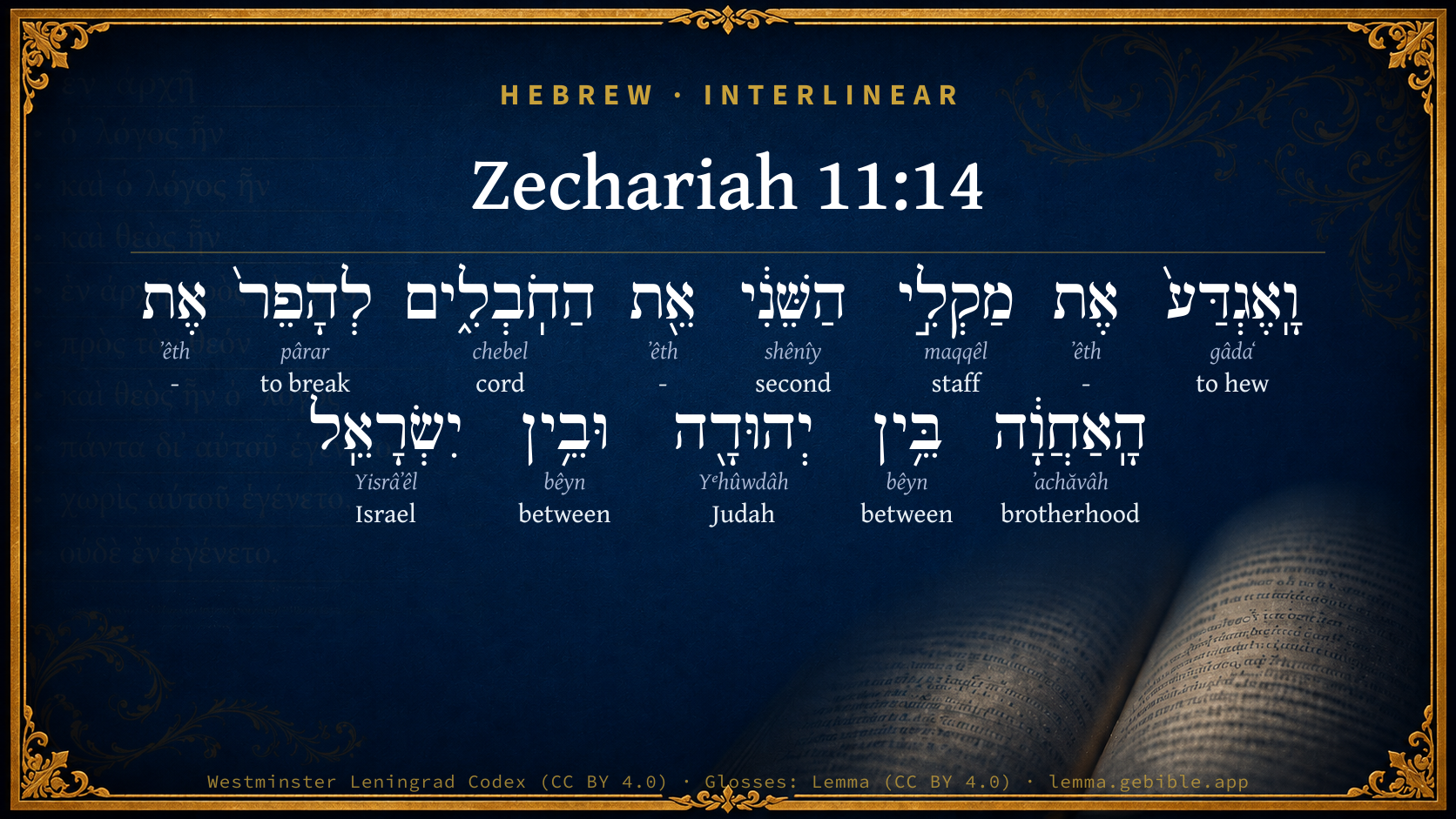
Hebrew (Westminster Leningrad Codex) Zechariah 11:14 appears in the Hebrew Old Testament. The text above is from the Westminster Leningrad Codex. Each word links to its Strong’s number, a concise gloss, and parsing drawn from the Open Scriptures Hebrew Bible morphology. Click any word for its full Brown-Driver-Briggs (BDB) entry.
Download image
Cite this verse

Zechariah 11:14 (World English Bible). Public Domain. Lemma interlinear Bible study tool, https://lemma.gebible.app/v/zechariah/11/14.

Show BibTeX & RIS
BibTeX
RIS
English Translation
Then I cut apart my other staff, even Union, that I might break the brotherhood between Judah and Israel.
World English Bible · Public Domain
Highlights
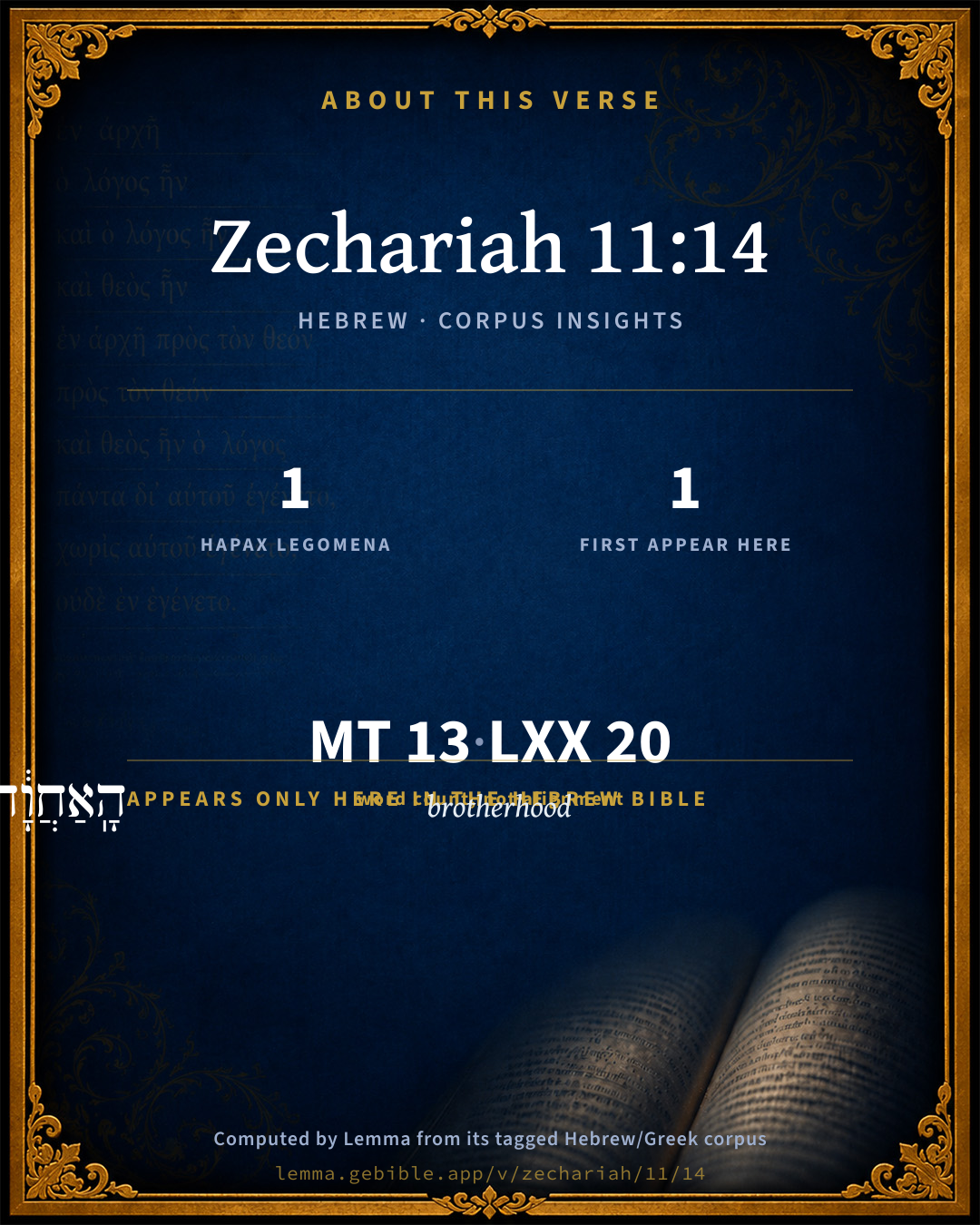
  • 1 hapax legomenon — only here in the Hebrew Bible
  • 1 first appearance in the Hebrew Bible
Full analysis ↓
Download a study sheet

One document with this verse’s original text, its word-by-word gloss line, the meaning frame, cross-references with their text, attributed commentary, and full source and license credits — printable, and it pastes into notes with its structure intact.

This verse Autodidact and up

Study sheet (.html) Plain text (.txt)

A passage Seminary Student

Up to 50 verses in one chapter. A passage sheet keeps up to 6 commentary sources and 12 cross-references per verse, in the order this page ranks them, and says so on the sheet whenever that leaves anything out. Ask for a single verse and you get the Autodidact verse sheet above.

Everything on this page stays free to read, with no account — the sheet is a download of what is already on screen, not access to it.

Want to remove ads? Support Godless Engineer
Compare translations 3

The same verse in 3 English versions, stacked beneath the original-language interlinear above. Click any original word for its lexicon entry.

Each is an independent rendering of the whole verse — the interlinear is not word-aligned to these translations.

Highlighted words mark where these versions differ — a whole-verse word diff, not a word-by-word alignment.

  • World English Bible Public Domain
    Then I cut apart my other staff, even Union, that I might break the brotherhood between Judah and Israel.
  • King James Version Public Domain
    Then I cut asunder mine other staff, even Bands, that I might break the brotherhood between Judah and Israel.
  • unfoldingWord Literal Text CC BY-SA 4.0
    Then I broke my second staff, “Unity,” to break the brotherhood between Judah and Israel.

unfoldingWord Literal Text — © unfoldingWord, licensed CC BY-SA 4.0. Word-aligned USFM3 via Door43 (git.door43.org/unfoldingWord/en_ult).

Versions to compare (up to 4)

3 of 4 selected

Show all 18 translations

Every available English version of this verse, each an independent rendering of the whole verse.

  • World English Bible Public Domain
    Then I cut apart my other staff, even Union, that I might break the brotherhood between Judah and Israel.
  • Berean Standard Bible Public Domain
    Then I cut in two my second staff called Union, breaking the brotherhood between Judah and Israel.
  • Majority Standard Bible Public Domain
    Then I cut in two my second staff called Union, breaking the brotherhood between Judah and Israel.
  • King James Version Public Domain
    Then I cut asunder mine other staff, even Bands, that I might break the brotherhood between Judah and Israel.
  • American Standard Version (1901) Public Domain
    Then I cut asunder mine other staff, even Bands, that I might break the brotherhood between Judah and Israel.
  • Revised Version (1885) Public Domain
    Then I cut asunder mine other staff, even Bands, that I might break the brotherhood between Judah and Israel.
  • Geneva Bible (1599) Public Domain
    Then brake I mine other staffe, euen the Bandes, that I might dissolue the brotherhood betweene Iudah and Israel.
  • Douay-Rheims (1899) Public Domain
    And I cut off my second rod that was called a Cord, that I might break the brotherhood between Juda and Israel.
  • Young's Literal Translation Public Domain
    And I cut asunder my second staff, Bands, to break the unity between Judah and Israel.
  • Literal Standard Version CC BY-SA 4.0
    And I cut apart my second staff, Bands, || To break the unity between Judah and Israel.
  • Unlocked Literal Bible CC BY-SA 4.0
    Then I broke my second staff, “Unity,” to break the brotherhood between Judah and Israel.
  • unfoldingWord Literal Text CC BY-SA 4.0
    Then I broke my second staff, “Unity,” to break the brotherhood between Judah and Israel.
  • Darby Bible Public Domain
    And I cut asunder mine other staff, Bands, to break the brotherhood between Judah and Israel.
  • World Messianic Bible Public Domain
    Then I cut apart my other staff, Union, that I might break the brotherhood between Judah and Israel.
  • Webster's Bible Public Domain
    Then I cut asunder my other staff, even Bands, that I might break the brotherhood between Judah and Israel.
  • Free Bible Version CC BY-SA 4.0
    Then I broke my second staff called Union, breaking the family union between Judah and Israel.
  • Bible in Basic English Public Domain
    Then I took my other rod, the one named Bands, cutting it in two, so that the relation of brothers between Judah and Israel might be broken.
  • JPS Tanakh (1917) Public Domain
    Then I cut asunder mine other staff, even Binders, that the brotherhood between Judah and Israel might be broken.

Literal Standard Version (2020), Covenant Press — licensed CC BY-SA 4.0. Text via the HelloAO Bible API (eBible.org). Unlocked Literal Bible (unfoldingWord) — licensed CC BY-SA 4.0. Text via the HelloAO Bible API (eBible.org). unfoldingWord Literal Text — © unfoldingWord, licensed CC BY-SA 4.0. Word-aligned USFM3 via Door43 (git.door43.org/unfoldingWord/en_ult). Free Bible Version, Dr. Jonathan Gallagher — licensed CC BY-SA 4.0. Text via the HelloAO Bible API (eBible.org).

Word by word

More ways to search: Search by grammar → Find every occurrence → Compare this word →

Practice this passage: Drill this verse → Learn its vocabulary →

הָֽאַחֲוָ֔ה
ʼachăvâh
H264
“the · brotherhood”
Particle, Definite Article + Noun, Common, Feminine, Singular, Absolute
Part of Speech
Particle + Noun
Type
Common
Gender
Feminine
Number
Singular
State
Absolute
Full BDB Definition

Origin: from H251

TWOT: 62b

fraternity, brotherhood
  1. וָֽאֶגְדַּע֙ gâdaʻ H1438 “and · to hew” Conjunction + Verb, Qal, Sequential Imperfect, 1st Person, Common, Singular
  2. אֶת ʼêth H853 “-” Particle, Direct Object
  3. מַקְלִ֣י maqqêl H4731 “staff · my” Noun, Common, Masculine, Singular, Construct + Suffix, Personal, 1st Person, Common, Singular
  4. הַשֵּׁנִ֔י shênîy H8145 “the · second” Particle, Definite Article + Adjective, Ordinal number, Masculine, Singular, Absolute
  5. אֵ֖ת ʼêth H853 “-” Particle, Direct Object
  6. הַחֹֽבְלִ֑ים chebel H2256 “the · cords” Particle, Definite Article + Noun, Common, Masculine, Plural, Absolute
  7. לְהָפֵר֙ pârar H6565 “to break” Preposition + Verb, Hiphil, Infinitive Construct
  8. אֶת ʼêth H853 “-” Particle, Direct Object
  9. בֵּ֥ין bêyn H996 “between” Preposition
  10. יְהוּדָ֖ה Yᵉhûwdâh H3063 “Judah” Noun, Proper
  11. וּבֵ֥ין bêyn H996 “and · between” Conjunction + Preposition
  12. יִשְׂרָאֵֽל Yisrâʼêl H3478 “Israel” Noun, Proper

About this verse

These counts appear in no published source. They are computed here, from the morphology-tagged text and Lemma’s own curated glosses. What Lemma adds →

13
words
10
distinct lemmas
Prophets
section

Notable vocabulary

1 hapax legomenon — a word that appears only here in the entire Hebrew Bible:

  • הָֽאַחֲוָ֔ה brotherhood H264

First appearance in Scripture

This word makes its first canonical appearance in the Hebrew Bible here:

  • הָֽאַחֲוָ֔ה brotherhood H264

Shared distinctive vocabulary

מַקְלִ֣י staff H4731 occurs in 16 verses of the Hebrew Bible. Also found in:

Grammatical profile

  • 2 verbs
  • 5 nouns
  • 1 adjective
  • 2 prepositions
  • 3 particles

Verb forms

  • וָֽאֶגְדַּע֙ Qal · Sequential Imperfect
  • לְהָפֵר֙ Hiphil · Infinitive Construct

Repetition

A word recurs within this verse — often emphatic in Hebrew:

  • בֵּ֥ין between H996 ×2

Hebrew & Septuagint length

In English translation the verse runs 19 words from the Hebrew and 19 from the Septuagint (LXX English) — the same length.

A rough comparison of the two English renderings, which tokenize alike — not a word-level alignment.

Word counts can differ between the Hebrew and the Greek without any difference in meaning — e.g. the Hebrew direct-object marker אֵת has no separate Greek word, and Greek often adds the article ὁ.

In the original languages it is 13 Hebrew tokens and 20 Greek tokens — but the two are counted differently (Hebrew bundles its prefixes and suffixes into one token; the Greek is in lemma form), so that isn’t a like-for-like length.

Cross-references

11

Topical passages linked to Zechariah 11:14 in the Treasury of Scripture Knowledge — connected by theme and wording, ordered by reader-vote popularity; previews shown in the World English Bible.

  • Isaiah 9:21 Manasseh, Ephraim; and Ephraim, Manasseh; and they together shall be against Judah. For all this his anger is not turned away, but his hand is stretched out still.
  • James 3:16 For where jealousy and selfish ambition are, there is confusion and every evil deed.
  • Isaiah 11:13 The envy also of Ephraim shall depart, and those who vex Judah shall be cut off: Ephraim shall not envy Judah, and Judah shall not vex Ephraim.
  • Ezekiel 37:16–20 You, son of man, take one stick, and write on it, For Judah, and for the children of Israel his companions: then take another stick, and write on it, For Joseph, the stick of Ephraim, and [for] all the house of Israel his companions:
  • Zechariah 11:7 So I fed the flock of slaughter, especially the oppressed of the flock. I took for myself two staffs. The one I called "Favor," and the other I called "Union," and I fed the flock.
  • Zechariah 11:9 Then I said, "I will not feed you. That which dies, let it die; and that which is to be cut off, let it be cut off; and let those who are left eat each other's flesh."
  • Matthew 24:10 Then many will stumble, and will deliver up one another, and will hate one another.
  • Acts 23:7–10 When he had said this, an argument arose between the Pharisees and Sadducees, and the assembly was divided.
  • Galatians 5:15 But if you bite and devour one another, be careful that you don't consume one another.
  • James 3:14 But if you have bitter jealousy and selfish ambition in your heart, don't boast and don't lie against the truth.
  • James 4:1–3 Where do wars and fightings among you come from? Don't they come from your pleasures that war in your members?

Cross-references courtesy of OpenBible.info (CC BY 4.0).

Hebrew and Greek witnesses Masoretic Hebrew ↔ Greek Septuagint

The same verse in the two great witnesses to the Old Testament, shown verse-for-verse.

These are two independent witnesses, not word-aligned to each other, and the Septuagint is shown in lemma (dictionary) form.

Hebrew Zechariah 11:14 Masoretic · Westminster Leningrad Codex

וָֽאֶגְדַּע֙ אֶת מַקְלִ֣י הַשֵּׁנִ֔י אֵ֖ת הַחֹֽבְלִ֑ים לְהָפֵר֙ אֶת הָֽאַחֲוָ֔ה בֵּ֥ין יְהוּדָ֖ה וּבֵ֥ין יִשְׂרָאֵֽל

Then I cut apart my other staff, even Union, that I might break the brotherhood between Judah and Israel.

World English Bible · Public Domain

Greek LXX Zechariah 11:14 Septuagint · lemma form

καί ἀποῥίπτω ὁ ῥάβδος ὁ δεύτερος ὁ σχοίνισμα ὁ διασκεδάζω ὁ κατάσχεσις ἀνά μέσος ιουδα καί ἀνά μέσος ὁ ἰσραήλ

And I cast away my second rod, even Line, that I might break the possession between Juda and Israel.

LXX2012 (modern English Septuagint) · Public Domain

On this verse, Trapp's Complete Commentary discusses the Septuagint’s reading. Read the note in Commentary ↓

Hebrew: Westminster Leningrad Codex (CC BY 4.0). Greek: Septuagint (public domain); English from LXX2012 (modern English Septuagint) (Public Domain). How the Septuagint differs from the Hebrew →

Targum (Aramaic paraphrase)

1

The Targum is the ancient Jewish Aramaic paraphrase of the Hebrew Scriptures — an interpretive translation, not the Hebrew text itself. Onkelos (literal) and Pseudo-Jonathan (expansive) render the Torah, and Jonathan the Prophets. Coverage is partial: where no permissively-licensed English translation exists for a verse, only the Aramaic is shown. This is verse-level text, not a word-by-word alignment to the Hebrew.

  1. Targum Jonathan Prophets (Joshua–Malachi)
    וְאַיְתֵיתִי נְבוּכַדְנֶאצַר מַלְכָּא דְבָבֶל עַל צִדְקִיָה מְלַךְ שִׁבְטָא דְבֵית יְהוּדָה וְאַגְלֵיתִי יָתֵיהּ עַל דְאַשְׁנִיאוּ קְיָמָא אַף אִינוּן דְבֵית יְהוּדָה כַּאֲחֵיהוֹן בֵּית יִשְׂרָאֵל:

    (no public-domain English translation for this verse)

    Targum Jonathan — Aramaic: “Mikraot Gedolot” (public domain). English: “Sefaria Community Translation” (CC0 1.0 (public-domain dedication)); “London "Chaldee Paraphrase," 1871” (public domain). Text via Sefaria.

Commentary

Notes on Zechariah 11:14 from classic Christian and Jewish commentators (each source and its license shown beneath its notes). The classic Christian expositions comment on the surrounding passage and are grouped to its opening verse, so a note may address several verses; the Jewish commentaries on the Tanakh (Rashi and others) are per-verse, so they appear only where the commentator wrote on this verse.

Lemma curates 59 commentaries, every one of them public domain or Creative Commons licensed, each selected and text-cleaned for this edition rather than reprinted as found. About our sources →

Trapp's Complete Commentary

John Trapp

Zec 11:14 Then I cut asunder mine other staff, [even] Bands, that I might break the brotherhood between Judah and Israel.

Ver. 14. Then I cut asunder mine other staff, even Bands] Or, binders; the bond of unity, say some; by sending a spirit of perversities among them, such as that was which made way for the ruin of Egypt, Isa 19:14; Isa 19:16-17. But see for the sense hereof what is noted. {See Trapp on "Zec 11:7"} God seems to say that he will now no more govern this people in mildness and clemency; nor yet exercise his shepherdly severity in saving corrections and visitations, as formerly he had done; but utterly reject and disject them.

That I might break the brotherhood] Germanitatem, saith the Vulgate. Mala quaedam olitores Germanitatis vocant, semper cohaerentia, semper gemella, nunquam singula in foetu. Such were Judah and Israel till the ten tribes revolted from the house of David. After which, many of the better affected Israelites went over to Rehoboam; besides those of the ten tribes that returned with them out of Babylon, twelve thousand at least, as may be gathered out of Ezr 2:64 1Ch 9:3. And in Jerusalem dwelt of the children of Judah, and of the children of Benjamin, and of the children of Ephraim and Manasseh; and between them there grew a brotherly conjunction and consociation, a league of love, as the Septuagint render it, or a national covenant (διαθηκην). This God threateneth here to dissolve and disannul; so that Ephraim shall be against Manasseh, and Manasseh against Ephraim, and both against Judah, Isa 9:21. Not many years before Christ’s coming in the flesh those two brethren, Hircanus and Aristobulus, disagreed about the government and high priesthood; and called in Pompey, who subdued the country, and reduced it into a province. And not many years after Christ’s passion Titus, the Roman emperor, utterly broke the brotherhood between Judah and Israel; and so scattered them, that like those priests in Ezra, they have utterly lost their pedigree, know not one another by their tribe or family, nor yet agree within themselves, Ezr 2:62. Those of them that were in Spain, and are now banished into the East (A.D. 1492), they hold to be of the tribe of Judah; and the other, in Germany and Italy, to be of the tribe of Benjamin; who in honour of the more noble tribe, and to correspond with them the better, do learn the Spanish tongue, which those still retain.

John Trapp, A Commentary or Exposition upon All the Books of the Old and New Testament (1647–1656) — public domain. Text from a community e-Sword module.

Joseph Benson's Commentary

Zec 11:14. Then — As soon as I saw what little value they put upon me, and my pastoral care over them, and services for them; I cut asunder mine other staff, even Bands — The prophet did this in type, and Christ in reality; that I might break the brotherhood between Judah and Israel — That I might declare, or foreshow, that the friendship and union which had existed between the two tribes and the remnant of the ten tribes, was broken. “From the time that the people returned from Babylon, the Jews and Israelites had formed one society, both of religion and polity, which society continued till the last destruction of Jerusalem, when, the Jewish kingdom being subverted, the bands were broken, and a disunion in religion was made; some of the Jews continuing attached to their ancient law as much as they could without the temple, and others professing the Christian faith.” — Houbigant. The design of the prophet’s commission, says Blayney, was to endeavour to bring about a reformation, upon which would depend the continuance of the brotherhood, or political union, between Judah and Israel. The second crook, or staff, was therefore called Bands. But when the commission ended without producing its effect, the breaking of the crook prefigured the dissolution of that brotherhood. What that brotherhood was, is well explained by Mr. Lowth, who says, that “upon the destruction of Jerusalem, which was the bond and cement of all their tribes, being the seat and centre both of their civil power, and of the divine worship, (Psa 132:3-5,) the consequence was the entire dissolution of the nation, and the dispersion and confusion of all their tribes, whose families could no longer be distinguished after the loss of their genealogies.” Calmet thinks that, in this verse, Israel denotes the unbelieving Jews, who rejected Christ, and Judah the faithful ones who believed in him.

Joseph Benson's Commentary on the Old and New Testaments (1811–1818) — public domain. Text from a community e-Sword module.

Jamieson, Fausset & Brown

Robert Jamieson, A. R. Fausset & David Brown

The breaking of the bond of union between Judah and Israel's ten tribes under Rehoboam is here the image used to represent the fratricidal discord of factions which raged within Jerusalem on the eve of its fall, while the Romans were thundering at its gates without. See JOSEPHUS [Wars of the Jews]. Also the continued severance of the tribes till their coming reunion (Rom 11:15).

Jamieson, Fausset & Brown — Commentary Critical and Explanatory on the Whole Bible (1871) — public domain (CC PDM 1.0). Text via the HelloAO Bible API.

Adam Clarke's Commentary

Verse 14. That I might break the brotherhood] I cannot, says Newcome, explain this passage, without supposing that the kingdom of Israel subsisted when the prophet wrote it; and that either the wars between Judah and Israel are referred to, (see 2Kg 16:5,) or the captivity of the ten tribes, when the brotherly connection between these kingdoms ceased.

Adam Clarke's Commentary on the Bible (1810–1826) — public domain. Text from a community e-Sword/MySword module.

John Calvin's Commentaries

There is here set before us the extreme vengeance of God in scattering his people, so that there would be no longer any union between the children of Abraham. We have seen that the Prophet took two staves or crooks to execute the office of a shepherd in ruling the people. The first staff he said was Beauty, because God had omitted nothing necessary to produce the best order of things. Now when this blessed mode of ruling was trodden under foot, then soon after followed the scattering of the people: and this is the reason why the Prophet says, that he broke the other rod, or his crook. We then see that this people by their ingratitude at length justly deserved to be left without any regular form of government, and also without any union.

As to the word חבלים, chebelim, we have before said that what the Rabbis teach us, that it means “destroyers,” does not comport with the passage. But why should Zechariah say here that the rod was broken, that there should be no more union or fraternity between the kingdom of Judah and the ten tribes? We have already said, that this word by changing the points may have the meaning which has been mentioned; for חבל, chebel, signifies a rope or binding. We must also bear in mind, that this is an instance of “last first” (ὕστερον πρότερον;) for he told us before that God, bidding adieu to the people, demanded his reward; this then ought to have been first mentioned: but this inversion of order is common in Hebrew. This verse then we are to read, as though it was placed before the last mission, by which God laid aside the office of a shepherd.

I will come now to the passage in Matthew; for after having told us that the thirty pieces of silver were cast away by Judah, and that by them the Potter’s Field was bought, he adds, that this prediction of the Prophet was fulfilled. He does not indeed repeat the same words, but it is quite clear, that this passage was quoted,

“They gave,” he says, “the thirty silvering, the price of the valued, whom they of the children of Israel have valued.” (Matthew 27:9.)

In substance then there is no doubt an agreement between the words of Matthew and those of the Prophet. But we must hold this principle, — that Christ was the true Jehovah from the beginning. As then the Son of God is the same in essence with the Father, and is with him the only true God, it is no wonder that what the Prophet figuratively expressed as having been done under the law by the ancient people, has been done to him literally in his own person: for as they had given to God thirty pieces of silver, a sordid price, as his just reward, so he complained that the labor he undertook in ruling them, was unjustly valued; and when Christ was sold for thirty pieces of silver, it was a visible specimen of this prophecy exhibited in his own person.

When Matthew says, that Christ was valued by the children of Israel, he charges the chosen people with impiety. The article ὁι, is to be here understood. The expression is indeed, ἀπὸ ὑιων Ισραὴλ; but the sentence is to be taken in this sense, — that he was valued at so low a price, not by barbarous nations, but by the very people who were of the children of Israel and of the seed of Abraham, as though he had said, “This wrong has been offered to God, not by strangers, but by a people whom he had chosen and adopted as his peculiar possession; and this wickedness is therefore less excusable.”

Then Matthew adds,

“They gave it for the Potter’s Field, as the Lord had commanded me.” Matthew 27:7-10.

This part also well agrees with the prophecy. It is indeed certain that this money was not designedly given to buy a field, that the Jews might obey God; but we know that God executes his purposes by means of the wicked, though they neither think nor wish to do such a thing. But what does Zechariah say? Cast it, he says, to the potter; he does not say “To the field of the potter.” But we have explained for what purpose God commanded the thirty silvering to be cast to the potter; it was, that he might get bricks or tiles to repair the temple; and this was said in contempt, or by way of ridicule. Such also was the visible symbol of this as to the purchase of the field; for the potter, the seller of the field, knew not what he was doing; the Scribes and Pharisees thought nothing of fulfilling what had been predicted. But that it might be made evident that Christ was the true God who had from the beginning spoken by the Prophet, God, by setting the thing before their eyes, intended that there should be a visible fact or transaction, that he might as it were draw the attention of the Jews to what is here said. The Prophet proceeds, -

John Calvin's Commentaries (1540-1563) — public domain. Text from the Calvin Translation Society English edition (1840s-50s) via the Christian Classics Ethereal Library (ccel.org). Calvin's coverage is partial (roughly two-thirds of the Bible); uncommented books and verses are honest gaps, never fabricated. The 19th-century editor's footnotes and remarks are omitted so the notes are faithfully Calvin's own voice.

Ellicott's Commentary for English Readers

(14) That I might break the brotherhood.—This was the result of their rejection of the Good Shepherd, and of their consequent rejection by Him. It began with the civil discords which followed the victorious days of the Maccabees, and reached its worst in the horrible scenes which took place during the siege of Jerusalem by the Romans.

A Bible Commentary for English Readers, edited by Charles John Ellicott (1878–1897) — public domain. Text from a community e-Sword module.

The Cambridge Bible for Schools and Colleges

gen. ed. J. J. S. Perowne

14. I cut asunder mine other staff] to signify both the completion of the rupture between the shepherd and the flock, with which he had now nothing more whatever to do, and also the second evil consequence of that rupture, which would befall the flock. Its beauty was gone already: its unity would now be gone also.

The Cambridge Bible for Schools and Colleges (gen. ed. J. J. S. Perowne; Cambridge University Press, 1878–1918) — public domain. Text from a community e-Sword module.

John Gill's Exposition

Then I cut asunder mine other staff, even Bands,.... By which is meant, either the removal of the form of civil government from the Jews; or the abrogation of the Mosaic law, and the carnal ordinances of the Jews, in which judaizing Christians joined them, until the destruction of Jerusalem; or rather the ordinances of the Gospel, which, upon taking that away, ceased:

that l might break the brotherhood between Judah and Israel; the Gospel and Gospel ordinances being removed from the Jews, there was no more work of conversion among them; their church state came to nothing, and an entire disagreement between them and the Gentiles ensued: and so it is when God takes away his word and ordinances from a people, they are unchurched and their brotherhood is broken, those being the bands which keep them together; and therefore, when loosed, their unity and society cease. There seems to be an allusion to the case of the two tribes of Judah and Benjamin, and of the ten tribes; the former are often signified by Judah only; and the latter by Israel or Ephraim: the division between them was made in the times of Rehoboam, which continued unto their respective captivities; after the Jews' return from the Babylonish captivity, there was some show of an union between them; some of the ten tribes returning with the Jews, and coalescing in one state; and moreover, at their certain stated feasts, they came from different parts of the world, and joined together in religious service; see Act 2:1 but, upon the dissolution of their civil and church state, this friendly correspondence was broken off, and their communion with each other ceased: and as for the Jews, after the Christians were called out from among them at Jerusalem, and removed to Pella, they fell into internal divisions and quarrels among themselves, which lasted during the siege of that city; and when it was taken and destroyed, their brotherhood and union among themselves were broken to such a degree, that they were scattered one from another; and now know not of what kingdom and tribe they are, whether of Judah or Israel, or of what tribe in either.

John Gill's Exposition of the Whole Bible (1746–1763) — public domain (CC PDM 1.0). Text via the HelloAO Bible API.

Albert Barnes' Notes on the Bible

And I cut asunder mine other staff, Bands, to dissolve the brotherhood between Judah and Israel - Hitherto prophecy had spoken of the healing of the great breach between Israel and Judah, in Christ. “The Lord,” Isaiah said, “shall assemble the outcasts of Israel, and gather together the dispersed of Judah from the four corners of the earth. The envy of Ephraim shall depart, and the adversaries of Judah shall be cut off: Ephraim shall not envy Judah, and Judah shall not vex Ephraim” Isa 11:12-13; and Hosea, “Then shall the children of Judah and the children of Israel be gathered together and shall appoint themselves one Head” Hos 1:11; and Jeremiah, “In those days the house of Judah shall walk with the house of Israel.” Jer 3:18. And Ezekiel, in the midst of the captivity, in a symbolic action the counterpart of this, is bidden, “Take thee one stick, and write upon it, For Judah, and for the children of Israel his companions; then take another stick, and write upon it, For Joseph, the stick of Ephraim, and all the house of Israel his companions, and join them one to another into one stick, and they shall become one in thy hand” Eze 37:16-17; and, when asked the meaning of this act, he was to say, “Thus saith the Lord God, I will take the stick of Joseph, which is in the hand of Ephraim, and the tribes of Israel his fellows, and will put them with him, even with the stick of Judah, and will make them one stick, and they shall be one in Mine hand” Eze 37:19.

And dropping the symbol; “Thus saith the Lord God, Behold, I will take the children of Israel from among the pagan, whither they be gone - and I will make them one nation in the land upon the mountains of Israel: and one king shall be king to them all: and they shall be no more two nations, neither shall they be divided into two kingdoms any more at all - I will cleanse them, and they shall be My people and I will be their God, and David My servant shall be king over them, and they all shall have one Shepherd” Eze 37:21-24. Such should be the unity of those who would be gathered under the One Shepherd. And so it was, “The multitude of them that believed were of one heart and of one soul” Act 4:32; and long afterward it was a proverb among the pagan, o, “See how these Christians love one another.” Zechariah is here speaking of those who had rejected the Good Shepherd, the Israel and Judah after the flesh, who shut themselves out from the promises of God. This had its first fulfillment in the terrible dissolution of every band of “brotherhood” and of our common nature, which made the siege of Jerusalem a proverb for horror, and precipitated its destruction. o “Having thus separated the believing from the unbelieving, He bared the rest of His care. And what we now see bears witness to the prophecy. For the Jews, being deprived, of prophets and priests and kings and temple and ark and altar and mercy-seat and candlestick and table and the rest, through which the legal worship was performed, have come to be deprived also of the guardianship from above; and, scattered, exiled, removed, serve against their will those who preach Christ: denying Him as Lord, they yield service to His servants. The prophet having foretold these things of Christ, our God and Saviour, and reproved the obstinacy of the Jews, naturally turns his prophecy straight to the God-opposed christ whom they expect, as they say. So said the Lord in the holy Gospels to them, “I am come in My Father’s name, and ye receive Me not; another will come in his own name, and him ye will receive” Joh 5:43. This the blessed Paul also prophesied of them, “Because they received not the love of the truth, that they might be saved, God shall send them strong delusion that they should believe a lie, that all might be damned, who believe not the truth, but have pleasure in unrighteousness” 2Th 2:10-12. The like does the blessed Zechariah prophesy, having received the power of the Holy Spirit.”

Albert Barnes' Notes on the Bible (1834–1885) — public domain. Text from a community e-Sword/MySword module.

Haydock's Catholic Bible Commentary

Israel. The latter remained obstinate, (Calmet) while Juda, the real "confessor," (Haydock) embraced the gospel. After the destruction of the temple, the Jewish ceremonies were no longer (Calmet) observed or tolerated in the Church, as they had been, in order that the synagogue might be buried with honour. (St. Augustine) (Haydock) --- The Jews are rejected. (Worthington)

George Leo Haydock (1774–1849), Haydock's Catholic Family Bible and Commentary, 1859 edition — public domain. Excludes Psalms (Douay-Rheims chapter numbering differs from Protestant) and Deuterocanonical books (Catholic canon only).

Matthew Poole's English Annotations

Then; so soon as I saw what value they put upon me, or presently after the casting them off from the covenant, and unchurching them.

I; Christ did it really, the prophet did it in the type.

Cut asunder mine other staff, even Bands; took no further care to keep them in civil peace among themselves, but left them to their seditious humours and inhuman animosities. Religion, which is true, is the best bond of peace, friendship, and love; when the Jews cast off religion, and murdered their Lord, next they fall to murdering one another.

That I might break; declare it broken, leave them to show it was broken.

The brotherhood; that friendship which had been among them.

Between Judah, the two tribes, and Israel, the remnant of the ten tribes, which fell into most unnatural seditions after the death of Christ, till the taking of Jerusalem by the Romans.

Matthew Poole's English Annotations on the Holy Bible (1683–1685) — public domain. Text from a community e-Sword/MySword module.

The Pulpit Commentary

I eat asunder mine other staff. As the flock, by their contemptuous payment, showed their alienation from the Shepherd, so he now, by his symbolical action, shows his rejection of them, and his surrender of them to anarchy, confusion, and ruin. The breaking of the first staff indicated that God withdrew his defensive care; the breaking of the staff called "Bands" signifies the utter dissolution of all the bends that held the nation together, the civil and social disunion that paved the way for the victory of the Romans, and issued in the final disruption which sent the Jews wandering through the world. This in the vision is represented as the breaking of the brotherhood between Judah and Israel, the component parts of the nation. Thus was hinted the ultimate rejection of the Jews in consequence of their treatment of Christ, the good Shepherd, who came unto his own, and his own received him not. (comp. Mat_23:36-38) This doom is declared more fully in the next section.

The Pulpit Commentary (1880–1919), ed. H.D.M. Spence-Jones & Joseph S. Exell — public domain. Text from a community e-Sword module.

Keil & Delitzsch

C. F. Keil & F. Delitzsch

In consequence of this shameful payment for his service, the shepherd of the Lord breaks his second staff, as a sign that he will no longer feed the ungrateful nation, and but leave it to its fate. The breaking of this staff is interpreted, in accordance with its name, as breaking or destroying the brotherhood between Judah and Israel. With these words, which are chosen with reference to the former division of the nation into two hostile kingdoms, the dissolution of the fraternal unity of the nation is depicted, and the breaking up of the nation into parties opposing and destroying one another is represented as the result of a divine decree. Hofmann, Ebrard (Offenbarung Johannis), and Kliefoth have erroneously supposed that this relates to the division of the covenant nation into two parties, one of which, answering to the earlier Judah, would receive Christ, and remain the people of God; whilst the other, answering to the Ephraim or Israel of the times after Solomon, would reject Christ, and therefore be exposed to hardening and judgment. According to the evident meaning of the symbolical representation, the whole flock paid the good shepherd wages, which were tantamount to a rejection of his pastoral care, and was therefore given up by him; so that by falling into parties it destroyed itself, and, as the shepherd tells it in Zac 11:9, one devoured the flesh of the other. This is not at variance with the fact that by this self-destroying process they did not all perish, but that the miserable ones among the sheep who gave heed to the Lord, i.e., discerned their Saviour in the shepherd, and accepted Jesus Christ as the Messiah, were saved. This is simply passed over in our description, which treats of the fate of the whole nation as such, as for example in Rom 9:31; Rom 11:11-15, because the number of these believers formed a vanishing minority in comparison with the whole nation. The breaking up of the nation into parties manifested itself, however, in a terrible manner soon after the rejection of Christ, and accelerated its ruin in the Roman war.

There is this difference, however, in the interpretation which has been given to this symbolical prophecy, so far as the historical allusion or fulfilment is concerned, by expositors who believe in revelation, and very properly understand it as referring to the times of the second temple: namely, that some regard it as setting forth the whole of the conduct of God towards the covenant nation under the second temple; whilst others take it to be merely a symbol of one single attempt to save the nation when on the verge of ruin, namely, that of the pastoral office of Christ. Hengstenberg, with many of the older commentators, has decided in favour of the latter view. But all that he adduces in proof of the exclusive correctness of this explanation does not touch the fact itself, but simply answers weak arguments by which the first view has been defended by its earlier supporters; whilst the main argument which he draws from Zac 11:8, to prove that the symbolical action of the prophet sets forth one single act of pastoral fidelity on the part of the Lord, to be accomplished in a comparatively brief space of time, rests upon a false interpretation of the verse in question. By the three shepherds, which the shepherd of Jehovah destroyed in a month, we are to understand, as we have shown at Zac 11:8, not the three classes of Jewish rulers, but the three imperial rulers, in whose power Israel continued from the times of the captivity to the time of Christ. But the supposition that this section refers exclusively to the work of Christ for the salvation of Israel during His life upon earth, is quite irreconcilable with this. We cannot therefore come to any other conclusion than that the first view, which has been defended by Calvin and others, and in the most recent times by Hofmann, Kliefoth, and Koehler, is the correct one, though we need not therefore assume with Calvin that the prophet "represents in his own person all the shepherds, by whose hand God ruled the people;" or discern, as Hofmann does, in the shepherd of the Lord merely a personification of the prophetic order; or, according to the form in which Koehler expresses the same view, a representation of the mediatorial work in the plan of salvation, of which Daniel was the first representative, and which was afterwards exhibited on the one hand by Haggai and Zechariah, and on the other hand by Zerubbabel and his successors, as the civil rulers of Israel, and by Joshua and those priests who resumed the duties of their office along with him. For the extermination or overthrow of the three imperial rulers or imperial powers was no more effected or carried out by the prophets named, than by the civil rulers and priesthood of Israel. The destruction was effected by Jehovah without the intervention of either the prophets, the priest, or the civil authorities of the Jews; and what Jehovah accomplished in this respect as the Shepherd of His people, was wrought by Him in that form of revelation by which He prepared the way for His coming to His people in the incarnation of Jesus Christ, namely as the Angel of Jehovah, although this form is not more precisely indicated in the symbolical action described in the chapter before us. In that action the shepherd, to whom thirty silverlings are weighed out as his wages, is of far from being regarded as distinct from Jehovah, that Jehovah Himself speaks of these wages as the price at which He was valued by the people; and it is only from the gospel history that we learn that it was not Jehovah the superterrestrial God, but the Son of God, who became incarnate in Christ, i.e., the Messiah, who was betrayed and sold for such a price as this.

What the Evangelist Matthew observes in relation to the fulfilment of Zac 11:12 and Zac 11:13, presents various difficulties. After describing in Mat 26:1 the betrayal of Jesus by Judas, the taking of Jesus, and His condemnation to death by the Roman governor Pontius Pilate at the instigation of the high priests and elders of the Jews; and having still further related that Judas, feeling remorse at the condemnation of Jesus, brought back to the high priests and elders the thirty silverlings paid to him for the betrayal, with the confession that he had betrayed innocent blood, and that having thrown down the money in the temple, he went and hanged himself, whereupon the high priests resolved to apply the money to the purchase of a potter's field as a burial-ground for pilgrims; he adds in Mat 27:9, Mat 27:10 : "Then was fulfilled that which was spoken by Jeremiah the prophet, saying, And they took the thirty pieces of silver, the price of him that was valued, whom they of the children of Israel did value, and gave them for the potter's field, as the Lord appointed me." The smallest difficulty of all is occasioned by the fact that the thirty silverlings were weighed, according to the prophecy, as wages for the shepherd; whereas, according to the fulfilment, they were paid to Judas for the betrayal of Jesus. For, as soon as we trace back the form of the prophecy to its idea, the difference is resolved into harmony. The payment of the wages to the shepherd in the prophetical announcement is simply the symbolical form in which the nation manifests its ingratitude for the love and fidelity shown towards it by the shepherd, and the sign that it will no longer have him as its shepherd, and therefore a sign of the blackest ingratitude, and of hard-heartedness in return for the love displayed by the shepherd. The same ingratitude and the same hardness of heart are manifested in the resolution of the representatives of the Jewish nation, the high priests and elders, to put Jesus their Saviour to death, and to take Him prisoner by bribing the betrayer. The payment of thirty silverlings to the betrayer was in fact the wages with which the Jewish nation repaid Jesus for what He had done for the salvation of Israel; and the contemptible sum which they paid to the betrayer was an expression of the deep contempt which they felt for Jesus. There is also no great importance in this difference, that here the prophet throws the money into the house of Jehovah to the potter; whereas, according to Matthew's account, Judas threw the silverlings into the temple, and the high priests would not put the money into the divine treasury, because it was blood-money, but applied it to the purchase of a potter's field, which received the name of a field of blood. For by this very fact not only was the prophecy almost literally fulfilled; but, so far as the sense is concerned, it was so exactly fulfilled, that every one could see that the same God who had spoken through the prophet, had by the secret operation of His omnipotent power, which extends even to the ungodly, so arranged the matter that Judas threw the money into the temple, to bring it before the face of God as blood-money, and to call down the vengeance of God upon the nation, and that the high priest, by purchasing the potter's field for this money, which received the name of "field of blood" in consequence "unto this day" (Mat 27:8), perpetuated the memorial of the sin committed against their Messiah. Matthew indicates this in the words "as the Lord commanded me," which correspond to ויּאמר יהוה אלי in Zac 11:13 of our prophecy; on which H. Aug. W. Meyer has correctly observed, "that the words 'as the Lord commanded me' express the fact, that the application of wages of treachery to the purchase of the potter's field took place 'in accordance with the purpose of God,' whose command the prophet had received. As God had directed the prophet (μοι) how to proceed with the thirty silverlings, so was it with the antitypical fulfilment of the prophecy by the high priests, and thus was the purpose of the divine will accomplished." The other points in which the quotation in Matthew differs from the original text (for the lxx have adopted a totally different rendering) may be explained from the fact that the passage is quoted memoriter, and that the allusion to the mode of fulfilment has exerted some influence upon the choice of words. This involuntary allusion shows itself in the reproduction of ואקחה וגו, "I took the thirty silverlings, and threw them to the potter," by "they took the thirty pieces of silver,... and gave them for the potter's field;" whilst "the price of him that was valued" is only a free rendering of אדר חיקר, and "of the children of Israel" an explanation of מעליהם.

The only real and important difficulty in the quotation is to be found in the fact that Matthew quotes the words of Zechariah as "that which was spoken by Jeremy the prophet," whereas all that he quotes is taken simply and solely from the prophet Zechariah. The reading Ἱερεμίου in Matthew is critically unassailable; and the assumption that Matthew refers to some lost scripture, or to a saying of Jeremiah handed down by oral tradition, and others of a similar kind, are simply arbitrary loopholes, which cannot come into any further consideration at all. On the other hand, the attempts made to explain the introduction of Jeremiah's name in the place of that of Zechariah, on the ground that, so far as the principal features are concerned, our prophecy is simply a resumption of the prophecy in Jer 19:1-15, and that Zechariah announces a second fulfilment of this prophecy (Hengstenberg), or that it rests upon the prophecy of Jeremiah 18, in which the potter is also introduced, and that its fulfilment goes beyond Zechariah's prophecy in those features which deviate from the words of Zechariah, so that Jeremiah 18-19 was fulfilled at the same time (Kliefoth), are deserving of serious consideration. Matthew, it is supposed, intended to point to this relation by mentioning Jeremiah instead of Zechariah. We would support this view without reserve, if the connection assumed to exist between our prophecy and the prophecies of Jeremiah 18 and Jer 19:1-15 could only be shown to be a probable one. But the proof adduced by Hengstenberg that our prophecy rests upon Jeremiah 18 reduces itself to these two remarks: (1) That the potter, of whom Jeremiah purchased a pot (Jer 19:1-15) to break it in the valley of Ben-hinnom, had his workshop in this valley, which was regarded with abhorrence, as being unclean; and (2) that Zechariah was to throw the bad wages into the valley of Ben-hinnom precisely at the spot where this potter's workshop was. This he supposes to have taken place with a distinct allusion to the prophecy in Jer 19:1-15, and with the assumption that the readers would have this prophecy before their minds. But in our exposition of Zac 11:13 we have already shown that Jeremiah did not purchase his pot in the valley of Ben-hinnom, but of the potter who dwelt within the city gate; and also that the words of Zechariah, "I threw it into the house of Jehovah to the potter," do not affirm that the prophet threw the wages paid him into the valley of Ben-hinnom. But with these false assumptions, the view founded upon them - namely, that our prophecy is a resumption of that of Jeremiah - necessarily falls to the ground. The symbolical action enjoined upon Jeremiah, and carried out by him, viz., the breaking to pieces in the valley of Ben-hinnom of the pot purchased of the potter in the city, does not stand in any perceptible relation to the word of the Lord to Zechariah, to throw the wages paid to him into the house of Jehovah to the potter, so as to lead us to take this word as a resumption of that prophecy of Jeremiah. Kliefoth appears to have seen this also, inasmuch as he gives up the idea of finding the proof that our prophecy rests upon that of Jeremiah in the prophecy itself. He therefore bases this view upon the simple fact that Matthew (Mat 27:9) does not quote our passage as a word of Zechariah, but as a word of Jeremiah, and therefore at any rate regarded it as such; and that our passage has nothing independent in its contents, but is rather to be completed or explained form Jeremiah, though not from Jer 19:1-15, but from Jeremiah 18, where the potter who makes a pot, and breaks it in pieces because it is marred, represents God, who is doing just the same with Israel as the potter with the pot that is marred. Consequently even in Zechariah we are to understand by the potter, to whom the prophet throws the wages in the temple, Jehovah Himself, who dwells in the temple. But apart from the impossibility of understanding the words of God in Zac 11:13, "Throw the splendid price at which I have been valued by them to the potter," as meaning "Throw this splendid price to me," this view founders on the simple fact that it necessitates the giving up of the agreement between the prophecy and its historical fulfilment, inasmuch as in the fulfilment the price of the betrayal of Jesus is paid, not to the potter, Jehovah, but to a common potter for his field in the valley of Ben-hinnom. If, therefore, it is impossible to show any connection between our prophecy and the prophecies of Jeremiah, there is no other course left than to follow the example of Luther, - namely, either to attribute the introduction of Jeremiah's name in Mat 27:9 in the place of that of Zechariah to a failure of memory, or to regard it as a very old copyist's error, of a more ancient date than any of the critical helps that have come down to us.

(Note: Luther says, in his Commentary on Zechariah, of the year 1528: "This chapter gives rise to the question, Why did Matthew attribute the text concerning the thirty pieces of silver to the prophet Jeremiah, whereas it stands here in Zechariah? This and other similar questions do not indeed trouble me very much, because they have but little bearing upon the matter; and Matthew does quite enough by quoting a certain scripture, although he is not quite correct about the name, inasmuch as he quotes prophetic sayings in other places, and yet does not even give the words as they stand in the Scripture. The same thing may occur now; and if it does not affect the sense that the words are not quoted exactly, what is to hinder his not having given the name quite correctly, since the words are of more importance than the name?")

Keil & Delitzsch — Biblical Commentary on the Old Testament (1861–1891) — public domain (CC PDM 1.0). Text via the HelloAO Bible API. (Old Testament only.)

Rashi

Rabbi Shlomo Yitzchaki (Rashi)

And I cut off My second staff I exiled Zedekiah.

the destroyers The wicked of his generation, for he was righteous, but his generation was wicked.

to nullify the brotherhood that the Judahites and the Benjamites were joined in brorherhood, and that they adhered to the abominations of the kings of Israel.

Rashi on the Tanakh — English translations: “The Judaica Press complete Tanach with Rashi, translated by A. J. Rosenberg” (CC BY 4.0); “Pentateuch with Rashi's commentary by M. Rosenbaum and A.M. Silbermann, 1929-1934” (public domain); “The Metsudah Tanach series, Lakewood, N.J” (CC BY 4.0); and “The Book of Joshua, Metsudah Publications, 1997” (CC BY 4.0). Text via Sefaria.

Lesson kit

Teaching starters — assembled from the data on this page, not authored interpretation. Every prompt links to the verse data it draws on. Edit before teaching.

Zechariah, in the Prophets, opens this verse with 13 words (10 distinct Hebrew lemmas). Its most distinctive word is ʼachăvâh (“brotherhood”). A historical commentator’s framing appears above. Read the whole chapter for the surrounding context.

Discussion questions

  1. How does “brotherhood” (ʼachăvâh) shape what this verse is saying?
  2. This verse holds 1 word here found nowhere else in the Hebrew Bible. What might the rare word draw attention to?
  3. The word “brotherhood” first appears here in Scripture. What is being introduced at this debut?
  4. Genesis 30:37 shares the word «staff» with this verse. How do the two illuminate each other?
  5. “between” occurs 2× in this one verse. What is the effect of the repetition?
  6. These translations render this verse differently; the difference is in the English rendering, not the original. What questions does that raise?
  7. The verb «וָֽאֶגְדַּע֙» is Qal Sequential Imperfect. How does its form color the action?
  8. Reading how Trapp's Complete Commentary and Joseph Benson's Commentary read this verse, where do the two commentators agree and where do they part?

Things to notice

  • 1 word in this verse appears nowhere else in the Hebrew Bible.
  • 1 word makes its first canonical appearance in Scripture here.
  • This verse counts 13 Hebrew ↔ 20 Greek words.
  • These translations choose different wording for 12 words in this verse.
  • “between” occurs 2× in this single verse.

Reading settings

Reading text

Shown beneath each verse's original-language words.

Old Testament
Old Testament edition

Read the OT as the Masoretic Hebrew (MT) or the Greek Septuagint (LXX).

English shown for the Greek Septuagint (in the Hebrew ↔ Greek comparison).

Comparing translations? Open the Compare panel on any verse page to stack up to four side by side.