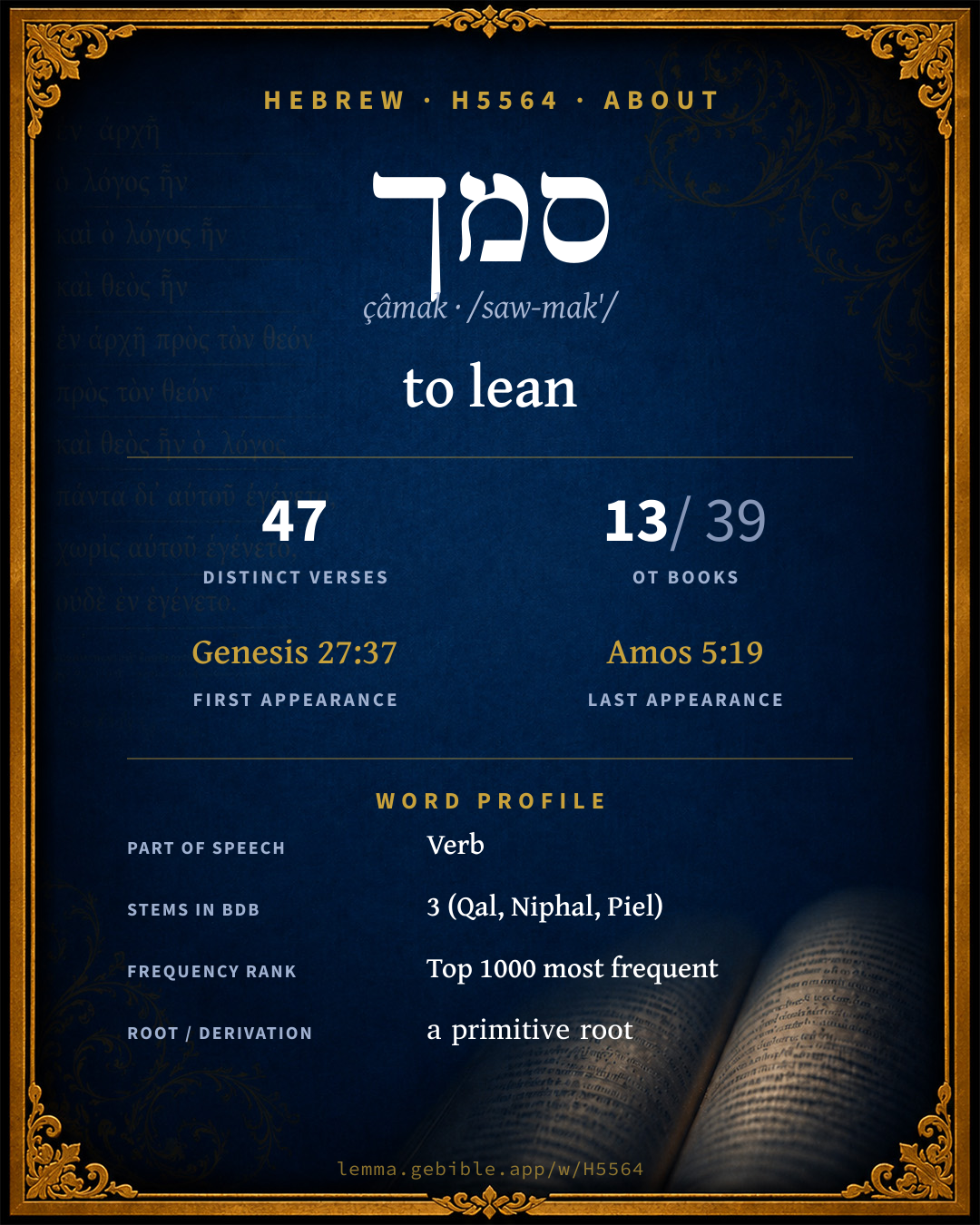
סָמַךְ
to lean
also: lay, rest, support, put fuller range ↓
Full lexicon entry — Brown-Driver-Briggs (BDB)
From Brown-Driver-Briggs (BDB)
Where this word appears
See every Qal verb in the Hebrew Bible →
Grammar key — what these labels mean
Part of speech
- Verb
- An action or state-of-being word.
Stem
- Qal
- The basic, simple active stem — the plain form of the verb (“he wrote”). Here: ‘lean or lay hand upon’
- Niphal
- Usually the simple passive or reflexive of the Qal (“he was written”).
- Piel
- An intensive or resultative active stem.
Form
- Sequential Perfect
- A perfect with prefixed waw continuing a preceding imperfect or command (waw-consecutive perfect).
- Sequential Imperfect
- An imperfect with prefixed waw — the standard past-narrative form (waw-consecutive imperfect).
- Participle Active
- A verbal adjective expressing ongoing or characteristic action (“writing / one who writes”).
- Imperfect
- An incomplete, ongoing, or future action (“he will / would write”).
- Perfect
- A completed action or state — Hebrew marks aspect (completeness) more than strict tense (“he wrote”).
- Participle Passive
- A verbal adjective expressing action received (“written”).
- Imperative
- A direct command (“write!”).
State
- Absolute
- The independent form of a noun, not bound to a following word.
- Construct
- A noun bound to a following noun in a possessive / “of” relationship (the construct chain).
Person
- 3rd Person
- The one spoken about (“he / she / it / they”).
- 2nd Person
- The one addressed (“you”).
- 1st Person
- The speaker (“I / we”).
Gender
- Masculine
- Grammatically masculine.
- Common
- Either gender — not distinguished for this form.
- Feminine
- Grammatically feminine.
Number
- Singular
- One.
- Plural
- More than one (in Hebrew, generally three or more).
Grammatical forms 23 distinct
- Verb, Qal, Sequential Perfect, 3rd Person, Masculine, Singular 12 times (25%)
- Verb, Qal, Participle Active, Masculine, Singular, Absolute 4 times (8%)
- Verb, Qal, Sequential Perfect, 3rd Person, Common, Plural 3 times (6%)
- Verb, Qal, Sequential Imperfect, 3rd Person, Masculine, Plural 3 times (6%)
- Verb, Qal, Perfect, 3rd Person, Feminine, Singular 3 times (6%)
- Verb, Qal, Sequential Imperfect, 3rd Person, Masculine, Singular 2 times (4%)
- Verb, Niphal, Imperfect, 3rd Person, Masculine, Singular 2 times (4%)
- Verb, Qal, Perfect, 3rd Person, Masculine, Singular 2 times (4%)
+15 more forms (17 occurrences)
Parsed forms decoded from the imported morphology (morphhb / Westminster Leningrad Codex — WLC text public domain, morphhb tagging CC BY 4.0), counted across 48 parsed occurrences — not distinct verses.
Every verse where H5564 appears — 47 distinct verses across 13 books. Click any verse to open its interlinear word-by-word view. Verse text shown in the World English Bible for context — . Each verse’s Hebrew form is shown with its reference; the English is not keyword-highlighted, since the data carries no word-level English alignment. Use “Compare translations” on any verse to read it across multiple English versions. This concordance covers the Hebrew Bible; Septuagint (Greek Old Testament) occurrences are not indexed here.
Genesis 1 verse
Exodus 3 verses
- Exodus 29:10 וְ/סָמַ֨ךְ conj + Qal wpf 3ms "You shall bring the bull before the tent of meeting: and Aaron and his sons shall lay their hands on the head of the bull.
- Exodus 29:15 וְ/סָ֨מְכ֜וּ conj + Qal wpf 3cp "You shall also take the one ram; and Aaron and his sons shall lay their hands on the head of the ram.
- Exodus 29:19 וְ/סָמַ֨ךְ conj + Qal wpf 3ms "You shall take the other ram; and Aaron and his sons shall lay their hands on the head of the ram.
Leviticus 14 verses
- Leviticus 1:4 וְ/סָמַ֣ךְ conj + Qal wpf 3ms He shall lay his hand on the head of the burnt offering, and it shall be accepted for him to make atonement for him.
- Leviticus 3:2 וְ/סָמַ֤ךְ conj + Qal wpf 3ms He shall lay his hand on the head of his offering, and kill it at the door of the tent of meeting: and Aaron's sons the priests shall sprinkle the blood on the altar round about.
- Leviticus 3:8 וְ/סָמַ֤ךְ conj + Qal wpf 3ms and he shall lay his hand on the head of his offering, and kill it before the tent of meeting: and Aaron's sons shall sprinkle its blood on the altar round about.
- Leviticus 3:13 וְ/סָמַ֤ךְ conj + Qal wpf 3ms and he shall lay his hand on its head, and kill it before the tent of meeting; and the sons of Aaron shall sprinkle its blood on the altar round about.
- Leviticus 4:4 וְ/סָמַ֤ךְ conj + Qal wpf 3ms He shall bring the bull to the door of the Tent of Meeting before Yahweh; and he shall lay his hand on the head of the bull, and kill the bull before Yahweh.
- Leviticus 4:15 וְ֠/סָמְכוּ conj + Qal wpf 3cp The elders of the congregation shall lay their hands on the head of the bull before Yahweh; and the bull shall be killed before Yahweh.
- Leviticus 4:24 וְ/סָמַ֤ךְ conj + Qal wpf 3ms He shall lay his hand on the head of the goat, and kill it in the place where they kill the burnt offering before Yahweh. It is a sin offering.
- Leviticus 4:29 וְ/סָמַךְ֙ conj + Qal wpf 3ms He shall lay his hand on the head of the sin offering, and kill the sin offering in the place of burnt offering.
- Leviticus 4:33 וְ/סָמַךְ֙ conj + Qal wpf 3ms He shall lay his hand on the head of the sin offering, and kill it for a sin offering in the place where they kill the burnt offering.
- Leviticus 8:14 וַ/יִּסְמֹ֨ךְ conj + Qal wimpf 3ms He brought the bull of the sin offering, and Aaron and his sons laid their hands on the head of the bull of the sin offering.
- Leviticus 8:18 וַֽ/יִּסְמְכ֞וּ conj + Qal wimpf 3mp He presented the ram of the burnt offering: and Aaron and his sons laid their hands on the head of the ram.
- Leviticus 8:22 וַֽ/יִּסְמְכ֞וּ conj + Qal wimpf 3mp He presented the other ram, the ram of consecration: and Aaron and his sons laid their hands on the head of the ram.
- Leviticus 16:21 וְ/סָמַ֨ךְ conj + Qal wpf 3ms Aaron shall lay both his hands on the head of the live goat, and confess over him all the iniquities of the children of Israel, and all their transgressions, even all their sins; and he shall put them on the head of the goat, and shall send him away into the wilderness by the hand of a man who is in readiness.
- Leviticus 24:14 וְ/סָמְכ֧וּ conj + Qal pf 3cp "Bring out of the camp him who cursed; and let all who heard him lay their hands on his head, and let all the congregation stone him.
Numbers 4 verses
- Numbers 8:10 וְ/סָמְכ֧וּ conj + Qal wpf 3cp You shall present the Levites before Yahweh. The children of Israel shall lay their hands on the Levites,
- Numbers 8:12 יִסְמְכ֣וּ Qal impf 3mp The Levites shall lay their hands on the heads of the bulls, and you shall offer the one for a sin offering, and the other for a burnt offering to Yahweh, to make atonement for the Levites.
- Numbers 27:18 וְ/סָמַכְתָּ֥ conj + Qal wpf 2ms Yahweh said to Moses, Take Joshua the son of Nun, a man in whom is the Spirit, and lay your hand on him;
- Numbers 27:23 וַ/יִּסְמֹ֧ךְ conj + Qal wimpf 3ms and he laid his hands on him, and gave him a charge, as Yahweh spoke by Moses.
Deuteronomy 1 verse
Judges 1 verse
2 Kings 1 verse
2 Chronicles 2 verses
- 2 Chronicles 29:23 וַ/יִּסְמְכ֥וּ conj + Qal wimpf 3mp They brought near the male goats for the sin-offering before the king and the assembly; and they laid their hands on them:
- 2 Chronicles 32:8 וַ/יִּסָּמְכ֣וּ conj + Niphal wimpf 3mp with him is an arm of flesh; but with us is Yahweh our God to help us, and to fight our battles. The people rested themselves on the words of Hezekiah king of Judah.
Psalms 11 verses
- Psalms 3:5 יִסְמְכֵֽ/נִי Qal impf 3ms + sfx pers 1cs I laid myself down and slept. I awakened; for Yahweh sustains me.
- Psalms 37:17 וְ/סוֹמֵ֖ךְ conj + Qal ptcp.act ms For the arms of the wicked shall be broken, But Yahweh upholds the righteous.
- Psalms 37:24 סוֹמֵ֥ךְ Qal ptcp.act ms Though he stumble, he shall not fall, For Yahweh holds him up with his hand.
- Psalms 51:12 תִסְמְכֵֽ/נִי Qal impf 2ms + sfx pers 1cs Restore to me the joy of your salvation. Uphold me with a willing spirit.
- Psalms 54:4 בְּֽ/סֹמְכֵ֥י prep + Qal ptcp.act mp cs Behold, God is my helper. The Lord is the one who sustains my soul.
- Psalms 71:6 נִסְמַ֬כְתִּי Niphal pf 1cs I have relied on you from the womb. You are he who took me out of my mother's womb. I will always praise you.
- Psalms 88:7 סָמְכָ֣ה Qal pf 3fs Your wrath lies heavily on me. You have afflicted me with all your waves. Selah.
- Psalms 111:8 סְמוּכִ֣ים Qal ptcp.pass mp They are established forever and ever. They are done in truth and uprightness.
- Psalms 112:8 סָמ֣וּךְ Qal ptcp.pass ms His heart is established. He will not be afraid in the end when he sees his adversaries.
- Psalms 119:116 סָמְכֵ֣/נִי Qal impv 2ms + sfx pers 1cs Uphold me according to your word, that I may live. Let me not be ashamed of my hope.
- Psalms 145:14 סוֹמֵ֣ךְ Qal ptcp.act ms Yahweh upholds all who fall, And raises up all those who are bowed down.
Song of Solomon 1 verse
Isaiah 5 verses
- Isaiah 26:3 סָמ֔וּךְ Qal ptcp.pass ms You will keep [him] in perfect peace, [whose] mind [is] stayed [on you]; because he trusts in you.
- Isaiah 36:6 יִסָּמֵ֥ךְ Niphal impf 3ms Behold, you trust on the staff of this bruised reed, even on Egypt, whereon if a man lean, it will go into his hand, and pierce it: so is Pharaoh king of Egypt to all who trust on him.
- Isaiah 48:2 נִסְמָ֑כוּ Niphal pf 3cp (for they call themselves of the holy city, and stay themselves on the God of Israel; Yahweh of Hosts is his name):
- Isaiah 59:16 סְמָכָֽתְ/הוּ Qal pf 3fs + sfx pers 3ms He saw that there was no man, and wondered that there was no intercessor: therefore his own arm brought salvation to him; and his righteousness, it upheld him.
- Isaiah 63:5 סוֹמֵ֑ךְ סְמָכָֽתְ/נִי Qal ptcp.act ms Qal pf 3fs + sfx pers 1cs I looked, and there was none to help; and I wondered that there was none to uphold: therefore my own arm brought salvation to me; and my wrath, it upheld me.
Ezekiel 2 verses
- Ezekiel 24:2 סָמַ֤ךְ Qal pf 3ms Son of man, write you the name of the day, [even] of this same day: the king of Babylon drew close to Jerusalem this same day.
- Ezekiel 30:6 סֹמְכֵ֣י Qal ptcp.act mp cs Thus says Yahweh: They also who uphold Egypt shall fall; and the pride of her power shall come down: from the tower of Seveneh shall they fall in it by the sword, says the Lord Yahweh.
Amos 1 verse
About this entry
At a glance — auto-summarized from this page’s data, not written by a person. Every figure links to its source below. This summary describes the numbers; it doesn’t interpret them.
At its core, סמך (çâmak) means “to lean.” Older and newer Bibles part ways — “he shall lay” in the King James Version, “he is to lay” (Berean Standard Bible) and “and” (unfoldingWord Literal Text) in modern versions. See the renderings breakdown. It turns up in 47 verses across 13 books, a moderately common footprint. The word gravitates to Leviticus (30%), then Psalms and Isaiah. The verb spans 3 stems, from Qal to Niphal. Dig into 47-verse concordance and the renderings breakdown below.
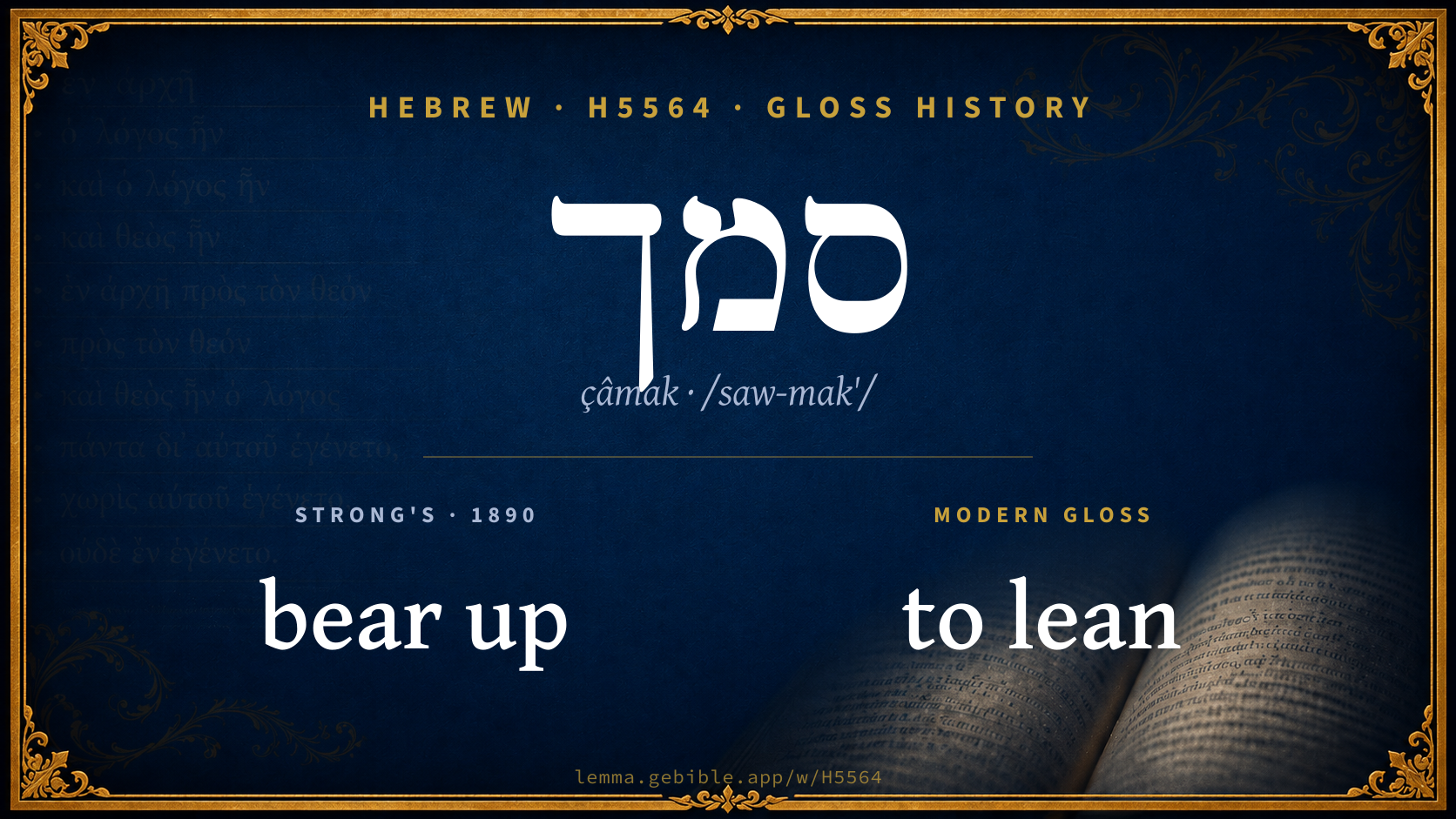
Gloss history
Strong's 1890 vs modern scholarship
About this word
Strong's H5564 catalogs a Hebrew word from the Hebrew Old Testament.
These counts are not copied from any lexicon or concordance. They are computed here, from the morphology-tagged Hebrew Old Testament. What Lemma adds →
- 47
- distinct verses
- The word appears in 47 distinct verses.
- 13 / 39
- OT books
- The word appears in 13 of 39 Old Testament books.
- #767
- by frequency
- Top 1000 most frequent Hebrew words (rank 767 of 8,640 Hebrew words by occurrence).
View all 47 occurrences in the concordance →
By section of the Old Testament
By traditional corpus
Conventional, traditional groupings — biblical authorship is debated, so this is a traditional corpus grouping, not an authorship claim. Each share is this word’s portion of its verses in that division of the Hebrew canon. Each figure is a share of the word’s 47 distinct verses.
- Torah (Pentateuch) 23 verses · 49%
- Writings (Ketuvim) 14 verses · 30%
- Prophets (Nevi'im) 10 verses · 21%
How translations render this word
Counts come from each version’s own published word-to-Strong’s tagging or interlinear alignment — an approximate guide to how each version renders this word, not a word-level alignment the data otherwise carries. Because each total is that version’s own tagged count, the per-version totals vary from one another and need not match the appearance or distinct-verse counts above. These counts may also differ from a printed concordance because Lemma counts each distinctly tagged rendering and does not collapse phrase taggings into a single head-word total. This is a fixed set of word-tagged versions (KJV, ASV, BSB, ULT) and does not change with the reading translation you choose elsewhere. Each version’s license is shown beside its name below (and on Sources).
- King James Version: He shall lay 6×, Shall lay 4×, Shall put 4×
- American Standard Version: He shall lay 8×, Shall lay 7×, Laid 3×
- Berean Standard Bible: He is to lay 6×, Laid 5×, Are to lay 4×
- unfoldingWord Literal Text: And 11×, He shall lay 8×, Shall lay 8×
King James Version Public Domain
Renders H5564 across 48 tagged occurrences — most commonly:
Plus 18 renderings that appear only once — usually multi-word phrases or single function words the recovered tagging swept in, not distinct renderings.
American Standard Version Public Domain
Renders H5564 across 47 tagged occurrences — most commonly:
Plus 18 renderings that appear only once — usually multi-word phrases or single function words the recovered tagging swept in, not distinct renderings. Not rendered by a distinct English word in 1 further occurrence.
Berean Standard Bible Public Domain
Renders H5564 across 48 tagged occurrences — most commonly:
Plus 24 renderings that appear only once — usually multi-word phrases or single function words the recovered tagging swept in, not distinct renderings.
unfoldingWord Literal Text CC BY-SA 4.0
Renders H5564 across 60 tagged occurrences — most commonly:
Plus 25 renderings that appear only once — usually multi-word phrases or single function words the recovered tagging swept in, not distinct renderings.
6 senses and sub-senses in the full BDB
Hebrew verbs can shift meaning by stem (binyan): Qal is the basic action, Niphal is often passive or reflexive, Piel often intensifies or makes it factitive, and Hiphil is typically causative. The senses below are grouped under the stem BDB assigns to each.
What do BDB’s symbols mean?
BDB uses these scholarly abbreviations:
| Symbol | Meaning |
|---|---|
| 𝔊 | the Septuagint (the ancient Greek translation, LXX) |
| 𝔙 | the Vulgate (the Latin translation) |
| 𝔖 | the Syriac version (the Peshitta) |
| 𝔗 | the Targum (the Aramaic translation) |
| ψ | the Psalms |
| √ | root (the underlying root or stem) |
| ‖ | parallel passage (a synonymous or contrasted parallel) |
| † | the dagger: every passage where the word occurs is cited |
The 6 senses and sub-senses the full Brown-Driver-Briggs lexicon distinguishes for this word, in lexicon order (not ranked by frequency), with BDB’s own verbatim wording and sub-sense lettering. Shown in Hebrew script with BDB’s own scholarly abbreviations. The condensed entry is in the Lexicon Entry tab. See also the Forms in the corpus table below.
Qal
- Pf. 3 ms. ס׳ Dt 34:9; Ez 24:2, וְסָמַךְ consec. Am 5:19 +; 3 fs. סָֽמְכָה ψ 88:8, sf. סְמָכָ֑תְהוֹ Is 59:16, סְמָכָ֑תְנִי 63:5, etc.; Impf. 3 ms. וַיִּסְמֹךְ Lv 8:14; Nu 27:23, sf. יִסְמְכֵ֫נִי ψ 3:6, etc.; Imv. ms. sf. סָמְכֵנִי ψ 119:116; Pt. act. סוֹמֵךְ Is 63:5 + 3 times; pl. cstr. סֹמְכֵי Ez 30:6 ψ 54:6; pass. סָמוּךְ Is 26:3 ψ 112:8; pl. סְמוּכִים 111:8;— e.g. Deuteronomy 34:9
- 1.
- a. lean or lay hand upon (עַל־): Am 5:19; elsewhere in sacred rite: on head of sacrif. victim, as those who share in sacrif., Ex 29:10, 15, 19; Lv 1:4 + 12 times Lv, Nu 8:12 (all P), 2 Ch 29:23; so of Levites, presented to י׳ Nu 8:10 (P); on head of blasphemer Lv 24:14 (P; as witnesses of his guilt); on head of Joshua in consecration (Moses subj.) Nu 27:18, 23; Dt 34:9 (all P). e.g. Amos 5:19
- b. intrans. ψ 88:8 thy wrath hath rested upon me (עָלַי); also סָמַךְ מֶלֶךְ־בָּבֶל אֶל־ Ez 24:2 hath leaned against, rested his weight upon, Jerusalem, i.e. invested (Toy), begun the siege of it. e.g. Psalms 88:8
- 2. support, uphold, sustain, only fig.: c. 2 acc. Gn 27:37 (J) with corn and must have I sustained him, provided sustenance for him, cf. (of י׳) ψ 51:14; uphold Egypt Ez 30:6; abs. Is 63:5; especially of י׳ upholding, sustaining Is 59:16; 63:5 ψ 3:6; 37:17, 24; 54:6 (on בְּ essentiae v. Ges§ 119 i, בְּ supr. 7 a), 119:116; 145:14; so pt. pass. ψ 111:8 they are sustained, i.e. maintained (י׳’s commands), סָמוּךְ לִבּוֹ 112:8 his heart is sustained, firm, and so יֵצֶר ס׳ Is 26:3. e.g. Genesis 27:37
Niphal
- Pf. 1 s. נִסְמַ֫כְתִּי ψ 71:6; 3 pl. נִסְמָ֑כוּ Is 48:2; Impf. יִסָּמֵךְ 2 K 18:21 Is 36:6, וַיִּסָּמֵךְ Ju 16:29; 3 mpl. וַיִּסָּֽמְכוּ 2 Ch 32:8;—reflex. support, or brace oneself, also c. עַל־: Ju 16:29 and he braced himself against (upon) them (the pillars): 2 K 18:21 (if) a man support himself on it (Egypt as a cracked reed) = Is 36:6; on cheering words 2 Ch 32:8; on God Is 48:2 ψ 71:6. e.g. Psalms 71:6
Piel
- Imv. mpl. sf. + בְּ instr.: סַמְּכוּנִי Ct 2:5 sustain (refresh, revive) me with raisin-cakes. e.g. Song of Solomon 2:5
Senses from the full Brown-Driver-Briggs lexicon (Brown, Driver, Briggs; Oxford 1906 — public domain), digitized via Sefaria, supplemented by the OpenScriptures HebrewLexicon (CC BY 4.0). Full attribution on Sources.
Word origin
vb. lean, lay, rest, support (NH id.; Ph. in n.pr. Lzb 317, 329; Aramaic סְמַךְ, ܣܡܰܟ; also Ethiopic ((ሰመከ) አስመከ) cause to lean upon, etc. Di 335; Arabic سَمَكَ is be high, ascend, raise, uplift, سَمْكٌ roof);—
— Brown-Driver-Briggs (Oxford 1906, public domain), digitized via Sefaria, supplemented by the OpenScriptures HebrewLexicon (CC BY 4.0). See Sources.
Origin: a primitive root
Jastrow Dictionary
A second Hebrew/Aramaic lexicon for comparison, covering Aramaic and post-biblical (Talmudic, Targumic, Midrashic) usage that the biblical-Hebrew BDB does not. Matched by lemma rather than by Strong’s number, so a lemma may carry more than one Jastrow headword (shown separately below), and the entries cover usage well beyond the Bible.
סָמַךְ
- (b. h.) [to close, join,]
- 1. to pack, make close, stamp. Shebi. III, 8 לא יִסְמוֹךְ בעפר one should not support the dam by packing earth upon it, v. סָבַךְ. Gen. R. s. 5 סְמָבָן וכ׳ he crowded them between &c. (Lev. R. s. 10 שָׂמָן); a. e.
- 2. to support, stem. Midr. Till. to Ps. CXXXVI, עוג היה … וסוֹמְכוֹ Og broke a mountain loose and threw it on the Israelites …, Moses took a pebble and mentioned the Holy Name over it and stemmed its fall; הידים שכך סוֹמְכוֹת the hands which thus stem (the mountain); Deut. R. s. 1, end; a. e.
- 3. to bring close, to join. Y. Sabb. III, 5ᵈ bot. אפי׳ לִסְמוֹךְ לו even to place a vessel close to it (to be warmed); Bab. Sabb. 38ᵇ. Y. Kil. II, 27ᵈ סוֹמְכִין עומרין וכ׳ you may put packed sheaves by the side of &c. Kil. II, 7 לסמוך לו וכ׳ to plant closely adjoining to it &c. Ib. 8; a. fr.—Esp. (sub. יד) a) to press hands on the head of a sacrifice (to indicate ownership). Men. IX, 8 הכל סוֹמְכִין וכ׳ all persons are entitled to lay hands on their sacrifices, except &c. Ḥag. II, 2 שלא לסמוך that the laying on of hands must not be done on the Holy Days. Ib. 3 ואין סומכין עליהם but hands must not be laid on them; a. fr.—b) to lay hands on the head of a scholar, in gen. to ordain. Snh. 14ᵃ the government decreed שכל הסומך יהרג וכ׳ that whosoever ordained a scholar should be put to death, and whosoever be ordained should be put to death, ועיר שסומכין וכ׳ and the town wherein the ordination takes place &c. Ib. וס׳ שם חמשה וכ׳ and he ordained there five elders. Ib. ר"מ לא סְמָכוֹ ר"ע that R. Akiba never ordained R. M.—Ib. סומכין בארץ ונִסְמָכִין וכ׳ if those ordaining stand on Palestinean ground, and those to be ordained outside of Palestine; a. fr.
- 4. to lean, to rely. Ber. 9ᵃ, a. fr., v. כְּדָיי. Erub. 65ᵇ נִסְמוֹךְ על וכ׳ let us rely on the opinion of &c.; a. fr.—Trnsf. a) to support; to find support for an opinion or a rule, (v. אַסְמַכְתָּא). Y. Shebi. X, 39ᶜ bot. (ref. to Deut. XV, 3) מיכן סָמְכוּ לפרוזבול וכ׳ here they found a support for the prosbol as a Biblical institution, expl. בשהתקין הלל סְמָכוּהוּ וכ׳ when Hillel had instituted it, they supported it by reference to &c.—b) (with ענין) to bring under the same rule laws which are joined in the Biblical text. Yeb. 4ᵃ (ref. to Ex. XXII, 17 a. 18) סמכו עניין לו וכ׳ they brought the subject (verse 17) close to it (verse 18) (to intimate) as the punishment for the one is stoning, so is it for the other. Ib. וכי מפני שסמכו וכ׳ can we put a person to death on an intimation suggested merely by the neighborhood of two subjects? (v. סְמוּכִים, infra).—Part. pass. סָמוּךְ; f. סְמוּכָה; pl. סְמוּכִים, סְמוּכִין; סְמוּכוֹת a) near, close by. Meg. 3ᵇ וכל הס׳ לו and all (the inhabited area) adjoining it. Men. 98ᵃ, a. e. על בס׳ the preposition ʿal means immediately on. Sifré Num. 131 הרבה פרשיות ס׳ וכ׳ many sections (in the Torah) adjoin one another, and yet are (mentally) as far from one another &c. Sabb. I, 2 ס׳ למנחה near Minḥah time; a. v. fr.—Esp. סְמוּכִין, סְמוּכִים the interpretation founded on the fact of local junction of texts (v. supra). Yeb. l. c. ס׳ מן התורה מנין where is it intimated that Biblical texts are to be interpreted on the basis of proximity? Answ. (ref. to Ps. CXI, 8): they are arranged &c. Ib. מאן דלא דריש ס׳ he who does not adopt the interpretation based on textual proximity. Ber. 10ᵃ; a. fr.—b) strong, hardened. Num. R. s. 9 לבה ס׳ עליהם her heart is hardened towards them (and their presence will prevent her from confessing her guilt); cmp. גּוּס I. e.g. Deuteronomy 15:3
- 1. to be adjoined. Ber. l. c. למה נִסְמְכָה וכ׳ why has the section referring to Absalom (Ps. III) been joined to that relating to Gog and Magog (Ps. II)? Tanḥ. Ḥuck. 20 ונ׳ להר וכ׳ and is close to the mountain opposite. M. Kat. 28ᵃ; a. fr.
- 2. to be ordained. Snh. l. c., v. supra. Yoma 87ᵃ שראויין לִיסָּמֵךְ who are worthy to be ordained; a. fr.
- to support, prop. Y. Maasr. II, 50ᵃ top המְסַמֵּךְ בגפנים he who props vines. Yalk. Ex. 244 עוזר ומסמך אתה וכ׳ thou art a helper and supporter to all &c.; a. e.—Part. pass. מְסוּמָּךְ, pl. מְסוּמָּכִין. Kel. II, 2 יושבין שלא מ׳ (vessels or fragments of vessels) resting without the need of a support.
- to pack, tread. Y. Maasr. l. c. ברגליו מַסְמִיךְ working with his feet is he who packs (sheaves &c.; Y. B. Mets. VII, beg. 11ᵇ מקמץ).
- to lean one’s self. Gen. R. s. 45, end היתה מִסְתַּמֶּכֶת על וכ׳ was leaning on her handmaid. Sifré Num. 131 והיה מִסְתַּמֵּךְ וכ׳ and he went off leaning on his stick; a. e.
סְמַךְ I
- 1. to press, lay hands on, lean on. Targ. Am. V, 19. Targ. Ex. XXIX, 10; a. fr.
- 2. to support, uphold. Targ. Ps. LI, 14; a. e.
- 3. to rest on; to rely, feel safe. Targ. II Sam. I, 6. Targ. Ps. LXXXVIII, 8. Ib. LXXI, 6; a.fr. fr.—Ḥag. 20ᵇ מִיסְמַךְ סָמְכָא דעתייהו their mind is at rest (they feel safe that they cannot be seen). Ab. Zar. 71ᵇ סמכא דעתיה he feels sure (of his bargain); a. fr.
- 4. to bring close, join. Y. Sabb. III, 5ᵈ bot., v. אֲדֵירָא. Yeb. 119ᵃ סְמוֹךְ מיעוטא וכ׳ bring close, i.e. add. &c., v. מִיעוּטָא; Kidd. 80ᵃ; a. e.—Esp. to ordain (v. preced., a. Targ. Deut. XXXIV, 9). Snh. 13ᵇ (expl. סמיכת זקנים, v. סְמִיכוּת) מִיסְמַךְ סבי ordaining of elders. Ib. בירֹא ממש סַמְכִין ליה או בשמא סמכין ליה Ms. M. must they ordain him by actually putting a hand on him, or merely by calling his name? Ib. וחד לא סָמֵיךְ and one alone cannot ordain? Ib. 14ᵃ ור"מ … סַמְכֵיה was it R. J. ben B. that ordained R. Meir? Ib. הוה מיטמר מלמיסמכיה Ms. M. was on his guard not to be ordained. Ib. סְמוֹכוּ לנא appoint for us as teachers, v. חֲמִיסִין; a. fr.—Part. pass. סָמִיךְ, סְמִיךְ a) ordained. Pes. 49ᵃ תרי בני סְמִיכֵי two sons both of whom were ordained teachers.—b) near, adjoining. Targ. Y. I Num. XXI, 14. Ib. II, 5; 12, a. e. (interch. with סְמוּכִין). Targ. Y. Deut. VI, 7.—Snh. 7ᵇ וס׳ ליה וכ׳ and next to it follows &c.; ib. 107ᵃ; a. fr.
- 1. to press, stamp, make a thick mass. Pes. 116ᵃ וצריך לסַמּוּכֵיה וכ׳ and you must make it a thick mass so as to be emblematical of clay (v. חֲרוֹסֶת).
- 2. to secure, esp. to refer to a depositary for payment; to draw an order for. Y. Kidd. III, 64ᵃ top סַמְּכֵיה גבי לוי he referred him to Levy (as his depositary). Ib. סַמְּכוּן … גבי זבונה they secured the teacher by a deposit with a merchant. Y. Shebu. VII, 38ᵃ top, כַּתָּפָא. Y. B. Mets. IV, beg. 9ᶜ; a. e.
- 1. to give an order to. Ib. אנא בעי … דאַסְמִיכְתַּנִי I want to collect the money for which thou hast given me an order (at the banker’s).
- 2. to lean on; to find support; to give support. Y. Ber. II, 4ᶜ כל מילה … מַסְמְכִין לה מן וכ׳ whenever a proposition is not evident, they try to support it by a large number of Biblical passages; Pesik. R. s. 22 מַסְמְכִינָן, v. אֲתַר. M. Kat. 5ᵃ אַסְמְכָהּ אקרא gave it support by reference to a Biblical verse. Ber. 19ᵇ כל מילי … אַסְמְכִינְהוּ על וכ׳ they lean all rules of the Rabbis on the law, ‘Thou shalt not deviate’, v. סוּר I; a. e.
- 3. to make substantial, put a thick layer on. M. Kat. 13ᵇ מעבין אַסְמוּכֵי mʾʿabbin (Mish. ib. II, 5) means covering with a heavy layer, opp. אַקְלוּשֵׁי, v. קְלַשׁ.
- to lean; to rely. Targ. Jud. XVI, 26. Targ. Is. L, 10; a. fr.—Yeb. 42ᵇ מִסְתְּמִיךְ ואזיל וכ׳ R. A. walked leaning on the shoulder of &c. Y. Ber. II, 4ᵇ; Y. M. Kat. III, 83ᶜ bot. ר׳ יוחנן הוה מיסתמיך וכ׳ R. J. was (walking) leaning on &c.; a. fr.
סְמַךְ II
- (preced.) support, help. Targ. O. Gen. II, 18 (ed. Vien. סָמֵךְ; Y. סְמִיךְ). Targ. Y. I Deut. XXXIII, 7 סמיך (Y. II סֶמֶךְ); a. e.
A Dictionary of the Targumim, the Talmud Babli and Yerushalmi, and the Midrashic Literature (Marcus Jastrow; London, Luzac, 1903) — Public Domain. Digitized via Sefaria. Digitized via Sefaria. Full attribution on Sources.
Forms in the corpus
The 37 distinct written forms H5564 takes in the Hebrew Bible, most frequent first — each parse links to that stem’s occurrences in the concordance. Hebrew forms include their vowel points and cantillation, so a single lemma takes many written forms.
Same root — word family
Other BDB entries built from the same root as H5564, grouped by Strong’s listed origin. These share a root / origin per the lexicon — not necessarily a shared meaning. Each links to that word’s own entry.
Derived from this word
Proper names from this root
People and places named from this root — a name, not an additional meaning of the word.
Compare all same-root words → 2 of the same-root words are proper names (people or places). They share a root, not necessarily a meaning.
Septuagint verse parallels
This word appears in 43 verses that also exist in the Greek Old Testament (Septuagint), out of the 47 Hebrew verses it occurs in. You can read those verses in Greek by switching the Old Testament edition to the Septuagint.
Read these verses in the Septuagint
- Genesis 27:37
- Exodus 29:10
- Leviticus 1:4
- Numbers 8:10
- Deuteronomy 34:9
- Judges 16:29
- 2 Kings 18:21
- 2 Chronicles 29:23
- Psalms 3:5
- Song of Solomon 2:5
- Isaiah 26:3
- Ezekiel 24:2
This is a verse-level parallel only — the same verses exist in both the Hebrew and Greek Old Testaments. No word-level Hebrew↔Greek correspondence is claimed: the data carries no such alignment, so no Greek word is shown as this Hebrew word’s translation. Coverage is not total — the Septuagint omits the deuterocanon and renumbers the Psalms, so some Hebrew verses have no direct Greek parallel.