
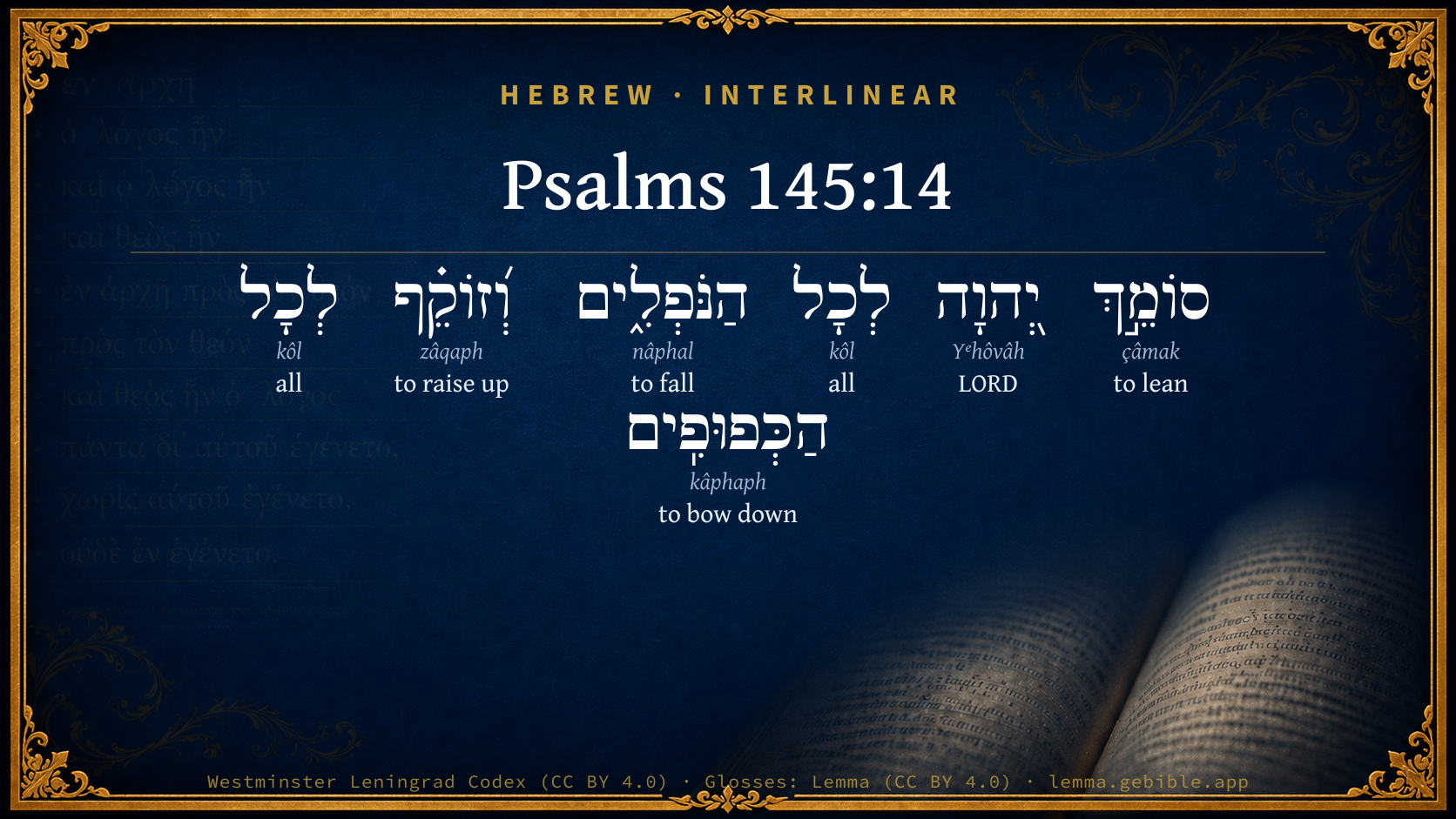
Psalms 145:14

Hebrew (Westminster Leningrad Codex) Psalms 145:14 appears in the Hebrew Old Testament. The text above is from the Westminster Leningrad Codex. Each word links to its Strong’s number, a concise gloss, and parsing drawn from the Open Scriptures Hebrew Bible morphology. Click any word for its full Brown-Driver-Briggs (BDB) entry.
Download image
Cite this verse

Psalms 145:14 (World English Bible). Public Domain. Lemma interlinear Bible study tool, https://lemma.gebible.app/v/psalms/145/14.

Show BibTeX & RIS
BibTeX
RIS
English Translation
Yahweh upholds all who fall, And raises up all those who are bowed down.
World English Bible · Public Domain
Highlights
  • 1 first appearance in the Hebrew Bible
Full analysis ↓
Download a study sheet

One document with this verse’s original text, its word-by-word gloss line, the meaning frame, cross-references with their text, attributed commentary, and full source and license credits — printable, and it pastes into notes with its structure intact.

This verse Autodidact and up

Study sheet (.html) Plain text (.txt)

A passage Seminary Student

Up to 50 verses in one chapter. A passage sheet keeps up to 6 commentary sources and 12 cross-references per verse, in the order this page ranks them, and says so on the sheet whenever that leaves anything out. Ask for a single verse and you get the Autodidact verse sheet above.

Everything on this page stays free to read, with no account — the sheet is a download of what is already on screen, not access to it.

Want to remove ads? Support Godless Engineer
Compare translations 3

The same verse in 3 English versions, stacked beneath the original-language interlinear above. Click any original word for its lexicon entry.

Each is an independent rendering of the whole verse — the interlinear is not word-aligned to these translations.

Highlighted words mark where these versions differ — a whole-verse word diff, not a word-by-word alignment.

  • World English Bible Public Domain
    Yahweh upholds all who fall, And raises up all those who are bowed down.
  • King James Version Public Domain
    The LORD upholdeth all that fall, and raiseth up all those that be bowed down.
  • unfoldingWord Literal Text CC BY-SA 4.0
    Yahweh is supporting all of the ones falling and raising up all of the ones being bowed down.

unfoldingWord Literal Text — © unfoldingWord, licensed CC BY-SA 4.0. Word-aligned USFM3 via Door43 (git.door43.org/unfoldingWord/en_ult).

Versions to compare (up to 4)

3 of 4 selected

Show all 18 translations

Every available English version of this verse, each an independent rendering of the whole verse.

  • World English Bible Public Domain
    Yahweh upholds all who fall, And raises up all those who are bowed down.
  • Berean Standard Bible Public Domain
    The LORD upholds all who fall and lifts up all who are bowed down.
  • Majority Standard Bible Public Domain
    The LORD upholds all who fall and lifts up all who are bowed down.
  • King James Version Public Domain
    The LORD upholdeth all that fall, and raiseth up all those that be bowed down.
  • American Standard Version (1901) Public Domain
    Jehovah upholdeth all that fall, And raiseth up all those that are bowed down.
  • Revised Version (1885) Public Domain
    The LORD upholdeth all that fall, and raiseth up all those that be bowed down.
  • Geneva Bible (1599) Public Domain
    The Lord vpholdeth all that fall, and lifteth vp all that are ready to fall.
  • Douay-Rheims (1899) Public Domain
    their oxen fat. There is no breach of wall, nor passage, nor crying out in their streets.
  • Young's Literal Translation Public Domain
    Jehovah is supporting all who are falling, And raising up all who are bowed down.
  • Literal Standard Version CC BY-SA 4.0
    YHWH is supporting all who are falling, || And raising up all who are bowed down.
  • Unlocked Literal Bible CC BY-SA 4.0
    Yahweh supports all who are falling and raises up all those who are bent over.
  • unfoldingWord Literal Text CC BY-SA 4.0
    Yahweh is supporting all of the ones falling and raising up all of the ones being bowed down.
  • Darby Bible Public Domain
    Jehovah upholdeth all that fall, and raiseth up all that are bowed down.
  • World Messianic Bible Public Domain
    The LORD upholds all who fall, and raises up all those who are bowed down.
  • Webster's Bible Public Domain
    The LORD upholdeth all that fall, and raiseth up all those that are bowed down.
  • Free Bible Version CC BY-SA 4.0
    The Lord helps up all those who fall down; he lifts up all those who are bowed down.
  • Bible in Basic English Public Domain
    The Lord is the support of all who are crushed, and the lifter up of all who are bent down.
  • JPS Tanakh (1917) Public Domain
    The LORD upholdeth all that fall, and raiseth up all those that are bowed down.

Literal Standard Version (2020), Covenant Press — licensed CC BY-SA 4.0. Text via the HelloAO Bible API (eBible.org). Unlocked Literal Bible (unfoldingWord) — licensed CC BY-SA 4.0. Text via the HelloAO Bible API (eBible.org). unfoldingWord Literal Text — © unfoldingWord, licensed CC BY-SA 4.0. Word-aligned USFM3 via Door43 (git.door43.org/unfoldingWord/en_ult). Free Bible Version, Dr. Jonathan Gallagher — licensed CC BY-SA 4.0. Text via the HelloAO Bible API (eBible.org).

Word by word

More ways to search: Search by grammar → Find every occurrence → Compare this word →

Practice this passage: Drill this verse → Learn its vocabulary →

About this verse

These counts appear in no published source. They are computed here, from the morphology-tagged text and Lemma’s own curated glosses. What Lemma adds →

7
words
6
distinct lemmas
Wisdom
section

Notable vocabulary

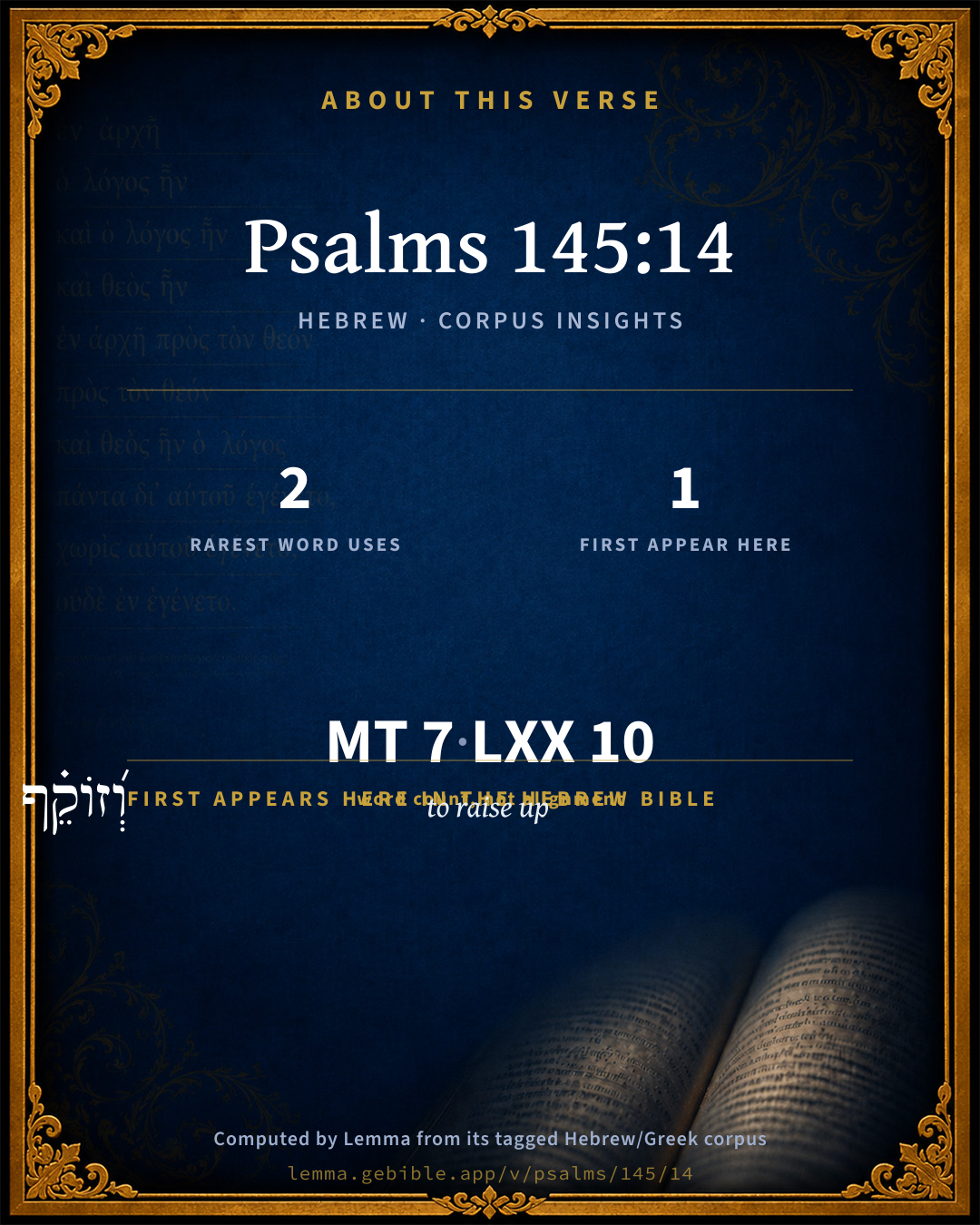
The rarest word here is וְ֝זוֹקֵ֗ף to raise up H2210 — appearing just 2 times in the whole Hebrew Bible.

First appearance in Scripture

This word makes its first canonical appearance in the Hebrew Bible here:

  • וְ֝זוֹקֵ֗ף to raise up H2210

Shared distinctive vocabulary

וְ֝זוֹקֵ֗ף to raise up H2210 occurs in 2 verses of the Hebrew Bible. Also found in:

Grammatical profile

  • 4 verbs
  • 3 nouns

Verb forms

  • סוֹמֵ֣ךְ Qal · Participle Active
  • הַנֹּפְלִ֑ים Qal · Participle Active
  • וְ֝זוֹקֵ֗ף Qal · Participle Active
  • הַכְּפוּפִֽים Qal · Participle Passive

Repetition

A word recurs within this verse — often emphatic in Hebrew:

  • לְכָל all H3605 ×2

Hebrew & Septuagint length

In English translation the verse runs 14 words from the Hebrew and 15 from the Septuagint (LXX English) — closely comparable.

A rough comparison of the two English renderings, which tokenize alike — not a word-level alignment.

Word counts can differ between the Hebrew and the Greek without any difference in meaning — e.g. the Hebrew direct-object marker אֵת has no separate Greek word, and Greek often adds the article ὁ.

In the original languages it is 7 Hebrew tokens and 10 Greek tokens — but the two are counted differently (Hebrew bundles its prefixes and suffixes into one token; the Greek is in lemma form), so that isn’t a like-for-like length.

Cross-references

8

Topical passages linked to Psalms 145:14 in the Treasury of Scripture Knowledge — connected by theme and wording, ordered by reader-vote popularity; previews shown in the World English Bible.

  • Psalms 146:8 Yahweh opens the eyes of the blind. Yahweh raises up those who are bowed down. Yahweh loves the righteous.
  • Psalms 37:24 Though he stumble, he shall not fall, For Yahweh holds him up with his hand.
  • Psalms 94:18 When I said, "My foot is slipping!" Your loving kindness, Yahweh, held me up.
  • Luke 22:31–32 The Lord said, "Simon, Simon, behold, Satan asked to have you, that he might sift you as wheat,
  • Psalms 119:117 Hold me up, and I will be safe, And will have respect for your statutes continually.
  • Luke 13:11–13 Behold, there was a woman who had a spirit of infirmity eighteen years, and she was bent over, and could in no way straighten herself up.
  • Psalms 42:5 Why are you in despair, my soul? Why are you disturbed within me? Hope in God! For I shall still praise him for the saving help of his presence.
  • Psalms 38:6 I am pained and bowed down greatly. I go mourning all day long.

Cross-references courtesy of OpenBible.info (CC BY 4.0).

Hebrew and Greek witnesses Masoretic Hebrew ↔ Greek Septuagint

The same verse in the two great witnesses to the Old Testament, shown verse-for-verse.

You’re reading Greek Psalm 144 (Hebrew Psalm 145). The Septuagint counts the superscription, so verse numbers can differ from the Hebrew — chapter-level alignment, not verse-by-verse. Numbering follows Rahlfs.

These are two independent witnesses, not word-aligned to each other, and the Septuagint is shown in lemma (dictionary) form.

Hebrew Psalms 145:14 Masoretic · Westminster Leningrad Codex

סוֹמֵ֣ךְ יְ֭הוָה לְכָל הַנֹּפְלִ֑ים וְ֝זוֹקֵ֗ף לְכָל הַכְּפוּפִֽים

Yahweh upholds all who fall, And raises up all those who are bowed down.

World English Bible · Public Domain

Greek LXX Greek Psalm 144:14 Septuagint · lemma form

ὑποστηρίζω κύριος πᾶς ὁ καταπίπτω καί ἀναὀρθόω πᾶς ὁ καταῥήγνυμι

The Lord supports all that are falling, and sets up all that are broken down.

LXX2012 (modern English Septuagint) · Public Domain

On this verse, Keil & Delitzsch discusses the Septuagint’s reading. Read the note in Commentary ↓

Hebrew: Westminster Leningrad Codex (CC BY 4.0). Greek: Septuagint (public domain); English from LXX2012 (modern English Septuagint) (Public Domain). How the Septuagint differs from the Hebrew →

Commentary

Notes on Psalms 145:14 from classic Christian and Jewish commentators (each source and its license shown beneath its notes). The classic Christian expositions comment on the surrounding passage and are grouped to its opening verse, so a note may address several verses; the Jewish commentaries on the Tanakh (Rashi and others) are per-verse, so they appear only where the commentator wrote on this verse.

Lemma curates 59 commentaries, every one of them public domain or Creative Commons licensed, each selected and text-cleaned for this edition rather than reprinted as found. About our sources →

Trapp's Complete Commentary

John Trapp

Psa 145:14 The LORD upholdeth all that fall, and raiseth up all [those that be] bowed down.

Ver. 14. The Lord upholdeth all that fall] None of his subjects can fall below his helping hand, his sweet support.

And raiseth up all those that are bowed down] Either with the burden of sin or misery in any kind. Alphonsus, king of Arragon, is famous for helping with his own hand one of his subjects out of a ditch. Of Queen Elizabeth it is recorded, to her eternal praise, that she hated (no less than did Mithridates) such as sought to crush virtue forsaken of fortune (Camden). Christ bruiseth not the broken reed, but upholdeth it; he quencheth not the smoking wick, but cherisheth it.

John Trapp, A Commentary or Exposition upon All the Books of the Old and New Testament (1647–1656) — public domain. Text from a community e-Sword module.

The Biblical Illustrator

Joseph S. Exell

Psa_145:14

The Lord upholdeth all that fall, and raiseth up all those that be bowed down.

The God of the unsuccessful

The Bible, being a book for humanity, is a book for the weak, the fallible, and the disappointed. A large part of it is devoted to the erring and the unsuccessful. Take its biographies. Abraham, Isaac, Jacob, Moses, Elijah, Job--every one of these biographies is the story of a faultful man. Then, so much of its counsel and warning is directed at servants of God and disciples of Christ. Not only guide-posts, but-danger-signals, are set up all along the way of life. It was to His own disciples that Christ said, Watch and pray that ye enter not into temptation. The spirit indeed is willing, but the flesh is weak. By far the larger part of its promises is to the sorrowful, and afflicted, and disappointed. When Christ invited the weary and heavy-laden to rest, He invited a restless and burdened world. When the Bible addresses the strong, it is to point them to the true source of their strength, to warn them against presuming on their own wisdom, and to commend the weak to their sympathy and helpfulness. The whole matter is summed up in the psalmists statement of Gods attitude toward His children at large. It is that of pity based on knowledge of their infirmity. I speak, as the psalmist does, of men and to men who recognize and honour the law of God, and are honestly striving to keep His laws. The words do not apply to the indolent who interpret the invitation to east their care on God as a permit to cast off all care about their own souls and lives. They do not apply to those who are indifferent to God and who wilfully defy His law. The psalmist settles that in verse 20. I am speaking, then, to you who honour God; who are making an honest fight for the truth and the right; who are trying to keep your lives pure and to make them useful. I know that you fall as I do, and are often bowed down. I know that you are not all successes, either from a worldly or a religious point of view. Now, first, in relation to your worldly affairs. You have stumbled and fallen in the path which you thought would lead you to success and victory. Well, look at the text. O merciful, wise, tender love, which, even while it denies what we long for, bends over us while we lie prone and weeping over our disappointment, and sets us on our feet again and bids us follow God and not the devices and desires of our own hearts. He may thus set us on our feet that we may walk another way from that on which we were going. The fall may be a blessing in disguise, a monition to abandon that way. Many a man has found that to give up the thing he desired and take something less and lower was not a sorrow after all. Or, suppose God means to admonish you by your fall to go more slowly after your desire. He that believeth shall not make haste. God will not let us pursue one remote end to the neglect of all that lies by the wayside. Success in life is not the gaining of that one end at the end. It is the right adjustment to all that lies in the track of each day. So God lets you walk, upholds you, teaches you to walk. He is doing you a greater service by upholding you, so that you can move on and win the strength, and discipline, and experience which come through walking circumspectly, than if lie had let you go straight to the thing you coveted and sit down and enjoy that. Disappointment need not mean wreck. It will not if God is in it. Sometimes it seems as if Gods policy toward a man is to keep him down, and yet keep him walking and working. That develops the highest type of moral heroism. It is a higher and greater thing for an unsuccessful and disappointed man to keep rising from his failures and to struggle on his way leaning on Gods hand to the very end, than for him to succeed before the world. God has a testimony to bear to the world through His sons and daughters no less than to them; and He bears that testimony most emphatically in showing the world that His hand can keep a man a man, with an honest soul and a persistent purpose in him, amid all his falls and disappointments. And as to the matter of Christian experience and the falls and stumblings which are along that line--I know that the ideal which at once beckons and reproaches us is that of a steady growth in faith, and love, and goodness, and Christian power. It is the true ideal too. Let us never lower it: never cease striving for it. Let us never admit to ourselves that yielding to temptation is anything less than sin: that sin is other than vile. Tried by the high ideal of the Gospel you are not a religious success, only trying hard to be. That is the saving clause. God is on the side of the unsuccessful but honestly-striving. You find in yourself a constant tendency to stumble. If Satan desires to sift you as wheat, Christ prays for you. He is bent, not on raising up you and your sin together, but on raising you out of your sin and making you a man in Christ Jesus in spite of your temptation and weakness. (M. R. Vincent, D. D.)

Recuperative grace

An Eastern parable represents a man as falling down by the way, and getting so broken up by his fall that he lay there eleven years. One day an old friend came along and began to commiserate and encourage him, and forthwith he poured out the story of his sorrows, and began to tell the ether what a dreadful thing it was to fall down. Ah, yes, said the friend, but I know something much worse than falling down. Why, said he, what can be worse? And the other answered, Not getting up again. Thank God for recuperative grace! When we were boys, at our wrestling matches we were not considered down until we said Down, and some of us refused to stay down long enough to count. Beloved, dont make the mistake of not getting up again. Be brave in spite even of yourself and your own failures and weaknesses. Remember that the Lord upholdeth all that fall, and raiseth up those that be bowed down.

The Biblical Illustrator, edited by Joseph S. Exell (c. 1880s–1900s) — public domain. Text from a community e-Sword module.

The Treasury of David

Charles H. Spurgeon

Ver. 14. The Lead upholdeth all that fall. Read this verse in connection with the preceding, and admire the unexpected contrast: he who reigns in glorious majesty, yet condescends to lift up and hold up those who are apt to fall. The form of the verb shows that he is always doing this; he is Jehovah upholding. His choice of the fallen, and the falling, as the subjects of his gracious help is specially to be noted. The fallen of our race, especially fallen women, are shunned by us, and it is peculiar tenderness on the Lord's part that such he looks upon, even those who are at once the chief of sinners and the least regarded of mankind. The falling ones among us are too apt to be pushed down by the strong: their timidity and dependence make them the victims of the proud and domineering. To them also the Lord gives his upholding help. The Lord loves to reverse things, he puts down the lofty, and lifts up the lowly.

And raiseth up all those that be bowed down. Another deed of condescension. Many are despondent, and cannot lift up their heads in courage, or their hearts with comfort; but these he cheers. Some are bent with their daily lead, and these he strengthens. Jesus loosed a daughter of Abraham whom Satan had so bound that she was bowed down, and could by no means lift up herself. In this he proved himself to be the true Son of the Highest. Think of the Infinite bowing to lift up the bowed, and stooping to be leaned upon by those who are ready to fall. The two "alls" should not be overlooked: the Lord has a kindly heart towards the whole company of the afflicted.

Ver. 14. The LORD upholdeth all that fall, etc. It is noteworthy how the Psalmist proceeds to exhibit the mightiness of God's kingdom, not by its power "to break in pieces and bruise", like the iron legs of the statue in Nebuchadnezzar's vision (Da 2:40), but by the King's readiness to aid the weak. Even a heathen could see that this was the noblest use of power.

Regia (crede mihi) res est succurrere lapsis.

Ovid., Ep. de Panto, ii. 9, II.

It is a kingly thing to help the fallen. Neale and Littledale.

Ver. 14. The LORD upholdeth all that fall, etc. oyekn nophelim the falling, or those who are not able to keep their feet; the weak. He shores them up; he is their prop. No man falls through his own weakness merely; if he rely on God, the strongest foe cannot shake him. Adam Clarke.

Ver. 14. And raiseth up all those that be bowed down, incurvatos. Many who do not actually fall are reduced to distress that may be even more painful; for the struggling are greater sufferers than the actually passive. Men are bowed down physically by infirmity; mentally, by care; spiritually, by remorse; some are even crushed by all three burdens. For all such there is help in a Mighty One. But none can help themselves alone: none are raised but by supernatural interpositionnon nisi opitulante Domino. Martin Geier.

Ver. 14. The LORD upholdeth all that fall. The word here used is a participle, literally, "The Lord sustaining" that is, the Lord is a Sustainer or Upholder of all that fall. Albert Barnes.

Ver. 14. And raiseth up all those that be bowed down. Alphonsus, King of Arragon, is famous for helping with his own hand one of his subjects out of a ditch. Of Queen Elizabeth it is recorded, to her eternal praise, that she hated (no less than did Mithridates) such as sought to crush virtue forsaken of fortune. Christ bruises not the broken reed, but upholdeth it, he quenches not the smoking wick, but cherisheth it. John Trapp.

Ver. 14-19. The Psalmist sets up a splendid argument. Having praised the kingdom, he goes on to display seven glories peculiar to kings, and shows that in Jehovah these shine supremely. Ps 145:14-19 contain each a royal virtue. John Lorinus.

Ver. 14. The grace of God in his kindness to the undeserving and the miserable, who look to him for help.

1. He "upholdeth all that fall."

a) A description, embracing (1) Sinners who have fallen lowest: (2) Backsliders who have tripped most foully.

b) An act implying (1) Pity which draws nigh; (2) Power which places the fallen upon their feet; (3) Preservation which keeps them standing.

2. He "raiseth up all those that are bowed down." Consolation for those who are

a) Bowed down with shame and penitence.

b) Oppressed with perplexities and cares.

c) Weighted with a sense of weakness in the presence of onerous duties.

d) Depressed because of prevailing error and sin around them. J. F.

Ver. 14. Help for the fallible.

1. Whatever our present position we are liable to fall. Sickness. Loss. Friendlessness. Sin.

2. However low we fall we are not below the reach of God's hand.

3. Within the reach of God's hand we shall experience the action of God's love. "Upholdeth." "Raiseth up." C.A.D.

Psalms 145:15*

Charles H. Spurgeon's The Treasury of David (1869–1885) — public domain. Psalms only. Text from a community e-Sword/MySword module.

Joseph Benson's Commentary

Psa 145:14-16. The Lord upholdeth all that fall — All that look to him for help; indeed all that are upheld, whose support is not from themselves, or from men, but only from God’s powerful providence and grace. The eyes of all — Of all living creatures; wait upon thee — Expect their supplies wholly from thy bounty. Expectation is here figuratively ascribed to brute creatures, as Psa 104:27, on which see note, and Rom 8:22. And givest them their meat in due season — When they need it. “What a just and beautiful picture,” says Dr. Horne, “is here presented to view! We see the whole animal world assembled before us, with their eyes fixed on the great King and Father of all things, like those of a flock on their shepherd, when he enters the field in time of dearth with provender for them. From the same divine person, as the Saviour of men, as the King, Father, and Pastor of the church, do believers, with earnest expectation, wait for the food of eternal life. And neither one nor the other look and wait in vain. To both he giveth their meat in due season; he openeth his hand and satisfieth the desire of every living thing.”

Joseph Benson's Commentary on the Old and New Testaments (1811–1818) — public domain. Text from a community e-Sword module.

J. A. Alexander on Psalms

Joseph Addison Alexander

14. (Psa 145:14) An upholder (is) Jehovah for all the falling, a lifter up for all the bowed down. The first word in each clause is properly a participle, here used as a noun, and therefore followed by the preposition to or for. Translated in either way, the words necessarily suggest the idea of habitual action. With the first clause compare Psa 37:17; Psa 37:24; Psa 54:4; Psa 119:116.

Joseph Addison Alexander, The Psalms Translated and Explained (1850) — public domain. Text from a community e-Sword module.

Tyndale Open Study Notes

Tyndale Open Resources

145:14-20 The Lord cares for his creatures.

Tyndale Open Study Notes — © Tyndale Open Resources, licensed CC BY-SA 4.0. Text via the HelloAO Bible API.

Geneva Bible (1599)

Geneva Bible translators

Who being in misery and affliction would faint and fall away, if God did not uphold them, and therefore they ought to reverence him that reigneth in heaven, and suffer themselves to be governed by him.

Geneva Bible (1599) marginal notes — public domain. Text via Bolls.life.

Jamieson, Fausset & Brown

Robert Jamieson, A. R. Fausset & David Brown

(Compare Psa 37:17; Psa 54:4).

Jamieson, Fausset & Brown — Commentary Critical and Explanatory on the Whole Bible (1871) — public domain (CC PDM 1.0). Text via the HelloAO Bible API.

Adam Clarke's Commentary

Verse 14. The Lord upholdeth all that fall] נפלים nophelim, the falling, or those who are not able to keep their feet; the weak. He shores them up; he is their prop. No man falls through his own weakness merely; if he rely on God, the strongest foe cannot shake him.

Adam Clarke's Commentary on the Bible (1810–1826) — public domain. Text from a community e-Sword/MySword module.

John Calvin's Commentaries

14. Jehovah upholding all the falling. He gives instances of the goodness and mercy of God, such as make it evident that God reigns only for the promotion of the general welfare of mankind. By the falling, and those who are bowed down, he means figuratively those who are overwhelmed by adversity, and would sink at once, were not God to extend his hand for their support. God, in short, has respect to the troubles of men, and helps such as are in distress, so that all ought not only to look upon his divine government with reverence, but willingly and cordially submit themselves to it. Another lesson taught us is, that none will be disappointed who seeks comfort from God in his affliction.

John Calvin's Commentaries (1540-1563) — public domain. Text from the Calvin Translation Society English edition (1840s-50s) via the Christian Classics Ethereal Library (ccel.org). Calvin's coverage is partial (roughly two-thirds of the Bible); uncommented books and verses are honest gaps, never fabricated. The 19th-century editor's footnotes and remarks are omitted so the notes are faithfully Calvin's own voice.

Ellicott's Commentary for English Readers

(14) The Lord.—Comp. Psa_37:24. It marks a grand step in theology when the first instance of majesty of the Divine Being is sought in His condescension to human weakness and pity for frailty and want. The heathen had seen that this was king-like—

“Regia (crede mihi) res est succurrere lapsis.”

OVID: Ep. de Ponto 11., 9, 11.

But they had hardly seen that it was also god-like.

For “raiseth” and “bowed down,” see Psa_146:8.

A Bible Commentary for English Readers, edited by Charles John Ellicott (1878–1897) — public domain. Text from a community e-Sword module.

The Cambridge Bible for Schools and Colleges

gen. ed. J. J. S. Perowne

14. all that fall] Or, all that are falling. But cp. Psa_37:17; Psa_37:24.

raiseth up] An Aramaic word, found in the Heb. of the O.T. only here and in Psa_146:8.

The Cambridge Bible for Schools and Colleges (gen. ed. J. J. S. Perowne; Cambridge University Press, 1878–1918) — public domain. Text from a community e-Sword module.

John Gill's Exposition

The Lord upholdeth all that fall,.... Not all that fell in Adam, as all mankind did; nor all that fall into sin, as every man does; and therefore not those that fall into hell: but this is to be understood of the subjects of Christ's kingdom, of which the psalmist is speaking; who does that which no mortal king can do, as Aben Ezra observes: another king raises up one, and depresses another; supports one, and lets another fall: but the Lord upholds all his people and subjects with the right hand of his righteousness; though they are liable to fall into sin, and in many instances do fall, and into various temptations and afflictions; yet he sustains and upholds them, that they shall not fall finally and totally by sin, nor be overwhelmed and crushed by their heavy afflictions. Or, "all that are falling" (g); he either upholds and keeps them that they shall not fall, at least so as to perish; or he holds them by his right hand when they are fallen, and raises them up again; and bears them up under all their exercises, so that they are not utterly cast down and destroyed, Psa 37:24;

and raiseth up all those that be bowed down: with a body of sin, under which they groan, being burdened, and which presses them sore; with Satan's temptations, like the woman in the Gospel, bound together by him; and with various troubles and afflictions; but the Lord raises and bears them up under all, and comforts and refreshes them.

(g) "emnes cadentes", Pagninus, Montanus, Junius & Tremellius, Piscator, &c.

John Gill's Exposition of the Whole Bible (1746–1763) — public domain (CC PDM 1.0). Text via the HelloAO Bible API.

Albert Barnes' Notes on the Bible

The Lord upholdeth all that fall - The word used here is a participle, literally, “The Lord sustaining;” that is, the Lord is a Sustainer or Upholder of all that fall. The allusion is to those who have no power to go of themselves; who would sink under the burdens of life if they were not supported. The idea is, that it is a characteristic of the Lord, that he does sustain such; that all such may confidently look to him to uphold them.

And raiseth up all those that be bowed down - The word here also is a participle: “he is lifting up;” that is, he is a lifter up. The reference is to those who are bent and bowed under the duties, the cares, the trials of life; who go bowed down under those burdens. God is able to strengthen them so that they can bear those burdens without being crushed under them.

Albert Barnes' Notes on the Bible (1834–1885) — public domain. Text from a community e-Sword/MySword module.

Matthew Poole's English Annotations

Upholdeth all; either,

1. All that look up to him for help: or,

2. All that are upheld; whose support is not from themselves, nor from other men, but only from God’s’ powerful and good providence.

Matthew Poole's English Annotations on the Holy Bible (1683–1685) — public domain. Text from a community e-Sword/MySword module.

The Pulpit Commentary

The Lord upholdeth all that fall. Lifts them up, i.e., and again "upholds" or supports them. (comp. Psa_37:24) And raiseth up all those that be bowed down. (comp. Psa_146:8)

For the fallen and the falling.

How different are the ways of him whose everlasting kingdom and enduring dominion are told of in the previous verse, from the ways of the world and of hard and selfish men! Vae victis! is the world"s verdict, and the facts of life too often confirm it; but the Lord, he is the Savior of the unsuccessful, the Speaker of heart-cheering words to the crushed ones in life"s stern conflict, and the Performer for them of corresponding deeds.

I CONSIDER THE TWO CLASSES OF PERSONS HERE SPOKEN OF.

1. Them that fall. How many of these there are in the secular struggle! The fight for mere life is not seldom so severe that many are beaten down, and unless men have some upholder, some strong support and prop, there would be no hope for any of them. And in the social struggle: there is the perpetual effort to advance in position; but there are many who are not only utterly unable to raise themselves to a higher social grade, but are unable even to maintain the position in which they now are; they are on the verge of a precipice, and they are in constant peril of falling over and down. And in the intellectual struggle: how the eager scholar strives, but the contests seem to get harder every day, and the overtaxed brain too often threatens to give way altogether! And there is the physical struggle: the conditions of life are often so destructive to health that they render full vigor of body an unattainable thing, or, if at first preserved, inevitably and speedily lost, and then what can a man do? And, above all, there is the spiritual struggle, to keep the garment of the soul unspotted, and the heart pure, and the will steadfast and true to God. Ah, how difficult is all this! How often we are compelled to confess, "My feet had well-nigh slipped"! How many are there of these fallen or falling ones!

2. And then, there are those that be bowed down." They do not fall, but it is with bent form and weary feet and burdened spirit that they stagger on as they best can. How frequent are the cries and complaints of such bowed-down ones heard in these Psalms! (see Psalm 42, etc.)

II SEE WHAT THE LORD DOES FOR THEM.

1. He upholdeth the falling ones. Illustration: the woman taken in adultery. (Joh 8 Luk_7:37, etc.) He does this by, as in these cases, gracious words; or through human ministries of sympathy and help; or by the kindly ordering of his providence; or, and yet more, by the ministry of the Holy Spirit shedding abroad in our hearts the love of God.

2. He raiseth up them that are bowed down. (Luk_13:16) The world says that the weakest must go to the wall; but the Lord"s thoughts concerning them are far otherwise. And so, also, have been and are his deeds. The saints on earth and in heaven attest this.

III WHEREFORE GOD THUS DEALS WITH THEM. Because God is love. So he wins trophies of his grace; and his most devoted servants, and successful workers; and thus he encourages all men to trust in him.

IV IN WHAT WAY SHOULD WE RESPOND? By rendering heartfelt praise; by imitating his example; by turning to and trusting him for ourselves; by making known his grace. S.C.

The Pulpit Commentary (1880–1919), ed. H.D.M. Spence-Jones & Joseph S. Exell — public domain. Text from a community e-Sword module.

John Wesley's Explanatory Notes

All - All that look up to him for help.

John Wesley, Explanatory Notes Upon the Whole Bible (1754–1765) — public domain. Text via the GEBible commentary corpus.

Keil & Delitzsch

C. F. Keil & F. Delitzsch

The poet now celebrates in detail the deeds of the gracious King. The words with ל are pure datives, cf. the accusative expression in Psa 146:8. He in person is the support which holds fast the falling ones (נופלים, here not the fallen ones, see Psa 28:1) in the midst of falling (Nicephorus: τοὺς καταπεσεῖν μέλλοντας ἑδραιοῖ, ὥστε μὴ καταπεσεῖν), and the stay by which those who are bowed together raise themselves. He is the Provider for all beings, the Father of the house, to whom in the great house of the world the eyes (עיני with the second ê toneless, Ew. 100, b) of all beings, endowed with reason and irrational, are directed with calm confidence (Mat 6:26), and who gives them their food in its, i.e., in due season. The language of Psa 104:27 is very similar, and it proceeds here, too, as there in Psa 104:28 (cf. Sir. 40:14). He opens His hand, which is ever full, much as a man who feeds the doves in his court does, and gives רצון, pleasure, i.e., that which is good, which is the fulfilling of their desire, in sufficient fulness to all living things (and therefore those in need of support for the body and the life). Thus it is to be interpreted, according to Deu 33:23 (after which here in the lxx the reading varies between εὐδοκίας and εὐλογίας), cf. Act 14:17, ἐμπιπλών τροφῆς καὶ εὐφροσύνης τάς καρδίας ἡμῶν. השׂבּיע is construed with a dative and accusative of the object instead of with two accusatives of the object (Ges. 139. 1, 2). The usage of the language is unacquainted with רצון as an adverb in the sense of "willingly" (Hitzig), which would rather be ברצונך. In all the ways that Jahve takes in His historical rule He is "righteous," i.e., He keeps strictly to the rule (norm) of His holy love; and in all His works which He accomplishes in the course of history He is merciful (חסיד), i.e., He practises mercy (חסד, see Psa 12:2); for during the present time of mercy the primary essence of His active manifestation is free preventing mercy, condescending love. True, He remains at a distance from the hypocrites, just as their heart remains far from Him (Isa 29:13); but as for the rest, with impartial equality He is nigh (קרוב as in Psa 34:19) to all who call upon Him בּאמת, in firmness, certainty, truth, i.e., so that the prayer comes from their heart and is holy fervour (cf. Isa 10:20; Isa 48:1). What is meant is true and real prayer in opposition to the νεκρὸν ἔργον, as is also meant in the main in Joh 4:23. To such true praying ones Jahve is present, viz., in mercy (for in respect of His power He is everywhere); He makes the desire of those who fear Him a reality, their will being also His; and He grants them the salvation (σωτηρία) prayed for. Those who are called in Psa 145:19 those who fear Him, are called in Psa 145:20 those who love Him. Fear and love of God belong inseparably together; for fear without love is an unfree, servile disposition, and love without fear, bold-faced familiarity: the one dishonours the all-gracious One, and the other the all-exalted One. But all who love and fear Him He preserves, and on the other hand exterminates all wanton sinners. Having reached the Tav, the hymn of praise, which has traversed all the elements of the language, is at an end. The poet does not, however, close without saying that praising God shall be his everlasting employment (פּי ידבּר with Olewejored, the Mahpach or rather Jethib sign of which above represents the Makkeph), and without wishing that all flesh, i.e., all men, who αρε σὰρξ καὶ αἷμα, בּשׂר ודם, may bless God's holy Name to all eternity. The realization of this wish is the final goal of history. It will then have reached Deu 32:43 of the great song in Deut. 32 - Jahve one and His Name one (Zac 14:9), Israel praising God ὑπὲρ ἀληθείας, and the Gentiles ὑπὲρ ἐλέους (Rom 15:8.).

Keil & Delitzsch — Biblical Commentary on the Old Testament (1861–1891) — public domain (CC PDM 1.0). Text via the HelloAO Bible API. (Old Testament only.)

unfoldingWord translationNotes

Door43 World Missions Community

supports all who are falling ... raises up all those who are bent over

The psalmist speaks of Yahweh encouraging people as if he were helping people who were physically weak. You may need to translate both lines using only one line. AT "encourages those who are discouraged" (See: Metaphor)

The eyes of all wait

Here the word "eyes" represents those who watch and wait for Yahweh to act. AT: "Everyone watches and waits" (See: Synecdoche)

You open your hand

"You generously provide"

satisfy the desire of every living thing

"you give everyone more than they need and as much as they want"

translationWords

raise

hand

life

unfoldingWord translationNotes — © Distant Shores Media and the Door43 World Missions Community, licensed CC BY-SA 4.0. Source: git.door43.org/Door43/en_tn.

Rashi

Rabbi Shlomo Yitzchaki (Rashi)

supports (The “nun” is missing from the “aleph-beth” because David saw in it a serious downfall [Amos 5:2]: “The virgin of Israel has fallen and shall not continue to rise.” And he returned and supported her with the holy spirit: The Lord supports all those who fall.)

Rashi on the Tanakh — English translations: “The Judaica Press complete Tanach with Rashi, translated by A. J. Rosenberg” (CC BY 4.0); “Pentateuch with Rashi's commentary by M. Rosenbaum and A.M. Silbermann, 1929-1934” (public domain); “The Metsudah Tanach series, Lakewood, N.J” (CC BY 4.0); and “The Book of Joshua, Metsudah Publications, 1997” (CC BY 4.0). Text via Sefaria.

Lesson kit

Teaching starters — assembled from the data on this page, not authored interpretation. Every prompt links to the verse data it draws on. Edit before teaching.

Psalms, in the Wisdom, opens this verse with 7 words (6 distinct Hebrew lemmas). Its most distinctive word is zâqaph (“to raise up”). A historical commentator’s framing appears above. Read the whole chapter for the surrounding context.

Discussion questions

  1. What does “to raise up” (zâqaph) contribute to the verse as a whole?
  2. This is the first place “to raise up” appears in Scripture (first appears here). What does its debut here establish?
  3. How does Psalms 146:8, which shares the word «to raise up», read alongside this verse?
  4. What does the repetition of “all” (2× in this one verse) do in this verse?
  5. These translations render this verse differently. What is at stake in choosing one wording over another?
  6. «סוֹמֵ֣ךְ» is a Qal Participle Active verb. How does that grammatical form shape the action described?
  7. Compare how Trapp's Complete Commentary and The Biblical Illustrator read this verse. Where do they agree or differ?

Things to notice

Reading settings

Reading text

Shown beneath each verse's original-language words.

Old Testament
Old Testament edition

Read the OT as the Masoretic Hebrew (MT) or the Greek Septuagint (LXX).

English shown for the Greek Septuagint (in the Hebrew ↔ Greek comparison).

Comparing translations? Open the Compare panel on any verse page to stack up to four side by side.