
Numbers 8:12

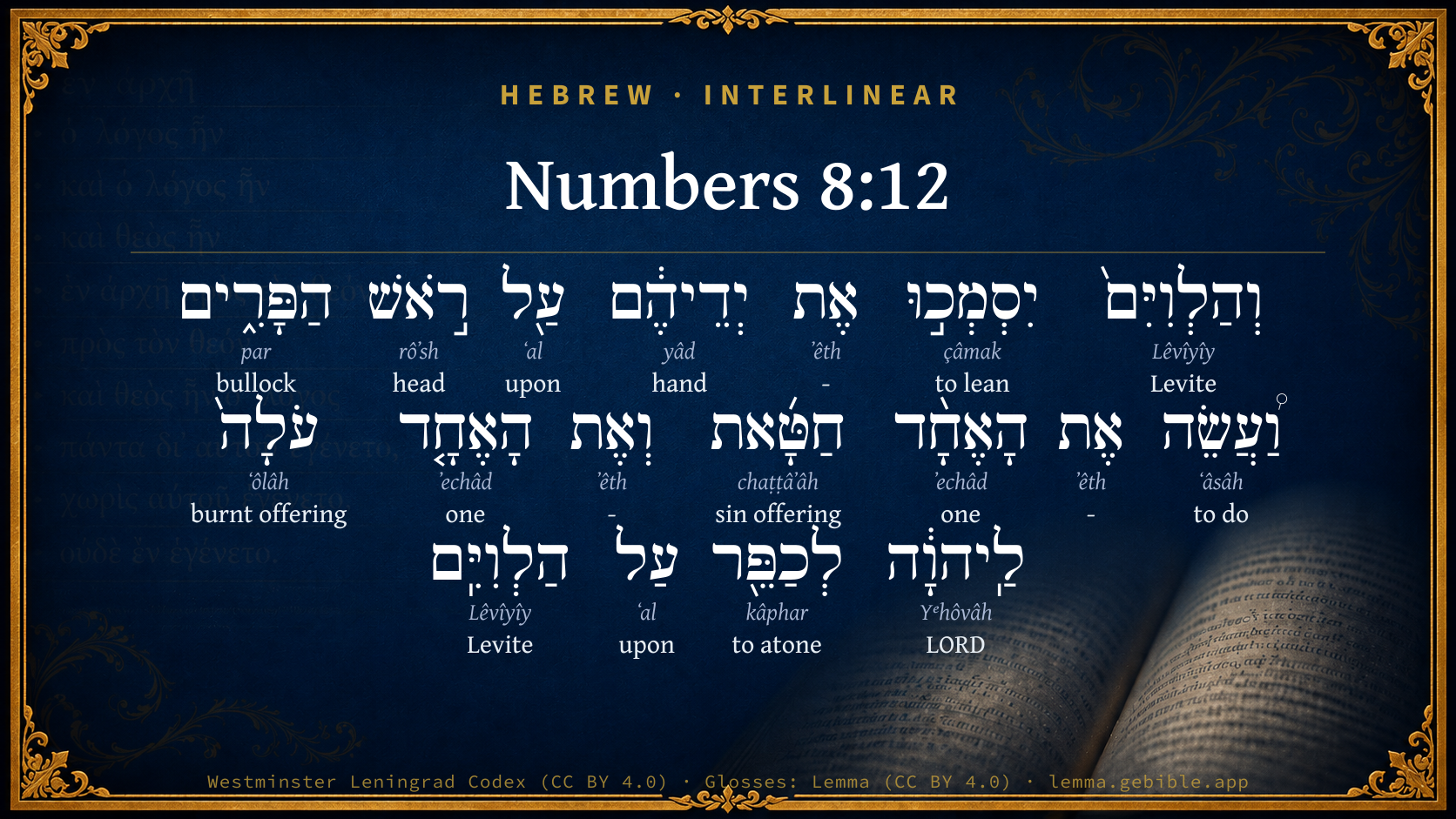
Hebrew (Westminster Leningrad Codex) Numbers 8:12 appears in the Hebrew Old Testament. The text above is from the Westminster Leningrad Codex. Each word links to its Strong’s number, a concise gloss, and parsing drawn from the Open Scriptures Hebrew Bible morphology. Click any word for its full Brown-Driver-Briggs (BDB) entry.
Download image
Cite this verse

Numbers 8:12 (World English Bible). Public Domain. Lemma interlinear Bible study tool, https://lemma.gebible.app/v/numbers/8/12.

Show BibTeX & RIS
BibTeX
RIS
English Translation
The Levites shall lay their hands on the heads of the bulls, and you shall offer the one for a sin offering, and the other for a burnt offering to Yahweh, to make atonement for the Levites.
World English Bible · Public Domain
Download a study sheet

One document with this verse’s original text, its word-by-word gloss line, the meaning frame, cross-references with their text, attributed commentary, and full source and license credits — printable, and it pastes into notes with its structure intact.

This verse Autodidact and up

Study sheet (.html) Plain text (.txt)

A passage Seminary Student

Up to 50 verses in one chapter. A passage sheet keeps up to 6 commentary sources and 12 cross-references per verse, in the order this page ranks them, and says so on the sheet whenever that leaves anything out. Ask for a single verse and you get the Autodidact verse sheet above.

Everything on this page stays free to read, with no account — the sheet is a download of what is already on screen, not access to it.

Want to remove ads? Support Godless Engineer
Compare translations 3

The same verse in 3 English versions, stacked beneath the original-language interlinear above. Click any original word for its lexicon entry.

Each is an independent rendering of the whole verse — the interlinear is not word-aligned to these translations.

Highlighted words mark where these versions differ — a whole-verse word diff, not a word-by-word alignment.

  • World English Bible Public Domain
    The Levites shall lay their hands on the heads of the bulls, and you shall offer the one for a sin offering, and the other for a burnt offering to Yahweh, to make atonement for the Levites.
  • King James Version Public Domain
    And the Levites shall lay their hands upon the heads of the bullocks: and thou shalt offer the one for a sin offering, and the other for a burnt offering, unto the LORD, to make an atonement for the Levites.
  • unfoldingWord Literal Text CC BY-SA 4.0
    And the Levites shall lay their hands on the head of the bulls, and make the one a sin offering and the one a burnt offering to Yahweh, to make atonement for the Levites.

unfoldingWord Literal Text — © unfoldingWord, licensed CC BY-SA 4.0. Word-aligned USFM3 via Door43 (git.door43.org/unfoldingWord/en_ult).

Versions to compare (up to 4)

3 of 4 selected

Show all 18 translations

Every available English version of this verse, each an independent rendering of the whole verse.

  • World English Bible Public Domain
    The Levites shall lay their hands on the heads of the bulls, and you shall offer the one for a sin offering, and the other for a burnt offering to Yahweh, to make atonement for the Levites.
  • Berean Standard Bible Public Domain
    And the Levites are to lay their hands on the heads of the bulls, and offer to the LORD one as a sin offering and the other as a burnt offering, to make atonement for the Levites.
  • Majority Standard Bible Public Domain
    And the Levites are to lay their hands on the heads of the bulls, and offer to the LORD one as a sin offering and the other as a burnt offering, to make atonement for the Levites.
  • King James Version Public Domain
    And the Levites shall lay their hands upon the heads of the bullocks: and thou shalt offer the one for a sin offering, and the other for a burnt offering, unto the LORD, to make an atonement for the Levites.
  • American Standard Version (1901) Public Domain
    And the Levites shall lay their hands upon the heads of the bullocks: and offer thou the one for a sin-offering, and the other for a burnt-offering, unto Jehovah, to make atonement for the Levites.
  • Revised Version (1885) Public Domain
    And the Levites shall lay their hands upon the heads of the bullocks: and offer thou the one for a sin offering, and the other for a burnt offering, unto the LORD, to make atonement for the Levites.
  • Geneva Bible (1599) Public Domain
    And the Leuites shall put their handes vpon the heades of the bullockes, and make thou the one a sinne offring, and the other a burnt offring vnto the Lord, that thou mayest make an atonement for the Leuites.
  • Douay-Rheims (1899) Public Domain
    The Levites also shall put their hands upon the heads of the oxen, of which thou shalt sacrifice one for sin, and the other for a holocaust to the Lord, to pray for them.
  • Young's Literal Translation Public Domain
    `And the Levites lay their hands on the head of the bullocks, and make thou the one a sin-offering, and the one a burnt-offering to Jehovah, to atone for the Levites,
  • Literal Standard Version CC BY-SA 4.0
    And the Levites lay their hands on the head of the bullocks, and make one a sin-offering and one a burnt-offering to YHWH, to atone for the Levites.
  • Unlocked Literal Bible CC BY-SA 4.0
    The Levites must place their hands on the heads of the bulls. You must offer one bull for a sin offering and the other bull for a burnt offering to me, to atone for the Levites.
  • unfoldingWord Literal Text CC BY-SA 4.0
    And the Levites shall lay their hands on the head of the bulls, and make the one a sin offering and the one a burnt offering to Yahweh, to make atonement for the Levites.
  • Darby Bible Public Domain
    And the Levites shall lay their hands upon the heads of the bullocks, and thou shalt offer the one for a sin-offering, and the other for a burnt-offering, to Jehovah, to make atonement for the Levites.
  • World Messianic Bible Public Domain
    “The Levites shall lay their hands on the heads of the bulls, and you shall offer the one for a sin offering and the other for a burnt offering to the LORD, to make atonement for the Levites.
  • Webster's Bible Public Domain
    And the Levites shall lay their hands upon the heads of the bullocks: and thou shalt offer the one for a sin-offering, and the other for a burnt-offering, to the LORD, to make an atonement for the Levites.
  • Free Bible Version CC BY-SA 4.0
    The Levites are to place their hands on the heads of the bulls. One is to be sacrificed as a sin offering to the Lord, and the other as a burnt offering to set the Levites right with the Lord.
  • Bible in Basic English Public Domain
    And the Levites are to put their hands on the heads of the oxen, and one of the oxen is to be offered for a sin-offering and the other for a burned offering to the Lord to take away the sin of the Levites.
  • JPS Tanakh (1917) Public Domain
    And the Levites shall lay their hands upon the heads of the bullocks; and offer thou the one for a sin-offering, and the other for a burnt-offering, unto the LORD, to make atonement for the Levites.

Literal Standard Version (2020), Covenant Press — licensed CC BY-SA 4.0. Text via the HelloAO Bible API (eBible.org). Unlocked Literal Bible (unfoldingWord) — licensed CC BY-SA 4.0. Text via the HelloAO Bible API (eBible.org). unfoldingWord Literal Text — © unfoldingWord, licensed CC BY-SA 4.0. Word-aligned USFM3 via Door43 (git.door43.org/unfoldingWord/en_ult). Free Bible Version, Dr. Jonathan Gallagher — licensed CC BY-SA 4.0. Text via the HelloAO Bible API (eBible.org).

Word by word

More ways to search: Search by grammar → Find every occurrence → Compare this word →

Practice this passage: Drill this verse → Learn its vocabulary →

יִסְמְכ֣וּ
çâmak
H5564
“to lean”
Verb, Qal, Imperfect, 3rd Person, Masculine, Plural
Part of Speech
Verb
Stem
Qal
Form
Imperfect
Person
3rd Person
Gender
Masculine
Number
Plural
Full BDB Definition

Origin: a primitive root

TWOT: 1514

to lean, lay, rest, support, put, uphold, lean upon - (Qal) - to lean or lay upon, rest upon, lean against - to support, uphold, sustain - (Niphal) to support or brace oneself - (Piel) to sustain, refresh, revive
  1. וְהַלְוִיִּם֙ Lêvîyîy H3881 “and · the · Levites” Conjunction + Particle, Definite Article + Noun, Gentilic, Masculine, Plural, Absolute
  2. אֶת ʼêth H853 “-” Particle, Direct Object
  3. יְדֵיהֶ֔ם yâd H3027 “hands · their” Noun, Common, Both, Dual, Construct + Suffix, Personal, 3rd Person, Masculine, Plural
  4. עַ֖ל ʻal H5921 “upon” Preposition
  5. רֹ֣אשׁ rôʼsh H7218 “head of” Noun, Common, Masculine, Singular, Construct
  6. הַפָּרִ֑ים par H6499 “the · bullocks” Particle, Definite Article + Noun, Common, Masculine, Plural, Absolute
  7. וַ֠עֲשֵׂה ʻâsâh H6213 “and · do” Conjunction + Verb, Qal, Imperative, 2nd Person, Masculine, Singular
  8. אֶת ʼêth H853 “-” Particle, Direct Object
  9. הָאֶחָ֨ד ʼechâd H259 “the · one” Particle, Definite Article + Adjective, Cardinal number, Masculine, Singular, Absolute
  10. חַטָּ֜את chaṭṭâʼâh H2403 “sin offering” Noun, Common, Feminine, Singular, Absolute
  11. וְאֶת ʼêth H853 “and · -” Conjunction + Particle, Direct Object
  12. הָאֶחָ֤ד ʼechâd H259 “the · one” Particle, Definite Article + Adjective, Cardinal number, Masculine, Singular, Absolute
  13. עֹלָה֙ ʻôlâh H5930 “burnt offering” Noun, Common, Feminine, Singular, Absolute
  14. לַֽיהוָ֔ה Yᵉhôvâh H3068 “to/for · LORD” Preposition + Noun, Proper
  15. לְכַפֵּ֖ר kâphar H3722 “to atone” Preposition + Verb, Piel, Infinitive Construct
  16. עַל ʻal H5921 “upon” Preposition
  17. הַלְוִיִּֽם Lêvîyîy H3881 “the · Levites” Particle, Definite Article + Noun, Gentilic, Masculine, Plural, Absolute

About this verse

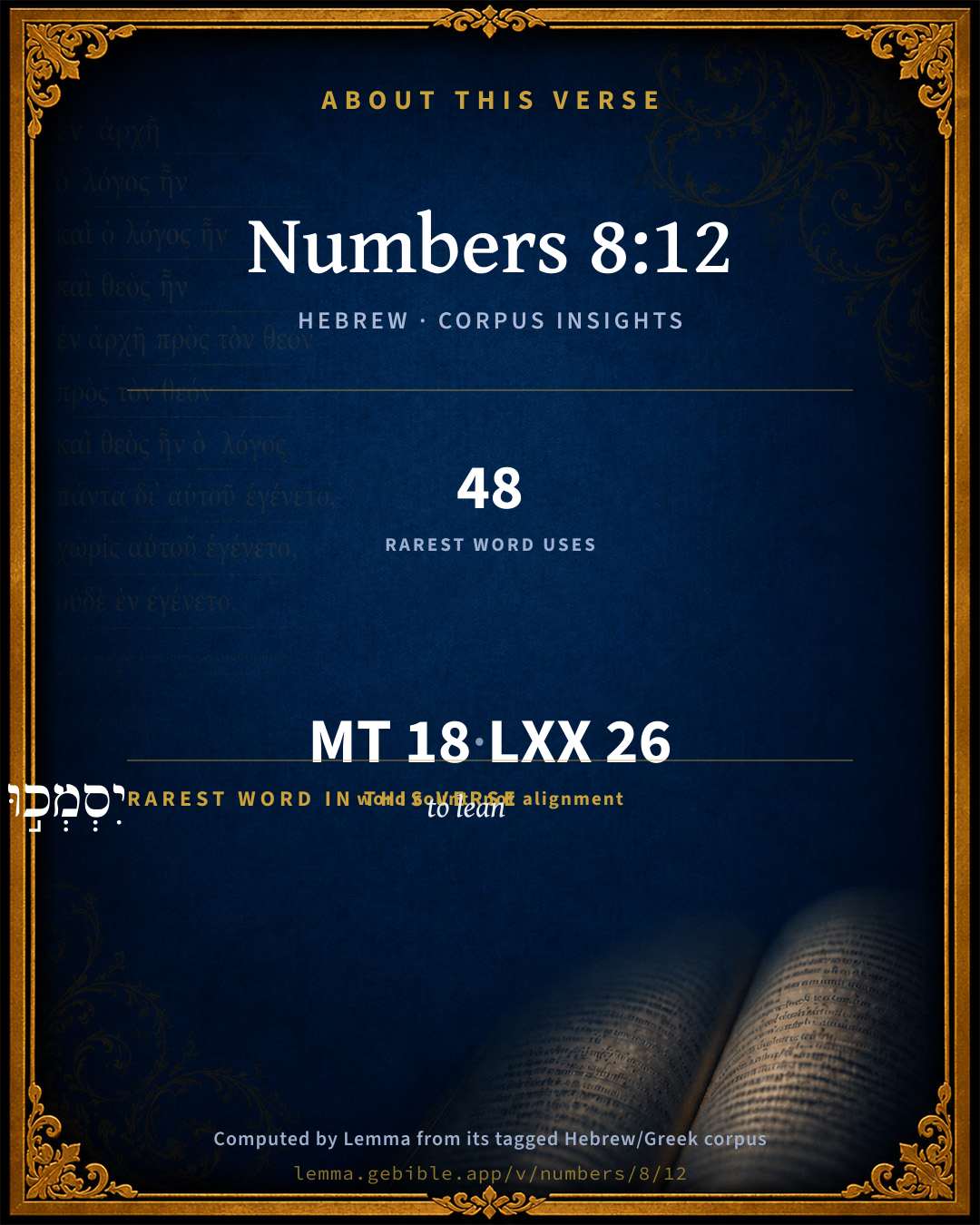
These counts appear in no published source. They are computed here, from the morphology-tagged text and Lemma’s own curated glosses. What Lemma adds →

18
words
13
distinct lemmas
Pentateuch
section

Shared distinctive vocabulary

יִסְמְכ֣וּ to lean H5564 occurs in 47 verses of the Hebrew Bible. Also found in:

Grammatical profile

  • 3 verbs
  • 8 nouns
  • 2 adjectives
  • 2 prepositions
  • 3 particles

Verb forms

  • יִסְמְכ֣וּ Qal · Imperfect
  • וַ֠עֲשֵׂה Qal · Imperative
  • לְכַפֵּ֖ר Piel · Infinitive Construct

Repetition

Words recur within this verse — often emphatic in Hebrew:

  • וְהַלְוִיִּם֙ Levite H3881 ×2
  • עַ֖ל upon H5921 ×2
  • הָאֶחָ֨ד one H259 ×2

Hebrew & Septuagint length

In English translation the verse runs 37 words from the Hebrew and 37 from the Septuagint (LXX English) — the same length.

A rough comparison of the two English renderings, which tokenize alike — not a word-level alignment.

Word counts can differ between the Hebrew and the Greek without any difference in meaning — e.g. the Hebrew direct-object marker אֵת has no separate Greek word, and Greek often adds the article ὁ.

In the original languages it is 18 Hebrew tokens and 26 Greek tokens — but the two are counted differently (Hebrew bundles its prefixes and suffixes into one token; the Greek is in lemma form), so that isn’t a like-for-like length.

Cross-references

21

Topical passages linked to Numbers 8:12 in the Treasury of Scripture Knowledge — connected by theme and wording, ordered by reader-vote popularity; previews shown in the World English Bible.

  • Hebrews 10:4–10 For it is impossible that the blood of bulls and goats should take away sins.
  • Exodus 29:10 "You shall bring the bull before the tent of meeting: and Aaron and his sons shall lay their hands on the head of the bull.
  • Leviticus 1:4 He shall lay his hand on the head of the burnt offering, and it shall be accepted for him to make atonement for him.
  • Leviticus 8:14 He brought the bull of the sin offering, and Aaron and his sons laid their hands on the head of the bull of the sin offering.
  • Hebrews 9:22 According to the law, nearly everything is cleansed with blood, and apart from shedding of blood there is no remission.
  • Numbers 8:8 Then let them take a young bull, and its meal offering, fine flour mixed with oil; and another young bull you shall take for a sin offering.
  • Leviticus 4:20 Thus shall he do with the bull; as he did with the bull of the sin offering, so shall he do with this; and the priest shall make atonement for them, and they shall be forgiven.
  • Leviticus 4:35 All its fat he shall take away, like the fat of the lamb is taken away from the sacrifice of peace offerings; and the priest shall burn them on the altar, on the offerings of Yahweh made by fire; and the priest shall make atonement for him concerning his sin that he has sinned, and he will be forgiven.
  • Leviticus 5:7 "'If he can't afford a lamb, then he shall bring his trespass offering for that in which he has sinned, two turtledoves, or two young pigeons, to Yahweh; one for a sin offering, and the other for a burnt offering.
  • Leviticus 5:9–10 He shall sprinkle some of the blood of the sin offering on the side of the altar; and the rest of the blood shall be drained out at the base of the altar. It is a sin offering.
  • Leviticus 8:18 He presented the ram of the burnt offering: and Aaron and his sons laid their hands on the head of the ram.
  • Leviticus 8:34 What has been done this day, so Yahweh has commanded to do, to make atonement for you.
  • Leviticus 9:7 Moses said to Aaron, "Draw near to the altar, and offer your sin offering, and your burnt offering, and make atonement for yourself, and for the people; and offer the offering of the people, and make atonement for them; as Yahweh commanded."
  • Leviticus 14:19–20 "The priest shall offer the sin offering, and make atonement for him who is to be cleansed because of his uncleanness: and afterward he shall kill the burnt offering;
  • Leviticus 14:22 and two turtledoves, or two young pigeons, such as he is able to afford; and the one shall be a sin offering, and the other a burnt offering.
  • Leviticus 16:6 "Aaron shall offer the bull of the sin offering, which is for himself, and make atonement for himself and for his house.
  • Leviticus 16:11 "Aaron shall present the bull of the sin offering, which is for himself, and shall make atonement for himself and for his house, and shall kill the bull of the sin offering which is for himself.
  • Leviticus 16:16–19 and he shall make atonement for the Holy Place, because of the uncleanness of the children of Israel, and because of their transgressions, even all their sins; and so he shall do for the Tent of Meeting, that dwells with them in the midst of their uncleanness.
  • Leviticus 16:21 Aaron shall lay both his hands on the head of the live goat, and confess over him all the iniquities of the children of Israel, and all their transgressions, even all their sins; and he shall put them on the head of the goat, and shall send him away into the wilderness by the hand of a man who is in readiness.
  • Numbers 6:14 and he shall offer his offering to Yahweh, one male lamb a year old without blemish for a burnt offering, and one ewe lamb a year old without blemish for a sin offering, and one ram without blemish for peace offerings,
  • Numbers 6:16 The priest shall present them before Yahweh, and shall offer his sin offering, and his burnt offering.

Cross-references courtesy of OpenBible.info (CC BY 4.0).

Hebrew and Greek witnesses Masoretic Hebrew ↔ Greek Septuagint

The same verse in the two great witnesses to the Old Testament, shown verse-for-verse.

These are two independent witnesses, not word-aligned to each other, and the Septuagint is shown in lemma (dictionary) form.

Hebrew Numbers 8:12 Masoretic · Westminster Leningrad Codex

וְהַלְוִיִּם֙ יִסְמְכ֣וּ אֶת יְדֵיהֶ֔ם עַ֖ל רֹ֣אשׁ הַפָּרִ֑ים וַ֠עֲשֵׂה אֶת הָאֶחָ֨ד חַטָּ֜את וְאֶת הָאֶחָ֤ד עֹלָה֙ לַֽיהוָ֔ה לְכַפֵּ֖ר עַל הַלְוִיִּֽם

The Levites shall lay their hands on the heads of the bulls, and you shall offer the one for a sin offering, and the other for a burnt offering to Yahweh, to make atonement for the Levites.

World English Bible · Public Domain

Greek LXX Numbers 8:12 Septuagint · lemma form

ὁ δέ λευίτης ἐπιτίθημι ὁ χείρ ἐπί ὁ κεφαλή ὁ μόσχος καί ποιέω ὁ εἷς περί ἁμαρτία καί ὁ εἷς εἰς ὁλοκαύτωμα κύριος ἐκἱλάσκομαι περί αὐτός

And the Levites shall lay their hands on the heads of the calves; and you shall offer one for a sin-offering, and the other for a whole burnt offering to the Lord, to make atonement for them.

LXX2012 (modern English Septuagint) · Public Domain

On this verse, Haydock's Catholic Bible Commentary discusses the Septuagint’s reading. Read the note in Commentary ↓

Hebrew: Westminster Leningrad Codex (CC BY 4.0). Greek: Septuagint (public domain); English from LXX2012 (modern English Septuagint) (Public Domain). How the Septuagint differs from the Hebrew →

Targum (Aramaic paraphrase)

2

The Targum is the ancient Jewish Aramaic paraphrase of the Hebrew Scriptures — an interpretive translation, not the Hebrew text itself. Onkelos (literal) and Pseudo-Jonathan (expansive) render the Torah, and Jonathan the Prophets. Coverage is partial: where no permissively-licensed English translation exists for a verse, only the Aramaic is shown. This is verse-level text, not a word-by-word alignment to the Hebrew.

  1. Targum Onkelos Torah (Genesis–Deuteronomy)
    וְלֵוָאֵי יִסְמְכוּן יָת יְדֵיהוֹן עַל רֵישׁ תּוֹרַיָא וַעֲבֵיד יָת חַד חַטָאתָא וְיָת חַד עֲלָתָא קֳדָם יְיָ לְכַפָּרָא עַל לֵוָאֵי

    (no public-domain English translation for this verse)

    Targum Onkelos — Aramaic: “Onkelos Genesis” (public domain); “Onkelos Exodus” (public domain); “Onkelos Leviticus” (public domain); “Onkelos Numbers” (public domain); “Onkelos Deuteronomy” (public domain). English: “Sefaria Community Translation” (CC0 1.0 (public-domain dedication)); “J.W. Etheridge. The Targums of Onkelos and Jonathan Ben Uzziel on the Pentateuch. London: Longmans, Green, 1862” (public domain). Text via Sefaria.

  2. Targum Pseudo-Jonathan Torah (Genesis–Deuteronomy)
    וְלֵיוָאֵי יִסְמְכוּן יַת יְדֵיהוֹן עַל רֵישׁ תּוֹרֵי וְעִיבַד יַת חַד חַטָאתָא וְיַת חַד עֲלָתָא קֳדָם יְיָ לְכַפָּרָא עַל לֵיוָאֵי

    And the Levites shall lay their hands upon the head of the bullocks, and make one a sin offering and one a burnt offering before the Lord, to atone for the Levites.

    Targum Pseudo-Jonathan — Aramaic: “Targum Jonathan on Genesis” (public domain); “Targum Jonathan on Exodus” (public domain); “Targum Jonathan on Leviticus” (public domain); “Targum Jonathan on Numbers” (public domain); “Targum Jonathan on Deuteronomy” (public domain). English: “The Targum of Jonathan ben Uzziel, trans. J. W. Etheridge, London, 1862” (public domain). Text via Sefaria.

Commentary

Notes on Numbers 8:12 from classic Christian and Jewish commentators (each source and its license shown beneath its notes). The classic Christian expositions comment on the surrounding passage and are grouped to its opening verse, so a note may address several verses; the Jewish commentaries on the Tanakh (Rashi and others) are per-verse, so they appear only where the commentator wrote on this verse.

Lemma curates 59 commentaries, every one of them public domain or Creative Commons licensed, each selected and text-cleaned for this edition rather than reprinted as found. About our sources →

Trapp's Complete Commentary

John Trapp

Num 8:12 And the Levites shall lay their hands upon the heads of the bullocks: and thou shalt offer the one [for] a sin offering, and the other [for] a burnt offering, unto the LORD, to make an atonement for the Levites.

Ver. 12. The one for a sin offering.] The sin offering for actual sin; the burnt offering for original.

John Trapp, A Commentary or Exposition upon All the Books of the Old and New Testament (1647–1656) — public domain. Text from a community e-Sword module.

Joseph Benson's Commentary

Num 8:12-15. Lay their hands — To signify that they were offered by them and for them. Set the Levites before Aaron and his sons — Give the Levites to them, or to their service. Unto the Lord — For to him they were first properly offered, and by him given to the priests in order to his service. The Levites shall go in — Into the court, where they were to wait upon the priests at the altar of burnt-offering; and, at present, into the tabernacle, to take it down and set it up.

Joseph Benson's Commentary on the Old and New Testaments (1811–1818) — public domain. Text from a community e-Sword module.

Tyndale Open Study Notes

Tyndale Open Resources

8:12-22 The Levites had to offer appropriate sacrifices before they performed their duties in the Tabernacle (8:15).

Tyndale Open Study Notes — © Tyndale Open Resources, licensed CC BY-SA 4.0. Text via the HelloAO Bible API.

The Cambridge Bible for Schools and Colleges

gen. ed. J. J. S. Perowne

12. For the sin-offering and burnt-offering see on Num_4:11.

The Cambridge Bible for Schools and Colleges (gen. ed. J. J. S. Perowne; Cambridge University Press, 1878–1918) — public domain. Text from a community e-Sword module.

John Gill's Exposition

And the Levites shall lay their hands on the heads of the bullocks,.... Or "on the head" (s); on the head of everyone of them, as Aben Ezra, thereby, as it were, transferring their sins to them, for these were to make atonement for them, as the latter part of the verse shows; and this was a figure of the imputation of sin to Christ, and taught that doctrine, and led the faith of the offerers to the sin bearing and sin atoning Saviour:

and thou shall offer the one for a sin offering, and the other for a burnt offering, unto the Lord; that is, shall order to be offered; for not Moses, but Aaron, offered these offerings, as Aben Ezra observes, of which this is a proof, that Aaron is said to make the atonement for them, Num 8:21, for which purpose these sacrifices were offered, particularly the first; and the latter by way of thanksgiving for atonement made by the former: so it follows:

to make an atonement for the Levites; who could not be admitted to service until their sins were expiated; as no man is worthy to be employed in the work of God, but such for whom reconciliation for their sins is made by the blood and sacrifice of Christ, by which they are purged from dead works to serve the living God.

(s) "super caput", Tigurine version. Pagninus, Montanus, Junius & Tremellius.

John Gill's Exposition of the Whole Bible (1746–1763) — public domain (CC PDM 1.0). Text via the HelloAO Bible API.

Haydock's Catholic Bible Commentary

Thou, Moses, though the Hebrew here seems to refer it to Aaron, "he shall." But the Septuagint and Arabic agree with the Vulgate, and the context shews that Moses is the person (Calmet) who had chiefly to officiate. Aaron also performed his part, ver. 11. (Haydock)

George Leo Haydock (1774–1849), Haydock's Catholic Family Bible and Commentary, 1859 edition — public domain. Excludes Psalms (Douay-Rheims chapter numbering differs from Protestant) and Deuterocanonical books (Catholic canon only).

Matthew Poole's English Annotations

Upon the heads of the bullocks; to signify, that they were offered by them and for them. See Exo 29:15,19; Le 1:4; 3:2; 4:4.

Matthew Poole's English Annotations on the Holy Bible (1683–1685) — public domain. Text from a community e-Sword/MySword module.

Whedon's Commentary on the Bible

Daniel D. Whedon

12. The Levites shall lay their hands — This imposition of hands differs from that in Num_8:10, inasmuch as it symbolically transfers guilt, (see Lev_1:4, note,) which is implied in an atonement. See Lev_4:20; Lev_16:10-34, notes. Even those whom God has accepted as a gift must be atoned for before they can begin to serve around the sanctuary. But there are in the Pentateuch no precepts regulating the personal conduct and life of the Levites as are there given for the priests, Leviticus 21.

Daniel D. Whedon (gen. ed.), Commentary on the Old and New Testaments (1874–1909) — public domain. Text from a community e-Sword module.

The Pulpit Commentary

Shall lay their hands upon the beads of the bullocks. In token that they constituted these victims the ritual representatives and embodiments, the one of their sin, to be consumed and done away as by fire, the other of their life and strength, to be wholly offered unto God and accepted as by fire.

HOMILIES BY E.S. PROUT Vers. 12, and 19. An offering to God, needing for itself an atonement.

The tribe of Levi was set apart for God"s service in the tabernacle in place of all the firstborn. Before they could enter on that service they needed a special call and consecration, including atoning sacrifices (verses 5-12). Thus we are reminded of the obvious truth that, without a sacrifice for us, we can never ourselves be acceptable sacrifices to God. Illustrate from the position of Rom_12:1 in the Epistle, coming after the exposition of the mercies of God, including the atonement of Christ. (Ro 3) But in verse 19 the services of the Levites (or the Levites themselves) are said to be an atonement. The Levites were regarded as a vicarious offering to God (verses 10, 11). In the wider sense of the word atonement, they are said to make (or to be) an atonement. ("The priests made an atonement by sacrifice; the Levites by attendance. M. Henry.) Yet even this vicarious offering needs to be atoned for (verse 12). Hence the lesson, that every human saint (separated to God, verse 14), service, or sacrifice needs an atonement. This is needed for

1. All God"s chosen servants, "a kind of first-fruits of his creatures. (Illustrate from 1Jn_1:7-10 1Jn_2:1, 1Jn_2:2, and from Joh_13:10)

2. All God"s selected ministers (pastors, missionaries, etc.). Illustrate from Tertullian"s request to his brethren: "Ye have sought, and ye have found; ye have knocked, and it is opened to you. Thus much I ask, that when you seek again, you remember me, Tertullian, a sinner;" or from W. Carey the missionary"s selected epitaph"A guilty, weak, and helpless worm, On thy kind arms I fall.

3. All the most sacred services of the most saintly men. Their prayers need to be prayed for; their tears to be washed from impurity; their gifts of gold to be refined from the dross of earthly motives. Though all Christians are priests unto God, their most solemn priestly acts need the blood of Christ to cleanse them from all sin. P.

The Pulpit Commentary (1880–1919), ed. H.D.M. Spence-Jones & Joseph S. Exell — public domain. Text from a community e-Sword module.

John Wesley's Explanatory Notes

Lay their hands - To signify that they were offered by them and for them.

John Wesley, Explanatory Notes Upon the Whole Bible (1754–1765) — public domain. Text via the GEBible commentary corpus.

Keil & Delitzsch

C. F. Keil & F. Delitzsch

The Levites were then to close this transfer of themselves to the Lord with a sin-offering and burnt-offering, in which they laid their hands upon the sacrificial animals. By this imposition of hands they made the sacrificial animals their representatives, in which they presented their own bodies to the Lord as a living sacrifice well-pleasing to Him. The signification of the dedication of the Levites, as here enjoined, is still further explained in Num 8:13-19. The meaning of Num 8:13. is this: According to the command already given (in Num 8:6-12), thou shalt place the Levites before Aaron and his sons, and wave them as a wave-offering before the Lord, and so separate them from the midst of the children of Israel, that they may be Mine. They shall then come to serve the tabernacle. So shalt thou cleanse them and wave them. The same reason is assigned for this in Num 8:16, Num 8:17, as in Num 3:11-13 (כּל בּכור for כּל־בּכור, cf. Num 3:13); and in Num 8:18 and Num 8:19, what was commanded in Num 3:6-9 is described as having been carried out. On Num 8:19 see Num 1:53.

Keil & Delitzsch — Biblical Commentary on the Old Testament (1861–1891) — public domain (CC PDM 1.0). Text via the HelloAO Bible API. (Old Testament only.)

Scofield Reference Notes

C. I. Scofield

atonement

(See Scofield "Exo 29:33")

The Scofield Reference Bible (1917 edition), notes by C. I. Scofield — public domain. Text from a community e-Sword module.

unfoldingWord translationNotes

Door43 World Missions Community

The Levites must place their hands on the heads of the bulls

This is a symbolic action that identifies the Levites with the animals being offered. In this way the person is offering himself through the animal to Yahweh. (See: Symbolic Action)

lift them up as a wave offering to me

Aaron was to present the Levites to Yahweh as if he were lifting up an offering to Yahweh. AT: "dedicate them to me, as if you were lifting them up a wave offering to me" (See: Simile)

translationWords

Levi

burnt offering

son

sacrifice

unfoldingWord translationNotes — © Distant Shores Media and the Door43 World Missions Community, licensed CC BY-SA 4.0. Source: git.door43.org/Door43/en_tn.

Lesson kit

Teaching starters — assembled from the data on this page, not authored interpretation. Every prompt links to the verse data it draws on. Edit before teaching.

Numbers, in the Pentateuch, opens this verse with 18 words (13 distinct Hebrew lemmas). Its most distinctive word is çâmak (“to lean”). A historical commentator’s framing appears above. Read the whole chapter for the surrounding context.

Discussion questions

  1. The word çâmak carries the sense “to lean.” How does it shape the verse?
  2. How does Genesis 27:37, which shares the word «to lean», read alongside this verse?
  3. What does the repetition of “Levite” (2× in this one verse) do in this verse?
  4. These translations render this verse differently; the difference is in the English rendering, not the original. What questions does that raise?
  5. «יִסְמְכ֣וּ» is a Qal Imperfect verb. How does that grammatical form shape the action described?
  6. Compare how Trapp's Complete Commentary and Joseph Benson's Commentary read this verse. Where do they agree or differ?

Things to notice

Reading settings

Reading text

Shown beneath each verse's original-language words.

Old Testament
Old Testament edition

Read the OT as the Masoretic Hebrew (MT) or the Greek Septuagint (LXX).

English shown for the Greek Septuagint (in the Hebrew ↔ Greek comparison).

Comparing translations? Open the Compare panel on any verse page to stack up to four side by side.