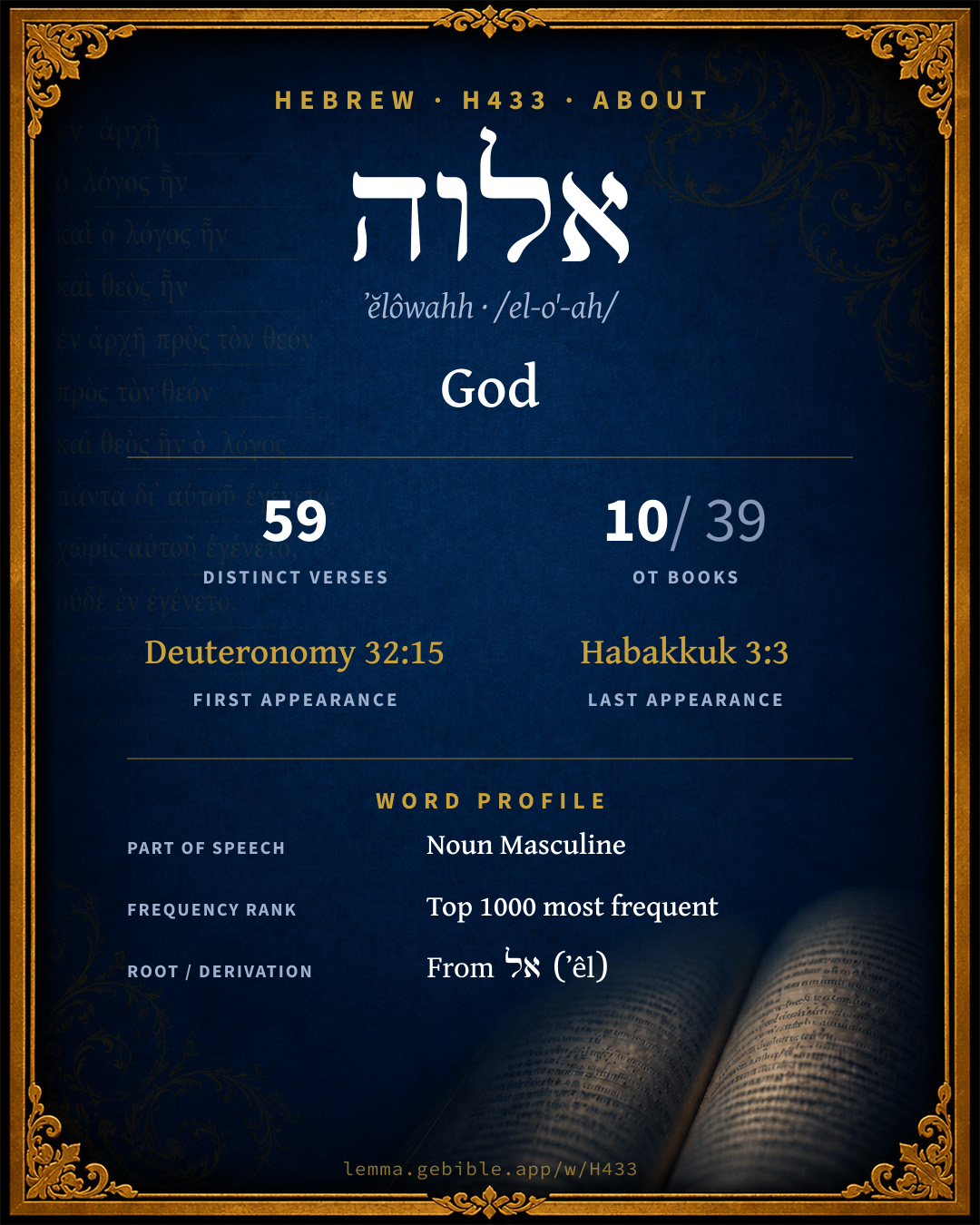
אֱלֹהַּ
God
‘God’ is one of 2 main senses fuller range ↓
Full lexicon entry — Brown-Driver-Briggs (BDB)
From Brown-Driver-Briggs (BDB)
Where this word appears
See every Absolute-state word in the Hebrew Bible →
Grammar key — what these labels mean
Part of speech
- Noun
- A naming word — a person, place, thing, or idea.
Noun type
- Common
- A common noun — a general class of person, place, or thing (“king,” “city,” “water”), not a specific name.
State
- Absolute
- The independent form of a noun, not bound to a following word.
- Construct
- A noun bound to a following noun in a possessive / “of” relationship (the construct chain).
Gender
- Masculine
- Grammatically masculine.
Number
- Singular
- One.
- Plural
- More than one (in Hebrew, generally three or more).
Grammatical forms
- Noun, Common, Masculine, Singular, Absolute 52 times (87%)
- Noun, Common, Masculine, Singular, Construct 5 times (8%)
- Noun, Common, Masculine, Plural, Construct 3 times (5%)
Parsed forms decoded from the imported morphology (morphhb / Westminster Leningrad Codex — WLC text public domain, morphhb tagging CC BY 4.0), counted across 60 parsed occurrences — not distinct verses.
Every verse where H433 appears — 59 distinct verses across 10 books. Click any verse to open its interlinear word-by-word view. Verse text shown in the World English Bible for context — . Each verse’s Hebrew form is shown with its reference; the English is not keyword-highlighted, since the data carries no word-level English alignment. Use “Compare translations” on any verse to read it across multiple English versions. This concordance covers the Hebrew Bible; Septuagint (Greek Old Testament) occurrences are not indexed here.
Deuteronomy 2 verses
- Deuteronomy 32:15 אֱל֣וֹהַ n c ms But Jeshurun grew fat, and kicked: You have grown fat, you are grown thick, you are become sleek; Then he forsook God who made him, Lightly esteemed the Rock of his salvation.
- Deuteronomy 32:17 אֱלֹ֔הַ n c ms They sacrificed to demons, [which were] no God, To gods that they didn't know, To new [gods] that came up of late, Which your fathers didn't dread.
2 Kings 1 verse
2 Chronicles 1 verse
Nehemiah 1 verse
Job 41 verses
- Job 3:4 אֱל֣וֹהַּ n c ms Let that day be darkness; Don't let God from above seek for it, Neither let the light shine on it.
- Job 3:23 אֱל֣וֹהַּ n c ms Why is light given to a man whose way is hid, Whom God has hedged in?
- Job 4:9 אֱל֣וֹהַ n c ms By the breath of God they perish, By the blast of his anger are they consumed.
- Job 4:17 מֵ/אֱל֣וֹהַ prep + n c ms 'Shall mortal man be more just than God? Shall a man be more pure than his Maker?
- Job 5:17 אֱל֑וֹהַּ n c ms "Behold, happy is the man whom God corrects: Therefore do not despise the chastening of the Almighty.
- Job 6:4 אֱל֣וֹהַּ n c ms For the arrows of the Almighty are within me, My spirit drinks up their poison. The terrors of God set themselves in array against me.
- Job 6:8 אֱלֽוֹהַּ n c ms "Oh that I might have my request; That God would grant the thing that I long for!
- Job 6:9 אֱ֭לוֹהַּ n c ms Even that it would please God to crush me; That he would let loose his hand, and cut me off!
- Job 9:13 אֱ֭לוֹהַּ n c ms "God will not withdraw his anger; The helpers of Rahab stoop under him.
- Job 10:2 אֱ֭לוֹהַּ n c ms I will tell God, 'Do not condemn me, Show me why you contend with me.
- Job 11:5 אֱל֣וֹהַּ n c ms But oh that God would speak, And open his lips against you,
- Job 11:6 אֱ֝ל֗וֹהַ n c ms That he would show you the secrets of wisdom! For true wisdom has two sides. Know therefore that God exacts of you less than your iniquity deserves.
- Job 11:7 אֱל֣וֹהַ n c ms "Can you fathom the mystery of God? Or can you probe the limits of the Almighty?
- Job 12:4 לֶ֭/אֱלוֹהַּ prep + n c ms I am like one who is a joke to his neighbor, I, who called on God, and he answered. The just, the blameless man is a joke.
- Job 12:6 אֱל֣וֹהַּ n c ms The tents of robbers prosper, Those who provoke God are secure; Who carry their God in their hands.
- Job 15:8 אֱל֣וֹהַ n c ms Have you heard the secret counsel of God? Do you limit wisdom to yourself?
- Job 16:20 אֱ֝ל֗וֹהַ n c ms My friends scoff at me. My eyes pour out tears to God,
- Job 16:21 אֱל֑וֹהַּ n c ms That he would maintain the right of a man with God, Of a son of man with his neighbor!
- Job 19:6 אֱל֣וֹהַּ n c ms Know now that God has subverted me, And has surrounded me with his net.
- Job 19:21 אֱ֝ל֗וֹהַּ n c ms "Have pity on me, have pity on me, you my friends; For the hand of God has touched me.
- Job 19:26 אֱלֽוֹהַּ n c ms After my skin is destroyed, Then in my flesh shall I see God,
- Job 21:9 אֱל֣וֹהַּ n c ms Their houses are safe from fear, Neither is the rod of God upon them.
- Job 21:19 אֱל֗וֹהַּ n c ms You say, 'God lays up his iniquity for his children.' Let him recompense it to himself, that he may know it.
- Job 22:12 אֱ֭לוֹהַּ n c ms "Isn't God in the heights of heaven? See the height of the stars, how high they are!
- Job 22:26 אֱל֣וֹהַּ n c ms For then shall you delight yourself in the Almighty, And shall lift up your face to God.
- Job 24:12 וֶ֝/אֱל֗וֹהַּ conj + n c ms From out of the populous city, men groan. The soul of the wounded cries out, Yet God doesn't regard the folly.
- Job 27:3 אֱל֣וֹהַּ n c ms (For the length of my life is still in me, And the spirit of God is in my nostrils);
- Job 27:8 אֱל֣וֹהַּ n c ms For what is the hope of the godless, when he is cut off, When God takes away his life?
- Job 27:10 אֱל֣וֹהַּ n c ms Will he delight himself in the Almighty, And call on God at all times?
- Job 29:2 אֱל֣וֹהַּ n c ms "Oh that I were as in the months of old, As in the days when God watched over me;
- Job 29:4 אֱ֝ל֗וֹהַּ n c ms As I was in the ripeness of my days, When the friendship of God was in my tent;
- Job 31:2 אֱל֣וֹהַּ n c ms For what is the portion from God above, And the heritage from the Almighty on high?
- Job 31:6 אֱ֝ל֗וֹהַּ n c ms (Let me be weighed in an even balance, That God may know my integrity);
- Job 33:12 אֱ֝ל֗וֹהַ n c ms "Behold, I will answer you. In this you are not just; For God is greater than man.
- Job 33:26 אֱל֨וֹהַּ n c ms He prays to God, and he is favorable to him, So that he sees his face with joy: He restores to man his righteousness.
- Job 35:10 אֱל֣וֹהַּ n c ms But none says, 'Where is God my Maker, Who gives songs in the night,
- Job 36:2 לֶ/אֱל֣וֹהַּ prep + n c ms "Bear with me a little, and I will show you; For I still have something to say on God's behalf.
- Job 37:15 אֱל֣וֹהַּ n c ms Do you know how God controls them, And causes the lightning of his cloud to shine?
- Job 37:22 אֱ֝ל֗וֹהַּ n c ms Out of the north comes golden splendor; With God is awesome majesty.
- Job 39:17 אֱל֣וֹהַּ n c ms Because God has deprived her of wisdom, Neither has he imparted to her understanding.
- Job 40:2 אֱל֣וֹהַּ n c ms "Shall he who argues contend with the Almighty? He who argues with God, let him answer it."
Psalms 7 verses
- Psalms 18:31 אֱ֭לוֹהַּ n c ms For who is God, except Yahweh? Who is a rock, besides our God,
- Psalms 18:46 אֱלוֹהֵ֥י n c mp cs Yahweh lives; and blessed be my rock. Exalted be the God of my salvation,
- Psalms 50:22 אֱל֑וֹהַּ n c ms "Now consider this, you who forget God, Lest I tear you into pieces, and there be none to deliver.
- Psalms 114:7 אֱל֣וֹהַּ n c ms cs Tremble, you earth, at the presence of the Lord, At the presence of the God of Jacob,
- Psalms 139:19 אֱל֥וֹהַּ n c ms If only you, God, would kill the wicked. Get away from me, you bloodthirsty men!
- Psalms 143:10 אֱל֫וֹהָ֥/י n c mp cs + sfx pers 1cs Teach me to do your will, For you are my God. Your Spirit is good. Lead me in the land of uprightness.
- Psalms 145:1 אֱלוֹהַ֣/י n c mp cs + sfx pers 1cs I will exalt you, my God, the King. I will praise your name forever and ever.
Proverbs 1 verse
Isaiah 1 verse
Daniel 3 verses
- Daniel 11:37 אֱל֖וֹהַּ n c ms Neither shall he regard the gods of his fathers, nor the desire of women, nor regard any god; for he shall magnify himself above all.
- Daniel 11:38 וְ/לֶ/אֱלֹ֨הַּ֙ וְ/לֶ/אֱל֜וֹהַּ conj + prep + n c ms cs conj + prep + n c ms But in his place shall he honor the god of fortresses; and a god whom his fathers didn't know shall he honor with gold, and silver, and with precious stones, and pleasant things.
- Daniel 11:39 אֱל֣וֹהַּ n c ms cs He shall deal with the strongest fortresses by the help of a foreign god: whoever acknowledges [him] he will increase with glory; and he shall cause them to rule over many, and shall divide the land for a price.
Habakkuk 1 verse
About this entry
At a glance — auto-summarized from this page’s data, not written by a person. Every figure links to its source below. This summary describes the numbers; it doesn’t interpret them.
The Hebrew name אלוה centers on the idea of “God.” Job dominates its distribution — 41 of 59 verses. The Hebrew Bible uses it across 59 verses — moderately common. First canonically at Deuteronomy 32:15, it enters the text early. For the data behind this summary, explore 59-verse concordance and the renderings breakdown below.
Gloss history
Strong's 1890 vs modern scholarship
About this word
Strong's H433 catalogs a Hebrew word from the Hebrew Old Testament.
These counts are not copied from any lexicon or concordance. They are computed here, from the morphology-tagged Hebrew Old Testament. What Lemma adds →
- 59
- distinct verses
- The word appears in 59 distinct verses.
- 10 / 39
- OT books
- The word appears in 10 of 39 Old Testament books.
- #639
- by frequency
- Top 1000 most frequent Hebrew words (rank 639 of 8,640 Hebrew words by occurrence).
View all 59 occurrences in the concordance →
By section of the Old Testament
By traditional corpus
Conventional, traditional groupings — biblical authorship is debated, so this is a traditional corpus grouping, not an authorship claim. Each share is this word’s portion of its verses in that division of the Hebrew canon. Each figure is a share of the word’s 59 distinct verses.
- Writings (Ketuvim) 54 verses · 92%
- Prophets (Nevi'im) 3 verses · 5%
- Torah (Pentateuch) 2 verses · 3%
How translations render this word
Counts come from each version’s own published word-to-Strong’s tagging or interlinear alignment — an approximate guide to how each version renders this word, not a word-level alignment the data otherwise carries. Because each total is that version’s own tagged count, the per-version totals vary from one another and need not match the appearance or distinct-verse counts above. These counts may also differ from a printed concordance because Lemma counts each distinctly tagged rendering and does not collapse phrase taggings into a single head-word total. This is a fixed set of word-tagged versions (KJV, ASV, BSB, ULT) and does not change with the reading translation you choose elsewhere. Each version’s license is shown beside its name below (and on Sources).
- King James Version: God 46×, Is god 2×
- American Standard Version: God 36×, Is god 2×
- Berean Standard Bible: God 46×, Is god 2×
- unfoldingWord Literal Text: God 52×, God of 4×
King James Version Public Domain
Renders H433 across 57 tagged occurrences — most commonly:
Plus 9 renderings that appear only once — usually multi-word phrases or single function words the recovered tagging swept in, not distinct renderings.
American Standard Version Public Domain
Renders H433 across 57 tagged occurrences — most commonly:
Plus 19 renderings that appear only once — usually multi-word phrases or single function words the recovered tagging swept in, not distinct renderings.
Berean Standard Bible Public Domain
Renders H433 across 58 tagged occurrences — most commonly:
Plus 10 renderings that appear only once — usually multi-word phrases or single function words the recovered tagging swept in, not distinct renderings.
unfoldingWord Literal Text CC BY-SA 4.0
Renders H433 across 62 tagged occurrences — most commonly:
Plus 6 renderings that appear only once — usually multi-word phrases or single function words the recovered tagging swept in, not distinct renderings.
Senses in the full BDB
What do BDB’s symbols mean?
BDB uses these scholarly abbreviations:
| Symbol | Meaning |
|---|---|
| 𝔊 | the Septuagint (the ancient Greek translation, LXX) |
| 𝔙 | the Vulgate (the Latin translation) |
| 𝔖 | the Syriac version (the Peshitta) |
| 𝔗 | the Targum (the Aramaic translation) |
| ψ | the Psalms |
| √ | root (the underlying root or stem) |
| ‖ | parallel passage (a synonymous or contrasted parallel) |
| † | the dagger: every passage where the word occurs is cited |
The 2 senses and sub-senses the full Brown-Driver-Briggs lexicon distinguishes for this word, in lexicon order (not ranked by frequency), with BDB’s own verbatim wording and sub-sense lettering. Shown in Hebrew script with BDB’s own scholarly abbreviations. The condensed entry is in the Lexicon Entry tab. See also the Forms in the corpus table below.
- 1. a heathen god, late usage
- 2. God, used in ancient poems
Senses from the full Brown-Driver-Briggs lexicon (Brown, Driver, Briggs; Oxford 1906 — public domain), digitized via Sefaria, supplemented by the OpenScriptures HebrewLexicon (CC BY 4.0). Full attribution on Sources.
Word origin
אֱלֹהַּ 67; elsewhere אֱלוֹהַּ n.m. god, God
— Brown-Driver-Briggs (Oxford 1906, public domain), digitized via Sefaria, supplemented by the OpenScriptures HebrewLexicon (CC BY 4.0). See Sources.
Derived from אל (ʼêl) (H410) — God.
Jastrow Dictionary
A second Hebrew/Aramaic lexicon for comparison, covering Aramaic and post-biblical (Talmudic, Targumic, Midrashic) usage that the biblical-Hebrew BDB does not. Matched by lemma rather than by Strong’s number, so a lemma may carry more than one Jastrow headword (shown separately below), and the entries cover usage well beyond the Bible.
אַלְוָה
- , pl. אַלְוִים (v. אַלְוָא) aloe-wood. Y. Keth. VII, end, 31ᵈ; Gen. R. s. 15, v. אַלְמוּג. V. also אַלְוִוין.
אֱלוֹהַּ
- v. אֵל) God. Pl. majest. אֱלֹהִים, cmp. אֵל.—האלהים by God! Sabb. 145ᵃ; a. fr. [ד is freq. substituted for ה as אלדים, אלדי, ידוד esp. in Targ. Y. ed. Sab.] אלקים, ch. אלקא, adopted in order to avoid uttering the divine name. B. Kam. 106ᵃ; cmp. אלעיקי, איפופי &c.—Pl. אֱלוֹהוֹת
- 1. deities, powers. Y. Ber. IX, beg. 12ᵈ. Lev. R. s. 4.
- 2. biblical verses containing the word El, Elohim &c. Y. R. Hash. IV, 59ᶜ.
A Dictionary of the Targumim, the Talmud Babli and Yerushalmi, and the Midrashic Literature (Marcus Jastrow; London, Luzac, 1903) — Public Domain. Digitized via Sefaria. Digitized via Sefaria. Full attribution on Sources.
Forms in the corpus
The 24 distinct written forms H433 takes in the Hebrew Bible, most frequent first — each parse links to that state’s occurrences in the concordance. Hebrew forms include their vowel points and cantillation, so a single lemma takes many written forms.
Same root — word family
Other BDB entries built from the same root as H433, grouped by Strong’s listed origin. These share a root / origin per the lexicon — not necessarily a shared meaning. Each links to that word’s own entry.
Derives from
Shares the same root
Proper names from this root
People and places named from this root — a name, not an additional meaning of the word.
- אל אלהי ישראל ʼÊl ʼĕlôhêy Yisrâʼêl H415 Elelohe-israel
- אל ביתאל ʼÊl Bêyth-ʼÊl H416 El-beth-el
- אלדד ʼEldâd H419 Eldad
- אלדעה ʼEldâʻâh H420 Eldaah
- אלזבד ʼElzâbâd H443 Elzabad
- אלחנן ʼElchânân H445 Elhanan
- אליאב ʼĔlîyʼâb H446 Eliab
- אליאל ʼĔlîyʼêl H447 Eliel
- אליאתה ʼĔlîyʼâthâh H448 Eliathah
- אלידע ʼElyâdâʻ H450 Eliada
- אליה ʼÊlîyâh H452 Elijah
- אליהו ʼĔlîyhûw H453 Elihu
- אליחבא ʼElyachbâʼ H455 Eliahba
- אליחרף ʼĔlîychôreph H456 Elihoreph
- אלימלך ʼĔlîymelek H458 Elimelech
- אליסף ʼElyâçâph H460 Eliasaph
- אליעזר ʼĔlîyʻezer H461 Eliezer
- אליעם ʼĔlîyʻâm H463 Eliam
- אליפז ʼĔlîyphaz H464 Eliphaz
- אליפל ʼĔlîyphâl H465 Eliphal
- אליפלהו ʼĔlîyphᵉlêhûw H466 Elipheleh
- אליפלט ʼĔlîypheleṭ H467 Eliphelet
- אליצור ʼĔlîytsûwr H468 Elizur
- אליצפן ʼĔlîytsâphân H469 Elizaphan
- אלה ʼĕlâhh H426 God
- אלהים ʼĕlôhîym H430 God
+24 more proper names from this root (not shown).
Compare all same-root words → Showing 4 of 53 — not the complete family. 51 of the same-root words are proper names (people or places). They share a root, not necessarily a meaning.
Bible dictionary
Public-domain dictionary articles matched to this entry by name (God). A biblical name can be shared by more than one person or place, so an article may treat several.
Easton's Bible Dictionary · M. G. Easton, 1897
(A.S. and Dutch God; Dan. Gud; Ger. Gott), the name of the Divine Being. It is the rendering (1) of the Hebrew 'El, from a word meaning to be strong; (2) of 'Eloah_, plural _'Elohim. The singular form, Eloah, is used only in poetry. The plural form is more commonly used in all parts of the Bible, The Hebrew word Jehovah (q.v.), the only other word generally employed to denote the Supreme Being, is uniformly rendered in the Authorized Version by "LORD," printed in small capitals. The existence of God is taken for granted in the Bible. There is nowhere any argument to prove it. He who disbelieves this truth is spoken of as one devoid of understanding (Ps. 14:1).
The arguments generally adduced by theologians in proof of the being of God are:
(1.) The a priori argument, which is the testimony afforded by reason.
(2.) The a posteriori argument, by which we proceed logically from the facts of experience to causes. These arguments are,
(a) The cosmological, by which it is proved that there must be a First Cause of all things, for every effect must have a cause.
(b) The teleological, or the argument from design. We see everywhere the operations of an intelligent Cause in nature.
(c) The moral argument, called also the anthropological argument, based on the moral consciousness and the history of mankind, which exhibits a moral order and purpose which can only be explained on the supposition of the existence of God. Conscience and human history testify that "verily there is a God that judgeth in the earth."
The attributes of God are set forth in order by Moses in Ex. 34:6, 7. (see also Deut. 6:4; 10:17; Num. 16:22; Ex. 15:11; 33:19; Isa. 44:6; Hab. 3:6; Ps. 102:26; Job 34:12.) They are also systematically classified in Rev. 5:12 and 7:12.
God's attributes are spoken of by some as absolute, i.e., such as belong to his essence as Jehovah, Jah, etc.; and relative, i.e., such as are ascribed to him with relation to his creatures. Others distinguish them into communicable, i.e., those which can be imparted in degree to his creatures: goodness, holiness, wisdom, etc.; and incommunicable, which cannot be so imparted: independence, immutability, immensity, and eternity. They are by some also divided into natural attributes, eternity, immensity, etc.; and moral, holiness, goodness, etc.
Smith's Bible Dictionary · William Smith, 1863
(good). Throughout the Hebrew Scriptures two chief names are used for the one true divine Being--ELOHIM, commonly translated God in our version, and Jehovah, translated Lord . Elohim is the plural of Eloah (in Arabic Allah); it is often used in the short form EL (a word signifying strength, as in EL-SHADDAI, God Almighty, the name by which God was specially known to the patriarchs. (Genesis 17:1; 28:3; Exodus 6:3) The etymology is uncertain, but it is generally agreed that the primary idea is that of strength, power of effect, and that it properly describes God in that character in which he is exhibited to all men in his works, as the creator, sustainer and supreme governor of the world. The plural form of Elohim has given rise to much discussion. The fanciful idea that it referred to the trinity of persons in the Godhead hardly finds now a supporter among scholars. It is either what grammarians call the plural of majesty, or it denotes the fullness of divine strength, the sum of the powers displayed by God. Jehovah denotes specifically the one true God, whose people the Jews were, and who made them the guardians of his truth. The name is never applied to a false god, nor to any other being except one, the ANGEL-JEHOVAH who is thereby marked as one with God, and who appears again in the New Covenant as "God manifested in the flesh." Thus much is clear; but all else is beset with difficulties. At a time too early to be traced, the Jews abstained from pronouncing the name, for fear of its irreverent use. The custom is said to have been founded on a strained interpretation of (Leviticus 24:16) and the phrase there used, "THE NAME" (Shema), is substituted by the rabbis for the unutterable word. In reading the Scriptures they substituted for it the word ADONAI (Lord), from the translation of which by Kurios in the LXX., followed by the Vulgate, which uses Dominus, we have the Lord of our version. The substitution of the word Lord is most unhappy, for it in no way represents the meaning of the sacred name. The key to the meaning of the name is unquestionably given in God's revelation of himself to Moses by the phrase "I AM THAT I AM," (Exodus 3:14; 6:3) We must connect the name Jehovah with the Hebrew substantive verb to be, with the inference that it expresses the essential, eternal, unchangeable being of Jehovah. But more, it is not the expression only, or chiefly, of an absolute truth: it is a practical revelation of God, in his essential, unchangeable relation to this chosen people, the basis of his covenant.
Classic public-domain reference works; full attribution on Sources.
Septuagint verse parallels
This word appears in 54 verses that also exist in the Greek Old Testament (Septuagint), out of the 59 Hebrew verses it occurs in. You can read those verses in Greek by switching the Old Testament edition to the Septuagint.
Read these verses in the Septuagint
- Deuteronomy 32:15
- 2 Kings 17:31
- 2 Chronicles 32:15
- Job 3:4
- Psalms 114:7
- Proverbs 30:5
- Isaiah 44:8
- Daniel 11:37
- Habakkuk 3:3
This is a verse-level parallel only — the same verses exist in both the Hebrew and Greek Old Testaments. No word-level Hebrew↔Greek correspondence is claimed: the data carries no such alignment, so no Greek word is shown as this Hebrew word’s translation. Coverage is not total — the Septuagint omits the deuterocanon and renumbers the Psalms, so some Hebrew verses have no direct Greek parallel.