

Job 6:8

Hebrew (Westminster Leningrad Codex) Job 6:8 appears in the Hebrew Old Testament. The text above is from the Westminster Leningrad Codex. Each word links to its Strong’s number, a concise gloss, and parsing drawn from the Open Scriptures Hebrew Bible morphology. Click any word for its full Brown-Driver-Briggs (BDB) entry.
Download image
Cite this verse

Job 6:8 (World English Bible). Public Domain. Lemma interlinear Bible study tool, https://lemma.gebible.app/v/job/6/8.

Show BibTeX & RIS
BibTeX
RIS
English Translation
"Oh that I might have my request; That God would grant the thing that I long for!
World English Bible · Public Domain
Download a study sheet

One document with this verse’s original text, its word-by-word gloss line, the meaning frame, cross-references with their text, attributed commentary, and full source and license credits — printable, and it pastes into notes with its structure intact.

This verse Autodidact and up

Study sheet (.html) Plain text (.txt)

A passage Seminary Student

Up to 50 verses in one chapter. A passage sheet keeps up to 6 commentary sources and 12 cross-references per verse, in the order this page ranks them, and says so on the sheet whenever that leaves anything out. Ask for a single verse and you get the Autodidact verse sheet above.

Everything on this page stays free to read, with no account — the sheet is a download of what is already on screen, not access to it.

Want to remove ads? Support Godless Engineer
Compare translations 3

The same verse in 3 English versions, stacked beneath the original-language interlinear above. Click any original word for its lexicon entry.

Each is an independent rendering of the whole verse — the interlinear is not word-aligned to these translations.

Highlighted words mark where these versions differ — a whole-verse word diff, not a word-by-word alignment.

  • World English Bible Public Domain
    "Oh that I might have my request; That God would grant the thing that I long for!
  • King James Version Public Domain
    Oh that I might have my request; and that God would grant me the thing that I long for!
  • unfoldingWord Literal Text CC BY-SA 4.0
    Who will grant that my request may come? And may God grant my longing

unfoldingWord Literal Text — © unfoldingWord, licensed CC BY-SA 4.0. Word-aligned USFM3 via Door43 (git.door43.org/unfoldingWord/en_ult).

Versions to compare (up to 4)

3 of 4 selected

Show all 18 translations

Every available English version of this verse, each an independent rendering of the whole verse.

  • World English Bible Public Domain
    "Oh that I might have my request; That God would grant the thing that I long for!
  • Berean Standard Bible Public Domain
    If only my request were granted and God would fulfill my hope:
  • Majority Standard Bible Public Domain
    If only my request were granted and God would fulfill my hope:
  • King James Version Public Domain
    Oh that I might have my request; and that God would grant me the thing that I long for!
  • American Standard Version (1901) Public Domain
    Oh that I might have my request; And that God would grant `me' the thing that I long for!
  • Revised Version (1885) Public Domain
    Oh that I might have my request; and that God would grant me the thing that I long for.
  • Geneva Bible (1599) Public Domain
    Oh that I might haue my desire, and that God would grant me the thing that I long for!
  • Douay-Rheims (1899) Public Domain
    Who will grant that my request may come: and that God may give me what I look for?
  • Young's Literal Translation Public Domain
    O that my request may come, That God may grant my hope!
  • Literal Standard Version CC BY-SA 4.0
    O that my request may come, || That God may grant my hope!
  • Unlocked Literal Bible CC BY-SA 4.0
    Oh, that I might have my request; oh, that God would grant me the thing I long for:
  • unfoldingWord Literal Text CC BY-SA 4.0
    Who will grant that my request may come? And may God grant my longing
  • Darby Bible Public Domain
    Oh that I might have my request, and that +God would grant my desire!
  • World Messianic Bible Public Domain
    “Oh that I might have my request, that God would grant the thing that I long for,
  • Webster's Bible Public Domain
    Oh that I might have my request; and that God would grant me the thing that I long for!
  • Free Bible Version CC BY-SA 4.0
    Oh, if only I could have what I really want, that God would give me what I most desire—
  • Bible in Basic English Public Domain
    If only I might have an answer to my prayer, and God would give me my desire!
  • JPS Tanakh (1917) Public Domain
    Oh that I might have my request, and that God would grant me the thing that I long for!

Literal Standard Version (2020), Covenant Press — licensed CC BY-SA 4.0. Text via the HelloAO Bible API (eBible.org). Unlocked Literal Bible (unfoldingWord) — licensed CC BY-SA 4.0. Text via the HelloAO Bible API (eBible.org). unfoldingWord Literal Text — © unfoldingWord, licensed CC BY-SA 4.0. Word-aligned USFM3 via Door43 (git.door43.org/unfoldingWord/en_ult). Free Bible Version, Dr. Jonathan Gallagher — licensed CC BY-SA 4.0. Text via the HelloAO Bible API (eBible.org).

Word by word

More ways to search: Search by grammar → Find every occurrence → Compare this word →

Practice this passage: Drill this verse → Learn its vocabulary →

About this verse

These counts appear in no published source. They are computed here, from the morphology-tagged text and Lemma’s own curated glosses. What Lemma adds →

7
words
6
distinct lemmas
Wisdom
section

Notable vocabulary

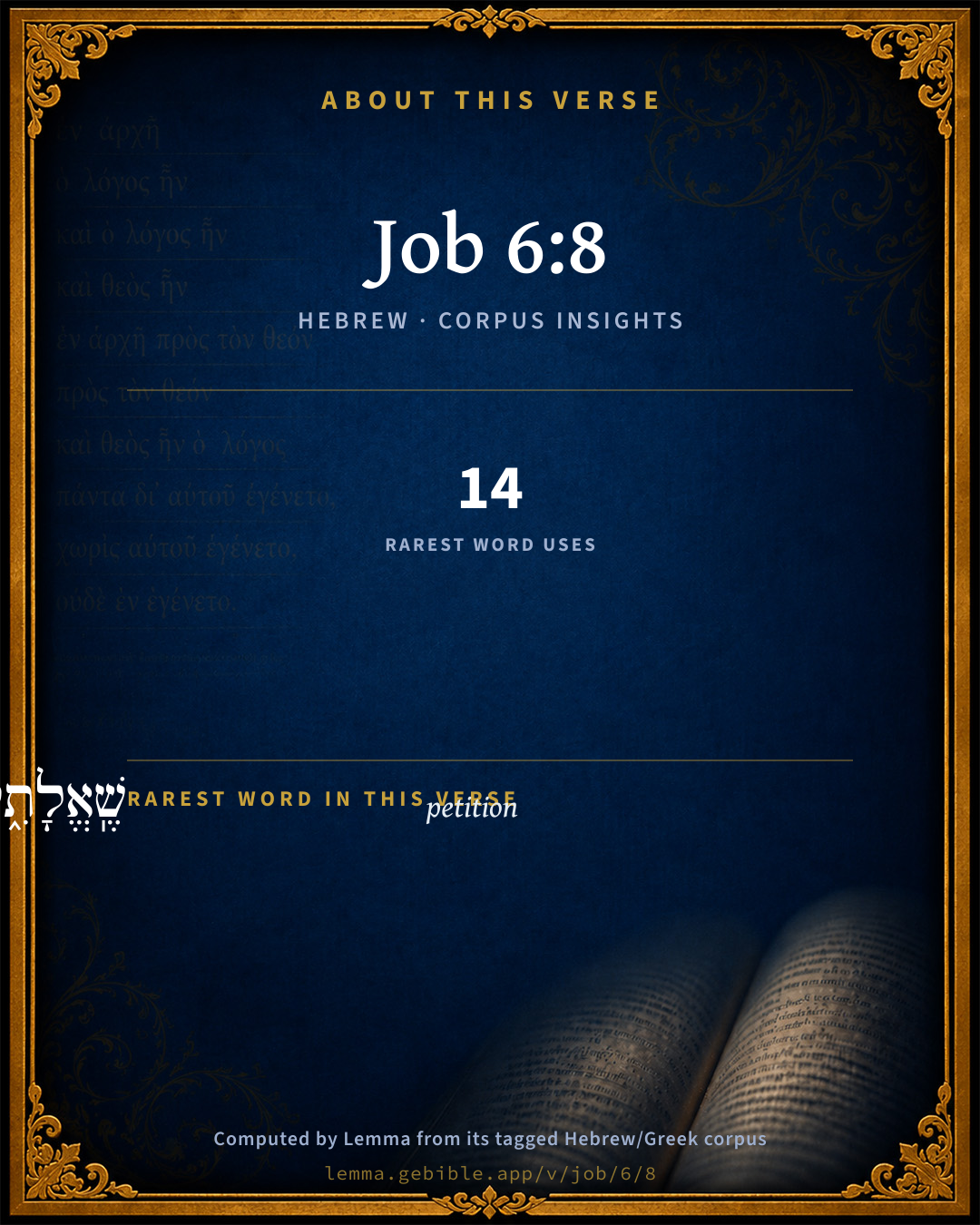
The rarest word here is שֶֽׁאֱלָתִ֑י petition H7596 — appearing just 14 times in the whole Hebrew Bible.

Shared distinctive vocabulary

שֶֽׁאֱלָתִ֑י petition H7596 occurs in 14 verses of the Hebrew Bible. Also found in:

Grammatical profile

  • 3 verbs
  • 3 nouns
  • 1 particle

Verb forms

  • יִ֭תֵּן Qal · Imperfect
  • תָּב֣וֹא Qal · Imperfect
  • יִתֵּ֥ן Qal · Imperfect

Repetition

A word recurs within this verse — often emphatic in Hebrew:

  • יִ֭תֵּן to give H5414 ×2

Hebrew & Septuagint length

In English translation the verse runs 17 words from the Hebrew and 20 from the Septuagint (LXX English) — closely comparable.

A rough comparison of the two English renderings, which tokenize alike — not a word-level alignment.

Word counts can differ between the Hebrew and the Greek without any difference in meaning — e.g. the Hebrew direct-object marker אֵת has no separate Greek word, and Greek often adds the article ὁ.

Cross-references

3

Topical passages linked to Job 6:8 in the Treasury of Scripture Knowledge — connected by theme and wording, ordered by reader-vote popularity; previews shown in the World English Bible.

  • Psalms 119:81 My soul faints for your salvation. I hope in your word.
  • Job 17:14–16 If I have said to corruption, 'You are my father;' To the worm, 'My mother,' and 'my sister;'
  • Job 6:11–13 What is my strength, that I should wait? What is my end, that I should be patient?

Cross-references courtesy of OpenBible.info (CC BY 4.0).

Hebrew and Greek witnesses Masoretic Hebrew ↔ Greek Septuagint

The same verse in the two great witnesses to the Old Testament, shown verse-for-verse.

These are two independent witnesses, not word-aligned to each other, and the Septuagint is shown in lemma (dictionary) form.

Hebrew Job 6:8 Masoretic · Westminster Leningrad Codex

מִֽי יִ֭תֵּן תָּב֣וֹא שֶֽׁאֱלָתִ֑י וְ֝תִקְוָתִ֗י יִתֵּ֥ן אֱלֽוֹהַּ

"Oh that I might have my request; That God would grant the thing that I long for!

World English Bible · Public Domain

Greek LXX Job 6:8 Septuagint · lemma form

εἰ γάρ δίδωμι καί ἔρχομαι ἐγώ ὁ αἴτησις καί ὁ ἐλπίς ἐγώ δίδωμι ὁ κύριος

For oh that he would grant my desire, and my petition might come, and the Lord would grant my hope!

LXX2012 (modern English Septuagint) · Public Domain

On this verse, Keil & Delitzsch discusses the Septuagint’s reading. Read the note in Commentary ↓

Hebrew: Westminster Leningrad Codex (CC BY 4.0). Greek: Septuagint (public domain); English from LXX2012 (modern English Septuagint) (Public Domain). How the Septuagint differs from the Hebrew →

Commentary

Notes on Job 6:8 from classic Christian and Jewish commentators (each source and its license shown beneath its notes). The classic Christian expositions comment on the surrounding passage and are grouped to its opening verse, so a note may address several verses; the Jewish commentaries on the Tanakh (Rashi and others) are per-verse, so they appear only where the commentator wrote on this verse.

Lemma curates 59 commentaries, every one of them public domain or Creative Commons licensed, each selected and text-cleaned for this edition rather than reprinted as found. About our sources →

Matthew Henry's Commentary

Ungoverned passion often grows more violent when it meets with some rebuke and check. The troubled sea rages most when it dashes against a rock. Job had been courting death, as that which would be the happy period of his miseries, ch. 3. For this Eliphaz had gravely reproved him, but he, instead of unsaying what he had said, says it here again with more vehemence than before; and it is as ill said as almost any thing we meet with in all his discourses, and is recorded for our admonition, not our imitation.

I. He is still most passionately desirous to die, as if it were not possible that he should ever see good days again in this world, or that, by the exercise of grace and devotion, he might make even these days of affliction good days. He could see no end of his trouble but death, and had not patience to wait the time appointed for that. He has a request to make; there is a thing he longs for (Job 6:8); and what is that? One would think it should be, "That it would please God to deliver me, and restore me to my prosperity again;" no, That it would please God to destroy me, Job 6:9. "As once he let loose his hand to make me poor, and then to make me sick, let him loose it once more to put an end to my life. Let him give the fatal stroke; it shall be to me the coup de grace - the stroke of favour," as, in France, they call the last blow which dispatches those that are broken on the wheel. There was a time when destruction from the Almighty was a terror to Job (Job 31:23), yet now he courts the destruction of the flesh, but in hopes that the spirit should be saved in the day of the Lord Jesus. Observe, Though Job was extremely desirous of death, and very angry at its delays, yet he did not offer to destroy himself, nor to take away his own life, only he begged that it would please God to destroy him. Seneca's morals, which recommend self-murder as the lawful redress of insupportable grievances, were not then known, nor will ever be entertained by any that have the least regard to the law of God and nature. How uneasy soever the soul's confinement in the body may be, it must by no means break prison, but wait for a fair discharge.

II. He puts this desire into a prayer, that God would grant him this request, that it would please God to do this for him. It was his sin so passionately to desire the hastening of his own death, and offering up that desire to God made it no better; nay, what looked ill in his wish looked worse in his prayer, for we ought not to ask any thing of God but what we can ask in faith, and we cannot ask any thing in faith but what is agreeable to the will of God. Passionate prayers are the worst of passionate expressions, for we should lift up pure hands without wrath.

III. He promises himself effectual relief, and the redress of all his grievances, by the stroke of death (Job 6:10): "Then should I yet have comfort, which now I have not, nor ever expect till then." See, 1. The vanity of human life; so uncertain a good is it that it often proves men's greatest burden and nothing is so desirable as to get clear of it. Let grace make us willing to part with it whenever God calls; for it may so happen that even sense may make us desirous to part with it before he calls. 2. The hope which the righteous have in their death. If Job had not had a good conscience, he could not have spoken with this assurance of comfort on the other side death, which turns the tables between the rich man and Lazarus. Now he is comforted, and thou art tormented.

IV. He challenges death to do its worst. If he could not die without the dreadful prefaces of bitter pains and agonies, and strong convulsions, if he must be racked before he be executed, yet, in prospect of dying at last, he would make nothing of dying pangs: "I would harden myself in sorrow, would open my breast to receive death's darts, and not shrink from them. Let him not spare; I desire no mitigation of that pain which will put a happy period to all my pains. Rather than not die, let me die so as to feel myself die." These are passionate words, which might better have been spared. We should soften ourselves in sorrow, that we may receive the good impressions of it, and by the sadness of the countenance our hearts, being made tender, may be made better; but, if we harden ourselves, we provoke God to proceed in his controversy; for when he judgeth he will overcome. It is great presumption to dare the Almighty, and to say, Let him not spare; for are we stronger than he? Co1 10:22. We are much indebted to sparing mercy; it is bad indeed with us when we are weary of that. Let us rather say with David, O spare me a little.

V. He grounds his comfort upon the testimony of his conscience for him that he had been faithful and firm to his profession of religion, and in some degree useful and serviceable to the glory of God in his generation: I have not concealed the words of the Holy One. Observe, 1. Job had the words of the Holy One committed to him. The people of God were at that time blessed with divine revelation. 2. It was his comfort that he had not concealed them, had not received the grace of God therein in vain. (1.) He had not kept them from himself, but had given them full scope to operate upon him, and in every thing to guide and govern him. He had not stifled his convictions, imprisoned the truth in unrighteousness, nor done any thing to hinder the digestion of this spiritual food and the operation of this spiritual physic. Let us never conceal God's word from ourselves, but always receive it in the light of it. (2.) He had not kept them to himself, but had been ready, on all occasions, to communicate his knowledge for the good of others, was never ashamed nor afraid to own the word of God to be his rule, nor remiss in his endeavours to bring others into an acquaintance with it. Note Those, and those only, may promise themselves comfort in death who are good, and do good, while they live.

VI. He justifies himself, in this extreme desire of death, from the deplorable condition he was now in, Job 6:11, Job 6:12. Eliphaz, in the close of his discourse, had put him in hopes that he should yet see a good issue of his troubles; but poor Job puts these cordials away from him, refuses to be comforted, abandons himself to despair, and very ingeniously, yet perversely, argues against the encouragements that were given him. Disconsolate spirits will reason strangely against themselves. In answer to the pleasing prospects Eliphaz had flattered him with, he here intimates, 1. That he had no reason to expect any such thing: "What is my strength, that I should hope? You see how I am weakened and brought low, how unable I am to grapple with my distempers, and therefore what reason have I to hope that I should out-live them, and see better days? Is my strength the strength of stones? Are my muscles brass and my sinews steel? No, they are not, and therefore I cannot hold out always in this pain and misery, but must needs sink under the load. Had I strength to grapple with my distemper, I might hope to look through it; but, alas! I have not. The weakening of my strength in the way will certainly be the shortening of my days," Psa 102:23. Note, All things considered, we have no reason to reckon upon the long continuance of life in this world. What is our strength? It is depending strength. We have no more strength than God gives us; for in him we live and move. It is decaying strength; we are daily spending the stock, and by degrees it will be exhausted. It is disproportionable to the encounters we may meet with; what is our strength to be depended upon, when two or three days' sickness will make us weak as water? Instead of expecting a long life, we have reason to wonder that we have lived hitherto and to feel that we are hastening off apace. 2. That he had no reason to desire any such thing: "What is my end, that I should desire to prolong my life? What comfort can I promise myself in life, comparable to the comfort I promise myself in death?" Note, Those who, through grace, are ready for another world, cannot see much to invite their stay in this world, or to make them fond of it. That, if it be God's will, we may do him more service and may get to be fitter and riper for heaven, is an end for which we may wish the prolonging of life, in subservience to our chief end; but, otherwise, what can we propose to ourselves in desiring to tarry here? The longer life is the more grievous will its burdens be (Ecc 12:1), and the longer life is the less pleasant will be its delights, Sa2 19:34, Sa2 19:35. We have already seen the best of this world, but we are not sure that we have seen the worst of it.

VII. He obviates the suspicion of his being delirious (Job 6:13): Is not my help in me? that is, "Have I not the use of my reason, with which, I thank God, I can help myself, though you do not help me? Do you think wisdom is driven quite from me, and that I am gone distracted? No, I am not mad, most noble Eliphaz, but speak the words of truth and soberness." Note, Those who have grace in them, who have the evidence of it and have it in exercise, have wisdom in them, which will be their help in the worst of times. Sat lucis intus - They have light within.

Matthew Henry's Commentary on the Whole Bible (1708–1710) — public domain (CC PDM 1.0). Text via the HelloAO Bible API.

Trapp's Complete Commentary

John Trapp

Job 6:8 Oh that I might have my request; and that God would grant [me] the thing that I long for!

Ver. 8. Oh that I might have my request!] How heartily begs Job for death, as a medicine of all his maladies and miseries; as that which would bring him malorum ademptionem, bonorum adeptionem, freedom from all evil, fruition of all good; by the force of his faith he looks upon death as the best physician, that would cure him of all infirmities inward and outward, and of all at once, and for ever. Job might likely be of the same mind that Chaucer was, who took for his English motto, Farewell, medicine; and for his Latin one, Mors aerumnarum requies, death will be a sweet rest from all my labours. The same to a believer death is that Mount Ararat was to Noah, where his ark rested after long tossing; or as Michal was to David, a means to shift him out of the way when Saul sent to slay him; or as the fall of the house was to Samson, an end of all his sorrows and sufferings. Hence it is that he rejoiceth under hope, and with stretched out neck looks and longs for death’s coming, as dearly as ever Sisera’s mother did out of a window for the coming of her son laden with spoils from the battle. As when death is come indeed, he welcometh it, as Jael did the same Sisera (but much more heartily), with, "Turn in, my lord, turn in to me," Jdg 4:18; and further bespeaketh it, as Jacob did his brother Esau, at their interview, Surely I have seen thy face as the face of God, who hath made thee to meet me with kisses instead of frowns, and hath sent thee to guard me safe home to my father’s house.

And that God would grant me the thing that I long for] Or, have long looked for. Heb. My hope or my expectation, as that which will put a period to my miseries, and possess me of heaven’s happiness, as that which will be a postern to let out temporal life, but a street door to let in eternal.

John Trapp, A Commentary or Exposition upon All the Books of the Old and New Testament (1647–1656) — public domain. Text from a community e-Sword module.

Joseph Benson's Commentary

Job 6:8-9. O that I might have my request! — The thing which I so passionately desired, and which, notwithstanding all your vain words, and weak arguments, I still continue to desire, and beseech God to grant me. The thing that I long for! — Hebrew, תקותי, tickvati, my hope or expectation. That it would please God to destroy me — To end my days and calamities together: that he would let loose his hand — Which is now, as it were, bound up or restrained from giving me that deadly blow which I desire. O that he would not restrain it any longer, and suffer me to languish in this miserable condition, but give me one stroke more and quite cut me off. Mr. Peters has justly observed, that “these two verses, as well as Job 6:11, with many more that might be quoted to the same purpose, are utterly inconsistent with Job’s believing that God would restore him to his former happy state;” as Bishop Warburton contended, that he might lay a foundation for an interpretation of the noted passage in Job 19:25-27, different from that commonly received, and might explain it, not of Job’s hope of immortality, but of his expectation of a restoration to temporal prosperity.

Joseph Benson's Commentary on the Old and New Testaments (1811–1818) — public domain. Text from a community e-Sword module.

Whedon's Commentary on the Bible

Daniel D. Whedon

Third strophe — So heavy is his burden of sorrow, that death would be true consolation, Job_6:8-10.

8. Oh that — We have here the optative formula, “Who will give”=Oh that! quite frequent in the addresses of Job, and occurring once besides in this book, in the first address of Zophar. Job_11:5. The pathos of this appeal is exceedingly touching, and is heightened by his assuming that all must know what that wish must be.

Daniel D. Whedon (gen. ed.), Commentary on the Old and New Testaments (1874–1909) — public domain. Text from a community e-Sword module.

Keil & Delitzsch

C. F. Keil & F. Delitzsch

8 Would that my request were fulfilled,

And that Eloah would grant my expectation,

9 That Eloah were willing and would crush me,

Let loose His hand and cut me off:

10 Then I should still have comfort -

(I should exult in unsparing pain) -

That I have not disowned the words of the Holy One.

His wish refers to the ending of his suffering by death. Hupfeld prefers to read ותאותי instead of ותקותי (Job 6:8); but death, which he desires, he even indeed expects. This is just the paradox, that not life, but death, is his expectation. "Cut me off," i.e., my soul or my life, my thread of life (Job 27:8; Isa 38:12). The optative יתּן מי (Ges. 136, 1) is followed by optative futt., partly of the so-called jussive form, as יאל, velit (Hiph. from ואל, velle), and יתּר, solvat (Hiph. from נתר). In the phrase יד התּיר, the stretching out of the hand is regarded as the loosening of what was hitherto bound. The conclusion begins with וּתהי, just like Job 13:5. But it is to be asked whether by consolation speedy death is to be understood, and the clause with כּי gives the ground of his claim for the granting of the wish, - or whether he means that just this: not having disowned the words of the Holy One (comp. Job 23:11., and אמרי־אל in the mouth of Balaam, the non-Israelitish prophet, Num 24:4, Num 24:16), would be his consolation in the midst of death. With Hupfeld we decide in favour of the latter, with Psa 119:50 in view: this consciousness of innocence is indeed throughout the whole book Job's shield and defence. If, however, נחמתי (with Kametz impurum) points towards כּי, quod, etc., the clause ואסלּדה is parenthetical. The cohortative is found thus parenthetical with a conjunctive sense also elsewhere (Psa 40:6; Psa 51:18). Accordingly: my comfort - I would exult, etc. - would be that I, etc. The meaning of סלד, tripudiare, is confirmed by the lxx ἡλλόμην, in connection with the Arabic ṣalada (of a galloping horse which stamps hard with its fore-feet), according to which the Targ. also translates ואבוּע (I will rejoice).

(Note: The primary meaning of סלד, according to the Arabic, is to be hard, then, to tread hard, firm, as in pulsanda tellus; whereas the poetry of the synagogue (Pijut) uses סלּד in the signification to supplicate, and סלד, litany (not: hymn, as Zunz gives it); and the Mishna-talmudic סלד signifies to singe, burn one's self, and to draw back affrighted.)

For יחמל לא, comp. Isa 30:14. (break in pieces unsparingly). יחמל לא certainly appears as though it must be referred to God (Ew., Hahn, Schlottm., and others), since חילה sounds feminine; but one can either pronounce חילה = חיל as Milel (Hitz.), or take יחמל לא adverbially, and not as an elliptical dependent clause (as Ges. 147, rem. 1), but as virtually an adjective: in pain unsparing.

Keil & Delitzsch — Biblical Commentary on the Old Testament (1861–1891) — public domain (CC PDM 1.0). Text via the HelloAO Bible API. (Old Testament only.)

Geneva Bible (1599)

Geneva Bible translators

Herein he sinneth double, both in wishing through impatience to die, and also in desiring of God a thing which was not agreeable to his will.

Geneva Bible (1599) marginal notes — public domain. Text via Bolls.life.

Jamieson, Fausset & Brown

Robert Jamieson, A. R. Fausset & David Brown

To desire death is no necessary proof of fitness for death. The ungodly sometimes desire it, so as to escape troubles, without thought of the hereafter. The godly desire it, in order to be with the Lord; but they patiently wait God's will.

Jamieson, Fausset & Brown — Commentary Critical and Explanatory on the Whole Bible (1871) — public domain (CC PDM 1.0). Text via the HelloAO Bible API.

Adam Clarke's Commentary

Verse 8. O that I might have] As Job had no hope that he should ever be redeemed from his present helpless state, he earnestly begs God to shorten it by taking away his life.

Adam Clarke's Commentary on the Bible (1810–1826) — public domain. Text from a community e-Sword/MySword module.

Ellicott's Commentary for English Readers

(8) Oh that I might have my request.—Baffled in the direction of his fellow-creatures, he turns, like many others, to God as his only hope, although it is rather from God than in God that his hope lies. However exceptional Job’s trials, yet his language is the common language of all sufferers who think that relief, if it comes, must come through change of circumstances rather than in themselves in relation to circumstances. Thus Job looks forward to death as his only hope; whereas with God and in God there were many years of life and prosperity in store for him. So strong is this feeling in him, that he calls death the thing that he longs for, his hope or expectation. (Comp. Job 17, where even the hope that he had in death seems to have passed away and to have issued in blank hopelessness.)

A Bible Commentary for English Readers, edited by Charles John Ellicott (1878–1897) — public domain. Text from a community e-Sword module.

The Cambridge Bible for Schools and Colleges

gen. ed. J. J. S. Perowne

8, 9. So keenly does Job realize the loathsomeness of his sufferings that he forgets his defence and breaks out into a passionate cry for death, which he calls the thing that he longs for.

The Cambridge Bible for Schools and Colleges (gen. ed. J. J. S. Perowne; Cambridge University Press, 1878–1918) — public domain. Text from a community e-Sword module.

John Gill's Exposition

Even that it would please God to destroy me,.... Not with an everlasting destruction of body and soul; for destruction from the Almighty was a terror to him, Job 31:23; but with the destruction of the body only; not with an annihilation of it, but with the dissolution of it, or of that union there was between his soul and body: the word (n) used signifies to bruise and beat to pieces; his meaning is, that his body, his house of clay in which he dwelt, might be crushed to pieces, and beat to powder, and crumbled into dust; and perhaps he may have regard to his original, the dust of the earth, and his return to it, according to the divine threatening, Gen 3:19; a phrase expressive of death; and so Mr. Broughton renders it, "to bring me to the dust", to "the dust of death", Psa 22:15,

that he would let loose his hand, and cut me off! he had let loose his hand in some degree already; he had given his substance and his body into the hand of Satan; his own hand had touched him, but he had only gone skin deep, as it were; he had smote him in his estate, in his family, and in the outward parts of his body; but now he desires that he would stretch out his hand further, and lift it up, and give a heavier stroke, and pierce him more deeply; strike through his heart and liver, and "make an end" of him, as Mr. Broughton translates the word, and dispatch him at once; cut him off like the flower of the field by the scythe, or like a tree cut down to its root by the axe, or cut off the thread of his life, Isa 38:12.

(n) "me conterat", V. L. Pagninus, Montanus, Mercerus, Schmidt; so Junius & Tremellius, Piscator, Michaelis, Schultens.

John Gill's Exposition of the Whole Bible (1746–1763) — public domain (CC PDM 1.0). Text via the HelloAO Bible API.

Albert Barnes' Notes on the Bible

Oh that I might have my request - To wit, death. This he desired as the end of his sorrows, either that he might be freed from them, or that he might be admitted to a happy world - or both.

Would grant me the thing that I long for - Margin, “My expectation.” That is, death. He expected it; he looked out for it; he was impatient that the hour should come. This state of feeling is not uncommon - where sorrows become so accumulated and intense that a man desires to die. It is no evidence, however, of a preparation for death. The wicked are more frequently in this state than the righteous. They are overwhelmed with pain; they see no hope of deliverance from it and they impatiently wish that the end had come. They are stupid about the future world, and either suppose that the grave is the end of their being, or that in some undefinable way they will be made happy hereafter. The righteous, on the other hand, are willing to wait until God shall be pleased to release them, feeling that He has some good purpose in all that they endure, and that they do not suffer one pang too much. Such sometimes were Job’s feelings; but here, as in some other instances, no one can doubt that he was betrayed into unjustifiable impatience under his sorrows, and that he expressed an improper wish to die.

Albert Barnes' Notes on the Bible (1834–1885) — public domain. Text from a community e-Sword/MySword module.

Matthew Poole's English Annotations

My request, i.e. the thing which I have so passionately desired, and, notwithstanding all your vain words and weak arguments, do still justly continue to desire, to wit, death, as is expressed Job 6:9, and more largely Job 3.

Matthew Poole's English Annotations on the Holy Bible (1683–1685) — public domain. Text from a community e-Sword/MySword module.

The Pulpit Commentary

Oh that I might have my request! Here the second point is taken up. Eliphaz has threatened Job with death, representing it as the last and most terrible of punishments. (Job_4:9, Job_4:20, 21 5:2) Job"s reply is that there is nothing he desires so much as death. His primary wish would have been never to have been born; (Job_3:3-10) next to that, he would have desired an early death the earlier the more acceptable. (Job_3:11-19) As both these have been denied him, what he now desires, and earnestly asks for, is a speedy demise. It is not as yet clear what he thinks death to be, or whether he has any hope beyond the grave. Putting aside all such considerations, he here simply balances death against such a life as he now leads, and must expect to lead, since his disease is incurable, and decides in favour of death. It is not only his desire, but his "request" to God, that death may come to him quickly. And that God would grant me the thing that I long for; literally, my expectation"or wish. The idea of taking his own life does not seem to have occurred to Job, as it would to a Greek (Plato, "Phaedo," or a Roman (Pithy, "Epist.," 1:12). He is too genuine a child of nature, too simple and unsophisticated, for such a thought to occur, and, if it occurred, would be too religious to entertain it for a moment. Like Aristotle, he would feel the act to be cowardly (Aristotle, "Eth. Nic.," 5., sub fin. ); and, like Plato (l.s.c. ), he would view it as rebellion against the will of God.

Vers. 8, 9. The prayer of despair.

This is an awful prayer. Job longs for death, and prays God to crush him. Then there will be an end to his agonies. He has rejected his wife"s temptation to suicide; (Job_2:9) but he begs that God will take his life.

I IT IS WELL TO BRING THE DESPAIR OF THE SOUL TO GOD. The despair is not utter and complete if it has not stifled the fountains of prayer. When it can be said of any one, "Behold, he prayeth," all hope is not yet gone. Although for the time being he had lost sight of it, still there is a point on which hope for better days may lay hold. When all things seem to be rushing to ruin, and there is no other outlook for the soul, the outlook to heaven is still open. If we can do nothing else, the way is still before us to cast our burden upon the Lord. Though the very prayer be one of horror and despair, like Job"s, still it is a prayer. There is the saving element. The Soul is looking up to God. It is not quite alone in its desolation.

II GOD UNDERSTANDS THE PRAYER OF DESPAIR. He is not like Job"s purblind censor Eliphaz, who judged in ignorance and wounded when he thought to heal. The breaches of conventional propriety in religion, which shock the more precise sort of piety, are not thus misapprehended by God. He views all with a large eye of charity, with a penetrating discernment of sympathy. The wild utterance that only scandalizes the superficial hearer moves the compassion of the Father of spirits. He knows from what depths of agony it has been forced, and he pardons the extravagance of it in pity for its misery.

III THE PRAYER OF DESPAIR IS FOOLISH AND SHORTSIGHTED. These two words "prayer" and "despair," are quite incongruous. The one should utterly banish the other. If we quite understood the meaning and power of prayer, despair would be impossible. For prayer implies that God has not forgotten us; or why should one pray to heedless ears? When we carry our grief to God we bring it to Almighty Love, and such a haven must be more congenial to hope than to despair.

IV GOD REFUSES TO ANSWER THE PRAYER OF DESPAIR, There are prayers which God will not answer, and that, not because he is inexorable, but because he is merciful; and as the mother is too kind to give her infant the flaming candles for which it cries, God is too good to bestow on his foolish children the evil things which they sometimes crave from his hand. Thus the very refusal to respond to the prayer is a result, not of disregarding it, but of giving to it more than that superficial attention which would have been enough for an unquestioning response. God sifts and weighs our prayers. We cannot present them as cheques on the bank of heaven, expecting immediate payment, exactly according to the measure of what we have set down in them. God is far better than our prayers. He exceeds our fears even when we beg him to act according to them. His sane mind corrects the wild fancies of our haste and passion. Therefore we need not shrink from the utmost freedom in prayer. God will not deal with us according to our words, but according to his love and our faith. W.F.A.

The Pulpit Commentary (1880–1919), ed. H.D.M. Spence-Jones & Joseph S. Exell — public domain. Text from a community e-Sword module.

Lesson kit

Teaching starters — assembled from the data on this page, not authored interpretation. Every prompt links to the verse data it draws on. Edit before teaching.

Job, in the Wisdom, opens this verse with 7 words (6 distinct Hebrew lemmas). Its most distinctive word is shᵉʼêlâh (“petition”). A historical commentator’s framing appears above. Read the whole chapter for the surrounding context.

Discussion questions

  1. The word shᵉʼêlâh carries the sense “petition.” How does it shape the verse?
  2. How does Judges 8:24, which shares the word «petition», read alongside this verse?
  3. What does the repetition of “to give” (2× in this one verse) do in this verse?
  4. The translations on this page render this verse differently — a whole-verse word diff, not a word-by-word alignment. What might account for the different wordings?
  5. «יִ֭תֵּן» is a Qal Imperfect verb. How does that grammatical form shape the action described?
  6. Compare how Matthew Henry's Commentary and Trapp's Complete Commentary read this verse. Where do they agree or differ?

Things to notice

Reading settings

Reading text

Shown beneath each verse's original-language words.

Old Testament
Old Testament edition

Read the OT as the Masoretic Hebrew (MT) or the Greek Septuagint (LXX).

English shown for the Greek Septuagint (in the Hebrew ↔ Greek comparison).

Comparing translations? Open the Compare panel on any verse page to stack up to four side by side.