
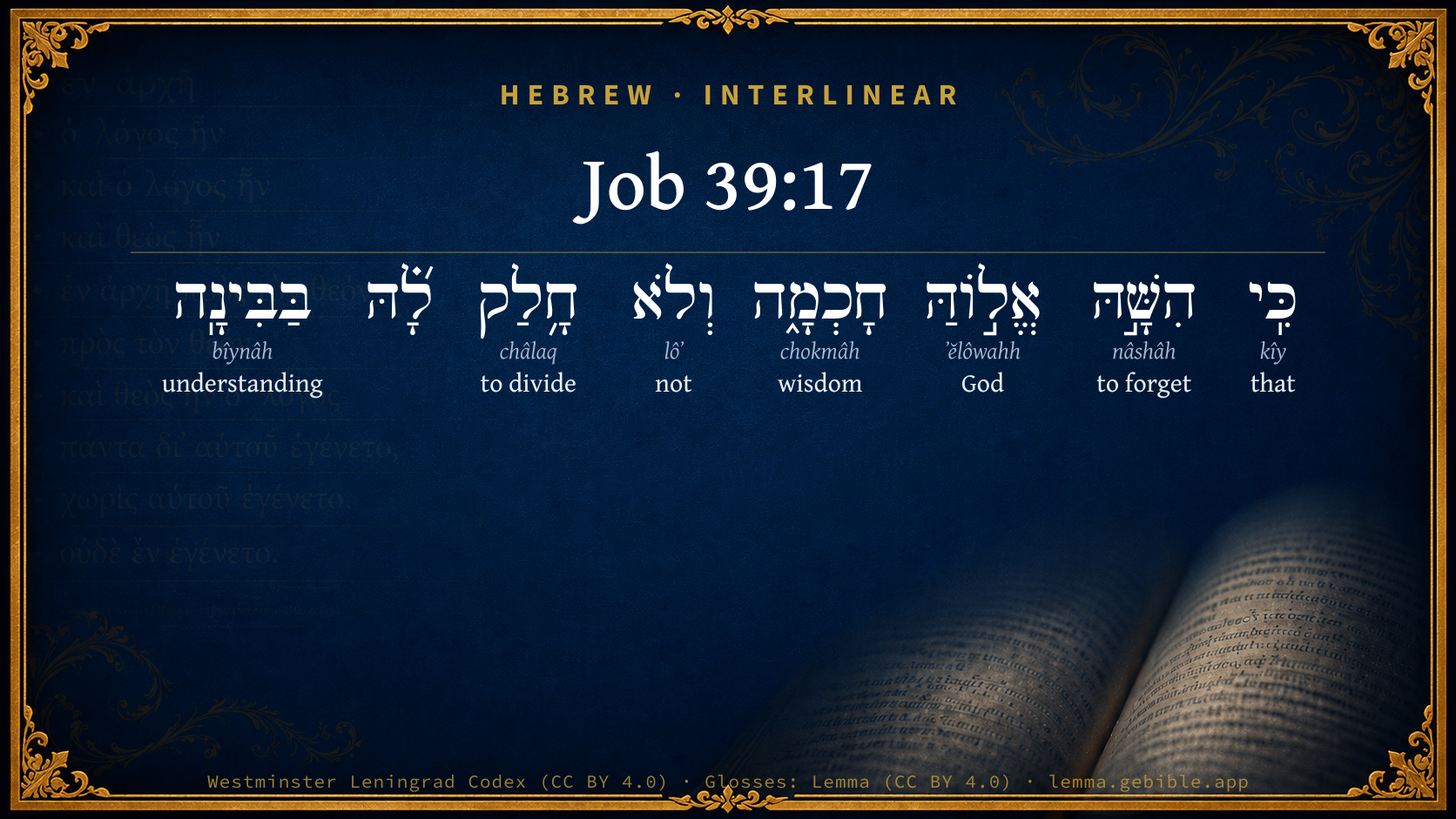
Job 39:17

Hebrew (Westminster Leningrad Codex) Job 39:17 appears in the Hebrew Old Testament. The text above is from the Westminster Leningrad Codex. Each word links to its Strong’s number, a concise gloss, and parsing drawn from the Open Scriptures Hebrew Bible morphology. Click any word for its full Brown-Driver-Briggs (BDB) entry.
Download image
Cite this verse

Job 39:17 (World English Bible). Public Domain. Lemma interlinear Bible study tool, https://lemma.gebible.app/v/job/39/17.

Show BibTeX & RIS
BibTeX
RIS
English Translation
Because God has deprived her of wisdom, Neither has he imparted to her understanding.
World English Bible · Public Domain
Download a study sheet

One document with this verse’s original text, its word-by-word gloss line, the meaning frame, cross-references with their text, attributed commentary, and full source and license credits — printable, and it pastes into notes with its structure intact.

This verse Autodidact and up

Study sheet (.html) Plain text (.txt)

A passage Seminary Student

Up to 50 verses in one chapter. A passage sheet keeps up to 6 commentary sources and 12 cross-references per verse, in the order this page ranks them, and says so on the sheet whenever that leaves anything out. Ask for a single verse and you get the Autodidact verse sheet above.

Everything on this page stays free to read, with no account — the sheet is a download of what is already on screen, not access to it.

Want to remove ads? Support Godless Engineer
Compare translations 3

The same verse in 3 English versions, stacked beneath the original-language interlinear above. Click any original word for its lexicon entry.

Each is an independent rendering of the whole verse — the interlinear is not word-aligned to these translations.

Highlighted words mark where these versions differ — a whole-verse word diff, not a word-by-word alignment.

  • World English Bible Public Domain
    Because God has deprived her of wisdom, Neither has he imparted to her understanding.
  • King James Version Public Domain
    Because God hath deprived her of wisdom, neither hath he imparted to her understanding.
  • unfoldingWord Literal Text CC BY-SA 4.0
    because God has caused it to forget wisdom, and he has not given understanding to it.

unfoldingWord Literal Text — © unfoldingWord, licensed CC BY-SA 4.0. Word-aligned USFM3 via Door43 (git.door43.org/unfoldingWord/en_ult).

Versions to compare (up to 4)

3 of 4 selected

Show all 18 translations

Every available English version of this verse, each an independent rendering of the whole verse.

  • World English Bible Public Domain
    Because God has deprived her of wisdom, Neither has he imparted to her understanding.
  • Berean Standard Bible Public Domain
    For God has deprived her of wisdom; He has not endowed her with understanding.
  • Majority Standard Bible Public Domain
    For God has deprived her of wisdom; He has not endowed her with understanding.
  • King James Version Public Domain
    Because God hath deprived her of wisdom, neither hath he imparted to her understanding.
  • American Standard Version (1901) Public Domain
    Because God hath deprived her of wisdom, Neither hath he imparted to her understanding.
  • Revised Version (1885) Public Domain
    Because God hath deprived her of wisdom, neither hath he imparted to her understanding.
  • Geneva Bible (1599) Public Domain
    Which leaueth his egges in the earth, and maketh them hote in the dust,
  • Douay-Rheims (1899) Public Domain
    For God hath deprived her of wisdom, neither hath he given her understanding.
  • Young's Literal Translation Public Domain
    For God hath caused her to forget wisdom, And He hath not given a portion To her in understanding:
  • Literal Standard Version CC BY-SA 4.0
    For God has caused her to forget wisdom, || And He has not given a portion || To her in understanding;
  • Unlocked Literal Bible CC BY-SA 4.0
    because God has deprived her of wisdom and has not given her any understanding.
  • unfoldingWord Literal Text CC BY-SA 4.0
    because God has caused it to forget wisdom, and he has not given understanding to it.
  • Darby Bible Public Domain
    For +God hath deprived her of wisdom, and hath not furnished her with understanding.
  • World Messianic Bible Public Domain
    because God has deprived her of wisdom, neither has he imparted to her understanding.
  • Webster's Bible Public Domain
    \\39:14\\Which leaveth her eggs in the earth, and warmeth them in the dust,
  • Free Bible Version CC BY-SA 4.0
    For I, God, made her forget wisdom—she didn't get her share of intelligence.
  • Bible in Basic English Public Domain
    That she puts her eggs on the earth, warming them in the dust,
  • JPS Tanakh (1917) Public Domain
    Because God hath deprived her of wisdom, neither hath He imparted to her understanding.

Literal Standard Version (2020), Covenant Press — licensed CC BY-SA 4.0. Text via the HelloAO Bible API (eBible.org). Unlocked Literal Bible (unfoldingWord) — licensed CC BY-SA 4.0. Text via the HelloAO Bible API (eBible.org). unfoldingWord Literal Text — © unfoldingWord, licensed CC BY-SA 4.0. Word-aligned USFM3 via Door43 (git.door43.org/unfoldingWord/en_ult). Free Bible Version, Dr. Jonathan Gallagher — licensed CC BY-SA 4.0. Text via the HelloAO Bible API (eBible.org).

Word by word

More ways to search: Search by grammar → Find every occurrence → Compare this word →

Practice this passage: Drill this verse → Learn its vocabulary →

About this verse

These counts appear in no published source. They are computed here, from the morphology-tagged text and Lemma’s own curated glosses. What Lemma adds →

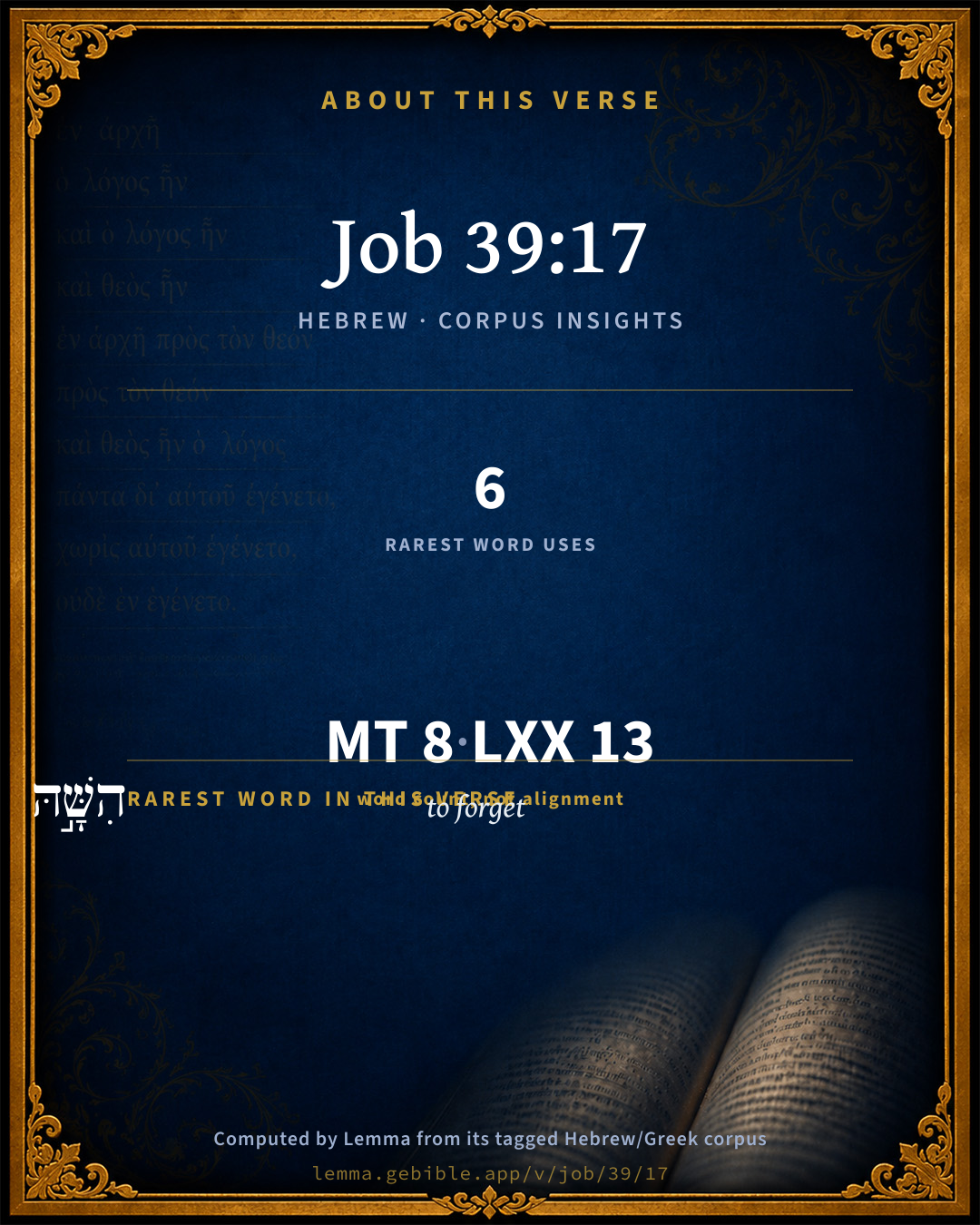
8
words
7
distinct lemmas
Wisdom
section

Notable vocabulary

The rarest word here is הִשָּׁ֣הּ to forget H5382 — appearing just 6 times in the whole Hebrew Bible.

Shared distinctive vocabulary

הִשָּׁ֣הּ to forget H5382 occurs in 6 verses of the Hebrew Bible. Also found in:

Grammatical profile

  • 2 verbs
  • 3 nouns
  • 1 preposition
  • 1 conjunction
  • 1 particle

Verb forms

  • הִשָּׁ֣הּ Hiphil · Perfect
  • חָ֥לַק Qal · Perfect

Hebrew & Septuagint length

In English translation the verse runs 14 words from the Hebrew and 15 from the Septuagint (LXX English) — closely comparable.

A rough comparison of the two English renderings, which tokenize alike — not a word-level alignment.

Word counts can differ between the Hebrew and the Greek without any difference in meaning — e.g. the Hebrew direct-object marker אֵת has no separate Greek word, and Greek often adds the article ὁ.

In the original languages it is 8 Hebrew tokens and 13 Greek tokens — but the two are counted differently (Hebrew bundles its prefixes and suffixes into one token; the Greek is in lemma form), so that isn’t a like-for-like length.

Cross-references

7

Topical passages linked to Job 39:17 in the Treasury of Scripture Knowledge — connected by theme and wording, ordered by reader-vote popularity; previews shown in the World English Bible.

  • Job 35:11 Who teaches us more than the animals of the earth, And makes us wiser than the birds of the sky?'
  • Deuteronomy 2:30 But Sihon king of Heshbon would not let us pass by him; for Yahweh your God hardened his spirit, and made his heart obstinate, that he might deliver him into your hand, as at this day.
  • 2 Chronicles 32:31 However in [the business of] the ambassadors of the princes of Babylon, who sent to him to inquire of the wonder that was done in the land, God left him, to try him, that he might know all that was in his heart.
  • Job 17:4 For you have hidden their heart from understanding, Therefore shall you not exalt them.
  • Isaiah 19:11–14 The princes of Zoan are utterly foolish; the counsel of the wisest counselors of Pharaoh is become brutish: how do you say to Pharaoh, I am the son of the wise, the son of ancient kings?
  • Isaiah 57:17 For the iniquity of his covetousness was I angry, and struck him; I hid [my face] and was angry; and he went on backsliding in the way of his heart.
  • James 1:17 Every good gift and every perfect gift is from above, coming down from the Father of lights, with whom can be no variation, nor turning shadow.

Cross-references courtesy of OpenBible.info (CC BY 4.0).

Hebrew and Greek witnesses Masoretic Hebrew ↔ Greek Septuagint

The same verse in the two great witnesses to the Old Testament, shown verse-for-verse.

These are two independent witnesses, not word-aligned to each other, and the Septuagint is shown in lemma (dictionary) form.

Hebrew Job 39:17 Masoretic · Westminster Leningrad Codex

כִּֽי הִשָּׁ֣הּ אֱל֣וֹהַּ חָכְמָ֑ה וְלֹא חָ֥לַק לָ֝֗הּ בַּבִּינָֽה

Because God has deprived her of wisdom, Neither has he imparted to her understanding.

World English Bible · Public Domain

Greek LXX Job 39:17 Septuagint · lemma form

ὅτι κατασιωπάω αὐτός ὁ θεός σοφία καί οὐ μερίζω αὐτός ἐν ὁ σύνεσις

For God has withholden wisdom from her, and not given her a portion in understanding.

LXX2012 (modern English Septuagint) · Public Domain

Hebrew: Westminster Leningrad Codex (CC BY 4.0). Greek: Septuagint (public domain); English from LXX2012 (modern English Septuagint) (Public Domain). How the Septuagint differs from the Hebrew →

Commentary

Notes on Job 39:17 from classic Christian and Jewish commentators (each source and its license shown beneath its notes). The classic Christian expositions comment on the surrounding passage and are grouped to its opening verse, so a note may address several verses; the Jewish commentaries on the Tanakh (Rashi and others) are per-verse, so they appear only where the commentator wrote on this verse.

Lemma curates 59 commentaries, every one of them public domain or Creative Commons licensed, each selected and text-cleaned for this edition rather than reprinted as found. About our sources →

Trapp's Complete Commentary

John Trapp

Job 39:17 Because God hath deprived her of wisdom, neither hath he imparted to her understanding.

Ver. 17. Because God hath deprived her of wisdom] That is, of such forecast to provide for her young ones by a natural instinct, as other fowls and beasts have, Struthionis astorgia declaratur e causis duabus, vacuitate metus et vacuitate intellectus. God’s mercy to men appeareth, 1. In giving us wisdom beyond them, Job 35:11 2. In giving us power over them, Psa 8:6-8; Psa 3:1-8. In learning us so much by them in those many Scripture comparisons, Pro 7:23; Pro 26:2; Pro 27:8; Mat 8:26. That is a sweet place, Isa 31:5, "As birds flying" (sc. to save their young), "so will the Lord defend Jerusalem; defending also he will deliver it; and passing over he will preserve it." The fowls of the air are and may be unto us examples and monitors of many virtues to be embraced and vices to be eschewed. In the ostrich, for instance, we may see that strength and size of body is not always accompanied with wisdom and understanding; that it is God who either giveth or denieth wisdom to his creatures; that natural affection is of him; that he gives not all things to one man, but diversely distributeth his gifts. The ostrich hath wings, but not to fly with.

Oυτως ου παντεσσι θεοι χαριεντα διδουσιν

‘Aνδρασι. - Non omnia possumus omnes.

John Trapp, A Commentary or Exposition upon All the Books of the Old and New Testament (1647–1656) — public domain. Text from a community e-Sword module.

Joseph Benson's Commentary

Job 39:17. Because God hath deprived her of wisdom — The want of natural affection to her young is not the only reproach due to the ostrich. “She is likewise inconsiderate and foolish in her private capacity, particularly in her choice of food, which is frequently highly detrimental and pernicious to her, for she swallows every thing greedily and indiscriminately, whether it be pieces of rags, leather, wood, stone, or even iron.” “When I was at Oran,” proceeds Dr. Shaw, “I saw one of these birds swallow, without any seeming uneasiness or inconvenience, several leaden bullets, as they were thrown upon the floor, scorching hot from the mould.” A second instance of her folly is, that, to secure herself, she will thrust her head into the shrubs, though her body which is of a great height, be exposed. As a third instance, it is said that she is sometimes taken by a stratagem of the sportsman, who clothes himself with the skin of an ostrich, putting his right hand into the skin of the neck, and moving it in the same manner as the ostrich does its own neck, and with his left hand strowing some seed from a bag that hangs down; by this means he entices the bird, and throws it into the valleys. A fourth is, the leaving her eggs, as has been just mentioned. A fifth instance is taken from the shape of its body, having a little head, and scarce any brain: hence historians tell us, that the Emperor Heliogabalus, to gratify his luxurious taste, together with other delicacies, such as the combs of cocks, the tongues of pheasants and nightingales, the eggs of partridges, the heads of parrots and peacocks, the brains of thrushes, had likewise served up to him, at one entertainment, the heads of six hundred ostriches for the sake of the brains; because, being so very small, a less number would not have been sufficient to make a dish. See Chappelow.

Joseph Benson's Commentary on the Old and New Testaments (1811–1818) — public domain. Text from a community e-Sword module.

Geneva Bible (1599)

Geneva Bible translators

They write that the ostrich covereth her eggs in the sand, and because the country is hot and the sun still keepeth them warm, they are hatched.

Geneva Bible (1599) marginal notes — public domain. Text via Bolls.life.

Jamieson, Fausset & Brown

Robert Jamieson, A. R. Fausset & David Brown

wisdom--such as God gives to other animals, and to man (Job 35:11). The Arab proverb is, "foolish as an ostrich." Yet her very seeming want of wisdom is not without wise design of God, though man cannot see it; just as in the trials of the godly, which seem so unreasonable to Job, there lies hid a wise design.

Jamieson, Fausset & Brown — Commentary Critical and Explanatory on the Whole Bible (1871) — public domain (CC PDM 1.0). Text via the HelloAO Bible API.

Adam Clarke's Commentary

Verse 17. God hath deprived her of wisdom] Of this foolishness we have an account from the ancients; and here follow two instances:

"1. It covers its head in the reeds, and thinks itself all out of sight because itself cannot see. So Claudian: -

____________ 'Stat lumine clauso

Ridendum revoluta caput: creditque latere

Quad non ipsa videt.'

"2. They who hunt them draw the skin of an ostrich's neck on one hand, which proves a sufficient lure to take them with the other. They have so little brain that Heliogabalus had six hundred heads for his supper. Here we may observe, that our judicious as well as sublime author just touches the great points of distinction in each creature, and then hastens to another. A description is exact when you cannot add but what is common to another thing; nor withdraw, but something peculiarly belonging to the thing described. A likeness is lost in too much description, as a meaning is often in too much illustration." - Dr. YOUNG.

Adam Clarke's Commentary on the Bible (1810–1826) — public domain. Text from a community e-Sword/MySword module.

The Cambridge Bible for Schools and Colleges

gen. ed. J. J. S. Perowne

17. God hath deprived her of wisdom] The Arabs have a proverb, “more stupid than an ostrich.” A poet suggests the reason of this charge of stupidity,

Like a bird that abandons her eggs in the desert,

And covers the eggs of another with her wings.

(Meidani, Prov. i. 405).

The Cambridge Bible for Schools and Colleges (gen. ed. J. J. S. Perowne; Cambridge University Press, 1878–1918) — public domain. Text from a community e-Sword module.

John Gill's Exposition

Because God hath deprived her of wisdom,.... Or "made her to forget" (d) what she had; an instance of her forgetfulness is mentioned Job 39:15; and so Leo Africanus (e) says of it, that it is of a very short memory, and presently forgets the place where its eggs are laid;

neither hath he imparted to her understanding; many instances are given of its stupidity by historians, as that it will take anything that is offered to it to eat, stones, iron, &c. (f); that it will thrust its head and neck into a thicket, fancying: it is hid and covered, and that none can see it; which Pliny (g) remarks as an instance of its foolishness; though Diodorus Siculus (h) takes this to be a point of prudence, for the preservation of those parts of it which are weakest. Strabo gives (i) another instance of its stupidity, its being so easily deceived by sportsmen, who, by putting the skin of an ostrich on their hands, and reaching out fruits or seeds to it, it will receive them of them, and be taken. Others observe the smallness of their heads, and so of their brains, as an argument of their want of understanding; and it has been remarked, as a proof of their having but few brains, that Heliogabalus, the Roman emperor, had six hundred heads of ostriches dressed at once for his supper, for the sake of their brains (k).

(d) "oblivisci fecit eum", Montanus, Mercerus, Drusius, Cocceius, Michaelis, Schultens. (e) Ut supra. (Desciptio. Africae, l. 9. p. 766.) (f) Aelian. ut supra. (de Animal. l. 5. c. 21.) Plin. Nat. Hist. l. 10. c. 1. (g) Ibid. (Plin. Nat. Hist. l. 10. c. 1.) (h) Ut supra. (Diodor. Sicul. Bibliothec. l. 2. p. 133.) (i) Geograph. l. 16. p. 531. (k) Lamprid. Vit. Heliogab. c. 20, 30.

John Gill's Exposition of the Whole Bible (1746–1763) — public domain (CC PDM 1.0). Text via the HelloAO Bible API.

Albert Barnes' Notes on the Bible

Because God hath deprived her of wisdom ... - That is, he has not imparted to her the wisdom which has been conferred on other animals. The meaning is, that all this remarkable arrangement, which distinguished the ostrich so much from other animals was to be traced to God. It was not the result of chance; it could not be pretended that it was by a human arrangement, but it was the result of divine appointment. Even in this apparent destitution of wisdom, there were reasons which had led to this appointment, and the care and good providence of God could be seen in the preservation of the animal. Particularly, though apparently so weak, and timid, and unwise, the ostrich had a noble hearing Job 39:18, and when aroused, would scorn the fleetest horse in the pursuit, and show that she was distinguished for properties that were expressive of the goodness of God toward her, and of his care over her.

Albert Barnes' Notes on the Bible (1834–1885) — public domain. Text from a community e-Sword/MySword module.

Haydock's Catholic Bible Commentary

Understanding. This bird has a head disproportionately small; insomuch, that Heliogabalus served up the brains of 600 at one supper. It greedily eats iron, &c., which may help its digestion, as sand does that of other birds. (Calmet) --- When it is hunted, it hides its head only, as if this would be a sufficient defence, (Pliny, [Natural History?] x. 1.) and is taken alive by a man, clothed in the skin of an ostrich, who moves the head with his hand. (Strabo xvi.) --- All which proves its stupidity. (Calmet)

George Leo Haydock (1774–1849), Haydock's Catholic Family Bible and Commentary, 1859 edition — public domain. Excludes Psalms (Douay-Rheims chapter numbering differs from Protestant) and Deuterocanonical books (Catholic canon only).

Matthew Poole's English Annotations

Because God hath not implanted in her that natural instinct, and providence, and affection, which he hath put into other birds and beasts towards their young. And yet no man presumes to reproach me for making this difference in my creatures. And as little reason hast thou to blame me for afflicting thee, when others not so bad as thou for the present go unpunished; because I have no less authority over thee than over them, and can dispose of all my creatures according to my good pleasure. The great folly of this bird is noted by Arabic writers, who best know her, and that not only for this property of forsaking her own eggs, but also for other things, as that she eats any thing which is offered to her, as iron, stones, glass, hot coals, &c., whereas other birds and beasts have so much sagacity, as to reject improper and unwholesome things; that being pursued by the hunter, she thinks herself safe and unseen by hiding her head in the sand; for which, and other such qualities, it is a proverb among the Arabians, More foolish than an ostrich.

Matthew Poole's English Annotations on the Holy Bible (1683–1685) — public domain. Text from a community e-Sword/MySword module.

Whedon's Commentary on the Bible

Daniel D. Whedon

17. Because God hath deprived, etc. — Rather, For God made her forgetful of wisdom, (hhokmah,) and gave her no share in understanding, (binah.) The Arabs have a proverb, “Foolish as the ostrich,” which might suffice for the illustration of the verse. Bochartus, however, cites five instances of stupidity. One may be given from Livingstone: “The ostrich is generally seen quietly feeding on some spot where no one can approach him without being seen by his wary eye. As the wagon moves along far to the windward, he thinks it is intended to circumvent him, so he rushes up a mile or so from the leeward, and so near to the front oxen that one sometimes gets a shot at the silly bird. When he begins to run, all the game in sight follow his example. I have seen this folly taken advantage of when he was feeding quietly in a valley open at both ends. A number of men would commence running, as if to cut off his retreat from the end through which the wind came; and although he had the whole country, hundreds of miles, before him by going to the other end, on he madly rushed to get past the men, and so was speared. He never swerves from the course he once adopts, but only increases his speed.” — South Africa, p. 171. See also Tristram, Nat. His., p. 238, and Wetzstein in Delitzsch, ii, pp. 341, 342. The difference thus suggested between the ostrich and animals pre-eminent in understanding must at the same time have impressed upon Job one of the many mysteries of the world of instinct; a world which Hume declares to be “inexplicable by all the disquisitions of human understanding.”

Daniel D. Whedon (gen. ed.), Commentary on the Old and New Testaments (1874–1909) — public domain. Text from a community e-Sword module.

The Pulpit Commentary

Because God hath deprived her of wisdom, neither hath he imparted to her understanding. There is an Arab proverb stupid as an ostrich which the Arabs justify on five grounds:

(1) The ostrich, they say, will swallow iron, stones, leaden bullets, and other things, which injure and sometimes prove fatal to it.

(2) When hunted, it thrusts its head into a hush, and ionone that the hunter does not see it.

(3) It allows itself to be captured by transparent devices.

(4) It neglects its eggs.

(5) Its head is small, and contains but a small quantity of brains. To these grounds I may add that in the South-African ostrich-farms, the birds allow themselves to be confined within a certain space by a fence of sticks and string raised about a foot from the ground. They seem to think that they cannot step over it.

The Pulpit Commentary (1880–1919), ed. H.D.M. Spence-Jones & Joseph S. Exell — public domain. Text from a community e-Sword module.

John Wesley's Explanatory Notes

Deprived - Because God hath not implanted in her that instinct, and affection, which he hath put into other birds and beasts toward their young.

John Wesley, Explanatory Notes Upon the Whole Bible (1754–1765) — public domain. Text via the GEBible commentary corpus.

Lesson kit

Teaching starters — assembled from the data on this page, not authored interpretation. Every prompt links to the verse data it draws on. Edit before teaching.

Job, in the Wisdom, opens this verse with 8 words (7 distinct Hebrew lemmas). Its most distinctive word is nâshâh (“to forget”). A historical commentator’s framing appears above. Read the whole chapter for the surrounding context.

Discussion questions

  1. The word nâshâh carries the sense “to forget.” How does it shape the verse?
  2. How does Genesis 41:51, which shares the word «to forget», read alongside this verse?
  3. The translations on this page render this verse differently — a whole-verse word diff, not a word-by-word alignment. What might account for the different wordings?
  4. «הִשָּׁ֣הּ» is a Hiphil Perfect verb. How does that grammatical form shape the action described?
  5. Compare how Trapp's Complete Commentary and Joseph Benson's Commentary read this verse. Where do they agree or differ?

Things to notice

Reading settings

Reading text

Shown beneath each verse's original-language words.

Old Testament
Old Testament edition

Read the OT as the Masoretic Hebrew (MT) or the Greek Septuagint (LXX).

English shown for the Greek Septuagint (in the Hebrew ↔ Greek comparison).

Comparing translations? Open the Compare panel on any verse page to stack up to four side by side.