
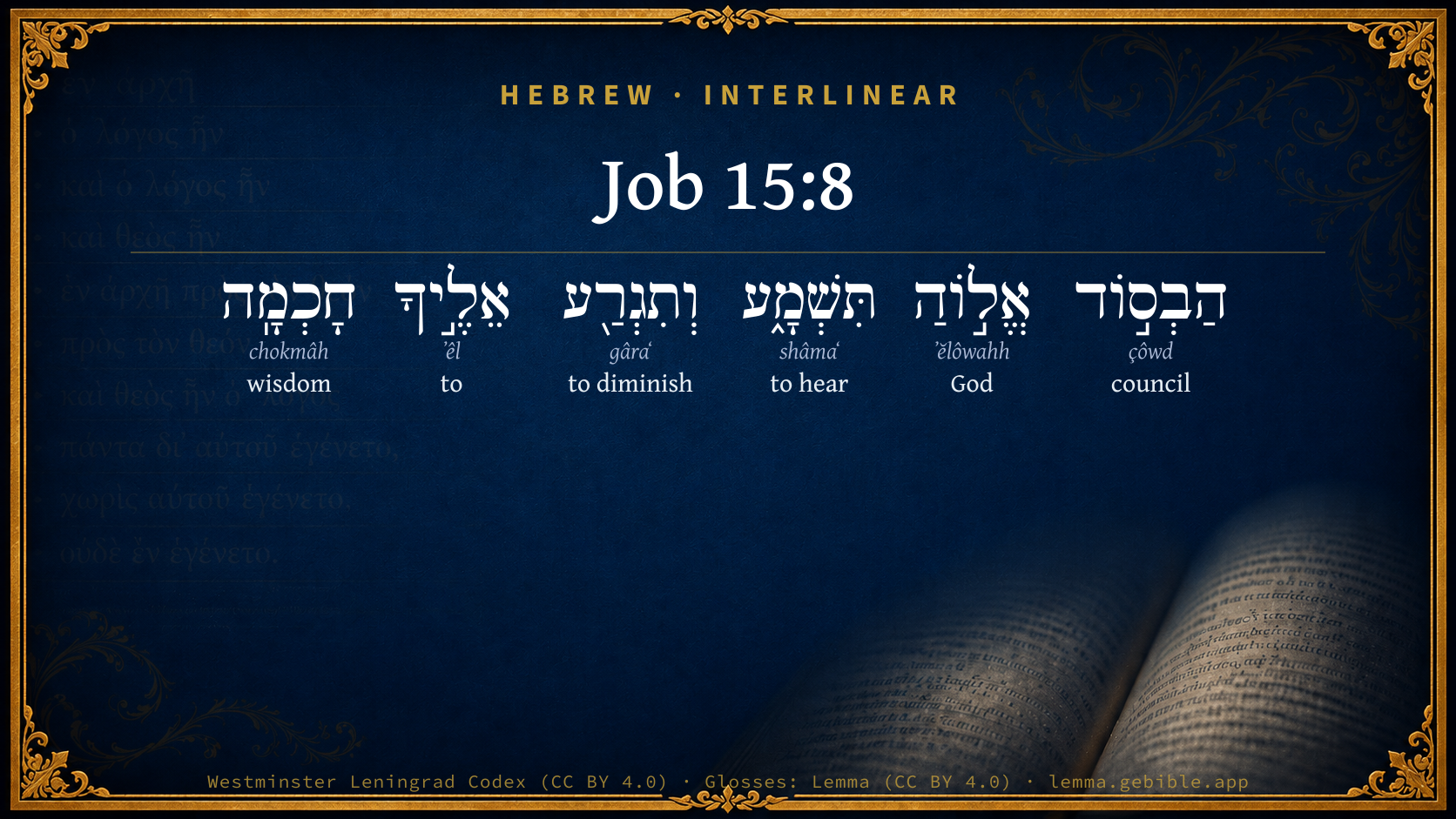
Job 15:8

Hebrew (Westminster Leningrad Codex) Job 15:8 appears in the Hebrew Old Testament. The text above is from the Westminster Leningrad Codex. Each word links to its Strong’s number, a concise gloss, and parsing drawn from the Open Scriptures Hebrew Bible morphology. Click any word for its full Brown-Driver-Briggs (BDB) entry.
Download image
Cite this verse

Job 15:8 (World English Bible). Public Domain. Lemma interlinear Bible study tool, https://lemma.gebible.app/v/job/15/8.

Show BibTeX & RIS
BibTeX
RIS
English Translation
Have you heard the secret counsel of God? Do you limit wisdom to yourself?
World English Bible · Public Domain
Download a study sheet

One document with this verse’s original text, its word-by-word gloss line, the meaning frame, cross-references with their text, attributed commentary, and full source and license credits — printable, and it pastes into notes with its structure intact.

This verse Autodidact and up

Study sheet (.html) Plain text (.txt)

A passage Seminary Student

Up to 50 verses in one chapter. A passage sheet keeps up to 6 commentary sources and 12 cross-references per verse, in the order this page ranks them, and says so on the sheet whenever that leaves anything out. Ask for a single verse and you get the Autodidact verse sheet above.

Everything on this page stays free to read, with no account — the sheet is a download of what is already on screen, not access to it.

Want to remove ads? Support Godless Engineer
Compare translations 3

The same verse in 3 English versions, stacked beneath the original-language interlinear above. Click any original word for its lexicon entry.

Each is an independent rendering of the whole verse — the interlinear is not word-aligned to these translations.

Highlighted words mark where these versions differ — a whole-verse word diff, not a word-by-word alignment.

  • World English Bible Public Domain
    Have you heard the secret counsel of God? Do you limit wisdom to yourself?
  • King James Version Public Domain
    Hast thou heard the secret of God? and dost thou restrain wisdom to thyself?
  • unfoldingWord Literal Text CC BY-SA 4.0
    Do you hear the counsel of God? Do you limit wisdom to yourself?

unfoldingWord Literal Text — © unfoldingWord, licensed CC BY-SA 4.0. Word-aligned USFM3 via Door43 (git.door43.org/unfoldingWord/en_ult).

Versions to compare (up to 4)

3 of 4 selected

Show all 18 translations

Every available English version of this verse, each an independent rendering of the whole verse.

  • World English Bible Public Domain
    Have you heard the secret counsel of God? Do you limit wisdom to yourself?
  • Berean Standard Bible Public Domain
    Do you listen in on the council of God or limit wisdom to yourself?
  • Majority Standard Bible Public Domain
    Do you listen in on the council of God or limit wisdom to yourself?
  • King James Version Public Domain
    Hast thou heard the secret of God? and dost thou restrain wisdom to thyself?
  • American Standard Version (1901) Public Domain
    Hast thou heard the secret counsel of God? And dost thou limit wisdom to thyself?
  • Revised Version (1885) Public Domain
    Hast thou heard the secret counsel of God? and dost thou restrain wisdom to thyself?
  • Geneva Bible (1599) Public Domain
    Hast thou heard the secret counsell of God, and doest thou restraine wisedome to thee?
  • Douay-Rheims (1899) Public Domain
    Hast thou heard God's counsel, and shall his wisdom be inferior to thee?
  • Young's Literal Translation Public Domain
    Of the secret counsel of God dost thou hear? And withdrawest thou unto thee wisdom?
  • Literal Standard Version CC BY-SA 4.0
    Do you hear of the secret counsel of God? And withdraw wisdom to you?
  • Unlocked Literal Bible CC BY-SA 4.0
    Have you heard the secret knowledge of God? Do you limit wisdom to yourself?
  • unfoldingWord Literal Text CC BY-SA 4.0
    Do you hear the counsel of God? Do you limit wisdom to yourself?
  • Darby Bible Public Domain
    Hast thou listened in the secret council of +God? And hast thou absorbed wisdom for thyself?
  • World Messianic Bible Public Domain
    Have you heard the secret counsel of God? Do you limit wisdom to yourself?
  • Webster's Bible Public Domain
    Hast thou heard the secret of God? and dost thou restrain wisdom to thyself?
  • Free Bible Version CC BY-SA 4.0
    Were you there listening in God's council? Does wisdom only belong to you?
  • Bible in Basic English Public Domain
    Were you present at the secret meeting of God? and have you taken all wisdom for yourself?
  • JPS Tanakh (1917) Public Domain
    Dost thou hearken in the council of God? And dost thou restrain wisdom to thyself?

Literal Standard Version (2020), Covenant Press — licensed CC BY-SA 4.0. Text via the HelloAO Bible API (eBible.org). Unlocked Literal Bible (unfoldingWord) — licensed CC BY-SA 4.0. Text via the HelloAO Bible API (eBible.org). unfoldingWord Literal Text — © unfoldingWord, licensed CC BY-SA 4.0. Word-aligned USFM3 via Door43 (git.door43.org/unfoldingWord/en_ult). Free Bible Version, Dr. Jonathan Gallagher — licensed CC BY-SA 4.0. Text via the HelloAO Bible API (eBible.org).

Word by word

More ways to search: Search by grammar → Find every occurrence → Compare this word →

Practice this passage: Drill this verse → Learn its vocabulary →

About this verse

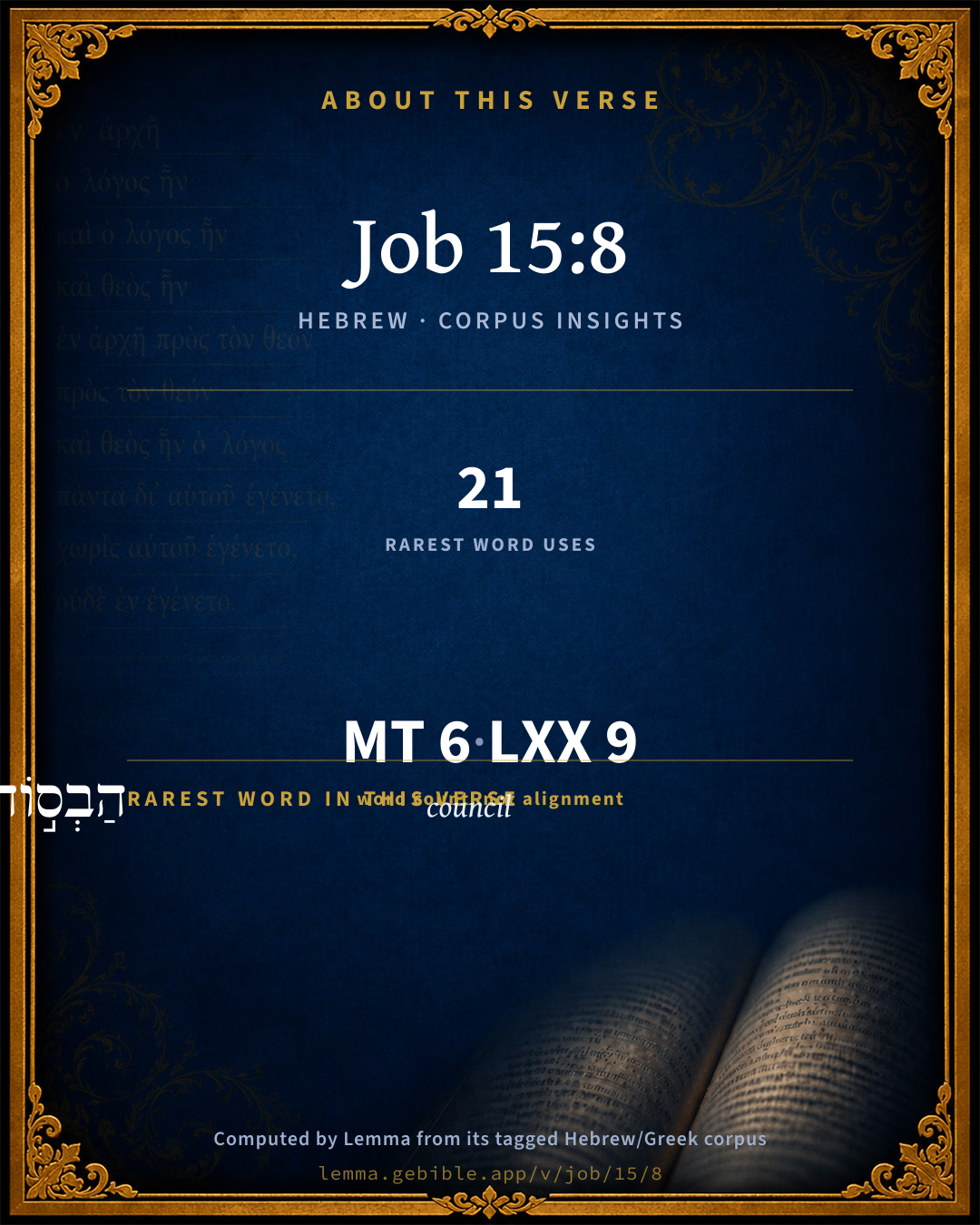
These counts appear in no published source. They are computed here, from the morphology-tagged text and Lemma’s own curated glosses. What Lemma adds →

6
words
6
distinct lemmas
Wisdom
section

Notable vocabulary

The rarest word here is הַבְס֣וֹד council H5475 — appearing just 21 times in the whole Hebrew Bible.

Shared distinctive vocabulary

הַבְס֣וֹד council H5475 occurs in 21 verses of the Hebrew Bible. Also found in:

Grammatical profile

  • 2 verbs
  • 3 nouns
  • 1 preposition

Verb forms

  • תִּשְׁמָ֑ע Qal · Imperfect
  • וְתִגְרַ֖ע Qal · Imperfect

Hebrew & Septuagint length

In English translation the verse runs 14 words from the Hebrew and 24 from the Septuagint (LXX English) — the Septuagint runs noticeably longer here. See the side-by-side →

A rough comparison of the two English renderings, which tokenize alike — not a word-level alignment.

Word counts can differ between the Hebrew and the Greek without any difference in meaning — e.g. the Hebrew direct-object marker אֵת has no separate Greek word, and Greek often adds the article ὁ.

In the original languages it is 6 Hebrew tokens and 9 Greek tokens — but the two are counted differently (Hebrew bundles its prefixes and suffixes into one token; the Greek is in lemma form), so that isn’t a like-for-like length.

Cross-references

17

Topical passages linked to Job 15:8 in the Treasury of Scripture Knowledge — connected by theme and wording, ordered by reader-vote popularity; previews shown in the World English Bible.

  • Romans 11:34 "For who has known the mind of the Lord? Or who has been his counselor?"
  • Jeremiah 23:18 For who has stood in the council of Yahweh, that he should perceive and hear his word? who has marked my word, and heard it?
  • Deuteronomy 29:29 The secret things belong to Yahweh our God; but the things that are revealed belong to us and to our children forever, that we may do all the words of this law.
  • Job 11:6 That he would show you the secrets of wisdom! For true wisdom has two sides. Know therefore that God exacts of you less than your iniquity deserves.
  • Job 12:2 "No doubt, but you are the people, And wisdom shall die with you.
  • Job 13:5–6 Oh that you would be completely silent! Then you would be wise.
  • Job 29:4 As I was in the ripeness of my days, When the friendship of God was in my tent;
  • Psalms 25:14 The friendship of Yahweh is with those who fear him. He will show them his covenant.
  • Proverbs 3:32 For the perverse is an abomination to Yahweh, But his friendship is with the upright.
  • Amos 3:7 Surely the Lord Yahweh will do nothing, Unless he reveals his secret to his servants the prophets.
  • Matthew 11:25 At that time, Jesus answered, "I thank you, Father, Lord of heaven and earth, that you hid these things from the wise and understanding, and revealed them to infants.
  • Matthew 13:11 He answered them, "To you it is given to know the mysteries of the Kingdom of Heaven, but it is not given to them.
  • Matthew 13:35 that it might be fulfilled which was spoken through the prophet, saying, "I will open my mouth in parables; I will utter things hidden from the foundation of the world."
  • John 15:15 No longer do I call you servants, for the servant doesn't know what his lord does. But I have called you friends, for everything that I heard from my Father, I have made known to you.
  • Romans 16:25–26
  • 1 Corinthians 2:9–11 But as it is written, "Things which an eye didn't see, and an ear didn't hear, Which didn't enter into the heart of man, These God has prepared for those who love him."
  • 1 Corinthians 2:16 "For who has known the mind of the Lord, that he should instruct him?" But we have Christ's mind.

Cross-references courtesy of OpenBible.info (CC BY 4.0).

Hebrew and Greek witnesses Masoretic Hebrew ↔ Greek Septuagint

The same verse in the two great witnesses to the Old Testament, shown verse-for-verse.

Here the Septuagint runs noticeably longer than the Hebrew — LXX2012 (modern English Septuagint) 24 words vs World English Bible 14. A rough length comparison of the two English translations, not a word-level alignment — read both below.

These are two independent witnesses, not word-aligned to each other, and the Septuagint is shown in lemma (dictionary) form.

Hebrew Job 15:8 Masoretic · Westminster Leningrad Codex

הַבְס֣וֹד אֱל֣וֹהַ תִּשְׁמָ֑ע וְתִגְרַ֖ע אֵלֶ֣יךָ חָכְמָֽה

Have you heard the secret counsel of God? Do you limit wisdom to yourself?

World English Bible · Public Domain

Greek LXX Job 15:8 Septuagint · lemma form

ἦ σύνταγμα κύριος ἀκούω εἰς δέ σύ ἀποἱκνέομαι σοφία

Or have you heard the ordinance of the Lord? or has God used you as his counsellor? and has wisdom come only to you?

LXX2012 (modern English Septuagint) · Public Domain

On this verse, Haydock's Catholic Bible Commentary discusses the Septuagint’s reading. Read the note in Commentary ↓

Hebrew: Westminster Leningrad Codex (CC BY 4.0). Greek: Septuagint (public domain); English from LXX2012 (modern English Septuagint) (Public Domain). How the Septuagint differs from the Hebrew →

Commentary

Notes on Job 15:8 from classic Christian and Jewish commentators (each source and its license shown beneath its notes). The classic Christian expositions comment on the surrounding passage and are grouped to its opening verse, so a note may address several verses; the Jewish commentaries on the Tanakh (Rashi and others) are per-verse, so they appear only where the commentator wrote on this verse.

Lemma curates 59 commentaries, every one of them public domain or Creative Commons licensed, each selected and text-cleaned for this edition rather than reprinted as found. About our sources →

Jamieson, Fausset & Brown

Robert Jamieson, A. R. Fausset & David Brown

secret--rather, "Wast thou a listener in the secret council of God?" The Hebrew means properly the cushions of a divan on which counsellors in the East usually sit. God's servants are admitted to God's secrets (Psa 25:14; Gen 18:17; Joh 15:15).

restrain--Rather, didst thou take away, or borrow, thence (namely, from the divine secret council) thy wisdom? Eliphaz in this (Job 15:8-9) retorts Job's words upon himself (Job 12:2-3; Job 13:2).

Jamieson, Fausset & Brown — Commentary Critical and Explanatory on the Whole Bible (1871) — public domain (CC PDM 1.0). Text via the HelloAO Bible API.

Trapp's Complete Commentary

John Trapp

Job 15:8 Hast thou heard the secret of God? and dost thou restrain wisdom to thyself?

Ver. 8. Hast thou heard the secret of God?] Thus he goes on to jeer Job, and to accuse him of insolent arrogance, as if he had taken himself to be of God’s cabinet council, and so to have known more of his mind than any other. Now this never came into Job’s heart; but these hot spirited people, Biliosi et bellicosi, when their choler is once up, will not stick to say anything against another whom they desire to gall, and to make the worst of his words, when as themselves cannot take a reproof, though never so just.

And dost thou restrain wisdom to thyself?] Hast thou engrossed all the wisdom in the world? and must it needs live and die with thee? Is every man a fool presently, who is not of thy mind and make? An solus sapis, ita ut te pereunte sit ipsa sapientia peritura? (Vatabl.) Epicurus indeed had such a conceit; and Pulaemen, in Suetonius, and Laurentius Valla, with some others of late: but Job was far from it, as appeareth by his many self-abasing expressions; and it had been well for him if his three friends had taken out that lesson in Wisdom’s school; viz. to judge those certain good things found in another better than they are; and certain evils, less; doubtful good things, certain; and doubtful evil things, none.

John Trapp, A Commentary or Exposition upon All the Books of the Old and New Testament (1647–1656) — public domain. Text from a community e-Sword module.

Tyndale Open Study Notes

Tyndale Open Resources

15:8 The book’s readers know about God’s secret council (1:6-12; 2:1-6; see 1 Kgs 22:19-20; Ps 89:5-7), but Job and his company did not.

Tyndale Open Study Notes — © Tyndale Open Resources, licensed CC BY-SA 4.0. Text via the HelloAO Bible API.

Geneva Bible (1599)

Geneva Bible translators

Art thou only wise?

Geneva Bible (1599) marginal notes — public domain. Text via Bolls.life.

Adam Clarke's Commentary

Verse 8. Hast thou heard the secret of God?] "Hast thou hearkened in God's council?" Wert thou one of the celestial cabinet, when God said, Let US make man in OUR image, and in OUR likeness?

Dost thou restrain wisdom to thyself?] Dost thou wish us to understand that God's counsels were revealed to none but thyself? And dost thou desire that we should give implicit credence to whatsoever thou art pleased to speak? These are all strong sarcastic questions, and apparently uttered with great contempt.

Adam Clarke's Commentary on the Bible (1810–1826) — public domain. Text from a community e-Sword/MySword module.

The Cambridge Bible for Schools and Colleges

gen. ed. J. J. S. Perowne

8. Hast thou heard the secret] Rather, didst thou listen in the council of God? Cf. Jer_23:22, Psa_89:7 (assembly = council).

dost thou restrain the wisdom] Rather, didst thou draw wisdom to thyself? i. e. appropriate or absorb wisdom. The “wisdom” here is the highest, divine wisdom. The question put is, whether Job was a a member of the Divine council, so as to have full knowledge of the mysteries of God? The Mohammedan conception of evil spirits (satans) listening and overhearing the Divine secrets is quite different from the idea here. Such spirits have no access to heaven, and seek only to filch fragments of God’s counsels. The shooting stars are bolts which God hurls at these intruding eavesdroppers; Kor. 37:6-10.

The Cambridge Bible for Schools and Colleges (gen. ed. J. J. S. Perowne; Cambridge University Press, 1878–1918) — public domain. Text from a community e-Sword module.

John Gill's Exposition

Hast thou heard the secret of God?.... Or, "in the secret of God" (a), in his cabinet council, what was said and done there? hast thou stood in the council of God? hast thou been one of his privy council, or counsellors, and been let into all the secrets of God, of his purposes and providence, and into the reasons of all his administrations, that thou talkest so freely, and boldly, and confidently as thou dost? Indeed Christ, the son of God, was the Angel of the great council; the counsel of peace was between him and his Father; yea, he was in his bosom, and privy to all his thoughts, designs, and decrees, and knew everything, what would be, and the reasons thereof; as well as the nature of his Father, his perfections, mind, and will, which he has declared: but could Job pretend to this, or anything like it? no, surely. Indeed there are some secrets of God which he makes known to his people, and no doubt, in some measure, Job was acquainted with them; such as the secrets of God's love, and of the covenant of his grace, which are with them that fear him; and such an one Job was, and with whom, in times past at least, the secret of God was, even his everlasting love in the open manifestation of it to him; which is a secret in the heart of God, till revealed and shed abroad in the hearts of his people; and so the "mysteries" of God, as some render the word, the doctrines of the Gospel, the mysteries of the kingdom of heaven, the knowledge of them, is given to the sons of men; Job was acquainted with them, with the incarnation of Christ, redemption by him, and the resurrection of the dead; the secrets of Providence, though they may not always be known now, they will be hereafter; yea, God does nothing but he reveals his secrets to his servants the prophets Amo 3:7, as he did to Abraham his friend; and as for the purposes of God, which are the secret things that belong to him, and can never be known unless revealed, and when fulfilled, even those, such as relate to the election of men, their redemption by Christ, and the effectual calling, are made known by God's saving and calling them according to them:

and dost thou restrain wisdom to thyself? not keep it to himself without communicating it to others, which to do is to imprison the truth, and detain it in unrighteousness; as men have freely received, they should freely give; but he arrogated and ascribed wisdom to himself, monopolized it, and would allow no man to have any share of it but himself; he reckoned so highly of himself, as if he was the only wise man in the world; thus what he charged his friends with Eliphaz retorts upon himself, Job 12:2; as he does his own words in Job 15:9.

(a) "in secreto Dei", Pagninus, Montanus, Cocceius. Schultens.

John Gill's Exposition of the Whole Bible (1746–1763) — public domain (CC PDM 1.0). Text via the HelloAO Bible API.

Albert Barnes' Notes on the Bible

Hast thou heard the secret of God? - literally, “in the secret of God hast thou heard” - הסוד hasôd. The word rendered “secret” (סוד sôd) means properly a “couch” or “cushion,” on which one reclines - whether for sleep or at a table, or as a divan. Hence, it means a divan, or circle of persons sitting together for familiar conversation, Jer 6:11; Jer 15:17; or of judges, counsellors, or advisers for consultation, as the word “divan” is now used in Oriental countries; Psa 89:7; Jer 33:18. Then it means any consultation, counsel, familiar conversation, or intimacy; Psa 55:14; Pro 15:22. Here God is represented in Oriental language as seated in a “divan,” or council of state: there is deliberation about the concerns of his government; important questions are agitated and decided; and Eliphaz asks of Job whether he had been admitted to that council, and had heard those deliberations; and whether, if he had not, he was qualified to pronounce as he had done, on the plans and purposes of the Almighty.

And dost thou restrain wisdom to thyself? - Having obtained the secret of that council, art thou now keeping it wholly to thyself - as a prime minister might be supposed to keep the purposes resolved on in the divan? “Hast thou listened in the council of yahweh, and dost thou now reserve all wisdom to thyself?”

Albert Barnes' Notes on the Bible (1834–1885) — public domain. Text from a community e-Sword/MySword module.

Haydock's Catholic Bible Commentary

His. Hebrew, "dost thou restrain wisdom to thyself? Septuagint, "or has wisdom come to thee?" (Haydock)

George Leo Haydock (1774–1849), Haydock's Catholic Family Bible and Commentary, 1859 edition — public domain. Excludes Psalms (Douay-Rheims chapter numbering differs from Protestant) and Deuterocanonical books (Catholic canon only).

Matthew Poole's English Annotations

Hath God acquainted thee with all his secret counsels, whereby he governs the world, that thou dost pass so bold a censure upon all his designs and actions? Art thou the only wise man in the world, and we and all others but fools?

Matthew Poole's English Annotations on the Holy Bible (1683–1685) — public domain. Text from a community e-Sword/MySword module.

Whedon's Commentary on the Bible

Daniel D. Whedon

8. Hast thou heard — Literally, Hast thou heartened in the council of God. “Wast thou present at the secret council of God at the creation.” (Targum.) After the manner of an Oriental monarch, God is represented as engaged in consultation with his counsellors upon important questions relative to his moral government. The intensest irony introduces Job as a listener, a kind of eavesdropper.

Daniel D. Whedon (gen. ed.), Commentary on the Old and New Testaments (1874–1909) — public domain. Text from a community e-Sword module.

The Pulpit Commentary

Hast thou heard the secret of God? or, Hast thou been a hearer in the secret counsel of God?. (comp. Jer_23:18, "Who hath stood in the counsel of the Lord, and hath perceived and hoard his word? who hath marked his word, and heard it? No mortal man was ever admitted to the secret counsel of the Most Highest. (comp. Rom_11:34) And dost thou restrain wisdom to thyself? or, Dost thou confine ( appropriate) wisdom to thyself? i.e. Dost thou suppose that thou art the only wise man in all the world? (comp. Job_12:2, where Job had brought the same charge against his three friends)

The Pulpit Commentary (1880–1919), ed. H.D.M. Spence-Jones & Joseph S. Exell — public domain. Text from a community e-Sword module.

Rashi

Rabbi Shlomo Yitzchaki (Rashi)

and increase And bring down much [wisdom] from above to descend upon you?

Rashi on the Tanakh — English translations: “The Judaica Press complete Tanach with Rashi, translated by A. J. Rosenberg” (CC BY 4.0); “Pentateuch with Rashi's commentary by M. Rosenbaum and A.M. Silbermann, 1929-1934” (public domain); “The Metsudah Tanach series, Lakewood, N.J” (CC BY 4.0); and “The Book of Joshua, Metsudah Publications, 1997” (CC BY 4.0). Text via Sefaria.

Lesson kit

Teaching starters — assembled from the data on this page, not authored interpretation. Every prompt links to the verse data it draws on. Edit before teaching.

Job, in the Wisdom, opens this verse with 6 words (6 distinct Hebrew lemmas). Its most distinctive word is çôwd (“council”). The Greek Septuagint runs longer here. A historical commentator’s framing appears above. Read the whole chapter for the surrounding context.

Discussion questions

  1. How does “council” (çôwd) shape what this verse is saying?
  2. How does Genesis 49:6, which shares the word «council», read alongside this verse?
  3. The Septuagint runs longer here than the Hebrew. What might account for the difference?
  4. These translations render this verse differently. What is at stake in choosing one wording over another?
  5. «תִּשְׁמָ֑ע» is a Qal Imperfect verb. How does that grammatical form shape the action described?
  6. Compare how Jamieson, Fausset & Brown and Trapp's Complete Commentary read this verse. Where do they agree or differ?

Things to notice

Reading settings

Reading text

Shown beneath each verse's original-language words.

Old Testament
Old Testament edition

Read the OT as the Masoretic Hebrew (MT) or the Greek Septuagint (LXX).

English shown for the Greek Septuagint (in the Hebrew ↔ Greek comparison).

Comparing translations? Open the Compare panel on any verse page to stack up to four side by side.