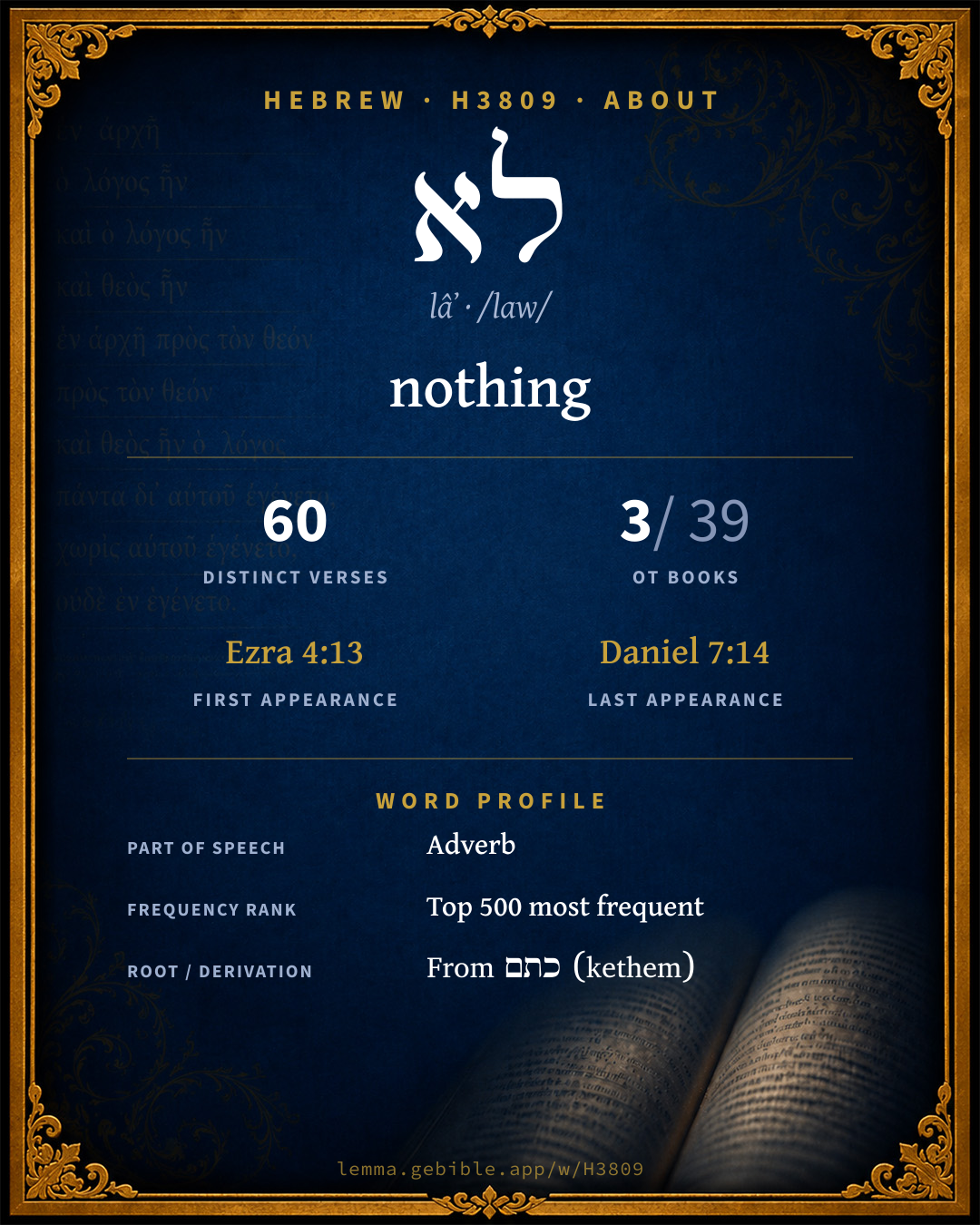
לָא
nothing
Full lexicon entry — Brown-Driver-Briggs (BDB)
From Brown-Driver-Briggs (BDB)
Where this word appears
Grammar key — what these labels mean
Part of speech
- Particle
- A short function word — article, negation, interrogative, the sign of the direct object, and the like.
Every verse where H3809 appears — 60 distinct verses across 3 books. Click any verse to open its interlinear word-by-word view. Verse text shown in the World English Bible for context — . Each verse’s Hebrew form is shown with its reference; the English is not keyword-highlighted, since the data carries no word-level English alignment. Use “Compare translations” on any verse to read it across multiple English versions. This concordance covers the Hebrew Bible; Septuagint (Greek Old Testament) occurrences are not indexed here.
Ezra 12 verses
- Ezra 4:13 לָ֣א ptcl neg Be it known now to the king that if this city is built, and the walls finished, they will not pay tribute, custom, or toll, and in the end it will be hurtful to the kings.
- Ezra 4:14 לָ֥א ptcl neg Now because we eat the salt of the palace, and it is not appropriate for us to see the king's dishonor, therefore have we sent and informed the king;
- Ezra 4:16 לָ֥א ptcl neg We inform the king that, if this city be built, and the walls finished, by this means you shall have no portion beyond the River.
- Ezra 4:21 לָ֣א ptcl neg Make you now a decree to cause these men to cease, and that this city not be built, until a decree shall be made by me.
- Ezra 5:5 וְ/לָא conj + ptcl neg But the eye of their God was on the elders of the Jews, and they did not make them cease, until the matter should come to Darius, and then answer should be returned by letter concerning it.
- Ezra 5:16 וְ/לָ֥א conj + ptcl neg Then came the same Sheshbazzar, and laid the foundations of the house of God which is in Jerusalem: and since that time even until now has it been in building, and yet it is not completed.
- Ezra 6:8 לָ֥א ptcl neg Moreover I make a decree what you shall do to these elders of the Jews for the building of this house of God: that of the king's goods, even of the tribute beyond the River, expenses be given with all diligence to these men, that they be not hindered.
- Ezra 6:9 לָ֥א ptcl neg That which they have need of, both young bulls, and rams, and lambs, for burnt offerings to the God of heaven; [also] wheat, salt, wine, and oil, according to the word of the priests who are at Jerusalem, let it be given them day by day without fail;
- Ezra 7:22 לָ֥א ptcl neg to one hundred talents of silver, and to one hundred measures of wheat, and to one hundred baths of wine, and to one hundred baths of oil, and salt without prescribing how much.
- Ezra 7:24 לָ֥א ptcl neg Also we inform you, that touching any of the priests and Levites, the singers, porters, Nethinim, or servants of this house of God, it shall not be lawful to impose tribute, custom, or toll, on them.
- Ezra 7:25 לָ֦א ptcl neg You, Ezra, after the wisdom of your God who is in your hand, appoint magistrates and judges, who may judge all the people who are beyond the River, all such as know the laws of your God; and teach you him who doesn't know them.
- Ezra 7:26 לָא֩ ptcl neg Whoever will not do the law of your God, and the law of the king, let judgment be executed on him with all diligence, whether it be to death, or to banishment, or to confiscation of goods, or to imprisonment.
Jeremiah 1 verse
Daniel 47 verses
- Daniel 2:5 לָ֤א ptcl neg The king answered the Chaldeans, The thing is gone from me: if you don't make known to me the dream and the interpretation of it, you shall be cut in pieces, and your houses shall be made a dunghill.
- Daniel 2:9 לָ֨א ptcl neg But if you don't make known to me the dream, there is but one law for you; for you have prepared lying and corrupt words to speak before me, until the time be changed: therefore tell me the dream, and I shall know that you can show me the interpretation of it.
- Daniel 2:10 לָֽא לָ֣א ptcl neg ptcl neg The Chaldeans answered before the king, and said, There is not a man on the earth who can show the king's matter, because no king, lord, or ruler, has asked such a thing of any magician, or enchanter, or Chaldean.
- Daniel 2:11 לָ֣א לָ֥א ptcl neg ptcl neg It is a rare thing that the king requires, and there is no other who can show it before the king, except the gods, whose dwelling is not with flesh.
- Daniel 2:18 לָ֤א ptcl neg that they would desire mercies of the God of heaven concerning this secret; that Daniel and his companions should nor perish with the rest of the wise men of Babylon.
- Daniel 2:27 לָ֧א ptcl neg Daniel answered before the king, and said, The secret which the king has demanded can neither wise men, enchanters, magicians, nor soothsayers, show to the king;
- Daniel 2:30 לָ֤א ptcl neg But as for me, this secret is not revealed to me for any wisdom that I have more than any living, but to the intent that the interpretation may be made known to the king, and that you may know the thoughts of your heart.
- Daniel 2:34 לָ֣א ptcl neg You saw until a stone was cut out without hands, which struck the image on its feet that were of iron and clay, and broke them in pieces.
- Daniel 2:35 לָא ptcl neg Then was the iron, the clay, the brass, the silver, and the gold, broken in pieces together, and became like the chaff of the summer threshing floors; and the wind carried them away, so that no place was found for them: and the stone that struck the image became a great mountain, and filled the whole earth.
- Daniel 2:43 וְ/לָֽא לָ֥א conj + ptcl neg ptcl neg Whereas you saw the iron mixed with miry clay, they shall mingle themselves with the seed of men; but they shall not cling to one another, even as iron does not mingle with clay.
- Daniel 2:44 לָ֣א לָ֣א ptcl neg ptcl neg In the days of those kings shall the God of heaven set up a kingdom which shall never be destroyed, nor shall the sovereignty of it be left to another people; but it shall break in pieces and consume all these kingdoms, and it shall stand forever.
- Daniel 2:45 לָ֣א ptcl neg Because you saw that a stone was cut out of the mountain without hands, and that it broke in pieces the iron, the brass, the clay, the silver, and the gold; the great God has made known to the king what shall happen hereafter: and the dream is certain, and the interpretation of it sure.
- Daniel 3:6 לָ֥א ptcl neg and whoever doesn't fall down and worships shall the same hour be cast into the midst of a burning fiery furnace.
- Daniel 3:11 לָ֥א ptcl neg and whoever doesn't fall down and worship shall be cast into the midst of a burning fiery furnace.
- Daniel 3:12 לָא לָ֣א לָ֥א ptcl neg ptcl neg ptcl neg There are certain Jews whom you have appointed over the affairs of the province of Babylon: Shadrach, Meshach, and Abednego; these men, O king, have not regarded you: they don't serve your gods, nor worship the golden image which you have set up.
- Daniel 3:14 לָ֤א לָ֥א ptcl neg ptcl neg Nebuchadnezzar answered them, Is it on purpose, Shadrach, Meshach, and Abednego, that you don't serve my god, nor worship the golden image which I have set up?
- Daniel 3:15 לָ֣א ptcl neg Now if you are ready whenever you hear the sound of the horn, flute, zither, lyre, harp, pipe, and all kinds of music to you fall down and worship the image which I have made, [well]: but if you don't worship, you shall be cast the same hour into the midst of a burning fiery furnace; and who is that god that shall deliver you out of my hands?
- Daniel 3:16 לָֽא ptcl neg Shadrach, Meshach, and Abednego answered the king, Nebuchadnezzar, we have no need to answer you in this matter.
- Daniel 3:18 לָ֔א לָא לָ֥א ptcl neg ptcl neg ptcl neg But if not, be it known to you, O king, that we will not serve your gods, nor worship the golden image which you have set up.
- Daniel 3:24 הֲ/לָא֩ ptcl inter + ptcl neg Then Nebuchadnezzar the king was astonished, and rose up in haste: he spoke and said to his counselors, Didn't we cast three men bound into the midst of the fire? They answered the king, True, O king.
- Daniel 3:25 לָא ptcl neg He answered, Look, I see four men loose, walking in the midst of the fire, and they have no hurt; and the aspect of the fourth is like a son of the gods.
- Daniel 3:27 לָֽא לָ֣א לָ֣א לָ֥א ptcl neg ptcl neg ptcl neg ptcl neg The satraps, the deputies, and the governors, and the king's counselors, being gathered together, saw these men, that the fire had no power on their bodies, nor was the hair of their head singed, neither were their pants changed, nor had the smell of fire passed on them.
- Daniel 3:28 לָֽא וְ/לָֽא ptcl neg conj + ptcl neg Nebuchadnezzar spoke and said, Blessed be the God of Shadrach, Meshach, and Abednego, who has sent his angel, and delivered his servants who trusted in him, and have changed the king's word, and have yielded their bodies, that they might not serve nor worship any god, except their own God.
- Daniel 3:29 לָ֤א ptcl neg Therefore I make a decree, that every people, nation, and language, which speak anything evil against the God of Shadrach, Meshach, and Abednego, shall be cut in pieces, and their houses shall be made a dunghill; because there is no other god who is able to deliver after this sort.
- Daniel 4:7 לָא ptcl neg Then came in the magicians, the enchanters, the Chaldeans, and the soothsayers; and I told the dream before them; but they did not make known to me the interpretation of it.
- Daniel 4:9 לָא ptcl neg Belteshazzar, master of the magicians, because I know that the spirit of the holy gods is in you, and no secret troubles you, tell me the visions of my dream that I have seen, and the interpretation of it.
- Daniel 4:18 לָֽא ptcl neg This dream I, king Nebuchadnezzar, have seen; and you, Belteshazzar, declare the interpretation, because all the wise men of my kingdom are not able to make known to me the interpretation; but you are able; for the spirit of the holy gods is in you.
- Daniel 4:30 הֲ/לָ֥א ptcl inter + ptcl neg The king spoke and said, Is not this great Babylon, which I have built for the royal dwelling-place, by the might of my power and for the glory of my majesty?
- Daniel 4:35 כְּ/לָ֣ה וְ/לָ֤א prep + ptcl neg conj + ptcl neg All the inhabitants of the earth are reputed as nothing; and he does according to his will in the army of heaven, and among the inhabitants of the earth; and none can stay his hand, or tell him, What do you?
- Daniel 5:8 וְ/לָֽא conj + ptcl neg Then came in all the king's wise men; but they could not read the writing, nor make known to the king the interpretation.
- Daniel 5:15 וְ/לָֽא conj + ptcl neg Now the wise men, the enchanters, have been brought in before me, that they should read this writing, and make known to me the interpretation of it; but they could not show the interpretation of the thing.
- Daniel 5:22 לָ֥א ptcl neg You his son, Belshazzar, have not humbled your heart, though you knew all this,
- Daniel 5:23 לָֽא וְ/לָא וְ/לָ֥א לָ֥א ptcl neg conj + ptcl neg conj + ptcl neg ptcl neg but have lifted up yourself against the Lord of heaven; and they have brought the vessels of his house before you, and you and your lords, your wives and your concubines, have drunk wine from them; and you have praised the gods of silver and gold, of brass, iron, wood, and stone, which don't see, nor hear, nor know; and the God in whose hand your breath is, and whose are all your ways, you have not glorified.
- Daniel 6:2 לָֽא ptcl neg and over them three presidents, of whom Daniel was one; that these satraps might give account to them, and that the king should have no damage.
- Daniel 6:4 לָא לָ֥א ptcl neg ptcl neg Then the presidents and the satraps sought to find occasion against Daniel as touching the kingdom; but they could find no occasion nor fault, because he was faithful, neither was there any error or fault found in him.
- Daniel 6:5 לָ֧א ptcl neg Then said these men, We shall not find any occasion against this Daniel, except we find it against him concerning the law of his God.
- Daniel 6:8 לָ֧א לָ֥א ptcl neg ptcl neg Now, O king, establish the interdict, and sign the writing, that it not be changed, according to the law of the Medes and Persians, which doesn't alter.
- Daniel 6:12 הֲ/לָ֧א לָ֥א ptcl inter + ptcl neg ptcl neg Then they came near, and spoke before the king concerning the king's interdict: Haven't you signed an interdict, that every man who shall make petition to any god or man within thirty days, save to you, O king, shall be cast into the den of lions? The king answered, The thing is true, according to the law of the Medes and Persians, which doesn't alter.
- Daniel 6:13 לָא ptcl neg Then answered they and said before the king, That Daniel, who is of the children of the captivity of Judah, doesn't regard you, O king, nor the interdict that you have signed, but makes his petition three times a day.
- Daniel 6:15 לָ֥א ptcl neg Then these men assembled together to the king, and said to the king, Know, O king, that it is a law of the Medes and Persians, that no interdict nor statute which the king establishes may be changed.
- Daniel 6:17 לָא ptcl neg A stone was brought, and laid on the mouth of the den; and the king sealed it with his own signet, and with the signet of his lords; that nothing might be changed concerning Daniel.
- Daniel 6:18 לָא ptcl neg Then the king went to his palace, and passed the night fasting; neither were instruments of music brought before him: and his sleep fled from him.
- Daniel 6:22 וְ/לָ֣א לָ֥א conj + ptcl neg ptcl neg My God has sent his angel, and has shut the lions' mouths, and they have not hurt me; because as before him innocence was found in me; and also before you, O king, have I done no hurt.
- Daniel 6:23 לָא ptcl neg Then was the king exceeding glad, and commanded that they should take Daniel up out of the den. So Daniel was taken up out of the den, and no manner of hurt was found on him, because he had trusted in his God.
- Daniel 6:24 וְ/לָֽא conj + ptcl neg The king commanded, and they brought those men who had accused Daniel, and they cast them into the den of lions, them, their children, and their wives; and the lions had the mastery of them, and broke all their bones in pieces, before they came to the bottom of the den.
- Daniel 6:26 לָ֣א ptcl neg I make a decree, that in all the dominion of my kingdom men tremble and fear before the God of Daniel; for he is the living God, and steadfast forever, His kingdom that which shall not be destroyed; and his dominion shall be even to the end.
- Daniel 7:14 לָ֣א לָ֥א ptcl neg ptcl neg There was given him dominion, and glory, and a kingdom, that all the peoples, nations, and languages should serve him: his dominion is an everlasting dominion, which shall not pass away, and his kingdom that which shall not be destroyed.
About this entry
At a glance — auto-summarized from this page’s data, not written by a person. Every figure links to its source below. This summary describes the numbers; it doesn’t interpret them.
At its core, לא (lâʼ) means “nothing.” The word gravitates to Daniel (78%), then Ezra and Jeremiah. It turns up in 60 verses across 3 books, a moderately common footprint. It first appears in Ezra 4:13. Translators differ — “not” in the King James Version, then “no” (Berean Standard Bible), as the renderings breakdown shows. Dig into 60-verse concordance and the renderings breakdown below.
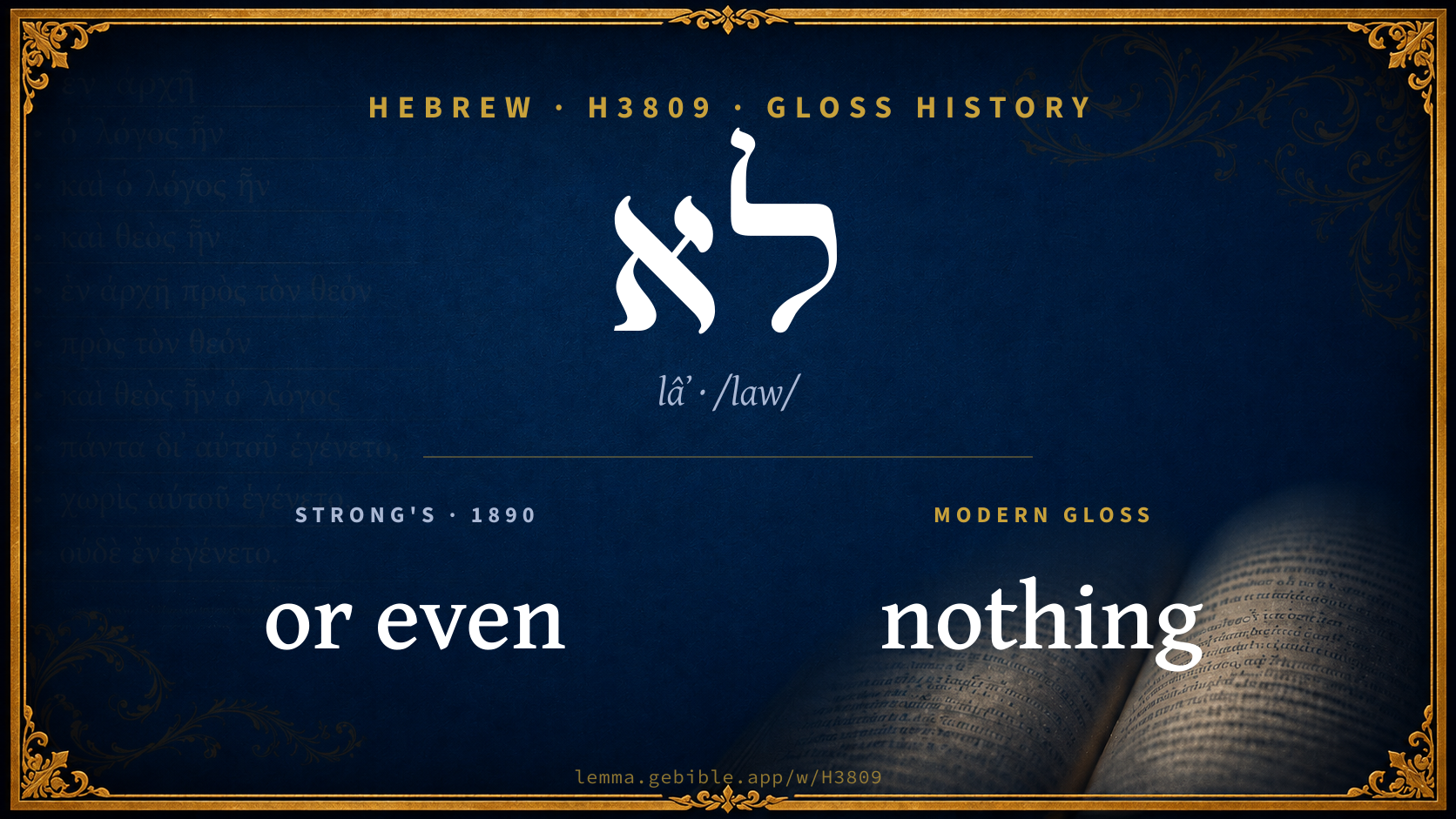
Gloss history
Strong's 1890 vs modern scholarship
About this word
Strong's H3809 catalogs a Hebrew word from the Hebrew Old Testament.
These counts are not copied from any lexicon or concordance. They are computed here, from the morphology-tagged Hebrew Old Testament. What Lemma adds →
- 60
- distinct verses
- The word appears in 60 distinct verses.
- 3 / 39
- OT books
- The word appears in 3 of 39 Old Testament books.
- #487
- by frequency
- Top 500 most frequent Hebrew words (rank 487 of 8,640 Hebrew words by occurrence).
View all 60 occurrences in the concordance →
By section of the Old Testament
By traditional corpus
Conventional, traditional groupings — biblical authorship is debated, so this is a traditional corpus grouping, not an authorship claim. Each share is this word’s portion of its verses in that division of the Hebrew canon. Each figure is a share of the word’s 60 distinct verses.
- Writings (Ketuvim) 59 verses · 98%
- Prophets (Nevi'im) 1 verse · 2%
How translations render this word
Counts come from each version’s own published word-to-Strong’s tagging or interlinear alignment — an approximate guide to how each version renders this word, not a word-level alignment the data otherwise carries. Because each total is that version’s own tagged count, the per-version totals vary from one another and need not match the appearance or distinct-verse counts above. These counts may also differ from a printed concordance because Lemma counts each distinctly tagged rendering and does not collapse phrase taggings into a single head-word total. This is a fixed set of word-tagged versions (KJV, ASV, BSB, ULT) and does not change with the reading translation you choose elsewhere. Each version’s license is shown beside its name below (and on Sources).
- King James Version: Not 17×, Nor 9×, No 7×
- American Standard Version: Not 17×, No 10×, Nor 10×
- Berean Standard Bible: No 12×, Not 10×, Cannot 4×
- unfoldingWord Literal Text: Not 55×, No 19×, But 4×
King James Version Public Domain
Renders H3809 across 79 tagged occurrences — most commonly:
Plus 19 renderings that appear only once — usually multi-word phrases or single function words the recovered tagging swept in, not distinct renderings. Not rendered by a distinct English word in 3 further occurrences.
American Standard Version Public Domain
Renders H3809 across 78 tagged occurrences — most commonly:
Plus 17 renderings that appear only once — usually multi-word phrases or single function words the recovered tagging swept in, not distinct renderings.
Berean Standard Bible Public Domain
Renders H3809 across 71 tagged occurrences — most commonly:
Plus 27 renderings that appear only once — usually multi-word phrases or single function words the recovered tagging swept in, not distinct renderings. Not rendered by a distinct English word in 10 further occurrences.
unfoldingWord Literal Text CC BY-SA 4.0
Renders H3809 across 92 tagged occurrences — most commonly:
Plus 7 renderings that appear only once — usually multi-word phrases or single function words the recovered tagging swept in, not distinct renderings.
Senses in BDB
The 1 sense BDB distinguishes for this word, in lexicon order (not ranked by frequency or importance). The full entry — with sub-senses — is in the Lexicon Entry tab.
- no, not, nothing
Word origin
Derived from כתם (kethem) (H3800) — gold.
Jastrow Dictionary
A second Hebrew/Aramaic lexicon for comparison, covering Aramaic and post-biblical (Talmudic, Targumic, Midrashic) usage that the biblical-Hebrew BDB does not. Matched by lemma rather than by Strong’s number, so a lemma may carry more than one Jastrow headword (shown separately below), and the entries cover usage well beyond the Bible.
לֹא
- v. לַאי) not, no. Ber. I, 1 לא קרינו וכ׳ we have omitted to recite &c. Ib. III, 4 לא … ולא וכ׳ neither before nor after. Nidd. 5ᵃ לא אין להן וכ׳, no; it means &c., v. לַאו; a. v. fr.—וְלֹא indeed not? Ḥull. 4ᵇ ולא והכתיב וכ׳ indeed not (is it so that the verb הֵסִית never refers to persuasion by speech)? Do we not read &c.?; a. v. fr.—(מִצְוַת) לֹא תַעֲשֶׂה a prohibitory law, opp. עֲשֵׂה, a positive command; v. לַאו. Kidd. I, 7. Macc. 14ᵇ bot.; a. v. fr.—בְּלֹא without. Ber. 35ᵃ bot. ב׳ ברכה without pronouncing a benediction; a. v. fr.—והוא שלא, v. הוּא.
לָא I
- Targ. Gen. II, 5; a. v. fr.—Pes. 10ᵇ מקמיה … אין בתר … לא before the time when it is forbidden, yes (he must search after leavened bread); after the time, no (he must not search). Ib. לא שנא there is no difference; a. v. fr.
לָא II
- (preced. wds.) particle, mote. Yoma 20ᵇ, v. חִרְגָּא. Midr. Till. to Ps. LXVIII, 3 כלא חשיבי they are like a mote.
לָא III
- La, abbrev. of אִילָא, הִילָא; v. Fr. M’bo, p. 75ᵇ.
A Dictionary of the Targumim, the Talmud Babli and Yerushalmi, and the Midrashic Literature (Marcus Jastrow; London, Luzac, 1903) — Public Domain. Digitized via Sefaria. Digitized via Sefaria. Full attribution on Sources.
Forms in the corpus
The 19 distinct written forms H3809 takes in the Hebrew Bible, most frequent first — each parse links to that state’s occurrences in the concordance. Hebrew forms include their vowel points and cantillation, so a single lemma takes many written forms.
| Form | Parsing | Example | Uses |
|---|---|---|---|
| לָ֥א | Particle, Negative | Daniel 2:11 | 22 |
| לָ֣א | Particle, Negative | Daniel 2:10 | 15 |
| לָא | Particle, Negative | Daniel 2:35 | 11 |
| לָֽא | Particle, Negative | Daniel 2:10 | 7 |
| וְ/לָֽא | Particle, Negative | Daniel 2:43 | 5 |
| לָ֤א | Particle, Negative | Daniel 2:5 | 5 |
| לָ֧א | Particle, Negative | Daniel 2:27 | 3 |
| וְ/לָ֥א | Particle, Negative | Daniel 5:23 | 2 |
| וְ/לָא | Particle, Negative | Daniel 5:23 | 2 |
| הֲ/לָ֥א | Particle, Negative | Daniel 4:30 | 1 |
| הֲ/לָ֧א | Particle, Negative | Daniel 6:12 | 1 |
| הֲ/לָא֩ | Particle, Negative | Daniel 3:24 | 1 |
| וְ/לָ֣א | Particle, Negative | Daniel 6:22 | 1 |
| וְ/לָ֤א | Particle, Negative | Daniel 4:35 | 1 |
| כְּ/לָ֣ה | Particle, Negative | Daniel 4:35 | 1 |
| לָ֔א | Particle, Negative | Daniel 3:18 | 1 |
| לָ֦א | Particle, Negative | Ezra 7:25 | 1 |
| לָ֨א | Particle, Negative | Daniel 2:9 | 1 |
| לָא֩ | Particle, Negative | Ezra 7:26 | 1 |
Septuagint verse parallels
This word appears in 56 verses that also exist in the Greek Old Testament (Septuagint), out of the 60 Hebrew verses it occurs in. You can read those verses in Greek by switching the Old Testament edition to the Septuagint.
Read these verses in the Septuagint
This is a verse-level parallel only — the same verses exist in both the Hebrew and Greek Old Testaments. No word-level Hebrew↔Greek correspondence is claimed: the data carries no such alignment, so no Greek word is shown as this Hebrew word’s translation. Coverage is not total — the Septuagint omits the deuterocanon and renumbers the Psalms, so some Hebrew verses have no direct Greek parallel.