
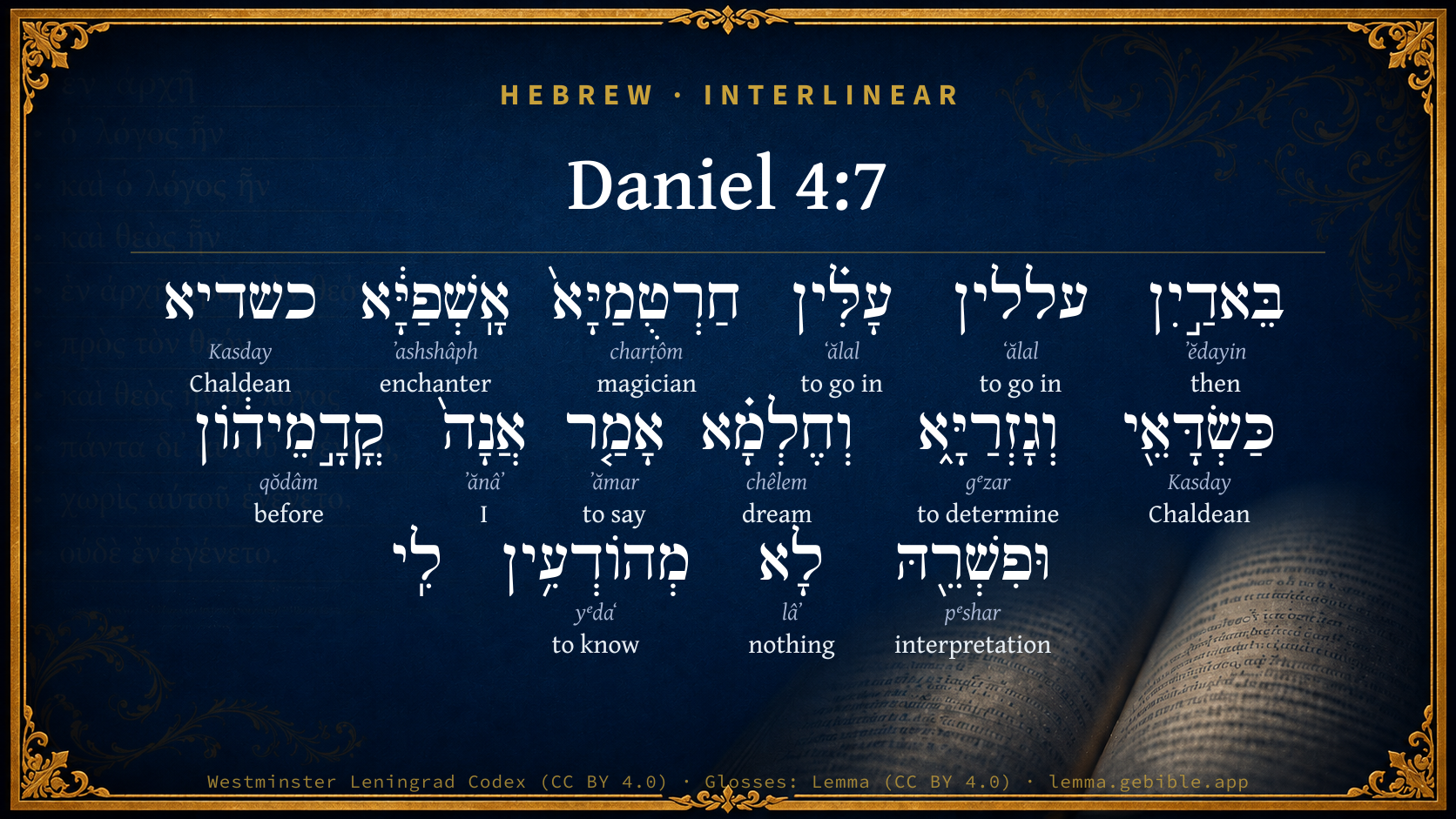
Daniel 4:7

Hebrew (Westminster Leningrad Codex) Daniel 4:7 appears in the Hebrew Old Testament. The text above is from the Westminster Leningrad Codex. Each word links to its Strong’s number, a concise gloss, and parsing drawn from the Open Scriptures Hebrew Bible morphology. Click any word for its full Brown-Driver-Briggs (BDB) entry.
Download image
Cite this verse

Daniel 4:7 (World English Bible). Public Domain. Lemma interlinear Bible study tool, https://lemma.gebible.app/v/daniel/4/7.

Show BibTeX & RIS
BibTeX
RIS
English Translation
Then came in the magicians, the enchanters, the Chaldeans, and the soothsayers; and I told the dream before them; but they did not make known to me the interpretation of it.
World English Bible · Public Domain
Download a study sheet

One document with this verse’s original text, its word-by-word gloss line, the meaning frame, cross-references with their text, attributed commentary, and full source and license credits — printable, and it pastes into notes with its structure intact.

This verse Autodidact and up

Study sheet (.html) Plain text (.txt)

A passage Seminary Student

Up to 50 verses in one chapter. A passage sheet keeps up to 6 commentary sources and 12 cross-references per verse, in the order this page ranks them, and says so on the sheet whenever that leaves anything out. Ask for a single verse and you get the Autodidact verse sheet above.

Everything on this page stays free to read, with no account — the sheet is a download of what is already on screen, not access to it.

Want to remove ads? Support Godless Engineer
Compare translations 3

The same verse in 3 English versions, stacked beneath the original-language interlinear above. Click any original word for its lexicon entry.

Each is an independent rendering of the whole verse — the interlinear is not word-aligned to these translations.

Highlighted words mark where these versions differ — a whole-verse word diff, not a word-by-word alignment.

  • World English Bible Public Domain
    Then came in the magicians, the enchanters, the Chaldeans, and the soothsayers; and I told the dream before them; but they did not make known to me the interpretation of it.
  • King James Version Public Domain
    Then came in the magicians, the astrologers, the Chaldeans, and the soothsayers: and I told the dream before them; but they did not make known unto me the interpretation thereof.
  • unfoldingWord Literal Text CC BY-SA 4.0
    Then the magicians, the enchanters, the Chaldeans, and the astrologers came in, and I told them the dream, but they could not make known to me its interpretation.

unfoldingWord Literal Text — © unfoldingWord, licensed CC BY-SA 4.0. Word-aligned USFM3 via Door43 (git.door43.org/unfoldingWord/en_ult).

Versions to compare (up to 4)

3 of 4 selected

Show all 18 translations

Every available English version of this verse, each an independent rendering of the whole verse.

  • World English Bible Public Domain
    Then came in the magicians, the enchanters, the Chaldeans, and the soothsayers; and I told the dream before them; but they did not make known to me the interpretation of it.
  • Berean Standard Bible Public Domain
    When the magicians, enchanters, astrologers, and diviners came in, I told them the dream, and they could not interpret it for me.
  • Majority Standard Bible Public Domain
    When the magicians, enchanters, astrologers, and diviners came in, I told them the dream, but they could not interpret it for me.
  • King James Version Public Domain
    Then came in the magicians, the astrologers, the Chaldeans, and the soothsayers: and I told the dream before them; but they did not make known unto me the interpretation thereof.
  • American Standard Version (1901) Public Domain
    Then came in the magicians, the enchanters, the Chaldeans, and the soothsayers; and I told the dream before them; but they did not make known unto me the interpretation thereof.
  • Revised Version (1885) Public Domain
    Then came in the magicians, the enchanters, the Chaldeans, and the soothsayers: and I told the dream before them; but they did not make known unto me the interpretation thereof.
  • Geneva Bible (1599) Public Domain
    Thus were the visions of mine head in my bed. And beholde, I sawe a tree in the middes of the earth and the height thereof was great:
  • Douay-Rheims (1899) Public Domain
    Then came in the diviners, the wise men, the Chaldeans, and the soothsayers, and I told the dream before them: but they did not shew me the interpretation thereof:
  • Young's Literal Translation Public Domain
    Then coming up are the scribes, the enchanters, the Chaldeans, and the soothsayers, and the dream I have told before them, and its interpretation they are not making known to me.
  • Literal Standard Version CC BY-SA 4.0
    Then coming up are the scribes, the enchanters, the Chaldeans, and the soothsayers, and the dream I have told before them, and its interpretation they are not making known to me.
  • Unlocked Literal Bible CC BY-SA 4.0
    Then came the magicians, those who claimed to speak with the dead, the wise men, and the astrologers. I told them the dream, but they could not interpret it for me.
  • unfoldingWord Literal Text CC BY-SA 4.0
    Then the magicians, the enchanters, the Chaldeans, and the astrologers came in, and I told them the dream, but they could not make known to me its interpretation.
  • Darby Bible Public Domain
    Then came in the scribes, the magicians, the Chaldeans, and the astrologers; and I told the dream before them; but they did not make known unto me the interpretation of it.
  • World Messianic Bible Public Domain
    Then the magicians, the enchanters, the Kasdim, and the soothsayers came in; and I told them the dream, but they didn’t make known to me its interpretation.
  • Webster's Bible Public Domain
    Then came in the magicians, the astrologers, the Chaldeans, and the sooth-sayers: and I told the dream before them; but they did not make known to me the interpretation of it.
  • Free Bible Version CC BY-SA 4.0
    When the magicians, enchanters, astrologers, and diviners came in I told them the dream, but they couldn't explain to me what it meant.
  • Bible in Basic English Public Domain
    Then the wonder-workers, the users of secret arts, the Chaldaeans, and the readers of signs came in to me: and I put the dream before them but they did not make clear the sense of it to me.
  • JPS Tanakh (1917) Public Domain
    (4-4) Then came in the magicians, the enchanters, the Chaldeans, and the astrologers; and I told the dream before them; but they did not make known unto me the interpretation thereof.

Literal Standard Version (2020), Covenant Press — licensed CC BY-SA 4.0. Text via the HelloAO Bible API (eBible.org). Unlocked Literal Bible (unfoldingWord) — licensed CC BY-SA 4.0. Text via the HelloAO Bible API (eBible.org). unfoldingWord Literal Text — © unfoldingWord, licensed CC BY-SA 4.0. Word-aligned USFM3 via Door43 (git.door43.org/unfoldingWord/en_ult). Free Bible Version, Dr. Jonathan Gallagher — licensed CC BY-SA 4.0. Text via the HelloAO Bible API (eBible.org).

Word by word

More ways to search: Search by grammar → Find every occurrence → Compare this word →

Practice this passage: Drill this verse → Learn its vocabulary →

חַרְטֻמַיָּא֙
charṭôm
H2749
“magicians · the”
Adjective, N, Common + Particle, Definite Article
Part of Speech
Adjective + Particle
Type
Definite Article
Full BDB Definition

Origin: the same as H2748

TWOT: 2742

magician, magician-astrologer
  1. בֵּאדַ֣יִן ʼĕdayin H116 “in/at · then” Adjective, R + Adverb
  2. עללין ʻălal H5954 “going in” Adjective, V
  3. עָלִּ֗ין ʻălal H5954 “going in” Adjective, V
  4. אָֽשְׁפַיָּ֔א ʼashshâph H826 “enchanters · the” Adjective, N, Common + Particle, Definite Article
  5. כשדיא Kasday H3779 “Chaldeans · the” Adjective, N + Particle, Definite Article
  6. כַּשְׂדָּאֵ֖י Kasday H3779 “Chaldean · my” Adjective, N + Suffix, Personal, 1st Person, Common, Singular
  7. וְגָזְרַיָּ֑א gᵉzar H1505 “and · determining · the” Adjective, C + Verb, Qal, Participle Active, Masculine, Plural, Determined + Particle, Definite Article
  8. וְחֶלְמָ֗א chêlem H2493 “and · dream · the” Adjective, C + Noun, Common, Masculine, Singular, Determined + Particle, Definite Article
  9. אָמַ֤ר ʼămar H560 “saying” Adjective, V
  10. אֲנָה֙ ʼănâʼ H576 “I” Adjective, P, Construct
  11. קֳדָ֣מֵיה֔וֹן qŏdâm H6925 “before · them” Adjective, R + Suffix, Personal, 3rd Person, Masculine, Plural
  12. וּפִשְׁרֵ֖הּ pᵉshar H6591 “and · interpretation · his” Adjective, C + Noun, Common, Masculine, Singular, Construct + Suffix, Personal, 3rd Person, Masculine, Singular
  13. לָא lâʼ H3809 “nothing” Adjective, T
  14. מְהוֹדְעִ֥ין yᵉdaʻ H3046 “knowing” Adjective, V

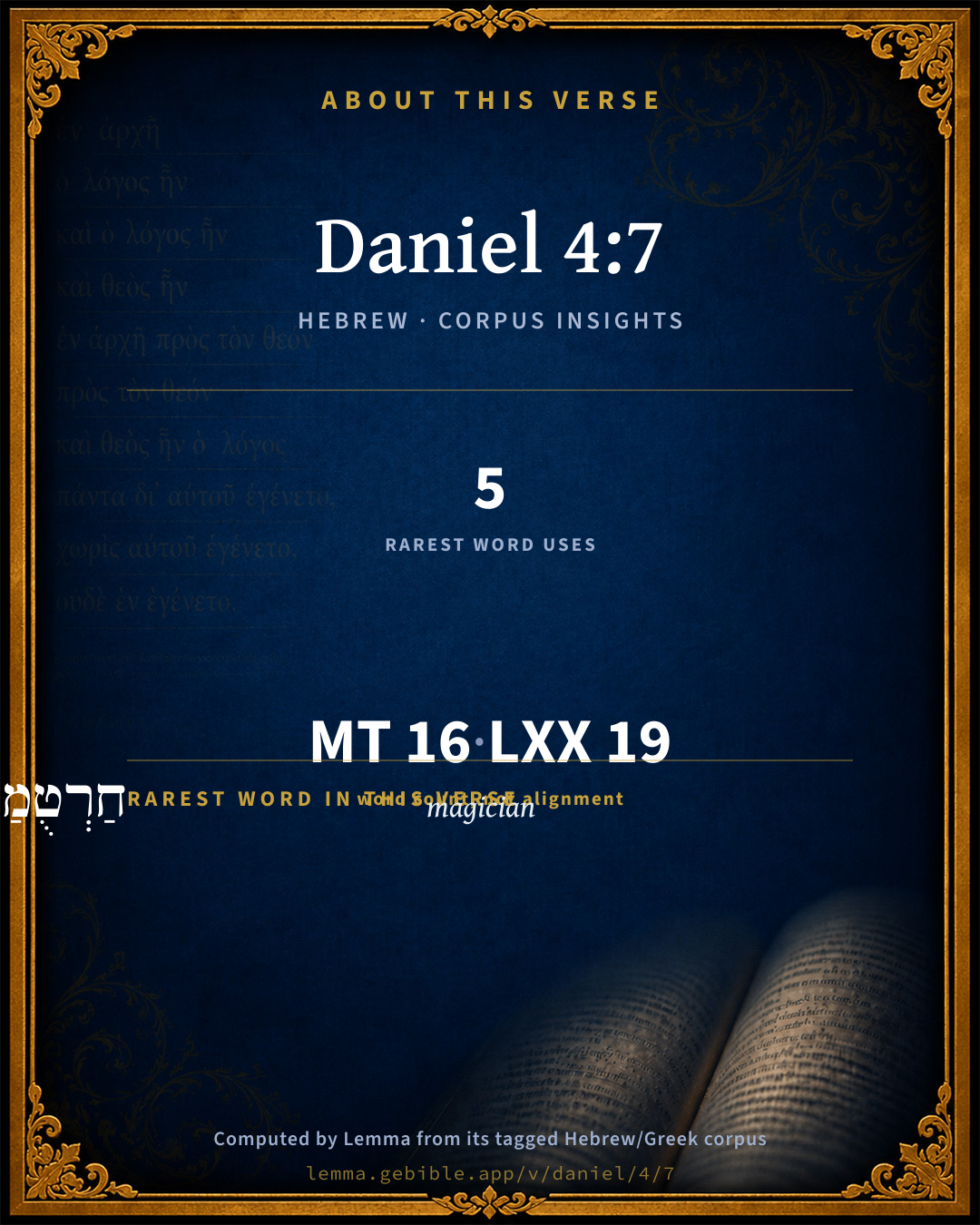
About this verse

These counts appear in no published source. They are computed here, from the morphology-tagged text and Lemma’s own curated glosses. What Lemma adds →

16
words
13
distinct lemmas
Prophets
section

Notable vocabulary

The rarest word here is חַרְטֻמַיָּא֙ magician H2749 — appearing just 5 times in the whole Hebrew Bible.

Shared distinctive vocabulary

חַרְטֻמַיָּא֙ magician H2749 occurs in 5 verses of the Hebrew Bible. Also found in:

Grammatical profile

  • 1 noun
  • 9 adjectives
  • 1 adverb
  • 5 particles

Verb forms

  • וְגָזְרַיָּ֑א Qal · Participle Active

Repetition

Words recur within this verse — often emphatic in Hebrew:

  • עללין to go in H5954 ×2
  • כשדיא Chaldean H3779 ×2

Hebrew & Septuagint length

In English translation the verse runs 31 words from the Hebrew and 22 from the Septuagint (LXX English) — the Septuagint runs noticeably shorter here. See the side-by-side →

A rough comparison of the two English renderings, which tokenize alike — not a word-level alignment.

Word counts can differ between the Hebrew and the Greek without any difference in meaning — e.g. the Hebrew direct-object marker אֵת has no separate Greek word, and Greek often adds the article ὁ.

In the original languages it is 16 Hebrew tokens and 19 Greek tokens — but the two are counted differently (Hebrew bundles its prefixes and suffixes into one token; the Greek is in lemma form), so that isn’t a like-for-like length.

Cross-references

8

Topical passages linked to Daniel 4:7 in the Treasury of Scripture Knowledge — connected by theme and wording, ordered by reader-vote popularity; previews shown in the World English Bible.

  • Isaiah 44:25 who frustrates the signs of the liars, and makes diviners mad; who turns wise men backward, and makes their knowledge foolish;
  • Daniel 2:7 They answered the second time and said, Let the king tell his servants the dream, and we will show the interpretation.
  • Genesis 41:8 It happened in the morning that his spirit was troubled, and he sent and called for all the magicians of Egypt, and all the wise men of it. Pharaoh told them his dream, but there was no one who could interpret them to Pharaoh.
  • Jeremiah 27:9–10 But as for you, don't you listen to your prophets, nor to your diviners, nor to your dreams, nor to your soothsayers, nor to your sorcerers, who speak to you, saying, You shall not serve the king of Babylon:
  • Daniel 2:1–2 In the second year of the reign of Nebuchadnezzar, Nebuchadnezzar dreamed dreams; and his spirit was troubled, and his sleep went from him.
  • Daniel 2:10 The Chaldeans answered before the king, and said, There is not a man on the earth who can show the king's matter, because no king, lord, or ruler, has asked such a thing of any magician, or enchanter, or Chaldean.
  • Daniel 2:27 Daniel answered before the king, and said, The secret which the king has demanded can neither wise men, enchanters, magicians, nor soothsayers, show to the king;
  • 2 Timothy 3:8–9 Even as Jannes and Jambres opposed Moses, so do these also oppose the truth; men corrupted in mind, reprobate concerning the faith.

Cross-references courtesy of OpenBible.info (CC BY 4.0).

Hebrew and Greek witnesses Masoretic Hebrew ↔ Greek Septuagint

The same verse in the two great witnesses to the Old Testament, shown verse-for-verse.

Here the Septuagint runs noticeably shorter than the Hebrew — LXX2012 (modern English Septuagint) 22 words vs World English Bible 31. A rough length comparison of the two English translations, not a word-level alignment — read both below.

These are two independent witnesses, not word-aligned to each other, and the Septuagint is shown in lemma (dictionary) form.

Hebrew Daniel 4:7 Masoretic · Westminster Leningrad Codex

בֵּאדַ֣יִן עללין עָלִּ֗ין חַרְטֻמַיָּא֙ אָֽשְׁפַיָּ֔א כשדיא כַּשְׂדָּאֵ֖י וְגָזְרַיָּ֑א וְחֶלְמָ֗א אָמַ֤ר אֲנָה֙ קֳדָ֣מֵיה֔וֹן וּפִשְׁרֵ֖הּ לָא מְהוֹדְעִ֥ין לִֽי

Then came in the magicians, the enchanters, the Chaldeans, and the soothsayers; and I told the dream before them; but they did not make known to me the interpretation of it.

World English Bible · Public Domain

Greek LXX Daniel 4:7 Septuagint · lemma form

καί φωνέω καί εἶπον αὐτός ἐκκόπτω αὐτός καί καταφθείρω αὐτός προςτάσσω γάρ ἀπό ὁ ὕψιστος ἐκῥιζόω καί ἀχρειόω αὐτός

I had a vision upon my bed; and behold a tree in the midst of the earth, and its height was great.

LXX2012 (modern English Septuagint) · Public Domain

Hebrew: Westminster Leningrad Codex (CC BY 4.0). Greek: Septuagint (public domain); English from LXX2012 (modern English Septuagint) (Public Domain). How the Septuagint differs from the Hebrew →

Commentary

Notes on Daniel 4:7 from classic Christian and Jewish commentators (each source and its license shown beneath its notes). The classic Christian expositions comment on the surrounding passage and are grouped to its opening verse, so a note may address several verses; the Jewish commentaries on the Tanakh (Rashi and others) are per-verse, so they appear only where the commentator wrote on this verse.

Lemma curates 59 commentaries, every one of them public domain or Creative Commons licensed, each selected and text-cleaned for this edition rather than reprinted as found. About our sources →

Trapp's Complete Commentary

John Trapp

Dan 4:7 Then came in the magicians, the astrologers, the Chaldeans, and the soothsayers: and I told the dream before them; but they did not make known unto me the interpretation thereof.

Ver. 7. Then came in the magicians.] As if they would do the deed. Seducers make up with boldness what they want of true worth. {2Pe 2:19}

John Trapp, A Commentary or Exposition upon All the Books of the Old and New Testament (1647–1656) — public domain. Text from a community e-Sword module.

Tyndale Open Study Notes

Tyndale Open Resources

4:7 The professionals could not interpret the dream even though it was told to them this time (cp. 2:1-11). Their dream manuals failed them (see study note on 2:4). • astrologers: See also 2:5, 10; 3:8; 5:7, 11, 30.

Tyndale Open Study Notes — © Tyndale Open Resources, licensed CC BY-SA 4.0. Text via the HelloAO Bible API.

Ibn Ezra

Rabbi Abraham ibn Ezra

[Daniel 4:7] And the visions (וְחֶזְוֵ֥י)... a tree (אִילָ֛ן): [The Aramaic word ilan means] a tree (עֵץ - etz) from within the earth.

Ibn Ezra on the Tanakh — English translations: “Sefaria Community Translation” (CC0 1.0 (public-domain dedication)); “Yalkut, Sifsei Chachomim Chumash, Metsudah Publications, 2009” (CC BY 4.0); and “Commentary of Ibn Ezra on Isaiah - trans. by M. Friedlander, 1873” (public domain). Text via Sefaria.

Geneva Bible (1599)

Geneva Bible translators

By the tree is signified the dignity of a king whom God ordaineth to be a defense for all kind of men, and whose state is profitable for mankind.

Geneva Bible (1599) marginal notes — public domain. Text via Bolls.life.

John Calvin's Commentaries

With respect to the words used above, we have formerly freed ourselves from all trouble, because we cannot accurately define what science each professed. Clearly enough they covered their shamelessness by honorable titles, although they gave themselves up to every possible imposture. They called themselves by the usual name of learned men, when they were really unacquainted with any art or science, and deluded mankind by miserable predictions; hence, by these words, Daniel comprehended all the Magi, soothsayers, astrologers, and augurs, who professed the art of divination. Here Nebuchadnezzar confesses that he sent; for these men in vain. Hence it follows, this whole science was a fallacy, or, at, least, Daniel’s exposition of the dream was not by human skill, but by revelation from heaven. I embrace this opinion, since Nebuchadnezzar wished clearly to express that Daniel’s power of interpreting his dream did not spring from man, but was a singular gift of the Spirit. He had considered it a settled point that, if any knowledge or skill in divination existed, it must belong to the Magi, soothsayers, augurs, and other Chaldeans who boasted in the possession of perfect wisdom. This, therefore, was with. out controversy—that the astrologers and the rest were most powerful in divination, and as far as human faculties would allow, nothing escaped them. Hence it follows, on the other hand, that Daniel was divinely instructed, since if he had been only an astrologer or magician, he must, like others, have required a long’ apprenticeship to this science. Nebuchadnezzar, therefore, wishes here to extol Daniel beyond all the Magi, as if he had said—He is a heavenly Prophet! And this, also, will appear better from what is added, as follows:

John Calvin's Commentaries (1540-1563) — public domain. Text from the Calvin Translation Society English edition (1840s-50s) via the Christian Classics Ethereal Library (ccel.org). Calvin's coverage is partial (roughly two-thirds of the Bible); uncommented books and verses are honest gaps, never fabricated. The 19th-century editor's footnotes and remarks are omitted so the notes are faithfully Calvin's own voice.

The Cambridge Bible for Schools and Colleges

gen. ed. J. J. S. Perowne

7. the magicians, the enchanters, the Chaldeans, and the determiners (of fates)] see on Dan_1:21, Dan_2:2, and Dan_2:27.

The Cambridge Bible for Schools and Colleges (gen. ed. J. J. S. Perowne; Cambridge University Press, 1878–1918) — public domain. Text from a community e-Sword module.

John Gill's Exposition

Then came in the magicians, the astrologers, the Chaldeans, and the soothsayers,.... See Gill on Dan 2:2,

and I told the dream before them, but they did not make known unto me the interpretation thereof; because they could not; before they pretended, if the dream was told, they could give the interpretation of it; but now, though it was told, they could not do it; which shows the vanity of their art, the falsehood of their pretensions, and that they were but jugglers and impostors.

John Gill's Exposition of the Whole Bible (1746–1763) — public domain (CC PDM 1.0). Text via the HelloAO Bible API.

Albert Barnes' Notes on the Bible

Then came in the magicians ... - All the words occurring here are found in Dan 2:2, and are explained in the note at that verse, except the word rendered “soothsayers.” This occurs in Dan 2:27. See it explained in the note at that verse. All these words refer to the same general class of persons - those who were regarded as endued with eminent wisdom; who were supposed to be qualified to explain remarkable occurrences, to foretell the future, and to declare the will of heaven from portents and wonders. At a time when there was yet a limited revelation; when the boundaries of science were not determined with accuracy; when it was not certain but that some way might be ascertained of lifting the mysterious veil from the future, and when it was an open question whether that might not be by dreams or by communication with departed spirits, or by some undisclosed secrets of nature, it was not unnatural that persons should be found who claimed that this knowledge was under their control. Such claimants to preternatural knowledge are found indeed in every age; and though a large portion of them are undoubted deceivers, yet the existence of such an order of persons should be regarded as merely the exponent of the deep and earnest desire existing in the human bosom to penetrate the mysterious future; to find something that shall disclose to man, all whose great interests lie in the future, what is yet to be. Compare the remarks at the close of Dan. 2.

And I told the dream before them ... - In their presence. In this instance he did not lay on them so hard a requisition as he did on a former occasion, when he required them not only to interpret the dream, but to tell him what it was, Dan. 2. But their pretended power here was equally vain. Whether they attempted an interpretation of this dream does not appear; but if they did, it was wholly unsatisfactory to the king himself. It would seem more probable that they supposed that the dream might have some reference to the proud monarch himself, and that, as it indicated some awful calamity, they did not dare to hazard a conjecture in regard to its meaning.

Albert Barnes' Notes on the Bible (1834–1885) — public domain. Text from a community e-Sword/MySword module.

Haydock's Catholic Bible Commentary

Tree often denotes princes; (Ezechiel xxxi. 3.) and according to the false principles (Calmet) of those who pretend to explain dreams, always (Haydock) implies some great personage. (Achmet. C. 200.) (Grotius) --- But nothing is more vain than these pretensions. (Calmet)

George Leo Haydock (1774–1849), Haydock's Catholic Family Bible and Commentary, 1859 edition — public domain. Excludes Psalms (Douay-Rheims chapter numbering differs from Protestant) and Deuterocanonical books (Catholic canon only).

Matthew Poole's English Annotations

And yet this was it they stood upon before, that the king should tell the dream, and they would interpret it, which now they could not do: this shows them to be mere impostors, and that neither their natural skill nor diabolical help could unfold God’s secrets.

Matthew Poole's English Annotations on the Holy Bible (1683–1685) — public domain. Text from a community e-Sword/MySword module.

unfoldingWord translationNotes

Door43 World Missions Community

General Information:

In verses 1-18, Nebuchadnezzar describes in the first person his vision from God. (See: First, Second, or Third Person)

who is named Belteshazzar

This can be stated in active form. AT: "who I named Belteshazzar" (See: Active or Passive)

Belteshazzar

This was the name the Babylonians gave to Daniel. See how you translated this name in Daniel 1:7.

the spirit of the holy gods

Nebuchadnezzar believed that Daniel's power came from the false gods that Nebuchadnezzar worshiped.

no mystery is too difficult for you

The can be stated in positive form. AT: "you understand the meaning of every mystery"

translationWords

magic

die

wise

learned men

dream

interpret

Daniel

false god

spirit

holy

chief

mystery

unfoldingWord translationNotes — © Distant Shores Media and the Door43 World Missions Community, licensed CC BY-SA 4.0. Source: git.door43.org/Door43/en_tn.

Lesson kit

Teaching starters — assembled from the data on this page, not authored interpretation. Every prompt links to the verse data it draws on. Edit before teaching.

Daniel, in the Prophets, opens this verse with 16 words (13 distinct Hebrew lemmas). Its most distinctive word is charṭôm (“magician”). The Greek Septuagint runs shorter here. A historical commentator’s framing appears above. Read the whole chapter for the surrounding context.

Discussion questions

  1. How does “magician” (charṭôm) shape what this verse is saying?
  2. Daniel 2:10 shares the word «magician» with this verse. How do the two illuminate each other?
  3. “to go in” occurs 2× in this one verse. What is the effect of the repetition?
  4. Compared with the Hebrew, the Septuagint runs shorter here. What questions does that raise?
  5. The translations on this page render this verse differently — a whole-verse word diff, not a word-by-word alignment. What might account for the different wordings?
  6. The verb «וְגָזְרַיָּ֑א» is Qal Participle Active. How does its form color the action?
  7. Reading how Trapp's Complete Commentary and Tyndale Open Study Notes read this verse, where do the two commentators agree and where do they part?

Things to notice

Reading settings

Reading text

Shown beneath each verse's original-language words.

Old Testament
Old Testament edition

Read the OT as the Masoretic Hebrew (MT) or the Greek Septuagint (LXX).

English shown for the Greek Septuagint (in the Hebrew ↔ Greek comparison).

Comparing translations? Open the Compare panel on any verse page to stack up to four side by side.