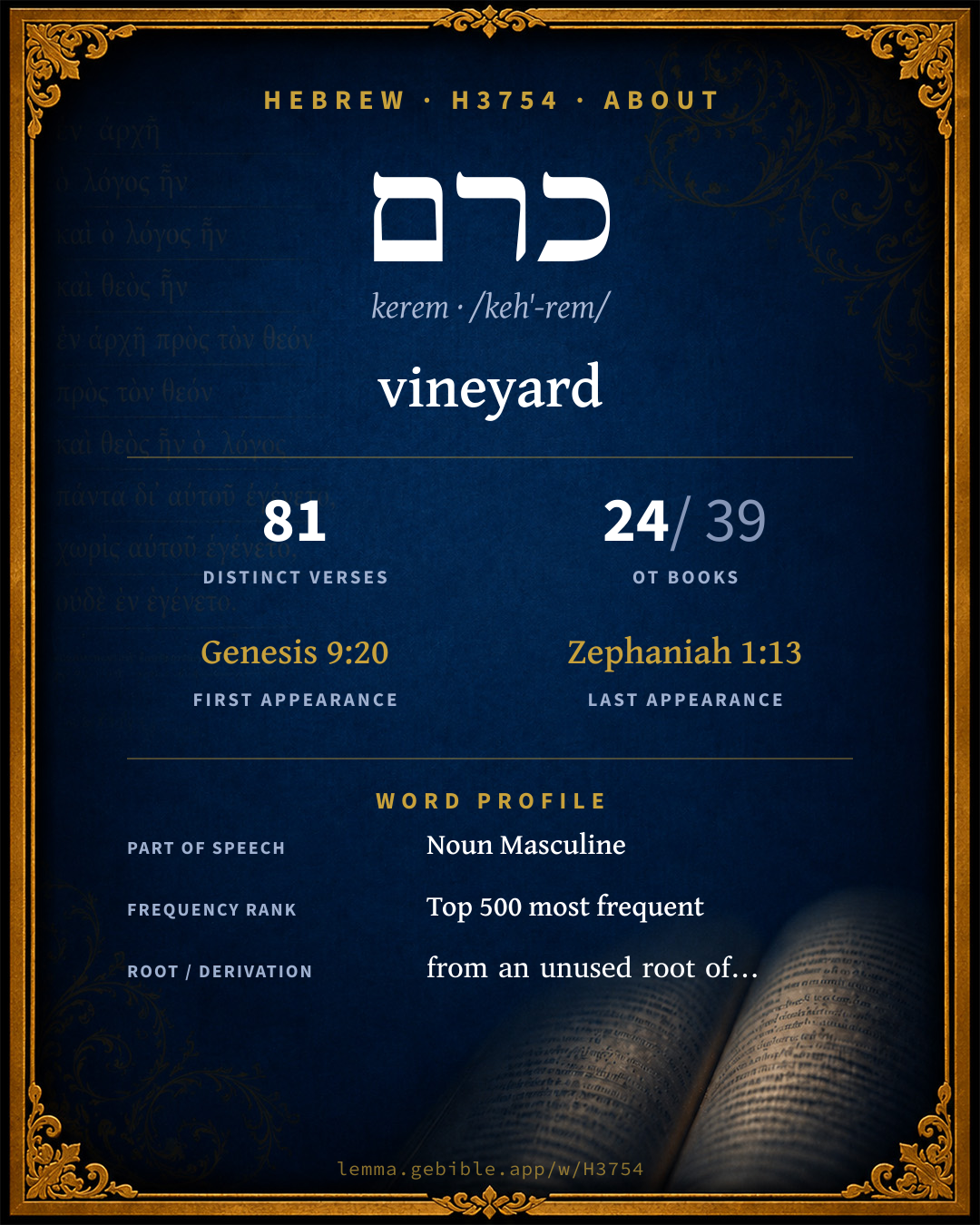
כֶּרֶם
vineyard
Full lexicon entry — Brown-Driver-Briggs (BDB)
From Brown-Driver-Briggs (BDB)
Where this word appears
See every Construct-state word in the Hebrew Bible →
Grammar key — what these labels mean
Part of speech
- Noun
- A naming word — a person, place, thing, or idea.
Noun type
- Common
- A common noun — a general class of person, place, or thing (“king,” “city,” “water”), not a specific name.
State
- Absolute
- The independent form of a noun, not bound to a following word.
- Construct
- A noun bound to a following noun in a possessive / “of” relationship (the construct chain).
Gender
- Both
- Attested as both masculine and feminine.
Number
- Plural
- More than one (in Hebrew, generally three or more).
- Singular
- One.
Every verse where H3754 appears in the Book of 1 Kings — 7 distinct verses. Click any verse to open its interlinear word-by-word view. Verse text shown in the World English Bible for context — . Each verse’s Hebrew form is shown with its reference; the English is not keyword-highlighted, since the data carries no word-level English alignment. Use “Compare translations” on any verse to read it across multiple English versions. This concordance covers the Hebrew Bible; Septuagint (Greek Old Testament) occurrences are not indexed here.
1 Kings
- 1 Kings 21:1 כֶּ֧רֶם n c bs It happened after these things, that Naboth the Jezreelite had a vineyard, which was in Jezreel, hard by the palace of Ahab king of Samaria.
- 1 Kings 21:2 כַּרְמְ/ךָ֜ כֶּ֖רֶם n c bs cs + sfx pers 2ms n c bs Ahab spoke to Naboth, saying, Give me your vineyard, that I may have it for a garden of herbs, because it is near to my house; and I will give you for it a better vineyard than it: or, if it seem good to you, I will give you the worth of it in money.
- 1 Kings 21:6 כַּרְמְ/ךָ֙ כֶ֖רֶם כַּרְמִֽ/י n c bs cs + sfx pers 2ms n c bs n c bs cs + sfx pers 1cs He said to her, Because I spoke to Naboth the Jezreelite, and said to him, Give me your vineyard for money; or else, if it please you, I will give you [another] vineyard for it: and he answered, I will not give you my vineyard.
- 1 Kings 21:7 כֶּ֖רֶם n c bs cs Jezebel his wife said to him, Do you now govern the kingdom of Israel? arise, and eat bread, and let your heart be merry: I will give you the vineyard of Naboth the Jezreelite.
- 1 Kings 21:15 כֶּ֣רֶם n c bs cs It happened, when Jezebel heard that Naboth was stoned, and was dead, that Jezebel said to Ahab, Arise, take possession of the vineyard of Naboth the Jezreelite, which he refused to give you for money; for Naboth is not alive, but dead.
- 1 Kings 21:16 כֶּ֛רֶם n c bs cs It happened, when Ahab heard that Naboth was dead, that Ahab rose up to go down to the vineyard of Naboth the Jezreelite, to take possession of it.
- 1 Kings 21:18 בְּ/כֶ֣רֶם prep + n c bs cs Arise, go down to meet Ahab king of Israel, who dwells in Samaria: behold, he is in the vineyard of Naboth, where he is gone down to take possession of it.
About this entry
At a glance — auto-summarized from this page’s data, not written by a person. Every figure links to its source below. This summary describes the numbers; it doesn’t interpret them.
כרם — transliterated kerem — is a Hebrew noun carrying the sense “vineyard.” Debuting at Genesis 9:20, it then recurs through the corpus. With 81 verses in 24 books, it is a moderately common word in the Hebrew Bible. Sharing its root, it stands alongside כרם, כרמל and כרמי. Each statement above links to its evidence; the full detail follows below.
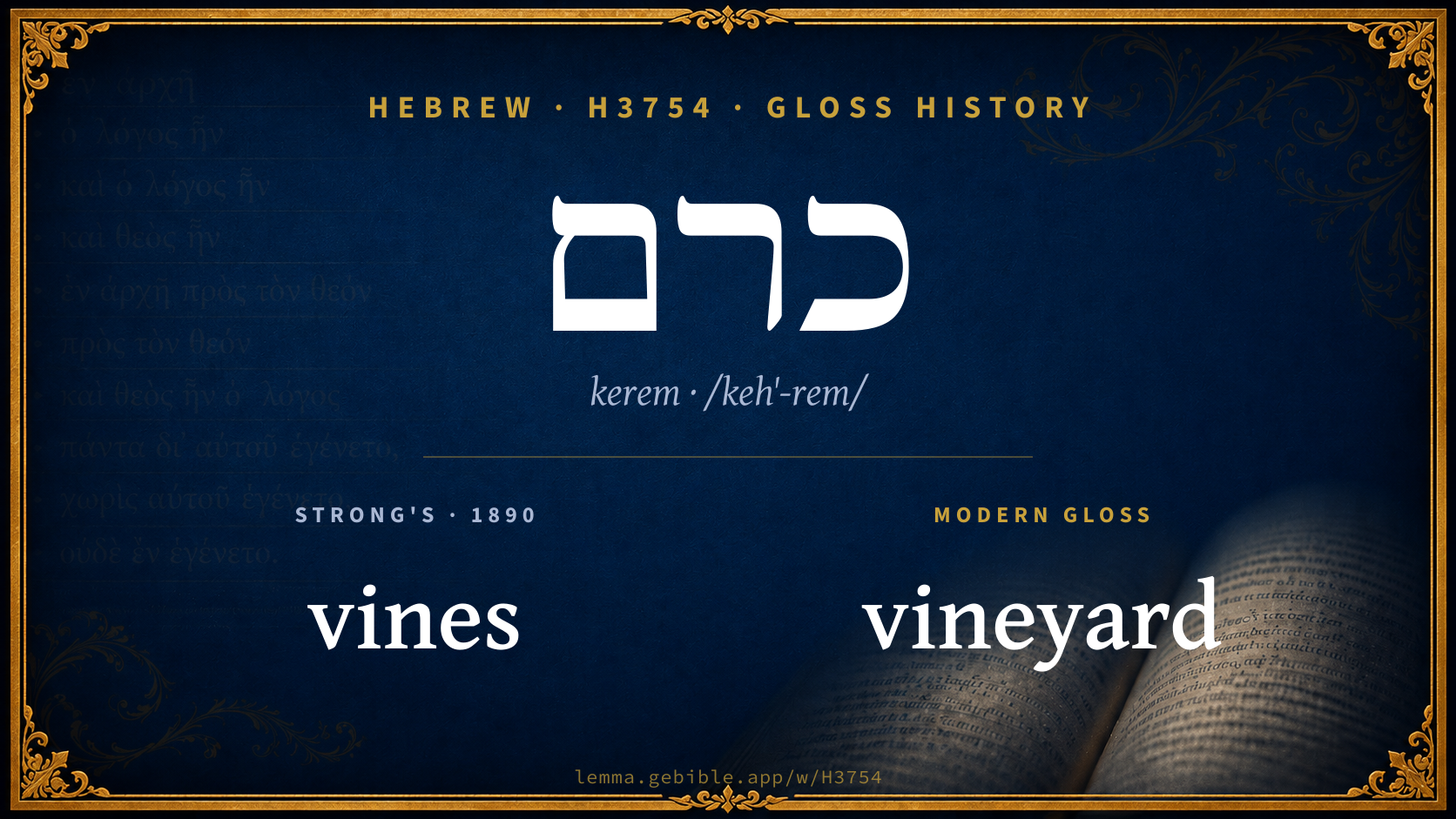
Gloss history
Strong's 1890 vs modern scholarship
About this word
Strong's H3754 catalogs a Hebrew word from the Hebrew Old Testament.
These counts are not copied from any lexicon or concordance. They are computed here, from the morphology-tagged Hebrew Old Testament. What Lemma adds →
- 81
- distinct verses
- The word appears in 81 distinct verses.
- 24 / 39
- OT books
- The word appears in 24 of 39 Old Testament books.
- #450
- by frequency
- Top 500 most frequent Hebrew words (rank 450 of 8,640 Hebrew words by occurrence).
View all 81 occurrences in the concordance →
Most concentrated in
- Isaiah 13 verses 16%
- Deuteronomy 7 verses 9%
- 1 Kings 7 verses 9%
By section of the Old Testament
By traditional corpus
Conventional, traditional groupings — biblical authorship is debated, so this is a traditional corpus grouping, not an authorship claim. Each share is this word’s portion of its verses in that division of the Hebrew canon. Each figure is a share of the word’s 81 distinct verses.
- Prophets (Nevi'im) 46 verses · 57%
- Writings (Ketuvim) 18 verses · 22%
- Torah (Pentateuch) 17 verses · 21%
How translations render this word
Counts come from each version’s own published word-to-Strong’s tagging or interlinear alignment — an approximate guide to how each version renders this word, not a word-level alignment the data otherwise carries. Because each total is that version’s own tagged count, the per-version totals vary from one another and need not match the appearance or distinct-verse counts above. These counts may also differ from a printed concordance because Lemma counts each distinctly tagged rendering and does not collapse phrase taggings into a single head-word total. This is a fixed set of word-tagged versions (KJV, ASV, BSB, ULT) and does not change with the reading translation you choose elsewhere. Each version’s license is shown beside its name below (and on Sources).
- King James Version: Vineyards 40×, Vineyard 28×, Vines 3×
- American Standard Version: Vineyards 34×, Vineyard 24×, Had a vineyard 3×
- Berean Standard Bible: Vineyards 43×, Vineyard 37×, Or vineyard 3×
- unfoldingWord Literal Text: Vineyards 35×, Vineyard 34×, Vineyard of 8×
King James Version Public Domain
Renders H3754 across 93 tagged occurrences — most commonly:
Plus 18 renderings that appear only once — usually multi-word phrases or single function words the recovered tagging swept in, not distinct renderings.
American Standard Version Public Domain
Renders H3754 across 92 tagged occurrences — most commonly:
Plus 26 renderings that appear only once — usually multi-word phrases or single function words the recovered tagging swept in, not distinct renderings.
Berean Standard Bible Public Domain
Renders H3754 across 91 tagged occurrences — most commonly:
Plus 6 renderings that appear only once — usually multi-word phrases or single function words the recovered tagging swept in, not distinct renderings. Not rendered by a distinct English word in 1 further occurrence.
unfoldingWord Literal Text CC BY-SA 4.0
Renders H3754 across 89 tagged occurrences — most commonly:
Plus 10 renderings that appear only once — usually multi-word phrases or single function words the recovered tagging swept in, not distinct renderings.
Senses in BDB
The 1 sense BDB distinguishes for this word, in lexicon order (not ranked by frequency or importance). The full entry — with sub-senses — is in the Lexicon Entry tab.
- vineyard
Word origin
n.m. Dt 28:30 (f. Is 27, 2) vineyard (NH id.; Aramaic כַּרְמָא, ܟܰܪܡܳܐ; Zinj. כרם DHMSendsch. 58; Arabic كَرْمٌ, كَرْمَةٌ vine; Ethiopic ክርም: ከርም: vine; Jen ZA vii. (1892), 217 comp. Assyrian karânu, vine;—etym. dub.; Thes al. comp. Arabic كَرُمَ noble, generous, fertile, but precarious);—abs. כ׳ Ex 22:4 +, כָּ֑רֶם Gn 9:20 +; cstr. כֶּ֫רֶם 1 K 21:7 +; sf. כַּרְמִי Is 5:3 +, כַּרְמְךָ Ex 23:11 +, etc.; pl. כְּרָמִים Jos 24:13 +; cstr. כַּרְמֵי Am 5:1 + 2 times; sf. כְּרָמֵנוּ Ne 5:3 + 3 times; כַּרְמֵיכֶם Am 4:9 + 2 times, etc.;—vineyard Gn 9:20 (J), 1 K 21:1 + 9 times 1 K 21, Ct 2:15(×2) +; so even Ju 15:5 (where read כ׳ וזית; cf. GFM, who however doubts genuineness); + זַיִת Ex 23:11 (E) and often (v. זית); + שָׂדֶה Ex 22:4, 5 (E), and often; fig. of Isr. under י׳’s care Is 5:1 ff., cf. 3:14 Je 12:10; fig. of Shulamite’s complexion Ct 1:6, of her heart 8:12.—Vbs. governing כ׳ are:—נָטַע Gn 9:20 Am 5:11 + 16 times, cf. מַטָּעֵי כ׳ Mi 1:6; זָרַע Dt 22:9 (c. 2 acc.); חִלֵּל = begin to use fruit of, Dt 20:6(×2); 28:30 Je 31:5; זָמַר prune, Lv 25:3, 4; בָּצַר gather, harvest (lit. cut off, i.e. grapes, Lv 25:5, 11), Dt 24:21; Ju 9:27, cf. לִקֵּשׁ Jb 24:6; עוֹלֵל glean, Lv 19:10; Dt 24:21; אָכַל Jos 24:13 (usually ‘eat fruit of’ Is 65:21, etc.); locusts devour Am 4:9 (si vera l.) On n.pr.loc. אָבֵל כְּרָמִים v. ii. אָבֵל 4; בֵּית הַכֶּרֶם v. p. 111 b.
— Brown-Driver-Briggs (Oxford 1906, public domain), digitized via Sefaria, supplemented by the OpenScriptures HebrewLexicon (CC BY 4.0). See Sources.
Origin: from an unused root of uncertain meaning
Jastrow Dictionary
A second Hebrew/Aramaic lexicon for comparison, covering Aramaic and post-biblical (Talmudic, Targumic, Midrashic) usage that the biblical-Hebrew BDB does not. Matched by lemma rather than by Strong’s number, so a lemma may carry more than one Jastrow headword (shown separately below), and the entries cover usage well beyond the Bible.
כָּרַם
- (v. כָּרָה)
- 1. to surround, cut off. Denom. כֶּרֶם, כַּרְמְלִית, כַּרְכּוֹם II.
- 2. to pile up. Kel. XXIII, 4 the washer’s chair שהוא כוֹרֵם עליו את הכלים (ed. Dehr. כּוֹרֵס) upon which he piles the clothes (to press them); Tosef. Kel. B. Bath. II, 9 שמוכרין ed. Zuck. (oth. ed. שמוכרים, read: שכּוֹרְמִ׳); Sabb. 88ᵇ (play on כרמי עין גדי Cant. I, 14) עון גדי שכָּרַמְתִּי לי וכ׳ the guilt of the kid (= golden calf; oth. opin. גַּדִּי the idol Gad) which I piled (stored up) for me (for future punishment). Ib. מאי … כרמי לישנא דמכניש הוא (Ms. M. כרם … דמכמש, Ms. O. דמכבש, v. Rabb. D. S. a. l. note) what evidence is there that the word Kerem has the meaning of gathering (or of pressing, preserving)?—Answ. (by ref. to Kel. l. c.) שכּוֹרְמִים עליו את הכלים. e.g. Song of Solomon 1:14
- 3. to cover, paint, v. כְּרוּם, כַּרְכּוֹם I.—[Tosef. Men. IX, 10 וכורמין Var., v. כָּמַר.]
כֶּרֶם
- preced.) [enclosure,] plantation, esp. vineyard. Ber. 35ᵃ, a. e. כ׳ זית איקרי כ׳ סתמא לא אקרי an orchard of olive trees is called kerem zayith, but not plain kerem. Ib. (ref. to Maas. Sh. V, 1 sq., a. fr.) חד תני כ׳ רבע … נטע רבעי one authority reads everywhere a kerem of the fourth year’s crop, the other nʾtʿa (plantation) &c. Lev. R. s. 32 (play on כְּרֻם, Ps. XII, 9) כַּרְמָן של ממזרים the plantation (genealogy, cmp. יִחוּס) of the bastards. Peah VII, 6. Kil. IV, 1, v. קָרַחַת; a. v. fr.—Trnsf. circle of scholars, college, esp. כ׳ ביבנה the college of R. Johanan b. Zaccai in Jamnia (v. יַבְנֶה). Keth. IV, 6; B. Bath. 131ᵇ; Y. Ber. IV, 7ᵈ top; a. fr.—[Ber. 63ᵇ כ׳ ביבנה for which Cant. R. to II, 5: אוּשָׁא.]—Pl. כְּרָמִים. Men. VIII, 6 (86ᵇ) כ׳ העבודים carefully cultivated vineyards (dug over twice a year); a. e.—בֵּית כֶּרֶם pr. n. pl. Beth-Kerem. Nidd. II, 7 בקעת ב׳ כ׳ the valley of Beth K. (whose soil was red); Tosef. ib. III, 11. e.g. Psalms 12:9
כְּרָם
- Targ. Ex. XXII, 4; a. fr.—B. Mets. 104ᵃ; B. Bath. 7ᵃ if one says (כרם) כרמא אני מוכר לך וכ׳ ‘I sell thee a vineyard’, although there are no vines in it &c.; והוא דמתקרי כ׳ provided the property goes by the name of vineyard (Karma); a. fr.—Yeb. 42ᵇ ממתניתן דכ׳ וכ׳ he changed his opinion on account of what had been taught in the college (at Jamnia), v. preced.—[Yeb. 121ᵃ בכרמא, v. כַּרְמִי.]—Pl. כַּרְמִין, כַּרְמַיָּא, כַּרְמֵי. Targ. Deut. VI, 11. Targ. Jud. XV, 5. Targ. Koh. II, 4 כ׳ ביבנה schools, (v. preced.); a. fr.—Y. Kil. IV, beg. 29ᵃ, v. next w.—Succ. 44ᵇ, v. קַשְׁקֵשׁ.
A Dictionary of the Targumim, the Talmud Babli and Yerushalmi, and the Midrashic Literature (Marcus Jastrow; London, Luzac, 1903) — Public Domain. Digitized via Sefaria. Digitized via Sefaria. Full attribution on Sources.
Forms in the corpus
The 71 distinct written forms H3754 takes in the Hebrew Bible, most frequent first — each parse links to that state’s occurrences in the concordance. Hebrew forms include their vowel points and cantillation, so a single lemma takes many written forms.
The 60 most common forms are shown; 11 rarer forms follow in the full concordance.
Same root — word family
Other BDB entries built from the same root as H3754, grouped by Strong’s listed origin. These share a root / origin per the lexicon — not necessarily a shared meaning. Each links to that word’s own entry.
Derived from this word
Proper names from this root
People and places named from this root — a name, not an additional meaning of the word.
Compare all same-root words → 1 of the same-root words is a proper name (a person or place). They share a root, not necessarily a meaning.
Septuagint verse parallels
This word appears in 75 verses that also exist in the Greek Old Testament (Septuagint), out of the 81 Hebrew verses it occurs in. You can read those verses in Greek by switching the Old Testament edition to the Septuagint.
Read these verses in the Septuagint
- Genesis 9:20
- Exodus 22:5
- Leviticus 19:10
- Numbers 16:14
- Deuteronomy 6:11
- Joshua 24:13
- Judges 9:27
- 1 Samuel 8:14
- 1 Kings 21:1
- 2 Kings 5:26
- 1 Chronicles 27:27
- Job 24:6
This is a verse-level parallel only — the same verses exist in both the Hebrew and Greek Old Testaments. No word-level Hebrew↔Greek correspondence is claimed: the data carries no such alignment, so no Greek word is shown as this Hebrew word’s translation. Coverage is not total — the Septuagint omits the deuterocanon and renumbers the Psalms, so some Hebrew verses have no direct Greek parallel.