
Song of Solomon 1:14

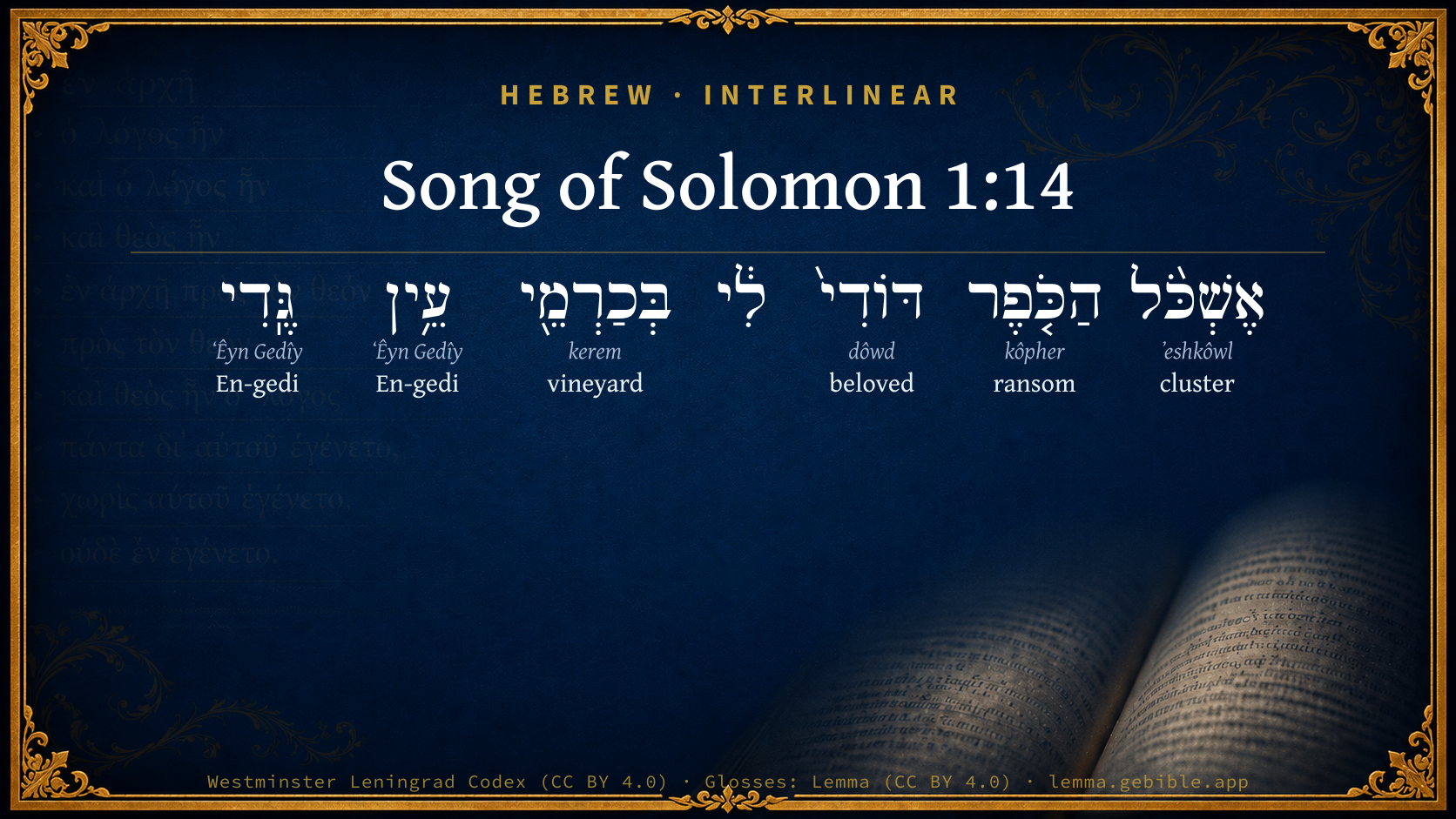
Hebrew (Westminster Leningrad Codex) Song of Solomon 1:14 appears in the Hebrew Old Testament. The text above is from the Westminster Leningrad Codex. Each word links to its Strong’s number, a concise gloss, and parsing drawn from the Open Scriptures Hebrew Bible morphology. Click any word for its full Brown-Driver-Briggs (BDB) entry.
Download image
Cite this verse

Song of Solomon 1:14 (World English Bible). Public Domain. Lemma interlinear Bible study tool, https://lemma.gebible.app/v/song-of-solomon/1/14.

Show BibTeX & RIS
BibTeX
RIS
English Translation
My beloved is to me a cluster of henna blossoms From the vineyards of En Gedi. Lover
World English Bible · Public Domain
Download a study sheet

One document with this verse’s original text, its word-by-word gloss line, the meaning frame, cross-references with their text, attributed commentary, and full source and license credits — printable, and it pastes into notes with its structure intact.

This verse Autodidact and up

Study sheet (.html) Plain text (.txt)

A passage Seminary Student

Up to 50 verses in one chapter. A passage sheet keeps up to 6 commentary sources and 12 cross-references per verse, in the order this page ranks them, and says so on the sheet whenever that leaves anything out. Ask for a single verse and you get the Autodidact verse sheet above.

Everything on this page stays free to read, with no account — the sheet is a download of what is already on screen, not access to it.

Want to remove ads? Support Godless Engineer
Compare translations 3

The same verse in 3 English versions, stacked beneath the original-language interlinear above. Click any original word for its lexicon entry.

Each is an independent rendering of the whole verse — the interlinear is not word-aligned to these translations.

Highlighted words mark where these versions differ — a whole-verse word diff, not a word-by-word alignment.

  • World English Bible Public Domain
    My beloved is to me a cluster of henna blossoms From the vineyards of En Gedi. Lover
  • King James Version Public Domain
    My beloved is unto me as a cluster of camphire in the vineyards of Engedi.
  • unfoldingWord Literal Text CC BY-SA 4.0
    A cluster of henna blossoms my beloved to me, in the vineyards of Engedi.

unfoldingWord Literal Text — © unfoldingWord, licensed CC BY-SA 4.0. Word-aligned USFM3 via Door43 (git.door43.org/unfoldingWord/en_ult).

Versions to compare (up to 4)

3 of 4 selected

Show all 18 translations

Every available English version of this verse, each an independent rendering of the whole verse.

  • World English Bible Public Domain
    My beloved is to me a cluster of henna blossoms From the vineyards of En Gedi. Lover
  • Berean Standard Bible Public Domain
    My beloved is to me a cluster of henna blossoms in the vineyards of En-gedi.
  • Majority Standard Bible Public Domain
    My beloved is to me a cluster of henna blossoms in the vineyards of En-gedi.
  • King James Version Public Domain
    My beloved is unto me as a cluster of camphire in the vineyards of Engedi.
  • American Standard Version (1901) Public Domain
    My beloved is unto me `as' a cluster of henna-flowers In the vineyards of En-gedi.
  • Revised Version (1885) Public Domain
    My beloved is unto me as a cluster of henna-flowers in the vineyards of En-gedi.
  • Geneva Bible (1599) Public Domain
    My loue, beholde, thou art faire: beholde, thou art faire: thine eyes are like the doues.
  • Douay-Rheims (1899) Public Domain
    Behold thou art fair, O my love, behold thou art fair, thy eyes are as those of doves.
  • Young's Literal Translation Public Domain
    A cluster of cypress `is' my beloved to me, In the vineyards of En-Gedi!
  • Literal Standard Version CC BY-SA 4.0
    A cluster of cypress [is] my beloved to me, || In the vineyards of En-Gedi!
  • Unlocked Literal Bible CC BY-SA 4.0
    My beloved is to me like a cluster of henna flowers in the vineyards of En Gedi.
  • unfoldingWord Literal Text CC BY-SA 4.0
    A cluster of henna blossoms my beloved to me, in the vineyards of Engedi.
  • Darby Bible Public Domain
    My beloved is unto me a cluster of henna-flowers In the vineyards of Engedi.
  • World Messianic Bible Public Domain
    My beloved is to me a cluster of henna blossoms from the vineyards of En Gedi.
  • Webster's Bible Public Domain
    My beloved is to me as a cluster of camphor in the vineyards of En-gedi.
  • Free Bible Version CC BY-SA 4.0
    My love is like a bunch of fragrant henna flowers in the vineyards of Engedi.
  • Bible in Basic English Public Domain
    My love is to me as a branch of the cypress-tree in the vine-gardens of En-gedi.
  • JPS Tanakh (1917) Public Domain
    My beloved is unto me as a cluster of henna in the vineyards of En-gedi.

Literal Standard Version (2020), Covenant Press — licensed CC BY-SA 4.0. Text via the HelloAO Bible API (eBible.org). Unlocked Literal Bible (unfoldingWord) — licensed CC BY-SA 4.0. Text via the HelloAO Bible API (eBible.org). unfoldingWord Literal Text — © unfoldingWord, licensed CC BY-SA 4.0. Word-aligned USFM3 via Door43 (git.door43.org/unfoldingWord/en_ult). Free Bible Version, Dr. Jonathan Gallagher — licensed CC BY-SA 4.0. Text via the HelloAO Bible API (eBible.org).

Word by word

More ways to search: Search by grammar → Find every occurrence → Compare this word →

Practice this passage: Drill this verse → Learn its vocabulary →

About this verse

These counts appear in no published source. They are computed here, from the morphology-tagged text and Lemma’s own curated glosses. What Lemma adds →

7
words
5
distinct lemmas
Wisdom
section

Notable vocabulary

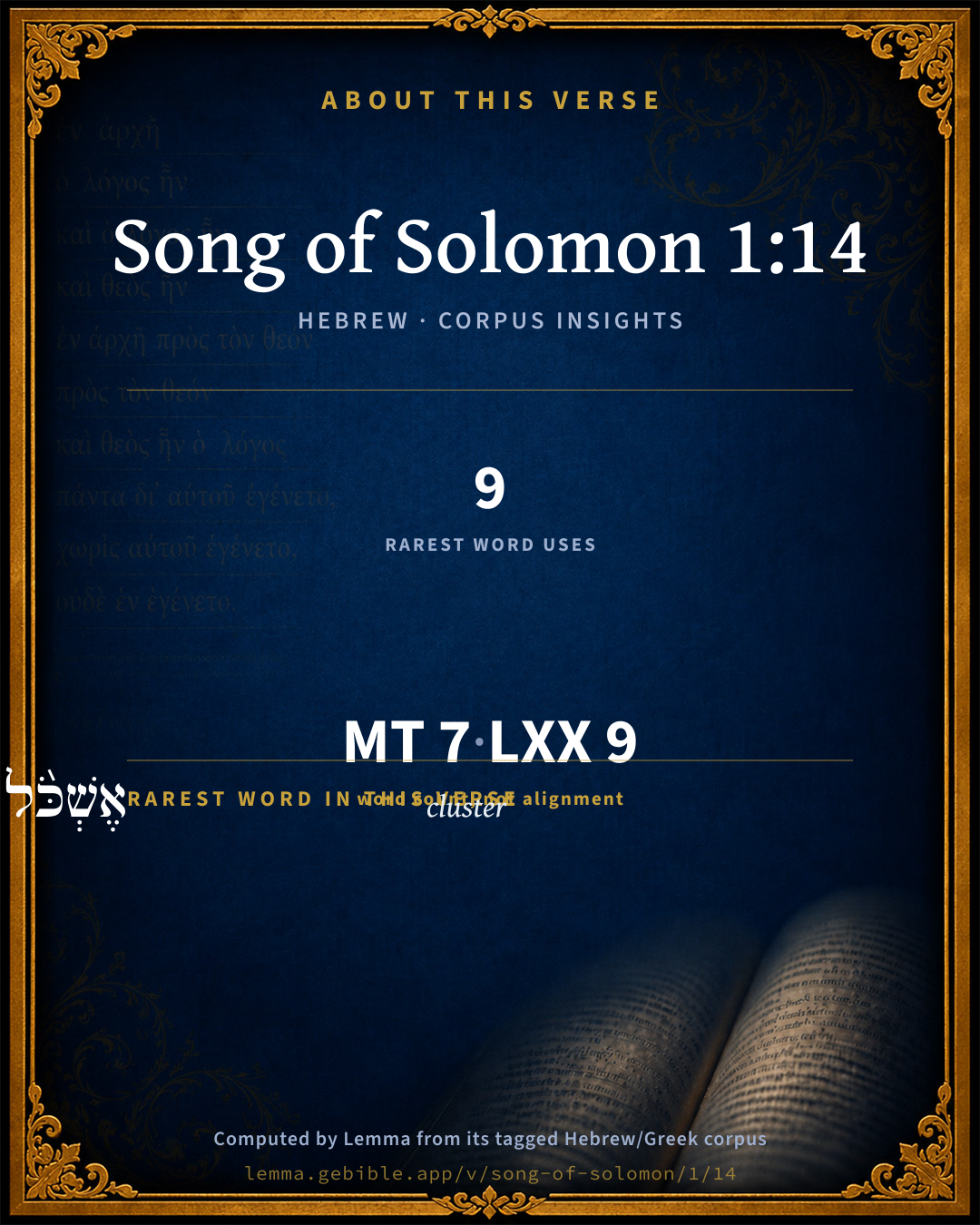
The rarest word here is אֶשְׁכֹּ֨ל cluster H811 — appearing just 9 times in the whole Hebrew Bible.

Shared distinctive vocabulary

אֶשְׁכֹּ֨ל cluster H811 occurs in 9 verses of the Hebrew Bible. Also found in:

Grammatical profile

  • 6 nouns
  • 1 preposition

Repetition

A word recurs within this verse — often emphatic in Hebrew:

  • עֵ֥ין En-gedi H5872 ×2

Hebrew & Septuagint length

In English translation the verse runs 17 words from the Hebrew and 14 from the Septuagint (LXX English) — closely comparable.

A rough comparison of the two English renderings, which tokenize alike — not a word-level alignment.

Word counts can differ between the Hebrew and the Greek without any difference in meaning — e.g. the Hebrew direct-object marker אֵת has no separate Greek word, and Greek often adds the article ὁ.

In the original languages it is 7 Hebrew tokens and 9 Greek tokens — but the two are counted differently (Hebrew bundles its prefixes and suffixes into one token; the Greek is in lemma form), so that isn’t a like-for-like length.

Cross-references

5

Topical passages linked to Song of Solomon 1:14 in the Treasury of Scripture Knowledge — connected by theme and wording, ordered by reader-vote popularity; previews shown in the World English Bible.

  • Joshua 15:62 and Nibshan, and the City of Salt, and En Gedi; six cities with their villages.
  • 1 Samuel 23:29–24:1 David went up from there, and lived in the strongholds of En Gedi.
  • Song of Solomon 1:13 My beloved is to me a sachet of myrrh, That lies between my breasts.
  • Song of Solomon 2:3 As the apple tree among the trees of the wood, So is my beloved among the sons. I sat down under his shadow with great delight, His fruit was sweet to my taste.
  • Song of Solomon 4:13–14 Your shoots are an orchard of pomegranates, with precious fruits: Henna with spikenard plants,

Cross-references courtesy of OpenBible.info (CC BY 4.0).

Hebrew and Greek witnesses Masoretic Hebrew ↔ Greek Septuagint

The same verse in the two great witnesses to the Old Testament, shown verse-for-verse.

These are two independent witnesses, not word-aligned to each other, and the Septuagint is shown in lemma (dictionary) form.

Hebrew Song of Solomon 1:14 Masoretic · Westminster Leningrad Codex

אֶשְׁכֹּ֨ל הַכֹּ֤פֶר דּוֹדִי֙ לִ֔י בְּכַרְמֵ֖י עֵ֥ין גֶּֽדִי

My beloved is to me a cluster of henna blossoms From the vineyards of En Gedi. Lover

World English Bible · Public Domain

Greek LXX Song of Solomon 1:14 Septuagint · lemma form

βότρυς ὁ κύπρος ἀδελφιδός ἐγώ ἐγώ ἐν ἀμπελών εγγαδδι

My kinsman is to me a cluster of camphor in the vineyards of Engaddi.

LXX2012 (modern English Septuagint) · Public Domain

Hebrew: Westminster Leningrad Codex (CC BY 4.0). Greek: Septuagint (public domain); English from LXX2012 (modern English Septuagint) (Public Domain). How the Septuagint differs from the Hebrew →

Commentary

Notes on Song of Solomon 1:14 from classic Christian and Jewish commentators (each source and its license shown beneath its notes). The classic Christian expositions comment on the surrounding passage and are grouped to its opening verse, so a note may address several verses; the Jewish commentaries on the Tanakh (Rashi and others) are per-verse, so they appear only where the commentator wrote on this verse.

Lemma curates 59 commentaries, every one of them public domain or Creative Commons licensed, each selected and text-cleaned for this edition rather than reprinted as found. About our sources →

Trapp's Complete Commentary

John Trapp

Son 1:14 My beloved [is] unto me [as] a cluster of camphire in the vineyards of Engedi.

Ver. 14. My beloved is unto me as a cluster of camphire.] "My beloved," and "unto me." This particular application is the very quintessence and pith of faith. H πιστις ιδιοποιει ται τον Cριστον. It is the property of true faith to individuate Christ, to appropriate him to herself, as if he were wholly and solely hers. She adjudgeth him in special to herself, with "My beloved," "My strength, and my Redeemer," "My Lord, and my God." This, when Thomas did, "Now thou believest," said our Saviour. {Joh 20:29} Were it not for this word of possession, mine, the devil might say the Creed to as good purpose: as any of us. He believes there is a God and a Christ; but that which torments him is, he can say my to never an article of faith. Wicked men likewise may Credere Deum, et Deo, sed non in Deum; they may hear with joy, and have a taste, yea, and apply the promises, but they do it presumptuously and sacrilegiously; because they accept not Christ upon Christ’s terms, take not whole Christ in all his offices and efficacies - would have him as a Saviour but not as a Sovereign - they make not a total resignation of themselves to Christ as Paul did {Gal 2:19-20}

As a cluster of camphire.] Or, As the cypress berry, within its white flower - sweet, pleasant, and very fragrant. {a} They that talk here of the island Cyprus are as far from the sense as that island is from Engedi, which was a place in the land of Canaan, in the tribe of Judah, near unto the Dead Sea. Here fled David one time when Saul pursued him; and here Jehoshaphat had that notable victory over his enemies by the power of prayer. {2Ch 20:1-28} This was a fruitful soil for gardens and vineyards. {Eze 47:10} Now the cypress tree, as also other aromatic trees, grow best in vineyards; and the Church, forgetting herself, as it were, and transported with love to Christ, heaps up thus one similitude upon another. Amor Christi est ecstaticus, neque iuris se sinit esse sui. R. Solomon Jarchi doth out of their Agada note that this cophir in the text is a tree that bringeth fruit four or five times yearly. Christ is that tree of life, that yields fruit every month, {Rev 22:2} being more fruitful than the lemon tree, or the Egyptian fig tree, that bears seven times a year, as Solinus reporteth. {b} Our English Bibles call it camphire, which being smelled unto, doth naturally keep under or weaken carnal lust, saith one. Now, if that should be here intended, how fitly is it here placed among the vines of Engedi, that is a medicine for bridling lust too soon stirred up by wine, which one well calls lac Veneris, the milk of Venus: -

“ Et Venus in vinis, ignis ut igne, furit. ”

Even Venus in wine, so rages fire by fire.

{a} Plin., lib. xii. cap. 14.

{b} Sol., cap. 45.

John Trapp, A Commentary or Exposition upon All the Books of the Old and New Testament (1647–1656) — public domain. Text from a community e-Sword module.

The Biblical Illustrator

Joseph S. Exell

Son_1:14

My Beloved is unto me as a cluster of camphire in the vineyards of En-gedi.

A beautiful symbol

Terraced on the side of the mountains were the vineyards of En-gedi. Oh, they were sweet places! From a shelving of the mountain four hundred feet high waters came down in beautiful baptism on the faces of the leaves; the grapes intoxicate with their own wine; pomegranates with juices bursting from the rind; all fruits, and flowers, and aromatic woods--among the sweetest of these the camphire plant of the text. Its flowers are in clusters like our lilac--graceful, fragrant, symbolical of Jesus.

I. I will first show you that this camphire plant of the text was a symbol of Christ, because of its fragrance. If I had a branch of it, and should wave it in your midst, it would fill all the house with the redolence. The camphor, as we have it, is offensive to some; but the camphire plant of the text had a fragrance gracious to all. The name of Caesar means power; the name of Herod means cruelty; the name of Alexander means conquest; the name of Demosthenes means eloquence; the name of Milton means poetry; the name of Benjamin West means painting; the name of Phidias means sculpture; the name of Beethoven means music; the name of Howard means reform; but the name of Christ means love! It is the sweetest name that ever melted from lip to heart. Oh, rich and rare, exquisite and everlasting perfume! Set it in every poor mans window; plant it on every grave; put its leaves under every dying hearth; wreath its blossoms for every garland; wave its branches in every home; and when I am about to die, and my hand lies cold and stiff and white upon the pillow, let no superstitious priest come with mumbling fooleries to put a crucifix of wood or stone in my hand, but rather some plain and humble soul--let him come and put in my dying grasp this living branch, with clusters of camphire from the vineyards of En-gedi.

II. This camphire plant of the text was a symbol of Christ in the fact that it gives colouring. From the Mediterranean to the Ganges, the people of the East gathered it, dried the leaves, pulverized them, and then used them as a dye for beautifying garments or their own persons. It was that fact that gave the camphire plant of the text its commercial value in the time of King Solomon; a type of my Lord Jesus, who beautifies and adorns, and colours everything He touches. I have no faith in that mans conversion whose religion does not colour his entire life. It was intended so to do. If a man has the grace of God in his heart, it ought to show itself in the life. There ought to be this cluster of camphire in the ledger, in the roll of government securities, in the medical prescription, in the law-book. I tell you, unless your religion goes with you everywhere, it goes nowhere. That religion was intended to colour all the heart and the life. But, mark you, it was a bright colour. For the most part, it was an orange dye made of this camphire plant, one of the most brilliant of all colours; and so the religion of Jesus Christ casts no blackness or gloom upon the soul. It brightens up life, it brightens up everything.

III. The camphire plant of the text was a symbol of Jesus Christ because it is a mighty restorative. You know that there is nothing that starts respiration so soon in one who has fainted as camphor, as we have it. Put upon a sponge or handkerchief, the effects are almost immediate. Well, this camphire plant of the text, though somewhat different from that which we have, was a pungent aromatic, and in that respect it becomes a type of our Lord Jesus Christ, who is the mightiest of all restoratives. I have carried this camphire plant into the sick-room, after the doctors had held their consultation and said there was no hope and nothing more could be done, and the soul brightened up under the spiritual restorative. There is no fever, no marasmus, no neuralgia, no consumption, no disease of the body, that the grace of God will not help. I wish that over every bed of pain and through every hospital of distress we might swing this cluster of camphire from the vineyards of En-gedi. Christs hand is the softest pillow, Christs pardon is the strongest stimulus, Christs comfort is the mightiest anodyne, Christs salvation is the grandest restorative. This grace is also a restorative for the backslider. For great sin, great pardon. For deep wounds, omnipotent surgery. For deaf ears, a Divine aurist. For blind eyes, a heavenly oculist. For the dead in sin, the upheaval of a great resurrection. But why should I particularize that class in this audience when we all need this restorative, for we have all wandered and gone away! (T. De Witt Talmage.)

.

The Biblical Illustrator, edited by Joseph S. Exell (c. 1880s–1900s) — public domain. Text from a community e-Sword module.

Tyndale Open Study Notes

Tyndale Open Resources

1:14 The woman thirsts for the sincere love of her man the way a traveler would thirst for the water of En-gedi, an oasis in the wilderness west of the Dead Sea. • Henna is an aromatic shrub from the region around En-gedi; its blossoms were used for red hair dye.

Tyndale Open Study Notes — © Tyndale Open Resources, licensed CC BY-SA 4.0. Text via the HelloAO Bible API.

Geneva Bible (1599)

Geneva Bible translators

Christ accepteth his Church, and commendeth her beauty.

Geneva Bible (1599) marginal notes — public domain. Text via Bolls.life.

Adam Clarke's Commentary

Verse 14. A cluster of camphire] Mr. Hasselquist supposes this to mean a bunch of the Cyprus grape; but this is supposed to mean a shrub so called, not any production of the isle of Cypress; the best kinds of which were found at En-gedi. This place belonged to the tribe of Judah.

Perhaps the poet alludes to the dark colour of the hair, which by the Greeks was not unfrequently compared to the bunches of grapes; by no means an unfit similitude for thick black clustering curls. The following lines represent the same idea: -

[Persian]

[Persian]

"The dark black locks that ornament her neck

Hang thick and clustering like the branchy palm."

Adam Clarke's Commentary on the Bible (1810–1826) — public domain. Text from a community e-Sword/MySword module.

Ellicott's Commentary for English Readers

(14) Camphire.—Marg., cypress: Heb., côpher. There is no doubt of the identity of this plant with the Henna of the Arabs, the Lawsonia aïba or inermis of botanists. Robinson found it growing in abundance at En-gedi (where alone it is found), and suggested the identification (see his Note, Researches, ii. 211). Tristram describes it thus: “It is a small shrub, eight or ten feet high, with dark back, pale green foliage, and clusters of white and yellow blossoms of a powerful fragrance. Not only is the perfume of the flower highly prized, but a paste is made of the dried and pounded leaves, which is used by the women of all ranks and the men of the wealthier classes to dye the palms of the hands, the soles of the feet, and the nails” (Nat. Hist. of the Bible, p. 339). (Comp. also Thomson, The Land and the Book, p. 602, who, however, prefers to identify côpher with some specially favourite kind of grapes, but without giving any sufficient reason.) For En-gedi, see Jos_15:62. It is the only place in Southern. Palestine mentioned in this poem, the other allusions (except Heshbon, Son_7:4, which is in Moab) being to northern localities.

A Bible Commentary for English Readers, edited by Charles John Ellicott (1878–1897) — public domain. Text from a community e-Sword module.

The Cambridge Bible for Schools and Colleges

gen. ed. J. J. S. Perowne

14. camphire] R.V. henna-flowers, the Lawsonia inermis or henna plant, from which Eastern women get the reddish yellow colour with which they stain their hands and feet (Tristram, op. cit. p. 340). It has a strongly perfumed flower which takes the form of yellowish white clusters. It is found to-day in Palestine only at En-gedi.

the vineyards of En-gedi] Martineau seems to take these words as an indication that the lover had his vineyards there, but this is highly improbable. En-gedi means the fountain of the kid, and the place still retains the name Ain Jidy. To this day the rocks and precipices above and about the well are frequented by wild goats. “The plain of En-gedi,” says Dr Porter in Murray’s Guide, “is a rich plain about half a mile square, sloping very gently from the declivity of the mountains to the shore of the Dead Sea, and is shut in on the North by the cliffs of Wady Sudeir, which are the highest along the whole Western coast. About one mile up the mountain side, and at an elevation of some 400 feet above the plain, is the fountain from which the place gets its name. The water is pure and sweet though the temperature is as high as 81 degrees Fahr. The plain is very fertile, and anciently its vineyards, and palm groves, and balsam plants were celebrated, but now none of these are to be seen there.”

The Cambridge Bible for Schools and Colleges (gen. ed. J. J. S. Perowne; Cambridge University Press, 1878–1918) — public domain. Text from a community e-Sword module.

Haydock's Catholic Bible Commentary

CHAPTER I.

[Title.] Canticles. Hebrew shir hashirim asher Lishlomo, "the Canticle of Canticles which is for (Haydock) or according to Solomon," (Menochius) dictated to him by the Holy Ghost.

Behold. Christ praiseth his spouse. (Worthington) --- Doves. Sharp-sighted, and reddish, Genesis xlix. 12. The Holy Ghost came upon Christ in the form of a dove, Matthew iii. 16. We must imitate his simplicity, (Matthew x. 16.) and have a pure and single eye, or intention, (Matthew vi. 22.; Calmet) inviolably to please God. (Origen) --- The Church decides matters of controversy, without any mistakes. (Menochius)

George Leo Haydock (1774–1849), Haydock's Catholic Family Bible and Commentary, 1859 edition — public domain. Excludes Psalms (Douay-Rheims chapter numbering differs from Protestant) and Deuterocanonical books (Catholic canon only).

Matthew Poole's English Annotations

Camphire; or, cypress, as others render it. It was an odoriferous plant growing in vineyards, and some think that it was a most pleasant kind of vine, like that which bears muscatel grapes; yea, some very learned men understand it of that plant which dropped balm, which grew in or near the place here specified, as is affirmed not only by the Jews, but also by pagan writers, as Diodorus and Trogus. Nor are we concerned to know which or what it was; it being confessed and evident, that it was some pleasant and grateful plant, and that it sets forth that great delight which the church hath in the enjoyment of Christ.

En-gedi; a pleasant and well-watered place in the tribe of Judah, Jos 15:62; Eze 47:10, where there were many pleasant plants, whence it was called Hazazontamar, 2Ch 20:2.

Matthew Poole's English Annotations on the Holy Bible (1683–1685) — public domain. Text from a community e-Sword/MySword module.

Whedon's Commentary on the Bible

Daniel D. Whedon

14. Camphire — Hebrew, Cypress flowers. The cypress is very much like our lilac in size and appearance, and in the shape of its flowers. It is very fragrant, and its flowers, white and yellow on a red spike, are a favourite eastern bouquet.

Engedi — A very fertile spot on the western shore of the Dead Sea, rich in the palm and the cypress; or, as the latter is sometimes called, the henna.

Daniel D. Whedon (gen. ed.), Commentary on the Old and New Testaments (1874–1909) — public domain. Text from a community e-Sword module.

John Wesley's Explanatory Notes

Camphire - We are not concerned to know exactly what this was; it being confessed, that it was some grateful plant, and that it sets forth that great delight which the church hath in the enjoyment of Christ. Engedi - A pleasant and well-watered place in the tribe of Judah, where there were many pleasant plants.

John Wesley, Explanatory Notes Upon the Whole Bible (1754–1765) — public domain. Text via the GEBible commentary corpus.

Rashi

Rabbi Shlomo Yitzchaki (Rashi)

A cluster of henna-flowers Heb. כֹּפֶר. There is a spice called כֹּפֶר, like (below 4:12): “Henna- flowers (כְּפָרִים) with spikenard,” and it is shaped like a sort of cluster.

in the vineyards of Ein-Gedi The name of a place, and there it is common. I saw in an aggadah (Song Zuta) that those vineyards produce fruits four or five times a year, and this is symbolic of the many atonements and forgivenesses that the Holy One, blessed be He, forgave them for the many trials that they tried Him in the desert.

Rashi on the Tanakh — English translations: “The Judaica Press complete Tanach with Rashi, translated by A. J. Rosenberg” (CC BY 4.0); “Pentateuch with Rashi's commentary by M. Rosenbaum and A.M. Silbermann, 1929-1934” (public domain); “The Metsudah Tanach series, Lakewood, N.J” (CC BY 4.0); and “The Book of Joshua, Metsudah Publications, 1997” (CC BY 4.0). Text via Sefaria.

Lesson kit

Teaching starters — assembled from the data on this page, not authored interpretation. Every prompt links to the verse data it draws on. Edit before teaching.

Song of Solomon, in the Wisdom, opens this verse with 7 words (5 distinct Hebrew lemmas). Its most distinctive word is ʼeshkôwl (“cluster”). A historical commentator’s framing appears above. Read the whole chapter for the surrounding context.

Discussion questions

  1. How does “cluster” (ʼeshkôwl) shape what this verse is saying?
  2. How does Genesis 40:10, which shares the word «cluster», read alongside this verse?
  3. What does the repetition of “En-gedi” (2× in this one verse) do in this verse?
  4. These translations render this verse differently; the difference is in the English rendering, not the original. What questions does that raise?
  5. Compare how Trapp's Complete Commentary and The Biblical Illustrator read this verse. Where do they agree or differ?

Things to notice

Reading settings

Reading text

Shown beneath each verse's original-language words.

Old Testament
Old Testament edition

Read the OT as the Masoretic Hebrew (MT) or the Greek Septuagint (LXX).

English shown for the Greek Septuagint (in the Hebrew ↔ Greek comparison).

Comparing translations? Open the Compare panel on any verse page to stack up to four side by side.