Isaiah 36:17

Hebrew (Westminster Leningrad Codex) Isaiah 36:17 appears in the Hebrew Old Testament. The text above is from the Westminster Leningrad Codex. Each word links to its Strong’s number, a concise gloss, and parsing drawn from the Open Scriptures Hebrew Bible morphology. Click any word for its full Brown-Driver-Briggs (BDB) entry.
Download image
Cite this verse

Isaiah 36:17 (World English Bible). Public Domain. Lemma interlinear Bible study tool, https://lemma.gebible.app/v/isaiah/36/17.

Show BibTeX & RIS
BibTeX
RIS
English Translation
until I come and take you away to a land like your own land, a land of grain and new wine, a land of bread and vineyards.
World English Bible · Public Domain
Download a study sheet

One document with this verse’s original text, its word-by-word gloss line, the meaning frame, cross-references with their text, attributed commentary, and full source and license credits — printable, and it pastes into notes with its structure intact.

This verse Autodidact and up

Study sheet (.html) Plain text (.txt)

A passage Seminary Student

Up to 50 verses in one chapter. A passage sheet keeps up to 6 commentary sources and 12 cross-references per verse, in the order this page ranks them, and says so on the sheet whenever that leaves anything out. Ask for a single verse and you get the Autodidact verse sheet above.

Everything on this page stays free to read, with no account — the sheet is a download of what is already on screen, not access to it.

Want to remove ads? Support Godless Engineer
Compare translations 3

The same verse in 3 English versions, stacked beneath the original-language interlinear above. Click any original word for its lexicon entry.

Each is an independent rendering of the whole verse — the interlinear is not word-aligned to these translations.

Highlighted words mark where these versions differ — a whole-verse word diff, not a word-by-word alignment.

  • World English Bible Public Domain
    until I come and take you away to a land like your own land, a land of grain and new wine, a land of bread and vineyards.
  • King James Version Public Domain
    Until I come and take you away to a land like your own land, a land of corn and wine, a land of bread and vineyards.
  • unfoldingWord Literal Text CC BY-SA 4.0
    until I come and take you to a land like your land, a land of grain and new wine, a land of bread and vineyards,

unfoldingWord Literal Text — © unfoldingWord, licensed CC BY-SA 4.0. Word-aligned USFM3 via Door43 (git.door43.org/unfoldingWord/en_ult).

Versions to compare (up to 4)

3 of 4 selected

Show all 18 translations

Every available English version of this verse, each an independent rendering of the whole verse.

  • World English Bible Public Domain
    until I come and take you away to a land like your own land, a land of grain and new wine, a land of bread and vineyards.
  • Berean Standard Bible Public Domain
    until I come and take you away to a land like your own—a land of grain and new wine, a land of bread and vineyards.
  • Majority Standard Bible Public Domain
    until I come and take you away to a land like your own—a land of grain and new wine, a land of bread and vineyards.
  • King James Version Public Domain
    Until I come and take you away to a land like your own land, a land of corn and wine, a land of bread and vineyards.
  • American Standard Version (1901) Public Domain
    until I come and take you away to a land like your own land, a land of grain and new wine, a land of bread and vineyards.
  • Revised Version (1885) Public Domain
    until I come and take you away to a laud like your own land, a land of corn and wine, a land of bread and vineyards.
  • Geneva Bible (1599) Public Domain
    Till I come and bring you to a land like your owne land, euen a land of wheate, and wine, a land of bread and vineyardes,
  • Douay-Rheims (1899) Public Domain
    Till I come and take you away to a land, like to your own, a land of corn and of wine, a land of bread and vineyards.
  • Young's Literal Translation Public Domain
    till my coming in, and I have taken you unto a land like your own land, a land of corn and wine, a land of bread and vineyards;
  • Literal Standard Version CC BY-SA 4.0
    until my coming in, and I have taken you to a land like your own land, a land of grain and wine, a land of bread and vineyards;
  • Unlocked Literal Bible CC BY-SA 4.0
    You will do this until I come and take you away to a land like your own land, a land of grain and new wine, a land of bread and vineyards.'
  • unfoldingWord Literal Text CC BY-SA 4.0
    until I come and take you to a land like your land, a land of grain and new wine, a land of bread and vineyards,
  • Darby Bible Public Domain
    until I come and take you away to a land like your own land, a land of corn and wine, a land of bread and vineyards.
  • World Messianic Bible Public Domain
    until I come and take you away to a land like your own land, a land of grain and new wine, a land of bread and vineyards.
  • Webster's Bible Public Domain
    Until I come and take you away to a land like your own land, a land of corn and wine, a land of bread and vineyards.
  • Free Bible Version CC BY-SA 4.0
    I will come and take you to a land that's like your own, a land of grain and new wine, a land of bread and vineyards.
  • Bible in Basic English Public Domain
    Till I come and take you away to a land like yours, a land of grain and wine, a land of bread and vine-gardens.
  • JPS Tanakh (1917) Public Domain
    until I come and take you away to a land like your own land, a land of corn and wine, a land of bread and vineyards.

Literal Standard Version (2020), Covenant Press — licensed CC BY-SA 4.0. Text via the HelloAO Bible API (eBible.org). Unlocked Literal Bible (unfoldingWord) — licensed CC BY-SA 4.0. Text via the HelloAO Bible API (eBible.org). unfoldingWord Literal Text — © unfoldingWord, licensed CC BY-SA 4.0. Word-aligned USFM3 via Door43 (git.door43.org/unfoldingWord/en_ult). Free Bible Version, Dr. Jonathan Gallagher — licensed CC BY-SA 4.0. Text via the HelloAO Bible API (eBible.org).

Word by word

More ways to search: Search by grammar → Find every occurrence → Compare this word →

Practice this passage: Drill this verse → Learn its vocabulary →

וְתִיר֔וֹשׁ
tîyrôwsh
H8492
“and · wine”
Conjunction + Noun, Common, Masculine, Singular, Absolute
Part of Speech
Conjunction + Noun
Type
Common
Gender
Masculine
Number
Singular
State
Absolute
Full BDB Definition

Origin: from H3423 in the sense of expulsion

TWOT: 2505

wine, fresh or new wine, must, freshly pressed wine
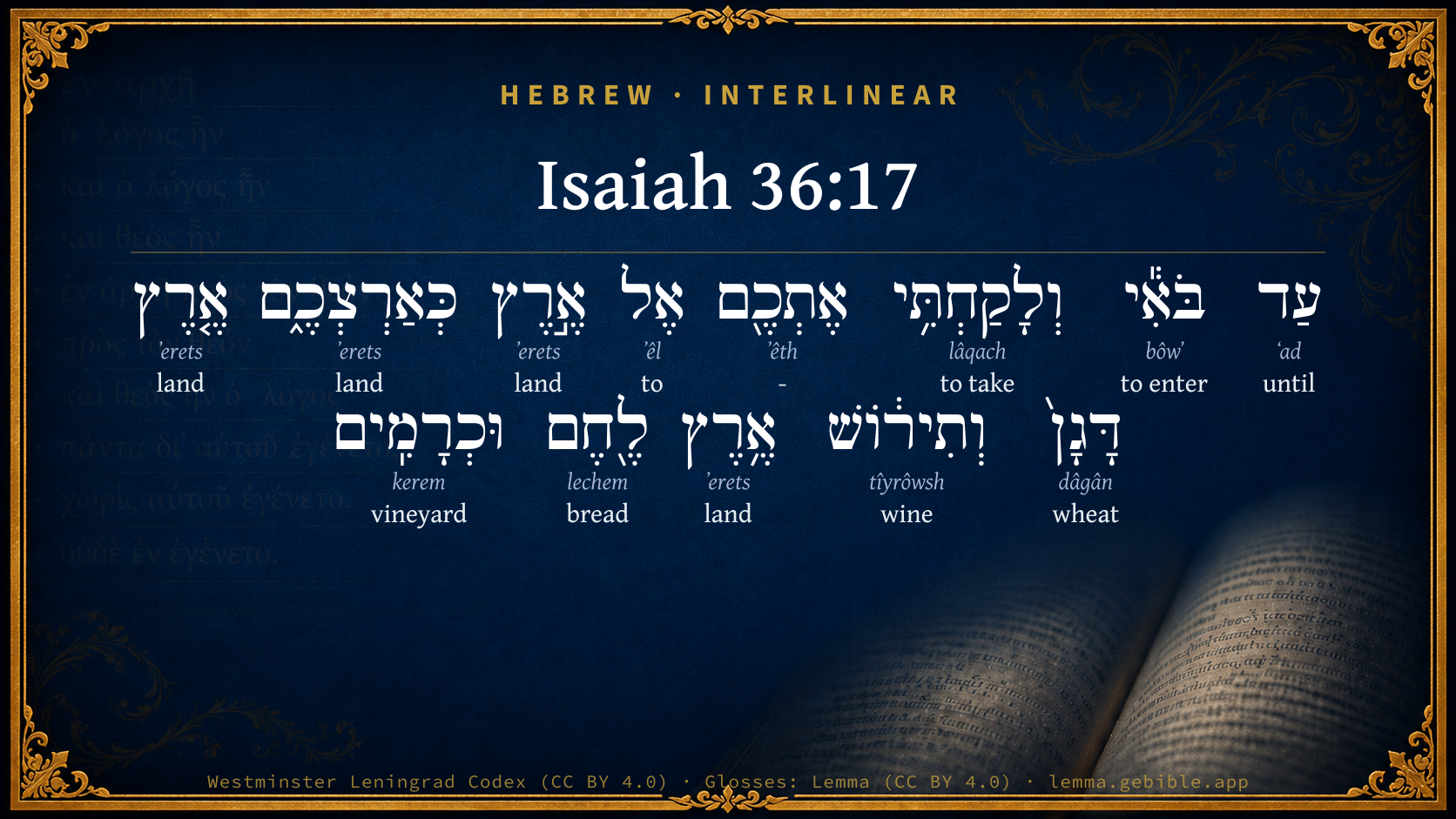
  1. עַד ʻad H5704 “until” Preposition
  2. בֹּאִ֕י bôwʼ H935 “to enter · me” Verb, Qal, Infinitive Construct + Suffix, Personal, 1st Person, Common, Singular
  3. וְלָקַחְתִּ֥י lâqach H3947 “and · to take” Conjunction + Verb, Qal, Sequential Perfect, 1st Person, Common, Singular
  4. אֶתְכֶ֖ם ʼêth H853 “- · you” Particle, Direct Object + Suffix, Personal, 2nd Person, Masculine, Plural
  5. אֶל ʼêl H413 “to” Preposition
  6. אֶ֣רֶץ ʼerets H776 “land” Noun, Common, Both, Singular, Absolute
  7. כְּאַרְצְכֶ֑ם ʼerets H776 “like/as · land · your” Preposition + Noun, Common, Both, Singular, Construct + Suffix, Personal, 2nd Person, Masculine, Plural
  8. אֶ֤רֶץ ʼerets H776 “land of” Noun, Common, Both, Singular, Construct
  9. דָּגָן֙ dâgân H1715 “wheat” Noun, Common, Masculine, Singular, Absolute
  10. אֶ֥רֶץ ʼerets H776 “land of” Noun, Common, Both, Singular, Construct
  11. לֶ֖חֶם lechem H3899 “bread” Noun, Common, Both, Singular, Absolute
  12. וּכְרָמִֽים kerem H3754 “and · vineyards” Conjunction + Noun, Common, Both, Plural, Absolute

About this verse

These counts appear in no published source. They are computed here, from the morphology-tagged text and Lemma’s own curated glosses. What Lemma adds →

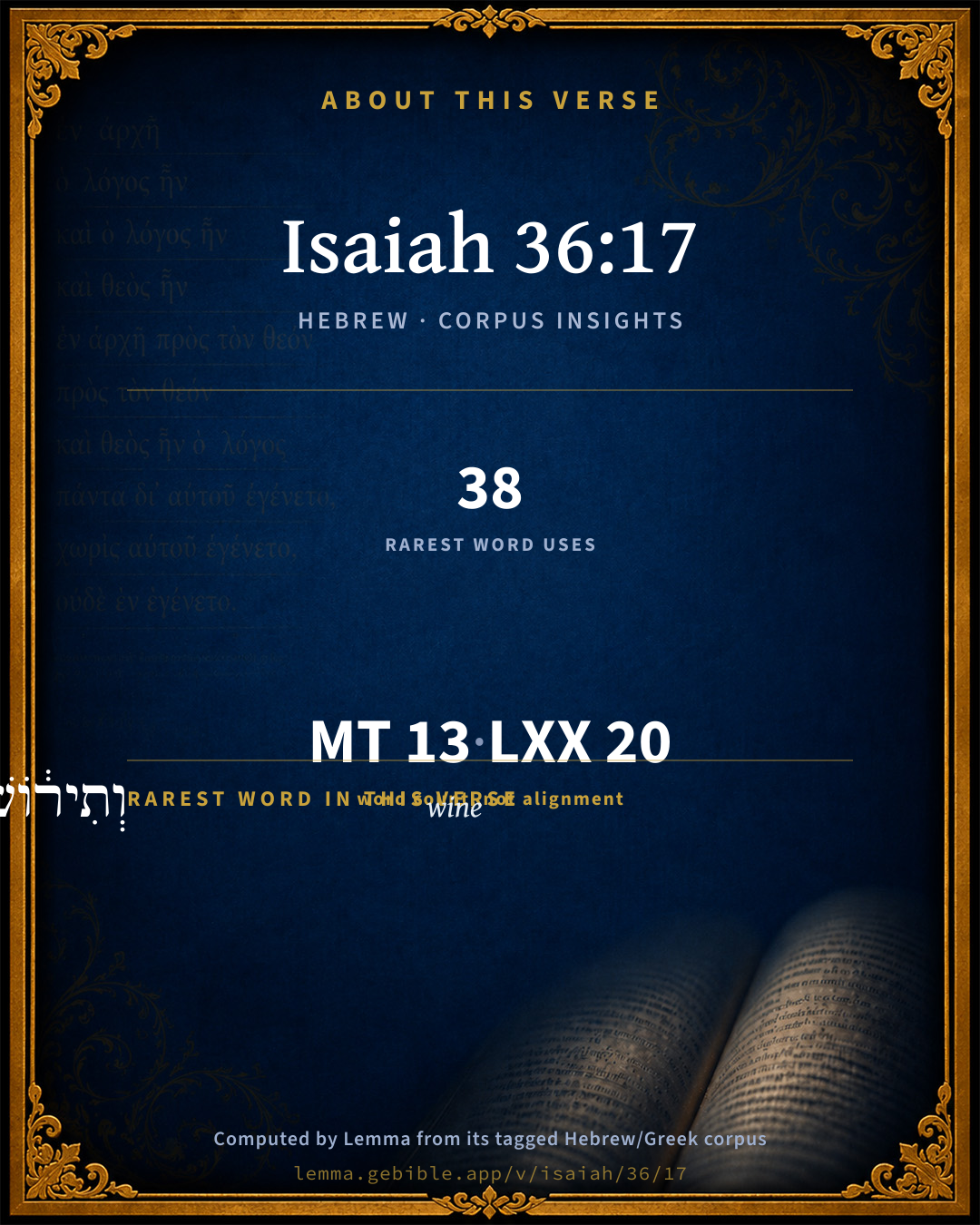
13
words
10
distinct lemmas
Prophets
section

Shared distinctive vocabulary

וְתִיר֔וֹשׁ wine H8492 occurs in 38 verses of the Hebrew Bible. Also found in:

Grammatical profile

  • 2 verbs
  • 8 nouns
  • 2 prepositions
  • 1 particle

Verb forms

  • בֹּאִ֕י Qal · Infinitive Construct
  • וְלָקַחְתִּ֥י Qal · Sequential Perfect

Repetition

A word recurs within this verse — often emphatic in Hebrew:

  • אֶ֣רֶץ land H776 ×4

Hebrew & Septuagint length

In English translation the verse runs 27 words from the Hebrew and 23 from the Septuagint (LXX English) — closely comparable.

A rough comparison of the two English renderings, which tokenize alike — not a word-level alignment.

Word counts can differ between the Hebrew and the Greek without any difference in meaning — e.g. the Hebrew direct-object marker אֵת has no separate Greek word, and Greek often adds the article ὁ.

In the original languages it is 13 Hebrew tokens and 20 Greek tokens — but the two are counted differently (Hebrew bundles its prefixes and suffixes into one token; the Greek is in lemma form), so that isn’t a like-for-like length.

Cross-references

9

Topical passages linked to Isaiah 36:17 in the Treasury of Scripture Knowledge — connected by theme and wording, ordered by reader-vote popularity; previews shown in the World English Bible.

  • 2 Kings 18:32 Until I come and take you away to a land like your own land, a land of grain and new wine, a land of bread and vineyards, a land of olive trees and of honey, that you may live, and not die: and don't listen to Hezekiah, when he persuades you, saying, Yahweh will deliver us.
  • Exodus 3:8 I have come down to deliver them out of the hand of the Egyptians, and to bring them up out of that land to a good and large land, to a land flowing with milk and honey; to the place of the Canaanite, the Hittite, the Amorite, the Perizzite, the Hivite, and the Jebusite.
  • Deuteronomy 8:7–9 For Yahweh your God brings you into a good land, a land of brooks of water, of springs and springs, flowing forth in valleys and hills;
  • Deuteronomy 11:12 a land which Yahweh your God cares for: the eyes of Yahweh your God are always on it, from the beginning of the year even to the end of the year.
  • 2 Kings 17:6–23 In the ninth year of Hoshea the king of Assyria took Samaria, and carried Israel away to Assyria, and placed them in Halah, and on the Habor, the river of Gozan, and in the cities of the Medes.
  • 2 Kings 18:9–12 It happened in the fourth year of king Hezekiah, which was the seventh year of Hoshea son of Elah king of Israel, that Shalmaneser king of Assyria came up against Samaria, and besieged it.
  • 2 Kings 24:11 Nebuchadnezzar king of Babylon came to the city, while his servants were besieging it;
  • Job 20:17 He shall not look at the rivers, The flowing streams of honey and butter.
  • Proverbs 12:10 A righteous man regards the life of his animal, But the tender mercies of the wicked are cruel.

Cross-references courtesy of OpenBible.info (CC BY 4.0).

Hebrew and Greek witnesses Masoretic Hebrew ↔ Greek Septuagint

The same verse in the two great witnesses to the Old Testament, shown verse-for-verse.

These are two independent witnesses, not word-aligned to each other, and the Septuagint is shown in lemma (dictionary) form.

Hebrew Isaiah 36:17 Masoretic · Westminster Leningrad Codex

עַד בֹּאִ֕י וְלָקַחְתִּ֥י אֶתְכֶ֖ם אֶל אֶ֣רֶץ כְּאַרְצְכֶ֑ם אֶ֤רֶץ דָּגָן֙ וְתִיר֔וֹשׁ אֶ֥רֶץ לֶ֖חֶם וּכְרָמִֽים

until I come and take you away to a land like your own land, a land of grain and new wine, a land of bread and vineyards.

World English Bible · Public Domain

Greek LXX Isaiah 36:17 Septuagint · lemma form

ἕως ἄν ἔρχομαι καί λαμβάνω σύ εἰς γῆ ὡς ὁ γῆ σύ γῆ σῖτος καί οἶνος καί ἄρτος καί ἀμπελών

until I come and take you to a land, like your own land, a land of corn and wine, and bread, and vineyards.

LXX2012 (modern English Septuagint) · Public Domain

Hebrew: Westminster Leningrad Codex (CC BY 4.0). Greek: Septuagint (public domain); English from LXX2012 (modern English Septuagint) (Public Domain). How the Septuagint differs from the Hebrew →

Targum (Aramaic paraphrase)

1

The Targum is the ancient Jewish Aramaic paraphrase of the Hebrew Scriptures — an interpretive translation, not the Hebrew text itself. Onkelos (literal) and Pseudo-Jonathan (expansive) render the Torah, and Jonathan the Prophets. Coverage is partial: where no permissively-licensed English translation exists for a verse, only the Aramaic is shown. This is verse-level text, not a word-by-word alignment to the Hebrew.

  1. Targum Jonathan Prophets (Joshua–Malachi)
    עַד מֵיתָא וְאֶדְבַּר יַתְכוֹן לְאַרְעָא טָבָא כְּאַרְעָכוֹן אֲרַע עִבּוּר וַחֲמַר אֲרַע חֶקְלִין וְכַרְמִין:

    Until I come and take you away to a good land like your own land, a land of corn and wine, a land of fields and vineyards.

    Targum Jonathan — Aramaic: “Mikraot Gedolot” (public domain). English: “Sefaria Community Translation” (CC0 1.0 (public-domain dedication)); “London "Chaldee Paraphrase," 1871” (public domain). Text via Sefaria.

Commentary

Notes on Isaiah 36:17 from classic Christian and Jewish commentators (each source and its license shown beneath its notes). The classic Christian expositions comment on the surrounding passage and are grouped to its opening verse, so a note may address several verses; the Jewish commentaries on the Tanakh (Rashi and others) are per-verse, so they appear only where the commentator wrote on this verse.

Lemma curates 59 commentaries, every one of them public domain or Creative Commons licensed, each selected and text-cleaned for this edition rather than reprinted as found. About our sources →

Adam Clarke's Commentary

Verse 17. And vineyards] The other copy, 2Kg 18:32, adds here: "A land of oil-olive, and of honey; that ye may live, and not die: and hearken not unto Hezekiah when he seduceth you."

Adam Clarke's Commentary on the Bible (1810–1826) — public domain. Text from a community e-Sword/MySword module.

The Cambridge Bible for Schools and Colleges

gen. ed. J. J. S. Perowne

17. But only for a time! The Rabshakeh does not conceal from them that their ultimate fate will be deportation; although he tries to present it in an attractive light. The parallel verse in 2 Kings (2Ki_18:31) contains these additional words “a land of oil olive and of honey, that ye may live, and not die; and hearken not unto Hezekiah.”

The Cambridge Bible for Schools and Colleges (gen. ed. J. J. S. Perowne; Cambridge University Press, 1878–1918) — public domain. Text from a community e-Sword module.

John Gill's Exposition

Until I come and take you away to a land like your own land,..... Some have thought, as Jerom observes, that the land of Media was meant, which bore some likeness to the land of Judea in situation and fruitfulness. Maimonides thinks that Africa is intended (l). Rabshakeh names no land, nor could he name any like, or equal to, the land of Canaan; he could not conceal his intention to remove them from their own land to another; this having been always done by the king of Assyria to people conquered by him, and as was usual for conquerors to do, that so the conquered might have no expectation or opportunity of recovering their own land:

a land of corn and wine, a land of bread and vineyards; corn for bread, and vineyards for wine, and both for food and drink; such a land was the land of Judea. The description agrees with Deu 8:8. Rabshakeh was well acquainted with the land of Judea; and this seems to confirm the conjecture of the Jews, that he was one of their people, since he could speak their language, and describe their land so well; all this he said to sooth and persuade them to a voluntary surrender.

(l) See T. Bab. Sanhedrin, fol. 94. 1.

John Gill's Exposition of the Whole Bible (1746–1763) — public domain (CC PDM 1.0). Text via the HelloAO Bible API.

Albert Barnes' Notes on the Bible

Until I come - These are the words of the king of Assyria delivered by Rabshakeh. It was proposed that they should remain safely in Jerusalem until Sennacherib should himself come and remove them to his own land. He was now engaged in the siege of Lachish Isa 36:2, and it is probable that he purposed to take some other of the unsubdued towns in that part of Palestine.

And take you away - It was common for conquerors in ancient times to remove a vanquished people from their own country. They did this either by sending them forth in colonies to people some unsettled region, or by removing the body of them to the land of the conqueror. This was done for various purposes. It was sometimes to make slaves of them; sometimes for the purposes of triumph; but more commonly to secure them from revolt. In this manner the ten tribes were removed from the kingdom of Samaria; and thus also the Jews were carried to Babylon. Suetonius says (chapter xxi.) of Augustus. that he removed the Suevi and the Sicambri into Gaul, and stationed them on the Rhine. The same thing was also practiced in Egypt, for the purpose of securing the people from revolt Gen 47:21.

A land like your own land - A fertile land, abounding in the same productions as your own.

And wine - Palestine was celebrated for the vine. The idea is, that in the land to which he would remove them, they should not want.

Albert Barnes' Notes on the Bible (1834–1885) — public domain. Text from a community e-Sword/MySword module.

The Pulpit Commentary

Until I come and take you away. It was so much thee usual policy of Assyria to remove to a new locality a conquered people, which had given them trouble, that Rabshakeh felt safe in assuming that the fate in store for the Jews, if they submitted themselves, was a transplantation. Sargon had transported the Israelites to Gozan and Media, (2Ki_18:11) the Tibarcni to Assyria, the Commageni to Susiana ("Ancient Monarchies," vol. 2. p. 423). Sennacherib himself had transported into Assyria more than two hundred thousand Aramaeans (ibid., p. 430). It might be confidently predicted that, if he conquered them, he would transplant the Jews. Rabshakeh tries to soften down the hardship of the lot before them by promises of a removal to a land equal in all respects to Palestine. To a land like your own land. This was certainly not a general principle of Assyrian administration. Nations were removed from the far north to the extreme south, and vice versa, from arid to marshy tracts, from fertile regions to comparative deserts. The security of the empire, not the gratification of the transported slaves, was the ruling and guiding principle of all such changes. A land of corn and wine, a land of bread and vineyards. The writer of Kings adds, "a land of oil olive and of honey." (On the productiveness of Palestine, see Num_13:27 Num_14:7 Deu_1:23 Deu_8:7-9 Deu_11:11, Deu_11:12)

The Pulpit Commentary (1880–1919), ed. H.D.M. Spence-Jones & Joseph S. Exell — public domain. Text from a community e-Sword module.

J. A. Alexander on Isaiah

Joseph Addison Alexander

“Until I come and take you away to a land like your own land, a land of corn and wine, a land of bread and vineyards.” The parallel passage (2Ki 18:32) adds, ‘a land of oil-olive and honey, that ye may live and not die’. This reference to the deportation of the people as a future event has led some interpreters to the conclusion, that Sennacherib was now on his way to Egypt, and deferred the measure until his return. It has been disputed what particular land is here meant, some saying Mesopotamia, to which others object that it was not a wine-growing country. But there is no need of supposing that the Assyrian’s description was exactly true. He may indeed have intended merely to promise them in general a country as abundant as their own.

Joseph Addison Alexander, The Prophecies of Isaiah (1846–1847; New York: Scribner, 1870–1878) — public domain. Text from a community e-Sword module.

Rashi

Rabbi Shlomo Yitzchaki (Rashi)

to a land like your land Said Rabbi Shimon ben Yochai: Was this one (Sennacherib) a fool? This is an example of a king, etc. in Sifre, parshath Ekev (Deut. 7:12). He should have said, “to a land better than your land,” but he could not denigrate it.

Rashi on the Tanakh — English translations: “The Judaica Press complete Tanach with Rashi, translated by A. J. Rosenberg” (CC BY 4.0); “Pentateuch with Rashi's commentary by M. Rosenbaum and A.M. Silbermann, 1929-1934” (public domain); “The Metsudah Tanach series, Lakewood, N.J” (CC BY 4.0); and “The Book of Joshua, Metsudah Publications, 1997” (CC BY 4.0). Text via Sefaria.

Lesson kit

Teaching starters — assembled from the data on this page, not authored interpretation. Every prompt links to the verse data it draws on. Edit before teaching.

Isaiah, in the Prophets, opens this verse with 13 words (10 distinct Hebrew lemmas). Its most distinctive word is tîyrôwsh (“wine”). A historical commentator’s framing appears above. Read the whole chapter for the surrounding context.

Discussion questions

  1. What does “wine” (tîyrôwsh) contribute to the verse as a whole?
  2. Genesis 27:28 shares the word «wine» with this verse. How do the two illuminate each other?
  3. “land” occurs 4× in this one verse. What is the effect of the repetition?
  4. These translations render this verse differently; the difference is in the English rendering, not the original. What questions does that raise?
  5. The verb «בֹּאִ֕י» is Qal Infinitive Construct. How does its form color the action?
  6. Reading how Adam Clarke's Commentary and The Cambridge Bible for Schools and Colleges read this verse, where do the two commentators agree and where do they part?

Things to notice

Reading settings

Reading text

Shown beneath each verse's original-language words.

Old Testament
Old Testament edition

Read the OT as the Masoretic Hebrew (MT) or the Greek Septuagint (LXX).

English shown for the Greek Septuagint (in the Hebrew ↔ Greek comparison).

Comparing translations? Open the Compare panel on any verse page to stack up to four side by side.