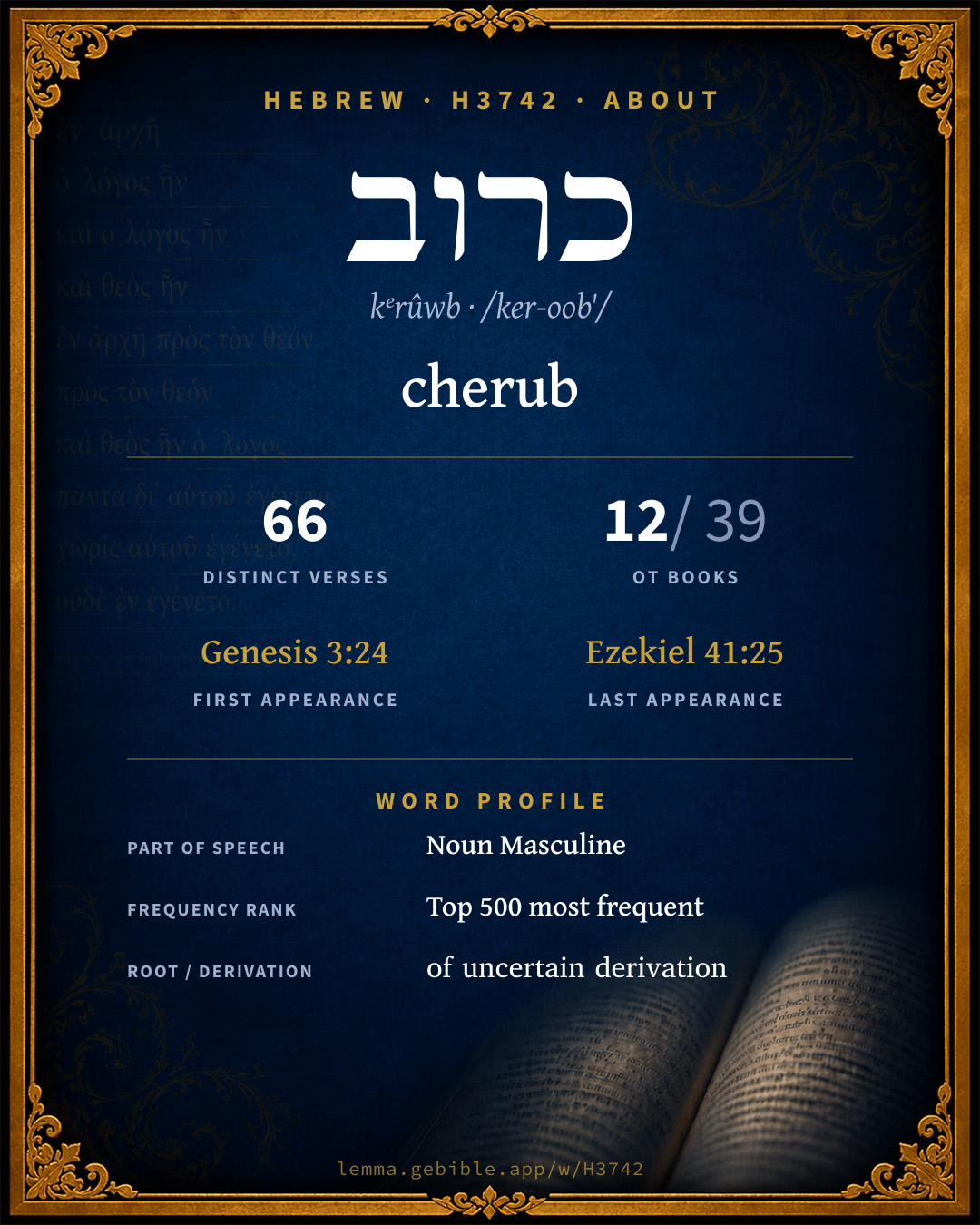
כְּרוּב
cherub
‘cherub’ is one of 5 main senses fuller range ↓
Full lexicon entry — Brown-Driver-Briggs (BDB)
From Brown-Driver-Briggs (BDB)
Where this word appears
Grammar key — what these labels mean
Part of speech
- Noun
- A naming word — a person, place, thing, or idea.
Noun type
- Common
- A common noun — a general class of person, place, or thing (“king,” “city,” “water”), not a specific name.
State
- Absolute
- The independent form of a noun, not bound to a following word.
- Construct
- A noun bound to a following noun in a possessive / “of” relationship (the construct chain).
Gender
- Masculine
- Grammatically masculine.
Number
- Plural
- More than one (in Hebrew, generally three or more).
- Singular
- One.
Every verse where H3742 appears in the Book of 1 Kings — 13 distinct verses. Click any verse to open its interlinear word-by-word view. Verse text shown in the World English Bible for context — . Each verse’s Hebrew form is shown with its reference; the English is not keyword-highlighted, since the data carries no word-level English alignment. Use “Compare translations” on any verse to read it across multiple English versions. This concordance covers the Hebrew Bible; Septuagint (Greek Old Testament) occurrences are not indexed here.
1 Kings
- 1 Kings 6:23 כְרוּבִ֖ים n c mp In the oracle he made two cherubim of olive-wood, each ten cubits high.
- 1 Kings 6:24 הַ/כְּרוּב֙ הַ/כְּר֖וּב ptcl def.art + n c ms ptcl def.art + n c ms Five cubits was the one wing of the cherub, and five cubits the other wing of the cherub: from the uttermost part of the one wing to the uttermost part of the other were ten cubits.
- 1 Kings 6:25 הַ/כְּר֖וּב הַ/כְּרֻבִֽים ptcl def.art + n c ms ptcl def.art + n c mp The other cherub was ten cubits: both the cherubim were of one measure and one form.
- 1 Kings 6:26 הַ/כְּר֣וּב הַ/כְּר֥וּב ptcl def.art + n c ms ptcl def.art + n c ms The height of the one cherub was ten cubits, and so was it of the other cherub.
- 1 Kings 6:27 הַ/כְּרוּבִ֜ים הַ/כְּרֻבִים֒ הַ/כְּר֣וּב ptcl def.art + n c mp ptcl def.art + n c mp ptcl def.art + n c ms He set the cherubim within the inner house; and the wings of the cherubim were stretched forth, so that the wing of the one touched the one wall, and the wing of the other cherub touched the other wall; and their wings touched one another in the midst of the house.
- 1 Kings 6:28 הַ/כְּרוּבִ֖ים ptcl def.art + n c mp He overlaid the cherubim with gold.
- 1 Kings 6:29 כְּרוּבִ֣ים n c mp He carved all the walls of the house round about with carved figures of cherubim and palm trees and open flowers, inside and outside.
- 1 Kings 6:32 כְּרוּבִ֧ים הַ/כְּרוּבִ֥ים n c mp ptcl def.art + n c mp So [he made] two doors of olive-wood; and he carved on them carvings of cherubim and palm trees and open flowers, and overlaid them with gold; and he spread the gold on the cherubim, and on the palm trees.
- 1 Kings 6:35 כְּרוּבִים֙ n c mp He carved [thereon] cherubim and palm trees and open flowers; and he overlaid them with gold fitted on the engraved work.
- 1 Kings 7:29 וּ/כְרוּבִ֔ים conj + n c mp and on the panels that were between the ledges were lions, oxen, and cherubim; and on the ledges there was a pedestal above; and beneath the lions and oxen were wreaths of hanging work.
- 1 Kings 7:36 כְּרוּבִ֖ים n c mp On the plates of the stays of it, and on the panels of it, he engraved cherubim, lions, and palm trees, according to the space of each, with wreaths round about.
- 1 Kings 8:6 הַ/כְּרוּבִֽים ptcl def.art + n c mp The priests brought in the ark of the covenant of Yahweh to its place, into the oracle of the house, to the most holy place, even under the wings of the cherubim.
- 1 Kings 8:7 הַ/כְּרוּבִים֙ הַ/כְּרֻבִ֛ים ptcl def.art + n c mp ptcl def.art + n c mp For the cherubim spread forth their wings over the place of the ark, and the cherubim covered the ark and the poles of it above.
About this entry
At a glance — auto-summarized from this page’s data, not written by a person. Every figure links to its source below. This summary describes the numbers; it doesn’t interpret them.
כרוב — transliterated kᵉrûwb — is a Hebrew noun carrying the sense “cherub.” Its English rendering has broadened — “cherubims” classically, “cherubim” (Berean Standard Bible) in modern versions; see the renderings breakdown. Spanning 66 verses in 12 books, it ranks among the moderately common words of the Hebrew Bible. Its uses concentrate in Ezekiel (33% of all occurrences). The lexicon spreads it across several senses; see its full sense range. Each statement above links to its evidence; the full detail follows below.
Gloss history
Strong's 1890 vs modern scholarship
About this word
Strong's H3742 catalogs a Hebrew word from the Hebrew Old Testament.
These counts are not copied from any lexicon or concordance. They are computed here, from the morphology-tagged Hebrew Old Testament. What Lemma adds →
- 66
- distinct verses
- The word appears in 66 distinct verses.
- 12 / 39
- OT books
- The word appears in 12 of 39 Old Testament books.
- #455
- by frequency
- Top 500 most frequent Hebrew words (rank 455 of 8,640 Hebrew words by occurrence).
View all 66 occurrences in the concordance →
By section of the Old Testament
By traditional corpus
Conventional, traditional groupings — biblical authorship is debated, so this is a traditional corpus grouping, not an authorship claim. Each share is this word’s portion of its verses in that division of the Hebrew canon. Each figure is a share of the word’s 66 distinct verses.
- Prophets (Nevi'im) 40 verses · 61%
- Torah (Pentateuch) 13 verses · 20%
- Writings (Ketuvim) 13 verses · 20%
How translations render this word
Counts come from each version’s own published word-to-Strong’s tagging or interlinear alignment — an approximate guide to how each version renders this word, not a word-level alignment the data otherwise carries. Because each total is that version’s own tagged count, the per-version totals vary from one another and need not match the appearance or distinct-verse counts above. These counts may also differ from a printed concordance because Lemma counts each distinctly tagged rendering and does not collapse phrase taggings into a single head-word total. This is a fixed set of word-tagged versions (KJV, ASV, BSB, ULT) and does not change with the reading translation you choose elsewhere. Each version’s license is shown beside its name below (and on Sources).
BDB lists this Strong’s number as 2 distinct words (homographs). Each count above pools all of them and is not split by sense — see the Senses section below. A low-frequency rendering may belong to a different one of those words, not the primary meaning.
- King James Version†: Cherubims 46×, Cherub 23×, Between the cherubims 9×
- American Standard Version†: Cherubim 41×, Cherub 23×, Above the cherubim 7×
- Berean Standard Bible†: Cherubim 51×, Cherub 15×, Between the cherubim 3×
- unfoldingWord Literal Text†: Cherubim 44×, Cherub 20×, Cherubs 16×
King James Version Public Domain
Renders H3742 across 91† tagged occurrences — most commonly:
Plus 13 renderings that appear only once — usually multi-word phrases or single function words the recovered tagging swept in, not distinct renderings.
American Standard Version Public Domain
Renders H3742 across 90† tagged occurrences — most commonly:
Plus 15 renderings that appear only once — usually multi-word phrases or single function words the recovered tagging swept in, not distinct renderings.
Berean Standard Bible Public Domain
Renders H3742 across 75† tagged occurrences — most commonly:
Plus 4 renderings that appear only once — usually multi-word phrases or single function words the recovered tagging swept in, not distinct renderings. Not rendered by a distinct English word in 16 further occurrences.
unfoldingWord Literal Text CC BY-SA 4.0
Renders H3742 across 105† tagged occurrences — most commonly:
Plus 5 renderings that appear only once — usually multi-word phrases or single function words the recovered tagging swept in, not distinct renderings.
12 senses and sub-senses in the full BDB
What do BDB’s symbols mean?
BDB uses these scholarly abbreviations:
| Symbol | Meaning |
|---|---|
| 𝔊 | the Septuagint (the ancient Greek translation, LXX) |
| 𝔙 | the Vulgate (the Latin translation) |
| 𝔖 | the Syriac version (the Peshitta) |
| 𝔗 | the Targum (the Aramaic translation) |
| ψ | the Psalms |
| √ | root (the underlying root or stem) |
| ‖ | parallel passage (a synonymous or contrasted parallel) |
| † | the dagger: every passage where the word occurs is cited |
The 12 senses and sub-senses the full Brown-Driver-Briggs lexicon distinguishes for this word, in lexicon order (not ranked by frequency), with BDB’s own verbatim wording and sub-sense lettering. Shown in Hebrew script with BDB’s own scholarly abbreviations. The condensed entry is in the Lexicon Entry tab. See also the Forms in the corpus table below.
כרוב I loc. in Babylonia Esr 2
כרוב II cherub
- 1. the living chariot of the theophanic God; possibly identified with the storm-wind ψ 18:11 = 2 S 22:11 וַיִּרְכַּב עַל־כְּרוּב and he rode upon a cherub (‖ flew swiftly on the wings of the wind). e.g. Psalms 18:11
- 2. as the guards of the garden of Eden Gn 3:24 (J). e.g. Genesis 3:24
- 3. as the throne of Yahweh Sabaoth, in phrase י׳ (צְבָאוֹת) יֹשֵׁב הַכְּרוּבִים Yahweh Sabaoth throned on the cherubim 1 S 4:4; 2 S 6:2 = 1 Ch 13:6; the context shews that the cherubim of the ark of the covenant are referred to, and it is probable that the same reference is in 2 K 19:15 = Is 37:16, ψ 80:2; 99:1. e.g. 1 Samuel 4:4
- 4. P gives an account of:
- a. two cherubim of solid gold upon the slab of gold of the כַּפֹּרֶת facing each other with wings outstretched above, so as to constitute a basis or throne on which the glory of Yahweh appeared, and from whence He spake Ex 25:18–22; 37:7–9; Nu 7:89; e.g. Exodus 25:18
- b. numerous cherubim woven into the texture of the inner curtains of the tabernacle and the veils Ex 26:1, 31; 36:8, 35. e.g. Exodus 26:1
- 5. K and Ch describe the cherubim of the temple:
- a. two gigantic images of olive wood plated with gold, ten cubits high, standing in the דְּבִיר facing the door, whose wings, five cubits each, extended, two of them meeting in the middle of the room to constitute the throne, two of them extending to the walls 1 K 6:23–28; 8:6–7 2 Ch 3:10–13; 5:7–8; Ch (doubtless influenced by Ez) represents them as the chariot of Yahweh 1 Ch 28:18; e.g. 1 Kings 6:23
- b. images of cherubim were carved on the gold plated cedar planks which constituted the inner walls of the temple, and upon the olive wood doors 1 K 6:29–35; 2 Ch 3:7; and on the bases of the portable lavers, interchanging with lions and oxen 1 K 7:29–36; Ch also represents that they were woven in the veil of the דְּבִיר 2 Ch 3:14. e.g. 1 Kings 6:29
- 6. Ezekiel describes the cherubim:
- a. as four living creatures, each with four faces, lion, ox, eagle, and man, having the figure and hands of men, and the feet of calves. Each has four wings, two of which are stretched upward, meeting above and sustaining the throne of Yahweh; two of them stretched downwards so as to cover the creatures themselves. The cherubim never turn but go straight forward, as do the wheels of the cherubic chariot, and they are full of eyes and are like burning coals of fire, Ez 1:5–28; 9:3; 10:1–20; 11:22; the king of Tyre is scornfully compared with one of these, and is assigned a residence in Eden and the mountain of God Ez 28:14, 16; e.g. Ezekiel 1:5
- b. Ez knows of no cherubic statues in the new temple, but represents the inner walls of the temple as carved with alternating palm trees and cherubim, each with two faces, the lion looking on one side, the man on the other. It is evident that the number and the form of the cherubim vary in the representations (cf. Ez 41:18–25). It is probable that the שְׂרָפִים of Is 6:2–6 are another form of the cherubim. The Apoc. of the seals Rev 4–6 combines them in four ζῷα. e.g. Ezekiel 41:18
Senses from the full Brown-Driver-Briggs lexicon (Brown, Driver, Briggs; Oxford 1906 — public domain), digitized via Sefaria, supplemented by the OpenScriptures HebrewLexicon (CC BY 4.0). Full attribution on Sources.
Word origin
I. n.pr.loc. in Babylonia Esr 2:59; Neh 7:61.
II. n.m. cherub;—כ׳ Ex 25:19 + 26 times; pl. כְּרוּבִים ψ 99:1 + 33 times; כְּרֻבִים Ex 25:18 + 29 times; (NH id.; Aramaic כְּרוּבָא, ܟܪܽܘܒܳܐ; √ dub.; Assyrian karâbu = be gracious to, bless DlHWB 350, but adj. karûbu is great, mighty, Id. ib. 352; on poss. connex. with כְּרוּב cf. Dl in Baer Ezech. xiii.; Assyrian kirubu = šêdu (name of winged bull in Assyrian; v. LenOrigines i. 118, Eng. Tr. 126 DlPar 154) has not been verified, cf. v. F.ZA i. 68 f. Budge Expos. Apr. May, 1885 Teloni ZA vi. 124 ff.; the older view, connecting כ׳ with γρύψ, and deriving from Pers. giriften, griffen, lacks evidence and probability.—Possibly the thunder-cloud underlies the conception);—
— Brown-Driver-Briggs (Oxford 1906, public domain), digitized via Sefaria, supplemented by the OpenScriptures HebrewLexicon (CC BY 4.0). See Sources.
Origin: of uncertain derivation
Jastrow Dictionary
A second Hebrew/Aramaic lexicon for comparison, covering Aramaic and post-biblical (Talmudic, Targumic, Midrashic) usage that the biblical-Hebrew BDB does not. Matched by lemma rather than by Strong’s number, so a lemma may carry more than one Jastrow headword (shown separately below), and the entries cover usage well beyond the Bible.
כְּרוּב I
- , however, Schr. KAT2 p. 39; p. 609) [head,] Cherub. Succ. 5ᵇ; Ḥag. 13ᵇ … מאי כ׳ כרַבְיָא וכ׳ what is K’rub?—… ‘Childlike’, for in Babylonia they call a child rabia. Ib. והפכו לכ׳ and he changed it (the face of the ox, Ez. I, 10) into that of a Cherub. Ib. היינו פני כ׳ וכ׳ the face of the Ch. is the same as that of man, the one being large, the other small. Yoma 77ᵃ. Lev. R. s. 32; a. e.—Pl. כְּרוּבִים. Tanḥ. ed. Bub. B’resh. 25 לפיכן נקראו כ׳ שהן רבים (read: רוֹבִים, v. רוֹבֶה) they are called Ch., because they are young (childlike), v. supra. Yoma 54ᵇ מעורים וכ׳ הכ׳ ראה saw the figures of the cherubs twined around each other. Ib. 54ᵃ כ׳ דצורתא וכ׳ painted cherubs were in the Second Temple; a. e. e.g. Ezekiel 1:10
כְּרוּב II
- (v. preced.) [rounded,] cabbage. Ter. X, 11 כ׳ של שקייא cabbage from an irrigated field, opp. כ׳ של בעל, v. בַּעַל 3.—Ber. 44ᵇ קלח של כ׳ cabbage stalk. Ib. כ׳ למזון cabbage is good for a satisfying meal. Ned. VI, 10, v. אִיסְפַּרְגּוֹס; a. fr.
רוֹב
- multitude; larger portion; majority. Meg. 15ᵇ (ref. to Esth. V, 11) וכמה ר׳ בניו how large was the multitude of his sons? Bekh. VI, 8 ר׳ המדבר וכ׳ the larger portion of the anterior part of the tongue. Keth. 15ᵃ הולכין אחר ר׳ העיר we are guided by the legal status of the majority of the inhabitants of the town; ר׳ סיעה the majority of the members of the caravan that encamped near the town. Ib.; Ḥull. 95ᵃ, a. e. בנמצא הלך אחר הר׳ when a piece of meat is found, we go by the majority of the meat stalls (to decide whether it be kasher or not). Ib. 3ᵇ, a. e. ר׳ מצויין וכ׳ most of those engaged in slaughtering are experts. Sabb. 118ᵇ רוּבָּן של צדיקים וכ׳ most righteous men die from bowel diseases. Ḥull. II, 1 רוּבֹּו של אחד כמוהו if one cuts through the larger portion of the organ (v. סִימָן), it is considered as if he had cut it through. Hor. 3ᵇ בכל התורה … רובו ככולו in the entire Law we adopt the rule that a majority (or the larger portion) are legally equal to an entirety; Naz. 42ᵃ; a. v. fr.—Gitt. 60ᵇ ר׳ בכתב וכ׳ the majority of the halakhic decisions rests on the Scripture (is derived from the text by interpretation), and the minority on tradition; v. Y. Peah I, 17ᵃ bot.—[Y. Yeb. IV, 6ᵇ top עד שיפרש לו רובו, read: רַבֹּו.] e.g. Esther 5:11
רִיב I
- (b. h.) to contend, strive; to plead. Meg. 21ᵇ הרָב את ריבנו who pleaded our cause.
- same. Tanḥ. Naso 12 כל זמן … אינה מְרִיבָה as long as she was engaged in it, she did not quarrel, v. רָנַן. Y. Taan. IV, 68ᵈ, v. מְסַרְבַּיי. Mekh. B’shall., Vayassʿa, s. 6 כל … מְרִיבִין וכ׳ whenever you strive with me, you tempt God. Tanḥ. Mick. 10 עד … מֵרִיב עמו while he was yet in his mother’s womb, Esau was contending with him. Num. R. s. 5 שלא יָרִיבוּ זה עם זה that they might not quarrel with one another; היה זה מריב וכ׳ this one contended and said, I want to load here &c.; a. fr.
A Dictionary of the Targumim, the Talmud Babli and Yerushalmi, and the Midrashic Literature (Marcus Jastrow; London, Luzac, 1903) — Public Domain. Digitized via Sefaria. Digitized via Sefaria. Full attribution on Sources.
Forms in the corpus
The 54 distinct written forms H3742 takes in the Hebrew Bible, most frequent first — each parse links to that state’s occurrences in the concordance. Hebrew forms include their vowel points and cantillation, so a single lemma takes many written forms.
Same root — word family
Other BDB entries built from the same root as H3742, grouped by Strong’s listed origin. These share a root / origin per the lexicon — not necessarily a shared meaning. Each links to that word’s own entry.
Derived from this word
Proper names from this root
People and places named from this root — a name, not an additional meaning of the word.
Compare all same-root words → 1 of the same-root words is a proper name (a person or place). They share a root, not necessarily a meaning.
Septuagint verse parallels
This word appears in 65 verses that also exist in the Greek Old Testament (Septuagint), out of the 66 Hebrew verses it occurs in. You can read those verses in Greek by switching the Old Testament edition to the Septuagint.
Read these verses in the Septuagint
- Genesis 3:24
- Exodus 25:18
- Numbers 7:89
- 1 Samuel 4:4
- 2 Samuel 6:2
- 1 Kings 6:23
- 2 Kings 19:15
- 1 Chronicles 13:6
- 2 Chronicles 3:7
- Psalms 18:10
- Isaiah 37:16
- Ezekiel 9:3
This is a verse-level parallel only — the same verses exist in both the Hebrew and Greek Old Testaments. No word-level Hebrew↔Greek correspondence is claimed: the data carries no such alignment, so no Greek word is shown as this Hebrew word’s translation. Coverage is not total — the Septuagint omits the deuterocanon and renumbers the Psalms, so some Hebrew verses have no direct Greek parallel.