2 Chronicles 3:14

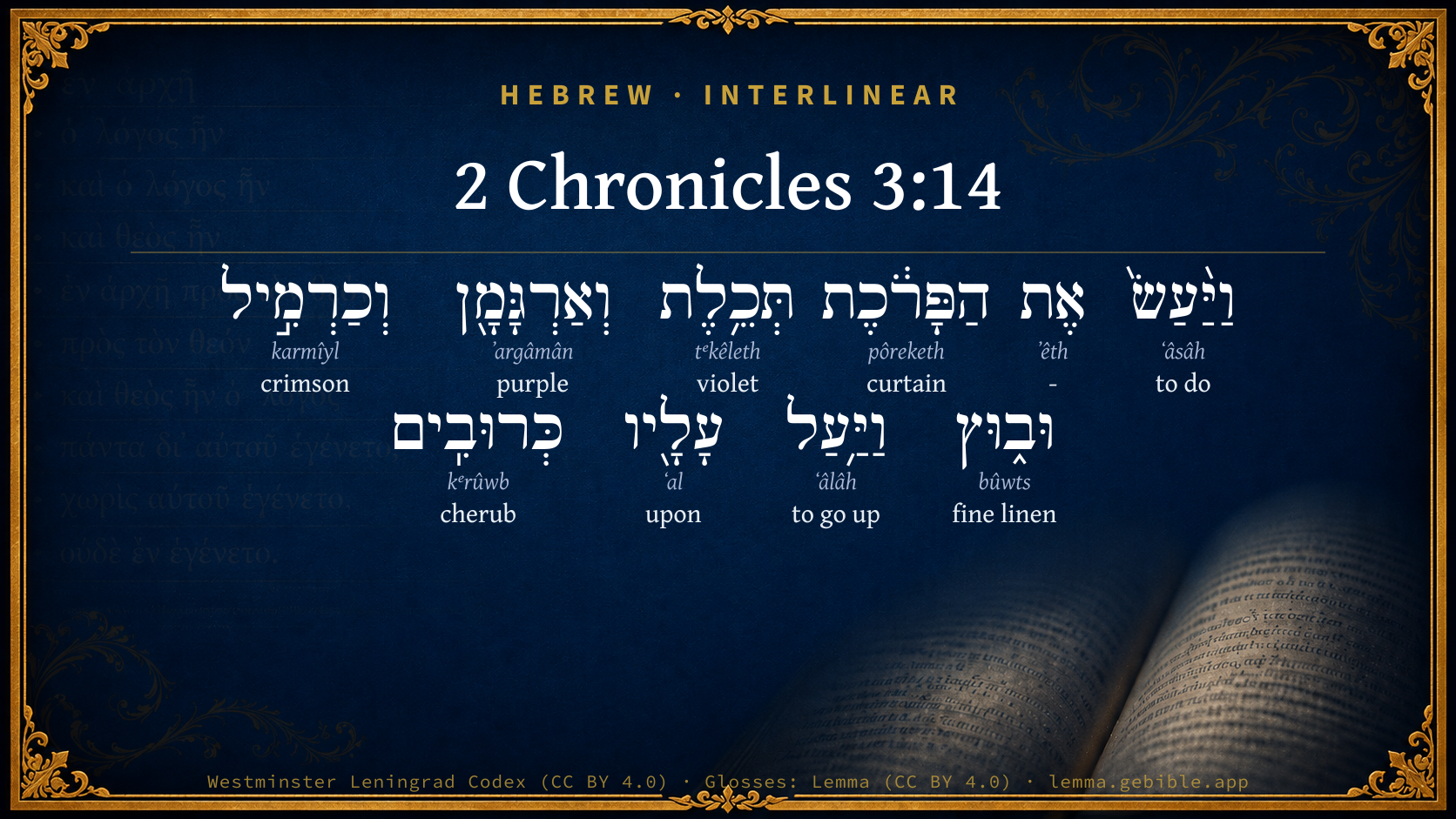
Hebrew (Westminster Leningrad Codex) 2 Chronicles 3:14 appears in the Hebrew Old Testament. The text above is from the Westminster Leningrad Codex. Each word links to its Strong’s number, a concise gloss, and parsing drawn from the Open Scriptures Hebrew Bible morphology. Click any word for its full Brown-Driver-Briggs (BDB) entry.
Download image
Cite this verse

2 Chronicles 3:14 (World English Bible). Public Domain. Lemma interlinear Bible study tool, https://lemma.gebible.app/v/2-chronicles/3/14.

Show BibTeX & RIS
BibTeX
RIS
English Translation
He made the veil of blue, and purple, and crimson, and fine linen, and worked cherubim thereon.
World English Bible · Public Domain
Download a study sheet

One document with this verse’s original text, its word-by-word gloss line, the meaning frame, cross-references with their text, attributed commentary, and full source and license credits — printable, and it pastes into notes with its structure intact.

This verse Autodidact and up

Study sheet (.html) Plain text (.txt)

A passage Seminary Student

Up to 50 verses in one chapter. A passage sheet keeps up to 6 commentary sources and 12 cross-references per verse, in the order this page ranks them, and says so on the sheet whenever that leaves anything out. Ask for a single verse and you get the Autodidact verse sheet above.

Everything on this page stays free to read, with no account — the sheet is a download of what is already on screen, not access to it.

Want to remove ads? Support Godless Engineer
Compare translations 3

The same verse in 3 English versions, stacked beneath the original-language interlinear above. Click any original word for its lexicon entry.

Each is an independent rendering of the whole verse — the interlinear is not word-aligned to these translations.

Highlighted words mark where these versions differ — a whole-verse word diff, not a word-by-word alignment.

  • World English Bible Public Domain
    He made the veil of blue, and purple, and crimson, and fine linen, and worked cherubim thereon.
  • King James Version Public Domain
    And he made the vail of blue, and purple, and crimson, and fine linen, and wrought cherubim thereon.
  • unfoldingWord Literal Text CC BY-SA 4.0
    And he made the curtain of violet, and purple, and crimson and fine linen, and he brought up on it cherubim.

unfoldingWord Literal Text — © unfoldingWord, licensed CC BY-SA 4.0. Word-aligned USFM3 via Door43 (git.door43.org/unfoldingWord/en_ult).

Versions to compare (up to 4)

3 of 4 selected

Show all 18 translations

Every available English version of this verse, each an independent rendering of the whole verse.

  • World English Bible Public Domain
    He made the veil of blue, and purple, and crimson, and fine linen, and worked cherubim thereon.
  • Berean Standard Bible Public Domain
    He made the veil of blue, purple, and crimson yarn and fine linen, with cherubim woven into it.
  • Majority Standard Bible Public Domain
    He made the veil of blue, purple, and crimson yarn and fine linen, with cherubim woven into it.
  • King James Version Public Domain
    And he made the vail of blue, and purple, and crimson, and fine linen, and wrought cherubim thereon.
  • American Standard Version (1901) Public Domain
    And he made the veil of blue, and purple, and crimson, and fine linen, and wrought cherubim thereon.
  • Revised Version (1885) Public Domain
    And he made the veil of blue, and purple, and crimson, and fine linen, and wrought cherubim thereon.
  • Geneva Bible (1599) Public Domain
    He made also the vaile of blew silke and purple, and crimosin, and fine linen, and wrought Cherubims thereon.
  • Douay-Rheims (1899) Public Domain
    He made also a veil of violet, purple, scarlet, and silk: and wrought in it cherubims.
  • Young's Literal Translation Public Domain
    And he maketh the vail of blue, and purple, and crimson, and fine linen, and causeth cherubs to go up on it.
  • Literal Standard Version CC BY-SA 4.0
    And he makes the veil of blue, and purple, and crimson, and fine linen, and causes cherubim to go up on it.
  • Unlocked Literal Bible CC BY-SA 4.0
    He made the curtain of blue, purple, and crimson wool and fine linen, and he fashioned cherubs on it.
  • unfoldingWord Literal Text CC BY-SA 4.0
    And he made the curtain of violet, and purple, and crimson and fine linen, and he brought up on it cherubim.
  • Darby Bible Public Domain
    And he made the veil of blue, and purple, and crimson, and byssus, and made cherubim upon it.
  • World Messianic Bible Public Domain
    He made the veil of blue, purple, crimson, and fine linen, and ornamented it with cherubim.
  • Webster's Bible Public Domain
    And he made the vail of blue, and purple, and crimson, and fine linen, and wrought cherubim upon it.
  • Free Bible Version CC BY-SA 4.0
    He made the veil of blue, purple, and crimson embroidery on fine linen, with images of cherubim on it.
  • Bible in Basic English Public Domain
    And he made the veil of blue and purple and red, of the best linen, worked with winged ones.
  • JPS Tanakh (1917) Public Domain
    And he made the veil of blue, and purple, and crimson, and fine linen, and wrought cherubim thereon.

Literal Standard Version (2020), Covenant Press — licensed CC BY-SA 4.0. Text via the HelloAO Bible API (eBible.org). Unlocked Literal Bible (unfoldingWord) — licensed CC BY-SA 4.0. Text via the HelloAO Bible API (eBible.org). unfoldingWord Literal Text — © unfoldingWord, licensed CC BY-SA 4.0. Word-aligned USFM3 via Door43 (git.door43.org/unfoldingWord/en_ult). Free Bible Version, Dr. Jonathan Gallagher — licensed CC BY-SA 4.0. Text via the HelloAO Bible API (eBible.org).

Word by word

More ways to search: Search by grammar → Find every occurrence → Compare this word →

Practice this passage: Drill this verse → Learn its vocabulary →

וְכַרְמִ֣יל
karmîyl
H3758
“and · crimson”
Conjunction + Noun, Common, Masculine, Singular, Absolute
Part of Speech
Conjunction + Noun
Type
Common
Gender
Masculine
Number
Singular
State
Absolute
Full BDB Definition

Origin: probably of foreign origin

TWOT: 1043

crimson, red, carmine
  1. וַיַּ֨עַשׂ֙ ʻâsâh H6213 “and · to do” Conjunction + Verb, Qal, Sequential Imperfect, 3rd Person, Masculine, Singular
  2. אֶת ʼêth H853 “-” Particle, Direct Object
  3. הַפָּרֹ֔כֶת pôreketh H6532 “the · curtain” Particle, Definite Article + Noun, Common, Feminine, Singular, Absolute
  4. תְּכֵ֥לֶת tᵉkêleth H8504 “violet” Noun, Common, Feminine, Singular, Absolute
  5. וְאַרְגָּמָ֖ן ʼargâmân H713 “and · purple” Conjunction + Noun, Common, Masculine, Singular, Absolute
  6. וּב֑וּץ bûwts H948 “and · fine linen” Conjunction + Noun, Common, Masculine, Singular, Absolute
  7. וַיַּ֥עַל ʻâlâh H5927 “and · to go up” Conjunction + Verb, Hiphil, Sequential Imperfect, 3rd Person, Masculine, Singular
  8. עָלָ֖יו ʻal H5921 “upon · him” Preposition + Suffix, Personal, 3rd Person, Masculine, Singular
  9. כְּרוּבִֽים kᵉrûwb H3742 “cherubim” Noun, Common, Masculine, Plural, Absolute

About this verse

These counts appear in no published source. They are computed here, from the morphology-tagged text and Lemma’s own curated glosses. What Lemma adds →

10
words
10
distinct lemmas
Historical
section

Notable vocabulary

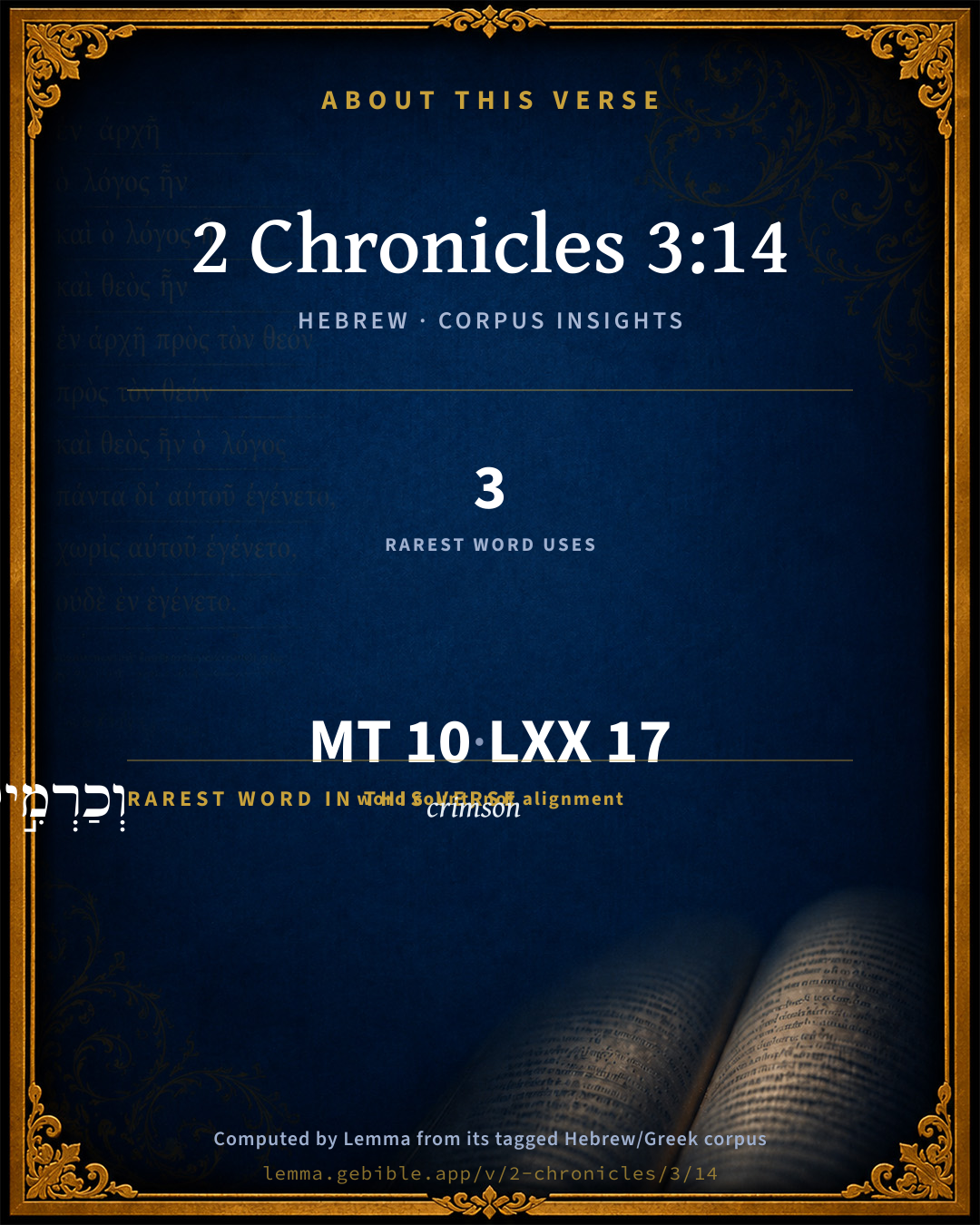
The rarest word here is וְכַרְמִ֣יל crimson H3758 — appearing just 3 times in the whole Hebrew Bible.

Shared distinctive vocabulary

וְכַרְמִ֣יל crimson H3758 occurs in 3 verses of the Hebrew Bible. Also found in:

Grammatical profile

  • 2 verbs
  • 6 nouns
  • 1 preposition
  • 1 particle

Verb forms

  • וַיַּ֨עַשׂ֙ Qal · Sequential Imperfect
  • וַיַּ֥עַל Hiphil · Sequential Imperfect

Hebrew & Septuagint length

In English translation the verse runs 17 words from the Hebrew and 19 from the Septuagint (LXX English) — closely comparable.

A rough comparison of the two English renderings, which tokenize alike — not a word-level alignment.

Word counts can differ between the Hebrew and the Greek without any difference in meaning — e.g. the Hebrew direct-object marker אֵת has no separate Greek word, and Greek often adds the article ὁ.

In the original languages it is 10 Hebrew tokens and 17 Greek tokens — but the two are counted differently (Hebrew bundles its prefixes and suffixes into one token; the Greek is in lemma form), so that isn’t a like-for-like length.

Cross-references

4

Topical passages linked to 2 Chronicles 3:14 in the Treasury of Scripture Knowledge — connected by theme and wording, ordered by reader-vote popularity; previews shown in the World English Bible.

  • Hebrews 9:3 After the second veil was the tabernacle which is called the Holy of Holies,
  • Exodus 26:31–35 "You shall make a veil of blue, and purple, and scarlet, and fine twined linen, with cherubim. The work of the skillful workman shall it be made.
  • Matthew 27:51 Behold, the veil of the temple was torn in two from the top to the bottom. The earth quaked and the rocks were split.
  • Hebrews 10:20 by the way which he dedicated for us, a new and living way, through the veil, that is to say, his flesh;

Cross-references courtesy of OpenBible.info (CC BY 4.0).

Hebrew and Greek witnesses Masoretic Hebrew ↔ Greek Septuagint

The same verse in the two great witnesses to the Old Testament, shown verse-for-verse.

These are two independent witnesses, not word-aligned to each other, and the Septuagint is shown in lemma (dictionary) form.

Hebrew 2 Chronicles 3:14 Masoretic · Westminster Leningrad Codex

וַיַּ֨עַשׂ֙ אֶת הַפָּרֹ֔כֶת תְּכֵ֥לֶת וְאַרְגָּמָ֖ן וְכַרְמִ֣יל וּב֑וּץ וַיַּ֥עַל עָלָ֖יו כְּרוּבִֽים

He made the veil of blue, and purple, and crimson, and fine linen, and worked cherubim thereon.

World English Bible · Public Domain

Greek LXX 2 Chronicles 3:14 Septuagint · lemma form

καί ποιέω ὁ καταπέτασμα ἐκ ὑάκινθος καί πορφύρα καί κόκκινος καί βύσσος καί ὑφαίνω ἐν αὐτός χερουβιν

And he made the vail of blue, and purple, and scarlet, and fine linen, and wove cherubs in it.

LXX2012 (modern English Septuagint) · Public Domain

Hebrew: Westminster Leningrad Codex (CC BY 4.0). Greek: Septuagint (public domain); English from LXX2012 (modern English Septuagint) (Public Domain). How the Septuagint differs from the Hebrew →

Commentary

Notes on 2 Chronicles 3:14 from classic Christian and Jewish commentators (each source and its license shown beneath its notes). The classic Christian expositions comment on the surrounding passage and are grouped to its opening verse, so a note may address several verses; the Jewish commentaries on the Tanakh (Rashi and others) are per-verse, so they appear only where the commentator wrote on this verse.

Lemma curates 59 commentaries, every one of them public domain or Creative Commons licensed, each selected and text-cleaned for this edition rather than reprinted as found. About our sources →

Trapp's Complete Commentary

John Trapp

2Ch 3:14 And he made the vail [of] blue, and purple, and crimson, and fine linen, and wrought cherubims thereon.

Ver. 14. And he made the veil.] See on 1Ki 6:21.

John Trapp, A Commentary or Exposition upon All the Books of the Old and New Testament (1647–1656) — public domain. Text from a community e-Sword module.

Joseph Benson's Commentary

2Ch 3:14. And he made the veil, &c. — The inner veil, which parted between the holy and the most holy place. This denoted the darkness of that dispensation, and the distance at which the worshippers were kept. But at the death of Christ this veil was rent; for through him we are brought nigh, and have boldness, or παρρησια, liberty, Heb 10:19, not only to look, but to enter into the holiest. And wrought cherubims thereon — Hebrew, ויעל, vajagnal, he caused to ascend; that is, they were made in raised work, embossed, and appeared probably on the wing, in an ascending posture, to remind the worshippers to raise their thoughts and affections to God, and to soar upward in their devotions.

Joseph Benson's Commentary on the Old and New Testaments (1811–1818) — public domain. Text from a community e-Sword module.

Geneva Bible (1599)

Geneva Bible translators

Which separated the Temple from the most holy place.

Geneva Bible (1599) marginal notes — public domain. Text via Bolls.life.

Ellicott's Commentary for English Readers

(14) The vail.—The Pârôkheth, or curtain, which divided the holy place from the holy of holies, is not mentioned in the existing text of 1Ki_6:21, which passage, however, speaks of the chains of gold by which the vail was probably suspended.

Blue, and purple, and crimson, and fine linen.—See Notes on 2Ch_2:7; 2Ch_2:14.

Wrought.—See Note on “set,” 2Ch_3:5. Here raised figures in tapestry or broidered work are meant. (See Exo_26:31, which gives an identical description of the vail of the tabernacle.)

A Bible Commentary for English Readers, edited by Charles John Ellicott (1878–1897) — public domain. Text from a community e-Sword module.

The Cambridge Bible for Schools and Colleges

gen. ed. J. J. S. Perowne

14 (cp. Exo_26:31-32). The Vail

No vail for Solomon’s Temple is mentioned in 1 Kings, but (1Ki_6:31-32) doors of olive wood with cherubim carved upon them stood at the entrance of the Holy of Holies. The vail here described seems to have been borrowed by the Chronicler from the account of the tabernacle given in Exodus.

The Cambridge Bible for Schools and Colleges (gen. ed. J. J. S. Perowne; Cambridge University Press, 1878–1918) — public domain. Text from a community e-Sword module.

Albert Barnes' Notes on the Bible

This is an important addition to the description in Kings, where the veil is not mentioned. It was made of exactly the same colors as the veil of the tabernacle Exo 26:31.

Albert Barnes' Notes on the Bible (1834–1885) — public domain. Text from a community e-Sword/MySword module.

Haydock's Catholic Bible Commentary

A veil. Abulensis places it between the court and the holy: but Jansenius would have it before the holy of holies. It seems rather that there was a veil in both places, (Barad. t. ii. b. iii. 23.; Menochius) as Josephus ([Antiquities?] viii. 2., and xii. 10.) clearly intimates; and St. Paul speaks of the second veil, Hebrews ix. 3. It is not certain which of them was torn at the death of Jesus Christ, Matthew xxvii. 51. Cherubims; extraordinary figures. (Calmet)

George Leo Haydock (1774–1849), Haydock's Catholic Family Bible and Commentary, 1859 edition — public domain. Excludes Psalms (Douay-Rheims chapter numbering differs from Protestant) and Deuterocanonical books (Catholic canon only).

Matthew Poole's English Annotations

The veil, to wit, the inner veil before the most holy place by comparing this with Exo 26:31; 1Ki 6:21.

Matthew Poole's English Annotations on the Holy Bible (1683–1685) — public domain. Text from a community e-Sword/MySword module.

The Pulpit Commentary

The veil of blue, and purple, and crimson, and fine linen. (Exo_26:31, Exo_26:33, 35 36:35 40:3, 21) It is remarkable that our parallel (1Ki 6) does not make mention of the veil, though a feature of which so much was always made (Mat_27:51; Mar_15:38 Luk_23:45; Heb_6:19 Heb_9:3) On the other hand, it is remarkable that our present passage does not make mention of the folding "doors of olive tree," which, with "the veil," intercepted the approach to the oracle, (1Ki_6:31, 1Ki_6:32) nor of the partition walls (1Ki_6:16) in which they were situate, nor of the "partition chains (1Ki_6:21) of gold before the oracle."

The Pulpit Commentary (1880–1919), ed. H.D.M. Spence-Jones & Joseph S. Exell — public domain. Text from a community e-Sword module.

John Wesley's Explanatory Notes

The veil - The inner veil before the most holy place. This denoted the darkness of that dispensation and the distance at which the worshippers were kept. But at the death of Christ this veil was rent; for thro' him we are brought nigh, and have boldness, or liberty, not only to look, but to enter into the holiest.

John Wesley, Explanatory Notes Upon the Whole Bible (1754–1765) — public domain. Text via the GEBible commentary corpus.

Keil & Delitzsch

C. F. Keil & F. Delitzsch

The veil between the holy place and the most holy, not mentioned in Kg1 6:21, was made of the same materials and colours as the veil on the tabernacle, and was inwoven with similar cherub figures; cf. Exo 26:31. וּבוּץ כּרמיל as in Ch2 2:13. עלה על, to bring upon; an indefinite expression for: to weave into the material.

Keil & Delitzsch — Biblical Commentary on the Old Testament (1861–1891) — public domain (CC PDM 1.0). Text via the HelloAO Bible API. (Old Testament only.)

Rashi

Rabbi Shlomo Yitzchaki (Rashi)

And he made the dividing curtain of blue, purple and he hung it on the door that was in the cubit between the two partitions, through which they would enter the Holy of Holies. Although it had doors, he hung it upon it as further (4:22): “And the entrance to the House, its inner doors to the Holy of Holies, etc.”

and he wrought cherubim into it pictures of cherubim.

Rashi on the Tanakh — English translations: “The Judaica Press complete Tanach with Rashi, translated by A. J. Rosenberg” (CC BY 4.0); “Pentateuch with Rashi's commentary by M. Rosenbaum and A.M. Silbermann, 1929-1934” (public domain); “The Metsudah Tanach series, Lakewood, N.J” (CC BY 4.0); and “The Book of Joshua, Metsudah Publications, 1997” (CC BY 4.0). Text via Sefaria.

Lesson kit

Teaching starters — assembled from the data on this page, not authored interpretation. Every prompt links to the verse data it draws on. Edit before teaching.

2 Chronicles, in the Historical, opens this verse with 10 words (10 distinct Hebrew lemmas). Its most distinctive word is karmîyl (“crimson”). A historical commentator’s framing appears above. Read the whole chapter for the surrounding context.

Discussion questions

  1. How does “crimson” (karmîyl) shape what this verse is saying?
  2. 2 Chronicles 2:7 shares the word «crimson» with this verse. How do the two illuminate each other?
  3. These translations render this verse differently. What is at stake in choosing one wording over another?
  4. The verb «וַיַּ֨עַשׂ֙» is Qal Sequential Imperfect. How does its form color the action?
  5. Reading how Trapp's Complete Commentary and Joseph Benson's Commentary read this verse, where do the two commentators agree and where do they part?

Things to notice

Reading settings

Reading text

Shown beneath each verse's original-language words.

Old Testament
Old Testament edition

Read the OT as the Masoretic Hebrew (MT) or the Greek Septuagint (LXX).

English shown for the Greek Septuagint (in the Hebrew ↔ Greek comparison).

Comparing translations? Open the Compare panel on any verse page to stack up to four side by side.