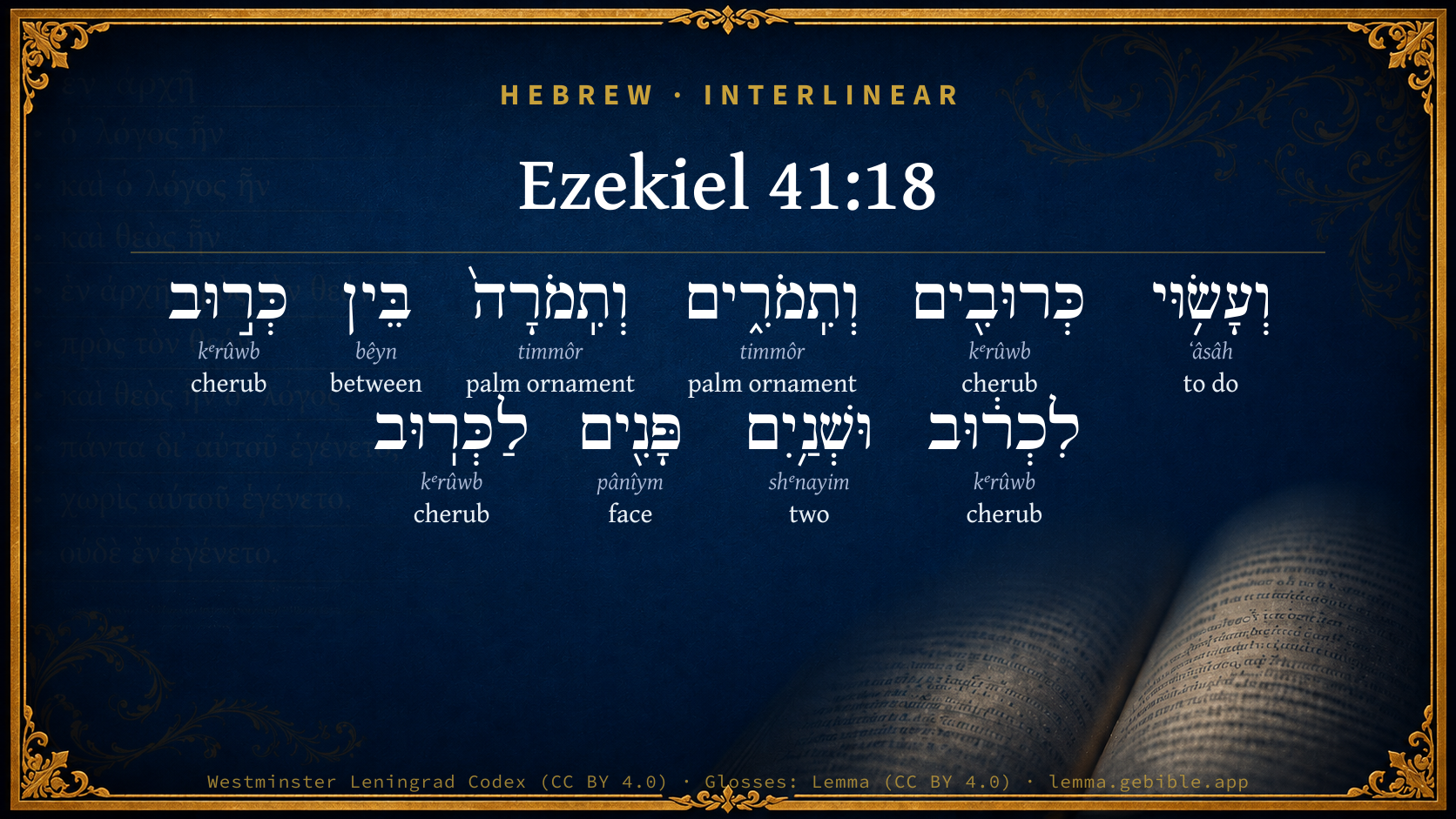
Ezekiel 41:18

Hebrew (Westminster Leningrad Codex) Ezekiel 41:18 appears in the Hebrew Old Testament. The text above is from the Westminster Leningrad Codex. Each word links to its Strong’s number, a concise gloss, and parsing drawn from the Open Scriptures Hebrew Bible morphology. Click any word for its full Brown-Driver-Briggs (BDB) entry.
Download image
Cite this verse

Ezekiel 41:18 (World English Bible). Public Domain. Lemma interlinear Bible study tool, https://lemma.gebible.app/v/ezekiel/41/18.

Show BibTeX & RIS
BibTeX
RIS
English Translation
It was made with cherubim and palm trees; and a palm tree was between cherub and cherub, and every cherub had two faces;
World English Bible · Public Domain
Download a study sheet

One document with this verse’s original text, its word-by-word gloss line, the meaning frame, cross-references with their text, attributed commentary, and full source and license credits — printable, and it pastes into notes with its structure intact.

This verse Autodidact and up

Study sheet (.html) Plain text (.txt)

A passage Seminary Student

Up to 50 verses in one chapter. A passage sheet keeps up to 6 commentary sources and 12 cross-references per verse, in the order this page ranks them, and says so on the sheet whenever that leaves anything out. Ask for a single verse and you get the Autodidact verse sheet above.

Everything on this page stays free to read, with no account — the sheet is a download of what is already on screen, not access to it.

Want to remove ads? Support Godless Engineer
Compare translations 3

The same verse in 3 English versions, stacked beneath the original-language interlinear above. Click any original word for its lexicon entry.

Each is an independent rendering of the whole verse — the interlinear is not word-aligned to these translations.

Highlighted words mark where these versions differ — a whole-verse word diff, not a word-by-word alignment.

  • World English Bible Public Domain
    It was made with cherubim and palm trees; and a palm tree was between cherub and cherub, and every cherub had two faces;
  • King James Version Public Domain
    And it was made with cherubims and palm trees, so that a palm tree was between a cherub and a cherub; and every cherub had two faces;
  • unfoldingWord Literal Text CC BY-SA 4.0
    It was decorated with cherubim and palm trees; with a palm tree between each cherub, and each cherub had two faces:

unfoldingWord Literal Text — © unfoldingWord, licensed CC BY-SA 4.0. Word-aligned USFM3 via Door43 (git.door43.org/unfoldingWord/en_ult).

Versions to compare (up to 4)

3 of 4 selected

Show all 18 translations

Every available English version of this verse, each an independent rendering of the whole verse.

  • World English Bible Public Domain
    It was made with cherubim and palm trees; and a palm tree was between cherub and cherub, and every cherub had two faces;
  • Berean Standard Bible Public Domain
    were alternating carved cherubim and palm trees. Each cherub had two faces:
  • Majority Standard Bible Public Domain
    were alternating carved cherubim and palm trees. Each cherub had two faces:
  • King James Version Public Domain
    And it was made with cherubims and palm trees, so that a palm tree was between a cherub and a cherub; and every cherub had two faces;
  • American Standard Version (1901) Public Domain
    And it was made with cherubim and palm-trees; and a palm-tree was between cherub and cherub, and every cherub had two faces;
  • Revised Version (1885) Public Domain
    And it was made with cherubim and palm trees; and a palm tree was between cherub and cherub, and every cherub had two faces;
  • Geneva Bible (1599) Public Domain
    And it was made with Cherubims and palme trees, so that a palme tree was betweene a Cherub and a Cherub: and euery Cherub had two faces.
  • Douay-Rheims (1899) Public Domain
    And there were cherubims and palm trees wrought, so that a palm tree was between a cherub and a cherub, and every cherub had two faces.
  • Young's Literal Translation Public Domain
    And it is made `with' cherubs and palm-trees, and a palm-tree `is' between cherub and cherub, and two faces `are' to the cherub;
  • Literal Standard Version CC BY-SA 4.0
    And it is made [with] cherubim and palm-trees, and a palm-tree [is] between cherub and cherub, and two faces [are] on the cherub;
  • Unlocked Literal Bible CC BY-SA 4.0
    It was decorated with cherubim and palm trees; with a palm tree between each cherub, and each cherub had two faces:
  • unfoldingWord Literal Text CC BY-SA 4.0
    It was decorated with cherubim and palm trees; with a palm tree between each cherub, and each cherub had two faces:
  • Darby Bible Public Domain
    And it was made with cherubim and palm-trees, and a palm-tree was between cherub and cherub; and the cherub had two faces:
  • World Messianic Bible Public Domain
    It was made with cherubim and palm trees. A palm tree was between cherub and cherub, and every cherub had two faces,
  • Webster's Bible Public Domain
    And it was made with cherubim and palm-trees, so that a palm-tree was between a cherub and a cherub; and every cherub had two faces;
  • Free Bible Version CC BY-SA 4.0
    were carved designs of cherubim and palm trees. Every cherub had two faces:
  • Bible in Basic English Public Domain
    And it had pictured forms of winged beings and palm-trees; a palm-tree between two winged ones, and every winged one had two faces;
  • JPS Tanakh (1917) Public Domain
    And it was made with cherubim and palm-trees; and a palm-tree was between cherub and cherub, and every cherub had two faces;

Literal Standard Version (2020), Covenant Press — licensed CC BY-SA 4.0. Text via the HelloAO Bible API (eBible.org). Unlocked Literal Bible (unfoldingWord) — licensed CC BY-SA 4.0. Text via the HelloAO Bible API (eBible.org). unfoldingWord Literal Text — © unfoldingWord, licensed CC BY-SA 4.0. Word-aligned USFM3 via Door43 (git.door43.org/unfoldingWord/en_ult). Free Bible Version, Dr. Jonathan Gallagher — licensed CC BY-SA 4.0. Text via the HelloAO Bible API (eBible.org).

Word by word

More ways to search: Search by grammar → Find every occurrence → Compare this word →

Practice this passage: Drill this verse → Learn its vocabulary →

וְתִֽמֹרִ֑ים
timmôr
H8561
“and · palm ornaments”
Conjunction + Noun, Common, Feminine, Plural, Absolute
Part of Speech
Conjunction + Noun
Type
Common
Gender
Feminine
Number
Plural
State
Absolute
Full BDB Definition

Origin: from the same root as H8558

TWOT: 2523c

palm tree figure (as ornament)
  1. וְעָשׂ֥וּי ʻâsâh H6213 “and · done” Conjunction + Verb, Qal, Participle Passive, Masculine, Singular, Absolute
  2. כְּרוּבִ֖ים kᵉrûwb H3742 “cherubim” Noun, Common, Masculine, Plural, Absolute
  3. וְתִֽמֹרָה֙ timmôr H8561 “and · palm ornament” Conjunction + Noun, Common, Feminine, Singular, Absolute
  4. בֵּין bêyn H996 “between” Preposition
  5. כְּר֣וּב kᵉrûwb H3742 “cherub” Noun, Common, Masculine, Singular, Absolute
  6. לִכְר֔וּב kᵉrûwb H3742 “to/for · cherub” Preposition + Noun, Common, Masculine, Singular, Absolute
  7. וּשְׁנַ֥יִם shᵉnayim H8147 “and · two” Conjunction + Adjective, Cardinal number, Masculine, Dual, Absolute
  8. פָּנִ֖ים pânîym H6440 “face(s)” Noun, Common, Both, Plural, Absolute
  9. לַכְּרֽוּב kᵉrûwb H3742 “to/for the · cherub” Preposition, Determined + Noun, Common, Masculine, Singular, Absolute

About this verse

These counts appear in no published source. They are computed here, from the morphology-tagged text and Lemma’s own curated glosses. What Lemma adds →

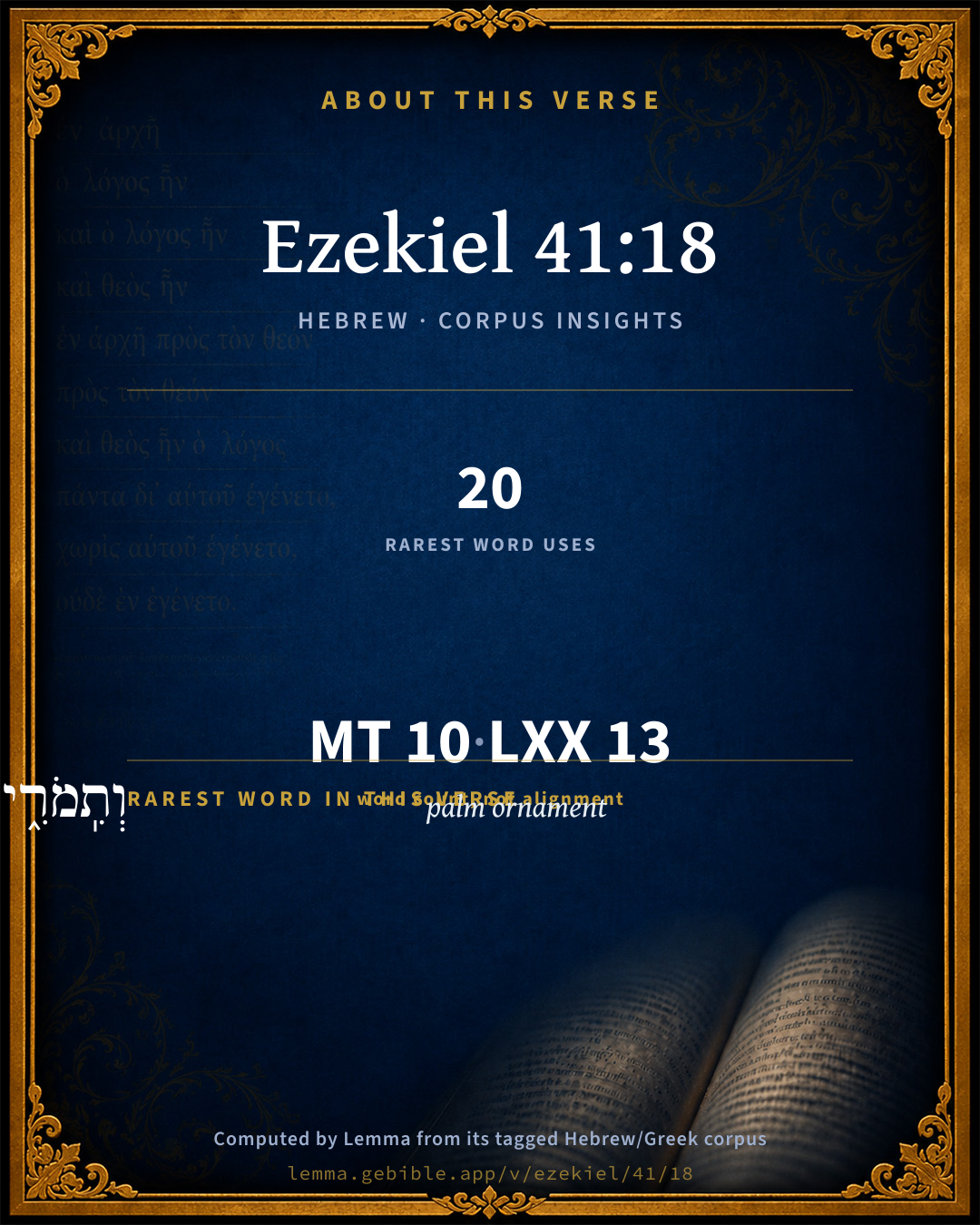
10
words
6
distinct lemmas
Prophets
section

Notable vocabulary

The rarest word here is וְתִֽמֹרִ֑ים palm ornament H8561 — appearing just 20 times in the whole Hebrew Bible.

Shared distinctive vocabulary

וְתִֽמֹרִ֑ים palm ornament H8561 occurs in 16 verses of the Hebrew Bible. Also found in:

Grammatical profile

  • 1 verb
  • 7 nouns
  • 1 adjective
  • 1 preposition

Verb forms

  • וְעָשׂ֥וּי Qal · Participle Passive

Repetition

Words recur within this verse — often emphatic in Hebrew:

  • כְּרוּבִ֖ים cherub H3742 ×4
  • וְתִֽמֹרִ֑ים palm ornament H8561 ×2

Hebrew & Septuagint length

In English translation the verse runs 23 words from the Hebrew and 14 from the Septuagint (LXX English) — the Septuagint runs noticeably shorter here. See the side-by-side →

A rough comparison of the two English renderings, which tokenize alike — not a word-level alignment.

Word counts can differ between the Hebrew and the Greek without any difference in meaning — e.g. the Hebrew direct-object marker אֵת has no separate Greek word, and Greek often adds the article ὁ.

In the original languages it is 10 Hebrew tokens and 13 Greek tokens — but the two are counted differently (Hebrew bundles its prefixes and suffixes into one token; the Greek is in lemma form), so that isn’t a like-for-like length.

Cross-references

14

Topical passages linked to Ezekiel 41:18 in the Treasury of Scripture Knowledge — connected by theme and wording, ordered by reader-vote popularity; previews shown in the World English Bible.

  • 1 Kings 7:36 On the plates of the stays of it, and on the panels of it, he engraved cherubim, lions, and palm trees, according to the space of each, with wreaths round about.
  • Ezekiel 40:16 There were closed windows to the lodges, and to their posts within the gate round about, and likewise to the arches; and windows were round about inward; and on [each] post were palm trees.
  • 2 Chronicles 3:7 He overlaid also the house, the beams, the thresholds, and the walls of it, and the doors of it, with gold; and engraved cherubim on the walls.
  • Ezekiel 10:21 Every one had four faces, and every one four wings; and the likeness of the hands of a man was under their wings.
  • Ezekiel 40:22 The windows of it, and the arches of it, and the palm trees of it, were after the measure of the gate whose prospect is toward the east; and they went up to it by seven steps; and the arches of it were before them.
  • 1 Kings 6:29–32 He carved all the walls of the house round about with carved figures of cherubim and palm trees and open flowers, inside and outside.
  • 1 Kings 6:35 He carved [thereon] cherubim and palm trees and open flowers; and he overlaid them with gold fitted on the engraved work.
  • 2 Chronicles 3:5 The greater house he made a ceiling with fir-wood, which he overlaid with fine gold, and worked thereon palm trees and chains.
  • Ezekiel 1:10 As for the likeness of their faces, they had the face of a man; and they four had the face of a lion on the right side; and they four had the face of an ox on the left side; they four had also the face of an eagle.
  • Ezekiel 10:14 Every one had four faces: the first face was the face of the cherub, and the second face was the face of a man, and the third face the face of a lion, and the fourth the face of an eagle.
  • Ezekiel 41:20 from the ground to above the door were cherubim and palm trees made: thus was the wall of the temple.
  • Ezekiel 41:25 There were made on them, on the doors of the temple, cherubim and palm trees, like as were made on the walls; and there was a threshold of wood on the face of the porch outside.
  • Revelation 4:7–9 The first creature was like a lion, and the second creature like a calf, and the third creature had a face like a man, and the fourth was like a flying eagle.
  • Revelation 7:9 After these things I looked, and behold, a great multitude, which no man could number, out of every nation and of all tribes, peoples, and languages, standing before the throne and before the Lamb, dressed in white robes, with palm branches in their hands.

Cross-references courtesy of OpenBible.info (CC BY 4.0).

Hebrew and Greek witnesses Masoretic Hebrew ↔ Greek Septuagint

The same verse in the two great witnesses to the Old Testament, shown verse-for-verse.

Here the Septuagint runs noticeably shorter than the Hebrew — LXX2012 (modern English Septuagint) 14 words vs World English Bible 23. A rough length comparison of the two English translations, not a word-level alignment — read both below.

These are two independent witnesses, not word-aligned to each other, and the Septuagint is shown in lemma (dictionary) form.

Hebrew Ezekiel 41:18 Masoretic · Westminster Leningrad Codex

וְעָשׂ֥וּי כְּרוּבִ֖ים וְתִֽמֹרִ֑ים וְתִֽמֹרָה֙ בֵּין כְּר֣וּב לִכְר֔וּב וּשְׁנַ֥יִם פָּנִ֖ים לַכְּרֽוּב

It was made with cherubim and palm trees; and a palm tree was between cherub and cherub, and every cherub had two faces;

World English Bible · Public Domain

Greek LXX Ezekiel 41:18 Septuagint · lemma form

γλύφω χερουβείμ καί φοῖνιξ ἀνά μέσος χερουβ καί χερουβ δύο πρόσωπον ὁ χερουβ

were carved cherubs and palm-trees between the cherubs, and each cherub had two faces.

LXX2012 (modern English Septuagint) · Public Domain

On this verse, Joseph Benson's Commentary discusses the Septuagint’s reading. Read the note in Commentary ↓

Hebrew: Westminster Leningrad Codex (CC BY 4.0). Greek: Septuagint (public domain); English from LXX2012 (modern English Septuagint) (Public Domain). How the Septuagint differs from the Hebrew →

Targum (Aramaic paraphrase)

1

The Targum is the ancient Jewish Aramaic paraphrase of the Hebrew Scriptures — an interpretive translation, not the Hebrew text itself. Onkelos (literal) and Pseudo-Jonathan (expansive) render the Torah, and Jonathan the Prophets. Coverage is partial: where no permissively-licensed English translation exists for a verse, only the Aramaic is shown. This is verse-level text, not a word-by-word alignment to the Hebrew.

  1. Targum Jonathan Prophets (Joshua–Malachi)
    וּגְלִיף כְּרוּבִין וְכוֹתְרָן וְכוֹתַרְתָּא בֵּין כְּרוּבָא לִכְרוּבָא וּתְרֵין אַפִּין לִכְּרוּבָא:

    (no public-domain English translation for this verse)

    Targum Jonathan — Aramaic: “Mikraot Gedolot” (public domain). English: “Sefaria Community Translation” (CC0 1.0 (public-domain dedication)); “London "Chaldee Paraphrase," 1871” (public domain). Text via Sefaria.

Commentary

Notes on Ezekiel 41:18 from classic Christian and Jewish commentators (each source and its license shown beneath its notes). The classic Christian expositions comment on the surrounding passage and are grouped to its opening verse, so a note may address several verses; the Jewish commentaries on the Tanakh (Rashi and others) are per-verse, so they appear only where the commentator wrote on this verse.

Lemma curates 59 commentaries, every one of them public domain or Creative Commons licensed, each selected and text-cleaned for this edition rather than reprinted as found. About our sources →

Ellicott's Commentary for English Readers

(18) With cherubims and palm trees.—Eze_41:18-21 describe the interior ornamentation of the Temple, which was like that of the Temple of Solomon (1Ki_6:29-30). It may be assumed that here, as there, these figures were carved upon the woodwork. The “s” at the end of “cherubims” is quite unnecessary, “cherubim” itself being plural.

Every cherub had two faces.—In Ezekiel 1, 10 the cherubim are represented each with four faces, but being merely symbolic, not actual creatures, they may be modified at pleasure, and here, in accordance with the exigencies of the carving, they have but two faces.

A Bible Commentary for English Readers, edited by Charles John Ellicott (1878–1897) — public domain. Text from a community e-Sword module.

Trapp's Complete Commentary

John Trapp

Eze 41:18 And [it was] made with cherubims and palm trees, so that a palm tree [was] between a cherub and a cherub; and [every] cherub had two faces;

Ver. 18. And it was made with cherubims and palm trees.] Viz., Upon the partition walls. This was to teach Christians, who are the temples of God, (1.) To live like angels for holiness; (2.) To suffer, as palm trees, any pressures or pains for his sake with invincible patience. {a} By their piety in their lives, and patience at their death, the primitive Christians won much upon their persecutors.

{a} Pressa sub ingenti ceu pondere palma virescit. - Plin., lib. xiii. cap. 4. Sub cruce sic florent dedita corda Deo.

John Trapp, A Commentary or Exposition upon All the Books of the Old and New Testament (1647–1656) — public domain. Text from a community e-Sword module.

Joseph Benson's Commentary

Eze 41:18-20. And it was made with cherubims and with palm-trees — On the inside of the house the walls were adorned with carved work of cherubim and palm-trees, as Solomon’s temple was, 1Ki 6:29. The cherubs and palm-trees were placed alternately; and according to the different ways of counting them, you might reckon a palm-tree placed between two cherubs, or a cherubim placed between two palm-trees. So the face of a man was toward a palm-tree, &c. — The cherubim had four faces, or appearances, but only two of these appeared plainly in this carved work; the two other faces, namely, that of an ox and an eagle, being supposed to be hid in the plain or surface of the wall. From the ground unto above the door — Up to the windows, as it is expressed Eze 41:16, or up to the ceiling, as the LXX. explain it.

Joseph Benson's Commentary on the Old and New Testaments (1811–1818) — public domain. Text from a community e-Sword module.

Adam Clarke's Commentary

Verse 18. A palm tree was between a cherub and a cherub] That is, the palm trees and the cherubs were alternated; and each cherub had two faces, one of a lion, and the other of a man; one of which was turned to the palm tree on the right, the other to the palm tree on the left.

Adam Clarke's Commentary on the Bible (1810–1826) — public domain. Text from a community e-Sword/MySword module.

John Gill's Exposition

And it was made with cherubim and palm trees,.... That is, all the wall of the house round about was ornamented with these, even both of the holy and of the most holy place; with these the curtains of Moses's tabernacle, and the vail that divided between the holy and the most holy place, were decorated; as also the walls, both of the sanctuary and oracle, in Solomon's temple, Exo 26:1. The former, according to the commonly received notion, were an emblem of angels; the latter of true believers, or holy upright men: why these are called palm trees; see Gill on Eze 40:16,

so that a palm tree was between a cherub and a cherub; these were so placed all around, that there was first a cherub, next a palm tree, and then a cherub again, and so on; and if angels and saints are meant, and that notion could be supported, which some have given into, that the number of men redeemed by Christ is the same with that of the angels that fell, and their places are filled up by them; this would serve to illustrate it, particularly as these were all around the walls of the most holy place; a type of heaven, as here of the New Jerusalem state; that as there was a cherub and a palm tree, a cherub and a palm tree, throughout all the house, so an angel and a saint, an angel and a saint, throughout all the mansions in the holy city, and in the heavenly glory:

and every cherub had two faces: which, by what follows, were the faces of a man, and of a lion. The "cherubim" Ezekiel saw in his first vision had four faces, Eze 1:10 and so these must be supposed to have, though only two were seen; because these were carved or painted on the walls, so that the hindmost faces, those of the ox and eagle, could not be perceived.

John Gill's Exposition of the Whole Bible (1746–1763) — public domain (CC PDM 1.0). Text via the HelloAO Bible API.

Albert Barnes' Notes on the Bible

On the symbolism of the “cherubim” see Eze 1:1 note ...

Every cherub had two faces - Not as in Ezek. 1, “four faces.” Convenience of delineation upon a wall may have suggested the alteration. The cherubic devices on the curtains of the tabernacle Exo 26:1; Exo 36:8 were no doubt like the cherubim over the ark, of which we have no reason to suppose that each had “two faces.” The symbolic character here admitted of the deviation.

Albert Barnes' Notes on the Bible (1834–1885) — public domain. Text from a community e-Sword/MySword module.

Haydock's Catholic Bible Commentary

Two. Before he describes them with four faces. But they varied, (Exodus xxv. 18.) or the other two might be against the wall. (Calmet) --- The cherub signified "knowledge," and the palm-tree victory, to shew that man must be instructed with divine knowledge, and so fight for the victory. The face of man implied that Christ would suffer, and that of a lion announced that he would overcome all his enemies. (Worthington)

George Leo Haydock (1774–1849), Haydock's Catholic Family Bible and Commentary, 1859 edition — public domain. Excludes Psalms (Douay-Rheims chapter numbering differs from Protestant) and Deuterocanonical books (Catholic canon only).

Matthew Poole's English Annotations

Now we are acquainted with the ornaments, the beautiful carving, which in all parts mentioned were to be seen.

Made; beautified.

Cherubims; generally taken for the portrait of angels, and framed to the beauty of young men with wings. Yet is the description of them very different in different places, as the curious observe in Ezekiel’s vision, Eze 1, Isaiah’s vision, Isa 6, John’s vision, Re 4, and in Solomon’s temple.

Palm trees; a very beautiful, upright tree, from a straight, well-grown body, spreading its head with large boughs and branches, which were used on occasions of joy, and were emblems of victory, Joh 12:13; Rev 7:9. These were so engraven, that each palm tree was between two cherubs, and each cherub between two palm trees, and this ariseth from the different aspect, or numbering them.

Two faces, curiously wrought on the same head, somewhat like a Janus’s head; what these facts were the next verse tells us.

Matthew Poole's English Annotations on the Holy Bible (1683–1685) — public domain. Text from a community e-Sword/MySword module.

Whedon's Commentary on the Bible

Daniel D. Whedon

18-20. The symbolic meaning of the carving upon the wainscoting was doubtless the same as the similar carving in Solomon’s temple. The palm represented life and fruitfulness in Babylon as in Palestine (compare Psa_92:12), and the double-faced cherub was the guardian of life, having lion-like strength united with human intelligence. The living cherubim previously described had a larger significance than these old and ornamental forms. (Compare “cherubim,” Eze_10:20.)

Daniel D. Whedon (gen. ed.), Commentary on the Old and New Testaments (1874–1909) — public domain. Text from a community e-Sword module.

The Pulpit Commentary

Vers. 18-20 As in Solomon"s temple, (1Ki_6:29) the wainscoting was adorned with artistic carving of cherubim and palm trees, a palm tree and a cherub standing alternately. Each cherub had two of its four faces exhibited (since four could not be conveniently represented on a plain surface) a man"s face (symbolizing the rational creation) directed towards the palm tree on one side, and a young lion"s face (symbolizing the irrational creation) turned towards the palm tree on the other side. This particular style of ornamentation was employed from the ground unto above the door, which Plumptre interprets as an indication of the height of the palm trees and cherubic figures, but which probably meant the same thing as the preceding clause, "through all the house round about." Cherubic figures formed part of the adornment of the tabernacle curtains. (Exo_26:1 Exo_36:8) (On the nature of the cherubim and their symbolic significance, see Eze_1:5-10)

Cherubims and palm trees.

Ezekiel is here in the midst of his favorite imagery. But as there were no palm trees in the old tabernacle of the wilderness, nor in Solomon"s temple, why does the prophet plant them among his cherubim?

I THE FUTURE WILL BE VICTORIOUS. The old times were times of darkness, fear, difficulty, and strife. Even yet we are not out of the noise of the battle, and perhaps a more fierce conflict is gathering. But beyond all these is the peace of Divine victory assured to the servants of Christ. This was anticipated by the exultant Galilaeans, who spread palm branches before our Lord as he rode up to Jerusalem. Now, the vision of the palm trees should encourage patience and inspire energy. A splendid future is Before us; let us, then, press on with undimmed hope.

1. The palm tree is lofty. It shoots straight up and towers above the plain, a graceful and a conspicuous object. The happy future will be exalted and heavenly.

2. The palm tree bears all its fruit on its summit. It is a high, bare pillar, crowned with fruit and foliage. Men must climb to reach its treasures. The victory of Christian experience is not for those who grovel in earthly-mindedness.

3. The palm flourishes in the desert. It is the one fruitful tree of the desert. The victory of Christ over Satan was obtained amidst outward darkness and despair. His future victory over all evil may be among discouraging external signs. We need not despair of the human desert if the palm of Christ is there.

4. The palm tree requires water for its nourishment. It will not grow in the sandy wastes of the Sahara. The victory of Christianity depends on hidden supplies of the water of life.

II THE VICTORY OF THE FUTURE WILL BE DIVINE. The palm tree is in the temple, planted among the heavenly cherubim. It is a bit of nature surrounded with things never found in nature. Christ"s kingdom grows upon earth. The people of God are to flourish like the palm tree. (Psa_92:12) But this prosperity is no mere natural growth of wild humanity; neither is it the cultivated product of secular education. The palm tree is not in the well-pruned and tended garden, but in the temple. It is through religion that we are led on by Christ to victory.

1. There is the conquest of evil. The palm tree is planted by the place of sacrifices in the temple. We can only hope for a good future when the wrongs and sins of mankind, which are its greatest evils, are overcome.

2. There is dedication to God. The palm tree grows in a holy place. We must be devoted to God if we would enjoy his smile and favor. The highest glory will crown the work of the most devoted servant of Christ. At the monastery of Mar Saba, in the wilderness of the Dead Sea, a palm tree grows on a shelf of the rock high up a wild, barren cliff, and yet flourishes there and bears fruit, because as the monks say it springs from a date-stone sown by the saint who founded the monastery. True saints will grow palms of victory from the hardest lives.

Vers. 18-20, 25. The significance of the cherubim.

Among the difficulties that attend this question, it seems clear that these composite forms were intended either to represent the human or the angelic, not the Divine. The idea of any artistic representation of the Divine Being in a Hebrew temple is surely quite inadmissible. (see Deu_4:15-17) Making our choice, then, between the human and the angelic, we distinctly prefer the former, and think that the general idea is that man, when raised to the highest conceivable condition, when possessed of the greatest variety of powers, should bring everything he has and is to the worship and service of God. The fact that, in Ezekiel"s vision, the cherubim had so large a share in the ornamentation, "made through all the house round about," suggests the very close connection there should be between the finest and highest powers of man and the worship of God. In other places (see Eze 1) we have a far fuller description of these "living ones," and there we have the idea not only of "peerless strength and majesty" suggested by the "face of a young lion" (ver. 19), but also of patient, productive labor (the ox), and of penetrating vision (the eagle); while the thought of swift motion is conveyed both by the wings and the wheels of the prophet"s former vision. Conceive man at his very best, endowed generally with such powers as he is never or rarely possessed of now; add to those capacities which he does enjoy those which are borrowed from other nonhuman spheres; and as he would then be, thus invested, thus enlarged and crowned, the fitting thing would be for him to be found in the temple, blessing and praising God. This is so, in several aspects and for many reasons.

I IT IS HIS MOST SACRED AND BOUNDEN DUTY. For however high in dignity man may rise, and to whatever commanding faculty he may attain, it is certain that:

1. He will always owe everything he may be or may possess to the creative power of God, and that:

2. He will be dependent on the providential goodness of God for their continuance. Thus gratitude and hope should bring him to the sanctuary, to bless God for bestowing them upon him, and to ask him to sustain and to enlarge them.

II IT IS HIS TRUEST AND HIGHEST HONOR. There are many engagements by which man does some honor to his human nature; e.g. conversing, reading, discussing, meditating, planning, learning, executing works of art, composing works of literature, etc. But never does he confer such honor on himself as when he is worshipping God; then the life of the "living one" reaches its very highest point. To come consciously into the near presence of God, to hold communion with the Eternal, to hymn his praise, to dwell in thought upon his nature and his high purposes, to speak his Divine truth or hear it, to work with him toward the gracious and glorious end he has in view, there is nothing we can do, here or perhaps hereafter, so worthy of, so honorable to, our human nature. Man reaches the very summit of his manhood when he is engaged in worshipping God.

III IT IS THE SOURCE OF THE PUREST AND MOST EXALTING JOY. Of all sources of delight, beginning with the sensuous and rising to the spiritual, there can be none purer or more ennobling than this.

IV IT BRINGS DOWN A LARGE SHARE OF DIVINE BLESSING. C.

Vers. 18-20, 25. The significance of the palm trees.

The cherubim and the palm trees were closely associated; both were largely represented, and they were found in close conjunction: "a palm tree was between a cherub and a cherub." Both of them pictured the righteous man in the sanctuary of God, but while the cherub signified the good man at his best bringing himself and all that he had as an offering to God, the palm tree stood for the good man as one who had been made what he was by the services of the sanctuary; the one was enlarged and ennobled humanity brining its offering to God, the other was that same humanity gaining its goodness and worth from God and from his house. "The righteous shall flourish like the palm tree," said the psalmist. (Psa_92:12) And there is very good reason why that tree should be taken as a type or picture of the righteous man; there is also excellent reason why the prominence of the palm tree in the prophet"s vision should picture the truth that man"s goodness is the fair and excellent result of much communion with God. Among the resemblances are these

I ITS UPRIGHTNESS. Some trees are irregular, they are twisted and tortuous in their growth; some hug the ground before they rise; but the palm rises straight toward heaven, it stands upright among the trees. "Like some tall palm the noiseless fabric grew." The good man is well figured here; he is the man who does not stoop, who does not bend and bow earthward, who stands erect, who moves in one heavenward direction, who is governed constantly by true and abiding principles. And these he gains from God and from his house. There, in the sanctuary, he is sustained in his principles, is reminded of them, gains fresh inspiration to illustrate and adorn them.

II ITS FRUITFULNESS. The palm, as a fruit-bearing tree, bearing a fruit which is remarkably nutritious for the date will sustain life for a long time, without any other kind of food is an admirable picture of the righteous man. He bears fruit; he is expected to "bear much fruit," and fruit of many kinds: excellency of spirit, love, joy, peace, long-suffering, etc.; worthiness of life, consistency, blamelessness, practical kindness, etc.; earnest effort to do good, patient, prayerful endeavor to awaken the slumbering, to elevate the fallen, to comfort the sorrowful, to encourage the feeble, etc. And if he does this, it can only be by having much to do with Jesus Christ his Lord. He must be a branch abiding in the vine; he must maintain a very close spiritual connection with Christ; and how shall he do this without the ordinances of his house?

III ITS BEAUTY. The palm tree lends a great charm to the landscape when seen standing in clusters upon the heights against the sky; and its evergreen foliage makes each particular tree an object of beauty. The righteous man is he whose character is fair, excellent, admirable. When he is what his Master calls on him to be, and what he actually becomes when he seeks the strength and refreshment to be found in communion with God, then the more he is observed the more he is admired. Those qualities are found in him which are "lovely and of good report;" he is unselfish, pure, considerate, open-handed, patient, brave, loyal, loving. His goodness, like the foliage of the palm, grows not near the ground, where it can easily be soiled and lost, but high up, where lower things cannot damage or destroy it.

IV ITS ELASTICITY. The fiber of the palm is so elastic that, even when loaded with considerable weights, it still grows determinately upwards (see Smith"s "Dictionary of the Bible"). The good man may have much to depress him and to hamper his growth, but if he "dwells in the house of the Lord," he will rise, notwithstanding all that would otherwise check him, to a noble height of virtue and of piety.

V ITS ULTIMATE TRIUMPH. It does not promise much at the beginning. "It is rough to the touch and enveloped in dry bark, but above it is adorned with fruit so is the life of the elect, despised below, beautiful above; down below straitened by innumerable afflictions, but on high it is expanded into a foliage of beautiful greenness". C. (Heb_12:11)

The Pulpit Commentary (1880–1919), ed. H.D.M. Spence-Jones & Joseph S. Exell — public domain. Text from a community e-Sword module.

John Wesley's Explanatory Notes

Cherubim - Generally taken for the portrait of angels, or young men with wings: yet is the description of them very different in different places; in Ezekiel's vision, chap. i, 5-14; x, 14, Isaiah's vision, Isaiah vi, 2, John's vision, Rev. iv, 6-8, and in Solomon's temple, 1 Kings vi, 23-26.

John Wesley, Explanatory Notes Upon the Whole Bible (1754–1765) — public domain. Text via the GEBible commentary corpus.

unfoldingWord translationNotes

Door43 World Missions Community

was decorated

"was made beautiful"

cherubim

See how you translated this in Ezekiel 9:3.

cherub

This is the singular form of "cherubim." See how you translated this in Ezekiel 10:9.

the house

"the temple"

translationWords

cherub

palm

lions

unfoldingWord translationNotes — © Distant Shores Media and the Door43 World Missions Community, licensed CC BY-SA 4.0. Source: git.door43.org/Door43/en_tn.

Rashi

Rabbi Shlomo Yitzchaki (Rashi)

And [it was] made of cherubim and palm trees And that cedar wood was decorated with cherubim and palm trees.

and the cherub had two faces One, the face of a young lion, and one, the face of a man. This one faced this way, and that one faced that way, and when the palm tree was between one cherub and another cherub, the face of the young lion was toward it from this side, and the face of man from that side, as is stated in this account.

Rashi on the Tanakh — English translations: “The Judaica Press complete Tanach with Rashi, translated by A. J. Rosenberg” (CC BY 4.0); “Pentateuch with Rashi's commentary by M. Rosenbaum and A.M. Silbermann, 1929-1934” (public domain); “The Metsudah Tanach series, Lakewood, N.J” (CC BY 4.0); and “The Book of Joshua, Metsudah Publications, 1997” (CC BY 4.0). Text via Sefaria.

Lesson kit

Teaching starters — assembled from the data on this page, not authored interpretation. Every prompt links to the verse data it draws on. Edit before teaching.

Ezekiel, in the Prophets, opens this verse with 10 words (6 distinct Hebrew lemmas). Its most distinctive word is timmôr (“palm ornament”). The Greek Septuagint runs shorter here. A historical commentator’s framing appears above. Read the whole chapter for the surrounding context.

Discussion questions

  1. The word timmôr carries the sense “palm ornament.” How does it shape the verse?
  2. How does 1 Kings 6:29, which shares the word «palm ornament», read alongside this verse?
  3. What does the repetition of “cherub” (4× in this one verse) do in this verse?
  4. The Septuagint runs shorter here than the Hebrew. What might account for the difference?
  5. The translations on this page render this verse differently — a whole-verse word diff, not a word-by-word alignment. What might account for the different wordings?
  6. «וְעָשׂ֥וּי» is a Qal Participle Passive verb. How does that grammatical form shape the action described?
  7. Compare how Ellicott's Commentary for English Readers and Trapp's Complete Commentary read this verse. Where do they agree or differ?

Things to notice

Reading settings

Reading text

Shown beneath each verse's original-language words.

Old Testament
Old Testament edition

Read the OT as the Masoretic Hebrew (MT) or the Greek Septuagint (LXX).

English shown for the Greek Septuagint (in the Hebrew ↔ Greek comparison).

Comparing translations? Open the Compare panel on any verse page to stack up to four side by side.