Ezekiel 10:20

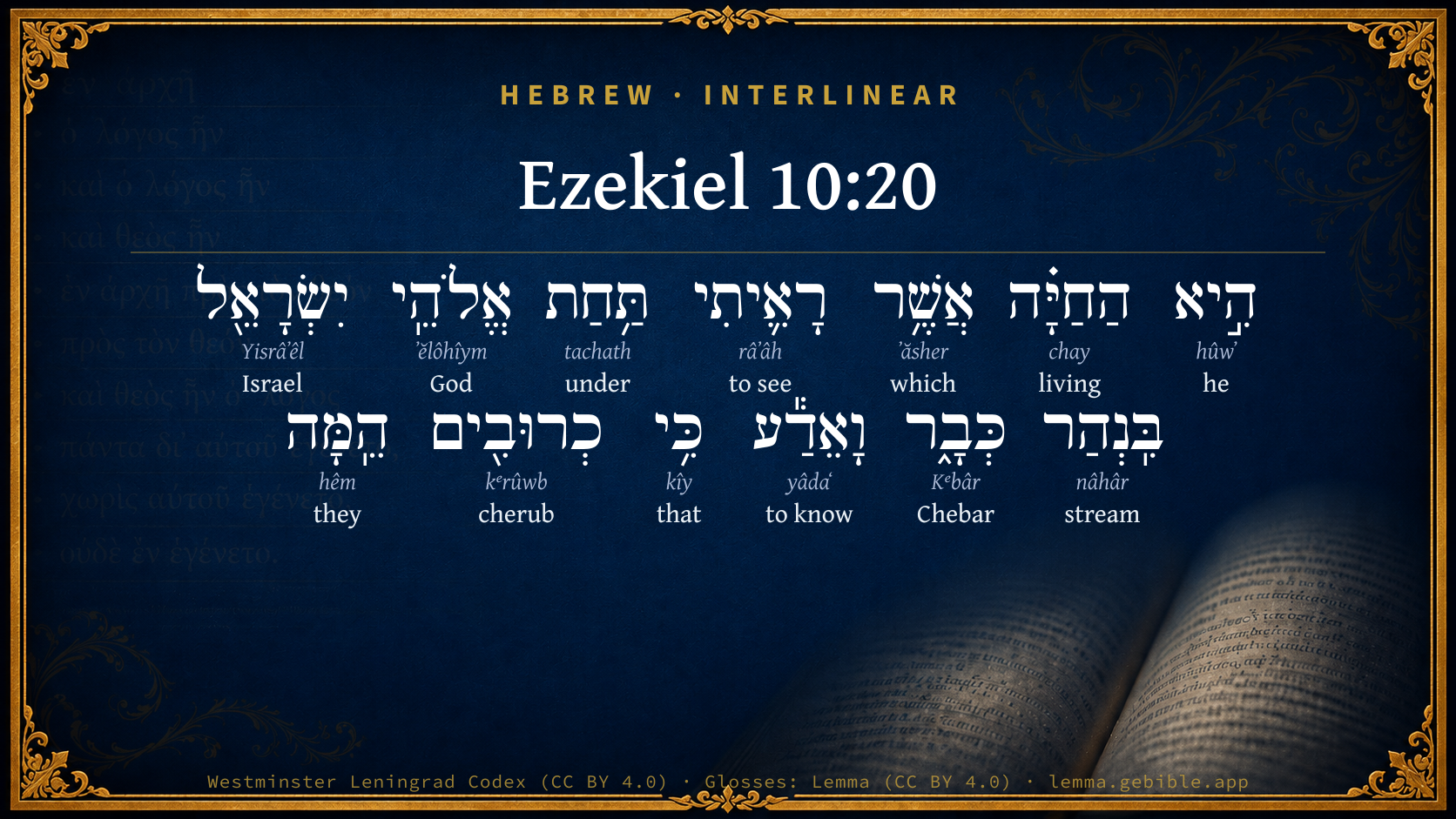
Hebrew (Westminster Leningrad Codex) Ezekiel 10:20 appears in the Hebrew Old Testament. The text above is from the Westminster Leningrad Codex. Each word links to its Strong’s number, a concise gloss, and parsing drawn from the Open Scriptures Hebrew Bible morphology. Click any word for its full Brown-Driver-Briggs (BDB) entry.
Download image
Cite this verse

Ezekiel 10:20 (World English Bible). Public Domain. Lemma interlinear Bible study tool, https://lemma.gebible.app/v/ezekiel/10/20.

Show BibTeX & RIS
BibTeX
RIS
English Translation
This is the living creature that I saw under the God of Israel by the river Chebar; and I knew that they were cherubim.
World English Bible · Public Domain
Download a study sheet

One document with this verse’s original text, its word-by-word gloss line, the meaning frame, cross-references with their text, attributed commentary, and full source and license credits — printable, and it pastes into notes with its structure intact.

This verse Autodidact and up

Study sheet (.html) Plain text (.txt)

A passage Seminary Student

Up to 50 verses in one chapter. A passage sheet keeps up to 6 commentary sources and 12 cross-references per verse, in the order this page ranks them, and says so on the sheet whenever that leaves anything out. Ask for a single verse and you get the Autodidact verse sheet above.

Everything on this page stays free to read, with no account — the sheet is a download of what is already on screen, not access to it.

Want to remove ads? Support Godless Engineer
Compare translations 3

The same verse in 3 English versions, stacked beneath the original-language interlinear above. Click any original word for its lexicon entry.

Each is an independent rendering of the whole verse — the interlinear is not word-aligned to these translations.

Highlighted words mark where these versions differ — a whole-verse word diff, not a word-by-word alignment.

  • World English Bible Public Domain
    This is the living creature that I saw under the God of Israel by the river Chebar; and I knew that they were cherubim.
  • King James Version Public Domain
    This is the living creature that I saw under the God of Israel by the river of Chebar; and I knew that they were the cherubims.
  • unfoldingWord Literal Text CC BY-SA 4.0
    These were the living creatures that I had seen below the God of Israel by the Kebar Canal, so I knew that they were cherubim!

unfoldingWord Literal Text — © unfoldingWord, licensed CC BY-SA 4.0. Word-aligned USFM3 via Door43 (git.door43.org/unfoldingWord/en_ult).

Versions to compare (up to 4)

3 of 4 selected

Show all 18 translations

Every available English version of this verse, each an independent rendering of the whole verse.

  • World English Bible Public Domain
    This is the living creature that I saw under the God of Israel by the river Chebar; and I knew that they were cherubim.
  • Berean Standard Bible Public Domain
    These were the living creatures I had seen beneath the God of Israel by the River Kebar, and I knew that they were cherubim.
  • Majority Standard Bible Public Domain
    These were the living creatures I had seen beneath the God of Israel by the River Kebar, and I knew that they were cherubim.
  • King James Version Public Domain
    This is the living creature that I saw under the God of Israel by the river of Chebar; and I knew that they were the cherubims.
  • American Standard Version (1901) Public Domain
    This is the living creature that I saw under the God of Israel by the river Chebar; and I knew that they were cherubim.
  • Revised Version (1885) Public Domain
    This is the living creature that I saw under the God of Israel by the river Chebar; and I knew that they were cherubim.
  • Geneva Bible (1599) Public Domain
    This is the beast that I sawe vnder the God of Israel by the riuer Chebar, and I knewe that they were the Cherubims.
  • Douay-Rheims (1899) Public Domain
    This is the living creature, which I saw under the God of Israel by the river Chobar: and I understood that they were cherubims.
  • Young's Literal Translation Public Domain
    It `is' the living creature that I saw under the God of Israel by the river Chebar, and I know that they are cherubs.
  • Literal Standard Version CC BY-SA 4.0
    It [is] the living creature that I saw under the God of Israel by the river Chebar, and I know that they are cherubim.
  • Unlocked Literal Bible CC BY-SA 4.0
    These were the living creatures that I had seen below the God of Israel by the Kebar Canal, so I knew that they were cherubim!
  • unfoldingWord Literal Text CC BY-SA 4.0
    These were the living creatures that I had seen below the God of Israel by the Kebar Canal, so I knew that they were cherubim!
  • Darby Bible Public Domain
    This is the living creature that I saw under the God of Israel by the river Chebar; and I knew that they were cherubim.
  • World Messianic Bible Public Domain
    This is the living creature that I saw under the God of Israel by the river Chebar; and I knew that they were cherubim.
  • Webster's Bible Public Domain
    This is the living creature that I saw under the God of Israel by the river of Kebar; and I knew that they were the cherubim.
  • Free Bible Version CC BY-SA 4.0
    These were the beings I had seen beneath the God of Israel by the River Kebar. I knew that they were cherubim.
  • Bible in Basic English Public Domain
    This is the living being which I saw under the God of Israel by the river Chebar; and it was clear to me that they were the winged ones.
  • JPS Tanakh (1917) Public Domain
    This is the living creature that I saw under the God of Israel by the river Chebar; and I knew that they were cherubim.

Literal Standard Version (2020), Covenant Press — licensed CC BY-SA 4.0. Text via the HelloAO Bible API (eBible.org). Unlocked Literal Bible (unfoldingWord) — licensed CC BY-SA 4.0. Text via the HelloAO Bible API (eBible.org). unfoldingWord Literal Text — © unfoldingWord, licensed CC BY-SA 4.0. Word-aligned USFM3 via Door43 (git.door43.org/unfoldingWord/en_ult). Free Bible Version, Dr. Jonathan Gallagher — licensed CC BY-SA 4.0. Text via the HelloAO Bible API (eBible.org).

Word by word

More ways to search: Search by grammar → Find every occurrence → Compare this word →

Practice this passage: Drill this verse → Learn its vocabulary →

כְּבָ֑ר
Kᵉbâr
H3529
“Chebar”
Noun, Proper
Part of Speech
Noun
Type
Proper
Full BDB Definition

Origin: the same as H3528

TWOT: 947d

Chebar = "far-off" - a Babylonian river near which many Israelite exiles settled; maybe the 'Habor' or the 'Royal Canal' of Nebuchadnezzar
  1. הִ֣יא hûwʼ H1931 “he” Pronoun, Personal, 3rd Person, Feminine, Singular
  2. הַחַיָּ֗ה chay H2416 “the · living” Particle, Definite Article + Noun, Common, Feminine, Singular, Absolute
  3. אֲשֶׁ֥ר ʼăsher H834 “which” Particle, Relative
  4. רָאִ֛יתִי râʼâh H7200 “to see” Verb, Qal, Perfect, 1st Person, Common, Singular
  5. תַּ֥חַת tachath H8478 “under” Preposition
  6. אֱלֹהֵֽי ʼĕlôhîym H430 “God(s) of” Noun, Common, Masculine, Plural, Construct
  7. יִשְׂרָאֵ֖ל Yisrâʼêl H3478 “Israel” Noun, Proper
  8. בִּֽנְהַר nâhâr H5104 “in/at · stream of” Preposition + Noun, Common, Masculine, Singular, Construct
  9. וָאֵדַ֕ע yâdaʻ H3045 “and · to know” Conjunction + Verb, Qal, Sequential Imperfect, 1st Person, Common, Singular
  10. כִּ֥י kîy H3588 “that” Conjunction
  11. כְרוּבִ֖ים kᵉrûwb H3742 “cherubim” Noun, Common, Masculine, Plural, Absolute
  12. הֵֽמָּה hêm H1992 “they” Pronoun, Personal, 3rd Person, Masculine, Plural

About this verse

These counts appear in no published source. They are computed here, from the morphology-tagged text and Lemma’s own curated glosses. What Lemma adds →

13
words
13
distinct lemmas
Prophets
section

Notable vocabulary

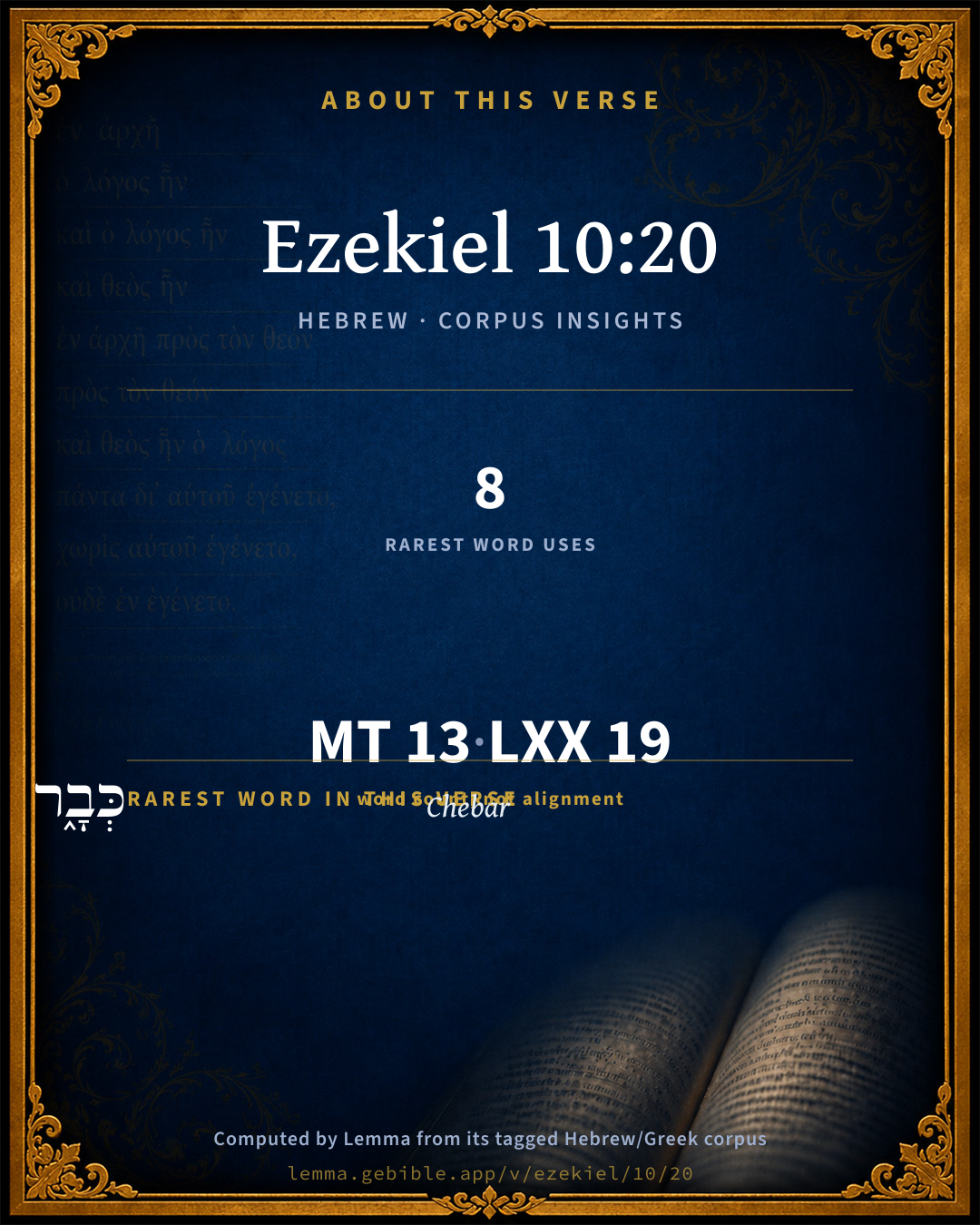
The rarest word here is כְּבָ֑ר Chebar H3529 — appearing just 8 times in the whole Hebrew Bible.

Shared distinctive vocabulary

כְּבָ֑ר Chebar H3529 occurs in 8 verses of the Hebrew Bible. Also found in:

Grammatical profile

  • 2 verbs
  • 6 nouns
  • 2 pronouns
  • 1 preposition
  • 1 conjunction
  • 1 particle

Verb forms

  • רָאִ֛יתִי Qal · Perfect
  • וָאֵדַ֕ע Qal · Sequential Imperfect

Hebrew & Septuagint length

In English translation the verse runs 24 words from the Hebrew and 25 from the Septuagint (LXX English) — closely comparable.

A rough comparison of the two English renderings, which tokenize alike — not a word-level alignment.

Word counts can differ between the Hebrew and the Greek without any difference in meaning — e.g. the Hebrew direct-object marker אֵת has no separate Greek word, and Greek often adds the article ὁ.

In the original languages it is 13 Hebrew tokens and 19 Greek tokens — but the two are counted differently (Hebrew bundles its prefixes and suffixes into one token; the Greek is in lemma form), so that isn’t a like-for-like length.

Cross-references

7

Topical passages linked to Ezekiel 10:20 in the Treasury of Scripture Knowledge — connected by theme and wording, ordered by reader-vote popularity; previews shown in the World English Bible.

  • Ezekiel 1:1 Now it happened in the thirtieth year, in the fourth [month], in the fifth [day] of the month, as I was among the captives by the river Chebar, that the heavens were opened, and I saw visions of God.
  • Ezekiel 10:15 The cherubim mounted up: this is the living creature that I saw by the river Chebar.
  • 1 Kings 6:29–35 He carved all the walls of the house round about with carved figures of cherubim and palm trees and open flowers, inside and outside.
  • 1 Kings 7:36 On the plates of the stays of it, and on the panels of it, he engraved cherubim, lions, and palm trees, according to the space of each, with wreaths round about.
  • Ezekiel 1:5 Out of the midst of it came the likeness of four living creatures. This was their appearance: they had the likeness of a man.
  • Ezekiel 1:22–28 Over the head of the living creature there was the likeness of an expanse, like the awesome crystal to look on, stretched forth over their heads above.
  • Ezekiel 3:23 Then I arose, and went forth into the plain: and, behold, the glory of Yahweh stood there, as the glory which I saw by the river Chebar; and I fell on my face.

Cross-references courtesy of OpenBible.info (CC BY 4.0).

Hebrew and Greek witnesses Masoretic Hebrew ↔ Greek Septuagint

The same verse in the two great witnesses to the Old Testament, shown verse-for-verse.

These are two independent witnesses, not word-aligned to each other, and the Septuagint is shown in lemma (dictionary) form.

Hebrew Ezekiel 10:20 Masoretic · Westminster Leningrad Codex

הִ֣יא הַחַיָּ֗ה אֲשֶׁ֥ר רָאִ֛יתִי תַּ֥חַת אֱלֹהֵֽי יִשְׂרָאֵ֖ל בִּֽנְהַר כְּבָ֑ר וָאֵדַ֕ע כִּ֥י כְרוּבִ֖ים הֵֽמָּה

This is the living creature that I saw under the God of Israel by the river Chebar; and I knew that they were cherubim.

World English Bible · Public Domain

Greek LXX Ezekiel 10:20 Septuagint · lemma form

οὗτος ὁ ζῷον εἰμί ὅς ὁράω ὑποκάτω θεός ἰσραήλ ἐπί ὁ ποταμός ὁ χοβαρ καί γιγνώσκω ὅτι χερουβείμ εἰμί

This is the living creature which I saw under the God of Israel by the river of Chobar; and I knew that they were cherubs.

LXX2012 (modern English Septuagint) · Public Domain

Hebrew: Westminster Leningrad Codex (CC BY 4.0). Greek: Septuagint (public domain); English from LXX2012 (modern English Septuagint) (Public Domain). How the Septuagint differs from the Hebrew →

Targum (Aramaic paraphrase)

1

The Targum is the ancient Jewish Aramaic paraphrase of the Hebrew Scriptures — an interpretive translation, not the Hebrew text itself. Onkelos (literal) and Pseudo-Jonathan (expansive) render the Torah, and Jonathan the Prophets. Coverage is partial: where no permissively-licensed English translation exists for a verse, only the Aramaic is shown. This is verse-level text, not a word-by-word alignment to the Hebrew.

  1. Targum Jonathan Prophets (Joshua–Malachi)
    אִינוּן בִּרְיָתָא דַחֲזֵיתִי תְּחוֹת יְקַד אֱלָהָא דְיִשְׂרָאֵל בִּנְהַר כְּבָר וִידָעִית אֲרֵי כְרוּבַיָא אִינוּן:

    (no public-domain English translation for this verse)

    Targum Jonathan — Aramaic: “Mikraot Gedolot” (public domain). English: “Sefaria Community Translation” (CC0 1.0 (public-domain dedication)); “London "Chaldee Paraphrase," 1871” (public domain). Text via Sefaria.

Commentary

Notes on Ezekiel 10:20 from classic Christian and Jewish commentators (each source and its license shown beneath its notes). The classic Christian expositions comment on the surrounding passage and are grouped to its opening verse, so a note may address several verses; the Jewish commentaries on the Tanakh (Rashi and others) are per-verse, so they appear only where the commentator wrote on this verse.

Lemma curates 59 commentaries, every one of them public domain or Creative Commons licensed, each selected and text-cleaned for this edition rather than reprinted as found. About our sources →

The Cambridge Bible for Schools and Colleges

gen. ed. J. J. S. Perowne

20. were the cherubims] Were cherubim. The remark that he knew that the living creatures were cherubim is of very great difficulty. It would scarcely be in the sense of the prophet to suppose that he learned that the living creatures were cherubim from hearing them so called by the divine speaker (Eze_10:2; Eze_10:6) because previous to this he himself has so called them (ch. Eze_9:3). The meaning is rather that this third vision of them (ch. 1 and ch. Eze_3:23) with its details and movements revealed to him that the creatures were cherubim. But admitting that the prophet had visions we can hardly escape the conclusion that the details of the phenomenon of the cherubim repose upon reflection. This reflection may have preceded the visions and been reproduced in them, but where did he find the elements that entered into his combination? Were they not derived from the temple largely, though also from the storm-cloud? Could he be unaware of the source whence he derived them? It is possible that in the excitation of the vision he did not recall the processes of his own reflection. Or may it be that we are straining the word “knew” when we understand it in the sense of learned, came to know? This is the natural sense to put upon it in this Book, and up to this time the prophet has not used the name cherubim.

The derivation of the word cherub is obscure. If Assyrian scholars are right the name is Babylonian, and is found given to the colossal winged bulls (called at other times shidu, Heb. shçd) which guard the portals of palaces and temples in Babylonia. The word (Kirubu) is said to have the sense of “great” (Schrader, KAT. on Gen_3:24, Del. Paradies, p. 150 seq.). But though the name be common to Babylonian and Hebrew, and though originally the idea expressed by the name may have been the same in both, the usage as known from Babylonian literature marks the end of a long development, and that in Hebrew marks the end of another long and independent development, and any attempt to control or explain the one by the other must be made with caution.

The narrative and essential part of Ch. 10 lies in Eze_10:2-4; Eze_10:6-7; Eze_10:18-19; the rest is annotation suggested by points in the narrative, in which ch. 1 is repeated without anything essential being added to it. A second description of the cherubim after ch. 1 looks unnecessary, and Cornill would excide Eze_10:8-17 entirely. There may be occasional glosses in these verses, but no reason exists for cutting them out which does not equally apply to Eze_10:20-22. The whole description of the divine chariot has an appearance of artificiality to us now, but in Ezekiel we have a peculiar mind, and it is safer to content ourselves with saying that we do not altogether understand the importance which he attaches to the phenomenon of the chariot and the living creatures.

The Cambridge Bible for Schools and Colleges (gen. ed. J. J. S. Perowne; Cambridge University Press, 1878–1918) — public domain. Text from a community e-Sword module.

Trapp's Complete Commentary

John Trapp

Eze 10:20 This [is] the living creature that I saw under the God of Israel by the river of Chebar; and I knew that they [were] the cherubims.

Ver. 20. And I knew that they were the cherubims.] Now at last I knew. Divine light is darted into the soul by degrees, and at different times.

John Trapp, A Commentary or Exposition upon All the Books of the Old and New Testament (1647–1656) — public domain. Text from a community e-Sword module.

Joseph Benson's Commentary

Eze 10:20. This is the living creature, &c. — See Eze 1:22-26. And I knew that they were the cherubims — Either by special assurance as a prophet, or from reading and hearing about those that were represented in the holy of holies.

Joseph Benson's Commentary on the Old and New Testaments (1811–1818) — public domain. Text from a community e-Sword module.

Geneva Bible (1599)

Geneva Bible translators

That is, the whole body of the four beasts or Cherubims.

Geneva Bible (1599) marginal notes — public domain. Text via Bolls.life.

Jamieson, Fausset & Brown

Robert Jamieson, A. R. Fausset & David Brown

I knew . . . cherubim--By the second sight of the cherubim, he learned to identify them with the angelic forms situated above the ark of the covenant in the temple, which as a priest, he "knew" about from the high priest.

Jamieson, Fausset & Brown — Commentary Critical and Explanatory on the Whole Bible (1871) — public domain (CC PDM 1.0). Text via the HelloAO Bible API.

Adam Clarke's Commentary

Verse 20. And I knew that they were the cherubims.] This formation of the plural is quite improper. In general, Hebrew nouns of the masculine gender end in ים im, in the plural; the s, therefore, should never be added to such. Cherub is singular; cherubim is plural. The s should be uniformly expunged.

I have already referred to the end of this chapter for farther information relative to this glorious chariot of Jehovah; but I must say that I have met with nothing on the subject that entirely satisfies myself. In the preceding notes I have endeavoured to make the literal meaning as plain as possible; and have occasionally given some intimations relative to the general design of this sublime vision. My readers are already apprised that I do not like conjectures on Divine things; many points, that had originally no other origin, are now incorporated with creeds of which it is deemed sinful to doubt. Because some learned and pious men have written to prove that this symbolical compound figure is a representation of the Holy Trinity; therefore, the sentiment now passes current. Now this is not proved; and I suppose never can be proved. The continuator of the Historical Discourses of Saurin has made some sensible remarks on the subject of this vision; and these I shall lay here before the intelligent reader. They deserve attention.

THIS intelligent writer observes: "For the right interpretation of this vision, the following rules should be laid down: -

"The first rule is this: - An explanation, which accounts for all the parts contained in the vision, is much more probable than those which explain only one part.

"The second is this: - An explanation which is conformable to the present circumstances of the prophet, and of the people to whom he is sent, as well as to the nature of the things which he is called upon to say to them, is incomparably more probable than those explanations which go in quest of past or future events, which have no connexion with the immediate circumstances of the prophet, nor with the end of his mission. These rules, which appear incontestable, being laid down, we observe, that their opinion who think that God here draws out a plan of the government of his providence, applied to the present state of the Jews, accounts for all that Ezekiel saw; and that in a manner which refers to the end of the prophet's mission, and all that he had to say to this rebellious people. Why wish God to represent to his prophet the future state of the Christian Church, which was not to be founded till after a series of time, rather than the state of the Jewish Church, and the chastisements which hung over the heads of that hardened people? The people having revolted from God, and persevering obstinately in that revolt, notwithstanding the menaces of the prophet, it was proper to show to Ezekiel, in order that he might declare it to the rebellious, that Providence had its eyes open to all that had been done, all that had hitherto happened, and that it had seized upon the rod to smite. The people imagined, but too much according to the errors of infidelity, that God saw every thing with indifference and had given the world up to chance. It was necessary, therefore, to divest them of these fatal prejudices; and to teach them that the Supreme Being did not behold with the same eye order and disorder, contempt of his laws and submission to his will; and that all the revolutions of states are directed by a superior intelligence, which cannot be imposed upon. The Jewish people imagined but too much that the prophets exaggerated when they threatened them with the severest chastisements. They repeated with emphasis and complacency the promises of God made to the patriarchs; that their posterity should not only be more numerous than the stars of heaven, and the sand which covers the sea-shore; but that it should subsist for ever and ever. God had declared to Abraham, 'I will establish my covenant between me and thee, and thy seed after thee, in their generations, for an everlasting covenant, to be a God unto thee and thy seed after thee,' Ge 17:7. It was proper, therefore, to show this stiff-necked people that the threatenings of God and his promises were not contradictory. That the people, conformable to the promises given by God to the patriarchs, should not be destroyed; but that, notwithstanding, they should be severely chastised, to correct them for their propensity to idolatry, and their scandalous irregularities.

"These suppositions, which are reasonable, being granted, we shall have no difficulty to perceive the sense of this celebrated vision. We shall not follow the order observed by Ezekiel, in the description of what he saw; he raises himself from the nearest to the most distant objects, going back from effects to their general cause. We will begin with the First Cause which gives motion to all that happens, traces out the plan, and procures the execution, according to the rules of his ineffable wisdom, and agreeably to the nature of those creatures which are the object of his agency. Next, we will proceed to consider the effects of this universal Providence, and the intelligent secondary causes which he frequently employs in the administration of the government of the universe.

"'Ezekiel saw a firmament which was above the heads of the animals; there was the resemblance of a throne like a sapphire stone; and over the resemblance of the throne, there was, as it were, the resemblance of a man.' This vast transparent firmament represents to us the heaven, the peculiar residence of the Lord of the earth; and where he hath established the throne of his empire. This 'appearance of a man' was the emblem of Providence or God; considered as taking care of all the creatures whom he hath made. Man is the symbol of intelligence. The mind of man, with respect to his knowledge and wisdom, is a weak sketch of that mind which knows all things, and whose wisdom is unbounded. And yet, of all sublunary beings, there is none that approaches so near to the Divine nature as man. Under this emblem also it is that God, considered as seeing all things, and directing all, would be represented. This resemblance of man was seated upon a throne, to show that God governs all things as Lord, and that without agitation and without labour.

"The shining metal, and the fire which surrounded him who sat on the throne, were the symbol of his glory and his judgments, which are poured upon the wicked as a fire which nothing can withstand; agreeably to Isaiah, Isa 33:14.

"The Jews acknowledged that there was a Providence which governs the whole universe with infinite wisdom. The psalmist gives us a description of it, equally just and pathetic, in Ps 104:27, c. Christians, no less than Jews, admit this important truth and the Gospel establishes it no less strongly than the law. See Mt 6:26; Mt 10:29; Mt 10:30. To raise the mind of the prophet up to the first Mover of those events which strike and admonish us in all the revolutions which happen to individuals, families, and states, God shows him four wheels above the firmament, over which the emblem of Providence was placed on a throne. These wheels are a symbol of those perpetual revolutions, which are observed in the earth; and which, by turns, lift up and abase individuals and nations. They are of a prodigious height, to show that man cannot fathom or know all that is great, wonderful, and astonishing, in the ways of Providence. See Job 11:7-8; Ro 11:33-34; Isa 55:8-9. These wheels move themselves every way, and are full of eyes in the vast circle of their felloes. This shows, that all which God does he effects without pain; and that the eye of his wisdom ordereth all events. The wheels did not move of themselves; but they followed the impulse of the four living creatures; 'when the living creatures went, they went.' This shows that, in the government of the world, all the living creatures are subject to Providence; and that God subordinates the creatures one to another. He directs what those holy intelligences ought to do, who serve him as ministers, and are here represented by the four animals. And these intelligences, enlightened and supported by the Supreme Wisdom, contribute, as far as is suitable, to all that happens to mankind. The angels whom Ezekiel saw were in number four, in reference to the four cardinal points of the world; to show that their ministry extends every where, and that there is no part of the universe which the Providence of God does not govern in an immediate manner, or by the means of his ministers. The extraordinary shape of these angels, which appeared to the prophet in vision, is symbolical; for it is not to be supposed that those heavenly ministers are really thus formed. The 'four faces, wings, and arms of a man,' denote the sublime qualities of these immediate ministers of the Deity; qualities entirely essential to fill up the extent of their duty. The face of a man denotes their intelligence; of a lion, their intrepid courage; of an ox, their patience and perseverance in labour; and of an eagle, their great penetration, their sublime sight into heavenly things, and their readiness to rise up into all that is great and Divine. The 'wings being stretched out,' signifies that they are always ready to set forward, and run with rapidity wherever the commands of their great Master call them. The 'wings bent down,' are a symbol of that profound respect in which these heavenly ministers stand before the Lord of the universe. Under the wings there were men's arms, to show that zeal produces application and labour. Labour, without zeal, can never be supported; and zeal, without application, is only a hypocritical ardour, which amounts to nothing with that supreme Master who requires sincere homage from those who serve him. If God chose to make known to Ezekiel that his providence extends to all things, and that even in this life it often takes up the rod to chastise nations and individuals, he would also show beforehand that he wished not the destruction of the Jewish people, whom he was about to visit in his anger, but only its correction and amendment. This is signified by the 'precious metal,' which the prophet found unmelted in the midst of the fiery cloud. This cloud of fire, urged on by a whirlwind, and involving on all sides the metal, represented the judgments of God which were about to fall upon this rebellious nation, not to destroy, but to humble and purify it. Nothing is more proper than afflictions to bring men back to their duty. As fire purifies metals, so the paternal chastisements of God have a tendency to purify the soul and heart, if the man be not entirely incorrigible. The people upon whom God was about to pour the vials of his anger, were not worthy of his lenity. But that great God, who is firm in his promises, remembers the covenant of peace he had made with the patriarchs. This covenant is made sensible to the prophet under the image of a rainbow, which was round about him who appeared upon the throne. Every one knows, that this splendid phenomenon, which seems to join heaven and earth together, was given to Noah and his posterity as a symbol of the covenant which God then made with mankind, and by which he declared to them that the earth should undergo a deluge no more. Thus, the Pagans considered the Iris as the messenger of the gods. See Virgil, AEn. lib. iv. ver. 694. But whereas the rainbow to the Jews was a symbol of peace, the Iris of the Pagans was a messenger of trouble. On the sight of this bow, the symbol of grace, Ezekiel was to be encouraged; and persuaded that his people were not threatened with an utter destruction. The event fully justified all that the prophet had contemplated, with surprise, in this enigmatical picture. The Chaldeans, the rod of the Lord's just severity, ravaged Judea; the people were carried away captive; they groaned for seventy years in a foreign land; but they were protected in a miraculous manner against the bloody designs of the cruel Haman; and at length, favoured with various decrees of the kings of Persia, they had permission, not only to return to their own country but also to rebuild Jerusalem and the temple.' See Dr. Dodd's notes on this place.

Adam Clarke's Commentary on the Bible (1810–1826) — public domain. Text from a community e-Sword/MySword module.

John Calvin's Commentaries

He repeats what we have seen before, namely, that one vision was offered twice, because God wished to mark distinctly what otherwise had been doubtful. The Prophet indeed was sufficiently persuaded that God had appeared to him, but the confirmation of it was not in vain, because he would have to sustain great conflicts. Meanwhile it must be observed, that the vision was confirmed a second time, not for the private advantage of a single person, but that this drawing attention to it might profit the whole people, or at any rate render those without excuse who so despised the favor of God, so manifest and so clearly laid open to them. He says, therefore, this was the living creature which he had seen under the God of Israel In the first chapter he related that there was a throne in the open firmament of heaven, where he sat who was like a man in external form, and yet was not a man. There we saw that the true and only God was alluded to, and yet that this description could not apply to the Father, but necessarily belonged to the Son. These two things then are to be borne in mind: and the Prophet here takes away all doubt when he names the God of Israel like a man, which could not apply to the person of the Father. That likeness then ought, to be agreed upon among the pious. Controversy, therefore, on this point ought not be engaged in; for Sabellius, who took away the distinction of persons, was sufficiently refuted by his own extravagance. Since, therefore, the Father never put on the form or likeness of man, and it is nowhere read in the Scriptures that. he is compared to a man, we must explain this of Christ. And now Ezekiel bears witness that he is the God of Israel. We see, therefore, how foolishly the triflers of our day babble who desire to disturb the Churches by making Christ a sort of deity transfused from the substance of the Father. They confess, indeed, that he is God, but this confession is a mere pretense, since they say that the God of Israel means God the Father, and that the title cannot apply to either the Son or the Spirit. The Spirit, therefore, is mistaken when he says by the Prophet’s mouth, the God of Israel appeared in human form This place, therefore, is remarkable for refuting that delusion by which foolish men fatigue themselves and others: while they allow Christ to be God, yet they deprive him of his true deity, because they say that it is derived from the Father.

He says also, that he knew them to be cherubim Now although he knew that God had appeared to him before, yet he had no certain knowledge concerning the living creatures, for with regard to them he remained in suspense; but now after God has familiarly explained to him the vision in the temple, he says, that he was taught that they were cherubim So what we said yesterday is confirmed, that the face of the ox was changed into that of a cherub, so that the Prophet understood that angels were pointed out under the form of cherubim, even those which surrounded the ark of the covenant. Let us proceed —

John Calvin's Commentaries (1540-1563) — public domain. Text from the Calvin Translation Society English edition (1840s-50s) via the Christian Classics Ethereal Library (ccel.org). Calvin's coverage is partial (roughly two-thirds of the Bible); uncommented books and verses are honest gaps, never fabricated. The 19th-century editor's footnotes and remarks are omitted so the notes are faithfully Calvin's own voice.

John Gill's Exposition

This is the living creature that I saw under the God of Israel, by the river of Chebar,.... This is repeated from Eze 10:15; not only for the confirmation of it; but with an addition, to show that the appearance of the man upon the throne, Eze 1:26, is no other than the God of Israel; and inasmuch as Christ is there meant, for the Father never appeared in a human form, it follows that Christ is the God of Israel, under whose power, protection, and influence, the cherubim, his ministers, are; and so this is a proof of the true and proper deity of Christ:

and I knew that they were the cherubim; not by having seen the cherubim on the mercy seat, and comparing these forms with them, which none but a high priest could ever see; for, though Ezekiel was a priest, it does not appear that he was a high priest; but by the forms of them he had seen carved on the doors and walls of the temple, Kg1 6:29.

John Gill's Exposition of the Whole Bible (1746–1763) — public domain (CC PDM 1.0). Text via the HelloAO Bible API.

Albert Barnes' Notes on the Bible

In this departure of the glory of the Lord from the temple, the seer recognizes for the first time the full meaning of the vision which he had seen on the banks of Chebar Ezek. 1. What he had seen there (did indeed imply that Yahweh had forsaken His house; but now this is made clear. The Glory has left the holy of holies, has appeared in the court, has been enthroned on the Living Four, and with them has departed from the temple. It is now clear that these Four (in form similar to, yet differing from, the cherubim of the temple) are indeed the cherubim, in the midst of whom the Lord dwelleth.

Albert Barnes' Notes on the Bible (1834–1885) — public domain. Text from a community e-Sword/MySword module.

Haydock's Catholic Bible Commentary

Creature. The cherubim and all the throne seemed alive. (Haydock)

George Leo Haydock (1774–1849), Haydock's Catholic Family Bible and Commentary, 1859 edition — public domain. Excludes Psalms (Douay-Rheims chapter numbering differs from Protestant) and Deuterocanonical books (Catholic canon only).

Matthew Poole's English Annotations

The living creature; though four in number, but one in form, mind, and work.

The God of Israel; appearing as he did, Eze 1:26-28, in form of a man, it leads us to conclude it meant of Christ.

I knew; either by special assurance as a prophet, or by comparing them with those which he had often, as priest about the temple, seen there.

Matthew Poole's English Annotations on the Holy Bible (1683–1685) — public domain. Text from a community e-Sword/MySword module.

Whedon's Commentary on the Bible

Daniel D. Whedon

20-22. I knew that they were the cherubim — If we try to dissect this vision we are in great danger of taking all the life out of it. It must not be forgotten that the cloud and the lightning, the wheels and cherubim, were only “the pictorial clothing of the supreme truth that in his vision, Ezekiel’s soul met the Infinite and Eternal face to face and heard the secret of Jehovah’s counsel from his own mouth” (W. Robertson Smith); yet, we may be able to catch, if only in dim outline, the meaning of each part of this complex picture. Not until Ezekiel had several times seen this vision did he realize that the “living creatures” who were the glory-bearers of Jehovah were the cherubim. They were so unlike the cherubim of the temple with which he was acquainted that he never realized their essential identity until he saw the vision in the temple itself, and perceived that these living creatures took the place above the mercy scat which the carved cherubim formerly occupied, just as the flying wheels and the throne took the place always sacred to the unseen glory (the Shekinah). It is surprising that expositors, notwithstanding the marked difference between Ezekiel’s cherubim and those of the tabernacle and temple, have yet attempted to make them as nearly identical in form as possible. Even M. Pinches supposes there must have been “a peculiar cherubic form” which Ezekiel recognized in the living creatures, “though kept secret from all others,” and even yet an “unfathomable mystery!” (Smith’s Dictionary of the Bible, 1893.) But whatever Ezekiel’s words imply here, they could not declare exact similarity of form (Exo_25:20; 1Ki_8:7). Indeed the chief object in repeating the vision must have been to bring out the new truth revealed by this new view of these strange symbolic creatures as cherubim. Muller’s idea (Ezekiel Studien, 1895) that Ezekiel substituted the cherubim in this vision for “living creatures” and made certain other changes because of the criticism of those to whom he had told the first vision, is as deficient in a just appreciation of the prophet’s character as in spiritual discernment. Eze_10:22 is in itself sufficient refutation of this hypothesis. Every Hebrew would have been surprised at the identification by a priest, such as Ezekiel, of these animal forms with the temple cherubim, and would begin to search at once for the points of comparison and contrast, and for spiritual lessons hidden therein.

On the other hand, it is equally clear that these “living creatures” of Ezekiel were not copies of the so-called “winged bulls” of Assyria. Those stone guardians of the temple, with their single human face and long beard and miter ornamented with horns, were strikingly different from these fiery four-faced “living ones” covered with eyes. It has recently been doubted whether the name Kerubi is ever used of these “guardians of the palace” (Davis, Genesis and Semitic Tradition). But if, indeed, those complex animal forms bore the same name as these living creatures of Ezekiel this would only more quickly lead everyone who listened on the banks of the old Babylonian canal to the recital of this strange vision, to compare and contrast these very different forms in order to learn the lessons, which might thus be taught, of providence and deity. What those spiritual lessons were we may be able now only to grasp very partially. One may well regret that the author of the Hebrews, when he spoke of the “cherubim of glory,” was forced to add, “of which we cannot now speak particularly” (Heb_9:3-5). How much controversy and confusion of tongues it would have saved if he had given just then one of the parentheses of which he was so fond! The similarity between the Babylonian and all forms of the Hebrew cherubim is evident. All of these “mighty ones” were symbolical forms manifesting the Invisible. They were divine watchers and “guardians,” mediators between God and man, representatives of the divine will, protectors of the divine law, and upholders of the divine throne.

But the differences grow on one. The Babylonian genii which protected the temples and palaces had an independent power for good or evil and needed to be propitiated by gifts and prayers. A recently deciphered text gives the piercing cry which daily ascended from those Babylonian homes: —

Propitious be the favorable Shidu that is before thee.

May the Lamassu that goeth behind thee be propitious.

— King, Illustrated Archaeology, 1894.

The horror of this worship is well expressed by the psalmist: —

They sacrificed their sons

And their daughters unto Shidim, And shed innocent blood.

— Psa_106:37; see also Deu_32:17.

How different from the Hebrew cherubim! They were wholly dominated by the One. There was no caprice or personal feeling possible. In Eden, in the tabernacle, in the temple, on the Chebar, everywhere and always, Jehovah dwells “between the cherubim,” and his will and his spirit moves them. But while the Bible cherubim agree in this — and thus differ vitally from the Babylonian — there is a vast growth to be traced in the Hebrew conception represented by these symbolic forms. The cherubim in Eden are guardians of the tree of life, and their revolving sword or “disk of fire” (Lenormant) is especially emphasized. They are pre-eminently representatives of the divine justice and power. The cherubim of the tabernacle and the temple have no sword. They watch over the mercy seat and the written law, and point the way with beckoning wings to the new Eden — the gates of which are now open — and to the Tree of Life of which, through God’s mercy, even the sinful man can now eat. All the cherubic heraldry wrought into the tapestry of the tabernacle and adorning the walls of the temple was a heraldry of grace.

But Ezekiel’s vision shows a great advance upon any previous revelation. Before this the cherubim were only seen in the temple. They were guardians of the covenant of grace which God had made with the Israelites.

Only Israelites could enter the temple. It was only the sins of the Jewish nation which the high priest confessed, and for which he received pardon as he knelt close to the mercy seat, shadowed by the glorious wings of the cherubim. Where the cherubim are God’s holy place must be; but Ezekiel sees the cherubim outside the temple and outside the limits by which heretofore he and his nation had always bounded the “holy city” and the “holy land.” God’s holy place and the holy guardians of his law and covenant are not confined any more within the walls of Jerusalem. The throne which the Jews always thought of as above the cherubim in the temple is now seen on the Chebar. Jehovah now “fills the whole earth with his glory,” and all nature “with the floating edges of his robe” (Jer_7:4), and the symbolic cherubim are no longer of the exclusive Jewish type! They have taken on a manifold form. They are neither Jewish nor Egyptian nor Babylonian. They combine all elements. The single-faced cherub of the Jerusalem temple has become the four-sided, four-winged, four-faced cherub of God’s universal sanctuary. It looks toward every point of the compass, toward every nation of men.* The images of gold in the local holy of holies has given way to living beings full of spiritual fires. The cloud of incense hiding the unseen Presence has given place to “the likeness of a man upon the throne.” The Palestinian and Jewish conception of God and his providence has gone down before the new and lofty thought that the one God belongs to the whole earth and the whole earth to him, and that all forms of life — even the gods and genii of the heathen and the guardians of death — are but manifestations or servants of the One supreme. (See notes chap. 1.) Never have the omnipotence, the omnipresence, and the omniscience of the Deity been more vividly and forcibly pictured. Whirlwind, cloud, and lightning, and all the most subtle and untamable forces of nature are his ministers. The powers of heaven and earth and the underworld bow submissively before his throne. Life and death, men and demons, are his servants. It was a lesson Ezekiel’s captive and stricken comrades needed to learn. They, no doubt, almost universally thought of Jehovah as the God of Jerusalem and of Canaan, and when they were carried away from these holy places — away from the temple, the altar, and the cherubim — and all the customary worship and ritual were left far behind them in the distance, many of them began to feel themselves justified in honoring the gods of the land wherein they dwelt. Especially were they tempted to do this when it appeared that even the sanctity of the distant temple was not to be maintained, but even the holy of holies had been profaned by the feet of the invading heathen. Then it was that this seer of God, in this splendid picture, painted before their eyes the mighty all-conquering truth, that “the Lord is here,” and every spot where he reveals himself is holy ground; and that he is “Lord” in Babylon as truly as in Jerusalem. This is the central thought of the vision and of the entire prophecy. Israel may sin, the temple may be destroyed, Jerusalem may fall, “the kings of the earth set themselves, and the rulers take council… against Jehovah,” but his sovereignty remains untouched. He is still “God of gods and Lord of lords, the great God, a mighty and a terrible,” who “doth execute the judgment… and loveth the stranger” (Deu_10:17); as powerful and as gracious on the plains of Chaldea as in the mountains about the holy city.

[*This explains the repetition again and again of this fourfold symbolism. The use of the numeral four in ancient times in this symbolic sense cannot be doubted. (See our Introduction to Ezekiel, “Symbolism.”)] This seems to have been the lesson which God taught Ezekiel and he in turn taught to his countrymen from this “vision of God.” Thus the nature and office of the cherubim are clearly seen. They are the guardians of the divine majesty, mediatorial revelations of the glory of the One, concentrating in themselves all the forces of immaterial nature and all the quintessence of universal life. Animate and inanimate nature, man, and all the powers and principalities of heaven and Hades are but revelations of the divine Presence, fitly enthroning the supreme revelation of the invisible God in the “man upon the throne.”

The influence of this vision upon later writers is almost unparalleled. The early fathers, particularly, were sure that the four cherubim were symbolical of the nature and work of Christ: the man representing his Incarnation; the lion, the emblem of Judah, his eternal Kingship; the ox, his atoning sacrifice; the eagle, his heavenly spirit and essential divinity. So also many of the earliest fathers believed that these “living creatures” prefigured the four evangelists: St. Matthew having written the gospel of his humanity; St. Mark, the eagle gospel; St. Luke, the priestly or sacrificial narrative; and St. John, the royal gospel, showing his glorious generation from the Father — though later writers almost universally assign the eagle to St. John, and the lion to St. Mark.

Daniel D. Whedon (gen. ed.), Commentary on the Old and New Testaments (1874–1909) — public domain. Text from a community e-Sword module.

The Pulpit Commentary

Once more the prophet asserts, with fresh emphasis, the identity of the two visions which it had been given him to see. Now, as it were, he understands why the first vision was seen as coming from the north. He does not tell us whether the journey of which he saw the beginning was to end. For the present there was a halt, as we learn from Eze_11:23, "over the midst of the city." Even when the vision ended, it had not gone further than the Mount of Olives. We may conjecture, however, that he thought of its goal as that more sacred region of the heavens in which it had at first manifested itself. (see note on Eze_1:4) It was, at any rate, no longer in the temple. The banks of Chebar or any other place might become, as Bethel had been to Jacob, (Gen_28:17) as "the house of God" and "the gate of heaven."

The Pulpit Commentary (1880–1919), ed. H.D.M. Spence-Jones & Joseph S. Exell — public domain. Text from a community e-Sword module.

John Wesley's Explanatory Notes

I knew - Either by special assurance as a prophet, or by comparing them with those which he had often seen in the temple.

John Wesley, Explanatory Notes Upon the Whole Bible (1754–1765) — public domain. Text via the GEBible commentary corpus.

unfoldingWord translationNotes

Door43 World Missions Community

the living creatures

See how you translated this in Ezekiel 1:13.

the Kebar Canal

This is a river that people in Chaldea had dug to give water to their gardens. See how you translated this in Ezekiel 1:1.

the likeness of human hands

Here the abstract noun "likeness" means that what Ezekiel saw looked like human hands. The word can be translated with a verbal phrase. AT: "something that looked like human hands" (See: Abstract Nouns)

the likeness of their faces was like the faces that I had seen

The abstract noun "likeness" can be translated with a verbal phrase. AT: "their faces looked like the faces that I had seen" (See: Abstract Nouns)

went straight ahead

"faced forward" or "looked directly ahead"

translationWords

creature

vision

unfoldingWord translationNotes — © Distant Shores Media and the Door43 World Missions Community, licensed CC BY-SA 4.0. Source: git.door43.org/Door43/en_tn.

Rashi

Rabbi Shlomo Yitzchaki (Rashi)

It was the living being Since I saw in this Chariot the entire phenomenon of the first Chariot, I say “[It] is the one I saw by the river Chebar.”

and I knew that the face of the ox was transformed into the face of a cherub, and there were in it two faces of man: a small face of a child and a large face of a man.

Rashi on the Tanakh — English translations: “The Judaica Press complete Tanach with Rashi, translated by A. J. Rosenberg” (CC BY 4.0); “Pentateuch with Rashi's commentary by M. Rosenbaum and A.M. Silbermann, 1929-1934” (public domain); “The Metsudah Tanach series, Lakewood, N.J” (CC BY 4.0); and “The Book of Joshua, Metsudah Publications, 1997” (CC BY 4.0). Text via Sefaria.

Lesson kit

Teaching starters — assembled from the data on this page, not authored interpretation. Every prompt links to the verse data it draws on. Edit before teaching.

Ezekiel, in the Prophets, opens this verse with 13 words (13 distinct Hebrew lemmas). Its most distinctive word is Kᵉbâr (“Chebar”). A historical commentator’s framing appears above. Read the whole chapter for the surrounding context.

Discussion questions

  1. The word Kᵉbâr carries the sense “Chebar.” How does it shape the verse?
  2. Ezekiel 1:1 shares the word «Chebar» with this verse. How do the two illuminate each other?
  3. These translations render this verse differently. What is at stake in choosing one wording over another?
  4. The verb «רָאִ֛יתִי» is Qal Perfect. How does its form color the action?
  5. Reading how The Cambridge Bible for Schools and Colleges and Trapp's Complete Commentary read this verse, where do the two commentators agree and where do they part?

Things to notice

Reading settings

Reading text

Shown beneath each verse's original-language words.

Old Testament
Old Testament edition

Read the OT as the Masoretic Hebrew (MT) or the Greek Septuagint (LXX).

English shown for the Greek Septuagint (in the Hebrew ↔ Greek comparison).

Comparing translations? Open the Compare panel on any verse page to stack up to four side by side.