
1 Kings 7:36

Hebrew (Westminster Leningrad Codex) 1 Kings 7:36 appears in the Hebrew Old Testament. The text above is from the Westminster Leningrad Codex. Each word links to its Strong’s number, a concise gloss, and parsing drawn from the Open Scriptures Hebrew Bible morphology. Click any word for its full Brown-Driver-Briggs (BDB) entry.
Download image
Cite this verse

1 Kings 7:36 (World English Bible). Public Domain. Lemma interlinear Bible study tool, https://lemma.gebible.app/v/1-kings/7/36.

Show BibTeX & RIS
BibTeX
RIS
English Translation
On the plates of the stays of it, and on the panels of it, he engraved cherubim, lions, and palm trees, according to the space of each, with wreaths round about.
World English Bible · Public Domain
Highlights Full analysis ↓
Download a study sheet

One document with this verse’s original text, its word-by-word gloss line, the meaning frame, cross-references with their text, attributed commentary, and full source and license credits — printable, and it pastes into notes with its structure intact.

This verse Autodidact and up

Study sheet (.html) Plain text (.txt)

A passage Seminary Student

Up to 50 verses in one chapter. A passage sheet keeps up to 6 commentary sources and 12 cross-references per verse, in the order this page ranks them, and says so on the sheet whenever that leaves anything out. Ask for a single verse and you get the Autodidact verse sheet above.

Everything on this page stays free to read, with no account — the sheet is a download of what is already on screen, not access to it.

Want to remove ads? Support Godless Engineer
Compare translations 3

The same verse in 3 English versions, stacked beneath the original-language interlinear above. Click any original word for its lexicon entry.

Each is an independent rendering of the whole verse — the interlinear is not word-aligned to these translations.

Highlighted words mark where these versions differ — a whole-verse word diff, not a word-by-word alignment.

  • World English Bible Public Domain
    On the plates of the stays of it, and on the panels of it, he engraved cherubim, lions, and palm trees, according to the space of each, with wreaths round about.
  • King James Version Public Domain
    For on the plates of the ledges thereof, and on the borders thereof, he graved cherubim, lions, and palm trees, according to the proportion of every one, and additions round about.
  • unfoldingWord Literal Text CC BY-SA 4.0
    And he engraved cherubs, lions, and palm trees on the plates of its hands and on its panels, according to the bare space of each, and wreaths all around.

unfoldingWord Literal Text — © unfoldingWord, licensed CC BY-SA 4.0. Word-aligned USFM3 via Door43 (git.door43.org/unfoldingWord/en_ult).

Versions to compare (up to 4)

3 of 4 selected

Show all 18 translations

Every available English version of this verse, each an independent rendering of the whole verse.

  • World English Bible Public Domain
    On the plates of the stays of it, and on the panels of it, he engraved cherubim, lions, and palm trees, according to the space of each, with wreaths round about.
  • Berean Standard Bible Public Domain
    He engraved cherubim, lions, and palm trees on the surfaces of the supports and panels, wherever each had space, with wreaths all around.
  • Majority Standard Bible Public Domain
    He engraved cherubim, lions, and palm trees on the surfaces of the supports and panels, wherever each had space, with wreaths all around.
  • King James Version Public Domain
    For on the plates of the ledges thereof, and on the borders thereof, he graved cherubim, lions, and palm trees, according to the proportion of every one, and additions round about.
  • American Standard Version (1901) Public Domain
    And on the plates of the stays thereof, and on the panels thereof, he graved cherubim, lions, and palm-trees, according to the space of each, with wreaths round about.
  • Revised Version (1885) Public Domain
    And on the plates of the stays thereof, and on the borders thereof, he graved cherubim, lions, and palm tress, according to the space of each, with wreaths round about.
  • Geneva Bible (1599) Public Domain
    And vpon the tables of the ledges thereof, and on the borders thereof he did graue Cherubims, lions and palmetrees, on the side of euery one, and addicions round about.
  • Douay-Rheims (1899) Public Domain
    He engraved also in those plates, which were of brass. and in the corners, cherubims, and lions, and palm trees, in likeness of a man standing, so that they seemed not to be engraven, but added round about.
  • Young's Literal Translation Public Domain
    And he openeth on the tablets of its spokes, and on its borders, cherubs, lions, and palm-trees, according to the void space of each, and additions round about.
  • Literal Standard Version CC BY-SA 4.0
    And he engraves on the tablets of its spokes, and on its borders, cherubim, lions, and palm-trees, according to the void space of each, and additions all around.
  • Unlocked Literal Bible CC BY-SA 4.0
    On the surfaces of the supports and on the panels Huram engraved cherubim, lions, and palm trees that covered the space available, and they were surrounded by wreaths.
  • unfoldingWord Literal Text CC BY-SA 4.0
    And he engraved cherubs, lions, and palm trees on the plates of its hands and on its panels, according to the bare space of each, and wreaths all around.
  • Darby Bible Public Domain
    And he engraved on the plates of its stays and on its panels cherubim, lions and palm-trees, according to the space upon each; and garlands were round about.
  • World Messianic Bible Public Domain
    On the plates of its supports and on its panels, he engraved cherubim, lions, and palm trees, each in its space, with wreaths all around.
  • Webster's Bible Public Domain
    For on the plates of its ledges, and on its borders, he graved cherubim, lions, and palm trees, according to the proportion of every one, and additions around.
  • Free Bible Version CC BY-SA 4.0
    He had designs of cherubim, lions, and palm trees engraved on the panels, supports, and frame, wherever there was space, with decorative wreaths all around.
  • Bible in Basic English Public Domain
    In the spaces of the flat sides and on the frames of them, he made designs of winged ones, lions, and palm-trees, with ornamented edges all round.
  • JPS Tanakh (1917) Public Domain
    And on the plates of the stays thereof, and on the borders thereof, he graved cherubim, lions, and palm-trees, according to the space of each, with wreaths round about.

Literal Standard Version (2020), Covenant Press — licensed CC BY-SA 4.0. Text via the HelloAO Bible API (eBible.org). Unlocked Literal Bible (unfoldingWord) — licensed CC BY-SA 4.0. Text via the HelloAO Bible API (eBible.org). unfoldingWord Literal Text — © unfoldingWord, licensed CC BY-SA 4.0. Word-aligned USFM3 via Door43 (git.door43.org/unfoldingWord/en_ult). Free Bible Version, Dr. Jonathan Gallagher — licensed CC BY-SA 4.0. Text via the HelloAO Bible API (eBible.org).

Word by word

More ways to search: Search by grammar → Find every occurrence → Compare this word →

Practice this passage: Drill this verse → Learn its vocabulary →

כְּמַֽעַר
maʻar
H4626
“like/as · nakedness of”
Preposition + Noun, Common, Masculine, Singular, Construct
Part of Speech
Preposition + Noun
Type
Common
Gender
Masculine
Number
Singular
State
Construct
Full BDB Definition

Origin: from H6168

TWOT: 1692d

bare, naked place, nakedness - bare place - nakedness, pudenda (exposed in punishment)
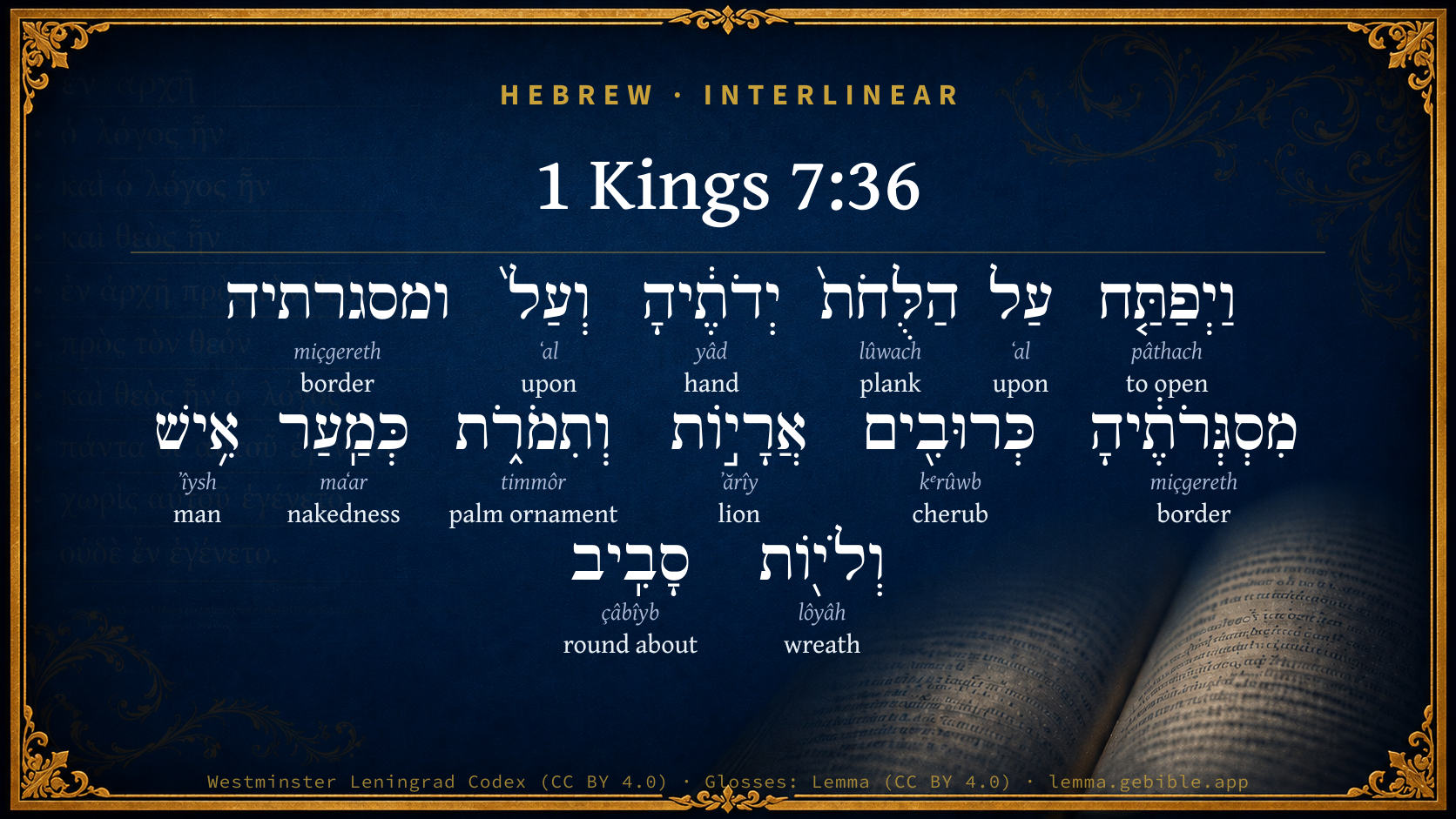
  1. וַיְפַתַּ֤ח pâthach H6605 “and · to open” Conjunction + Verb, Piel, Sequential Imperfect, 3rd Person, Masculine, Singular
  2. עַל ʻal H5921 “upon” Preposition
  3. הַלֻּחֹת֙ lûwach H3871 “the · planks” Particle, Definite Article + Noun, Common, Masculine, Plural, Absolute
  4. יְדֹתֶ֔יהָ yâd H3027 “hands · her” Noun, Common, Both, Plural, Construct + Suffix, Personal, 3rd Person, Feminine, Singular
  5. וְעַל֙ ʻal H5921 “and · upon” Conjunction + Preposition
  6. ומסגרתיה miçgereth H4526 “and · borders · her” Conjunction + Noun, Common, Feminine, Plural, Construct + Suffix, Personal, 3rd Person, Feminine, Singular
  7. מִסְגְּרֹתֶ֔יהָ miçgereth H4526 “borders · her” Noun, Common, Feminine, Plural, Construct + Suffix, Personal, 3rd Person, Feminine, Singular
  8. כְּרוּבִ֖ים kᵉrûwb H3742 “cherubim” Noun, Common, Masculine, Plural, Absolute
  9. אֲרָי֣וֹת ʼărîy H738 “lions” Noun, Common, Masculine, Plural, Absolute
  10. וְתִמֹרֹ֑ת timmôr H8561 “and · palm ornaments” Conjunction + Noun, Common, Feminine, Plural, Absolute
  11. אִ֥ישׁ ʼîysh H376 “man” Noun, Common, Masculine, Singular, Absolute
  12. וְלֹי֖וֹת lôyâh H3914 “and · wreaths” Conjunction + Noun, Common, Feminine, Plural, Absolute
  13. סָבִֽיב çâbîyb H5439 “round about” Noun, Common, Both, Singular, Absolute

About this verse

These counts appear in no published source. They are computed here, from the morphology-tagged text and Lemma’s own curated glosses. What Lemma adds →

14
words
12
distinct lemmas
Historical
section

Notable vocabulary

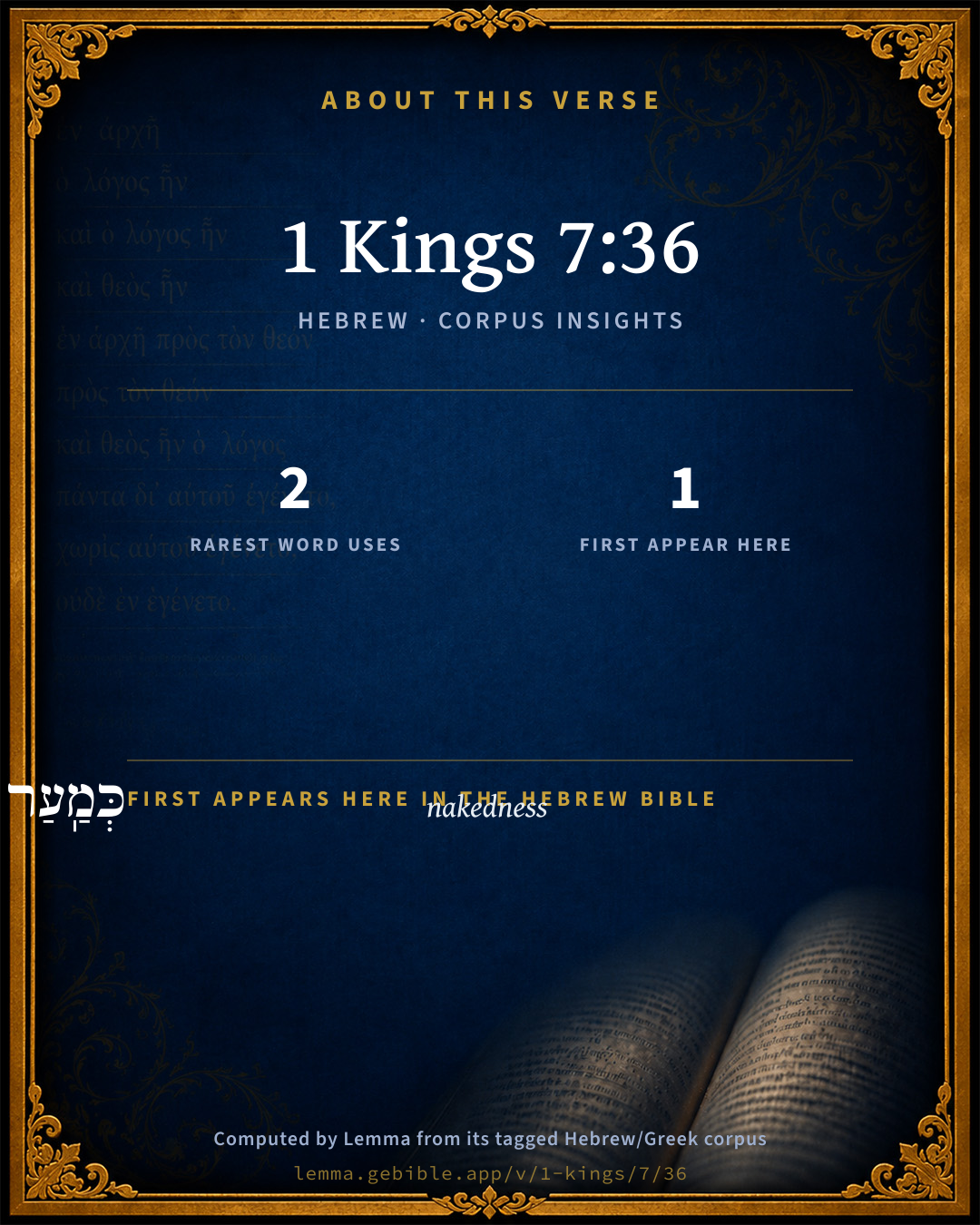
The rarest word here is כְּמַֽעַר nakedness H4626 — appearing just 2 times in the whole Hebrew Bible.

First appearance in Scripture

This word makes its first canonical appearance in the Hebrew Bible here:

  • כְּמַֽעַר nakedness H4626

Shared distinctive vocabulary

כְּמַֽעַר nakedness H4626 occurs in 2 verses of the Hebrew Bible. Also found in:

Grammatical profile

  • 1 verb
  • 11 nouns
  • 2 prepositions

Verb forms

  • וַיְפַתַּ֤ח Piel · Sequential Imperfect

Repetition

Words recur within this verse — often emphatic in Hebrew:

  • עַל upon H5921 ×2
  • ומסגרתיה border H4526 ×2

Hebrew & Septuagint length

In English translation the verse runs 31 words from the Hebrew and 20 from the Septuagint (LXX English) — the Septuagint runs noticeably shorter here. See the side-by-side →

A rough comparison of the two English renderings, which tokenize alike — not a word-level alignment.

Word counts can differ between the Hebrew and the Greek without any difference in meaning — e.g. the Hebrew direct-object marker אֵת has no separate Greek word, and Greek often adds the article ὁ.

Cross-references

8

Topical passages linked to 1 Kings 7:36 in the Treasury of Scripture Knowledge — connected by theme and wording, ordered by reader-vote popularity; previews shown in the World English Bible.

  • 1 Kings 7:29 and on the panels that were between the ledges were lions, oxen, and cherubim; and on the ledges there was a pedestal above; and beneath the lions and oxen were wreaths of hanging work.
  • 1 Kings 6:29 He carved all the walls of the house round about with carved figures of cherubim and palm trees and open flowers, inside and outside.
  • 1 Kings 6:32 So [he made] two doors of olive-wood; and he carved on them carvings of cherubim and palm trees and open flowers, and overlaid them with gold; and he spread the gold on the cherubim, and on the palm trees.
  • 1 Kings 6:35 He carved [thereon] cherubim and palm trees and open flowers; and he overlaid them with gold fitted on the engraved work.
  • Ezekiel 40:31 The arches of it were toward the outer court; and palm trees were on the posts of it: and the ascent to it had eight steps.
  • Ezekiel 40:37 The posts of it were toward the outer court; and palm trees were on the posts of it, on this side, and on that side: and the ascent to it had eight steps.
  • Ezekiel 41:18–20 It was made with cherubim and palm trees; and a palm tree was between cherub and cherub, and every cherub had two faces;
  • Ezekiel 41:25–26 There were made on them, on the doors of the temple, cherubim and palm trees, like as were made on the walls; and there was a threshold of wood on the face of the porch outside.

Cross-references courtesy of OpenBible.info (CC BY 4.0).

Hebrew and Greek witnesses Masoretic Hebrew ↔ Greek Septuagint

The same verse in the two great witnesses to the Old Testament, shown verse-for-verse.

Here the Septuagint runs noticeably shorter than the Hebrew — LXX2012 (modern English Septuagint) 20 words vs World English Bible 31. A rough length comparison of the two English translations, not a word-level alignment — read both below.

These are two independent witnesses, not word-aligned to each other, and the Septuagint is shown in lemma (dictionary) form.

Hebrew 1 Kings 7:36 Masoretic · Westminster Leningrad Codex

וַיְפַתַּ֤ח עַל הַלֻּחֹת֙ יְדֹתֶ֔יהָ וְעַל֙ ומסגרתיה מִסְגְּרֹתֶ֔יהָ כְּרוּבִ֖ים אֲרָי֣וֹת וְתִמֹרֹ֑ת כְּמַֽעַר אִ֥ישׁ וְלֹי֖וֹת סָבִֽיב

On the plates of the stays of it, and on the panels of it, he engraved cherubim, lions, and palm trees, according to the space of each, with wreaths round about.

World English Bible · Public Domain

Greek LXX 1 Kings 7:36 Septuagint · lemma form

καί ὁ πρόθυρον καί ὁ ἧλος καί ὁ φιάλη καί ὁ τρυβλίον καί ὁ θυΐσκη χρυσοῦς σύγκλειστος καί ὁ θύρωμα ὁ θύρα ὁ οἶκος ὁ ἐσώτερος ἅγιος ὁ ἅγιος καί ὁ θύρα ὁ οἶκος ὁ ναός χρυσοῦς

And its borders were cherubs, and lions, and palm-trees, upright, each was joined in front and within and round about.

LXX2012 (modern English Septuagint) · Public Domain

Hebrew: Westminster Leningrad Codex (CC BY 4.0). Greek: Septuagint (public domain); English from LXX2012 (modern English Septuagint) (Public Domain). How the Septuagint differs from the Hebrew →

Targum (Aramaic paraphrase)

1

The Targum is the ancient Jewish Aramaic paraphrase of the Hebrew Scriptures — an interpretive translation, not the Hebrew text itself. Onkelos (literal) and Pseudo-Jonathan (expansive) render the Torah, and Jonathan the Prophets. Coverage is partial: where no permissively-licensed English translation exists for a verse, only the Aramaic is shown. This is verse-level text, not a word-by-word alignment to the Hebrew.

  1. Targum Jonathan Prophets (Joshua–Malachi)
    וּגְלַף עַל לוּחַיָא אַשְׁדָתָהָא וְעַל גְדַנְפָהָא כְּרוּבִין אַרְיְוָן וְצוּרַת דִקְלִין כְּבַשׁ חָד וּמַדְבַּק סְחוֹר סְחוֹר:

    (no public-domain English translation for this verse)

    Targum Jonathan — Aramaic: “Mikraot Gedolot” (public domain). English: “Sefaria Community Translation” (CC0 1.0 (public-domain dedication)); “London "Chaldee Paraphrase," 1871” (public domain). Text via Sefaria.

Commentary

Notes on 1 Kings 7:36 from classic Christian and Jewish commentators (each source and its license shown beneath its notes). The classic Christian expositions comment on the surrounding passage and are grouped to its opening verse, so a note may address several verses; the Jewish commentaries on the Tanakh (Rashi and others) are per-verse, so they appear only where the commentator wrote on this verse.

Lemma curates 59 commentaries, every one of them public domain or Creative Commons licensed, each selected and text-cleaned for this edition rather than reprinted as found. About our sources →

Trapp's Complete Commentary

John Trapp

1Ki 7:36 For on the plates of the ledges thereof, and on the borders thereof, he graved cherubims, lions, and palm trees, according to the proportion of every one, and additions round about.

Ver. 36. According to the proportion of every one.] Heb., According to the nakedness; that is, the true resemblance. Truth is like our first parents, most beautiful when naked.

And additions round about.] Round about the base were certain fillings and finishings, on the uppermost edgings.

John Trapp, A Commentary or Exposition upon All the Books of the Old and New Testament (1647–1656) — public domain. Text from a community e-Sword module.

The Cambridge Bible for Schools and Colleges

gen. ed. J. J. S. Perowne

36. according to the proportion of every one, and additions round about] The word rendered ‘proportion’ means rather any ‘bare space.’ Hence the sense is that the graving was such as the space admitted. So, and to harmonize the final words with the previous verse, we should render ‘according to the space in every one, and with wreaths round about.’

The Cambridge Bible for Schools and Colleges (gen. ed. J. J. S. Perowne; Cambridge University Press, 1878–1918) — public domain. Text from a community e-Sword module.

John Gill's Exposition

After this manner he made the ten bases,.... This was the form and fashion of them as above described:

all of them had one casting, one measure, and one size; they were all cast into the same mould, and were exactly alike in their form, figures, and size, and each weighed 2000 talents, and the weight of a talent was ninety three pounds and upwards, according to Jacob Leon (b).

(b) Relation of Memorable Things in the Temple, c. 4. p. 21.

John Gill's Exposition of the Whole Bible (1746–1763) — public domain (CC PDM 1.0). Text via the HelloAO Bible API.

Albert Barnes' Notes on the Bible

According to the proportion of every one - i. e. “as large as the room left for them allowed,” implying that the panels were smaller than those on the sides of the base, and allowed scant room for the representations.

Albert Barnes' Notes on the Bible (1834–1885) — public domain. Text from a community e-Sword/MySword module.

Haydock's Catholic Bible Commentary

Palm-trees were not expressed, ver. 29. All was in relievo, and represented in its natural posture. (Calmet) --- About. One would have taken them to be alive, they were so well executed. Hebrew, "according to the proportion of every one, and added round about," (Haydock) projecting. (Menochius)

George Leo Haydock (1774–1849), Haydock's Catholic Family Bible and Commentary, 1859 edition — public domain. Excludes Psalms (Douay-Rheims chapter numbering differs from Protestant) and Deuterocanonical books (Catholic canon only).

Matthew Poole's English Annotations

According to the proportion, or, empty place, i.e. according to the bigness of the spaces which were left empty for them, implying that they were smaller than those above mentioned.

Matthew Poole's English Annotations on the Holy Bible (1683–1685) — public domain. Text from a community e-Sword/MySword module.

Whedon's Commentary on the Bible

Daniel D. Whedon

36. Plates of the ledges — Rather, plates of the hands; the outer surface of the plates which formed a part of the base-work or supports of the laver. (n n in figure.)

According to the proportion of every one — Better, according to the open space of each. That is, according to the room or space which each afforded for such engravings.

Additions round about — Garlands. (c c in figure.) See on 1Ki_7:29.

Daniel D. Whedon (gen. ed.), Commentary on the Old and New Testaments (1874–1909) — public domain. Text from a community e-Sword module.

The Pulpit Commentary

For on the plates of the ledges hands thereof; and on the borders sides, panels thereof, he graved cherubims, lions, and palm trees, according to the proportion Heb. nakedness, hence naked space, void. The meaning is that he filled all the spaces with carvings of every one, and additions wreaths, festoons round about.

The Pulpit Commentary (1880–1919), ed. H.D.M. Spence-Jones & Joseph S. Exell — public domain. Text from a community e-Sword module.

John Wesley's Explanatory Notes

The proportion - Or, empty place, that is, according to the bigness of the spaces which were left empty for them, implying that they were smaller than those above mentioned.

John Wesley, Explanatory Notes Upon the Whole Bible (1754–1765) — public domain. Text via the GEBible commentary corpus.

unfoldingWord translationNotes

Door43 World Missions Community

Huram engraved ... He made

Huram would have commanded his workers to do this work. AT: "they engraved ... He commanded them to make" (See: Metonymy)

they were surrounded

Here the word "they" refers to the cherubim, lions, and palm trees.

they were surrounded by wreaths

The word "wreaths" refers to spiral-shaped pieces of bronze. This can be stated in active form. AT: "there were wreaths all around them" (See: Active or Passive)

All of them were cast in the same molds

This can be stated in active form. AT: "Huram cast all of the stands in the same mold" or "They cast all of the stand in the same mold" (See: Active or Passive)

they had one size, and the same shape

"all of the stands were the same size and shape"

translationWords

cherub

lions

palm

unfoldingWord translationNotes — © Distant Shores Media and the Door43 World Missions Community, licensed CC BY-SA 4.0. Source: git.door43.org/Door43/en_tn.

Rashi

Rabbi Shlomo Yitzchaki (Rashi)

He engraved on the plates, on its axles, and on its frames. On the lower ones. On both of them, he engraved and inscribed cherubim, lions.

(And palm trees, this is not [found] in other texts.) Pairs attached to each other. He engraved around the likeness of a male and female that are joined by their arms, thus our Rabbis explained this.

Attached. An expression of attachment, as a male that is attached to a female, and its meaning is, “a man with his attachment.” According to its simple meaning, לויות is an expression of “attachment,” soldore, in O.F. There were attachments there made as the joining of a man, and the joining was in the manner we explained.

Rashi on the Tanakh — English translations: “The Judaica Press complete Tanach with Rashi, translated by A. J. Rosenberg” (CC BY 4.0); “Pentateuch with Rashi's commentary by M. Rosenbaum and A.M. Silbermann, 1929-1934” (public domain); “The Metsudah Tanach series, Lakewood, N.J” (CC BY 4.0); and “The Book of Joshua, Metsudah Publications, 1997” (CC BY 4.0). Text via Sefaria.

Lesson kit

Teaching starters — assembled from the data on this page, not authored interpretation. Every prompt links to the verse data it draws on. Edit before teaching.

1 Kings, in the Historical, opens this verse with 14 words (12 distinct Hebrew lemmas). Its most distinctive word is maʻar (“nakedness”). The Greek Septuagint runs shorter here. A historical commentator’s framing appears above. Read the whole chapter for the surrounding context.

Discussion questions

  1. The word maʻar carries the sense “nakedness.” How does it shape the verse?
  2. This is the first place “nakedness” appears in Scripture (first appears here). What does its debut here establish?
  3. How does Nahum 3:5, which shares the word «nakedness», read alongside this verse?
  4. What does the repetition of “upon” (2× in this one verse) do in this verse?
  5. The Septuagint runs shorter here than the Hebrew. What might account for the difference?
  6. These translations render this verse differently; the difference is in the English rendering, not the original. What questions does that raise?
  7. «וַיְפַתַּ֤ח» is a Piel Sequential Imperfect verb. How does that grammatical form shape the action described?
  8. Compare how Trapp's Complete Commentary and The Cambridge Bible for Schools and Colleges read this verse. Where do they agree or differ?

Things to notice

  • 1 word makes its first canonical appearance in Scripture here.
  • These translations choose different wording for 22 words in this verse.
  • “upon” occurs 2× in this single verse.
  • 12 distinct Hebrew lemmas span 14 words in this verse.

Reading settings

Reading text

Shown beneath each verse's original-language words.

Old Testament
Old Testament edition

Read the OT as the Masoretic Hebrew (MT) or the Greek Septuagint (LXX).

English shown for the Greek Septuagint (in the Hebrew ↔ Greek comparison).

Comparing translations? Open the Compare panel on any verse page to stack up to four side by side.