
Ezekiel 28:14

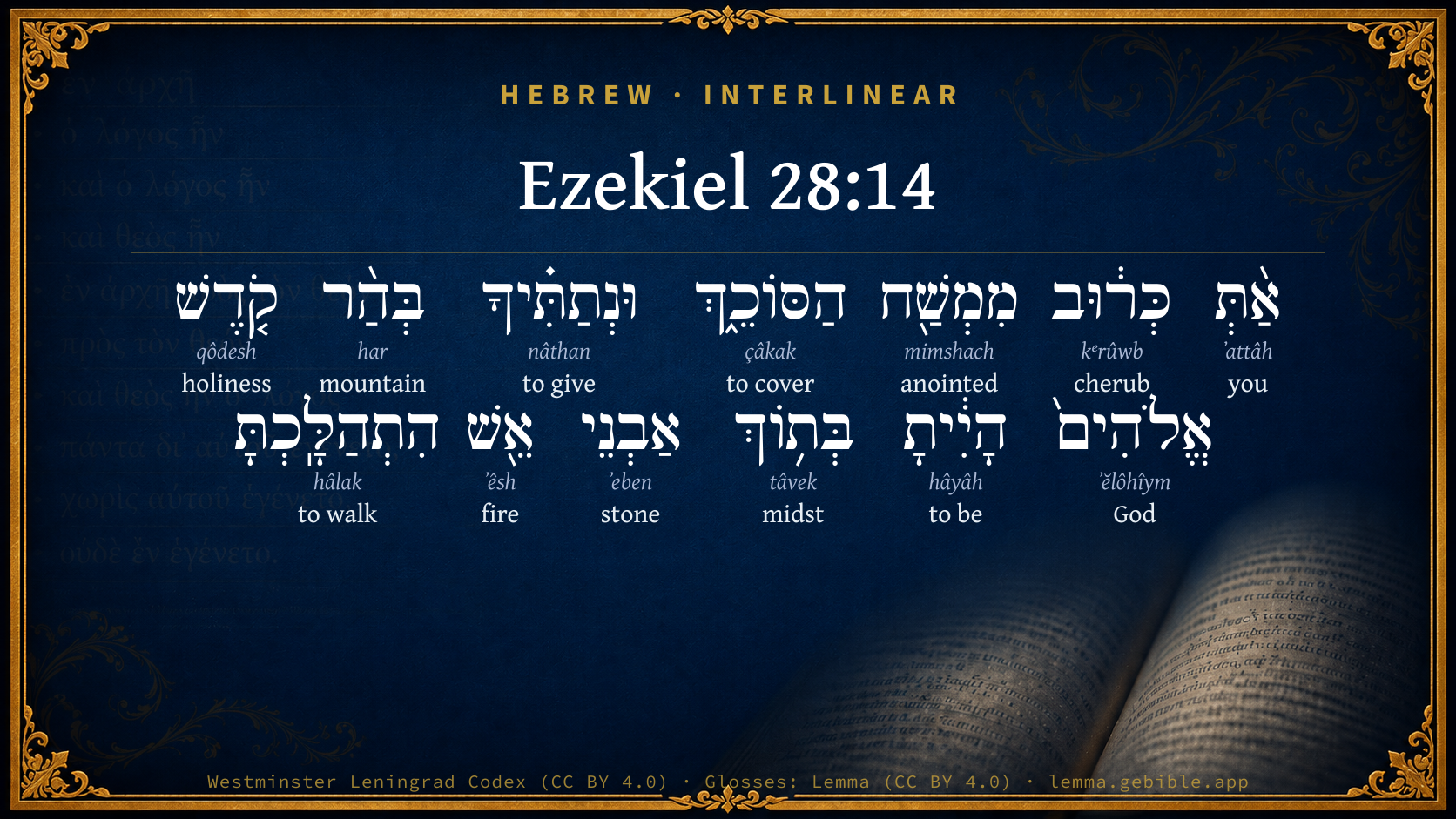
Hebrew (Westminster Leningrad Codex) Ezekiel 28:14 appears in the Hebrew Old Testament. The text above is from the Westminster Leningrad Codex. Each word links to its Strong’s number, a concise gloss, and parsing drawn from the Open Scriptures Hebrew Bible morphology. Click any word for its full Brown-Driver-Briggs (BDB) entry.
Download image
Cite this verse

Ezekiel 28:14 (World English Bible). Public Domain. Lemma interlinear Bible study tool, https://lemma.gebible.app/v/ezekiel/28/14.

Show BibTeX & RIS
BibTeX
RIS
English Translation
You were the anointed cherub who covers: and I set you, [so that] you were on the holy mountain of God; you have walked up and down in the midst of the stones of fire.
World English Bible · Public Domain
Highlights
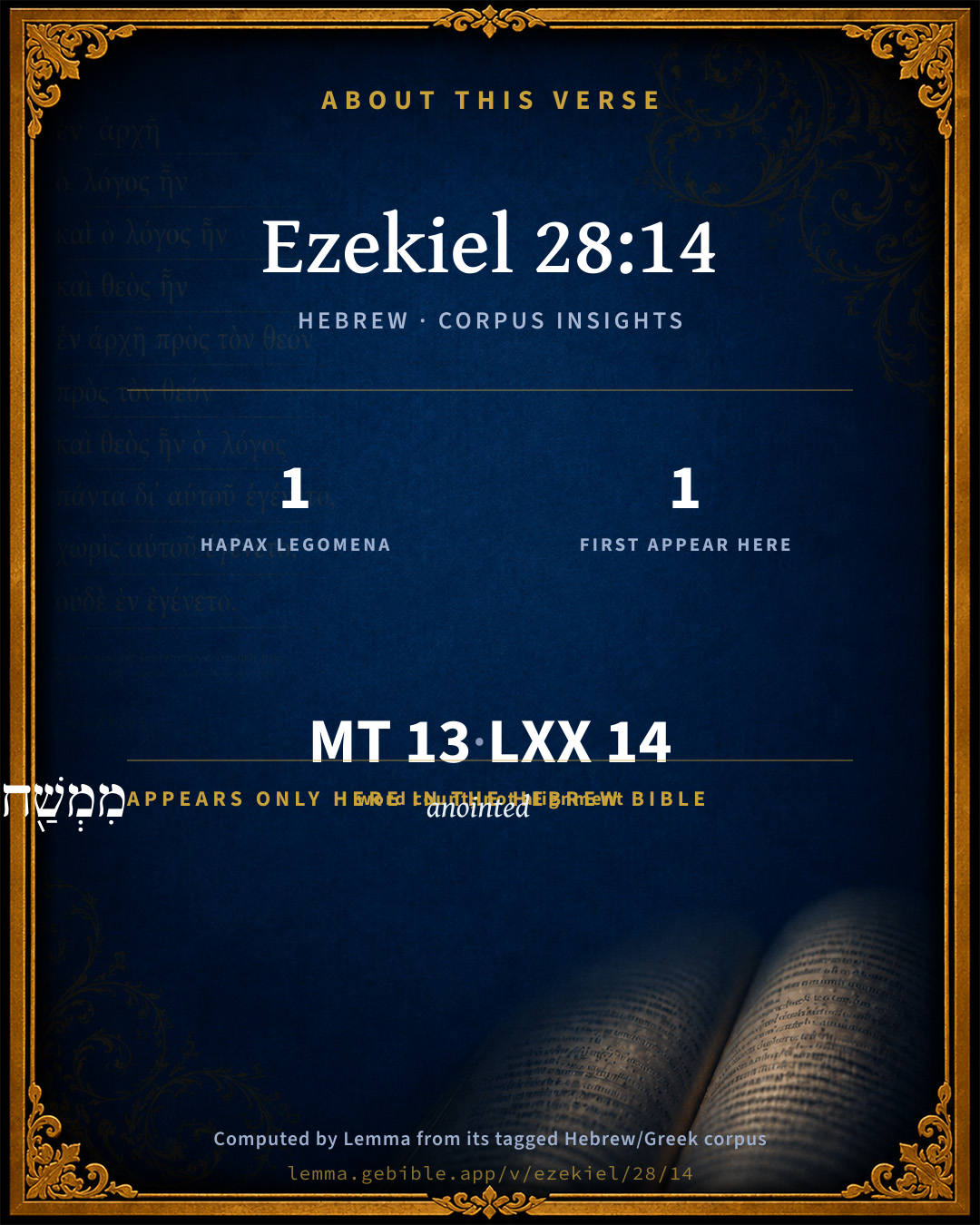
  • 1 hapax legomenon — only here in the Hebrew Bible
  • 1 first appearance in the Hebrew Bible
Full analysis ↓
Download a study sheet

One document with this verse’s original text, its word-by-word gloss line, the meaning frame, cross-references with their text, attributed commentary, and full source and license credits — printable, and it pastes into notes with its structure intact.

This verse Autodidact and up

Study sheet (.html) Plain text (.txt)

A passage Seminary Student

Up to 50 verses in one chapter. A passage sheet keeps up to 6 commentary sources and 12 cross-references per verse, in the order this page ranks them, and says so on the sheet whenever that leaves anything out. Ask for a single verse and you get the Autodidact verse sheet above.

Everything on this page stays free to read, with no account — the sheet is a download of what is already on screen, not access to it.

Want to remove ads? Support Godless Engineer
Compare translations 3

The same verse in 3 English versions, stacked beneath the original-language interlinear above. Click any original word for its lexicon entry.

Each is an independent rendering of the whole verse — the interlinear is not word-aligned to these translations.

Highlighted words mark where these versions differ — a whole-verse word diff, not a word-by-word alignment.

  • World English Bible Public Domain
    You were the anointed cherub who covers: and I set you, [so that] you were on the holy mountain of God; you have walked up and down in the midst of the stones of fire.
  • King James Version Public Domain
    Thou art the anointed cherub that covereth; and I have set thee so: thou wast upon the holy mountain of God; thou hast walked up and down in the midst of the stones of fire.
  • unfoldingWord Literal Text CC BY-SA 4.0
    I placed you on the holy mountain of God as the cherub I anointed to guard mankind. You were in the midst of the fiery stones where you walked about.

unfoldingWord Literal Text — © unfoldingWord, licensed CC BY-SA 4.0. Word-aligned USFM3 via Door43 (git.door43.org/unfoldingWord/en_ult).

Versions to compare (up to 4)

3 of 4 selected

Show all 18 translations

Every available English version of this verse, each an independent rendering of the whole verse.

  • World English Bible Public Domain
    You were the anointed cherub who covers: and I set you, [so that] you were on the holy mountain of God; you have walked up and down in the midst of the stones of fire.
  • Berean Standard Bible Public Domain
    You were anointed as a guardian cherub, for I had ordained you. You were on the holy mountain of God; you walked among the fiery stones.
  • Majority Standard Bible Public Domain
    You were anointed as a guardian cherub, for I had ordained you. You were on the holy mountain of God; you walked among the fiery stones.
  • King James Version Public Domain
    Thou art the anointed cherub that covereth; and I have set thee so: thou wast upon the holy mountain of God; thou hast walked up and down in the midst of the stones of fire.
  • American Standard Version (1901) Public Domain
    Thou wast the anointed cherub that covereth: and I set thee, `so that' thou wast upon the holy mountain of God; thou hast walked up and down in the midst of the stones of fire.
  • Revised Version (1885) Public Domain
    Thou wast the anointed cherub that covereth: and I set thee, so that thou wast upon the holy mountain of God; thou hast walked up and down in the midst of the stones of fire.
  • Geneva Bible (1599) Public Domain
    Thou art the anointed Cherub, that couereth, and I haue set thee in honour: thou wast vpon the holy mountaine of God: thou hast walked in the middes of the stones of fire.
  • Douay-Rheims (1899) Public Domain
    Thou a cherub stretched out, and protecting, and I set thee in the holy mountain of God, thou hast walked in the midst of the stones of fire.
  • Young's Literal Translation Public Domain
    Thou `art' an anointed cherub who is covering, And I have set thee in the holy mount, God thou hast been, In the midst of stones of fire thou hast walked up and down.
  • Literal Standard Version CC BY-SA 4.0
    And I established you as the anointed, covering cherub, || You have been in [the] holy mountain of God, || You have walked up and down in [the] midst of [the] stones of fire.
  • Unlocked Literal Bible CC BY-SA 4.0
    I placed you on the holy mountain of God as the cherub I anointed to guard mankind. You were in the midst of the fiery stones where you walked about.
  • unfoldingWord Literal Text CC BY-SA 4.0
    I placed you on the holy mountain of God as the cherub I anointed to guard mankind. You were in the midst of the fiery stones where you walked about.
  • Darby Bible Public Domain
    Thou wast the anointed covering cherub, and I had set thee [so]: thou wast upon the holy mountain of God; thou didst walk up and down in the midst of stones of fire.
  • World Messianic Bible Public Domain
    You were the anointed cherub who covers. Then I set you up on the holy mountain of God. You have walked up and down in the middle of the stones of fire.
  • Webster's Bible Public Domain
    Thou art the anointed cherub that covereth; and I have set thee so: thou wast upon the holy mountain of God; thou hast walked up and down in the midst of the stones of fire.
  • Free Bible Version CC BY-SA 4.0
    I gave you the position of guardian cherub, and I anointed you. You lived on God's holy mountain and you walked among the stones of fire.
  • Bible in Basic English Public Domain
    I gave you your place with the winged one; I put you on the mountain of God; you went up and down among the stones of fire.
  • JPS Tanakh (1917) Public Domain
    Thou wast the far-covering cherub; and I set thee, so that thou wast upon the holy mountain of God; thou hast walked up and down in the midst of stones of fire.

Literal Standard Version (2020), Covenant Press — licensed CC BY-SA 4.0. Text via the HelloAO Bible API (eBible.org). Unlocked Literal Bible (unfoldingWord) — licensed CC BY-SA 4.0. Text via the HelloAO Bible API (eBible.org). unfoldingWord Literal Text — © unfoldingWord, licensed CC BY-SA 4.0. Word-aligned USFM3 via Door43 (git.door43.org/unfoldingWord/en_ult). Free Bible Version, Dr. Jonathan Gallagher — licensed CC BY-SA 4.0. Text via the HelloAO Bible API (eBible.org).

Word by word

More ways to search: Search by grammar → Find every occurrence → Compare this word →

Practice this passage: Drill this verse → Learn its vocabulary →

מִמְשַׁ֖ח
mimshach
H4473
“anointed of”
Noun, Common, Masculine, Singular, Construct
Part of Speech
Noun
Type
Common
Gender
Masculine
Number
Singular
State
Construct
Full BDB Definition

Origin: from H4886 , in the sense of expansion

TWOT: 1255d

anointed, expansion - meaning uncertain
  1. אַ֨תְּ ʼattâh H859 “you” Pronoun, Personal, 2nd Person, Feminine, Singular
  2. כְּר֔וּב kᵉrûwb H3742 “cherub of” Noun, Common, Masculine, Singular, Construct
  3. הַסּוֹכֵ֑ךְ çâkak H5526 “the · covering” Particle, Definite Article + Verb, Qal, Participle Active, Masculine, Singular, Absolute
  4. וּנְתַתִּ֗יךָ nâthan H5414 “and · to give · you” Conjunction + Verb, Qal, Perfect, 1st Person, Common, Singular + Suffix, Personal, 2nd Person, Masculine, Singular
  5. בְּהַ֨ר har H2022 “in/at · mountain of” Preposition + Noun, Common, Masculine, Singular, Construct
  6. קֹ֤דֶשׁ qôdesh H6944 “holiness” Noun, Common, Masculine, Singular, Absolute
  7. אֱלֹהִים֙ ʼĕlôhîym H430 “God(s)” Noun, Common, Masculine, Plural, Absolute
  8. הָיִ֔יתָ hâyâh H1961 “to be” Verb, Qal, Perfect, 2nd Person, Masculine, Singular
  9. בְּת֥וֹךְ tâvek H8432 “in/at · midst of” Preposition + Noun, Common, Masculine, Singular, Construct
  10. אַבְנֵי ʼeben H68 “stones of” Noun, Common, Feminine, Plural, Construct
  11. אֵ֖שׁ ʼêsh H784 “fire” Noun, Common, Both, Singular, Absolute
  12. הִתְהַלָּֽכְתָּ hâlak H1980 “to walk” Verb, Hithpael, Perfect, 2nd Person, Masculine, Singular

About this verse

These counts appear in no published source. They are computed here, from the morphology-tagged text and Lemma’s own curated glosses. What Lemma adds →

13
words
13
distinct lemmas
Prophets
section

Notable vocabulary

1 hapax legomenon — a word that appears only here in the entire Hebrew Bible:

  • מִמְשַׁ֖ח anointed H4473

First appearance in Scripture

This word makes its first canonical appearance in the Hebrew Bible here:

  • מִמְשַׁ֖ח anointed H4473

Shared distinctive vocabulary

הַסּוֹכֵ֑ךְ to cover H5526 occurs in 24 verses of the Hebrew Bible. Also found in:

Grammatical profile

  • 4 verbs
  • 8 nouns
  • 1 pronoun

Verb forms

  • הַסּוֹכֵ֑ךְ Qal · Participle Active
  • וּנְתַתִּ֗יךָ Qal · Perfect
  • הָיִ֔יתָ Qal · Perfect
  • הִתְהַלָּֽכְתָּ Hithpael · Perfect

Hebrew & Septuagint length

In English translation the verse runs 35 words from the Hebrew and 31 from the Septuagint (LXX English) — closely comparable.

A rough comparison of the two English renderings, which tokenize alike — not a word-level alignment.

Word counts can differ between the Hebrew and the Greek without any difference in meaning — e.g. the Hebrew direct-object marker אֵת has no separate Greek word, and Greek often adds the article ὁ.

In the original languages it is 13 Hebrew tokens and 14 Greek tokens — but the two are counted differently (Hebrew bundles its prefixes and suffixes into one token; the Greek is in lemma form), so that isn’t a like-for-like length.

Cross-references

20

Topical passages linked to Ezekiel 28:14 in the Treasury of Scripture Knowledge — connected by theme and wording, ordered by reader-vote popularity; previews shown in the World English Bible.

  • Isaiah 14:12–15 How you are fallen from heaven, day-star, son of the morning! How you are cut down to the ground, who laid the nations low!
  • Exodus 30:26 You shall use it to anoint the tent of meeting, the ark of the testimony,
  • Exodus 40:9 You shall take the anointing oil, and anoint the tent, and all that is in it, and shall make it holy, and all its furniture: and it will be holy.
  • Ezekiel 20:40 For in my holy mountain, in the mountain of the height of Israel, says the Lord Yahweh, there shall all the house of Israel, all of them, serve me in the land: there will I accept them, and there will I require your offerings, and the first fruits of your offerings, with all your holy things.
  • Ezekiel 28:13 You were in Eden, the garden of God; every precious stone adorned you: ruby, topaz, emerald, chrysolite, onx, jasper, sapphire, turquoise, and beryl. Gold work of tambourines and of pipes was in you. In the day that you were created they were prepared.
  • Exodus 9:16 but indeed for this cause I have made you stand: to show you my power, and that my name may be declared throughout all the earth;
  • Exodus 25:17–20 You shall make a mercy seat of pure gold. Two and a half cubits shall be its length, and a cubit and a half its breadth.
  • Psalms 75:5–7 Don't lift up your horn on high. Don't speak with a stiff neck."
  • Revelation 18:16 saying, 'Woe, woe, the great city, she who was dressed in fine linen, purple, and scarlet, and decked with gold and precious stones and pearls!
  • Isaiah 10:6 I will send him against a profane nation, and against the people of my wrath will I give him a charge, to take the spoil, and to take the prey, and to tread them down like the mire of the streets.
  • Isaiah 10:15 Shall the axe boast itself against him who hews therewith? Shall the saw magnify itself against him who wields it? as if a rod should wield those who lift it up, [or] as if a staff should lift up [him who is] not wood.
  • Isaiah 37:26–27 Have you not heard how I have done it long ago, and formed it of ancient times? now have I brought it to pass, that it should be your to lay waste fortified cities into ruinous heaps.
  • Ezekiel 28:2 Son of man, tell the prince of Tyre, Thus says the Lord Yahweh: Because your heart is lifted up, and you have said, I am a god, I sit in the seat of God, in the midst of the seas; yet you are man, and not God, though you did set your heart as the heart of God;-
  • Ezekiel 28:16–17 By the abundance of your traffic they filled the midst of you with violence, and you have sinned: therefore I have cast you as profane out of the mountain of God; and I have destroyed you, covering cherub, from the midst of the stones of fire.
  • Daniel 2:37–38 You, O king, are king of kings, to whom the God of heaven has given the kingdom, the power, and the strength, and the glory;
  • Daniel 4:35 All the inhabitants of the earth are reputed as nothing; and he does according to his will in the army of heaven, and among the inhabitants of the earth; and none can stay his hand, or tell him, What do you?
  • Daniel 5:18–23 You king, the Most High God gave Nebuchadnezzar your father the kingdom, and greatness, and glory, and majesty:
  • 2 Thessalonians 2:4 he who opposes and exalts himself against all that is called God or that is worshiped; so that he sits as God in the temple of God, setting himself up as God.
  • Revelation 9:17 Thus I saw the horses in the vision, and those who sat on them, having breastplates of fiery red, hyacinth blue, and sulfur yellow; and the heads of lions. Out of their mouths proceed fire, smoke, and sulfur.
  • John 11:51 Now he didn't say this of himself, but being high priest that year, he prophesied that Jesus would die for the nation,

Cross-references courtesy of OpenBible.info (CC BY 4.0).

Hebrew and Greek witnesses Masoretic Hebrew ↔ Greek Septuagint

The same verse in the two great witnesses to the Old Testament, shown verse-for-verse.

These are two independent witnesses, not word-aligned to each other, and the Septuagint is shown in lemma (dictionary) form.

Hebrew Ezekiel 28:14 Masoretic · Westminster Leningrad Codex

אַ֨תְּ כְּר֔וּב מִמְשַׁ֖ח הַסּוֹכֵ֑ךְ וּנְתַתִּ֗יךָ בְּהַ֨ר קֹ֤דֶשׁ אֱלֹהִים֙ הָיִ֔יתָ בְּת֥וֹךְ אַבְנֵי אֵ֖שׁ הִתְהַלָּֽכְתָּ

You were the anointed cherub who covers: and I set you, [so that] you were on the holy mountain of God; you have walked up and down in the midst of the stones of fire.

World English Bible · Public Domain

Greek LXX Ezekiel 28:14 Septuagint · lemma form

μετά ὁ χερουβ τίθημι σύ ἐν ὄρος ἅγιος θεός γίγνομαι ἐν μέσος λίθος πύρινος

From the day that you were created you was with the cherub: I set you on the holy mount of God; you were in the midst of the stones of fire.

LXX2012 (modern English Septuagint) · Public Domain

On this verse, The Cambridge Bible for Schools and Colleges discusses the Septuagint’s reading. Read the note in Commentary ↓

Hebrew: Westminster Leningrad Codex (CC BY 4.0). Greek: Septuagint (public domain); English from LXX2012 (modern English Septuagint) (Public Domain). How the Septuagint differs from the Hebrew →

Targum (Aramaic paraphrase)

1

The Targum is the ancient Jewish Aramaic paraphrase of the Hebrew Scriptures — an interpretive translation, not the Hebrew text itself. Onkelos (literal) and Pseudo-Jonathan (expansive) render the Torah, and Jonathan the Prophets. Coverage is partial: where no permissively-licensed English translation exists for a verse, only the Aramaic is shown. This is verse-level text, not a word-by-word alignment to the Hebrew.

  1. Targum Jonathan Prophets (Joshua–Malachi)
    אַתְּ מְלַךְ מְרַבָּא לְמָלְכוּ וִיהֵבִית לָךְ רְבוּתָא וְאַתְּ עַל טוּר קוּדְשָׁא דַייָ בְּסַרְתָּא וּבְעַמָא קַדִישָׁא סְבַרְתָּא לְמִשְׁלַט:

    (no public-domain English translation for this verse)

    Targum Jonathan — Aramaic: “Mikraot Gedolot” (public domain). English: “Sefaria Community Translation” (CC0 1.0 (public-domain dedication)); “London "Chaldee Paraphrase," 1871” (public domain). Text via Sefaria.

Commentary

Notes on Ezekiel 28:14 from classic Christian and Jewish commentators (each source and its license shown beneath its notes). The classic Christian expositions comment on the surrounding passage and are grouped to its opening verse, so a note may address several verses; the Jewish commentaries on the Tanakh (Rashi and others) are per-verse, so they appear only where the commentator wrote on this verse.

Lemma curates 59 commentaries, every one of them public domain or Creative Commons licensed, each selected and text-cleaned for this edition rather than reprinted as found. About our sources →

Trapp's Complete Commentary

John Trapp

Eze 28:14 Thou [art] the anointed cherub that covereth; and I have set thee [so]: thou wast upon the holy mountain of God; thou hast walked up and down in the midst of the stones of fire.

Ver. 14. Thou art the anointed cherub.] Or, Thou art a cherub ever since I anointed thee for protector. {a} As the cherubims cover the ark with their wing, so dost thou thy people; and therefore takest upon thee as if an earthly angel.

Thou wast upon the holy mountain of God.] Thou hast been in heaven: or, at least, on Mount Sinai with Moses, where God appeared with millions of his angels, having a fiery pavement under his feet. {Exo 24:10}

In the midst of the stones of fire,] i.e., Of seraphims, say some, those flaming creatures of lightnings and thunderbolts, say others, which thou hurlest about at thy pleasure.

“ Saevum praelustri fulmen ab arce venit. ”

{a} Trem.

John Trapp, A Commentary or Exposition upon All the Books of the Old and New Testament (1647–1656) — public domain. Text from a community e-Sword module.

The Biblical Illustrator

Joseph S. Exell

Eze_28:14-16

Thou art the anointed cherub that covereth; and I have set thee so: thou wast upon the holy mountain of God.

The religious claims of the British colonies

Let Britain recognise, not merely the elements of her greatness in her commercial relations, but the type of her majesty in a state, planted like itself in the midst of the seas, enthroned queen of the nations whom she overshadowed with her powers. Let her look at the character of her own crimes, and consider the peril of corresponding visitations; let her look to her obligations and her responsibilities; and, as the chief of these, hearken to the claims of her colonies.

I. The obligations arising from her position. Thou art the anointed cherub that covereth, etc. If this glowing and magnificent description was true of Tyre, it can lose nothing in its application to Britain. In arts and in arms, in commerce and in agriculture, in facility of local position and fertility of soil--secure from invasion, prolific in produce, rich in cultivation, replenished with merchandise, powerful in political relations, redundant in population--above all, unrivalled in religious advantages; all these secured by a civil constitution peculiar to herself, balancing the national interests, and destroying the elements of internal discord and division: what more can be enjoyed to give national prosperity and preeminence? But whence flows the tide of greatness? and to whom is Britain indebted for her supremacy? It is not self-produced; it cannot be self-sustained: I have set thee so. Not to know, not to feel, not to acknowledge this, is the source of national decay and ruin. We are exalted to sovereignty, and entrusted with dominion, that the parent state may be to her widely spread and numerous colonies the anointed cherub that covereth. She owes them political protection, to gather them under her wings, like the eagle: but she owes them also religious instruction; she should engage in a holy traffic, infinitely advantageous to them, and, for the wealth which they pour into her bosom, repay them with durable riches and righteousness.

II. The responsibility of her vast extent of territory. The statesman may contemplate this prodigious dependency upon the crown of his country with unmixed emotions of pride and exultation; I see in it, primarily, a corresponding magnitude of national responsibility. It were superfluous here to recount the names and localities of her dominions; but it is of importance to call to mind that the colonial territory of Britain has put under her responsibility not only so many more bodies, but so many more souls; that it is not over inert matter, but over spirit and life, that she rules; that a population vastly surpassing her own is of equal value with her own; that one immortal spirit of all these millions is of more worth than the material universe, and must remain indestructible, in happiness or misery, when the heavens are no more; and that the present all-fluctuating, transient, uncertain existence is the only period to fix its destiny irreversibly and forever. Her responsibility is heightened by the moral condition of that vast extent of territory over which she rules; and which, participating the depravity of fallen nature, common to all presents peculiarities of corruption or of destitution characteristic of the particular states in which they are respectively placed.

III. The reparation due from oppressors. Iniquity was found in thee. By the multitude of thy merchandise they have filled the midst of thee with violence, and thou hast sinned. Ambition has been charged, and justly charged, with trampling upon the rights and liberties of mankind, turning the fruitful land into barrenness, beating down with unsparing force and cruelty whatever withstood its advance, outraging every principle, if expediency required its sacrifice, wasting human life remorselessly in furtherance of its plans, and deluging the earth with blood. What has Commerce to say, in answer to the accusation, should every one of these imputations be alleged against her? Have her crimes been fewer? Have the injuries inflicted upon society been less aggravated, and has the love of money been less powerful than the love of fame? Has the lust of dominion been more persevering and reckless than the cupidity of accumulation? Let the colonies of Britain, even Christian Britain, stand forth and give their testimony, in vindication of the sentiment of the text. It is true, much is without remedy: the early victims of oppression are out of the reach of the oppressor; even a nations repentance cannot recall a single departed spirit from its dreadful abode; but the children are in the place of the fathers. A debt of crime is incurred which the consecrated energies of the nation alone can repay; let the inheritors of the wrongs of their ancestors remove and redress all their grievances in the ample compensation which the parent state has it yet in her power to effect, in sending to them the glad tidings of salvation. The slave trade has been abolished in vain, and in vain are you now proclaiming liberty to the captive, if this great obligation be neglected. You have not given freedom to the slave thoroughly until you have given him the Gospel; heavier, invisible, infrangible chains remain when you have taken the yoke from his shoulders and struck the fetters from his limbs.

IV. The sentence pronounced against national guilt. I will cast thee as profane out of the mountain of God, etc. This judgment proceeds on two principles. The one is a personal degradation: I will cast thee as profane out of the mountain of God. It is national irreligion. The privileges of the Gospel have been neglected or despised; they shall be removed; they shall be insulted no longer; the prosperity that made them of no account shall be withdrawn also. The other principle on which judgment proceeds is relative, commercial, colonial, bears expressly upon the point discussed. Thou hast defiled thy sanctuaries, etc. Every part of this sentence is full of meaning. It is the soul that has been trifled with; it is the blood of souls that is required; it is the blood of the souls of poor innocents, who knew not what they did, abandoned to ignorance, to negligence, to misery. The negligence is palpable, multiplied; the consequences deplorable; yet insensibility and security fortify the guilty city, even in the midst of impending retribution; and they justify themselves under the scrutiny of that eye from which nothing can be concealed. The judgment threatened is just. Again, as in a glass, the crimes, the danger, and the duty of the country are alike apparent, and the religious claims of her colonies depicted. Jerusalem is not, because of these oppressions, combined with this other neglect of the souls of those depending upon her; and shall we altogether escape?

V. An irresistible appeal to her christian principles. Thou art the anointed cherub that covereth; and I have set thee so: thou wast upon the holy mountain of God. This is the highest of all possible distinctions; the greatest of all possible blessings. And if it were but a presumptuous imagination in the heart of the king of Tyre, or a figure the strongest that could be imagined, of security and felicity, it is unquestionably a reality with us, a reality in respect to privilege; whether a reality in respect to principle, remains to be perceived, and will be determined by the hold which the appeal, So irresistible in its own nature, made to these principles in reference to these claims, shall have upon the conviction, the concurrence and the energies of the nation at large, and upon the hearts, consciences, and exertions of professors of religion in particular. For it is the work of the nation, and it is the work of the nation in her magnitude, and it has wherewithal to occupy all the labour and talent that can be brought to bear upon it. Here differences should be merged in the prominent object of general concernment, of universal utility, and faithful allegiance to our common Lord. Here, if ever, all envy and strife, all doubts and surmisings, all malice and evil speaking--at all times so unbecoming the Gospel of Christ, so unworthy Christian character, so hateful in themselves, so pernicious in their effects, so opposed to the spirit of our Master--should be laid aside; remembering, that during the time that is consumed in contention the work of God must stand still. Here there should be no emulation, but such as should call forth holy ardour and brotherly affections and stir up to love and to good works. (W. B. Collyer, D. D.)

The Biblical Illustrator, edited by Joseph S. Exell (c. 1880s–1900s) — public domain. Text from a community e-Sword module.

Joseph Benson's Commentary

Eze 28:14-15. Thou art the anointed cherub that covereth — The prophet here alludes to the cherubim in the temple of Solomon, which were a part of the ark, being made of beaten gold, and therefore were with it anointed, and were very large, and covered the mercy-seat with their wings. The prince of Tyrus is here compared to one of these, on account of the high power which he bore among men, and his covering or protecting his people by that power. St. Jerome translates the expression, The extended cherub that covereth: that is, whose wings are stretched out to cover, &c., reading ממשׁן, extended, instead of ממשׁח, anointed. And I have set thee so — It was I myself that determined that thou shouldest be so great a king, and have a vast power to defend and protect thy people. But this prince, like too many of mankind, was insensible of the hand which raised him, and did not consider to whom he owed his power and glory. Thou wast upon the holy mountain of God — The image of the cherub is pursued. “Such was thy eminent distinction, that thou wast, as it were, placed in the temple of God on his holy mountain.” Or, thou wast placed in as secure a situation as if thou hadst been fixed on the holy mountain where the temple of God stands. Thou hast walked, &c., in the midst of the stones of fire — Thou hast, as it were, been placed among the twelve precious stones on the breast-plate of the high-priest. Or this obscure sentence may signify that this prince’s palace and his attendants were very richly adorned with precious stones, which shone with a burning brightness, like fire. Lowth thinks “the words allude to the high advancement of Satan in heaven before his fall, where he was placed in one of the highest orders of angels, such as were nearest in attending upon the Divine Majesty.” Thou wast perfect in thy ways, till iniquity was found in thee — “An exact description of the evangelical purity in which the devil was created, and in which he continued till, being lifted up with pride, he fell from his first estate.” “Whoever compares this place in Ezekiel with the parallel place in Isa 14:12, &c., where the downfall of the king of Babylon is foretold in the same prophetic language, will soon perceive that they throw a reciprocal light upon each other, and that the fall of angels is alluded to in both. The beauty and propriety of these allusions of the prophets will appear with greater lustre when it is considered that the host of heaven were the objects of the heathen idolatry; both the visible and invisible host, as well the angels as the lights of heaven; for the superstition seems to have been originally the same, as the worship of the heavenly bodies terminated in the worship of those angels, or intelligences, who were believed to animate and conduct them: and hence we see a reason why the angels were called stars, and morning-stars, in Scripture: as in Job 38:7, and so here, the covering cherub is the same with Lucifer, the son of the morning, in Isaiah. Thus, while the prophets describe the overthrow of an idolatrous prince or state by a fallen angel, or a falling star, they only make their gods to tumble with them: see Dissertation on Job, p. 374.

Joseph Benson's Commentary on the Old and New Testaments (1811–1818) — public domain. Text from a community e-Sword module.

Geneva Bible (1599)

Geneva Bible translators

I did thee this honor to make thee one of the builders of my Temple, which was when Hiram sent unto Solomon things necessary for the work.

To wit, among my people Israel, which shined as precious stones.

He meaneth the royal state of Tyre, which for the excellency and glory thereof he compareth to the Cherubims which covered the Ark: and by this word anointed he signifieth the same.

Geneva Bible (1599) marginal notes — public domain. Text via Bolls.life.

Jamieson, Fausset & Brown

Robert Jamieson, A. R. Fausset & David Brown

anointed cherub--GESENIUS translates from an Aramaic root, "extended cherub." English Version, from a Hebrew root, is better. "The cherub consecrated to the Lord by the anointing oil" [FAIRBAIRN].

covereth--The imagery employed by Ezekiel as a priest is from the Jewish temple, wherein the cherubim overshadowed the mercy seat, as the king of Tyre, a demi-god in his own esteem, extended his protection over the interests of Tyre. The cherub--an ideal compound of the highest kinds of animal existence and the type of redeemed man in his ultimate state of perfection--is made the image of the king of Tyre, as if the beau ideal of humanity. The pretensions of Antichrist are the ulterior reference, of whom the king of Tyre is a type. Compare "As God . . . in the temple of God" (Th2 2:4).

I have set thee--not thou set thyself (Pro 8:16; Rom 13:1).

upon the holy mountain of God--Zion, following up the image.

in . . . midst of . . . stones of fire--In ambitious imagination he stood in the place of God, "under whose feet was, as it were, a pavement of sapphire," while His glory was like "devouring fire" (Exo 24:10, Exo 24:17).

Jamieson, Fausset & Brown — Commentary Critical and Explanatory on the Whole Bible (1871) — public domain (CC PDM 1.0). Text via the HelloAO Bible API.

Adam Clarke's Commentary

Verse 14. Thou art the anointed cherub that covereth] The irony is continued; and here he is likened to the CHERUB that guarded the gates of Paradise, and kept the way of the tree of life; or to one of the cherubs whose wings, spread out, covered the mercy-seat.

Thou wast upon the holy mountain of God] The irony is still continued; and now he is compared to Moses, and afterwards to one of the chief angels, who has walked up and down among the stones of fire; that is, thy floors have been paved with precious stones, that shone and sparkled like fire.

Lucan, describing the splendour of the apartments of Cleopatra, queen of Egypt, speaks in nearly a similar language: -

Nec summis crustata domus, sectisque nitebat

Marmoribus, stabatque sibi non segnis achates,

Purpureusque lapis, totusque effusus in aula

Calcabatur onyx --

Pharsal. lib. x.

Rich as some fane by slavish zealots reared,

For the proud banquet stood the hall prepared:

Thick golden plates the latent beams infold,

And the high roof was fretted o'er with gold.

Of solid marble all the walls were made,

And onyx e'en the meaner floor inlaid;

While porphyry and agate round the court

In massy columns rose, a proud support.

Of solid ebony each post was wrought,

From swarthy Meroe profusely brought.

With ivory was the entrance crusted o'er,

And polished tortoise hid each shining door;

While on the cloudy spots enchased was seen

The trusty emerald's never-fading green.

Within the royal beds and couches shone,

Beamy and bright with many a costly stone,

The glowing purple rich.

ROWE.

Adam Clarke's Commentary on the Bible (1810–1826) — public domain. Text from a community e-Sword/MySword module.

Ellicott's Commentary for English Readers

(14) Thou art the anointed cherub.—The tense is not expressed in the Hebrew, and it is better to supply the same simple past as is used throughout the passage: thou wert. The imagery is taken from the Temple upon Mount Zion: not that the king of Tyre had at this time any special connection with this, but that these terms were natural to the prophet in this ironical description of him. “The cherub that covereth” the mercy-seat is spoken of as anointed, with reference to Exo_30:26; Exo_40:9.

Upon the holy mountain of God.—The prophet still has his mind upon Mount Zion (comp. Isa_11:9; Isa_56:7), but yet the words are ironically spoken of Tyre as a venerated sanctuary, rising up from the sea.

Stones of fire.—An obvious explanation of this expression, given by many writers, is that it refers to the brilliant sparkling jewels on the robes in which the king walked. But if this were the case, the expression would be a strange one, and the connection implies a deeper and a religious meaning. It is better, therefore, to understand the imagery as similar to that in Rev_2:1, and to suppose the prophet to have had in mind such a passage as Exo_24:10, where a paved work of sapphire stone appears as beneath the feet of God, while His glory is “like a devouring fire.” This would then be one of the ways in which the king of Tyre is ironically represented as assuming to himself God-like attributes.

A Bible Commentary for English Readers, edited by Charles John Ellicott (1878–1897) — public domain. Text from a community e-Sword module.

The Cambridge Bible for Schools and Colleges

gen. ed. J. J. S. Perowne

14. Thou art the anointed] The word “thou” is pointed here anomalously as Num_11:15; Deu_5:24. It may more naturally be read with or beside. The terms rendered “anointed” and “that covereth” are wanting in LXX. (also in Eze_28:16). No meaning can be attached to anointed cherub, probably: cherub with spreading wings. The other phrase “that covereth” is used to describe the cherubim over the mercy-seat whose wings covered it and (at least in the temple of Solomon) extended from wall to wall of the most holy place (Exo_25:20; Exo_37:9; 1Ch_28:18). In these passages LXX. renders the word rightly “overshadowing.”

I have set thee] I set thee.

holy mountain of God] Different representations of the abode of God were current; it was sometimes spoken of as a mountain and sometimes as a garden. The mountain here is the same as the garden of Eze_28:13, cf. Eze_28:16. It is the abode of God, where the cherub was and where the prince was placed on the day when he was created. The allusion to the mount of assembly in Isa_14:13 is obscure. The combinations of Del. (Parad.) and Jeremias (Bab. Assyr. Vorstellungen vom Leben nach dem Tode) are controverted by Jensen, who makes it probable that Arâlu, the “mountain of the countries,” is not a special mountain on the earth, but the earth itself conceived as a mountain, under which lay the primary ocean. Neither is there the slightest foundation for the supposition that the prophet compares the prince of Tyre to a Gryph guarding treasure upon the mountain of God.

hast walked up and down] didst walk in the midst of (the) stones of fire. The “stones of fire” might be flashing precious stones (Assyr. aban ishâti, precious stone, Frd. Del., Par. p. 118); more probably there is some reference to the phenomena attending the divine presence and manifestation, ch. Eze_1:13, Eze_10:6, cf. Isa_6:6; Psa_18:14. Among the Muhammedans the shooting stars are held to be thunderbolts hurled at the eavesdropping demons who pry into the divine secrets.

The Cambridge Bible for Schools and Colleges (gen. ed. J. J. S. Perowne; Cambridge University Press, 1878–1918) — public domain. Text from a community e-Sword module.

John Gill's Exposition

Thou art the anointed cherub that covereth,.... In allusion to the cherubim over the mercy seat, which covered it with their wings; and which, as the ark of the testimony and all the vessels of the tabernacle were anointed, were so likewise; in all probability the king of Tyre is called a "cherub" because of his wisdom and power; "anointed", because of his royal dignity; and "that covereth", because of his office, which was to protect his people; all which he either was, or ought to be, or was in his own opinion so: antichrist makes great boasts of his wisdom, power, and authority, as a teacher, pastor, or bishop, the cherubim being symbolical of the ministers of the word; and of his being anointed by men, that he may be the cover and shield of the church; and of his being the Lord's anointed, and the vicar of Christ, and head and protector of the church, as he calls himself (s). The Targum understands all this of regal power, and renders it,

"thou art a king anointed for a kingdom:''

and I have set thee so; from whom all kings have their sceptres, crowns, and kingdoms; and by whom they reign; and who can put them down as well as set them up at his pleasure. It may be rendered, "I have given thee" (t); or suffered thee to be so, as the word "give" is often used; it is by divine permission that antichrist has taken such power to himself, and in judgment to them over whom he rules, who are given up to believe a lie; yea, God "put", or, as it is in the original text, "gave" it into the hearts of the kings to agree and give their kingdom to the beast, Rev 17:17,

thou wast upon the holy mountain of God; not on Sinai, nor on Zion; on neither of which was the king of Tyre; nor was this literally true of him; for to say, as Kimchi does to illustrate it, that Hiram king of Tyre assisted Solomon with materials to build the temple, is very foreign; but this is true of the antitype of the king of Tyre, antichrist; who has set his foot on God's holy mountain the church; here he first appeared and stood, as before observed on the preceding verse:

thou hast walked up and down in the midst of the stones of fire; which some understand of the precious stones with which the king of Tyre was adorned, which glittered like fire; though rather they design the people of God, those living lively stones of which the spiritual house is built; who, for their clear light, and burning zeal and love, may be said to be as stones of fire; and among these the bishop of Rome, or the antichristian king of Tyre, first walked: so Kimchi interprets them of the Israelites, who were a holy people; and Jarchi of the kings of Israel, who were as the ministering angels; the seraphim perhaps he means, so called from their burning and flaming love. The Targum is,

"and over the holy people thou hast thought to rule.''

(s) Vid. Gurtler. Voc. Typic. Prophet. Explicat. p. 238. (t) "et dedi te", Montanus.

John Gill's Exposition of the Whole Bible (1746–1763) — public domain (CC PDM 1.0). Text via the HelloAO Bible API.

Haydock's Catholic Bible Commentary

Stretched out. That is, thy wings extended. This alludes to the figure of the cherubims in the sanctuary, which with stretched out wings covered the ark, (Challoner) on the holy mountain. (St. Jerome, &c.) --- Fire. That is, bright and precious stones, which sparkle like fire. (Challoner) --- With these the king’s robes glittered, or he walked upon them, Esther i. 6. (Calmet) --- Calcacabatur onyx. (Lucan x.)

George Leo Haydock (1774–1849), Haydock's Catholic Family Bible and Commentary, 1859 edition — public domain. Excludes Psalms (Douay-Rheims chapter numbering differs from Protestant) and Deuterocanonical books (Catholic canon only).

Matthew Poole's English Annotations

Thou art the anointed cherub: I would rather keep the order of the words in the Hebrew, which the French also keep, Thou art a cherub, anointed, a protector, or one who covereth for defence. For thy wisdom, power, and excellency, like a cherub or angel; for the sacredness of thy person and office, as the anointed of God; for the exercise of thy power and office, as a shield or a protector of the weak; thus thou art, or thinkest thyself to be, and pridest thyself herein.

I have set thee so; I, whom thou forgettest, I have made thee so, set thee above others; this should have been matter of thanks and humility, not of pride and atheism. Thus the sarcasm is continued, and he is upbraided for his insolence.

Thou wast upon the holy mountain of God; or thus, in the holy mountain a god thou hast been; so it is an irony, and suits the rest; or else, in pursuance of our version, thou wast advanced to kingly dignity, (which David calls a mountain, Psa 30:7; Jer 51:25; Dan 2:35) a sacred office, and of Divine institution and consecration, and thou hast in pride exalted thyself above me, as well as above men.

Walked up and down, in proud and stately manner, surrounded every way in thy chambers and beds and clothes with stones that sparkle like fire, thy crown, thy throne, thy chariots, thy umbrellas or canopies, glistering and dazzling beholders; as if thus also thou wouldst contend with God, who is clothed with light.

Matthew Poole's English Annotations on the Holy Bible (1683–1685) — public domain. Text from a community e-Sword/MySword module.

Whedon's Commentary on the Bible

Daniel D. Whedon

14. The anointed cherub — The prince stood in Eden as divinely appointed guard and protector of the treasures of the garden, and as the highest possible form of life (Eze_1:10, and note Eze_10:1-16; Gen_3:24; Exo_25:20). Some scholars read, “the far covering cherub.” The Polychrome Bible, followed by Bertholet, reads (as LXX.), “with the cherub.”

The holy mountain — The Tyrian Olympus, the throne of deity filled with treasures which all nations have thought of as close to the primeval home of the race. (See Isa_14:13-14; compare Warren’s Paradise Found.) The Tyrian ruler seems to stand on the navel of the world and to occupy the highest seat of the gods. There was no mountain in the Hebrew paradise, but Ezekiel, “in addressing himself to the heathen, speaks in a way which they can understand” (Orelli). Mount Zion and the sacred mountains in every religion were only symbolical of the universal “Mount of El,” so the altar of Ezekiel’s ideal temple was called by the Babylonian name, Aralu, “mountain of countries” (Eze_43:15-16), as a symbol in miniature of the terrestrial Arula, “Mount Zion” (Jeremias, p. 122).

Stones of fire — “Precious stones” — Brown’s Hebrew and English Lexicon. These were supposed by the Babylonians and others to be in abundance on the Mount of the Gods. It must be remembered also that every jewel among the Egyptians, and presumably among the Babylonians, had a symbolic meaning. For example, the Egyptians called the sapphire and lapis lazuli Dorneken, “Preserving from danger,” and one burial inscription reads, “I kept myself far from quartz and always chose the emerald” (Brugsch, Steininschrift und Bibelwort, pp. 324, 329). Even these magical protecting jewels could not save the Tyrian prince.

Daniel D. Whedon (gen. ed.), Commentary on the Old and New Testaments (1874–1909) — public domain. Text from a community e-Sword module.

The Pulpit Commentary

The anointed cherub that covereth. The word for "anointed" is not found elsewhere, but is cognate in form with that which is commonly so rendered. The Vulgate, however, tracing it to another root, gives extentus et protegens, and is followed by Luther, Gesenius, Ewald, and others. Keil and Hengstenberg accept "anointed." The sequence of thought seems to be as follows: The splendor of the King of Tyre had suggested the idea of Eden the garden of God. This, in its turn, led on to that of the cherub that was the warder of that garden. (Gen_3:24) The Paradise of God is pictured as still existing, and the cherub we remember how prominent the word and the thing had been in Ezekiel"s thoughts (Eze_1:10 Eze_10:1-16) is there (according as we take the above words) either as its anointed, i.e. "consecrated," ruler, or as extending the protection of its overshadowing wings far and wide as the cherubim of the tabernacle extended their wings over the ark. (comp. Exo_25:20 Exo_33:22; 1Ki_8:7) Those cherubim, we may remember, were actually anointed. (Exo_30:2, Exo_30:6) The King of Tyro boasted that he was, like them, consecrated to his office as king "by the grace of God." In that earthly Paradise the prophet saw the "holy mountain of God," the Olympus, so to speak, of the Hebrews, the throne of the Eternal (compare the Meru of India, the Albard of Iran, the Asgard of German poetry). Isaiah"s words as to the King of Babylon (Isa_14:13, Isa_14:14) present a suggestive parallel. In the midst of the stones of fire. The words receive their interpretation partly from Gen_3:24; partly 2Sa_22:9, 2Sa_22:15; Psa_18:8, 12 120:4. The cherub"s sword of fire is identified with the lightning-flash, and that in its turn with the thunderbolts of God. Out of the throne of God went thunders and lightnings. (Exo_19:16) The "Flammantia maenia mundi" of Lucretius (1. 73) offers a suggestive parallel. The King of Tyre, like the King of Babylon, (Isa_14:13, Isa_14:14) is painted as exulting in thatattribute of the Divine glory.

The Pulpit Commentary (1880–1919), ed. H.D.M. Spence-Jones & Joseph S. Exell — public domain. Text from a community e-Sword module.

John Wesley's Explanatory Notes

Cherub - For thy wisdom, power, and excellency, like a cherub, or angel; for the sacredness of thy person, and office, as the anointed of God; for the exercise of thy power, as a shield, as a protector of the weak. And I - I, whom thou forgetest have made thee so. Thou wast - Thou wast advanced to kingly dignity, (which David calls a mountain, Psalm xxx, 7,) a sacred office, and of divine institution. In the midst - Surrounded with stones, that sparkle like fire.

John Wesley, Explanatory Notes Upon the Whole Bible (1754–1765) — public domain. Text via the GEBible commentary corpus.

unfoldingWord translationNotes

Door43 World Missions Community

Connecting Statement:

Yahweh continues giving Ezekiel his message to the king of Tyre.

General Information:

The word "you" in these verses refers to the king of Tyre.

cherub

See how you translated this in Ezekiel 10:9.

the fiery stones

"the stones of fire." Possible meanings are 1) a metaphor for the colorful and bright stones mentioned in Ezekiel 28:13 or 2) other fiery stones on the "holy mountain of God" (See: Metaphor)

from the day you were created until injustice was found within you

This can be stated in active form. AT: "since the day that I created you until I found injustice within you" (See: Active or Passive)

translationWords

holy

God

cherub

anoint

integrity

unfoldingWord translationNotes — © Distant Shores Media and the Door43 World Missions Community, licensed CC BY-SA 4.0. Source: git.door43.org/Door43/en_tn.

Rashi

Rabbi Shlomo Yitzchaki (Rashi)

You are a cherub of great measure, that covers You are a bird of measure, i.e., the huge bird that covers a large area with his wings; i.e., you rule over a large dominion. מִמְשַּׁח is a word for largeness, like (Num. 13:32): “men of stature (אַנְשֵּׁי מִדוֹת).” which is translated into Aramaic as גַבְרֵי דְמִשְּׂחָן.

and I gave that to you; you were on the mount of the sanctuary of God and I gave you a place to acquire a name for yourself in the edifice of the mountain of My sanctuary, for you assisted Solomon with the cedar wood.

you walked among stones of fire You acquired for yourself a memorial with the kings of Israel, who are like the ministering angels.

Rashi on the Tanakh — English translations: “The Judaica Press complete Tanach with Rashi, translated by A. J. Rosenberg” (CC BY 4.0); “Pentateuch with Rashi's commentary by M. Rosenbaum and A.M. Silbermann, 1929-1934” (public domain); “The Metsudah Tanach series, Lakewood, N.J” (CC BY 4.0); and “The Book of Joshua, Metsudah Publications, 1997” (CC BY 4.0). Text via Sefaria.

Lesson kit

Teaching starters — assembled from the data on this page, not authored interpretation. Every prompt links to the verse data it draws on. Edit before teaching.

Ezekiel, in the Prophets, opens this verse with 13 words (13 distinct Hebrew lemmas). Its most distinctive word is mimshach (“anointed”). A historical commentator’s framing appears above. Read the whole chapter for the surrounding context.

Discussion questions

  1. The word mimshach carries the sense “anointed.” How does it shape the verse?
  2. This verse holds 1 word here found nowhere else in the Hebrew Bible. What might the rare word draw attention to?
  3. The word “anointed” first appears here in Scripture. What is being introduced at this debut?
  4. Exodus 25:20 shares the word «to cover» with this verse. How do the two illuminate each other?
  5. These translations render this verse differently. What is at stake in choosing one wording over another?
  6. The verb «הַסּוֹכֵ֑ךְ» is Qal Participle Active. How does its form color the action?
  7. Reading how Trapp's Complete Commentary and The Biblical Illustrator read this verse, where do the two commentators agree and where do they part?

Things to notice

Reading settings

Reading text

Shown beneath each verse's original-language words.

Old Testament
Old Testament edition

Read the OT as the Masoretic Hebrew (MT) or the Greek Septuagint (LXX).

English shown for the Greek Septuagint (in the Hebrew ↔ Greek comparison).

Comparing translations? Open the Compare panel on any verse page to stack up to four side by side.