2 Samuel 8:18

Hebrew (Westminster Leningrad Codex) 2 Samuel 8:18 appears in the Hebrew Old Testament. The text above is from the Westminster Leningrad Codex. Each word links to its Strong’s number, a concise gloss, and parsing drawn from the Open Scriptures Hebrew Bible morphology. Click any word for its full Brown-Driver-Briggs (BDB) entry.
Download image
Cite this verse

2 Samuel 8:18 (World English Bible). Public Domain. Lemma interlinear Bible study tool, https://lemma.gebible.app/v/2-samuel/8/18.

Show BibTeX & RIS
BibTeX
RIS
English Translation
and Benaiah the son of Jehoiada [was over] the Cherethites and the Pelethites; and David's sons were chief ministers.
World English Bible · Public Domain
Highlights
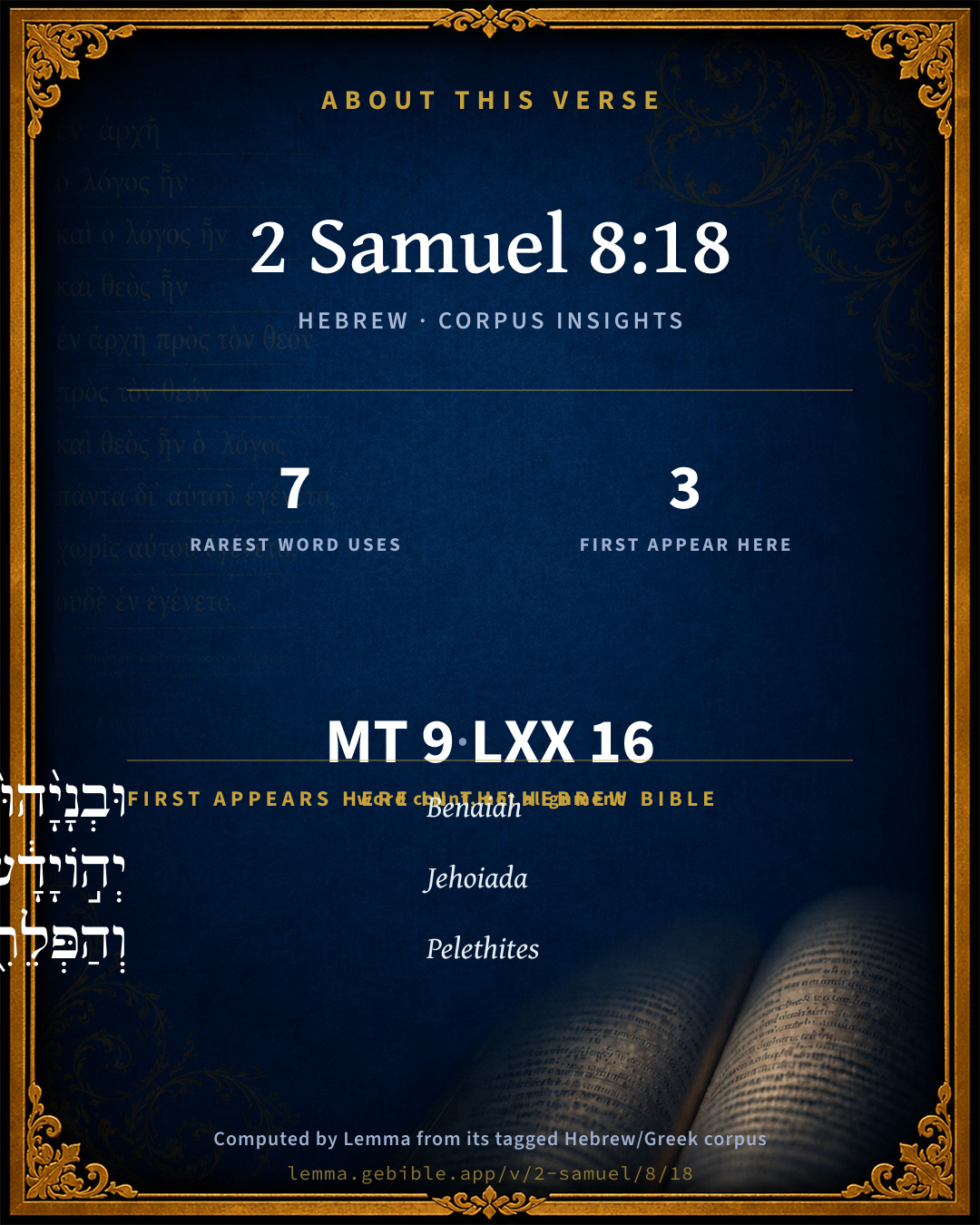
  • 3 first appearances in the Hebrew Bible
Full analysis ↓
Download a study sheet

One document with this verse’s original text, its word-by-word gloss line, the meaning frame, cross-references with their text, attributed commentary, and full source and license credits — printable, and it pastes into notes with its structure intact.

This verse Autodidact and up

Study sheet (.html) Plain text (.txt)

A passage Seminary Student

Up to 50 verses in one chapter. A passage sheet keeps up to 6 commentary sources and 12 cross-references per verse, in the order this page ranks them, and says so on the sheet whenever that leaves anything out. Ask for a single verse and you get the Autodidact verse sheet above.

Everything on this page stays free to read, with no account — the sheet is a download of what is already on screen, not access to it.

Want to remove ads? Support Godless Engineer
Compare translations 3

The same verse in 3 English versions, stacked beneath the original-language interlinear above. Click any original word for its lexicon entry.

Each is an independent rendering of the whole verse — the interlinear is not word-aligned to these translations.

Highlighted words mark where these versions differ — a whole-verse word diff, not a word-by-word alignment.

  • World English Bible Public Domain
    and Benaiah the son of Jehoiada [was over] the Cherethites and the Pelethites; and David's sons were chief ministers.
  • King James Version Public Domain
    And Benaiah the son of Jehoiada was over both the Cherethites and the Pelethites; and David's sons were chief rulers.
  • unfoldingWord Literal Text CC BY-SA 4.0
    And Benaiah, the son of Jehoiada, both the Cherethites and the Pelethites, and the sons of David were priests.

unfoldingWord Literal Text — © unfoldingWord, licensed CC BY-SA 4.0. Word-aligned USFM3 via Door43 (git.door43.org/unfoldingWord/en_ult).

Versions to compare (up to 4)

3 of 4 selected

Show all 18 translations

Every available English version of this verse, each an independent rendering of the whole verse.

  • World English Bible Public Domain
    and Benaiah the son of Jehoiada [was over] the Cherethites and the Pelethites; and David's sons were chief ministers.
  • Berean Standard Bible Public Domain
    Benaiah son of Jehoiada was over the Cherethites and Pelethites; and David’s sons were priestly leaders.
  • Majority Standard Bible Public Domain
    Benaiah son of Jehoiada was over the Cherethites and Pelethites; and David’s sons were priestly leaders.
  • King James Version Public Domain
    And Benaiah the son of Jehoiada was over both the Cherethites and the Pelethites; and David's sons were chief rulers.
  • American Standard Version (1901) Public Domain
    and Benaiah the son of Jehoiada `was over' the Cherethites and the Pelethites; and David's sons were chief ministers.
  • Revised Version (1885) Public Domain
    and Benaiah the son of Jehoiada was over the Cherethites and the Pelethites; and David’s sons were priests.
  • Geneva Bible (1599) Public Domain
    And Benaiah the sonne of Iehoiada and the Cherethites and the Pelethites, and Dauids sonnes were chiefe rulers.
  • Douay-Rheims (1899) Public Domain
    And Banaias the son of Joiada was over the Cerethi and Phelethi: and the sons of David were the princes.
  • Young's Literal Translation Public Domain
    and Benaiah son of Jehoiada `is over' both the Cherethite and the Pelethite, and the sons of David have been ministers.
  • Literal Standard Version CC BY-SA 4.0
    and Benaiah son of Jehoiada [is over] both the Cherethite and the Pelethite, and the sons of David have been ministers.
  • Unlocked Literal Bible CC BY-SA 4.0
    Benaiah son of Jehoiada was in charge of the Kerethites and Pelethites, and David's sons were the chief officials at the king's hand.
  • unfoldingWord Literal Text CC BY-SA 4.0
    And Benaiah, the son of Jehoiada, both the Cherethites and the Pelethites, and the sons of David were priests.
  • Darby Bible Public Domain
    and Benaiah the son of Jehoiada was over the Cherethites and the Pelethites; and David's sons were chief rulers.
  • World Messianic Bible Public Domain
    Benaiah the son of Jehoiada was over the Cherethites and the Pelethites; and David’s sons were chief ministers.
  • Webster's Bible Public Domain
    And Benaiah the son of Jehoiada was over both the Cherethites and the Pelethites; and David's sons were chief rulers.
  • Free Bible Version CC BY-SA 4.0
    Benaiah, son of Jehoiada was in charge of the Cherethites and Pelethites; and David's sons were priests.
  • Bible in Basic English Public Domain
    And Benaiah, the son of Jehoiada, was over the Cherethites and the Pelethites; and David's sons were priests.
  • JPS Tanakh (1917) Public Domain
    and Benaiah the son of Jehoiada was over the Cherethites and the Pelethites; and David's sons were chief ministers.

Literal Standard Version (2020), Covenant Press — licensed CC BY-SA 4.0. Text via the HelloAO Bible API (eBible.org). Unlocked Literal Bible (unfoldingWord) — licensed CC BY-SA 4.0. Text via the HelloAO Bible API (eBible.org). unfoldingWord Literal Text — © unfoldingWord, licensed CC BY-SA 4.0. Word-aligned USFM3 via Door43 (git.door43.org/unfoldingWord/en_ult). Free Bible Version, Dr. Jonathan Gallagher — licensed CC BY-SA 4.0. Text via the HelloAO Bible API (eBible.org).

Word by word

More ways to search: Search by grammar → Find every occurrence → Compare this word →

Practice this passage: Drill this verse → Learn its vocabulary →

וְהַפְּלֵתִ֑י
Pᵉlêthîy
H6432
“and · the · Pelethites”
Conjunction + Particle, Definite Article + Noun, Gentilic, Masculine, Singular, Absolute
Part of Speech
Conjunction + Particle + Noun
Type
Gentilic
Gender
Masculine
Number
Singular
State
Absolute
Full BDB Definition

Origin: from the same form as H6431

TWOT: None

Pelethites = "couriers" - a collective name for the guardsmen of David - probably descendants of an unknown person, perhaps Philistine mercenaries
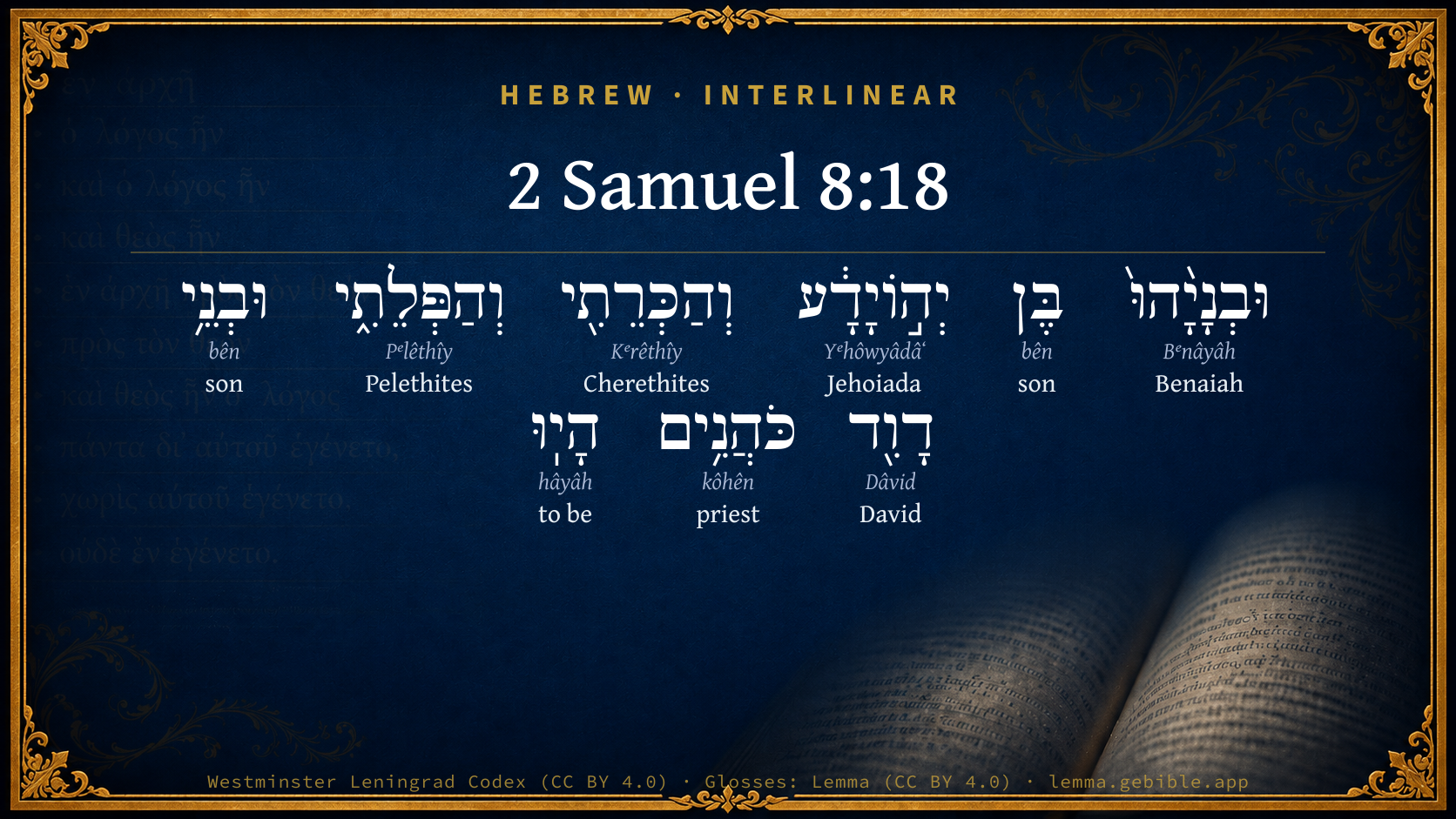
  1. וּבְנָיָ֨הוּ֙ Bᵉnâyâh H1141 “and · Benaiah” Conjunction + Noun, Proper
  2. בֶּן bên H1121 “son of” Noun, Common, Masculine, Singular, Construct
  3. יְה֣וֹיָדָ֔ע Yᵉhôwyâdâʻ H3077 “Jehoiada” Noun, Proper
  4. וְהַכְּרֵתִ֖י Kᵉrêthîy H3774 “and · the · Cherethites” Conjunction + Particle, Definite Article + Noun, Gentilic, Masculine, Singular, Absolute
  5. וּבְנֵ֥י bên H1121 “and · sons of” Conjunction + Noun, Common, Masculine, Plural, Construct
  6. דָוִ֖ד Dâvid H1732 “David” Noun, Proper
  7. כֹּהֲנִ֥ים kôhên H3548 “priests” Noun, Common, Masculine, Plural, Absolute
  8. הָיֽוּ hâyâh H1961 “to be” Verb, Qal, Perfect, 3rd Person, Common, Plural

About this verse

These counts appear in no published source. They are computed here, from the morphology-tagged text and Lemma’s own curated glosses. What Lemma adds →

9
words
8
distinct lemmas
Historical
section

Notable vocabulary

The rarest word here is וְהַפְּלֵתִ֑י Pelethites H6432 — appearing just 7 times in the whole Hebrew Bible.

First appearance in Scripture

These words make their first canonical appearance in the Hebrew Bible here:

  • וּבְנָיָ֨הוּ֙ Benaiah H1141
  • יְה֣וֹיָדָ֔ע Jehoiada H3077
  • וְהַפְּלֵתִ֑י Pelethites H6432

Shared distinctive vocabulary

וְהַפְּלֵתִ֑י Pelethites H6432 occurs in 7 verses of the Hebrew Bible. Also found in:

Grammatical profile

  • 1 verb
  • 8 nouns

Verb forms

  • הָיֽוּ Qal · Perfect

Repetition

A word recurs within this verse — often emphatic in Hebrew:

Hebrew & Septuagint length

In English translation the verse runs 19 words from the Hebrew and 23 from the Septuagint (LXX English) — closely comparable.

A rough comparison of the two English renderings, which tokenize alike — not a word-level alignment.

Word counts can differ between the Hebrew and the Greek without any difference in meaning — e.g. the Hebrew direct-object marker אֵת has no separate Greek word, and Greek often adds the article ὁ.

In the original languages it is 9 Hebrew tokens and 16 Greek tokens — but the two are counted differently (Hebrew bundles its prefixes and suffixes into one token; the Greek is in lemma form), so that isn’t a like-for-like length.

Cross-references

13

Topical passages linked to 2 Samuel 8:18 in the Treasury of Scripture Knowledge — connected by theme and wording, ordered by reader-vote popularity; previews shown in the World English Bible.

  • 1 Samuel 30:14 We made a raid on the South of the Cherethites, and on that which belongs to Judah, and on the South of Caleb; and we burned Ziklag with fire.
  • 2 Samuel 15:18 All his servants passed on beside him; and all the Cherethites, and all the Pelethites, and all the Gittites, six hundred men who came after him from Gath, passed on before the king.
  • 2 Samuel 20:7 There went out after him Joab's men, and the Cherethites and the Pelethites, and all the mighty men; and they went out of Jerusalem, to pursue after Sheba the son of Bichri.
  • 2 Samuel 20:23 Now Joab was over all the host of Israel; and Benaiah the son of Jehoiada was over the Cherethites and over the Pelethites;
  • 1 Chronicles 18:17 and Benaiah the son of Jehoiada was over the Cherethites and the Pelethites; and the sons of David were chief about the king.
  • 2 Samuel 23:20–23 Benaiah the son of Jehoiada, the son of a valiant man of Kabzeel, who had done mighty deeds, he killed the two [sons of] Ariel of Moab: he went down also and killed a lion in the midst of a pit in time of snow.
  • 1 Kings 1:38 So Zadok the priest, and Nathan the prophet, and Benaiah the son of Jehoiada, and the Cherethites and the Pelethites, went down, and caused Solomon to ride on king David's mule, and brought him to Gihon.
  • 1 Kings 1:44 and the king has sent with him Zadok the priest, and Nathan the prophet, and Benaiah the son of Jehoiada, and the Cherethites and the Pelethites; and they have caused him to ride on the king's mule;
  • 2 Samuel 20:26 and also Ira the Jairite was chief minister to David.
  • 1 Kings 2:34–35 Then Benaiah the son of Jehoiada went up, and fell on him, and killed him; and he was buried in his own house in the wilderness.
  • 1 Kings 4:4 and Benaiah the son of Jehoiada was over the host; and Zadok and Abiathar were priests;
  • Ezekiel 25:16 therefore thus says the Lord Yahweh, Behold, I will stretch out my hand on the Philistines, and I will cut off the Cherethites, and destroy the remnant of the sea coast.
  • Zephaniah 2:5 Woe to the inhabitants of the sea coast, the nation of the Cherethites! The word of Yahweh is against you, Canaan, the land of the Philistines. I will destroy you, that there will be no inhabitant.

Cross-references courtesy of OpenBible.info (CC BY 4.0).

Hebrew and Greek witnesses Masoretic Hebrew ↔ Greek Septuagint

The same verse in the two great witnesses to the Old Testament, shown verse-for-verse.

These are two independent witnesses, not word-aligned to each other, and the Septuagint is shown in lemma (dictionary) form.

Hebrew 2 Samuel 8:18 Masoretic · Westminster Leningrad Codex

וּבְנָיָ֨הוּ֙ בֶּן יְה֣וֹיָדָ֔ע וְהַכְּרֵתִ֖י וְהַפְּלֵתִ֑י וּבְנֵ֥י דָוִ֖ד כֹּהֲנִ֥ים הָיֽוּ

and Benaiah the son of Jehoiada [was over] the Cherethites and the Pelethites; and David's sons were chief ministers.

World English Bible · Public Domain

Greek LXX 2 Samuel 8:18 Septuagint · lemma form

καί βαναιας υἱός ιωδαε σύμβουλος καί ὁ χελεθθι καί ὁ φελεττι καί υἱός δαυίδ αὐλάρχης εἰμί

and Banaeas son of Jodae was councillor, and the Chelethite and the Phelethite, and the sons of David, were princes of the court.

LXX2012 (modern English Septuagint) · Public Domain

On this verse, Haydock's Catholic Bible Commentary discusses the Septuagint’s reading. Read the note in Commentary ↓

Hebrew: Westminster Leningrad Codex (CC BY 4.0). Greek: Septuagint (public domain); English from LXX2012 (modern English Septuagint) (Public Domain). How the Septuagint differs from the Hebrew →

Targum (Aramaic paraphrase)

1

The Targum is the ancient Jewish Aramaic paraphrase of the Hebrew Scriptures — an interpretive translation, not the Hebrew text itself. Onkelos (literal) and Pseudo-Jonathan (expansive) render the Torah, and Jonathan the Prophets. Coverage is partial: where no permissively-licensed English translation exists for a verse, only the Aramaic is shown. This is verse-level text, not a word-by-word alignment to the Hebrew.

  1. Targum Jonathan Prophets (Joshua–Malachi)
    וּבְנָיָהוּ בַּר יְהוֹיָדָע מְמַנָא עַל קַשְׁתַּיָא וְעַל קַלְעֲיָא וּבְנֵי דָוִד רַבְרְבִין הֲווֹ:

    (no public-domain English translation for this verse)

    Targum Jonathan — Aramaic: “Mikraot Gedolot” (public domain). English: “Sefaria Community Translation” (CC0 1.0 (public-domain dedication)); “London "Chaldee Paraphrase," 1871” (public domain). Text via Sefaria.

Commentary

Notes on 2 Samuel 8:18 from classic Christian and Jewish commentators (each source and its license shown beneath its notes). The classic Christian expositions comment on the surrounding passage and are grouped to its opening verse, so a note may address several verses; the Jewish commentaries on the Tanakh (Rashi and others) are per-verse, so they appear only where the commentator wrote on this verse.

Lemma curates 59 commentaries, every one of them public domain or Creative Commons licensed, each selected and text-cleaned for this edition rather than reprinted as found. About our sources →

Trapp's Complete Commentary

John Trapp

2Sa 8:18 And Benaiah the son of Jehoiada [was over] both the Cherethites and the Pelethites; and David’s sons were chief rulers.

Ver. 18. Was over both the Cherethites and the Pelethites,] i.e., Was Praefectus cohortis praetoriance, captain of the king’s guard, {a} who might be native Philistines, great and mighty men of stature, but proselytes and professors of the true religion.

And David’s sons were chief rulers.] Or, Princes, chief about the king, {1Ch 18:17} which preferment haply might puff up Absalom and Adonijah, and put them upon ill exploits. Our Henry II was very unhappy in his eldest son Henry, whom he crowned whilst he was yet alive, but killed him with that kindness; in his second son Richard, who, being set over Normandy, conspired with the king of France against him; and in his third son John, upon whom by heaping honours, he made him more dangerous at home. {b}

{a} σωματοφυλακες. - Joseph. Illis erat commissa cura corporis regii. - Vatab.

{b} Dan 109,144

John Trapp, A Commentary or Exposition upon All the Books of the Old and New Testament (1647–1656) — public domain. Text from a community e-Sword module.

Joseph Benson's Commentary

2Sa 8:18. Benaiah, &c. — Benaiah was one of David’s three worthies of the second order; eminent for many great exploits, of which three only are recounted by the sacred historian. Was over both the Cherethites and the Pelethites — These were undoubtedly soldiers of some kind, and even such as were eminent for their valour and fidelity to the king, as is evident from 2Sa 15:18; 2Sa 20:7; and 1Ki 1:38; 1Ki 1:44; yet they were not common soldiers, but probably the constant guards of David’s person; like the Prætorian bands among the Romans. Josephus calls them keepers of the body, or body-guards, who never departed from the place where the king was. That Cherethites is sometimes another word for Philistines, appears plainly from Zep 2:5, and Eze 25:16; But, “that David’s guards were native Philistines, of his mortal enemies, is not to be imagined, even although we should suppose them proselytes. For how could their being proselyted more effectually recommend the fidelity of any men to him than being natives of his own country, and known and tried subjects? The only question, then, is, why any of his own subjects should be called Cherethites; and the answer is obvious. They were called so from their having gone with him into Philistia, and continued there with him all the time that he was under the protection of Achish. These were they who resorted to him from the beginning, in his utmost distress; and clave to him in all his calamities; and it is no wonder if men of such approved fidelity were in a more intimate degree of favour and confidence with the king, and enjoyed, among other privileges, an exemption from the authority of the captain-general, and were placed under peculiar commanders. And it will be no uncommon thing in the history of any country, to find legions and bands of soldiers, denominated, not from the place of their nativity, but that of their residence; as General Monk’s troops, who sojourned with him in Scotland, were called Coldstreamers.” — Delaney. The same author apprehends the Pelethites to have been another body of troops, made up of those valiant men who resorted to David when he resided at Ziklag, among whom we find one Pelet, the son of Azmaveth, (1Ch 12:3,) who, it is supposed, became their captain, and from whom they were called Pelethites, as the soldiers disciplined by Fabius and Iphicrates were called Fabians and Iphicratians. “Now, as the Cherethites adhered to David and followed his fortune from the beginning, they justly held the first degree of favour with him, and therefore they are always placed before the Pelethites, who only resorted to him when he was in Ziklag; and for that reason were only entitled to the second degree of favour.” See 1Sa 30:14. It must be observed, however, that the Chaldee interpretation of these terms is, archers and slingers, an interpretation which is defended by a learned professor abroad, deriving the name Cherethite from Caratha, which, in the Arabic language, signifies to hit the mark, and Pelethite, from pelet, which in the same language, among other things, signifies to be alert, to leap, to run swiftly. The latter, therefore, he thinks, were soldiers chosen for their speed, and were light armed, like the Roman velites, who, with their other weapons, carried very light arrows, which were called pelles, and the use of which came from the East. And David’s sons were chief rulers — For so the Hebrew word, כהנים, cohanim, generally translated priests, must often be interpreted. Indeed it signifies any ministers, either of God or of man. David’s sons, being of the tribe of Judah, and not of the posterity of Aaron, could not be priests, according to the law. But they were among the principal officers of his court, the prime ministers of his household. Upon the whole, we find by this chapter that so long as David was zealous for the honour of God, and faithful in the discharge of his duty, God defended and protected him against his enemies, and blessed him with glory and happiness; but the scene changed when he provoked God by his sins, as we see in the sequel of his history.

Joseph Benson's Commentary on the Old and New Testaments (1811–1818) — public domain. Text from a community e-Sword module.

Tyndale Open Study Notes

Tyndale Open Resources

8:18 the king’s bodyguard: Hebrew the Kerethites and Pelethites. Both peoples were probably foreigners, especially the Kerethites, who might have come from the island of Crete (see also 1 Sam 30:14; Ezek 25:16). These groups might have been Philistine mercenaries. • David’s sons served as priestly leaders: David was from Judah and was not a Levite. Alongside the traditional priesthood, David might have inaugurated a religious class specifically tied to his dynasty, probably to serve the royal court (see also study note on 2 Sam 20:26).

Tyndale Open Study Notes — © Tyndale Open Resources, licensed CC BY-SA 4.0. Text via the HelloAO Bible API.

Geneva Bible (1599)

Geneva Bible translators

Or, was over the Cherethites.

The Cherethites and Pelethites were as the king’s guard, and had charge of his person.

Geneva Bible (1599) marginal notes — public domain. Text via Bolls.life.

Jamieson, Fausset & Brown

Robert Jamieson, A. R. Fausset & David Brown

Cherethites--that is, Philistines (Zep 2:5).

Pelethites--from Pelet (Ch1 12:3). They were the valiant men who, having accompanied David during his exile among the Philistines, were made his bodyguard.

Next: 2 Samuel Chapter 9

Jamieson, Fausset & Brown — Commentary Critical and Explanatory on the Whole Bible (1871) — public domain (CC PDM 1.0). Text via the HelloAO Bible API.

Adam Clarke's Commentary

Verse 18. Benaiah] The chief of the second class of David's worthies. We shall meet with him again.

The Cherethites and the Pelethites] The former supposed to be those who accompanied David when he fled from Saul; the latter, those who came to him at Ziklag. But the Targum translates these two names thus, the archers and the slingers; and this is by far the most likely. It is not at all probable that David was without a company both of archers and slingers. The bow is celebrated in the funeral lamentation over Saul and Jonathan; and the sling was renowned as the weapon of the Israelites, and how expert David was in the use of it we learn from the death of Goliath. I take for granted that the Chaldee paraphrast is correct. No weapons then known were equally powerful with these; the spears, swords, and javelins, of other nations, were as stubble before them. The bow was the grand weapon of our English ancestors; and even after the invention of firearms, they were with difficulty persuaded to prefer them and leave their archery.

Adam Clarke's Commentary on the Bible (1810–1826) — public domain. Text from a community e-Sword/MySword module.

Ellicott's Commentary for English Readers

(18) The Cherethites and the Pelethites.—These bodies of men, here mentioned for the first time, afterwards appear frequently, constituting the most trusted part of the king’s army, and forming his especial body-guard (2Sa_15:18; 2Sa_20:7; 2Sa_20:23; 1Ki_1:38; 1Ki_1:44; 1Ch_18:17). Benaiah, who commanded them, a hero from Kabzeel (2Sa_23:20), was afterwards promoted by Solomon to be general-in-chief (1Ki_2:35). But the meaning of the words, “the Che-rethites and the Pelethites,” has been much disputed. On the one hand it is urged that the form of the name indicates a tribal designation, and that there was a tribe of Cherethites living south of Philistia (1Sa_30:14), who are also mentioned in connection with the Philistines in Eze_25:16; Zep_2:5. Besides, these names appear as those of bodies of troops only during the reign of David, and the objection that he would have been unlikely to employ foreign mercenaries may be met by the supposition that they had embraced the religion of Israel. On the other hand, the Chaldee (“archers and slingers”) and Syriac (“nobles and Tustics”) understood them as appellatives, and it is said that they should properly be translated “executioners and runners,” such offices falling to the chief troops in all Oriental armies; no tribe of “Pelethites” is known, and in 2Sa_20:23 the expression translated “Cherethites and Pelethites” has another form for “Cherethites,” which again occurs with “Pelethites” in 2Ki_11:4; 2Ki_11:19, and is translated “the captains and the guard.” The question does not seem to admit of positive determination.

Chief rulers.—So these words are rendered in all the ancient versions except the Vulg., and the same term is applied in 1Ki_4:5 to Zabud, with the explanation “the king’s friend,” and also in 2Sa_20:26 to Ira, “a chief ruler about (literally, at the side of) David.” The word, however (cohen), is the one generally used for “priest,” and there seems here to be a reminiscence in the word of that early time when the chief civil and ecclesiastical offices were united in the head of the family or tribe. Such use of the word had become now almost obsolete, and quite so in the time when the Chronicles were written, since they substitute here (1Ch_18:17) “chief about (literally, at the hand of) the king.” For this change in the use of the word, “exact analogies may be found in ecclesiastical words, as bishop, priest, deacon, minister, and many others.”—Speaker’s Commentary.

A Bible Commentary for English Readers, edited by Charles John Ellicott (1878–1897) — public domain. Text from a community e-Sword module.

The Cambridge Bible for Schools and Colleges

gen. ed. J. J. S. Perowne

18. Benaiah] See note on ch. 2Sa_23:20.

was over] Over is not in the Heb. text, and must be supplied from Chr. But possibly there is some further defect, for the Sept. reads “Benaiah the son of Jehoiada was counsellor.” Cp. note on ch. 2Sa_23:23.

the Cherethites and the Pelethites] The first reference to these troops, which are mentioned by this name during the reign of David only. They seem to have formed the king’s body-guard. See ch. 2Sa_15:18, 2Sa_20:7; 2Sa_20:23; 1Ki_1:38; 1Ki_1:44; 1Ch_18:17. Two explanations of the names have been proposed: (1) that they mean executioners and runners, it being the duty of the royal guards to execute sentence (see Gen_37:36 marg.; 1Ki_2:25), and to convey the king’s orders from place to place (see 2Ch_30:6): (2) that they are the names of two Philistine tribes, the body-guard being composed of foreign mercenaries, like the Pope’s Swiss guard. In favour of the latter explanation it may be urged (a) that the names are gentilic in form; (b) that Cherethites certainly denotes a Philistine tribe in the other passages where it occurs (1Sa_30:14; Eze_25:16; Zep_2:5); (c) that they are mentioned in conjunction with the Gittites in ch. 2Sa_15:18, so that David evidently had some foreign troops in his service, whom he had gathered round him during his residence at Ziklag.

chief rulers] Ministers. The word is that usually translated priest. It is derived from a root meaning to serve or minister, and in a few instances denotes a civil not an ecclesiastical minister, the king’s confidential adviser. Cp. the paraphrase in 1Ch_18:17 “chief by the side of the king;” and 1Ki_4:5, where the E. V. renders “principal officer.”

The Cambridge Bible for Schools and Colleges (gen. ed. J. J. S. Perowne; Cambridge University Press, 1878–1918) — public domain. Text from a community e-Sword module.

John Gill's Exposition

And Benaiah the son of Jehoiada was over both the Cherethites and Pelethites,.... These, according to Josephus (k), were the king's bodyguards, and this man is expressly said to be set over his guards, Sa2 23:22; and which some think were of the nation of the Philistines, famous for archery, and slinging of stones; and so the Targum renders it,"was appointed over the archers and slingers;''so "choriti" in Virgil (l) are quivers for arrows; the great use of which in fighting David had observed, and therefore got a select company of these men, partly to teach Israel, and partly to guard himself: but others are of opinion that David would never suffer such as were Heathens to be so near his person, and therefore take them to be Israelites; and so some Jewish writers say they were two families in Israel; which is much better than to interpret them as others do of the sanhedrim, and even of the Urim and Thummim, as in the Targum on Ch1 18:17; See Gill on Zep 2:5; and it is most probable that they were Israelites, who were David's guards, and consisted of the chiefs that were with him in Philistia, and particularly at Ziklag, which lay on the south of the Cherethites, Sa1 30:14; and so had their name from thence; and among the chief of those that came to him at Ziklag there was one named Peleth, from whence might come the Pelethites, and they were all of them archers; see Ch1 12:2,

and David's sons were chief rulers; princes, princes of the blood, or "chief about the king", as in Ch1 18:17; they were constant attendants at court, waiting on the king, ready at hand to do what he pleased to order; they were the chief ministers, and had the management of the principal affairs at court. Abarbinel thinks that this respects not only David's sons, but Benaiah, and the family of the Cherethites and Pelethites, who had none of them particular posts assigned them, which were settled and known, as those before mentioned had, but were always near at hand, to do whatsoever the king commanded them; and which seems better to agree with the literal order and construction of the words; which are:

and Benaiah the son of Jehoiada, and the Cherethites, and Pelethites,

and the sons of David, were princes, or chief rulers; or priests, who according to Gussetius (m) brought the offerings or presents to the king, and did that to him the priests did to the Lord.

(k) Ut supra. (Antiqu. l. 7. c. 5. sect.4.) (l) Aeneid. 10. (m) Ebr. Comment. p. 366.

Next: 2 Samuel Chapter 9

John Gill's Exposition of the Whole Bible (1746–1763) — public domain (CC PDM 1.0). Text via the HelloAO Bible API.

Haydock's Catholic Bible Commentary

The Cerethi and Phelithi. The king’s guards. (Challoner) --- They were Philistines, and had attached themselves to David while he was at Geth, continuing always faithful to him. We read of them in the Vulgate, under the reign of Joas, 4 Kings xi. 19. David selected some out of all Israel, towards the end of his reign, 1 Paralipomenon xxvii. --- Princes: literally, priests; (Cohen) so called, by a title of honour, and not for exercising the priestly function. (Challoner) --- Sanctius translates, they "were like priests." The book of 1 Paralipomenon (xviii. 17,) explains, were chief about the king. Septuagint, "masters of the palace." David kept them near his person, and employed them as he thought proper: Bertram thinks, in embassies, till after the revolt of Absalom, when Ira took their place, chap. xx. 26. (Calmet) --- Protestants, "David’s sons were chief rulers." Chaldean, "grandees;" (Haydock) "ministers." (Grotius) (Du Hamel)

George Leo Haydock (1774–1849), Haydock's Catholic Family Bible and Commentary, 1859 edition — public domain. Excludes Psalms (Douay-Rheims chapter numbering differs from Protestant) and Deuterocanonical books (Catholic canon only).

Matthew Poole's English Annotations

Was over: these words are supplied out of the parallel place, 1Ch 18:17, and out of 2Sa 20:23, where they are expressed.

The Cherethites and Pelethites were undoubtedly soldiers, and such as were eminent for their valour and fidelity to the king, as is evident from 2Sa 15:18; 20:7; 1Ki 1:38,44; and most probably they were the king’s guards, which consisted of these two bands, who might be distinguished either by their several weapons, or by the differing time or manner of their service. They are supposed to be thus called, either, first, from their office, which was upon the king’s command to cut off or punish offenders, and to preserve the king’s person, as their names in the Hebrew tongue may seem to imply; or, secondly, from some country or place to which they had relation. As for the Cherethites, it is certain they were either a branch of the Philistines, or a people neighbouring to them, and confederate with them, as is manifest from 1Sa 30:14; Eze 25:16; Zep 2:4,5. And so might the Pelethites be too, though that be not related in Scripture. And these Israelites and soldiers of David might be so called, either because they went and lived with David when he dwelt in those parts; or from some notable exploit against or victory over these people; as among the Romans the names of Asiaticus, Africanus, &c. were given for the same reason. One of their exploits against the Cherethites is in part related 1Sa 30:14. And it is likely they did many other against them, and against other people, amongst which the Pelethites might be one.

Were chief rulers; had the places of greatest. authority and dignity conferred upon them.

Matthew Poole's English Annotations on the Holy Bible (1683–1685) — public domain. Text from a community e-Sword/MySword module.

Whedon's Commentary on the Bible

Daniel D. Whedon

18. The Cherethites and the Pelethites — The Syriac and Arabic versions render these words, nobles and soldiers; the Targum of Jonathan, archers and slingers. Josephus simply says: “He committed the command over his body guards to Benaiah,” and this agrees with chap. xxiii, 23, where it is said that Benaiah was set over the guard, or privy council, of the king. The Hebrew words are in the form of adjectives, and may be translated by executioners and runners, and such offices they probably served in David’s army. But the words seem to refer most naturally to the nationality of the men, and to indicate that they were composed principally, if not altogether, of foreigners — Cretans and Philistines. A common and prevailing opinion is, that the Philistines were originally colonists from Crete, and perhaps numerous immigrants from that earlier home of the race were continually coming into Philistia during David’s residence at Ziklag. These later immigrants may have been called Cherethites in distinction from the older Philistine settlers. See note on 1Sa_30:14. The fact that David had a considerable body of Gittites in his army (2Sa_15:18) forbids our assuming that he would never have composed his body-guard of foreigners, He may have had peculiar reasons for so doing of which we are now ignorant. And, as Ewald well says, “This small body could at no time become a source of danger to the State. Far more was to be apprehended from the Gibborim, (mighty men,) who obviously formed the commencement of a sort of milites praetoriani, or janissaries, and were already of sufficient importance to play a part at Solomon’s accession. 1Ki_1:8; 1Ki_1:10. To this must be added that they might also be chosen from foreigners as soon as they conformed to the religion of the country. Uriah was a Hittite, but, as far as religion went, a good Israelite; Zelek was an Ammonite, (2Sa_23:37,) and Ithmah a Moabite, (1Ch_11:46;) and Ittai of Gath, who was appointed commander of one of the three divisions of the army in the battle against Absalom, is expressly designated as a foreigner by David. 2Sa_15:19.”

David’s sons were chief rulers — Literally, priests; margin, princes. The word has been explained as domestic priests, court chaplains, or spiritual advisers. The parallel passage in Chronicles seems to give the true sense, chief at the hand of the king; that is, his most intimate counsellors and confidants. See note on 1Ki_4:2; 1Ki_4:5.

Daniel D. Whedon (gen. ed.), Commentary on the Old and New Testaments (1874–1909) — public domain. Text from a community e-Sword module.

The Pulpit Commentary

The Cherethites and the Pelethites. As we have already seen, (1Sa_30:14) the Cherethim were an insignificant tribe inhabiting the southern part of the country of the Philistines. Nor is that place the only proof of this fact; for they are connected with the Philistines also in Eze_25:16 and Zep_2:5. David made their acquaintance when at Ziklag; and probably the Pelethim dwelt in the same neighbourhood, and were a still more unimportant clan or family. Much ingenuity has been expended in finding for their names a Hebrew derivation, and Gesenius explains them as meaning "cutters and runners," though for the latter signification he has to go to the Arabic, where he finds a verb falata, "to run away," "flee." But this craze of explaining the names of aboriginal tribes and their towns by Hebrew words is not only absurd in itself, but bars the way to sounder knowledge. For it is possible that, by the study of names not belonging to the Hebrew language, we might arrive at some correct ideas about the races who had previously occupied Palestine. Instead of this, the whole system of derivation is corrupted, and philology made ridiculous. What can be more ludicrous than to explain these Pelethim as "runners away," unless it be the notion that the Rephaim took their name from the Hebrew word for "a ghost"? In his "mighties" David had a powerful bodyguard of native Israelites, and Saul previously had formed a similar force of three thousand men, not merely for the protection of his own person, but to guard the land from marauding incursions of Amalekites and other freebooting tribes. Such a body of men was of primary importance for police purposes anti the safety of the frontiers. How useful such a force would be we can well understand from the history of the marches between England and Scotland (see also note on; (2Sa_3:22) but I imagine that the Cherethites and Pelethites were used for humbler purposes. While "the mighties" guarded the frontiers, and kept the peace of the kingdom, these men would be used about the court and in Jerusalem, to execute the commands of the king and his great officers. Native Israelites would refuse such servile work, and the conquered Canaanites might become dangerous if trained and armed; while these foreigners, like the Swiss Guard in France, would be trustworthy and efficient. As for the true-born Israelites, they probably did not form the mass of the population, but, like the Franks in France, were the privileged and dominant race. We read that even from Egypt, besides their own dependents, there went up with Israel "a great mixture". (Exo_12:38, margin) In Num_11:4 these are even contemptuously designated by a word which answers to our "omnium gatherum;" yet even they, after the conquest of Palestine, would be higher in rank than the subjugated Canaanites, from whom, together with another "mixed multitude" spoken Neh_13:3, are descended the felahin of the present day. David"s armies would be drawn from the Israelites, among whom were now reckoned the mixed multitude which went up from Egypt, and which was ennobled by taking part in the conquest of Canaan. In the army "the mighties" would hold the chief place; while the mercenaries, recruited from Ziklag and its neighbourhood, which continued to be David"s private property, (1Sa_27:6) would be most useful in the discharge of all kinds of administrative duty, and would also guard the king"s person. In 2Sa_20:23 for Cherethi we find Cheri, which word also occurs in 2Ki_11:4, 2Ki_11:19. In the former passage the spelling is a mistake, the letter t having dropped out, and it is so regarded by the Jews, who read "Cherethi." The versions also translate there just as they do here, namely the Vulgate and LXX., " Cherethi and Pelethi;" and the Syriac by two nouns of somewhat similar sound to the Hebrew, and which signify "freemen and soldiers." In the latter place in Kings it is probable that some other tribe supplied the bodyguard in Queen Athaliah"s time. David"s sons were chief rulers; Hebrew and Revised Version, priests. Similarly, in ch. 20:26, "Ira the Jairite was David"s priest," Hebrew, cohen; and in 1Ki_4:5, "Zabud was Solomon"s priest." Gesenius and others suppose that they were domestic chaplains, not ministering according to the Levitical law, but invested with a sort of sacerdotal sacredness in honour of their birth. But if we look again at 1Ki_4:5 we find "Zabud was priest, the king"s friend;" and the latter words seem to be an explanation of the title cohen, added because the word in this sense was already becoming obsolete.

1Ch_18:17 the language is completely changed, and we read, "and David"s sons were chief at the king"s hand." We may feel sure that the Chronicler knew what was the meaning of the phrase in the Books of Samuel, and that he was also aware that it had gone out of use, and therefore gave instead the right sense. Evidently the word cohen had at first a wider significance, and meant a "minister and confidant." He was the officer who stood next to his master, and knew his purpose and saw to its execution. And this was the meaning of the term when applied to the confidential minister of Jehovah, whose duty it was to execute his will according to the commands given in the Law; but when so used it gradually became too sacred for ordinary employment. Still, there is a divinity about a king, and so his confidants and the officers nearest to his person were still called cohens; and we find the phrase lingering on for another century and a half. For Jehu puts to death, not only Ahab"s great men and kinsfolk, but also "his cohens," the men who had been his intimate friends. (2Ki_10:11)

The Pulpit Commentary (1880–1919), ed. H.D.M. Spence-Jones & Joseph S. Exell — public domain. Text from a community e-Sword module.

John Wesley's Explanatory Notes

Cherethites, &c. - The Cherethites and Pelethites were undoubtedly soldiers, and such as were eminent for their valour and fidelity. Most probable they were the king's guards, which consisted of these two bands, who might be distinguished either by their several weapons, or by the differing time or manner of their service. They are supposed to be thus called either, first, from their office, which was upon the king's command to cut off or punish offenders, and to preserve the king's person, as their names in the Hebrew tongue may seem to imply. Or, secondly, from some country, or place to which they had relation. As for the Cherithites, it is certain they were ether a branch of the Philistines, or a people neighbouring to them, and so might the Pelethites be too, though that be not related in scripture. And these Israelites and soldiers of David might be so called, either because they went and lived with David when he dwelt in those parts or, for some notable exploit against, or victory over these people.

John Wesley, Explanatory Notes Upon the Whole Bible (1754–1765) — public domain. Text via the GEBible commentary corpus.

Keil & Delitzsch

C. F. Keil & F. Delitzsch

Benaiah the son of Jehoiada, a very brave hero of Kabzeel (see at Sa2 23:20.), was over the Crethi and Plethi. Instead of והכּרתי, which gives no sense, and must be connected in some way with Kg1 1:38, Kg1 1:44, we must read הכּרתי על according to the parallel passage Sa2 20:23, and the corresponding text of the Chronicles. The Crethi and Plethi were the king's body-guard, σωματοφύλακες (Josephus, Ant. vii. 5, 4). The words are adjectives in form, but with a substantive meaning, and were used to indicate a certain rank, lit. the executioners and runners, like השּׁלישׁי (Sa2 23:8). כּרתי, from כּרת, to cut down or exterminate, signifies confessor, because among the Israelites (see at Kg1 2:25), as in fact throughout the East generally, the royal halberdiers had to execute the sentence of death upon criminals. פּלתי, from פלת (to fly, or be swift), is related to פּלט, and signifies runners. It is equivalent to רץ, a courier, as one portion of the halberdiers, like the ἄγγαροι of the Persians, had to convey the king's orders to distant places (vid., Ch2 30:6). This explanation is confirmed by the fact that the epithet והרצים הכּדי was afterwards applied to the king's body-guard (Kg2 11:4, Kg2 11:19), and that הכּרי for הכּרתי occurs as early as Sa2 20:23.

כּרי, from כוּר, fodit, perfodit, is used in the same sense.

(Note: Gesenius (Thes. s. vv.) and Thenius (on Kg1 1:38) both adopt this explanation; but the majority of the modern theologians decide in favour of Lakemacher's opinion, to which Ewald has given currency, viz., that the Crethi or Cari are Cretes or Carians, and the Pelethi Philistines (vid., Ewald, Krit. Gramm. p. 297, and Gesch. des Volkes Israel, pp. 330ff.; Bertheau, zur Geschichte Israel, p. 197; Movers, Phnizier i. p. 19). This view is chiefly founded upon the fact that the Philistines are called C'rethi in Sa1 30:14, and C'rethim in Zep 2:5 and Eze 25:16. But in both the passages from the prophets the name is used with special reference to the meaning of the word הכרית, viz., to exterminate, cut off, as Jerome has shown in the case of Ezekiel by adopting the rendering interficiam interfectores (I will slay the slayers) for את־כּרתים הכרתּי. The same play upon the words takes place in Zephaniah, upon which Strauss has correctly observed: "Zephaniah shows that this violence of theirs had not been forgotten, calling the Philistines Crethim for that very reason, ut sit nomen et omen." Besides, in both these passages the true name Philistines stands by the side as well, so that the prophets might have used the name Crethim (slayers, exterminators) without thinking at all of Sa1 30:14. In this passage it is true the name Crethi is applied to a branch of the Philistine people that had settled on the south-west of Philistia, and not to the Philistines generally. The idea that the name of a portion of the royal body-guard was derived from the Cretans is precluded, first of all, by the fact of its combination with הפּלתי (the Pelethites); for it is a totally groundless assumption that this name signifies the Philistines, and is a corruption of פלשׁתּים. There are no such contractions as these to be found in the Semitic languages, as Gesenius observes in his Thesaurus (l.c.), "quis hujusmodi contractionem in linguis Semiticis ferat?" Secondly, it is also precluded by the strangeness of such a combination of two synonymous names to denote the royal body-guard. "Who could believe it possible that two synonymous epithets should be joined together in this manner, which would be equivalent to saying Englishmen and Britons?" (Ges. Thes. p. 1107). Thirdly, it is opposed to the title afterwards given to the body-guard, והרצים הכּרי (Kg2 11:4, Kg2 11:19), in which the Cari correspond to the Crethi, as in Sa2 20:23, and ha-razim to the Pelethi; so that the term pelethi can no more signify a particular tribe than the term razim can. Moreover, there are other grave objections to this interpretation. In the first place, the hypothesis that the Philistines were emigrants from Crete is merely founded upon the very indefinite statements of Tacitus (Hist. v. 3, 2), "Judaeos Creta insula profugos novissima Libyae insedisse memorant," and that of Steph. Byz. (s. v. Γαζά), to the effect that the city of Gaza was once called Minoa, from Minos a king of Crete, - statements which, according to the correct estimate of Strauss (l.c.), "have all so evidently the marks of fables that they hardly merit discussion," at all events when opposed to the historical testimony of the Old Testament (Deu 2:23; Amo 9:7), to the effect that the Philistines sprang from Caphtor. And secondly, "it is a priori altogether improbable, that a man with so patriotic a heart, and so devoted to the worship of the one God, should have surrounded himself with a foreign and heathen body-guard" (Thenius). This argument cannot be invalidated by the remark "that it is well known that at all times kings and princes have preferred to commit the protection of their persons to foreign mercenaries, having, as they thought, all the surer pledge of their devotedness in the fact that they did not spring from the nation, and were dependent upon the ruler alone" (Hitzig). For, in the first place, the expression "at all times" is one that must be very greatly modified; and secondly, this was only done by kings who did not feel safe in the presence of their own people, which was not the case with David. And the Philistines, those arch-foes of Israel, would have been the last nation that David would have gone to for the purpose of selecting his own body-guard. It is true that he himself had met with a hospitable reception in the land of the Philistines; but it must be borne in mind that it was not as king of Israel that he found refuge there, but as an outlaw flying from Saul the king of Israel, and even then the chiefs of the Philistines would not trust him (Sa1 29:3.). And when Hitzig appeals still further to the fact, that according to Sa2 18:2, David handed over the command of a third of his army to a foreigner who had recently entered his service, having emigrated from Gath with a company of his fellow-countrymen (Sa2 15:19-20, Sa2 15:22), and who had displayed the greatest attachment to the person of David (Sa2 15:21), it is hardly necessary to observe that the fact of David's welcoming a brave soldier into his army, when he had come over to Israel, and placing him over a division of the army, after he had proved his fidelity so decidedly as Ittai had at the time of Absalom's rebellion, is no proof that he chose his body-guard from the Philistines. Nor can Sa2 15:18 be adduced in support of this, as the notion that, according to that passage, David had 600 Gathites in his service as body-guard, is simply founded upon a misinterpretation of the passage mentioned.)

And David's sons were כּהנים ("confidants"); not priests, domestic priests, court chaplains, or spiritual advisers, as Gesenius, De Wette, and others maintain, but, as the title is explained in the corresponding text of the Chronicles, when the title had become obsolete, "the first at the hand (or side) of the king." The correctness of this explanation is placed beyond the reach of doubt by Kg1 4:5, where the cohen is called, by way of explanation, "the king's friend." The title cohen may be explained from the primary signification of the verb כּהן, as shown in the corresponding verb and noun in Arabic ("res alicujus gerere," and "administrator alieni negotii"). These cohanim, therefore, were the king's confidential advisers.

Keil & Delitzsch — Biblical Commentary on the Old Testament (1861–1891) — public domain (CC PDM 1.0). Text via the HelloAO Bible API. (Old Testament only.)

Rashi

Rabbi Shlomo Yitzchaki (Rashi)

Venoyohaa, the son of Yehoyodoh [was in charge of] the archers and the sling shooters. Yonasan translated, "Venoyoha, the son of Yehoydoh was appointed [in charge] over the archers and over the sling shooters." [Alternatively] our Rabbis said [that the words] keraisi and plaisi refer to the Urim and Tumim.

Were prominent [leaders]. [Yonasan translates] "They were prominent."

Rashi on the Tanakh — English translations: “The Judaica Press complete Tanach with Rashi, translated by A. J. Rosenberg” (CC BY 4.0); “Pentateuch with Rashi's commentary by M. Rosenbaum and A.M. Silbermann, 1929-1934” (public domain); “The Metsudah Tanach series, Lakewood, N.J” (CC BY 4.0); and “The Book of Joshua, Metsudah Publications, 1997” (CC BY 4.0). Text via Sefaria.

Lesson kit

Teaching starters — assembled from the data on this page, not authored interpretation. Every prompt links to the verse data it draws on. Edit before teaching.

2 Samuel, in the Historical, opens this verse with 9 words (8 distinct Hebrew lemmas). Its most distinctive word is Pᵉlêthîy (“Pelethites”). A historical commentator’s framing appears above. Read the whole chapter for the surrounding context.

Discussion questions

  1. What does “Pelethites” (Pᵉlêthîy) contribute to the verse as a whole?
  2. 3 words here appear for the first time in Scripture. What is being introduced at this debut?
  3. 2 Samuel 15:18 shares the word «Pelethites» with this verse. How do the two illuminate each other?
  4. “son” occurs 2× in this one verse. What is the effect of the repetition?
  5. These translations render this verse differently. What is at stake in choosing one wording over another?
  6. The verb «הָיֽוּ» is Qal Perfect. How does its form color the action?
  7. Reading how Trapp's Complete Commentary and Joseph Benson's Commentary read this verse, where do the two commentators agree and where do they part?

Things to notice

Reading settings

Reading text

Shown beneath each verse's original-language words.

Old Testament
Old Testament edition

Read the OT as the Masoretic Hebrew (MT) or the Greek Septuagint (LXX).

English shown for the Greek Septuagint (in the Hebrew ↔ Greek comparison).

Comparing translations? Open the Compare panel on any verse page to stack up to four side by side.