Nehemiah 12:10

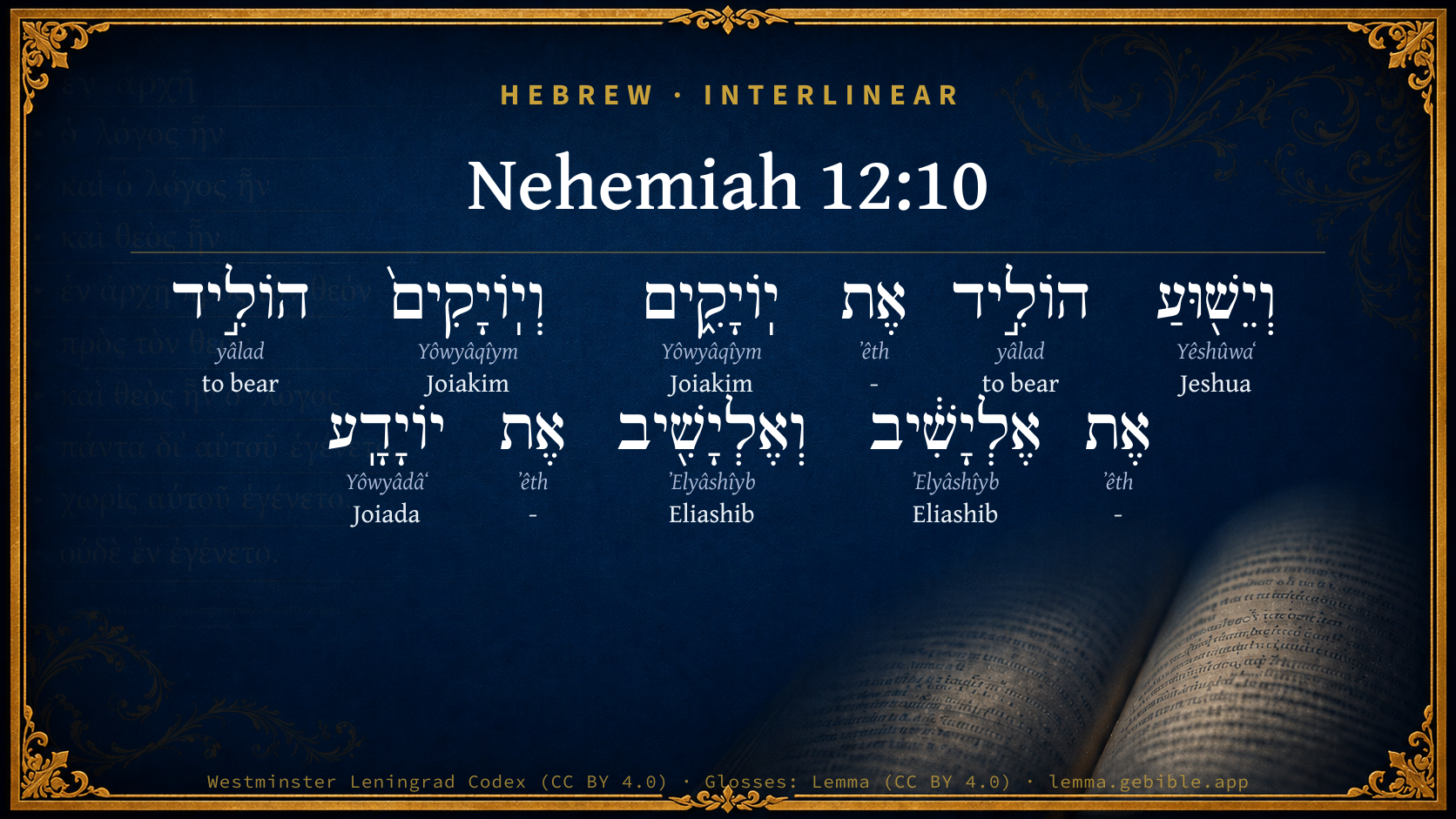
Hebrew (Westminster Leningrad Codex) Nehemiah 12:10 appears in the Hebrew Old Testament. The text above is from the Westminster Leningrad Codex. Each word links to its Strong’s number, a concise gloss, and parsing drawn from the Open Scriptures Hebrew Bible morphology. Click any word for its full Brown-Driver-Briggs (BDB) entry.
Download image
Cite this verse

Nehemiah 12:10 (World English Bible). Public Domain. Lemma interlinear Bible study tool, https://lemma.gebible.app/v/nehemiah/12/10.

Show BibTeX & RIS
BibTeX
RIS
English Translation
Jeshua became the father of Joiakim, and Joiakim became the father of Eliashib, and Eliashib became the father of Joiada,
World English Bible · Public Domain
Highlights
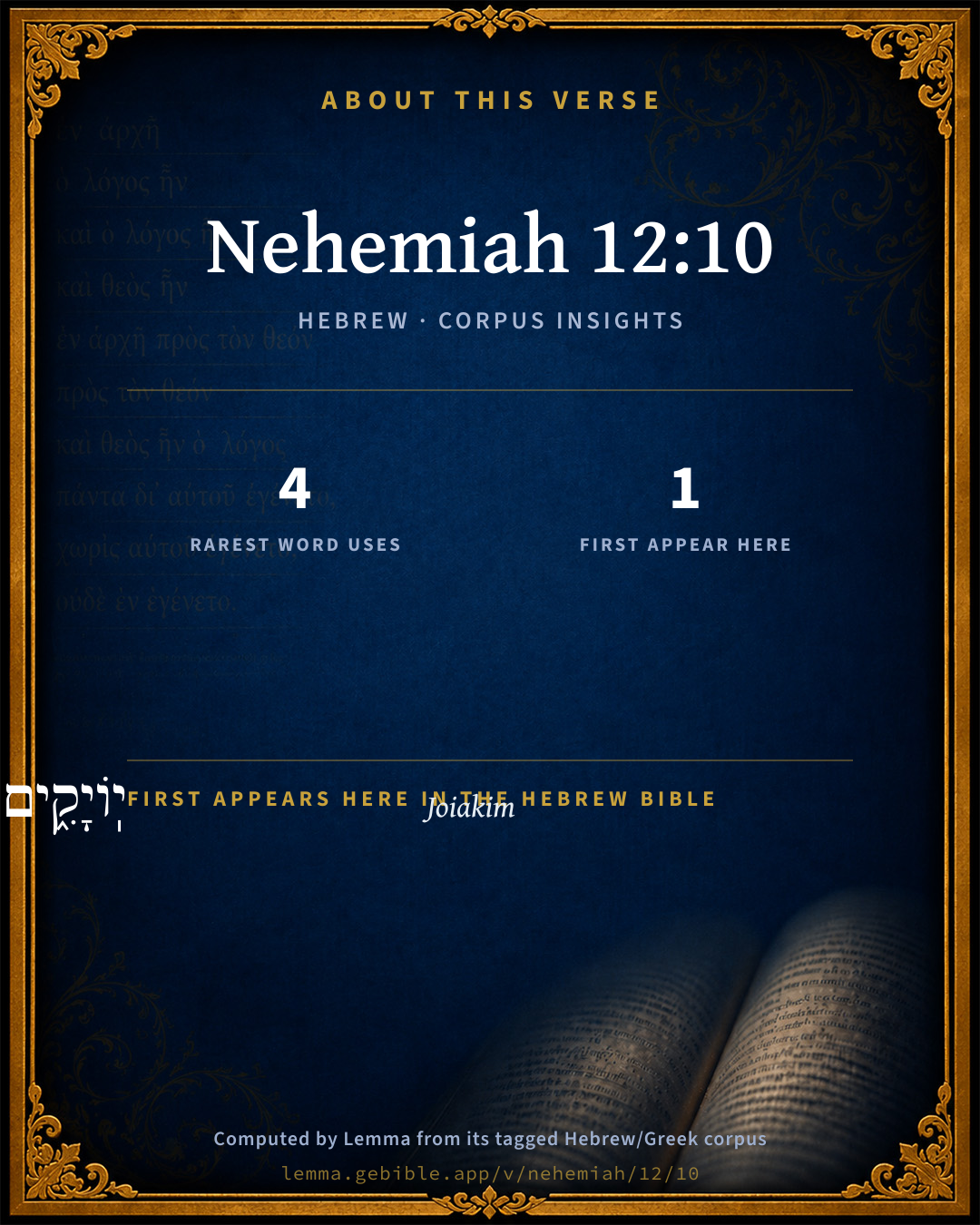
  • 1 first appearance in the Hebrew Bible
Full analysis ↓
Download a study sheet

One document with this verse’s original text, its word-by-word gloss line, the meaning frame, cross-references with their text, attributed commentary, and full source and license credits — printable, and it pastes into notes with its structure intact.

This verse Autodidact and up

Study sheet (.html) Plain text (.txt)

A passage Seminary Student

Up to 50 verses in one chapter. A passage sheet keeps up to 6 commentary sources and 12 cross-references per verse, in the order this page ranks them, and says so on the sheet whenever that leaves anything out. Ask for a single verse and you get the Autodidact verse sheet above.

Everything on this page stays free to read, with no account — the sheet is a download of what is already on screen, not access to it.

Want to remove ads? Support Godless Engineer
Compare translations 3

The same verse in 3 English versions, stacked beneath the original-language interlinear above. Click any original word for its lexicon entry.

Each is an independent rendering of the whole verse — the interlinear is not word-aligned to these translations.

Highlighted words mark where these versions differ — a whole-verse word diff, not a word-by-word alignment.

  • World English Bible Public Domain
    Jeshua became the father of Joiakim, and Joiakim became the father of Eliashib, and Eliashib became the father of Joiada,
  • King James Version Public Domain
    And Jeshua begat Joiakim, Joiakim also begat Eliashib, and Eliashib begat Joiada,
  • unfoldingWord Literal Text CC BY-SA 4.0
    And Jeshua fathered Joiakim; and Joiakim fathered Eliashib; and Eliashib, Joiada;

unfoldingWord Literal Text — © unfoldingWord, licensed CC BY-SA 4.0. Word-aligned USFM3 via Door43 (git.door43.org/unfoldingWord/en_ult).

Versions to compare (up to 4)

3 of 4 selected

Show all 18 translations

Every available English version of this verse, each an independent rendering of the whole verse.

  • World English Bible Public Domain
    Jeshua became the father of Joiakim, and Joiakim became the father of Eliashib, and Eliashib became the father of Joiada,
  • Berean Standard Bible Public Domain
    Jeshua was the father of Joiakim, Joiakim was the father of Eliashib, Eliashib was the father of Joiada,
  • Majority Standard Bible Public Domain
    Jeshua was the father of Joiakim, Joiakim was the father of Eliashib, Eliashib was the father of Joiada,
  • King James Version Public Domain
    And Jeshua begat Joiakim, Joiakim also begat Eliashib, and Eliashib begat Joiada,
  • American Standard Version (1901) Public Domain
    And Jeshua begat Joiakim, and Joiakim begat Eliashib, and Eliashib begat Joiada,
  • Revised Version (1885) Public Domain
    And Jeshua begat Joiakim, and Joiakim begat Eliashib, and Eliashib begat Joiada,
  • Geneva Bible (1599) Public Domain
    And Ieshua begate Ioiakim: Ioiakim also begate Eliashib, and Eliashib begate Ioiada.
  • Douay-Rheims (1899) Public Domain
    And Josue beget Joacim, and Joacim beget Eliasib, and Eliasib beget Joiada,
  • Young's Literal Translation Public Domain
    And Jeshua hath begotten Joiakim, and Joiakim hath begotten Eliashib, and Eliashib hath begotten Joiada,
  • Literal Standard Version CC BY-SA 4.0
    And Jeshua has begotten Joiakim, and Joiakim has begotten Eliashib, and Eliashib has begotten Joiada,
  • Unlocked Literal Bible CC BY-SA 4.0
    Jeshua was the father of Joiakim, Joiakim was the father of Eliashib, Eliashib was the father of Joiada,
  • unfoldingWord Literal Text CC BY-SA 4.0
    And Jeshua fathered Joiakim; and Joiakim fathered Eliashib; and Eliashib, Joiada;
  • Darby Bible Public Domain
    And Jeshua begot Joiakim, and Joiakim begot Eliashib, and Eliashib begot Joiada,
  • World Messianic Bible Public Domain
    Yeshua became the father of Joiakim, and Joiakim became the father of Eliashib, and Eliashib became the father of Joiada,
  • Webster's Bible Public Domain
    And Jeshua begat Joiakim, Joiakim also begat Eliashib, and Eliashib begat Joiada,
  • Free Bible Version CC BY-SA 4.0
    Jeshua the high priest was the father of Joiakim, who was the father of Eliashib, who was the father of Joiada,
  • Bible in Basic English Public Domain
    And Jeshua was the father of Joiakim, and Joiakim was the father of Eliashib, and Eliashib was the father of Joiada,
  • JPS Tanakh (1917) Public Domain
    And Jeshua begot Joiakim, and Joiakim begot Eliashib, and Eliashib begot Joiada,

Literal Standard Version (2020), Covenant Press — licensed CC BY-SA 4.0. Text via the HelloAO Bible API (eBible.org). Unlocked Literal Bible (unfoldingWord) — licensed CC BY-SA 4.0. Text via the HelloAO Bible API (eBible.org). unfoldingWord Literal Text — © unfoldingWord, licensed CC BY-SA 4.0. Word-aligned USFM3 via Door43 (git.door43.org/unfoldingWord/en_ult). Free Bible Version, Dr. Jonathan Gallagher — licensed CC BY-SA 4.0. Text via the HelloAO Bible API (eBible.org).

Word by word

More ways to search: Search by grammar → Find every occurrence → Compare this word →

Practice this passage: Drill this verse → Learn its vocabulary →

About this verse

These counts appear in no published source. They are computed here, from the morphology-tagged text and Lemma’s own curated glosses. What Lemma adds →

11
words
6
distinct lemmas
Historical
section

Notable vocabulary

The rarest word here is יֽוֹיָקִ֑ים Joiakim H3113 — appearing just 4 times in the whole Hebrew Bible.

First appearance in Scripture

This word makes its first canonical appearance in the Hebrew Bible here:

  • יֽוֹיָקִ֑ים Joiakim H3113

Shared distinctive vocabulary

יֽוֹיָקִ֑ים Joiakim H3113 occurs in 3 verses of the Hebrew Bible. Also found in:

Grammatical profile

  • 2 verbs
  • 6 nouns
  • 3 particles

Verb forms

  • הוֹלִ֣יד Hiphil · Perfect
  • הוֹלִ֣יד Hiphil · Perfect

Repetition

Words recur within this verse — often emphatic in Hebrew:

  • הוֹלִ֣יד to bear H3205 ×2
  • יֽוֹיָקִ֑ים Joiakim H3113 ×2
  • אֶלְיָשִׁ֔יב Eliashib H475 ×2

Cross-references

6

Topical passages linked to Nehemiah 12:10 in the Treasury of Scripture Knowledge — connected by theme and wording, ordered by reader-vote popularity; previews shown in the World English Bible.

  • 1 Chronicles 6:3–15 The children of Amram: Aaron, and Moses, and Miriam. The sons of Aaron: Nadab, and Abihu, Eleazar, and Ithamar.
  • Nehemiah 3:1 Then Eliashib the high priest rose up with his brothers the priests, and they built the sheep gate; they sanctified it, and set up the doors of it; even to the tower of Hammeah they sanctified it, to the tower of Hananel.
  • Nehemiah 12:26 These were in the days of Joiakim the son of Jeshua, the son of Jozadak, and in the days of Nehemiah the governor, and of Ezra the priest the scribe.
  • Nehemiah 13:4 Now before this, Eliashib the priest, who was appointed over the chambers of the house of our God, being allied to Tobiah,
  • Nehemiah 13:7 and I came to Jerusalem, and understood the evil that Eliashib had done for Tobiah, in preparing him a chamber in the courts of the house of God.
  • Nehemiah 13:28 One of the sons of Joiada, the son of Eliashib the high priest, was son-in-law to Sanballat the Horonite: therefore I chased him from me.

Cross-references courtesy of OpenBible.info (CC BY 4.0).

Hebrew and Greek witnesses Masoretic Hebrew ↔ Greek Septuagint

The same verse in the two great witnesses to the Old Testament, shown verse-for-verse.

These are two independent witnesses, not word-aligned to each other, and the Septuagint is shown in lemma (dictionary) form.

Hebrew Nehemiah 12:10 Masoretic · Westminster Leningrad Codex

וְיֵשׁ֖וּעַ הוֹלִ֣יד אֶת יֽוֹיָקִ֑ים וְיֽוֹיָקִים֙ הוֹלִ֣יד אֶת אֶלְיָשִׁ֔יב וְאֶלְיָשִׁ֖יב אֶת יוֹיָדָֽע

Jeshua became the father of Joiakim, and Joiakim became the father of Eliashib, and Eliashib became the father of Joiada,

World English Bible · Public Domain

Greek LXX Structure differs

The Septuagint has no separate book of Nehemiah. Its Greek text is the second half of Esdras B (2 Esdras), chapters 11–23; Ezra is the first half (1–10).

A verse-for-verse comparison isn’t shown here because the chapters and verses don’t line up. Switch to the LXX edition with the MT / LXX toggle above to read the Greek directly.

Hebrew: Westminster Leningrad Codex (CC BY 4.0). Greek: Septuagint (public domain); English from a public-domain English Septuagint. How the Septuagint differs from the Hebrew →

Commentary

Notes on Nehemiah 12:10 from classic Christian and Jewish commentators (each source and its license shown beneath its notes). The classic Christian expositions comment on the surrounding passage and are grouped to its opening verse, so a note may address several verses; the Jewish commentaries on the Tanakh (Rashi and others) are per-verse, so they appear only where the commentator wrote on this verse.

Lemma curates 59 commentaries, every one of them public domain or Creative Commons licensed, each selected and text-cleaned for this edition rather than reprinted as found. About our sources →

Jamieson, Fausset & Brown

Robert Jamieson, A. R. Fausset & David Brown

SUCCESSION OF THE HIGH PRIESTS. (Neh. 12:10-47)

Jeshua begat Joiakim, &c.--This enumeration was of great importance, not only as establishing their individual purity of descent, but because the chronology of the Jews was henceforth to be reckoned, not as formerly by the reigns of their kings, but by the successions of their high priests.

Jamieson, Fausset & Brown — Commentary Critical and Explanatory on the Whole Bible (1871) — public domain (CC PDM 1.0). Text via the HelloAO Bible API.

Trapp's Complete Commentary

John Trapp

Neh 12:10 And Jeshua begat Joiakim, Joiakim also begat Eliashib, and Eliashib begat Joiada,

Ver. 10. Joiakim begat Eliashib] Who proved a very wicked priest, Neh 13:4-5, and his son Joiada was little better, being allied to Sanballat, Neh 13:28.

John Trapp, A Commentary or Exposition upon All the Books of the Old and New Testament (1647–1656) — public domain. Text from a community e-Sword module.

Joseph Benson's Commentary

Neh 12:10-11. And Jeshua begat Joiakim — In these two verses is an account of the succession of the high-priests, from the return of the captivity till the time when they began to bear the greatest sway in the Jewish nation. For the Jaddua mentioned at the end of Neh 12:11, is commonly thought to be that Jaddus, the high-priest, who went to meet Alexander the Great in his pontifical habit, as he came from the conquest of Tyre and Gaza, and procured great privileges for the Jewish nation. This catalogue of their high-priests was the more necessary, because their times were now to be measured, not by the years of their kings, as formerly, but by their high-priests.

Joseph Benson's Commentary on the Old and New Testaments (1811–1818) — public domain. Text from a community e-Sword module.

The Pulpit Commentary

LIST OF THE HIGH PRIESTS FROM JESHUA TO JADDUA. (Neh_12:10, Neh_12:11) That this is the line of descent in the high priestly family of the time sufficiently appears both from the names themselves, and from the position assigned to those who bore them in vers. 22, 23, 26. Whether all of them actually exercised the high priest"s office is left uncertain in Scripture, but satisfactorily established by Josephus. The six names cover a space of at least 205 years from the conquest of Babylon by Cyrus, B.C. 538, to the submission of Jerusalem to Alexander the Great, B.C. 333, which gives very long generations, but still such as are historically possible. Jeshua was certainly high priest from B.C. 538 to B.C. 516. He may have been succeeded by his son, Joiakim, about B.C. 490. Joiakim had certainly been succeeded by his son, Eliashib, before B.C. 444; (Neh_3:1) and Eliashib was probably succeeded by Joiada about B.C. 420. Joiada"s high priesthood may be assigned to the period between B.C. 420 and 380; Jonathan"s to that between B.C. 380 and 350. Jaddua might then hold the dignity from B.C. 350 to 330, or later, and so be brought into contact with Alexander the Great. It is questioned whether in that case Nehemiah can have written the present passage, and certain that he cannot have done so unless he lived to be at least 131 years of age. As this is exceedingly improbable, it is best to suppose, either that the whole list was placed here by Malachi, or at any rate that that prophet added the clause, "and Jonathan begat Jaddua.

Jeshua. The "Jeshua" of ver. 1, not of ver. 8 the high priest of Zerub-babel"s time. (Ezr_3:2, 8 4:3 5:2, etc.) Begat Joiakim. The high priesthood of Joiakim falls into the interval between the first part (chs. 1-7) and the second part (chs. 7-10) of Ezra. He is only mentioned in this chapter (vers. 12, 26). Eliashib is first mentioned in Ezr_10:6, but he does not appear as high priest until after Nehemiah reaches Jerusalem. (Neh_3:1) On his close connection with Tobiah see Neh_13:4, Neh_13:5, Neh_13:28. Joiada is called Judas by Josephus. ("Ant. Jud:," 11:7, His term of office lasted, according to Syncellus and the Paschal Chronicle, thirty-six years.

The Pulpit Commentary (1880–1919), ed. H.D.M. Spence-Jones & Joseph S. Exell — public domain. Text from a community e-Sword module.

Tyndale Open Study Notes

Tyndale Open Resources

12:10-11 Joiakim probably served in the early years of Ezra’s service. • Eliashib and Joiada served during Nehemiah’s time (3:1; 13:4, 28). • Johanan: An Aramaic papyrus document from a Jewish colony that settled in Elephantine, Egypt (about 410 BC) and Josephus (Antiquities 11.5.4, AD 93) both mention Johanan serving after Nehemiah’s time.

Tyndale Open Study Notes — © Tyndale Open Resources, licensed CC BY-SA 4.0. Text via the HelloAO Bible API.

Ellicott's Commentary for English Readers

(10, 11) Pedigree of certain high priests, with supplement from a later hand. The six generations stretch over 200 years—from B.C. 536 to B.C. 332.

A Bible Commentary for English Readers, edited by Charles John Ellicott (1878–1897) — public domain. Text from a community e-Sword module.

The Cambridge Bible for Schools and Colleges

gen. ed. J. J. S. Perowne

10, 11. The lists of the high-priests in 1Ch_6:3-15 concluded with Jehozadak, who ‘went into captivity when the Lord carried away Judah and Jerusalem by the hand of Nebuchadnezzar.’ Jehozadak’s son was Jeshua (see Ezr_3:1), who returned from the captivity with Zerubbabel. The present list of the high-priesthood follows directly upon that given in 1 Chronicles 6.

Joiakim] From the special mention of this high-priest in Neh_12:12; Neh_12:26, we may conjecture that during his tenure of office the houses of the priests and Levites were registered or reconstituted.

Eliashib] The high-priest in Nehemiah’s period of governorship (Neh_3:1; Neh_13:4; Neh_13:7; Neh_13:28). His son Joiada, who is called Juda by Josephus (Ant. xi. 7. 1), is mentioned again in Neh_13:28. A slight difficulty is presented by the name Jonathan. In Neh_12:22, we find ‘Johanan’ stands between ‘Joiada’ and ‘Jaddua;’ and in Neh_12:23, this Johanan is called the son of Eliashib. We must either suppose that Jonathan is here a mistake for Johanan, or that ‘Jonathan’ was high-priest for a short period, and was succeeded by his better known brother Johanan.

Jaddua] There is no reason to doubt that this is the same Jaddua, who was high-priest at the time that Alexander passed along the borders of Palestine on his march into Egypt. The probably legendary account of Alexander’s visit to Jerusalem, and his meeting with the high-priest Jaddua, attended by the priests in their most splendid robes, is narrated by Josephus (Ant. xi. 8. 5).

The occurrence of Jaddua’s name shows that the compilation of these books must be later than 340–333 b.c.

Between Eliashib (Neh_13:28) who was high-priest in 432 b.c. and Jaddua who was high-priest in 333 b.c. there are thus only two names, or at the most three, recorded in this list, i.e. Joiada, Johanan or (? and) Jonathan.

The Cambridge Bible for Schools and Colleges (gen. ed. J. J. S. Perowne; Cambridge University Press, 1878–1918) — public domain. Text from a community e-Sword module.

John Gill's Exposition

And Jeshua begat Joiakim, Joiakim also begat Eliashib, and Eliashib begot Joiada, and Joiada begat Jonathan, and Jonathan begot Jaddua. This is an account of the high priests in succession in the second temple, the first six of them; and if Jaddua, the last mentioned, is the same with Jaddus, as Josephus (n) supposes, who went forth in his pontifical robes to meet Alexander the great returning from his conquests of Tyre and Gaza, from whom he obtained many favours, and whom he had into the temple, and showed him the prophecy of Daniel concerning himself; this paragraph must be written by another hand, and not Nehemiah, since it can hardly be thought he should live so long; and as to his times, this account of him, or the history of his own times, seems not to have gone through the priesthood of Eliashib, the third of those high priests, see Neh 13:28, and to reach no further than to the thirty second of Darius Hystaspis, Neh 13:6 this fragment therefore might be inserted by some godly man under a divine direction in later times, as we have several insertions in the books of Moses and Joshua of the like kind; and particularly in Ch1 3:19 where the genealogy of Zerubbabel is carried down beyond the times of the Maccabees, and so could not be placed there by Ezra.

(n) Antiqu. l. 11. c. 8. sect. 5.

John Gill's Exposition of the Whole Bible (1746–1763) — public domain (CC PDM 1.0). Text via the HelloAO Bible API.

Albert Barnes' Notes on the Bible

The six generations of high priests covered a little more than two centuries (538-333 B.C.), or a little under thirty-five years to a generation. Jaddua was the high priest who (according to Josephus) had an interview with Alexander shortly after the battle of Issus.

Albert Barnes' Notes on the Bible (1834–1885) — public domain. Text from a community e-Sword/MySword module.

Haydock's Catholic Bible Commentary

Joacim. These are some of the successors of Josue, (Menochius) who were high priests till the time of Jeddoa, or Jaddus. (Worthington)

George Leo Haydock (1774–1849), Haydock's Catholic Family Bible and Commentary, 1859 edition — public domain. Excludes Psalms (Douay-Rheims chapter numbering differs from Protestant) and Deuterocanonical books (Catholic canon only).

Matthew Poole's English Annotations

Here follows a catalogue of the Jewish high priests; which was the more necessary, because their times were now to be measured, not by the years of their kings, as formerly, but by their high priests.

Eliashib; of whom see Neh 3:1; 13:4,5.

Matthew Poole's English Annotations on the Holy Bible (1683–1685) — public domain. Text from a community e-Sword/MySword module.

John Wesley's Explanatory Notes

Jeshua - Here follows a catalogue of the Jewish high-priests; which was the more necessary, because their times were now to be measured, not by the years of their kings as formerly, but by their high-priests.

John Wesley, Explanatory Notes Upon the Whole Bible (1754–1765) — public domain. Text via the GEBible commentary corpus.

Keil & Delitzsch

C. F. Keil & F. Delitzsch

A note on the genealogy of the high-priestly line from Jeshua to Jaddua is inserted, so to speak, as a connecting link between the lists of Levites, to explain the statements concerning the dates of their composition, - dates defined by the name of the respective high priests. The lists given Neh 12:1 were of the time of Jeshua; those from Neh 12:12 and onwards, of the days of Joiakim and his successors. The name יונתן, as is obvious from Neh 12:22 and Neh 12:23, is a clerical error for יוחנן, Johanan, Greek Ἰωάννης, of whom we are told, Joseph. Ant. xi. 7. 1, that he murdered his brother Jesus, and thus gave Bagoses, the general of Artaxerxes Mnemon, an opportunity for taking severe measures against the Jews.

Keil & Delitzsch — Biblical Commentary on the Old Testament (1861–1891) — public domain (CC PDM 1.0). Text via the HelloAO Bible API. (Old Testament only.)

unfoldingWord translationNotes

Door43 World Missions Community

Jeshua ... Joiakim ... Eliashib ... Joiada ... Jonathan ... Jaddua

These are names of men. (See: How to Translate Names)

Jeshua was the father of Joiakim

This was the same Jeshua named in Nehemiah 12:1. The original readers would have understood that Jeshua was the high priest. AT: "Jeshua the high priest was the father of Joiakim" (See: Assumed Knowledge and Implicit Information)

translationWords

ancestor

unfoldingWord translationNotes — © Distant Shores Media and the Door43 World Missions Community, licensed CC BY-SA 4.0. Source: git.door43.org/Door43/en_tn.

Rashi

Rabbi Shlomo Yitzchaki (Rashi)

Now Jeshua begot Joiakim, etc. All those [listed] in this verse were high priests.

Rashi on the Tanakh — English translations: “The Judaica Press complete Tanach with Rashi, translated by A. J. Rosenberg” (CC BY 4.0); “Pentateuch with Rashi's commentary by M. Rosenbaum and A.M. Silbermann, 1929-1934” (public domain); “The Metsudah Tanach series, Lakewood, N.J” (CC BY 4.0); and “The Book of Joshua, Metsudah Publications, 1997” (CC BY 4.0). Text via Sefaria.

Lesson kit

Teaching starters — assembled from the data on this page, not authored interpretation. Every prompt links to the verse data it draws on. Edit before teaching.

Nehemiah, in the Historical, opens this verse with 11 words (6 distinct Hebrew lemmas). Its most distinctive word is Yôwyâqîym (“Joiakim”). A historical commentator’s framing appears above. Read the whole chapter for the surrounding context.

Discussion questions

  1. The word Yôwyâqîym carries the sense “Joiakim.” How does it shape the verse?
  2. This is the first place “Joiakim” appears in Scripture (first appears here). What does its debut here establish?
  3. How does Nehemiah 12:12, which shares the word «Joiakim», read alongside this verse?
  4. What does the repetition of “to bear” (2× in this one verse) do in this verse?
  5. These translations render this verse differently; the difference is in the English rendering, not the original. What questions does that raise?
  6. «הוֹלִ֣יד» is a Hiphil Perfect verb. How does that grammatical form shape the action described?
  7. Compare how Jamieson, Fausset & Brown and Trapp's Complete Commentary read this verse. Where do they agree or differ?

Things to notice

  • 1 word makes its first canonical appearance in Scripture here.
  • These translations choose different wording for 5 words in this verse.
  • “to bear” occurs 2× in this single verse.
  • 6 distinct Hebrew lemmas span 11 words in this verse.

Reading settings

Reading text

Shown beneath each verse's original-language words.

Old Testament
Old Testament edition

Read the OT as the Masoretic Hebrew (MT) or the Greek Septuagint (LXX).

English shown for the Greek Septuagint (in the Hebrew ↔ Greek comparison).

Comparing translations? Open the Compare panel on any verse page to stack up to four side by side.