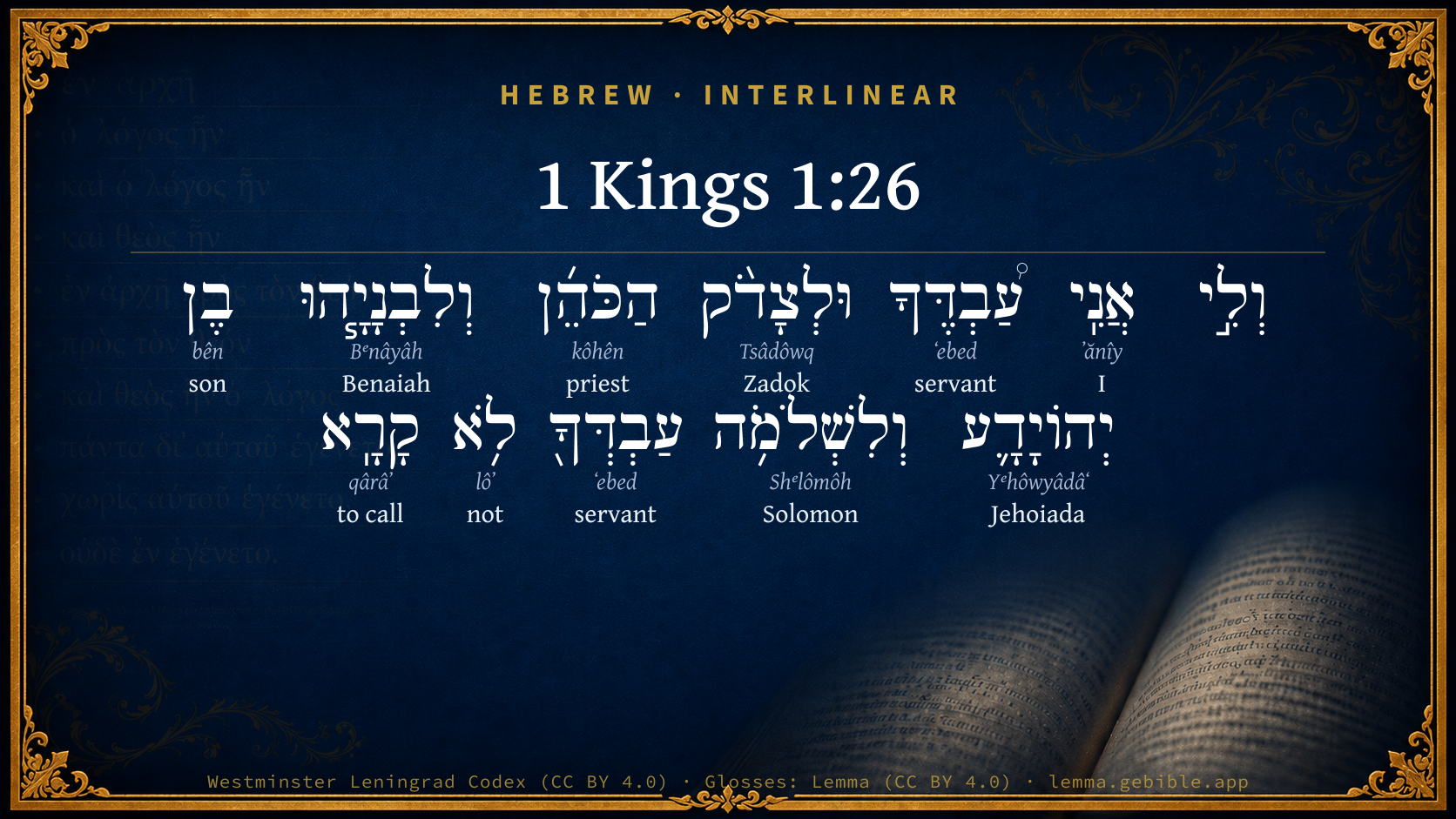
1 Kings 1:26

Hebrew (Westminster Leningrad Codex) 1 Kings 1:26 appears in the Hebrew Old Testament. The text above is from the Westminster Leningrad Codex. Each word links to its Strong’s number, a concise gloss, and parsing drawn from the Open Scriptures Hebrew Bible morphology. Click any word for its full Brown-Driver-Briggs (BDB) entry.
Download image
Cite this verse

1 Kings 1:26 (World English Bible). Public Domain. Lemma interlinear Bible study tool, https://lemma.gebible.app/v/1-kings/1/26.

Show BibTeX & RIS
BibTeX
RIS
English Translation
But he hasn't called me, even me your servant, and Zadok the priest, and Benaiah the son of Jehoiada, and your servant Solomon.
World English Bible · Public Domain
Download a study sheet

One document with this verse’s original text, its word-by-word gloss line, the meaning frame, cross-references with their text, attributed commentary, and full source and license credits — printable, and it pastes into notes with its structure intact.

This verse Autodidact and up

Study sheet (.html) Plain text (.txt)

A passage Seminary Student

Up to 50 verses in one chapter. A passage sheet keeps up to 6 commentary sources and 12 cross-references per verse, in the order this page ranks them, and says so on the sheet whenever that leaves anything out. Ask for a single verse and you get the Autodidact verse sheet above.

Everything on this page stays free to read, with no account — the sheet is a download of what is already on screen, not access to it.

Want to remove ads? Support Godless Engineer
Compare translations 3

The same verse in 3 English versions, stacked beneath the original-language interlinear above. Click any original word for its lexicon entry.

Each is an independent rendering of the whole verse — the interlinear is not word-aligned to these translations.

Highlighted words mark where these versions differ — a whole-verse word diff, not a word-by-word alignment.

  • World English Bible Public Domain
    But he hasn't called me, even me your servant, and Zadok the priest, and Benaiah the son of Jehoiada, and your servant Solomon.
  • King James Version Public Domain
    But me, even me thy servant, and Zadok the priest, and Benaiah the son of Jehoiada, and thy servant Solomon, hath he not called.
  • unfoldingWord Literal Text CC BY-SA 4.0
    But to me, me your servant, and to Zadok the priest and to Benaiah, the son of Jehoiada, and to Solomon your servant, he has not called.

unfoldingWord Literal Text — © unfoldingWord, licensed CC BY-SA 4.0. Word-aligned USFM3 via Door43 (git.door43.org/unfoldingWord/en_ult).

Versions to compare (up to 4)

3 of 4 selected

Show all 18 translations

Every available English version of this verse, each an independent rendering of the whole verse.

  • World English Bible Public Domain
    But he hasn't called me, even me your servant, and Zadok the priest, and Benaiah the son of Jehoiada, and your servant Solomon.
  • Berean Standard Bible Public Domain
    But me your servant he did not invite, nor Zadok the priest, nor Benaiah son of Jehoiada, nor your servant Solomon.
  • Majority Standard Bible Public Domain
    But me your servant he has not invited, nor Zadok the priest, nor Benaiah son of Jehoiada, nor your servant Solomon.
  • King James Version Public Domain
    But me, even me thy servant, and Zadok the priest, and Benaiah the son of Jehoiada, and thy servant Solomon, hath he not called.
  • American Standard Version (1901) Public Domain
    But me, even me thy servant, and Zadok the priest, and Benaiah the son of Jehoiada, and thy servant Solomon, hath he not called.
  • Revised Version (1885) Public Domain
    But me, even me thy servant, and Zadok the priest, and Benaiah the son of Jehoiada, and thy servant Solomon, hath he not called.
  • Geneva Bible (1599) Public Domain
    But me thy seruant, and Zadok the Priest, and Benaiah the sonne of Iehoiada, and thy seruant Salomon hath he not called.
  • Douay-Rheims (1899) Public Domain
    But me thy servant, and Sadoc the priest, and Banaias the son of Joiada, and Solomon thy servant he hath not invited.
  • Young's Literal Translation Public Domain
    `And for me -- me, thy servant, and for Zadok the priest, and for Benaiah, son of Jehoiada, and for Solomon thy servant, he hath not called;
  • Literal Standard Version CC BY-SA 4.0
    But he has not called for me, your servant, and for Zadok the priest, and for Benaiah, son of Jehoiada, and for your servant Solomon;
  • Unlocked Literal Bible CC BY-SA 4.0
    But as for me, your servant, Zadok the priest, Benaiah son of Jehoiada, and your servant Solomon, he has not invited us.
  • unfoldingWord Literal Text CC BY-SA 4.0
    But to me, me your servant, and to Zadok the priest and to Benaiah, the son of Jehoiada, and to Solomon your servant, he has not called.
  • Darby Bible Public Domain
    But me, [even] me thy servant, and Zadok the priest, and Benaiah the son of Jehoiada, and thy servant Solomon, he has not invited.
  • World Messianic Bible Public Domain
    But he hasn’t called me, even me your servant, Zadok the priest, Benaiah the son of Jehoiada, and your servant Solomon.
  • Webster's Bible Public Domain
    But me, even me thy servant, and Zadok the priest, and Benaiah the son of Jehoiada, and thy servant Solomon, hath he not called.
  • Free Bible Version CC BY-SA 4.0
    But he didn't invite me, your servant, or Zadok the priest, or Benaiah, son of Jehoiada, or your son Solomon.
  • Bible in Basic English Public Domain
    But me, your servant, and Zadok the priest, and Benaiah, the son of Jehoiada, and your servant Solomon, he has not sent for.
  • JPS Tanakh (1917) Public Domain
    But me, even me thy servant, and Zadok the priest, and Benaiah the son of Jehoiada, and thy servant Solomon hath he not called.

Literal Standard Version (2020), Covenant Press — licensed CC BY-SA 4.0. Text via the HelloAO Bible API (eBible.org). Unlocked Literal Bible (unfoldingWord) — licensed CC BY-SA 4.0. Text via the HelloAO Bible API (eBible.org). unfoldingWord Literal Text — © unfoldingWord, licensed CC BY-SA 4.0. Word-aligned USFM3 via Door43 (git.door43.org/unfoldingWord/en_ult). Free Bible Version, Dr. Jonathan Gallagher — licensed CC BY-SA 4.0. Text via the HelloAO Bible API (eBible.org).

Word by word

More ways to search: Search by grammar → Find every occurrence → Compare this word →

Practice this passage: Drill this verse → Learn its vocabulary →

וְלִבְנָיָ֧הוּ
Bᵉnâyâh
H1141
“and · to/for · Benaiah”
Conjunction + Preposition + Noun, Proper
Part of Speech
Conjunction + Preposition + Noun
Type
Proper
Full BDB Definition

Origin: from H1129 and H3050

TWOT: None

Benaiah = "Jehovah has built" or " Yahweh has built up" - one of David's mighty warriors, son of Jehoiada the chief priest, a Levite, set by David over his bodyguard, later having remained faithful to Solomon during Adonijah's attempt on the crown, was raised into the place of Joab as commander-in-chief of the army - the Pirathonite, an Ephraimite, one of David's thirty mighty warriors, and the captain of the eleventh monthly course - a Simeonite, a prince of the families of Simeon - a Levite in the time of David who played with a psaltery on Alamoth - a priest in the time of David, appointed to blow the trumpet before the ark - a Levite of the sons of Asaph - a Levite in the time of Hezekiah - Four Israelites in the time of Ezra who had taken strange wives - the father of Pelatiah
  1. אֲנִֽי ʼănîy H589 “I” Pronoun, Personal, 1st Person, Common, Singular
  2. עַ֠בְדֶּךָ ʻebed H5650 “servant · your” Noun, Common, Masculine, Singular, Construct + Suffix, Personal, 2nd Person, Masculine, Singular
  3. וּלְצָדֹ֨ק Tsâdôwq H6659 “and · to/for · Zadok” Conjunction + Preposition + Noun, Proper
  4. הַכֹּהֵ֜ן kôhên H3548 “the · priest” Particle, Definite Article + Noun, Common, Masculine, Singular, Absolute
  5. בֶן bên H1121 “son of” Noun, Common, Masculine, Singular, Construct
  6. יְהוֹיָדָ֛ע Yᵉhôwyâdâʻ H3077 “Jehoiada” Noun, Proper
  7. וְלִשְׁלֹמֹ֥ה Shᵉlômôh H8010 “and · to/for · Solomon” Conjunction + Preposition + Noun, Proper
  8. עַבְדְּךָ֖ ʻebed H5650 “servant · your” Noun, Common, Masculine, Singular, Construct + Suffix, Personal, 2nd Person, Masculine, Singular
  9. לֹ֥א lôʼ H3808 “not” Particle, Negative
  10. קָרָֽא qârâʼ H7121 “to call” Verb, Qal, Perfect, 3rd Person, Masculine, Singular

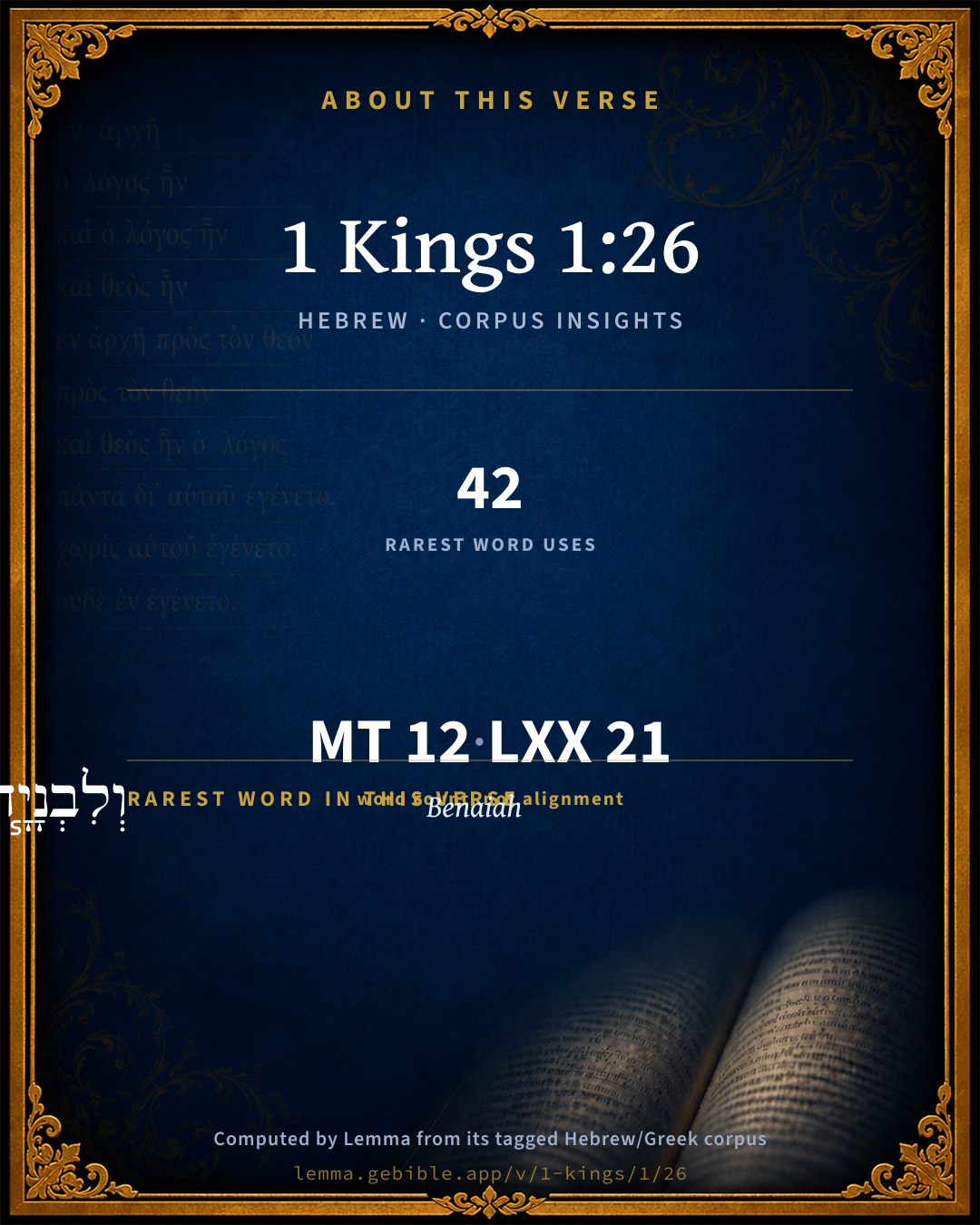
About this verse

These counts appear in no published source. They are computed here, from the morphology-tagged text and Lemma’s own curated glosses. What Lemma adds →

12
words
10
distinct lemmas
Historical
section

Shared distinctive vocabulary

וְלִבְנָיָ֧הוּ Benaiah H1141 occurs in 41 verses of the Hebrew Bible. Also found in:

Grammatical profile

  • 1 verb
  • 8 nouns
  • 1 pronoun
  • 1 preposition
  • 1 particle

Verb forms

  • קָרָֽא Qal · Perfect

Repetition

A word recurs within this verse — often emphatic in Hebrew:

  • עַ֠בְדֶּךָ servant H5650 ×2

Hebrew & Septuagint length

In English translation the verse runs 23 words from the Hebrew and 22 from the Septuagint (LXX English) — closely comparable.

A rough comparison of the two English renderings, which tokenize alike — not a word-level alignment.

Word counts can differ between the Hebrew and the Greek without any difference in meaning — e.g. the Hebrew direct-object marker אֵת has no separate Greek word, and Greek often adds the article ὁ.

In the original languages it is 12 Hebrew tokens and 21 Greek tokens — but the two are counted differently (Hebrew bundles its prefixes and suffixes into one token; the Greek is in lemma form), so that isn’t a like-for-like length.

Cross-references

6

Topical passages linked to 1 Kings 1:26 in the Treasury of Scripture Knowledge — connected by theme and wording, ordered by reader-vote popularity; previews shown in the World English Bible.

  • 1 Kings 1:8 But Zadok the priest, and Benaiah the son of Jehoiada, and Nathan the prophet, and Shimei, and Rei, and the mighty men who belonged to David, were not with Adonijah.
  • 1 Kings 1:10 but Nathan the prophet, and Benaiah, and the mighty men, and Solomon his brother, he didn't call.
  • 2 Samuel 7:2 that the king said to Nathan the prophet, See now, I dwell in a house of cedar, but the ark of God dwells within curtains.
  • 2 Samuel 7:12–17 When your days are fulfilled, and you shall sleep with your fathers, I will set up your seed after you, who shall proceed out of your bowels, and I will establish his kingdom.
  • 2 Samuel 12:25 and he sent by the hand of Nathan the prophet; and he named him Jedidiah, for Yahweh's sake.
  • 1 Kings 1:19 and he has slain oxen and fatlings and sheep in abundance, and has called all the sons of the king, and Abiathar the priest, and Joab the captain of the host; but he hasn't called Solomon your servant.

Cross-references courtesy of OpenBible.info (CC BY 4.0).

Hebrew and Greek witnesses Masoretic Hebrew ↔ Greek Septuagint

The same verse in the two great witnesses to the Old Testament, shown verse-for-verse.

These are two independent witnesses, not word-aligned to each other, and the Septuagint is shown in lemma (dictionary) form.

Hebrew 1 Kings 1:26 Masoretic · Westminster Leningrad Codex

וְלִ֣י אֲנִֽי עַ֠בְדֶּךָ וּלְצָדֹ֨ק הַכֹּהֵ֜ן וְלִבְנָיָ֧הוּ בֶן יְהוֹיָדָ֛ע וְלִשְׁלֹמֹ֥ה עַבְדְּךָ֖ לֹ֥א קָרָֽא

But he hasn't called me, even me your servant, and Zadok the priest, and Benaiah the son of Jehoiada, and your servant Solomon.

World English Bible · Public Domain

Greek LXX 1 Kings 1:26 Septuagint · lemma form

καί ἐγώ αὐτός ὁ δοῦλος σύ καί σαδωκ ὁ ἱερεύς καί βαναιας υἱός ιωδαε καί σαλωμών ὁ δοῦλος σύ οὐ καλέω

But he has not invited me your servant, and Sadoc the priest, and Banaeas the son of Jodae, and Solomon your servant.

LXX2012 (modern English Septuagint) · Public Domain

Hebrew: Westminster Leningrad Codex (CC BY 4.0). Greek: Septuagint (public domain); English from LXX2012 (modern English Septuagint) (Public Domain). How the Septuagint differs from the Hebrew →

Targum (Aramaic paraphrase)

1

The Targum is the ancient Jewish Aramaic paraphrase of the Hebrew Scriptures — an interpretive translation, not the Hebrew text itself. Onkelos (literal) and Pseudo-Jonathan (expansive) render the Torah, and Jonathan the Prophets. Coverage is partial: where no permissively-licensed English translation exists for a verse, only the Aramaic is shown. This is verse-level text, not a word-by-word alignment to the Hebrew.

  1. Targum Jonathan Prophets (Joshua–Malachi)
    וְלִי אֲנָא עַבְדָךְ וּלְצָדוֹק כַּהֲנָא וְלִבְנָיָהוּ בַר יְהוֹיָדָע וְלִשְׁלֹמֹה עַבְדָךְ לָא זַמִין:

    (no public-domain English translation for this verse)

    Targum Jonathan — Aramaic: “Mikraot Gedolot” (public domain). English: “Sefaria Community Translation” (CC0 1.0 (public-domain dedication)); “London "Chaldee Paraphrase," 1871” (public domain). Text via Sefaria.

Commentary

Notes on 1 Kings 1:26 from classic Christian and Jewish commentators (each source and its license shown beneath its notes). The classic Christian expositions comment on the surrounding passage and are grouped to its opening verse, so a note may address several verses; the Jewish commentaries on the Tanakh (Rashi and others) are per-verse, so they appear only where the commentator wrote on this verse.

Lemma curates 59 commentaries, every one of them public domain or Creative Commons licensed, each selected and text-cleaned for this edition rather than reprinted as found. About our sources →

Trapp's Complete Commentary

John Trapp

1Ki 1:26 But me, [even] me thy servant, and Zadok the priest, and Benaiah the son of Jehoiada, and thy servant Solomon, hath he not called.

Ver. 26. But me, even me.] As some useless person, as an ουτιδανος, as if I were no prophet of the Lord, or as if there were not a woe to such rebellious children as "take counsel, but not of God; and cover with a covering, but not of his Spirit, that they may add sin to sin." {Isa 30:1}

John Trapp, A Commentary or Exposition upon All the Books of the Old and New Testament (1647–1656) — public domain. Text from a community e-Sword module.

Joseph Benson's Commentary

1Ki 1:26-27. But me hath he not called — Whom he knew to be acquainted with thy mind, and with the mind of God in this matter; and therefore his neglect of me herein gives me cause to suspect that this is done without thy knowledge. Thou hast not showed it to thy servant — Who, having been an instrument in delivering God’s message to thee concerning thy successor, might reasonably expect that if thou hadst changed thy mind, thou wouldest have acquainted me with it, as being both a prophet of the Lord, and one whom thou hast found faithful to thee. He insinuates that, in a matter of such importance, he could not believe the king would act without his advice, whom he was wont to consult on other occasions, and who had acquainted him with the mind of God concerning Solomon. Nathan knew that David had given no orders about this thing, but thought it prudent to introduce in this manner a relation of what Adonijah had done.

Joseph Benson's Commentary on the Old and New Testaments (1811–1818) — public domain. Text from a community e-Sword module.

John Gill's Exposition

But me, even me thy servant,.... Meaning himself, Nathan the prophet, who was David's servant, his seer, and counsellor:

and Zadok the priest; for whom David had a great respect:

and Benaiah the son of Jehoiada; who was captain of his bodyguards; here Nathan observes more than Bathsheba had, and supplies what she had omitted, and so filled up her words, as in Kg1 1:14;

and thy servant Solomon, hath he not called; which showed his ill intention.

John Gill's Exposition of the Whole Bible (1746–1763) — public domain (CC PDM 1.0). Text via the HelloAO Bible API.

Matthew Poole's English Annotations

Even me thy servant, whom he knew to be acquainted with thy mind, and with the mind of God in this matter; and therefore his neglect of me herein gives me cause to suspect that this is done without thy privity; which now I come to know.

Matthew Poole's English Annotations on the Holy Bible (1683–1685) — public domain. Text from a community e-Sword/MySword module.

The Pulpit Commentary

But me, even me Hebrews I thy servant to Nathan this omission was most significant. He seems to say that he had not been called because he had been concerned in the appointment of a successor 2Sa_7:13 and Zadok the priest, and Benaiah the son of Jehoiada, and thy servant Solomon Bahr thinks that "we have in the order of these names a climax, in which Solomon, as the highest personage, is named last" hath he not called. Then spake the woman whose the living child was unto the king, for her bowels thought by most of the ancients to be the seat of the affections, probably because of the sensations which strong emotions excite there. Cf. tagcna in the New Testament (2Co_6:12; Php_2:1; Phm_1:7, Phm_1:20) etc. yearned Heb. glowed. We speak of "glowing with pity," etc. upon her son, and she said, O my lord, give her the living child, and in no wise slay it, But the other Heb. this said Heb. saying Let it be neither mine nor thine, but divide it. The Hebrew is strikingly concise, "divide. We have here by far the greatest difficulty in the story. When the pretender, who has clamoured for the child, is at last offered it by its mother, she refuses the gift and heartlessly urges that it shall be cut in two. We can only account for her strange conduct on the supposition that. she caught eagerly at any way of escape from the dilemma in which she had placed herself, and thought, no doubt, that to accept his decision would be to flatter and please the king. (See Homiletics.)

Let it be neither mine nor thine, but divide it.

Word of God is quick and powerful, and sharper than any two-edged sword and is a discerner of the thoughts and intents of the heart.

The judgment of Solomon is a striking commentary on this passage; indeed, it is possible that the writer had this incident in his mind when he penned these words. For assuredly the word of Solomon, "Divide," etc., was sharper than the sword they had just brought him in wounding the mother"s heart; (Luk_2:35) while not more surely would the king"s sword, had it not been stayed, have pierced to the dividing asunder of the joints and marrow of the child, than did the king"s word distinguish between the true and the false, revealing both the tenderness and yearning love of the real mother, and also the thoughts and intents and workings of heart of the pretender. It is probably, in part at least, because of their revelation of character that they are recorded here. Let us now, therefore, consider the character and motives of the pseudo mother, as disclosed to us in her words and conduct. And first, let us ask, what can have led to this cruel and unnatural speech? Here is a woman who has recently become a mother, and who claims to be the mother of the child, having no pity on a helpless babe. At one moment, she strenuously contends before the king for its possession, and at the next she connives at, and indeed clamours for, its murder. She has surreptitiously taken it from one who would have guarded and cherished it; she loudly protests that it is hers; she is so anxious to have it that she will plead for it before the royal tribunal, and yet, when it is gravely proposed to cut the hapless child in two, she is loud in her approval of the plan. How can we account for such strange inconsistency? The usual explanation is that she was impelled to do and say what she did by spite, by jealousy. And, without doubt, there was an element of spite in her conduct. If she was to be denied the child, she was resolved that none else should have it. She would never submit to the humiliation of leaving the judgement seat with the character of an impostor, while that other one carried off the babe in her arms in triumph. But while the feeling of "dog in the manger" explains much, it does not explain all. It does not account, for example, for her having cumbered herself with the care of the child in the first instance; and it hardly explains her proceeding to the extremity of judicial murder. Nor even if we combine with spite the desire to flatter the youthful king, do we find a sufficient explanation of her inconsistency. No doubt she thought it would be a compliment to her prince readily to acquiesce in his proposal. It is not the first time or the last that men have readily assented to wrong-doing because a crowned head suggested it. We see in her cry, "Divide it," a cringing, fawning desire to ingratiate herself into Solomon"s favour, or if not that, at least to play the courtier; but we do not see in this desire alone a sufficient explanation of this clamour for the life of a puling and innocent babe. No, if we are to get at the very root of her strange and shameful conduct, we must first ask another question, viz., What led her to steal this child from its mother"s arms and to claim it for her own? What induced her when she woke in the night and found her own child dead, to creep in the darkness to her companion"s couch and take a changeling for her son. For this was surely a strange thing to do. We could more readily understand her rejoicing in the death of her own child of shame than this eager desire to burden herself with a bastard that she had not borne.

Now, it is quite possible that there were special circumstances connected with this case, which, if we knew them, would offer a complete and certain explanation of her conduct. For example, to pass by other possibilities, hers may have been such case as Tamar"s (Ge 38) But as we do not and cannot know what these peculiar circumstances were, if there were any, we can only collect her motives, as best we may, from the record of facts which we possess.

It is clear, then, that she was not actuated by love for the child. It is unlikely that a woman such as she was could have love for a child such as this was; while it is inconceivable that if she really loved it, she would have consented to and counselled its death. Nor can it have been the pride and joy of having a man child to call her son. (Joh_16:21) For the child was not hers, and no one knew this better than herself. No doubt the Jewish mother had special reasons for desiring offspring and for cherishing her children, but this was the child of stranger.

What then were her motives? Were they not these? First, the fear of reproach, and secondly, jealousy of her more fortunate companion. Fear of reproach; for no woman, in any age of the world, or under any circumstances, can fail to be mortified and humbled and ashamed at having occasioned, by her maladroitness, the death of her child. She knew what the tongues of the neighbours would say: she could see them, perhaps, even mocking her as a murderess. For they could not know that the death was accidental and some of them, she feared, might think, if they did not say, that there had been foul play on her part. These thoughts, as they rushed through her mind in the black and dark night, would be accentuated and made well nigh intolerable by the thought that her companion had been more careful or more fortunate. What may have passed between these two women we cannot say. For aught we know, each may have boasted of her child, or the one may have disparaged the child of the other. There must almost have been something of the kind and it may have been something extremely simple to account for this act of child stealing.

It is quite possible, of course, that this woman, had she been interrogated after the fraud was detected, would have found it difficult to say what led her to play this false part. For we may rest assured she did not argue about it, did not stop to parley with herself or to weigh the consequences. She acted on a blind, hasty, unreasoning impulse. But all the same it is not difficult for us to see that these must have been among the springs of her conduct. And when the fatal move was once made, the rest of her sin is easily explained. There was then nothing for her to do but to brazen it out. It was impossible for her to stop, without proclaiming herself both liar and thief. As she had lied to her companion, so she must lie to the neighbours, and as she had lied to the neighbours, so she must lie even before the king. There was no help for it. Vestigia nulla retrorsum! She must go on to the bitter end.

But it is easy to see how terribly trying and painful her position would at last become. The constant fear of detection, or the fear lest she should betray herself, must have made it almost insupportable. Any moment something might ooze out which would reveal the deceit and cover her with infamy. Bitterly must she have regretted that she had ever embarked on this course of fraud; eagerly must she have cast about for any chance of escape.

And so when the king proposed to cut the Gordian knot; when he proposed, that is, to extricate her from the toils which she had woven round herself, is there any wonder that she caught eagerly at the first chance that offered, and that without a moment"s reflection as to the morality of the remedy, and without the least perception of the snare that was spread for her. All she thought was that it promised an honourable retreat from ground which was every moment becoming more insecure; that it opened to her, in her despair and dread of detection, a door of escape. It is this accounts for the cry, "Divide it." The murder would cover her multitude of lies, the blood of the innocent would efface the traces of her guilt.

The lessons taught by this history must be very briefly indicated. Among them are these:

1. Impurity almost inevitably leads to deceit. The root of all the mischief here was the unchastity. The sin against the body makes other sins comparatively easy. "It is only the first step that costs." And what a step is that!

2. Moral cowardice may lead to murder. The fear which prompted the hasty resolve to possess herself of the living child, led this miserable woman to stealing, lying, persistent falseness, and to murder, in thought and will. Facilis descensus Averni, etc.

3. Falsehood leads to falsehood. The proverb says, "If we tell one lie we must tell twenty more to bury it." "One lie must be thatched with another or it will soon rain through.

O what a tangled web we weave When once we venture to deceive.

4. Jealousy dries up the milk of human kindness. It is "cruel as the grave.

Fiercer than famine, war, or spotted pestilence; Baneful as death, and horrible as hell.

It led this woman to act like a fiend; to desire the butchery of an innocent babe.

1. Sin overreaches itself. The pretender was caught in her own toils. She had no sooner said, "Divide it," than she saw she was undone. She had proclaimed her own falseness. "Out of thine own mouth will I judge thee.

2. When the sinner is most secure, then sudden destruction comes upon him. This woman had never breathed freely till Solomon said, "Divide it." That seemed such a certain deliverance that she echoed the cry. Now she began to feel safe. The next moment she was disgraced, condemned, ruined. Cf. Mat_24:50 Mat_25:44; 1Th_5:8, etc.

The Pulpit Commentary (1880–1919), ed. H.D.M. Spence-Jones & Joseph S. Exell — public domain. Text from a community e-Sword module.

John Wesley's Explanatory Notes

But me - Whom he knew to be acquainted with thy mind, and with the mind of God in this matter: and therefore his neglect of me herein gives me cause to suspect that this is done without thy privity.

John Wesley, Explanatory Notes Upon the Whole Bible (1754–1765) — public domain. Text via the GEBible commentary corpus.

unfoldingWord translationNotes

Door43 World Missions Community

General Information:

Nathan the prophet continues to speak to King David.

Has my master the king done this without telling us, your servants, who should sit on the throne after him?

Nathan refers to David in the third person. This is a way of showing respect to the king. It can be stated in second person. AT: "Have you, my master the king, done this without telling us, your servants, who should sit on the throne after you?" (See: First, Second, or Third Person)

who should sit on the throne

Sitting on the throne is a metonym for being king. See how you translated similar words in 1 Kings 1:13. AT: "who would be king after him" (See: Metonymy)

translationWords

Zadok

Benaiah

throne

unfoldingWord translationNotes — © Distant Shores Media and the Door43 World Missions Community, licensed CC BY-SA 4.0. Source: git.door43.org/Door43/en_tn.

Lesson kit

Teaching starters — assembled from the data on this page, not authored interpretation. Every prompt links to the verse data it draws on. Edit before teaching.

1 Kings, in the Historical, opens this verse with 12 words (10 distinct Hebrew lemmas). Its most distinctive word is Bᵉnâyâh (“Benaiah”). A historical commentator’s framing appears above. Read the whole chapter for the surrounding context.

Discussion questions

  1. What does “Benaiah” (Bᵉnâyâh) contribute to the verse as a whole?
  2. 2 Samuel 8:18 shares the word «Benaiah» with this verse. How do the two illuminate each other?
  3. “servant” occurs 2× in this one verse. What is the effect of the repetition?
  4. These translations render this verse differently. What is at stake in choosing one wording over another?
  5. The verb «קָרָֽא» is Qal Perfect. How does its form color the action?
  6. Reading how Trapp's Complete Commentary and Joseph Benson's Commentary read this verse, where do the two commentators agree and where do they part?

Things to notice

Reading settings

Reading text

Shown beneath each verse's original-language words.

Old Testament
Old Testament edition

Read the OT as the Masoretic Hebrew (MT) or the Greek Septuagint (LXX).

English shown for the Greek Septuagint (in the Hebrew ↔ Greek comparison).

Comparing translations? Open the Compare panel on any verse page to stack up to four side by side.