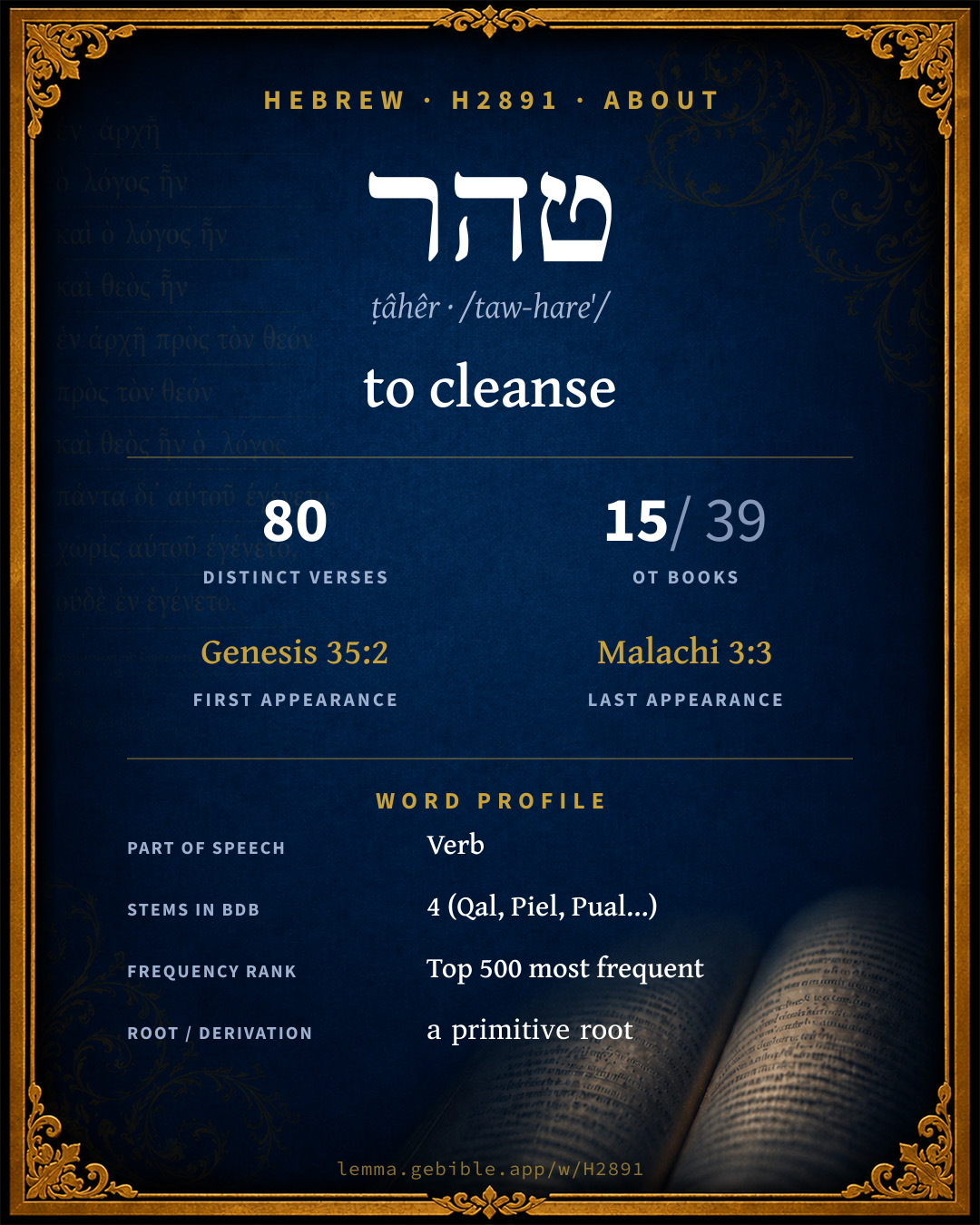
טָהֵר
to cleanse
‘to cleanse’ is one of 2 main senses fuller range ↓
Full lexicon entry — Brown-Driver-Briggs (BDB)
From Brown-Driver-Briggs (BDB)
Where this word appears
See every Piel verb in the Hebrew Bible →
Grammar key — what these labels mean
Part of speech
- Verb
- An action or state-of-being word.
Stem
- Qal
- The basic, simple active stem — the plain form of the verb (“he wrote”). Here: ‘be clean’
- Hithpael
- The reflexive or reciprocal stem (the subject acts on itself). Here: ‘purify oneself’
- Piel
- An intensive or resultative active stem. Here: ‘cleanse’
- Pual
- The passive counterpart of the Piel.
Form
- Sequential Perfect
- A perfect with prefixed waw continuing a preceding imperfect or command (waw-consecutive perfect).
- Participle Active
- A verbal adjective expressing ongoing or characteristic action (“writing / one who writes”).
- Infinitive Construct
- A bound verbal noun, frequently with prepositions (“to write / in writing”).
- Imperfect
- An incomplete, ongoing, or future action (“he will / would write”).
- Sequential Imperfect
- An imperfect with prefixed waw — the standard past-narrative form (waw-consecutive imperfect).
- Imperative
- A direct command (“write!”).
- Perfect
- A completed action or state — Hebrew marks aspect (completeness) more than strict tense (“he wrote”).
- Participle Passive
- A verbal adjective expressing action received (“written”).
State
- Absolute
- The independent form of a noun, not bound to a following word.
- Construct
- A noun bound to a following noun in a possessive / “of” relationship (the construct chain).
Person
- 3rd Person
- The one spoken about (“he / she / it / they”).
- 2nd Person
- The one addressed (“you”).
- 1st Person
- The speaker (“I / we”).
Gender
- Masculine
- Grammatically masculine.
- Common
- Either gender — not distinguished for this form.
- Feminine
- Grammatically feminine.
Number
- Singular
- One.
- Plural
- More than one (in Hebrew, generally three or more).
2 verses where H2891 appears in the Hithpael stem in the Book of Nehemiah. Filtered view — show all forms. Click any verse to open its interlinear word-by-word view. Verse text shown in the World English Bible for context — . Each verse’s Hebrew form is shown with its reference; the English is not keyword-highlighted, since the data carries no word-level English alignment. Use “Compare translations” on any verse to read it across multiple English versions. This concordance covers the Hebrew Bible; Septuagint (Greek Old Testament) occurrences are not indexed here.
Nehemiah
- Nehemiah 12:30 וַ/יִּֽטַּהֲר֔וּ וַֽ/יְטַהֲרוּ֙ conj + Hithpael wimpf 3mp conj + Piel wimpf 3mp The priests and the Levites purified themselves; and they purified the people, and the gates, and the wall.
- Nehemiah 13:22 מִֽטַּהֲרִים֙ Hithpael ptcp.act mp I commanded the Levites that they should purify themselves, and that they should come and keep the gates, to sanctify the Sabbath day. Remember to me, my God, this also, and spare me according to the greatness of your loving kindness.
About this entry
At a glance — auto-summarized from this page’s data, not written by a person. Every figure links to its source below. This summary describes the numbers; it doesn’t interpret them.
At its core, טהר (ṭâhêr) means “to cleanse.” Translators differ — “is to be cleansed” in the King James Version, then “one to be cleansed” (Berean Standard Bible) and “he will be clean” (unfoldingWord Literal Text), as the renderings breakdown shows. It turns up in 80 verses across 15 books, a moderately common footprint. The word gravitates to Leviticus (44%), then Ezekiel and Numbers. Read the stem: it spans 4 stems, including Qal and Piel. Each statement above links to its evidence; the full detail follows below.
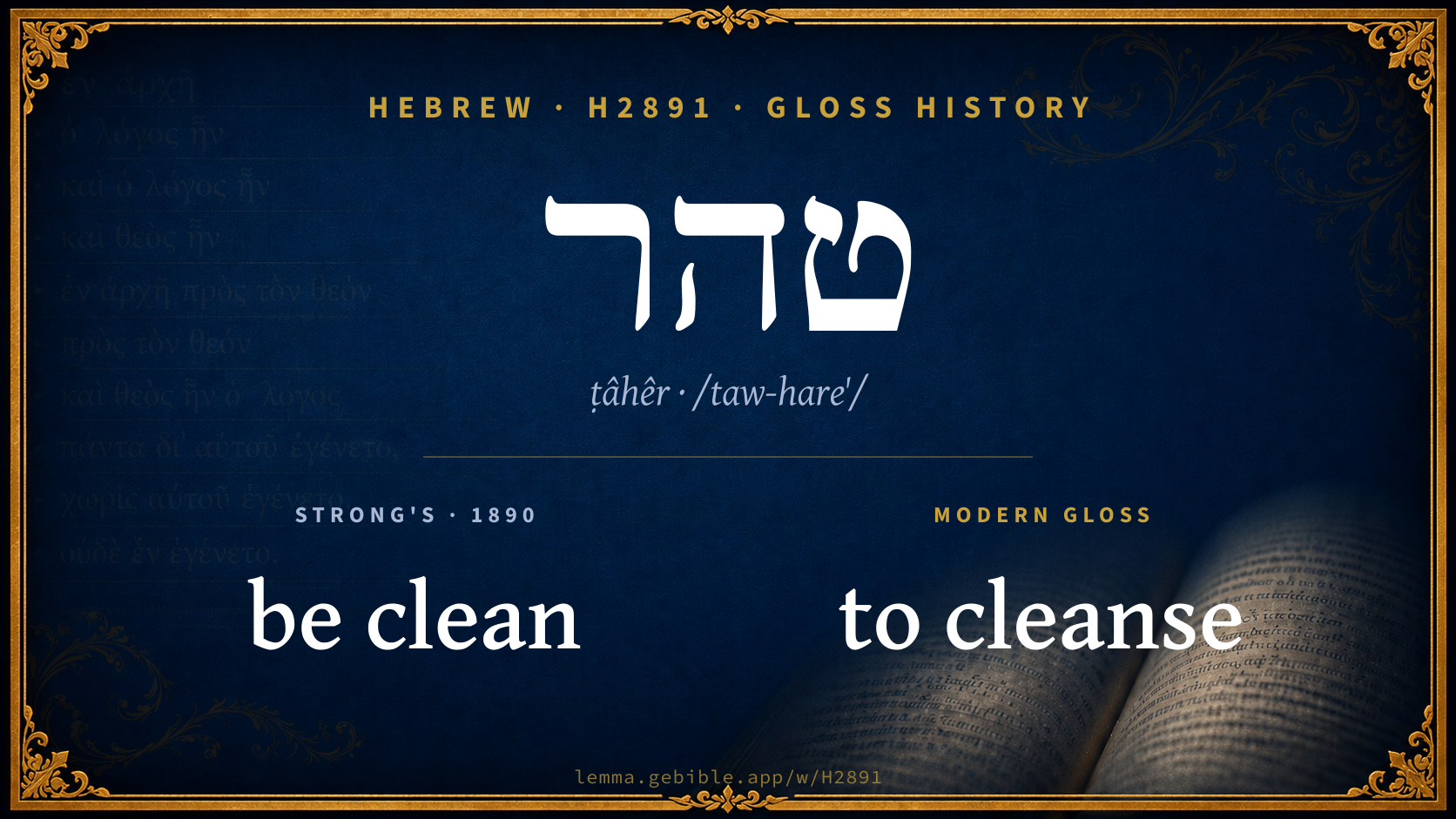
Gloss history
Strong's 1890 vs modern scholarship
About this word
Strong's H2891 catalogs a Hebrew word from the Hebrew Old Testament.
These counts are not copied from any lexicon or concordance. They are computed here, from the morphology-tagged Hebrew Old Testament. What Lemma adds →
- 80
- distinct verses
- The word appears in 80 distinct verses.
- 15 / 39
- OT books
- The word appears in 15 of 39 Old Testament books.
- #437
- by frequency
- Top 500 most frequent Hebrew words (rank 437 of 8,640 Hebrew words by occurrence).
View all 80 occurrences in the concordance →
By section of the Old Testament
By traditional corpus
Conventional, traditional groupings — biblical authorship is debated, so this is a traditional corpus grouping, not an authorship claim. Each share is this word’s portion of its verses in that division of the Hebrew canon. Each figure is a share of the word’s 80 distinct verses.
- Torah (Pentateuch) 44 verses · 55%
- Prophets (Nevi'im) 18 verses · 23%
- Writings (Ketuvim) 18 verses · 23%
How translations render this word
Counts come from each version’s own published word-to-Strong’s tagging or interlinear alignment — an approximate guide to how each version renders this word, not a word-level alignment the data otherwise carries. Because each total is that version’s own tagged count, the per-version totals vary from one another and need not match the appearance or distinct-verse counts above. These counts may also differ from a printed concordance because Lemma counts each distinctly tagged rendering and does not collapse phrase taggings into a single head-word total. This is a fixed set of word-tagged versions (KJV, ASV, BSB, ULT) and does not change with the reading translation you choose elsewhere. Each version’s license is shown beside its name below (and on Sources).
- King James Version: Is to be cleansed 10×, Cleanse 8×, Shall pronounce him clean 7×
- American Standard Version: Is to be cleansed 11×, Shall pronounce him clean 6×, Cleanse 5×
- Berean Standard Bible: One to be cleansed 10×, He will be clean 6×, Cleanse 5×
- unfoldingWord Literal Text: He will be clean 10×, Person being cleansed 7×, Cleanse 6×
King James Version Public Domain
Renders H2891 across 94 tagged occurrences — most commonly:
Plus 51 renderings that appear only once — usually multi-word phrases or single function words the recovered tagging swept in, not distinct renderings.
American Standard Version Public Domain
Renders H2891 across 91 tagged occurrences — most commonly:
Plus 50 renderings that appear only once — usually multi-word phrases or single function words the recovered tagging swept in, not distinct renderings.
Berean Standard Bible Public Domain
Renders H2891 across 94 tagged occurrences — most commonly:
Plus other, less common renderings. Plus 37 renderings that appear only once — usually multi-word phrases or single function words the recovered tagging swept in, not distinct renderings.
unfoldingWord Literal Text CC BY-SA 4.0
Renders H2891 across 110 tagged occurrences — most commonly:
Plus other, less common renderings. Plus 48 renderings that appear only once — usually multi-word phrases or single function words the recovered tagging swept in, not distinct renderings.
17 senses and sub-senses in the full BDB
Hebrew verbs can shift meaning by stem (binyan): Qal is the basic action, Niphal is often passive or reflexive, Piel often intensifies or makes it factitive, and Hiphil is typically causative. The senses below are grouped under the stem BDB assigns to each. This entry also uses Pual (the passive of Piel) and Hithpael (reflexive or reciprocal).
What do BDB’s symbols mean?
BDB uses these scholarly abbreviations:
| Symbol | Meaning |
|---|---|
| 𝔊 | the Septuagint (the ancient Greek translation, LXX) |
| 𝔙 | the Vulgate (the Latin translation) |
| 𝔖 | the Syriac version (the Peshitta) |
| 𝔗 | the Targum (the Aramaic translation) |
| ψ | the Psalms |
| √ | root (the underlying root or stem) |
| ‖ | parallel passage (a synonymous or contrasted parallel) |
| † | the dagger: every passage where the word occurs is cited |
The 17 senses and sub-senses the full Brown-Driver-Briggs lexicon distinguishes for this word, in lexicon order (not ranked by frequency), with BDB’s own verbatim wording and sub-sense lettering. Shown in Hebrew script with BDB’s own scholarly abbreviations. The condensed entry is in the Lexicon Entry tab. See also the Forms in the corpus table below.
Qal
- Pf. ט׳ Lv 11:32 + 12 times; 3 fs. טָֽהֲרָה Lv 12:7; 15:28; טָהֵ֑רָה Lv 12:8 etc., + 5 times Pf.; Impf. יִטְהַר Lv 15:13 Jb 4:17 etc., + 9 times Impf.; Imv. טְהָ֑ר 2 K 5:10, 13;— e.g. Leviticus 11:32
- 1. be clean, i.e. (miraculously) freed from leprosy by washing in the Jordan 2 K 5:10, 12, 13, 14. e.g. 2 Kings 5:10
- 2. be clean ceremonially (only H P), Lv 15:13, 28(×2) (P), 22:4 (H); by washing with water, the flesh Lv 22:7 (H); garments Lv 13:6, 34, 58 Nu 31:24 (all P); both flesh and garments Lv 17:5 (H), 14:8, 9; 15:13 Nu 19:19 (all P); other articles Lv 11:32 (P); passing things through the fire Nu 31:23 (P); offering sin-offerings Lv 12:7, 8; 14:20 (P); by the ceremony of the two birds Lv 14:53 (P); by ashes of red heifer Nu 19:12(×2) (P). e.g. Leviticus 15:13
- 3. be clean morally, of people, made clean by י׳’s scattering clean water upon them Ez 36:25; of Jerus., specif. made clean from idolatry, under fig. of adultery Je 13:27; also sq. מִן Ez 24:13(×2) (purification by י׳); made clean מִכָּל־חַטֹּאתֵיכֶם Lv 16:30 (P; by the sin-offering of the atonement day); also of the individual, be clean מֵחַטָּאוֹת Pr 20:9 (‖ זכה); become clean by use of hyssop ψ 51:9 (‖ אַלְבִּין); more generally אִם־מֵעֹשֵׂהוּ יִטְהַר־גָּ֑בֶר Jb 4:17 shall a man be more pure than his maker? (‖ יִצְדָּ֑ק). e.g. Ezekiel 36:25
Piel
- Pf. טִהַר Lv 13:3 + 4 times; sf. טִהֲרוֹ Lv 13:6 + 5 times; 2 ms. טִהַרְתָּ Nu 8:6, 15 etc. + 7 times Pf.; Impf. יְטַהֵר 2 Ch 34:5 etc. + 4 times Impf.; Imv. sf. טַהֲרֵנִי ψ 51:4; Inf. cstr. טַהֵר Ez 39:12 + 5 times; sf. טַהֲרִי Ez 36:33 etc. + 4 times Inf.; Pt. מְטַחֵר Lv 14:11 Mal 3:3;—chiefly P; e.g. Leviticus 13:3
- 1. cleanse, purify:
- a. physically, metals from dross Mal 3:3; land from corpses Ez 39:12, 14, 16; heavens from clouds Jb 37:21; temple from unclean things 2 Ch 29:15, 16, 18; land and city from Asherim and images 2 Ch 34:3, 5, 8; store-chambers of temple from household stuff Ne 13:9; priesthood by exclusion of alien blood Ne 13:30. e.g. Malachi 3:3
- b. ceremonially, the altar of incense by the blood of the annual sin-offering Lv 16:19 (P); the people, gates, and wall (by some undefined ceremony) Ne 12:30; the altar of the court by the blood of sin-offerings Ez 43:26; of consecration of Levites by מֵי חטאת Nu 8:6, 7 (P), and חטאת Nu 8:15, 21 (P). e.g. Leviticus 16:19
- c. morally Lv 16:30 (P), Ez 37:23 Mal 3:3; מֵחַטָּאֹת ψ 51:4; מֵעונ(ות) Je 33:8 Ez 36:33; מִטּמא(ו)ת Ez 24:13; 36:25. e.g. Leviticus 16:30
- 2. pronounce clean, ceremonially Lv 13:6, 13, 17, 23, 28, 34, 37, 59; 14:7, 48 (all P). e.g. Leviticus 13:6
- 3. perform the ceremony of cleansing Lv 14:11 (P). e.g. Leviticus 14:11
Pual
- Pf. 3 ms. טֹהַר 1 S 20:26 (so read for MT טהור 𝔊 We Dr, he is not clean, because he hath not been cleansed); Pt. אֶרֶץ לֹא מְטֹהָרָה a land not cleansed Ez 22:24 (but 𝔊 Hi Ew Co SS read a land not rained upon, v. מטר). e.g. 1 Samuel 20:26
Hithpael
- Pf. 3 pl. הִטָּֽהֲרוּ Ezr 6:20; הִטֶּהָ֑רוּ (Köi 271) 2 Ch 30:18; Nu 8:7; 1 pl. הִטַּהַרְנוּ Jos 22:17; Impf. יִטָּֽהֲרוּ Ne 12:30; Imv. הִטָּֽהֲרוּ Gn 35:2; Pt. מִטַּהֵר Lv 14:7 + 11 times; pl. מִטַּהֲרִים Ne 13:22 Is 66:17;—reflexive: e.g. Ezra 6:20
- 1. purify oneself:
- a. ceremonially, especially in preparation for sacred duties Gn 35:2 (R), Nu 8:7 2 Ch 30:18 Ezr 6:20 Ne 13:22; also for heathen mysteries Is 66:17; of purifying priests, people, and wall Ne 12:30 (cf. Pi. 1 b). e.g. Genesis 35:2
- b. morally Jos 22:17 (P). e.g. Joshua 22:17
- 2. present oneself for purification, only pt. הַמִּטַּהֵר the candidate for purificaion Lv 14:4, 7, 8, 11, 14, 17, 18, 19, 25, 28, 29, 31 (P). e.g. Leviticus 14:4
Senses from the full Brown-Driver-Briggs lexicon (Brown, Driver, Briggs; Oxford 1906 — public domain), digitized via Sefaria, supplemented by the OpenScriptures HebrewLexicon (CC BY 4.0). Full attribution on Sources.
Word origin
vb. be clean, pure (Arabic طَهَرَ, طَهُرَ id.; NH id., Pi. make or declare ceremonially clean; Aramaic טְהַר emptiness, טִיהֲרָא brightness; Sab. טהר Hal 682; Ethiopic አጥሀረ, ተጣሀረ purify, wash oneself with water)—
— Brown-Driver-Briggs (Oxford 1906, public domain), digitized via Sefaria, supplemented by the OpenScriptures HebrewLexicon (CC BY 4.0). See Sources.
Origin: a primitive root
Jastrow Dictionary
A second Hebrew/Aramaic lexicon for comparison, covering Aramaic and post-biblical (Talmudic, Targumic, Midrashic) usage that the biblical-Hebrew BDB does not. Matched by lemma rather than by Strong’s number, so a lemma may carry more than one Jastrow headword (shown separately below), and the entries cover usage well beyond the Bible.
טָהֵר
- [to be bright, to glitter,]
- 1. to be clean, pure, esp. to be levitically clean; to be unsusceptible of levitical uncleanness. Neg. X, 8 שט׳ שעה אחת which has been declared clean once. Mikv. II, 2 עד שיודע שט׳ until it is ascertained that it has become clean. Ib. III, 2 ויִטְהֲרוּ העליונים מן וכ׳ so that the waters coming from above become cleansed from the impurity of the lower waters. Neg. VII, 4 ויִטְהַר ממנו and is declared clean from it (the last scall); a. fr.
- 2. to be cleared, removed. Ber. 2ᵇ, v. next w.
- 1. to purify, make (levitically) clean; to absolve from sin. Yoma VIII, 9 מי מְטַהֵר וכ׳ who is it that absolves you? Ib. (ref. to Jer. XVII, 13) מה מקוה מט׳ וכ׳ as the ritual bath (v. מִקְוֶה) cleanses the unclean, so does the Lord &c.; a. fr. e.g. Jeremiah 17:13
- 2. to keep clean, guard against contact with unclean things. R. Hash. 16ᵇ חייב … לטַהֵר את עצמו וכ׳ one is bound to keep one’s self clean for the festive days.
- 3. to declare טָהוֹר, to decide in favor of cleanness. Snh. 17ᵃ bot. מי שיודע לטַ׳ וכ׳ one who knows how to prove a creeping thing to be clean. Ib. אני אדון ואֲטַהֲרֶנוּ I will argue and prove it to be clean. Eduy. VIII, 7 לטמא ולטַ׳ to decide on unclean and clean; a. v. fr.—Part. pass. מְטוֹהָר, pl. מְטוֹהָרִים. Ber. 2ᵇ, v. preced.
- 4. to become clean. Snh. 94ᵇ מיד ט׳ it becomes clean at once. Ḥull. 60ᵇ טִיהֲרוּ; Gitt. 38ᵃ טהרו, v. סִיחוֹן.
- to become clean. Tanḥ. Metsora 7 נִטְהֲרָה וכ׳ she became clean on the eighth day. Ib. ונִטְהֶרֶת and becomes clean; a. fr.
- to be cleansed, to cleanse one’s self; to amend. Yoma 38ᵇ בא לִטָּהֵר מסייעים אותו (Ms. M. 2 להִטָּהֵר) if one is willing to do good, he will be assisted; Sabb. 104ᵃ; Yalk. Prov. 935 לִיטָּהֵר; a. e.—Yoma VIII, 9 (85ᵇ) לפני מי אתם מִיטַּהֲרִים Mish. a. Y. ed. (Bab. ed. מִטַּ׳) before whom do you cleanse yourselves (from sin)?; a. e.
טְהֵר
- 1. to be clean (usually דכי). Ber. 2ᵇ וט׳ גברא, v. infra.
- 2. to be cleared away, be gone. Ib. 2ᵃ, sq. (ref. to Lev. XXII, 7 ובא השמש וטהר) ממאי דהאי … והאי וטהר ט׳ יומא דלמא … ט׳ גברא how do you know that this uba hash-shemesh means his sunset (the finished sunset of the seventh day, v. Ms. M. in Rabb. D. S. a. l.), and v’taher means, the day is gone; may be uba &c. means the approach of his evening (beginning sunset. Tosaf. a. l.; Rashi: the arrival of his (eighth) morning), and v’taher (referring to the man) means, the man becomes clean (by means of his sacrifice, Rashi). e.g. Leviticus 22:7
- 3. (denom. of טִיהֲרָא) to be noon-time. Yoma 59ᵃ, a. e., v. טִיהֲרָא a. next w.
- to declare clean. B. Mets. 84ᵇ טַהֲרִינְהוּ he declared them clean.
טֹהַר
- preced. wds.)
- 1. the pure, real surface (of gold). Yoma V, 6 על טָהֳרוֹ של מזבח (or טְהָרוֹ) immediately on the top of the golden altar (free from coals or ashes, v. גִּילּוּיָא). Men. 97ᵃ על טהרו של שולחן (Ms. M. על השל׳) immediately on the golden table.
- 2. (cmp. חָזֶה) the centre of the front. Yoma 59ᵃ (one opinion explain. טהרו של מזבח, v. supra) פלגיה דמזבח the centre of the altar front, as people say, טהר טיהרא והוי פלגא דיומא ‘the noon-light shines’ meaning by tihara the middle of the day; ib. 15ᵃ; Zeb. 38ᵇ
טִהָר
- v. sub. טִיה׳.
טִיהָר
- (v. טַהֲרָה) bright sky after rain. Ber. 59ᵃ Ms. F.; Y. ib. IX, 13ᵈ; Yalk. Is. 335 נראה שמים בטִהֲרוֹ (read: רקיע).
A Dictionary of the Targumim, the Talmud Babli and Yerushalmi, and the Midrashic Literature (Marcus Jastrow; London, Luzac, 1903) — Public Domain. Digitized via Sefaria. Digitized via Sefaria. Full attribution on Sources.
Forms in the corpus
The 74 distinct written forms H2891 takes in the Hebrew Bible, most frequent first — each parse links to that stem’s occurrences in the concordance. Hebrew forms include their vowel points and cantillation, so a single lemma takes many written forms.
The 60 most common forms are shown; 14 rarer forms follow in the full concordance.
Same root — word family
Other BDB entries built from the same root as H2891, grouped by Strong’s listed origin. These share a root / origin per the lexicon — not necessarily a shared meaning. Each links to that word’s own entry.
Derived from this word
Compare all same-root words → They share a root, not necessarily a meaning.
Septuagint verse parallels
This word appears in 76 verses that also exist in the Greek Old Testament (Septuagint), out of the 80 Hebrew verses it occurs in. You can read those verses in Greek by switching the Old Testament edition to the Septuagint.
Read these verses in the Septuagint
- Genesis 35:2
- Leviticus 11:32
- Numbers 8:6
- Joshua 22:17
- 2 Kings 5:10
- 2 Chronicles 29:15
- Ezra 6:20
- Job 4:17
- Psalms 51:2
- Proverbs 20:9
- Isaiah 66:17
- Jeremiah 13:27
This is a verse-level parallel only — the same verses exist in both the Hebrew and Greek Old Testaments. No word-level Hebrew↔Greek correspondence is claimed: the data carries no such alignment, so no Greek word is shown as this Hebrew word’s translation. Coverage is not total — the Septuagint omits the deuterocanon and renumbers the Psalms, so some Hebrew verses have no direct Greek parallel.