
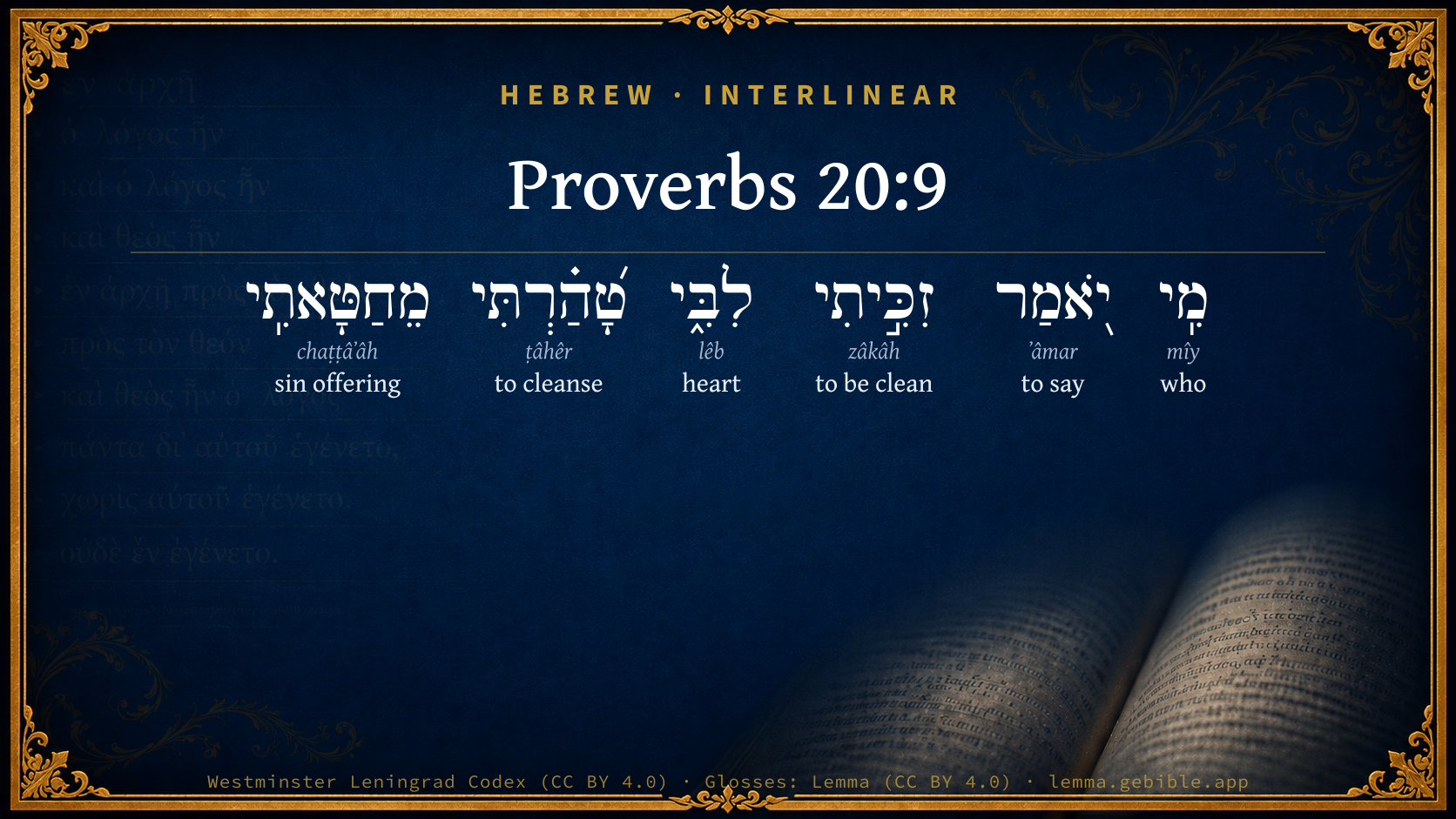
Proverbs 20:9

Hebrew (Westminster Leningrad Codex) Proverbs 20:9 appears in the Hebrew Old Testament. The text above is from the Westminster Leningrad Codex. Each word links to its Strong’s number, a concise gloss, and parsing drawn from the Open Scriptures Hebrew Bible morphology. Click any word for its full Brown-Driver-Briggs (BDB) entry.
Download image
Cite this verse

Proverbs 20:9 (World English Bible). Public Domain. Lemma interlinear Bible study tool, https://lemma.gebible.app/v/proverbs/20/9.

Show BibTeX & RIS
BibTeX
RIS
English Translation
Who can say, "I have made my heart pure. I am clean and without sin?"
World English Bible · Public Domain
Download a study sheet

One document with this verse’s original text, its word-by-word gloss line, the meaning frame, cross-references with their text, attributed commentary, and full source and license credits — printable, and it pastes into notes with its structure intact.

This verse Autodidact and up

Study sheet (.html) Plain text (.txt)

A passage Seminary Student

Up to 50 verses in one chapter. A passage sheet keeps up to 6 commentary sources and 12 cross-references per verse, in the order this page ranks them, and says so on the sheet whenever that leaves anything out. Ask for a single verse and you get the Autodidact verse sheet above.

Everything on this page stays free to read, with no account — the sheet is a download of what is already on screen, not access to it.

Want to remove ads? Support Godless Engineer
Compare translations 3

The same verse in 3 English versions, stacked beneath the original-language interlinear above. Click any original word for its lexicon entry.

Each is an independent rendering of the whole verse — the interlinear is not word-aligned to these translations.

Highlighted words mark where these versions differ — a whole-verse word diff, not a word-by-word alignment.

  • World English Bible Public Domain
    Who can say, "I have made my heart pure. I am clean and without sin?"
  • King James Version Public Domain
    Who can say, I have made my heart clean, I am pure from my sin?
  • unfoldingWord Literal Text CC BY-SA 4.0
    Who can say, “I have made my heart pure; I am clean from my sin”?

unfoldingWord Literal Text — © unfoldingWord, licensed CC BY-SA 4.0. Word-aligned USFM3 via Door43 (git.door43.org/unfoldingWord/en_ult).

Versions to compare (up to 4)

3 of 4 selected

Show all 18 translations

Every available English version of this verse, each an independent rendering of the whole verse.

  • World English Bible Public Domain
    Who can say, "I have made my heart pure. I am clean and without sin?"
  • Berean Standard Bible Public Domain
    Who can say, “I have kept my heart pure; I am cleansed from my sin”?
  • Majority Standard Bible Public Domain
    Who can say, “I have kept my heart pure; I am cleansed from my sin”?
  • King James Version Public Domain
    Who can say, I have made my heart clean, I am pure from my sin?
  • American Standard Version (1901) Public Domain
    Who can say, I have made my heart clean, I am pure from my sin?
  • Revised Version (1885) Public Domain
    Who can say, I have made my heart clean, I am pure from my sin?
  • Geneva Bible (1599) Public Domain
    Who can say, I haue made mine heart cleane, I am cleane from my sinne?
  • Douay-Rheims (1899) Public Domain
    Who can say: My heart is clean, I am pure from sin?
  • Young's Literal Translation Public Domain
    Who saith, `I have purified my heart, I have been cleansed from my sin?'
  • Literal Standard Version CC BY-SA 4.0
    Who says, “I have purified my heart, || I have been cleansed from my sin?”
  • Unlocked Literal Bible CC BY-SA 4.0
    Who can say, “I have kept my heart pure; I am clean from my sin”?
  • unfoldingWord Literal Text CC BY-SA 4.0
    Who can say, “I have made my heart pure; I am clean from my sin”?
  • Darby Bible Public Domain
    Who can say, I have made my heart clean, I am pure from my sin?
  • World Messianic Bible Public Domain
    Who can say, “I have made my heart pure. I am clean and without sin”?
  • Webster's Bible Public Domain
    Who can say, I have made my heart clean, I am pure from my sin?
  • Free Bible Version CC BY-SA 4.0
    Who can claim, “I've made sure my conscience is clean; I've purified myself from sin”?
  • Bible in Basic English Public Domain
    Who is able to say, I have made my heart clean, I am free from my sin?
  • JPS Tanakh (1917) Public Domain
    Who can say: 'I have made my heart clean, I am pure from my sin'?

Literal Standard Version (2020), Covenant Press — licensed CC BY-SA 4.0. Text via the HelloAO Bible API (eBible.org). Unlocked Literal Bible (unfoldingWord) — licensed CC BY-SA 4.0. Text via the HelloAO Bible API (eBible.org). unfoldingWord Literal Text — © unfoldingWord, licensed CC BY-SA 4.0. Word-aligned USFM3 via Door43 (git.door43.org/unfoldingWord/en_ult). Free Bible Version, Dr. Jonathan Gallagher — licensed CC BY-SA 4.0. Text via the HelloAO Bible API (eBible.org).

Word by word

More ways to search: Search by grammar → Find every occurrence → Compare this word →

Practice this passage: Drill this verse → Learn its vocabulary →

About this verse

These counts appear in no published source. They are computed here, from the morphology-tagged text and Lemma’s own curated glosses. What Lemma adds →

6
words
6
distinct lemmas
Wisdom
section

Notable vocabulary

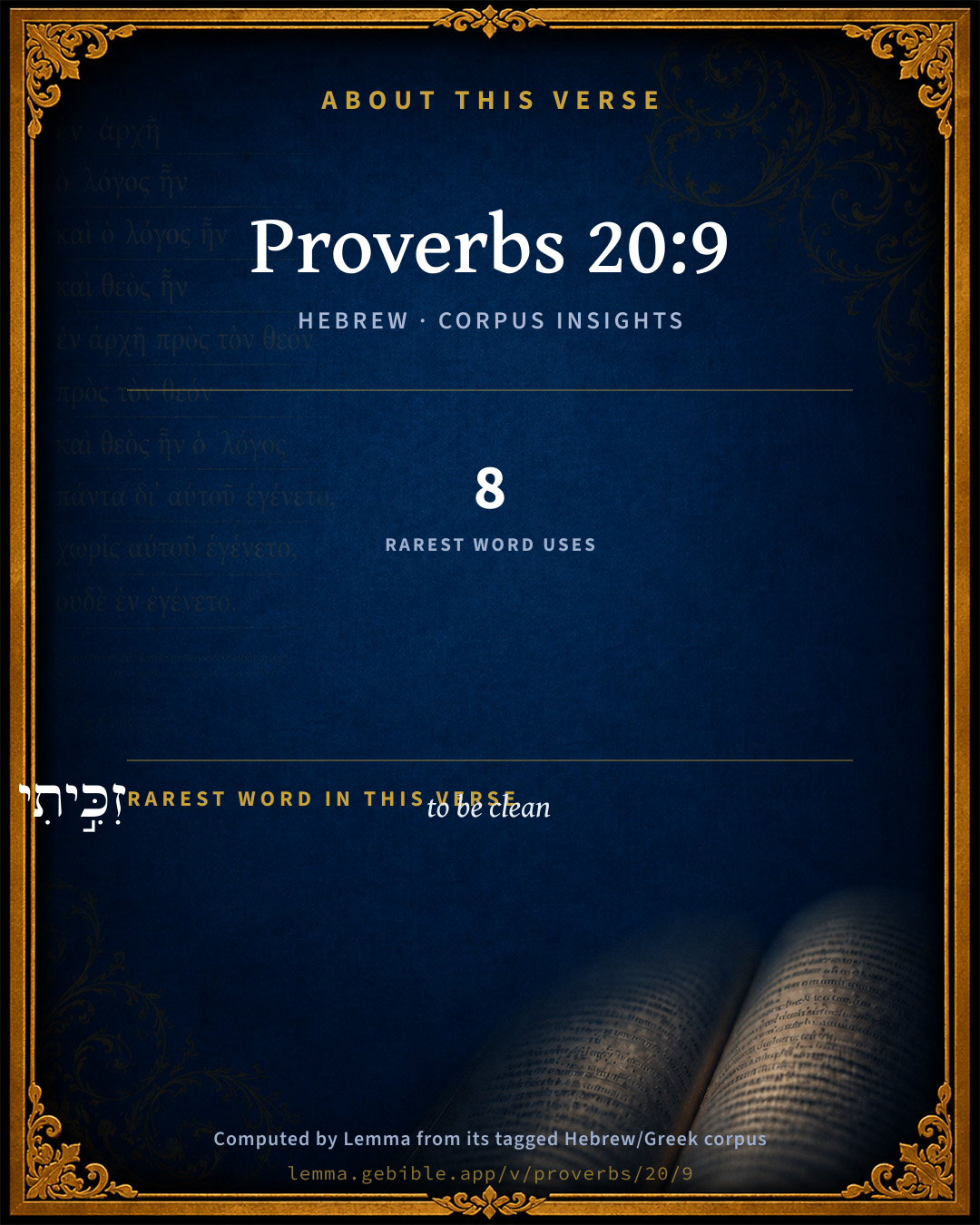
The rarest word here is זִכִּ֣יתִי to be clean H2135 — appearing just 8 times in the whole Hebrew Bible.

Shared distinctive vocabulary

זִכִּ֣יתִי to be clean H2135 occurs in 8 verses of the Hebrew Bible. Also found in:

Grammatical profile

  • 3 verbs
  • 2 nouns
  • 1 particle

Verb forms

  • יֹ֭אמַר Qal · Imperfect
  • זִכִּ֣יתִי Piel · Perfect
  • טָ֝הַ֗רְתִּי Qal · Perfect

Hebrew & Septuagint length

In English translation the verse runs 15 words from the Hebrew and 20 from the Septuagint (LXX English) — closely comparable.

A rough comparison of the two English renderings, which tokenize alike — not a word-level alignment.

Word counts can differ between the Hebrew and the Greek without any difference in meaning — e.g. the Hebrew direct-object marker אֵת has no separate Greek word, and Greek often adds the article ὁ.

Cross-references

10

Topical passages linked to Proverbs 20:9 in the Treasury of Scripture Knowledge — connected by theme and wording, ordered by reader-vote popularity; previews shown in the World English Bible.

  • Ecclesiastes 7:20 Surely there is not a righteous man on earth, who does good and doesn't sin.
  • 1 John 1:8–10 If we say that we have no sin, we deceive ourselves, and the truth is not in us.
  • 1 Kings 8:46 If they sin against you (for there is no man who doesn't sin), and you are angry with them, and deliver them to the enemy, so that they carry them away captive to the land of the enemy, far off or near;
  • Job 14:4 Who can bring a clean thing out of an unclean? Not one.
  • Job 15:14 What is man, that he should be clean? He who is born of a woman, that he should be righteous?
  • Job 25:4 How then can man be just with God? Or how can he who is born of a woman be clean?
  • 1 Corinthians 4:4 For I know nothing against myself. Yet I am not justified by this, but he who judges me is the Lord.
  • James 3:2 For in many things we all stumble. If anyone doesn't stumble in word, the same is a perfect man, able to bridle the whole body also.
  • 2 Chronicles 6:36 If they sin against you (for there is no man who doesn't sin), and you are angry with them, and deliver them to the enemy, so that they carry them away captive to a land far off or near;
  • Psalms 51:5 Behold, I was brought forth in iniquity. In sin my mother conceived me.

Cross-references courtesy of OpenBible.info (CC BY 4.0).

Hebrew and Greek witnesses Masoretic Hebrew ↔ Greek Septuagint

The same verse in the two great witnesses to the Old Testament, shown verse-for-verse.

These are two independent witnesses, not word-aligned to each other, and the Septuagint is shown in lemma (dictionary) form.

Hebrew Proverbs 20:9 Masoretic · Westminster Leningrad Codex

מִֽי יֹ֭אמַר זִכִּ֣יתִי לִבִּ֑י טָ֝הַ֗רְתִּי מֵחַטָּאתִֽי

Who can say, "I have made my heart pure. I am clean and without sin?"

World English Bible · Public Domain

Greek LXX Proverbs 20:9 Septuagint · lemma form

τίς καυχάομαι ἁγνός ἔχω ὁ καρδία ἤ τίς παρρησιάζομαι καθαρός εἰμί ἀπό ἁμαρτία κακολογέω πατήρ ἤ μήτηρ σβέννυμι λαμπτήρ ὁ δέ κόρη ὁ ὀφθαλμός αὐτός ὁράω σκότος μερίς ἐπισπουδάζω ἐν πρῶτος ἐν ὁ τελευταῖος οὐ εὐλογέω μή εἶπον τίνω ὁ ἐχθρός ἀλλά ὑπομένω ὁ κύριος ἵνα σύ βοηθέω

Who will boast that he has a pure heart? or who will boldly say that he is pure from sins?

LXX2012 (modern English Septuagint) · Public Domain

On this verse, Whedon's Commentary on the Bible discusses the Septuagint’s reading. Read the note in Commentary ↓

Hebrew: Westminster Leningrad Codex (CC BY 4.0). Greek: Septuagint (public domain); English from LXX2012 (modern English Septuagint) (Public Domain). How the Septuagint differs from the Hebrew →

Commentary

Notes on Proverbs 20:9 from classic Christian and Jewish commentators (each source and its license shown beneath its notes). The classic Christian expositions comment on the surrounding passage and are grouped to its opening verse, so a note may address several verses; the Jewish commentaries on the Tanakh (Rashi and others) are per-verse, so they appear only where the commentator wrote on this verse.

Lemma curates 59 commentaries, every one of them public domain or Creative Commons licensed, each selected and text-cleaned for this edition rather than reprinted as found. About our sources →

Trapp's Complete Commentary

John Trapp

Pro 20:9 Who can say, I have made my heart clean, I am pure from my sin?

Ver. 9. Who can say, I have made my heart clean?] That can I, saith the proud Pharisee and the Popish justiciary. Non habeo, Domine, quod mihi ignoscas: I have nothing, Lord, for thee to pardon, saith Isidore the monk. When St Paul, that had been in the third, heaven, complains of his inward impurities, {Rom 7:15} and though he should have known no evil by himself, yet durst he not look to be thereby justified. {1Co 4:4} And holy Job could say, "If I wash myself with snow water, and make my hands never so clean; yet God would plunge me in the ditch, so that my own clothes should abhor me." {Job 9:30-31} And "If thou, Lord, shouldest mark iniquities," saith David, "who should stand before thee?" {Psa 130:3}

John Trapp, A Commentary or Exposition upon All the Books of the Old and New Testament (1647–1656) — public domain. Text from a community e-Sword module.

The Biblical Illustrator

Joseph S. Exell

Pro_20:9

Who can say, I have made my heart clean; I am pure from my sin?

Purity of heart

I. Who can say, i have made my heart clean? We read of some who have clean hands, which implies an abstinence from outward sins. A clean heart implies more than this; it relates to the inward temper and disposition, to the bias of the will, and the various operations of the affections, as being spiritual and acceptable in the sight of God.

1. Purity of heart is much to be desired.

2. It is the work of the Spirit alone to impart it.

3. There is so much self-righteous pride and vanity in man that many are apt to think they have made their hearts clean.

II. Who can say, i am pure from my sin? To be pure from sin is similar to our being in a state of sinless perfection. This no one ever enjoyed in the present life, except Him only who knew no sin.

1. Who can say that they were never defiled with original sin, or that they are now free from that defilement?

2. Who can say that they are pure from inward sins, the evils of the heart?

3. Who can say that they are wholly free from practical evil in life and conversation?

4. Who can say they are free from every besetting sin, or that they are not defiled with any of those evils to which they are more especially exposed by constitutional habits, or by their occupation or immediate connections. As no one can say with truth that he is pure from his sin, what reason have the best of men to be abased before God! (B. Beddome, M. A.)

The duty of mortification

The trial and examination of our hearts and ways in reference to God is a duty which, though hard and difficult, is exceedingly useful and beneficial to us.

I. The duty of mortification. The cleansing of our hearts, to be pure from sin.

1. The nature of the action. Cleansing. A word implying some change and alteration that is to be made in us. That which is purged was formerly impure. God is pure; the saints are purged and purified. This shows us the nature of sin: it is a matter of uncleanness. Uncleanness is a debasing quality; a loathsome quality; a thing odious in itself and for itself. Cleansing shows the sovereign virtue of grace and repentance. It is of a purging virtue. It hath a power of cleansing us from the pollutions of sin. It is compared to clean water, which washes away filth. To a wind, which, passing, cleanseth. To a fire, that consumes dross and corruption.

2. The property of the agent. The text makes us agents in this great work. Sin is cleansed in our justification, when it is pardoned and forgiven. The act of forgiveness is Gods alone. Sin is cleansed by mortification, and regeneration, and conversion. The progress of these acts God works in us, and by us. His Spirit enables us to carry forward this work which He graciously begins, and to cleanse ourselves.

3. The circumstance of time. I have cleansed. Mortification is a work of long continuance; it requires progress and perseverance.

II. The object that must be wrought upon. The heart. The whole man must be cleansed, but first and specially the heart. The heart is the fountain and original from whence all other uncleannesses do stream and flow. The heart is the lurking-hole, to which sin betakes itself. The heart is the proper seat and residence of sin.

III. The measure or degree of mortification. I am pure from my sin. This is the high aim that a Christian must set to himself, to press forward to perfection. The text lays our sin at our own doors, and so it concerns us to rid ourselves of it. Sin is the offspring of our will. There is the sin of inbred and natural inclination; the sin to which our particular age disposes us: childhood is idle, youth wanton, age covetous; the sins of our calling and vocation: every calling has its special temptations.

IV. The difficulty of mortification. This question, Who? is not meant for all sorts of sinners. It is not propounded to the profane man, to the grossly ignorant man, or to the negligent and careless man. The question reaches to the best sort of men, those that have made good progress in this work of cleansing and mortification, who, nevertheless, are condemned by their own consciences; who have still leaven to purge out; find some sins of surreption will steal in upon them. As to the question itself. It runs thus: Who can say? Not Who doth say? or Who will say? or Who dare say? We may safely resolve the question into a peremptory assertion, and conclude that no man is clear or free from sin. The earnest Christian can say, Through grace I have broken the strength and dominion of sin. (Bp. Brownrigg.)

The Biblical Illustrator, edited by Joseph S. Exell (c. 1880s–1900s) — public domain. Text from a community e-Sword module.

Joseph Benson's Commentary

Pro 20:9. Who can say, I have made my heart clean? — No man can say that he hath made his own heart clean: but God can create in man a clean heart, as David expresses himself, Psa 51:10, (on which see the note,) and can renew a right spirit within him; I am pure from my sin — No man can render himself pure, either from the guilt of his past sins, or from the power or pollution of his corrupt inclinations and passions; but God surely, according to his promise, if we confess our sins, past and present, with humiliation, contrition, and godly sorrow for them, and rely on him, who gave himself for his church, that he might sanctify and cleanse it, and render it a glorious church without spot or wrinkle, or any such thing, can, and will freely and fully forgive us our sins, and cleanse us from all unrighteousness. He can justify us from all things, communicate to us a divine nature, and stamp his whole image on our souls.

Joseph Benson's Commentary on the Old and New Testaments (1811–1818) — public domain. Text from a community e-Sword module.

Whedon's Commentary on the Bible

Daniel D. Whedon

9. Made my heart clean — Morally pure. This is an expression of human consciousness in respect to the impurity and imperfection of man. No man can claim either that he has never sinned, (has no sin, 1Jn_1:8; 1Jn_1:10,) or that he has by any work or deed of his own purified his heart and made himself clean. There were modes, temporary and unsatisfactory, of purification and pardon under the old dispensation, (see Numbers xix, and Hebrews 9,) but it remained for the gospel dispensation to declare that only the blood of Jesus Christ, the Lamb of God, cleanseth us from all sin. 1 John 1, 7. A Christian may be assured, or conscious, not that he has made himself clean, but that, through the great atoning sacrifice, his sins are all washed away. By faith he is justified, sanctified. Comp. Job_14:14; Job_15:14; Psa_51:5; Psa_51:7; 1Ki_8:46; Ecc_7:20; 1Jn_1:10; 1Jn_3:20; Jas_3:2. In the Septuagint the verses of the chapter are somewhat transposed; after Pro_20:9 come in Pro_20:20-22; then Pro_20:10-13; then Pro_20:23, and so regularly on to Pro_20:30.

Daniel D. Whedon (gen. ed.), Commentary on the Old and New Testaments (1874–1909) — public domain. Text from a community e-Sword module.

Tyndale Open Study Notes

Tyndale Open Resources

20:9 Wise people recognize their own weaknesses. Pride prohibits people from seeing their faults (6:17-18; 11:2; 13:10; 15:33; 16:18; 18:12; see also 1 Jn 1:8-10).

Tyndale Open Study Notes — © Tyndale Open Resources, licensed CC BY-SA 4.0. Text via the HelloAO Bible API.

Matthew Henry's Commentary

This question is not only a challenge to any man in the world to prove himself sinless, whatever he pretends, but a lamentation of the corruption of mankind, even that which remains in the best. Alas! Who can say, "I am sinless?" Observe, 1. Who the persons are that are excluded from these pretensions - all, one as well as another. Here, in this imperfect state, no person whatsoever can pretend to be without sin. Adam could say so in innocency, and saints can say so in heaven, but none in this life. Those that think themselves as good as they should be cannot, nay, and those that are really good will not, dare not, say this. 2. What the pretension is that is excluded. We cannot say, We have made our hearts clean. Though we can say, through grace, "We are cleaner than we have been," yet we cannot say, "We are clean and pure from all remainders of sin." Or, though we are clean from the gross acts of sin, yet we cannot say, "Our hearts are clean." Or, though we are washed and cleansed, yet we cannot say, "We ourselves made our own hearts clean;" it was the work of the Spirit. Or, though we are pure from the sins of many others, yet we cannot say, "We are pure from our sin, the sin that easily besets us, the body of death which Paul complained of," Rom 7:24.

Matthew Henry's Commentary on the Whole Bible (1708–1710) — public domain (CC PDM 1.0). Text via the HelloAO Bible API.

Jamieson, Fausset & Brown

Robert Jamieson, A. R. Fausset & David Brown

The interrogation in the affirmative strengthens the implied negation (compare Job 15:14; Ecc 7:20).

Jamieson, Fausset & Brown — Commentary Critical and Explanatory on the Whole Bible (1871) — public domain (CC PDM 1.0). Text via the HelloAO Bible API.

Adam Clarke's Commentary

Verse 9. Who can say, I have made my heart clean] No man. But thousands can testify that the blood of Jesus Christ has cleansed them from all unrighteousness. And he is pure from his sin, who is justified freely through the redemption that is in Jesus.

Adam Clarke's Commentary on the Bible (1810–1826) — public domain. Text from a community e-Sword/MySword module.

Ellicott's Commentary for English Readers

(9) Who can say, I have made my heart clean?—Though we may have done our best by self-examination and confession, and repentance and trust in the atoning blood of Christ to obtain remission of sin, still the heart is so deceitful (Jer_17:9), sins may so easily have escaped our notice (Psa_19:12, 1Co_4:4), that satisfaction with ourselves ought never to be allowed (Rom_11:20).

A Bible Commentary for English Readers, edited by Charles John Ellicott (1878–1897) — public domain. Text from a community e-Sword module.

The Cambridge Bible for Schools and Colleges

gen. ed. J. J. S. Perowne

9. Comp. Psa_19:12; Jer_2:22; Luk_18:9-14.

The Cambridge Bible for Schools and Colleges (gen. ed. J. J. S. Perowne; Cambridge University Press, 1878–1918) — public domain. Text from a community e-Sword module.

John Gill's Exposition

Who can say, I have made my heart clean,.... The heart of than is naturally unclean, the mind, conscience, understanding, will, and affections; there is no part clean, all are defiled with sin; and though there is such a thing as a pure or clean heart, yet not as made so by men; it is God that has made the heart, that can only make it clean, or create a clean heart in men; it is not to be done by themselves, or by anything that they can do; it is done only by the grace of God, and blood of Christ: God has promised to do it, and he does it; and to him, and to him only, is it to be ascribed;

I am pure from my sin? the sin of nature or of action: such indeed who are washed from their sins in the blood of Christ; whose sins are all pardoned for his sake, and who are justified from all things by his righteousness; they are pure from sin, none is to be seen in them, or found upon them in a legal sense: they are all fair and comely, and without fault in the sight of God; their iniquities are caused to pass from them; and they are clothed with fine linen, clean and white, the righteousness of the saints: but then none are pure from indwelling sin, nor from the commission of sin; no man can say this, any more than the former; if he does, he is an ignorant man, and does not know the plague of his heart; and he is a vain pharisaical man; yea, a man that does not speak the truth, nor is the truth in him, Jo1 1:8.

John Gill's Exposition of the Whole Bible (1746–1763) — public domain (CC PDM 1.0). Text via the HelloAO Bible API.

Albert Barnes' Notes on the Bible

A warning voice against the spirit, which, ignorant of its own guilt, is forward to condemn others.

Albert Barnes' Notes on the Bible (1834–1885) — public domain. Text from a community e-Sword/MySword module.

Haydock's Catholic Bible Commentary

Sin. Protestants, "my sin?" We know not when it is remitted. (Haydock) --- Without a special revelation, no one can be secure, 1 John i. 8., and Ecclesiastes ix. 1. (Bayn.) (St. Augustine in Psalm cxlix.)

George Leo Haydock (1774–1849), Haydock's Catholic Family Bible and Commentary, 1859 edition — public domain. Excludes Psalms (Douay-Rheims chapter numbering differs from Protestant) and Deuterocanonical books (Catholic canon only).

Matthew Poole's English Annotations

Who can say? no man living upon earth can say this truly and sincerely. Compare 1Ki 8:46; Job 14:4; 15:14; Ecc 7:20; 1Jo 1:8. I am pure from my sin; I am perfectly free from all guilt and filth of sin in my heart and life.

Matthew Poole's English Annotations on the Holy Bible (1683–1685) — public domain. Text from a community e-Sword/MySword module.

The Pulpit Commentary

Who can say, I have made my heart clean, I am pure from my sin? The question implies the answer, "No one." This is expressed in Job_14:4, "Who can bring a clean thing out of an unclean? not one." At the dedication of the temple, Solomon enunciates this fact of man"s corruption, "There is no man that sinneth not". (1Ki_8:46) The prophet testifies, "The heart is deceitful above all things, and it is desperately sick: who can know it?". (Jer_17:9) And St. John warns, "If we say that we have no sin, we deceive ourselves, and the truth is not in us". (1Jn_1:8) The heart is cleansed by self-examination and repentance; but it is so easy to deceive one"s self in this matter, sins may lurk undetected, motives may be overlooked, so that no one can rightly be self-righteous, or conceited, or proud of his spiritual state. The "my sin" at the end of the clause is rather possible than actual sin; and the expression means that no one can pride himself on being secure from yielding to temptation, however clean for a time his conscience may be. The verse, therefore, offers a stern corrective of two grievous spiritual errors presumption and apathy.

The Pulpit Commentary (1880–1919), ed. H.D.M. Spence-Jones & Joseph S. Exell — public domain. Text from a community e-Sword module.

Keil & Delitzsch

C. F. Keil & F. Delitzsch

9 Who can say I have made my heart clean,

I am pure from my sins?

It is the same thought that Solomon expresses in his prayer at the consecration of the temple, Kg1 8:46 : there is no man who sinneth not. To cleanse his heart (as Psa 73:13), is equivalent to to empty it, by self-examination and earnest effort after holiness, of all impure motives and inclinations; vid., regarding זכה, to be piercing, shining brightly, cloudlessly pure, Fleischer in Levy's Chald. Wrterbuch, i. 424. The consequence of זכּות is, becoming pure; and the consequence of זכּות לב, i.e., of the purifying of the heart, the being pure from sinful conduct: I have become pure from my sins, i.e., from such as I might fall into by not resisting temptations; the suffix is not understood as actual, but as potential, like Psa 18:24. No one can boast of this, for man's knowledge of himself and of his sins remains always limited (Jer 17:9.; Psa 19:13); and sin is so deeply rooted in his nature (Job 14:4; Job 15:14-16), that the remains of a sinful tendency always still conceal themselves in the folds of his heart, sinful thoughts still cross his soul, sinful inclinations still sometimes by their natural force overcome the moral resistance that opposes them, and stains of all kinds still defile even his best actions.

Keil & Delitzsch — Biblical Commentary on the Old Testament (1861–1891) — public domain (CC PDM 1.0). Text via the HelloAO Bible API. (Old Testament only.)

Bridges on Proverbs

Charles Bridges

Behold the Great King sitteth on the throne of judgment, and challenging every child of Adam — "Gird up now thy loins like a man; for I will demand of thee; and answer thou me." (Job 38:3 .) The question is confounding. The answer humbles us in the dust — Who can say — truly say — I have made my heart clean? A sinner in his self-delusion may conceive himself to be a saint. But that a saint should ever believe that he made himself so, is impossible. Who can say — I am pure from my sin? What! no vain thoughts, no sinful imaginations, lodging within! No ignorance, pride, wandering, coldness, worldliness, unbelief indulged! The more we search the heart, the more will its impurity open upon us. "Turn thou yet again, and thou shalt see greater abominations" (Eze 8:13 ), evils hitherto unsuspected. Vain boasters there are, who proclaim their good hearts. But the boast proves, not their goodness, but their blindness; that man is so depraved, that he cannot understand his own depravity.†1 What say they, who have entered into the presence of the King, whose holiness scattereth away all evil? "Behold! I am vile!" said one. "Now mine eye seeth thee. Wherefore I abhor myself." "Woe is me" — said another — "for I am a man of unclean lips, for mine eyes have seen the King, the LORD of hosts."†2 Take again one — counted as the foremost of the saints of God; a very flame of love for Christ and his Church; "in labors more abundant than all;" in tenderness as a mother for her new-born child; in walk "holy, just, and unblameable" — does he speak of his purity from sin? Verily in his highest state of Christian attainment he feels himself to be the chief of sinners — a wondrous "pattern of Divine long-suffering." (1Ti 1:15-16 .) Such was the mighty power of depravity, mingled with such shining grace, that but for a miracle of instant Almighty help, he might have been thrown from "the third heavens into the snare of the devil."†3 To descend to the level near to our own day. ’Once I thought’ — said a holy man of God — ’some humiliating expressions of the saints of God, too low for me — proud, blind wretch as I was! Now I can say with Edwards — ’Infinite upon infinite only reaches to my sinfulness.’ ’†4 And indeed there is not a conscious child of God, that does not drink into this self-abased spirit. But for the clear manifestation of gospel grace, should we not have cause to tremble, lest our sins — after such multiplied engagements on our part, and such tender long-suffering on God’s part — should remain in all their hundredfold aggravations uncanceled in the great account, and consign us in just demerit "to everlasting punishment"? The clean heart therefore is not the heart pure from sin, but the heart cleansed and renewed by grace. And truly, if none can say — I have made my heart clean, myriads can witness to the blood of him, who is the Son of God, cleansing it from guilt (1Jn 1:7 ), and to the mightiness of the Creator to renew it unto holiness.

But are there not many, who in the house of God will confess themselves miserable sinners, and at the holy table will acknowledge ’the burden of their sin to be intolerable,’ who yet will go back to the world, and boast or comfort themselves in the confidence of their goodness? confessing indeed, that they are sinners, but stoutly warding off every charge of sin? Ah! such are not "the heavy-laden," to whom Christ hath promised "rest" (Mat 11:28 ); not "the lost, whom the Son of Man is come to seek and to save." (Luk 19:10 .) They will lie beside the cleansing fountain, but never care to "wash and be clean." But observe in this proverb the fundamentals of the gospel — man’s total corruption; his inability to make his heart clean; and his grievous tendency to self-deception. Hence his need. Hence, when that need is felt, the value of the cleansing remedy. "If thou wash thee not, thou hast no part in me." If this be so, then, Lord, "not my feet only, but my hands and my head." (Joh 13:8- .) "Wash me throughly from my transgressions, that I may be whiter than snow. Create in me a clean heart, O God, and renew a right spirit within me." (Psa 51:2, Psa 51:7, Psa 51:10 .)

Footnotes:

†1 1Jn 1:8 . Compare 1Ki 8:46 . Ecc 7:20 . Jer 2:35 . Hos 12:8 .

†2 Job 40:4; Job 42:5-6 . Isa 6:5 .

†3 2Co 12:2-7, with 1Ti 3:6-7 .

†4 Venn’s Life, p. 183.

Charles Bridges, An Exposition of the Book of Proverbs (1846) — public domain. Text from a community e-Sword module.

Kretzmann's Popular Commentary

Paul E. Kretzmann

v. 9. Who can say, I have made my heart clean, purifying it to the point of moral perfection, I am pure from my sin? The answer is clearly given in the question and stated, Ecc 7:20.

Paul E. Kretzmann, Popular Commentary of the Bible (1921–1924) — public domain. Text from a community e-Sword module.

unfoldingWord translationNotes

Door43 World Missions Community

Who can say, "I have kept my heart pure; I am clean from my sin"?

The implicit answer to this question is, "No one can say that." This rhetorical question can be written as a statement. AT: "No one can say that his heart is clean and that he is free from sin" (See: Rhetorical Question)

my heart

Here a person's "heart" refers to his thoughts and desires. AT: "my thoughts" (See: Metonymy)

clean

A person who God considers spiritually acceptable is spoken of as if the person where physically clean. (See: Metaphor)

I am clean from my sin

"I am without sin" or "I have not sinned"

translationWords

heart

clean

free

sin

Yahweh

unfoldingWord translationNotes — © Distant Shores Media and the Door43 World Missions Community, licensed CC BY-SA 4.0. Source: git.door43.org/Door43/en_tn.

Lesson kit

Teaching starters — assembled from the data on this page, not authored interpretation. Every prompt links to the verse data it draws on. Edit before teaching.

Proverbs, in the Wisdom, opens this verse with 6 words (6 distinct Hebrew lemmas). Its most distinctive word is zâkâh (“to be clean”). A historical commentator’s framing appears above. Read the whole chapter for the surrounding context.

Discussion questions

  1. What does “to be clean” (zâkâh) contribute to the verse as a whole?
  2. Job 15:14 shares the word «to be clean» with this verse. How do the two illuminate each other?
  3. These translations render this verse differently; the difference is in the English rendering, not the original. What questions does that raise?
  4. The verb «יֹ֭אמַר» is Qal Imperfect. How does its form color the action?
  5. Reading how Trapp's Complete Commentary and The Biblical Illustrator read this verse, where do the two commentators agree and where do they part?

Things to notice

Reading settings

Reading text

Shown beneath each verse's original-language words.

Old Testament
Old Testament edition

Read the OT as the Masoretic Hebrew (MT) or the Greek Septuagint (LXX).

English shown for the Greek Septuagint (in the Hebrew ↔ Greek comparison).

Comparing translations? Open the Compare panel on any verse page to stack up to four side by side.