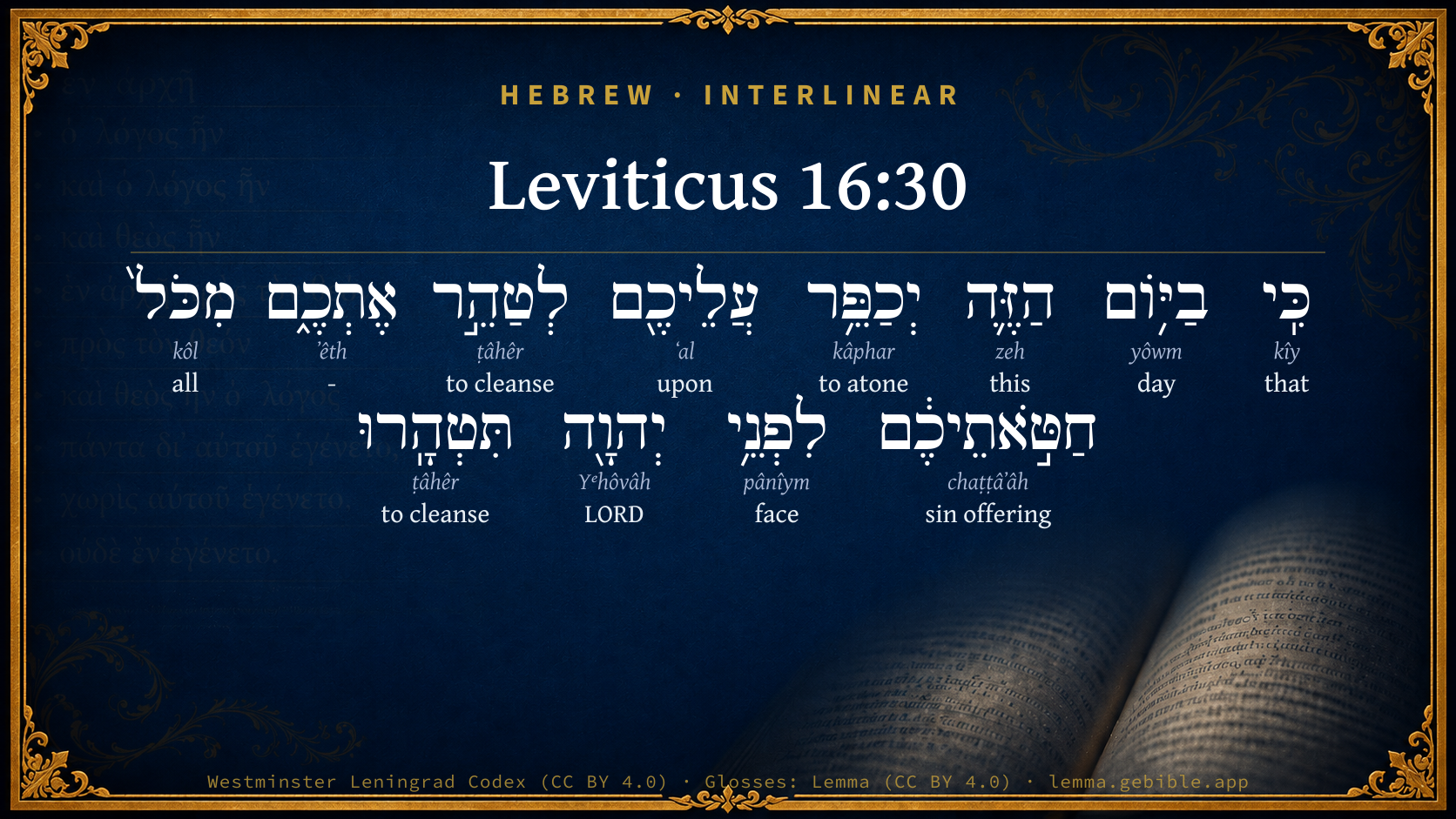
Leviticus 16:30

Hebrew (Westminster Leningrad Codex) Leviticus 16:30 appears in the Hebrew Old Testament. The text above is from the Westminster Leningrad Codex. Each word links to its Strong’s number, a concise gloss, and parsing drawn from the Open Scriptures Hebrew Bible morphology. Click any word for its full Brown-Driver-Briggs (BDB) entry.
Download image
Cite this verse

Leviticus 16:30 (World English Bible). Public Domain. Lemma interlinear Bible study tool, https://lemma.gebible.app/v/leviticus/16/30.

Show BibTeX & RIS
BibTeX
RIS
English Translation
for on this day shall atonement be made for you, to cleanse you; from all your sins you shall be clean before Yahweh.
World English Bible · Public Domain
Download a study sheet

One document with this verse’s original text, its word-by-word gloss line, the meaning frame, cross-references with their text, attributed commentary, and full source and license credits — printable, and it pastes into notes with its structure intact.

This verse Autodidact and up

Study sheet (.html) Plain text (.txt)

A passage Seminary Student

Up to 50 verses in one chapter. A passage sheet keeps up to 6 commentary sources and 12 cross-references per verse, in the order this page ranks them, and says so on the sheet whenever that leaves anything out. Ask for a single verse and you get the Autodidact verse sheet above.

Everything on this page stays free to read, with no account — the sheet is a download of what is already on screen, not access to it.

Want to remove ads? Support Godless Engineer
Compare translations 3

The same verse in 3 English versions, stacked beneath the original-language interlinear above. Click any original word for its lexicon entry.

Each is an independent rendering of the whole verse — the interlinear is not word-aligned to these translations.

Highlighted words mark where these versions differ — a whole-verse word diff, not a word-by-word alignment.

  • World English Bible Public Domain
    for on this day shall atonement be made for you, to cleanse you; from all your sins you shall be clean before Yahweh.
  • King James Version Public Domain
    For on that day shall the priest make an atonement for you, to cleanse you, that ye may be clean from all your sins before the LORD.
  • unfoldingWord Literal Text CC BY-SA 4.0
    for on this day, he will make atonement for you to cleanse you from all your sins; to the face of Yahweh, you will be clean.

unfoldingWord Literal Text — © unfoldingWord, licensed CC BY-SA 4.0. Word-aligned USFM3 via Door43 (git.door43.org/unfoldingWord/en_ult).

Versions to compare (up to 4)

3 of 4 selected

Show all 18 translations

Every available English version of this verse, each an independent rendering of the whole verse.

  • World English Bible Public Domain
    for on this day shall atonement be made for you, to cleanse you; from all your sins you shall be clean before Yahweh.
  • Berean Standard Bible Public Domain
    because on this day atonement will be made for you to cleanse you, and you will be clean from all your sins before the LORD.
  • Majority Standard Bible Public Domain
    because on this day atonement will be made for you to cleanse you, and you will be clean from all your sins before the LORD.
  • King James Version Public Domain
    For on that day shall the priest make an atonement for you, to cleanse you, that ye may be clean from all your sins before the LORD.
  • American Standard Version (1901) Public Domain
    for on this day shall atonement be made for you, to cleanse you; from all your sins shall ye be clean before Jehovah.
  • Revised Version (1885) Public Domain
    for on this day shall atonement be made for you, to cleanse you; from all your sins shall ye be clean before the LORD.
  • Geneva Bible (1599) Public Domain
    For that day shall ye Priest make an atonement for you to clense you: ye shalbe cleane from all your sinnes before the Lord.
  • Douay-Rheims (1899) Public Domain
    Upon this day shall be the expiation for you, and the cleansing from all your sins: you shall be cleansed before the Lord.
  • Young's Literal Translation Public Domain
    for on this day he maketh atonement for you, to cleanse you; from all your sins before Jehovah ye are clean;
  • Literal Standard Version CC BY-SA 4.0
    for on this day he makes atonement for you, to cleanse you; you are clean from all your sins before YHWH;
  • Unlocked Literal Bible CC BY-SA 4.0
    This is because on this day atonement will be made for you, to cleanse you from all your sins so you will be clean before Yahweh.
  • unfoldingWord Literal Text CC BY-SA 4.0
    for on this day, he will make atonement for you to cleanse you from all your sins; to the face of Yahweh, you will be clean.
  • Darby Bible Public Domain
    for on that day shall atonement be made for you, to cleanse you: from all your sins shall ye be clean before Jehovah.
  • World Messianic Bible Public Domain
    for on this day shall atonement be made for you, to cleanse you. You shall be clean from all your sins before the LORD.
  • Webster's Bible Public Domain
    For on that day shall the priest make an atonement for you, to cleanse you, that ye may be clean from all your sins before the LORD.
  • Free Bible Version CC BY-SA 4.0
    for on this day the process of making you right will be done, to make you clean from all your sins, clean before the Lord.
  • Bible in Basic English Public Domain
    For on this day your sin will be taken away and you will be clean: you will be made free from all your sins before the Lord.
  • JPS Tanakh (1917) Public Domain
    For on this day shall atonement be made for you, to cleanse you; from all your sins shall ye be clean before the LORD.

Literal Standard Version (2020), Covenant Press — licensed CC BY-SA 4.0. Text via the HelloAO Bible API (eBible.org). Unlocked Literal Bible (unfoldingWord) — licensed CC BY-SA 4.0. Text via the HelloAO Bible API (eBible.org). unfoldingWord Literal Text — © unfoldingWord, licensed CC BY-SA 4.0. Word-aligned USFM3 via Door43 (git.door43.org/unfoldingWord/en_ult). Free Bible Version, Dr. Jonathan Gallagher — licensed CC BY-SA 4.0. Text via the HelloAO Bible API (eBible.org).

Word by word

More ways to search: Search by grammar → Find every occurrence → Compare this word →

Practice this passage: Drill this verse → Learn its vocabulary →

לְטַהֵ֣ר
ṭâhêr
H2891
“to cleanse”
Preposition + Verb, Piel, Infinitive Construct
Part of Speech
Preposition + Verb
Stem
Piel
Form
Infinitive Construct
Full BDB Definition

Origin: a primitive root

TWOT: 792

to be clean, be pure - (Qal) - to be clean (physically - of disease) - to be clean ceremonially - to purify, be clean morally, made clean - (Piel) - to cleanse, purify - physically - ceremonially - morally - to pronounce clean - to perform the ceremony of cleansing - (Pual) to be cleansed, be pronounced clean - (Hithpael) - to purify oneself - ceremonially - morally - to present oneself for purification
  1. כִּֽי kîy H3588 “that” Conjunction
  2. בַיּ֥וֹם yôwm H3117 “in/at the · day” Preposition, Determined + Noun, Common, Masculine, Singular, Absolute
  3. הַזֶּ֛ה zeh H2088 “the · this” Particle, Definite Article + Pronoun, Demonstrative, Masculine, Singular
  4. יְכַפֵּ֥ר kâphar H3722 “to atone” Verb, Piel, Imperfect, 3rd Person, Masculine, Singular
  5. עֲלֵיכֶ֖ם ʻal H5921 “upon · you” Preposition + Suffix, Personal, 2nd Person, Masculine, Plural
  6. אֶתְכֶ֑ם ʼêth H853 “- · you” Particle, Direct Object + Suffix, Personal, 2nd Person, Masculine, Plural
  7. מִכֹּל֙ kôl H3605 “from · all of” Preposition + Noun, Common, Masculine, Singular, Construct
  8. חַטֹּ֣אתֵיכֶ֔ם chaṭṭâʼâh H2403 “sin offerings · your” Noun, Common, Feminine, Plural, Construct + Suffix, Personal, 2nd Person, Masculine, Plural
  9. לִפְנֵ֥י pânîym H6440 “to/for · face(s) of” Preposition + Noun, Common, Both, Plural, Construct
  10. יְהוָ֖ה Yᵉhôvâh H3068 “LORD” Noun, Proper
  11. תִּטְהָֽרוּ ṭâhêr H2891 “to cleanse” Verb, Qal, Imperfect, 2nd Person, Masculine, Plural

About this verse

These counts appear in no published source. They are computed here, from the morphology-tagged text and Lemma’s own curated glosses. What Lemma adds →

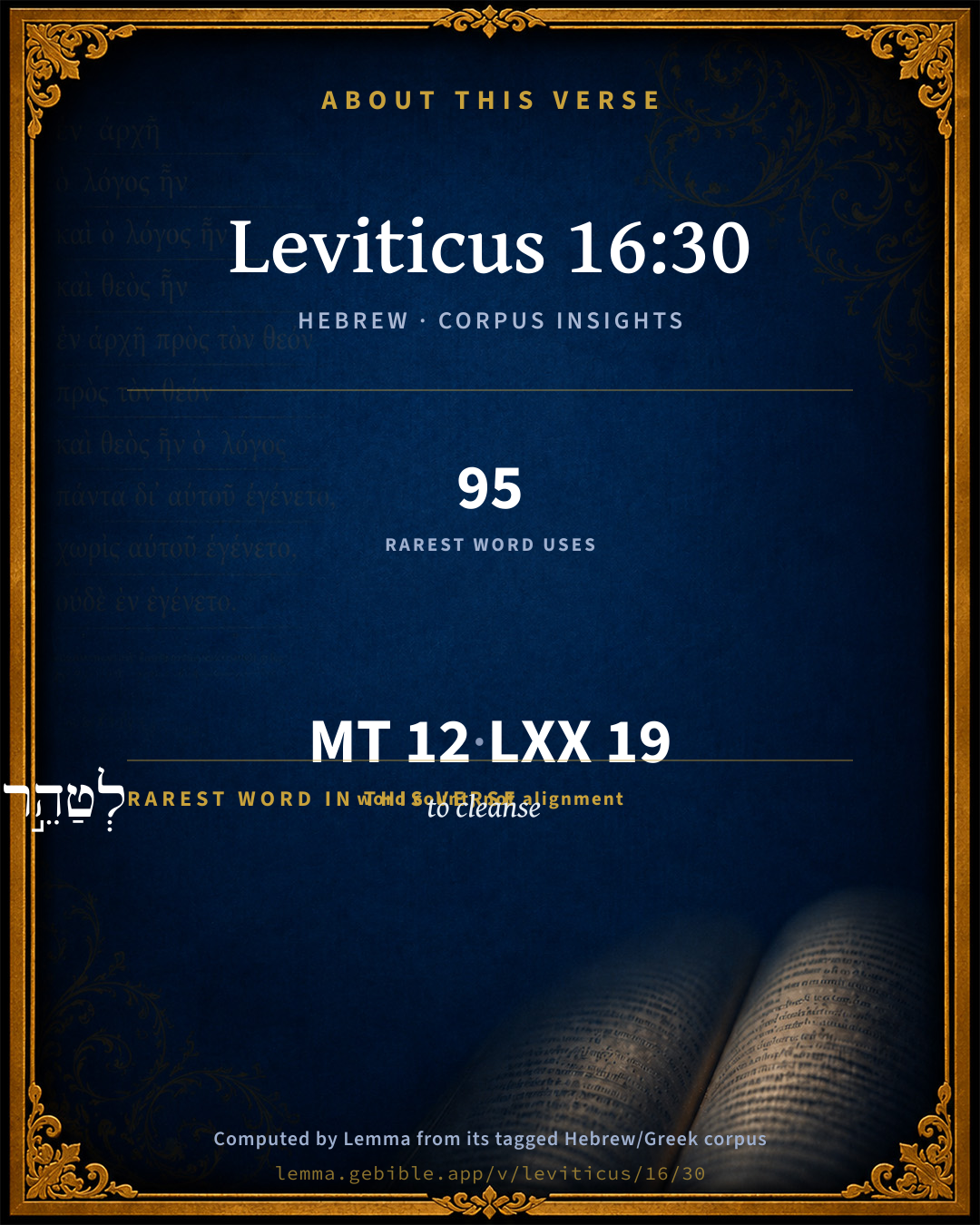
12
words
11
distinct lemmas
Pentateuch
section

Grammatical profile

  • 3 verbs
  • 5 nouns
  • 1 pronoun
  • 1 preposition
  • 1 conjunction
  • 1 particle

Verb forms

  • יְכַפֵּ֥ר Piel · Imperfect
  • לְטַהֵ֣ר Piel · Infinitive Construct
  • תִּטְהָֽרוּ Qal · Imperfect

Repetition

A word recurs within this verse — often emphatic in Hebrew:

  • לְטַהֵ֣ר to cleanse H2891 ×2

Hebrew & Septuagint length

In English translation the verse runs 23 words from the Hebrew and 26 from the Septuagint (LXX English) — closely comparable.

A rough comparison of the two English renderings, which tokenize alike — not a word-level alignment.

Word counts can differ between the Hebrew and the Greek without any difference in meaning — e.g. the Hebrew direct-object marker אֵת has no separate Greek word, and Greek often adds the article ὁ.

In the original languages it is 12 Hebrew tokens and 19 Greek tokens — but the two are counted differently (Hebrew bundles its prefixes and suffixes into one token; the Greek is in lemma form), so that isn’t a like-for-like length.

Cross-references

10

Topical passages linked to Leviticus 16:30 in the Treasury of Scripture Knowledge — connected by theme and wording, ordered by reader-vote popularity; previews shown in the World English Bible.

  • Jeremiah 33:8 I will cleanse them from all their iniquity, by which they have sinned against me; and I will pardon all their iniquities, by which they have sinned against me, and by which they have transgressed against me.
  • Psalms 51:2 Wash me thoroughly from my iniquity. Cleanse me from my sin.
  • Ephesians 5:26 that he might sanctify it, having cleansed it by the washing of water with the word,
  • Hebrews 10:1–2 For the law, having a shadow of the good to come, not the very image of the things, can never with the same sacrifices year by year, which they offer continually, make perfect those who draw near.
  • 1 John 1:7–9 But if we walk in the light, as he is in the light, we have fellowship with one another, and the blood of Jesus Christ, his Son, cleanses us from all sin.
  • Psalms 51:7 Purify me with hyssop, and I will be clean. Wash me, and I will be whiter than snow.
  • Psalms 51:10 Create in me a clean heart, O God. Renew a right spirit within me.
  • Ezekiel 36:25–27 I will sprinkle clean water on you, and you shall be clean: from all your filthiness, and from all your idols, will I cleanse you.
  • Titus 2:14 who gave himself for us, that he might redeem us from all iniquity, and purify for himself a people for his own possession, zealous for good works.
  • Hebrews 9:13–14 For if the blood of goats and bulls, and the ashes of a heifer sprinkling those who have been defiled, sanctify to the cleanness of the flesh:

Cross-references courtesy of OpenBible.info (CC BY 4.0).

Hebrew and Greek witnesses Masoretic Hebrew ↔ Greek Septuagint

The same verse in the two great witnesses to the Old Testament, shown verse-for-verse.

These are two independent witnesses, not word-aligned to each other, and the Septuagint is shown in lemma (dictionary) form.

Hebrew Leviticus 16:30 Masoretic · Westminster Leningrad Codex

כִּֽי בַיּ֥וֹם הַזֶּ֛ה יְכַפֵּ֥ר עֲלֵיכֶ֖ם לְטַהֵ֣ר אֶתְכֶ֑ם מִכֹּל֙ חַטֹּ֣אתֵיכֶ֔ם לִפְנֵ֥י יְהוָ֖ה תִּטְהָֽרוּ

for on this day shall atonement be made for you, to cleanse you; from all your sins you shall be clean before Yahweh.

World English Bible · Public Domain

Greek LXX Leviticus 16:30 Septuagint · lemma form

ἐν γάρ ὁ ἡμέρα οὗτος ἐκἱλάσκομαι περί σύ καθαρίζω σύ ἀπό πᾶς ὁ ἁμαρτία σύ ἔναντι κύριος καί καθαρίζω

For in this day he shall make an atonement for you, to cleanse you from all your sins before the Lord, and you⌃ shall be purged.

LXX2012 (modern English Septuagint) · Public Domain

Hebrew: Westminster Leningrad Codex (CC BY 4.0). Greek: Septuagint (public domain); English from LXX2012 (modern English Septuagint) (Public Domain). How the Septuagint differs from the Hebrew →

Targum (Aramaic paraphrase)

2

The Targum is the ancient Jewish Aramaic paraphrase of the Hebrew Scriptures — an interpretive translation, not the Hebrew text itself. Onkelos (literal) and Pseudo-Jonathan (expansive) render the Torah, and Jonathan the Prophets. Coverage is partial: where no permissively-licensed English translation exists for a verse, only the Aramaic is shown. This is verse-level text, not a word-by-word alignment to the Hebrew.

  1. Targum Onkelos Torah (Genesis–Deuteronomy)
    אֲרֵי בְיוֹמָא הָדֵין יְכַפֵּר עֲלֵיכוֹן לְדַכָּאָה יָתְכוֹן מִכָּל חוֹבֵיכוֹן קֳדָם יְיָ תִּדְכּוּן

    (no public-domain English translation for this verse)

    Targum Onkelos — Aramaic: “Onkelos Genesis” (public domain); “Onkelos Exodus” (public domain); “Onkelos Leviticus” (public domain); “Onkelos Numbers” (public domain); “Onkelos Deuteronomy” (public domain). English: “Sefaria Community Translation” (CC0 1.0 (public-domain dedication)); “J.W. Etheridge. The Targums of Onkelos and Jonathan Ben Uzziel on the Pentateuch. London: Longmans, Green, 1862” (public domain). Text via Sefaria.

  2. Targum Pseudo-Jonathan Torah (Genesis–Deuteronomy)
    אֲרוּם בְּיוֹמָא הָדֵין יְכַפֵּר עֲלֵיכוֹן לְדַכָּאָה יַתְכוֹן מִכָּל חוֹבֵיכוֹן וְאַתּוּן קֳדָם יְיָ תּוֹדוּן סוּרְחָנוּתְכוֹן וְתִידְכּוּן

    For on this day be shall make ATONEMENT for you to cleanse you from all your sins; and you shall confess your transgressions before the Lord, and shall be clean.

    Targum Pseudo-Jonathan — Aramaic: “Targum Jonathan on Genesis” (public domain); “Targum Jonathan on Exodus” (public domain); “Targum Jonathan on Leviticus” (public domain); “Targum Jonathan on Numbers” (public domain); “Targum Jonathan on Deuteronomy” (public domain). English: “The Targum of Jonathan ben Uzziel, trans. J. W. Etheridge, London, 1862” (public domain). Text via Sefaria.

Commentary

Notes on Leviticus 16:30 from classic Christian and Jewish commentators (each source and its license shown beneath its notes). The classic Christian expositions comment on the surrounding passage and are grouped to its opening verse, so a note may address several verses; the Jewish commentaries on the Tanakh (Rashi and others) are per-verse, so they appear only where the commentator wrote on this verse.

Lemma curates 59 commentaries, every one of them public domain or Creative Commons licensed, each selected and text-cleaned for this edition rather than reprinted as found. About our sources →

Trapp's Complete Commentary

John Trapp

Lev 16:30 For on that day shall [the priest] make an atonement for you, to cleanse you, [that] ye may be clean from all your sins before the LORD.

Ver. 30. That ye may be clean from all your sins.] And so God may turn your fasting into feasting, as Zec 8:19. The joyful jubilee was begun and proclaimed in this same tenth day. {Lev 25:8-9}

John Trapp, A Commentary or Exposition upon All the Books of the Old and New Testament (1647–1656) — public domain. Text from a community e-Sword module.

Ellicott's Commentary for English Readers

(30) For on that day shall the priest make an atonement.—Literally, For on that day he shall make atonement for you, which may either be the Lord, who is mentioned in the next clause, or, more probably, the high priest, who is mentioned five verses before. (See Lev_16:25, and especially Lev_16:32.)

That ye may be clean . . . —Better, you shall be clean, &c. Because it is here said “you shall be clean from all your sins before the Lord,” the administrators of the law in the time of Christ declared that only the sins which a man commits before, i.e., against the Lord, are atoned for on the Day of Atonement, but the sins which man commits against his fellow man are not forgiven on this day unless we have first satisfied our injured neighbour, and have obtained pardon from him. Again, he who sinneth in the hope that he will obtain absolution on the Day of Atonement, for him there is no forgiveness on this day.

A Bible Commentary for English Readers, edited by Charles John Ellicott (1878–1897) — public domain. Text from a community e-Sword module.

John Gill's Exposition

It shall be a sabbath of rest unto you,.... From all servile work, as before observed; typical of a cessation from the performance of sinful works, at least from a sinful course of life, and from a dependence on works of righteousness, when a man is brought to believe in Christ, and in the atonement which he has made, see Heb 4:3,

and ye shall afflict your souls by a statute for ever: as long as the ceremonial law, and its statutes and ordinances lasted, which were to be until the time of reformation; and till that time came, once a year, on the day of atonement, they were to keep a severe fast, here called an afflicting of their souls; and in this respect this day differed from the seventh day sabbath, which was rather a festival than a fast, and is what led some of the Heathen writers (z) into that this take, that the Jews fasted on the sabbath day. The time of Christ's sufferings, and of his being a sacrifice for the sins of his people, was a time of great affliction to his disciples; then it was the children of the bridegroom fasted, he being taken from them; and true humiliation for sin, and repentance of it, are occasioned and influenced by a view of a suffering Saviour, and atonement by him; and this may denote also, that such that believe in Christ, and in his atonement, must expect afflictions and troubles in this world,

(z) Martial. l. 4. Epigram. 4. Justin. e Trogo, l. 36. Suetonius in Vita Octav. Aug. c. 76.

John Gill's Exposition of the Whole Bible (1746–1763) — public domain (CC PDM 1.0). Text via the HelloAO Bible API.

Whedon's Commentary on the Bible

Daniel D. Whedon

30. To cleanse you — This cleansing was, 1.) a restoration of the worshipper to membership and communion with the congregation of Israel; and, 2.) the pretermission or Old Testament forgiveness of sins to the penitent believer in the divine promises. For we cannot admit that there was in the Jewish sacraments an operation of grace propria virtute, that is, by themselves alone, irrespective of the spiritual state of the worshipper. “The perfection of the worshippers is the complete restoration of their peace with God; and this only can be attained by the complete removal of the barrier formed by sin, by making them in the fullest sense cleansed.

Had this ever really been once effected for the congregation of Israel by the annual sacrifices of the day of atonement, no need would have been felt for a repetition of them. But this was not so.” — Delitzsch on Heb_10:2. See Introduction, (7.)

Daniel D. Whedon (gen. ed.), Commentary on the Old and New Testaments (1874–1909) — public domain. Text from a community e-Sword module.

Lesson kit

Teaching starters — assembled from the data on this page, not authored interpretation. Every prompt links to the verse data it draws on. Edit before teaching.

Leviticus, in the Pentateuch, opens this verse with 12 words (11 distinct Hebrew lemmas). Its most distinctive word is ṭâhêr (“to cleanse”). A historical commentator’s framing appears above. Read the whole chapter for the surrounding context.

Discussion questions

  1. The word ṭâhêr carries the sense “to cleanse.” How does it shape the verse?
  2. Jeremiah 33:8 shares this passage’s theme. How do the two illuminate each other?
  3. “to cleanse” occurs 2× in this one verse. What is the effect of the repetition?
  4. These translations render this verse differently; the difference is in the English rendering, not the original. What questions does that raise?
  5. The verb «יְכַפֵּ֥ר» is Piel Imperfect. How does its form color the action?
  6. Reading how Trapp's Complete Commentary and Ellicott's Commentary for English Readers read this verse, where do the two commentators agree and where do they part?

Things to notice

Reading settings

Reading text

Shown beneath each verse's original-language words.

Old Testament
Old Testament edition

Read the OT as the Masoretic Hebrew (MT) or the Greek Septuagint (LXX).

English shown for the Greek Septuagint (in the Hebrew ↔ Greek comparison).

Comparing translations? Open the Compare panel on any verse page to stack up to four side by side.