
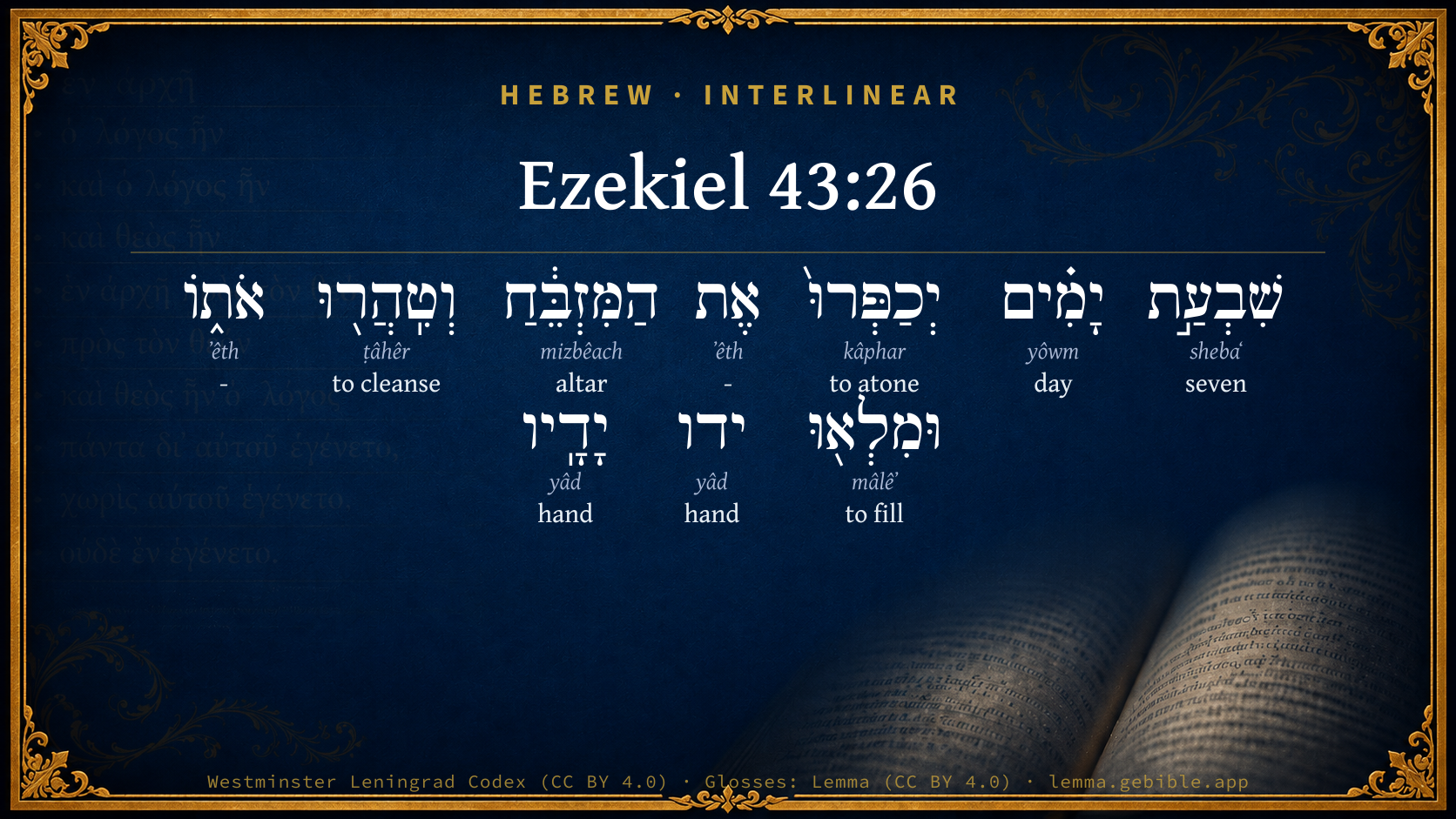
Ezekiel 43:26

Hebrew (Westminster Leningrad Codex) Ezekiel 43:26 appears in the Hebrew Old Testament. The text above is from the Westminster Leningrad Codex. Each word links to its Strong’s number, a concise gloss, and parsing drawn from the Open Scriptures Hebrew Bible morphology. Click any word for its full Brown-Driver-Briggs (BDB) entry.
Download image
Cite this verse

Ezekiel 43:26 (World English Bible). Public Domain. Lemma interlinear Bible study tool, https://lemma.gebible.app/v/ezekiel/43/26.

Show BibTeX & RIS
BibTeX
RIS
English Translation
Seven days shall they make atonement for the altar and purify it; so shall they consecrate it.
World English Bible · Public Domain
Download a study sheet

One document with this verse’s original text, its word-by-word gloss line, the meaning frame, cross-references with their text, attributed commentary, and full source and license credits — printable, and it pastes into notes with its structure intact.

This verse Autodidact and up

Study sheet (.html) Plain text (.txt)

A passage Seminary Student

Up to 50 verses in one chapter. A passage sheet keeps up to 6 commentary sources and 12 cross-references per verse, in the order this page ranks them, and says so on the sheet whenever that leaves anything out. Ask for a single verse and you get the Autodidact verse sheet above.

Everything on this page stays free to read, with no account — the sheet is a download of what is already on screen, not access to it.

Want to remove ads? Support Godless Engineer
Compare translations 3

The same verse in 3 English versions, stacked beneath the original-language interlinear above. Click any original word for its lexicon entry.

Each is an independent rendering of the whole verse — the interlinear is not word-aligned to these translations.

Highlighted words mark where these versions differ — a whole-verse word diff, not a word-by-word alignment.

  • World English Bible Public Domain
    Seven days shall they make atonement for the altar and purify it; so shall they consecrate it.
  • King James Version Public Domain
    Seven days shall they purge the altar and purify it; and they shall consecrate themselves.
  • unfoldingWord Literal Text CC BY-SA 4.0
    They must atone for the altar for seven days and purify it, and in this way they must consecrate it.

unfoldingWord Literal Text — © unfoldingWord, licensed CC BY-SA 4.0. Word-aligned USFM3 via Door43 (git.door43.org/unfoldingWord/en_ult).

Versions to compare (up to 4)

3 of 4 selected

Show all 18 translations

Every available English version of this verse, each an independent rendering of the whole verse.

  • World English Bible Public Domain
    Seven days shall they make atonement for the altar and purify it; so shall they consecrate it.
  • Berean Standard Bible Public Domain
    For seven days the priests are to make atonement for the altar and cleanse it; so they shall consecrate it.
  • Majority Standard Bible Public Domain
    For seven days the priests are to make atonement for the altar and cleanse it; so they shall consecrate it.
  • King James Version Public Domain
    Seven days shall they purge the altar and purify it; and they shall consecrate themselves.
  • American Standard Version (1901) Public Domain
    Seven days shall they make atonement for the altar and purify it; so shall they consecrate it.
  • Revised Version (1885) Public Domain
    Seven days shall they make atonement for the altar and purify it; so shall they consecrate it.
  • Geneva Bible (1599) Public Domain
    Thus shall they seuen dayes purifie the altar, and clense it, and consecrate it.
  • Douay-Rheims (1899) Public Domain
    Seven days shalt thou offer a he goat for sill daily: they shall offer also a calf of the herd, and a ram of the flock without blemish.
  • Young's Literal Translation Public Domain
    Seven days they purify the altar, and have cleansed it, and filled their hand.
  • Literal Standard Version CC BY-SA 4.0
    [For] seven days they purify the altar, and have cleansed it, and filled their hand.
  • Unlocked Literal Bible CC BY-SA 4.0
    They must atone for the altar for seven days and purify it, and in this way they must consecrate it.
  • unfoldingWord Literal Text CC BY-SA 4.0
    They must atone for the altar for seven days and purify it, and in this way they must consecrate it.
  • Darby Bible Public Domain
    Seven days shall they make atonement for the altar and purify it, and consecrate it.
  • World Messianic Bible Public Domain
    Seven days shall they make atonement for the altar and purify it. So shall they consecrate it.
  • Webster's Bible Public Domain
    Seven days shall they purge the altar and purify it; and they shall consecrate themselves.
  • Free Bible Version CC BY-SA 4.0
    For seven days the priests are to set the altar right and purify it. This is how they will dedicate it.
  • Bible in Basic English Public Domain
    For seven days they are to make offerings to take away sin from the altar and to make it clean; so they are to make it holy.
  • JPS Tanakh (1917) Public Domain
    Seven days shall they make atonement for the altar and cleanse it; so shall they consecrate it.

Literal Standard Version (2020), Covenant Press — licensed CC BY-SA 4.0. Text via the HelloAO Bible API (eBible.org). Unlocked Literal Bible (unfoldingWord) — licensed CC BY-SA 4.0. Text via the HelloAO Bible API (eBible.org). unfoldingWord Literal Text — © unfoldingWord, licensed CC BY-SA 4.0. Word-aligned USFM3 via Door43 (git.door43.org/unfoldingWord/en_ult). Free Bible Version, Dr. Jonathan Gallagher — licensed CC BY-SA 4.0. Text via the HelloAO Bible API (eBible.org).

Word by word

More ways to search: Search by grammar → Find every occurrence → Compare this word →

Practice this passage: Drill this verse → Learn its vocabulary →

וְטִֽהֲר֖וּ
ṭâhêr
H2891
“and · to cleanse”
Conjunction + Verb, Piel, Sequential Perfect, 3rd Person, Common, Plural
Part of Speech
Conjunction + Verb
Stem
Piel
Form
Sequential Perfect
Person
3rd Person
Gender
Common
Number
Plural
Full BDB Definition

Origin: a primitive root

TWOT: 792

to be clean, be pure - (Qal) - to be clean (physically - of disease) - to be clean ceremonially - to purify, be clean morally, made clean - (Piel) - to cleanse, purify - physically - ceremonially - morally - to pronounce clean - to perform the ceremony of cleansing - (Pual) to be cleansed, be pronounced clean - (Hithpael) - to purify oneself - ceremonially - morally - to present oneself for purification
  1. שִׁבְעַ֣ת shebaʻ H7651 “seven” Adjective, Cardinal number, Masculine, Singular, Construct
  2. יָמִ֗ים yôwm H3117 “days” Noun, Common, Masculine, Plural, Absolute
  3. יְכַפְּרוּ֙ kâphar H3722 “to atone” Verb, Piel, Imperfect, 3rd Person, Masculine, Plural
  4. אֶת ʼêth H853 “-” Particle, Direct Object
  5. הַמִּזְבֵּ֔חַ mizbêach H4196 “the · altar” Particle, Definite Article + Noun, Common, Masculine, Singular, Absolute
  6. אֹת֑וֹ ʼêth H853 “- · him” Particle, Direct Object + Suffix, Personal, 3rd Person, Masculine, Singular
  7. וּמִלְא֖וּ mâlêʼ H4390 “and · to fill” Conjunction + Verb, Piel, Sequential Perfect, 3rd Person, Common, Plural
  8. ידו yâd H3027 “hand · his” Noun, Common, Both, Singular, Construct + Suffix, Personal, 3rd Person, Masculine, Singular
  9. יָדָֽיו yâd H3027 “hand · his” Noun, Common, Both, Singular, Construct + Suffix, Personal, 3rd Person, Masculine, Singular

About this verse

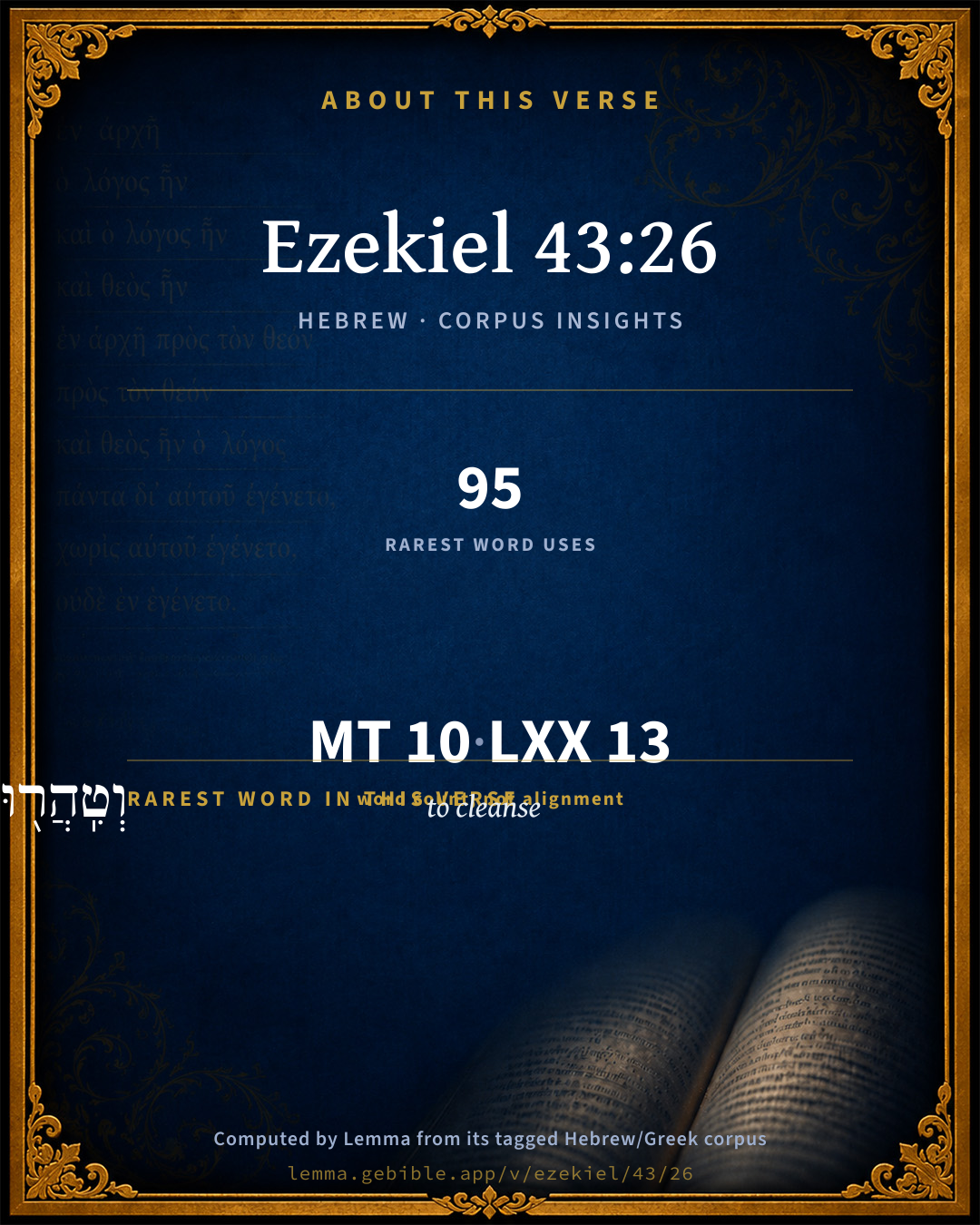
These counts appear in no published source. They are computed here, from the morphology-tagged text and Lemma’s own curated glosses. What Lemma adds →

10
words
8
distinct lemmas
Prophets
section

Grammatical profile

  • 3 verbs
  • 4 nouns
  • 1 adjective
  • 2 particles

Verb forms

  • יְכַפְּרוּ֙ Piel · Imperfect
  • וְטִֽהֲר֖וּ Piel · Sequential Perfect
  • וּמִלְא֖וּ Piel · Sequential Perfect

Repetition

A word recurs within this verse — often emphatic in Hebrew:

Hebrew & Septuagint length

In English translation the verse runs 17 words from the Hebrew and 17 from the Septuagint (LXX English) — the same length.

A rough comparison of the two English renderings, which tokenize alike — not a word-level alignment.

Word counts can differ between the Hebrew and the Greek without any difference in meaning — e.g. the Hebrew direct-object marker אֵת has no separate Greek word, and Greek often adds the article ὁ.

In the original languages it is 10 Hebrew tokens and 13 Greek tokens — but the two are counted differently (Hebrew bundles its prefixes and suffixes into one token; the Greek is in lemma form), so that isn’t a like-for-like length.

Cross-references

3

Topical passages linked to Ezekiel 43:26 in the Treasury of Scripture Knowledge — connected by theme and wording, ordered by reader-vote popularity; previews shown in the World English Bible.

  • Exodus 29:24 You shall put all of this in Aaron's hands, and in his sons' hands, and shall wave them for a wave-offering before Yahweh.
  • Exodus 32:29 Moses said, "Consecrate yourselves today to Yahweh, yes, every man against his son, and against his brother; that he may bestow on you a blessing this day."
  • Leviticus 8:34 What has been done this day, so Yahweh has commanded to do, to make atonement for you.

Cross-references courtesy of OpenBible.info (CC BY 4.0).

Hebrew and Greek witnesses Masoretic Hebrew ↔ Greek Septuagint

The same verse in the two great witnesses to the Old Testament, shown verse-for-verse.

These are two independent witnesses, not word-aligned to each other, and the Septuagint is shown in lemma (dictionary) form.

Hebrew Ezekiel 43:26 Masoretic · Westminster Leningrad Codex

שִׁבְעַ֣ת יָמִ֗ים יְכַפְּרוּ֙ אֶת הַמִּזְבֵּ֔חַ וְטִֽהֲר֖וּ אֹת֑וֹ וּמִלְא֖וּ ידו יָדָֽיו

Seven days shall they make atonement for the altar and purify it; so shall they consecrate it.

World English Bible · Public Domain

Greek LXX Ezekiel 43:26 Septuagint · lemma form

ἑπτά ἡμέρα καί ἐκἱλάσκομαι ὁ θυσιαστήριον καί καθαρίζω αὐτός καί πίμπλημι χείρ αὐτός

and they shall make atonement for the altar, and shall purge it; and they shall consecrate themselves.

LXX2012 (modern English Septuagint) · Public Domain

On this verse, Haydock's Catholic Bible Commentary discusses the Septuagint’s reading. Read the note in Commentary ↓

Hebrew: Westminster Leningrad Codex (CC BY 4.0). Greek: Septuagint (public domain); English from LXX2012 (modern English Septuagint) (Public Domain). How the Septuagint differs from the Hebrew →

Targum (Aramaic paraphrase)

1

The Targum is the ancient Jewish Aramaic paraphrase of the Hebrew Scriptures — an interpretive translation, not the Hebrew text itself. Onkelos (literal) and Pseudo-Jonathan (expansive) render the Torah, and Jonathan the Prophets. Coverage is partial: where no permissively-licensed English translation exists for a verse, only the Aramaic is shown. This is verse-level text, not a word-by-word alignment to the Hebrew.

  1. Targum Jonathan Prophets (Joshua–Malachi)
    שַׁבְעָה יוֹמִין יְכַפְּרוּן עַל מַדְבְּחָא וְיִדְכּוּן יָתֵיהּ וְיַקְרִיבוּן קוּרְבָּנֵיהּ:

    (no public-domain English translation for this verse)

    Targum Jonathan — Aramaic: “Mikraot Gedolot” (public domain). English: “Sefaria Community Translation” (CC0 1.0 (public-domain dedication)); “London "Chaldee Paraphrase," 1871” (public domain). Text via Sefaria.

Commentary

Notes on Ezekiel 43:26 from classic Christian and Jewish commentators (each source and its license shown beneath its notes). The classic Christian expositions comment on the surrounding passage and are grouped to its opening verse, so a note may address several verses; the Jewish commentaries on the Tanakh (Rashi and others) are per-verse, so they appear only where the commentator wrote on this verse.

Lemma curates 59 commentaries, every one of them public domain or Creative Commons licensed, each selected and text-cleaned for this edition rather than reprinted as found. About our sources →

Trapp's Complete Commentary

John Trapp

Eze 43:26 Seven days shall they purge the altar and purify it; and they shall consecrate themselves.

Ver. 26. They shall purge.] Thou and they together. We must also sanctify the Lord God in our hearts. {1Pe 3:15}

John Trapp, A Commentary or Exposition upon All the Books of the Old and New Testament (1647–1656) — public domain. Text from a community e-Sword module.

Tyndale Open Study Notes

Tyndale Open Resources

43:26-27 These sin offerings properly set the Temple apart for holy use, so that the priests could once again sacrifice . . . the burnt offerings and peace offerings of the people. These offerings were necessary if the Lord were to accept his people.

Tyndale Open Study Notes — © Tyndale Open Resources, licensed CC BY-SA 4.0. Text via the HelloAO Bible API.

Geneva Bible (1599)

Geneva Bible translators

Hebrew, fill his hand.

Geneva Bible (1599) marginal notes — public domain. Text via Bolls.life.

Jamieson, Fausset & Brown

Robert Jamieson, A. R. Fausset & David Brown

Seven days--referring to the original directions of Moses for seven days' purification services of the altar (Exo 29:37).

consecrate themselves--literally, "fill their hands," namely, with offerings; referring to the mode of consecrating a priest (Exo 29:24, Exo 29:35).

Jamieson, Fausset & Brown — Commentary Critical and Explanatory on the Whole Bible (1871) — public domain (CC PDM 1.0). Text via the HelloAO Bible API.

Ellicott's Commentary for English Readers

(26) Shall consecrate themselves.—Our version has here followed the Masoretic emendation of the text; the literal translation of the text itself is, shall fill its hand, referring to the altar. To “fill the hand” is a synonym for consecration, commonly applied to the priests, who were consecrated by placing in their hands the gifts they were to offer to God. Here it is better to keep to the text as it stands, “filling the hand of the altar” being a strong figurative expression to denote that it shall always be supplied with sacrificial gifts. Nothing is said throughout the passage of the consecration of the priests, the whole family of Aaron having been consecrated once for all by the ceremonies of Leviticus 8.

A Bible Commentary for English Readers, edited by Charles John Ellicott (1878–1897) — public domain. Text from a community e-Sword module.

The Cambridge Bible for Schools and Colleges

gen. ed. J. J. S. Perowne

26. The ceremonial of consecrating the altar lasts seven days. On to “purge” cf. Eze_43:20.

consecrate themselves] consecrate it, i.e. the altar, lit. fill its hand (or, hands). The phrase is properly said of the priests, to install; here of the altar, to inaugurate it. Originally the expression had probably a literal meaning, to put the things to be offered into the hands of the priests (Lev_8:25 seq.), but later it came to be used generally in the sense of initiate, consecrate (Exo_28:41; Exo_29:9; Exo_29:29; Exo_29:33; Exo_29:35; Lev_7:37; Num_3:3; Jdg_17:5; Jdg_17:12), cf. Exo_32:29. Wellh. Hist. p. 152, argues that the priest’s hand was originally “filled” with money (Judges 17). The phrase “fill the hand” of one appears also in the general meaning “to invest with office” in Assyrian; Fd. Del. Heb. Lang. p. 20, Prolegomena, p. 48.

In all the above passage it is the altar not the priests that is consecrated. The consecration of the altar appears to carry with it that of the whole sanctuary. The altar needs atonement not because it is a work of human hands, but because it belongs to the things of the world. The sin of the world has defiled all things, penetrating even to the precincts of that where Jehovah abides as he is in himself (Heb_9:23). The passage can scarcely be compared with Exodus 29 and Leviticus 8 because there the ceremonies refer to the consecration of the priests chiefly and little to the altar. Cf. Exo_29:36; Lev_8:11; Lev_8:15; Lev_8:33. In these passages the altar is said to have been anointed with oil, a ceremony wanting in Ezek.; the sin-offering was a young bullock each day and the burnt—offering simply a ram each day.

The Cambridge Bible for Schools and Colleges (gen. ed. J. J. S. Perowne; Cambridge University Press, 1878–1918) — public domain. Text from a community e-Sword module.

John Gill's Exposition

Seven days shall they purge the altar, and purify it,.... Which denotes the perfect purity and sanctification of it; which how to be applied to Christ; see Gill on Eze 43:20;

and they shall consecrate themselves: the priests shall consecrate themselves, or devote themselves to the service of the altar; so Gospel ministers to the ministry of a crucified Christ: or they themselves should consecrate the altar by the above rites: or rather it may be literally rendered,

and they shall fill its hands, or "their own hands" (b); that is, either they shall fill the sides of the altar with sacrifices, as much as it could hold; or the hands of the priests with parts of the sacrifice, or with gifts, as a token of their being inaugurated into, and invested with, the priestly office: so Gospel ministers should have their hands full of, or be filled with, the gifts and graces of the Spirit, and with the knowledge of Christ, his person, offices, grace, righteousness, and sacrifice, that they may minister unto others.

(b) There is a double reading of the words; the Cetib or textual reading is "its hand"; the Keri or marginal reading is "their own hands".

John Gill's Exposition of the Whole Bible (1746–1763) — public domain (CC PDM 1.0). Text via the HelloAO Bible API.

Haydock's Catholic Bible Commentary

Consecrate it. Literally, "fill his hand;" that is, dedicate and apply it to holy service, (Challoner) as the Hebrew, &c., speak of the altar. Septuagint, "they shall fill their hands," seems more natural, (Exodus xxviii. 41.) and is adopted by Pagnin, Vatable, &c. (Calmet)

George Leo Haydock (1774–1849), Haydock's Catholic Family Bible and Commentary, 1859 edition — public domain. Excludes Psalms (Douay-Rheims chapter numbering differs from Protestant) and Deuterocanonical books (Catholic canon only).

Matthew Poole's English Annotations

They, the priests in course,

shall purge the altar: the same with what is said of the priests; they and the altar were thus consecrated and dedicated unto God, to be his in peculiar manner.

Matthew Poole's English Annotations on the Holy Bible (1683–1685) — public domain. Text from a community e-Sword/MySword module.

The Pulpit Commentary

They shall purge the altar. Smend thinks it strange that only the purification of the altar should be mentioned here, while that of the sanctuary is referred to later, (Eze_45:18) and finds in this an explanation (at least, perhaps) of the fact that in Exo_29:36 only the consecration of the Mosaic altar not of the Mosaic tabernacle is reported. He conceives it likely that the author of Exo_29:36 copied Ezekiel, but does not explain why Ezekiel may not have copied the author Exo_29:36. And they shall consecrate themselves; more correctly, they i.e. the priestsshall consecrate it; literally, fill its hand. The phrase, dy; aLemi, "to fill one"s hand," sc. with gifts, occurs with reference to Jehovah. (Exo_32:29; 1Ch_29:5; 2Ch_29:31) It is also employed in the sense of filling the hand of another, as e.g. of a priest, with sacrificial gifts, when he is instituted into his sacred office. (Exo_28:41 Exo_29:9; Lev_21:10; comp, Lev_8:27) Here the hand to be filled is that of the altar, which is personified for the purpose (compare the use of the terms "bosom" and "lip" in connection with the altar). The meaning is that the altar, at its consecration, should have a plentiful supply of gifts, to symbolize that the offering of such gifts was the work for which it was set apart, and that it should never be without them.

The Pulpit Commentary (1880–1919), ed. H.D.M. Spence-Jones & Joseph S. Exell — public domain. Text from a community e-Sword module.

John Wesley's Explanatory Notes

They - The priests in course.

John Wesley, Explanatory Notes Upon the Whole Bible (1754–1765) — public domain. Text via the GEBible commentary corpus.

Lesson kit

Teaching starters — assembled from the data on this page, not authored interpretation. Every prompt links to the verse data it draws on. Edit before teaching.

Ezekiel, in the Prophets, opens this verse with 10 words (8 distinct Hebrew lemmas). Its most distinctive word is ṭâhêr (“to cleanse”). A historical commentator’s framing appears above. Read the whole chapter for the surrounding context.

Discussion questions

  1. What does “to cleanse” (ṭâhêr) contribute to the verse as a whole?
  2. Exodus 29:24 shares this passage’s theme. How do the two illuminate each other?
  3. “hand” occurs 2× in this one verse. What is the effect of the repetition?
  4. These translations render this verse differently; the difference is in the English rendering, not the original. What questions does that raise?
  5. The verb «יְכַפְּרוּ֙» is Piel Imperfect. How does its form color the action?
  6. Reading how Trapp's Complete Commentary and Tyndale Open Study Notes read this verse, where do the two commentators agree and where do they part?

Things to notice

Reading settings

Reading text

Shown beneath each verse's original-language words.

Old Testament
Old Testament edition

Read the OT as the Masoretic Hebrew (MT) or the Greek Septuagint (LXX).

English shown for the Greek Septuagint (in the Hebrew ↔ Greek comparison).

Comparing translations? Open the Compare panel on any verse page to stack up to four side by side.