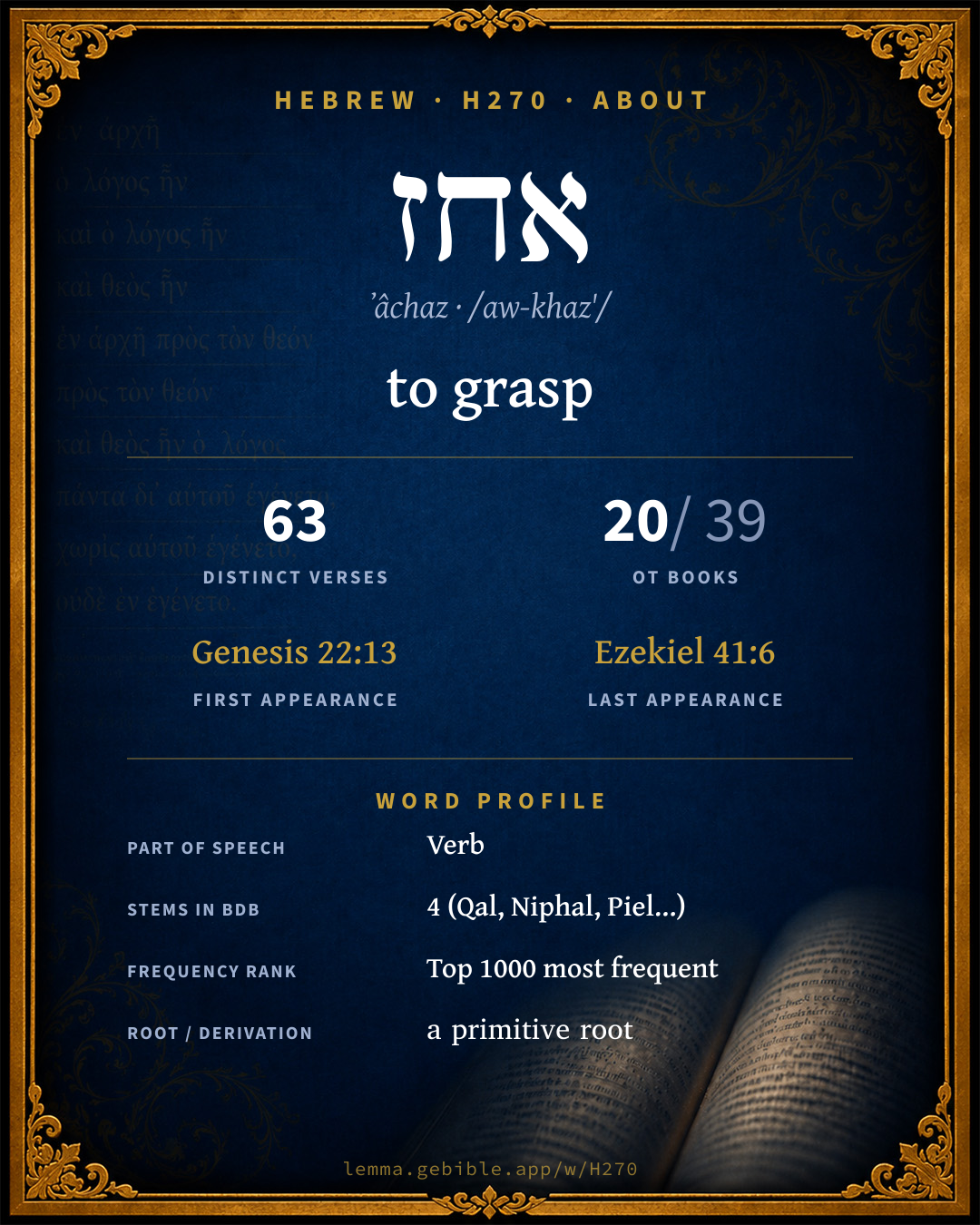
אָחַז
to grasp
‘to grasp’ is one of 5 main senses fuller range ↓
Full lexicon entry — Brown-Driver-Briggs (BDB)
From Brown-Driver-Briggs (BDB)
Where this word appears
See every Qal verb in the Hebrew Bible →
Grammar key — what these labels mean
Part of speech
- Verb
- An action or state-of-being word.
Stem
- Qal
- The basic, simple active stem — the plain form of the verb (“he wrote”).
- Niphal
- Usually the simple passive or reflexive of the Qal (“he was written”).
- Hophal
- The passive counterpart of the Hiphil (“he was caused to…”). Here: ‘pl.’
- Piel
- An intensive or resultative active stem.
Form
- Participle Passive
- A verbal adjective expressing action received (“written”).
- Sequential Imperfect
- An imperfect with prefixed waw — the standard past-narrative form (waw-consecutive imperfect).
- Infinitive Construct
- A bound verbal noun, frequently with prepositions (“to write / in writing”).
- Imperative
- A direct command (“write!”).
- Imperfect
- An incomplete, ongoing, or future action (“he will / would write”).
- Sequential Perfect
- A perfect with prefixed waw continuing a preceding imperfect or command (waw-consecutive perfect).
- Perfect
- A completed action or state — Hebrew marks aspect (completeness) more than strict tense (“he wrote”).
- Participle Active
- A verbal adjective expressing ongoing or characteristic action (“writing / one who writes”).
- Cohortative
- A first-person volitional form expressing wish or resolve (“let me / let us write”).
State
- Absolute
- The independent form of a noun, not bound to a following word.
- Construct
- A noun bound to a following noun in a possessive / “of” relationship (the construct chain).
Person
- 3rd Person
- The one spoken about (“he / she / it / they”).
- 2nd Person
- The one addressed (“you”).
- 1st Person
- The speaker (“I / we”).
Gender
- Masculine
- Grammatically masculine.
- Feminine
- Grammatically feminine.
- Common
- Either gender — not distinguished for this form.
Number
- Singular
- One.
- Plural
- More than one (in Hebrew, generally three or more).
Grammatical forms 33 distinct
- Verb, Qal, Participle Passive, Masculine, Singular, Absolute 6 times (9%)
- Verb, Qal, Infinitive Construct 5 times (7%)
- Verb, Qal, Imperfect, 3rd Person, Masculine, Singular 5 times (7%)
- Verb, Qal, Perfect, 3rd Person, Feminine, Singular 5 times (7%)
- Verb, Qal, Sequential Imperfect, 3rd Person, Masculine, Singular 3 times (4%)
- Verb, Qal, Sequential Imperfect, 3rd Person, Masculine, Plural 3 times (4%)
- Verb, Qal, Perfect, 3rd Person, Masculine, Singular 3 times (4%)
- Verb, Qal, Imperfect, 3rd Person, Masculine, Plural 3 times (4%)
+25 more forms (35 occurrences)
Parsed forms decoded from the imported morphology (morphhb / Westminster Leningrad Codex — WLC text public domain, morphhb tagging CC BY 4.0), counted across 68 parsed occurrences — not distinct verses.
Every verse where H270 appears — 63 distinct verses across 20 books. Click any verse to open its interlinear word-by-word view. Verse text shown in the World English Bible for context — . Each verse’s Hebrew form is shown with its reference; the English is not keyword-highlighted, since the data carries no word-level English alignment. Use “Compare translations” on any verse to read it across multiple English versions. This concordance covers the Hebrew Bible; Septuagint (Greek Old Testament) occurrences are not indexed here.
Genesis 4 verses
- Genesis 22:13 נֶאֱחַ֥ז Niphal pf 3ms Abraham lifted up his eyes, and looked, and saw that behind him was a ram caught in the thicket by his horns. Abraham went and took the ram, and offered him up for a burnt offering instead of his son.
- Genesis 25:26 אֹחֶ֨זֶת֙ Qal ptcp.act fs After that, his brother came out, and his hand had hold on Esau's heel. He was named Jacob. Isaac was sixty years old when she bore them.
- Genesis 34:10 וְ/הֵֽאָחֲז֖וּ conj + Niphal impv 2mp You shall dwell with us: and the land will be before you. Live and trade in it, and get possessions in it."
- Genesis 47:27 וַ/יֵּאָחֲז֣וּ conj + Niphal wimpf 3mp Israel lived in the land of Egypt, in the land of Goshen; and they got themselves possessions therein, and were fruitful, and multiplied exceedingly.
Exodus 3 verses
- Exodus 4:4 וֶ/אֱחֹ֖ז conj + Qal impv 2ms Yahweh said to Moses, "Put forth your hand, and take it by the tail." He put forth his hand, and laid hold of it, and it became a rod in his hand.
- Exodus 15:14 אָחַ֔ז Qal pf 3ms The peoples have heard. They tremble. Pangs have taken hold on the inhabitants of Philistia.
- Exodus 15:15 יֹֽאחֲזֵ֖/מוֹ Qal impf 3ms + sfx pers 3mp Then the chiefs of Edom were dismayed. Trembling takes hold of the mighty men of Moab. All the inhabitants of Canaan are melted away.
Numbers 3 verses
- Numbers 31:30 אָחֻ֣ז Qal ptcp.pass ms Of the children of Israel's half, you shall take one drawn out of every fifty, of the persons, of the oxen, of the donkeys, and of the flocks, [even] of all the cattle, and give them to the Levites, who keep the charge of the tent of Yahweh.
- Numbers 31:47 הָֽ/אָחֻז֙ ptcl def.art + Qal ptcp.pass ms even of the children of Israel's half, Moses took one drawn out of every fifty, both of man and of animal, and gave them to the Levites, who kept the charge of the tent of Yahweh; as Yahweh commanded Moses.
- Numbers 32:30 וְ/נֹֽאחֲז֥וּ conj + Niphal wpf 3cp but if they will not pass over with you armed, they shall have possessions among you in the land of Canaan.
Deuteronomy 1 verse
Joshua 2 verses
- Joshua 22:9 נֹֽאחֲזוּ Niphal pf 3cp The children of Reuben and the children of Gad and the half-tribe of Manasseh returned, and departed from the children of Israel out of Shiloh, which is in the land of Canaan, to go to the land of Gilead, to the land of their possession, which they owned, according to the commandment of Yahweh by Moses.
- Joshua 22:19 וְ/הֵאָחֲז֖וּ conj + Niphal impv 2mp However, if the land of your possession be unclean, then pass over to the land of the possession of Yahweh, in which Yahweh's tent dwells, and take possession among us: but don't rebel against Yahweh, nor rebel against us, in building you an altar besides the altar of Yahweh our God.
Judges 5 verses
- Judges 1:6 וַ/יֹּאחֲז֣וּ conj + Qal wimpf 3mp But Adoni-bezek fled; and they pursued after him, and caught him, and cut off his thumbs and his great toes.
- Judges 12:6 וַ/יֹּאחֲז֣וּ conj + Qal wimpf 3mp then said they to him, Say now Shibboleth; and he said Sibboleth; for he couldn't manage to pronounce it right: then they laid hold on him, and killed him at the fords of the Jordan. There fell at that time of Ephraim forty-two thousand.
- Judges 16:3 וַ/יֶּאֱחֹ֞ז conj + Qal wimpf 3ms Samson lay until midnight, and arose at midnight, and laid hold of the doors of the gate of the city, and the two posts, and plucked them up, bar and all, and put them on his shoulders, and carried them up to the top of the mountain that is before Hebron.
- Judges 16:21 וַ/יֹּאחֲז֣וּ/הוּ conj + Qal wimpf 3mp + sfx pers 3ms The Philistines laid hold on him, and put out his eyes; and they brought him down to Gaza, and bound him with fetters of brass; and he did grind in the prison-house.
- Judges 20:6 וָֽ/אֹחֵ֤ז conj + Qal wimpf 1cs I took my concubine, and cut her in pieces, and sent her throughout all the country of the inheritance of Israel; for they have committed lewdness and folly in Israel.
Ruth 1 verse
2 Samuel 5 verses
- 2 Samuel 1:9 אֲחָזַ֖/נִי Qal pf 3ms + sfx pers 1cs He said to me, Stand, I pray you, beside me, and kill me; for anguish has taken hold of me, because my life is yet whole in me.
- 2 Samuel 2:21 וֶ/אֱחֹ֣ז conj + Qal impv 2ms Abner said to him, Turn you aside to your right hand or to your left, and lay you hold on one of the young men, and take you his armor. But Asahel would not turn aside from following him.
- 2 Samuel 4:10 וָ/אֹחֲזָ֣/ה conj + Qal wimpf 1cs + sfx h when one told me, saying, Behold, Saul is dead, thinking to have brought good news, I took hold of him, and killed him in Ziklag, which was the reward I gave him for his news.
- 2 Samuel 6:6 וַ/יֹּ֣אחֶז conj + Qal wimpf 3ms When they came to the threshing floor of Nacon, Uzzah put forth [his hand] to the ark of God, and took hold of it; for the oxen stumbled.
- 2 Samuel 20:9 וַ/תֹּ֜חֶז conj + Qal wimpf 3fs Joab said to Amasa, Is it well with you, my brother? Joab took Amasa by the beard with his right hand to kiss him.
1 Kings 3 verses
- 1 Kings 1:51 אָחַ֞ז Qal pf 3ms It was told Solomon, saying, Behold, Adonijah fears king Solomon; for, behold, he has laid hold on the horns of the altar, saying, Let king Solomon swear to me first that he will not kill his servant with the sword.
- 1 Kings 6:6 אֲחֹ֥ז Qal inf.cs The nethermost story was five cubits broad, and the middle was six cubits broad, and the third was seven cubits broad; for on the outside he made offsets [in the wall] of the house round about, that [the beams] should not have hold in the walls of the house.
- 1 Kings 6:10 וַ/יֶּאֱחֹ֥ז conj + Qal wimpf 3ms He built the stories against all the house, each five cubits high: and they rested on the house with timber of cedar.
1 Chronicles 2 verses
- 1 Chronicles 13:9 לֶ/אֱחֹז֙ prep + Qal inf.cs When they came to the threshing floor of Chidon, Uzza put forth his hand to hold the ark; for the oxen stumbled.
- 1 Chronicles 24:6 אָחֻז֙ וְ/אָחֻ֥ז אָחֻ֖ז Qal ptcp.pass ms conj + Qal ptcp.pass ms Qal ptcp.pass ms Shemaiah the son of Nethanel the scribe, who was of the Levites, wrote them in the presence of the king, and the princes, and Zadok the priest, and Ahimelech the son of Abiathar, and the heads of the fathers' [houses] of the priests and of the Levites; one fathers' house being taken for Eleazar, and one taken for Ithamar.
2 Chronicles 2 verses
- 2 Chronicles 9:18 מָאֳחָזִ֔ים Hophal ptcp.pass mp nd there were six steps to the throne, with a footstool of gold, which were fastened to the throne, and stays on either side by the place of the seat, and two lions standing beside the stays.
- 2 Chronicles 25:5 אֹחֵ֖ז Qal ptcp.act ms Moreover Amaziah gathered Judah together, and ordered them according to their fathers' houses, under captains of thousands and captains of hundreds, even all Judah and Benjamin: and he numbered them from twenty years old and upward, and found them three hundred thousand chosen men, able to go forth to war, who could handle spear and shield.
Nehemiah 1 verse
Esther 1 verse
Job 9 verses
- Job 16:12 וְ/אָחַ֣ז conj + Qal wpf 3ms I was at ease, and he broke me apart. Yes, he has taken me by the neck, and dashed me to pieces. He has also set me up for his target.
- Job 17:9 וְ/יֹאחֵ֣ז conj + Qal impf 3ms Yet shall the righteous hold on his way. He who has clean hands shall grow stronger and stronger.
- Job 18:9 יֹאחֵ֣ז Qal impf 3ms A snare shall take him by the heel; A trap shall lay hold on him.
- Job 18:20 אָ֣חֲזוּ Qal pf 3cp Those who come after shall be astonished at his day, As those who went before were frightened.
- Job 21:6 וְ/אָחַ֥ז conj + Qal wpf 3ms When I remember, I am troubled. Horror takes hold of my flesh.
- Job 23:11 אָחֲזָ֣ה Qal pf 3fs My foot has held fast to his steps. His way have I kept, and not turned aside.
- Job 26:9 מְאַחֵ֥ז Piel ptcp.act ms He encloses the face of his throne, And spreads his cloud on it.
- Job 30:16 יֹ֭אחֲז֣וּ/נִי Qal impf 3mp + sfx pers 1cs "Now my soul is poured out within me. Days of affliction have taken hold on me.
- Job 38:13 לֶ֭/אֱחֹז prep + Qal inf.cs That it might take hold of the ends of the earth, And shake the wicked out of it?
Psalms 7 verses
- Psalms 48:6 אֲחָזָ֣תַ/ם Qal pf 3fs + sfx pers 3mp Trembling took hold of them there, Pain, as of a woman in travail.
- Psalms 56:1 בֶּֽ/אֱחֹ֨ז prep + Qal inf.cs Be merciful to me, God, for man wants to swallow me up. All day long, he attacks and oppresses me.
- Psalms 73:23 אָ֝חַ֗זְתָּ Qal pf 2ms Nevertheless, I am continually with you. You have held my right hand.
- Psalms 77:4 אָ֭חַזְתָּ Qal pf 2ms You hold my eyelids open. I am so troubled that I can't speak.
- Psalms 119:53 אֲ֭חָזַתְ/נִי Qal pf 3fs + sfx pers 1cs Indignation has taken hold on me, Because of the wicked who forsake your law.
- Psalms 137:9 שֶׁ/יֹּאחֵ֓ז ptcl rel + Qal impf 3ms Happy shall he be, Who takes and dashes your little ones against the rock.
- Psalms 139:10 וְֽ/תֹאחֲזֵ֥/נִי conj + Qal impf 3fs + sfx pers 1cs Even there your hand will lead me, And your right hand will hold me.
Ecclesiastes 3 verses
- Ecclesiastes 2:3 וְ/לֶ/אֱחֹ֣ז conj + prep + Qal inf.cs I searched in my heart how to cheer my flesh with wine, my heart yet guiding me with wisdom, and how to lay hold of folly, until I might see what it was good for the sons of men that they should do under heaven all the days of their lives.
- Ecclesiastes 7:18 תֶּאֱחֹ֣ז Qal impf 2ms It is good that you should take hold of this. Yes, also from that don't withdraw your hand; for he who fears God will come forth from them all.
- Ecclesiastes 9:12 שֶׁ/נֶּֽאֱחָזִים֙ הָ/אֲחֻז֖וֹת ptcl rel + Niphal ptcp.pass mp ptcl def.art + Qal ptcp.pass fp For man also doesn't know his time. As the fish that are taken in an evil net, and as the birds that are caught in the snare, even so are the sons of men snared in an evil time, when it falls suddenly on them.
Song of Solomon 4 verses
- Song of Solomon 2:15 אֶֽחֱזוּ Qal impv 2mp Catch for us the foxes, The little foxes that spoil the vineyards; For our vineyards are in blossom. Beloved
- Song of Solomon 3:4 אֲחַזְתִּי/ו֙ Qal pf 1cs + sfx pers 3ms I had scarcely passed from them, When I found him whom my soul loves. I held him, and would not let him go, Until I had brought him into my mother's house, Into the chamber of her who conceived me.
- Song of Solomon 3:8 אֲחֻ֣זֵי Qal ptcp.pass mp cs They all handle the sword, and are expert in war. Every man has his sword on his thigh, Because of fear in the night.
- Song of Solomon 7:8 אֹֽחֲזָ֖ה Qal coh 1cs I said, "I will climb up into the palm tree. I will take hold of its fruit." Let your breasts be like clusters of the vine, The smell of your breath like apples, Beloved
Isaiah 4 verses
- Isaiah 5:29 וְ/יֹאחֵ֣ז conj + Qal impf 3ms Their roaring will be like a lioness. They will roar like young lions. Yes, they shall roar, And seize their prey and carry it off, And there will be no one to deliver.
- Isaiah 13:8 יֹֽאחֵז֔וּ/ן Qal impf 3mp + sfx n and they shall be dismayed; pangs and sorrows shall take hold [of them]; they shall be in pain as a woman in travail: they shall look in amazement one at another; their faces [shall be] faces of flame.
- Isaiah 21:3 אֲחָז֔וּ/נִי Qal pf 3cp + sfx pers 1cs Therefore are my loins filled with anguish; pangs have taken hold on me, as the pangs of a woman in travail: I am pained so that I can't hear; I am dismayed so that I can't see.
- Isaiah 33:14 אָחֲזָ֥ה Qal pf 3fs The sinners in Zion are afraid; trembling has seized the godless ones: Who among us can dwell with the devouring fire? who among us can dwell with everlasting burning?
Jeremiah 2 verses
- Jeremiah 13:21 יֹאחֱז֔וּ/ךְ Qal impf 3mp + sfx pers 2fs What will you say, when he shall set over you as head those whom you have yourself taught to be friends to you? shall not sorrows take hold of you, as of a woman in travail?
- Jeremiah 49:24 אֲחָזַ֖תָּ/ה Qal pf 3fs + sfx pers 3fs Damascus has grown feeble, she turns herself to flee, and trembling has seized on her: anguish and sorrows have taken hold of her, as of a woman in travail.
Ezekiel 1 verse
About this entry
At a glance — auto-summarized from this page’s data, not written by a person. Every figure links to its source below. This summary describes the numbers; it doesn’t interpret them.
אחז — transliterated ʼâchaz — is a Hebrew verb carrying the sense “to grasp.” Across 4 stems, its meaning turns on the binyan (Qal, Niphal). With 63 verses in 20 books, it is a moderately common word in the Hebrew Bible. Debuting at Genesis 22:13, it then recurs through the corpus. Sharing its root, it stands alongside אחזה, אחז and אחזי. Each statement above links to its evidence; the full detail follows below.
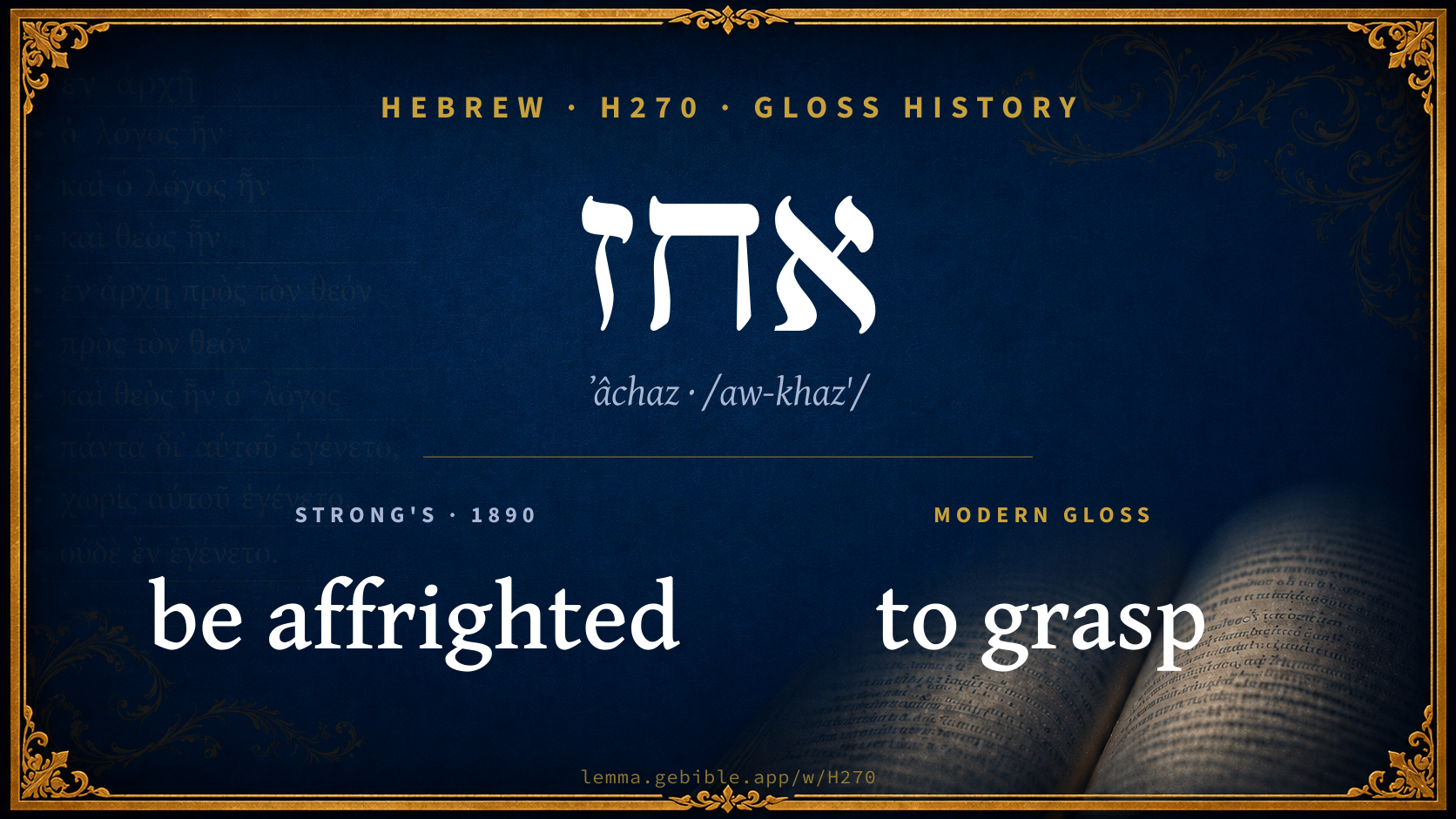
Gloss history
Strong's 1890 vs modern scholarship
About this word
Strong's H270 catalogs a Hebrew word from the Hebrew Old Testament.
These counts are not copied from any lexicon or concordance. They are computed here, from the morphology-tagged Hebrew Old Testament. What Lemma adds →
- 63
- distinct verses
- The word appears in 63 distinct verses.
- 20 / 39
- OT books
- The word appears in 20 of 39 Old Testament books.
- #582
- by frequency
- Top 1000 most frequent Hebrew words (rank 582 of 8,640 Hebrew words by occurrence).
View all 63 occurrences in the concordance →
By section of the Old Testament
By traditional corpus
Conventional, traditional groupings — biblical authorship is debated, so this is a traditional corpus grouping, not an authorship claim. Each share is this word’s portion of its verses in that division of the Hebrew canon. Each figure is a share of the word’s 63 distinct verses.
- Writings (Ketuvim) 30 verses · 48%
- Prophets (Nevi'im) 22 verses · 35%
- Torah (Pentateuch) 11 verses · 17%
How translations render this word
Counts come from each version’s own published word-to-Strong’s tagging or interlinear alignment — an approximate guide to how each version renders this word, not a word-level alignment the data otherwise carries. Because each total is that version’s own tagged count, the per-version totals vary from one another and need not match the appearance or distinct-verse counts above. These counts may also differ from a printed concordance because Lemma counts each distinctly tagged rendering and does not collapse phrase taggings into a single head-word total. This is a fixed set of word-tagged versions (KJV, ASV, BSB, ULT) and does not change with the reading translation you choose elsewhere. Each version’s license is shown beside its name below (and on Sources).
- King James Version: Took 4×, Shall take hold 3×, Take 3×
- American Standard Version: Drawn 2×, Have taken hold 2×, Hold 2×
- Berean Standard Bible: Took hold 3×, Caught 2×, Seize 2×
- unfoldingWord Literal Text: And 6×, Seizes 5×, Held 3×
King James Version Public Domain
Renders H270 across 67 tagged occurrences — most commonly:
Plus 44 renderings that appear only once — usually multi-word phrases or single function words the recovered tagging swept in, not distinct renderings.
American Standard Version Public Domain
Renders H270 across 66 tagged occurrences — most commonly:
Plus 56 renderings that appear only once — usually multi-word phrases or single function words the recovered tagging swept in, not distinct renderings.
Berean Standard Bible Public Domain
Renders H270 across 65 tagged occurrences — most commonly:
Plus 54 renderings that appear only once — usually multi-word phrases or single function words the recovered tagging swept in, not distinct renderings. Not rendered by a distinct English word in 3 further occurrences.
unfoldingWord Literal Text CC BY-SA 4.0
Renders H270 across 76 tagged occurrences — most commonly:
Plus 42 renderings that appear only once — usually multi-word phrases or single function words the recovered tagging swept in, not distinct renderings.
Senses in the full BDB
Hebrew verbs can shift meaning by stem (binyan): Qal is the basic action, Niphal is often passive or reflexive, Piel often intensifies or makes it factitive, and Hiphil is typically causative. The senses below are grouped under the stem BDB assigns to each. This entry also uses Hophal (the passive of Hiphil).
What do BDB’s symbols mean?
BDB uses these scholarly abbreviations:
| Symbol | Meaning |
|---|---|
| 𝔊 | the Septuagint (the ancient Greek translation, LXX) |
| 𝔙 | the Vulgate (the Latin translation) |
| 𝔖 | the Syriac version (the Peshitta) |
| 𝔗 | the Targum (the Aramaic translation) |
| ψ | the Psalms |
| √ | root (the underlying root or stem) |
| ‖ | parallel passage (a synonymous or contrasted parallel) |
| † | the dagger: every passage where the word occurs is cited |
The 4 senses and sub-senses the full Brown-Driver-Briggs lexicon distinguishes for this word, in lexicon order (not ranked by frequency), with BDB’s own verbatim wording and sub-sense lettering. Shown in Hebrew script with BDB’s own scholarly abbreviations. The condensed entry is in the Lexicon Entry tab. See also the Forms in the corpus table below.
Qal
- Pf. אָחַז Ex 15:14 +; אָֽחֲזָה Jb 23:11 Is 33:14; sf. אֲחָזַנִי 2 S 1:9; 1 s. sf. אֲחַזְתִּיו Ct 3:4, etc.; Impf. יֹאחֵז Jb 17:9 +; וַיֹּ֫אחֶז 2 S 6:6; 3 fs. תֹּאחֵז Dt 32:41; וַתֹּאחֶז Ru 3:15; וַתֹּחֶז 2 S 20:9; וָאֹחֵז Ju 20:6 יֹאחֵזוּן Is 13:8; sf. יֹאחֲזֵ֫מוֹ Ex 15:15; יֹאחֱזוּךְ Je 13:21, etc.;—†as פ׳ gutt. וַיֶּאֱחֹז Ju 16:3 1 K 6:10; 2 ms. תֶּאֱחֹז Ec 7:18; Inf. אֲחֹז 1 K 6:6; אֱחֹז 1 Ch 13:9 + 3 times; Imv. אֱחֹז Ex 4:4 2 S 2:21, אֶחֳזִי־ Ru 3:15; אֶהֱזוּ Ct 2:15; אֱחֹ֑זוּ Ne 7:3; Pt. act. אֹחֵז 2 Ch 25:5; pass. אָחוּז Est 1:6, etc.;—grasp, take hold of, sq. בְּ Gn 25:26 Ex 4:4 (both J) Ju 16:3; 20:6 (= וַיַּחֲזֵק בְּ 19:29) 2 S 4:10; 6:6; 20:9 1 K 1:51 Ru 3:15(×2); 1 K 6:6 of beams having hold in a wall; (cf. בֵּית אֲבָנִים יֶֽחֱזֶה֑ Jb 8:17; Hoffm reads יֹחֲזָה = יֹא׳); also Ct 7:9 of taking hold of branches, in metaph.; poet. fig., of God’s seizing man in wrath Jb 16:12; taking hold graciously ψ 73:23; taking hold of judgment Dt 32:41; subj. man בַּאֲשֻׁרוֹ אָֽחֲזָה רַגְלִי Jb 23:11 (‖ דַּרְכּוֹ שָׁמַרְתִּי cf. also 17:9); of taking hold of folly Ec 2:3 cf. 7:18; subj. הַשַּׁהַר Jb 38:13, לֶאֱחֹז בְּכַנְפוֹת הָאָ֑רֶץ; also sq. acc. Ju 1:6; 12:6; 16:21 2 S 2:21 Is 5:29 Ct 2:15; 3:4 1 Ch 13:9 2 Ch 25:5 ψ 56:1; 137:9; cf. 1 K 6:10 (cf. v 6 supr.), subj. הַיָּצוּעַ, וַיֶּא׳ אֶת־הַבַּיִת בַּעֲצֵי אֲרָזִים; of a snare catching the heel, in metaph. Jb 18:9; fig., subj. God ψ 77:5; God’s hand 139:10; subj. pain, sorrow, fear, etc. Ex 15:14, 15 2 S 1:9 Jb 21:6; 30:16 ψ 48:7; 119:53 Is 21:3; 33:14 Je 13:21; 49:24; subj. man, obj. fear, etc. Jb 18:20 Is 13:8; obj. דֶּרֶךְ take one’s way Jb 17:9 יֹאחֵז צַדִּיק דַּרְכּוֹ AV RV hold on his way (cf. 23:11 supr., & Assyrian ṣabâtu urḫu, e.g. V. R 1, 74);—abs. Ne 7:3 of barring gates; pt. pass. caught Ec 9:12; fastened, held Est 1:6; taken (by lot) 1 Ch 24:6(×3) (on text v. Öt); taken out of a number Nu 31:30, 47; pt. act. of same form אֲחֻזֵי חֶרֶב Ct 3:8 cf. Thes BaNB 175 & Ethiopic pt.; similarly Aramaic אָחִיד, e.g. 𝔗 Am 2:5; ܐܰܚܺܝܕ e.g. 𝔖 Ju 8:10 1 Ch 5:18; & Ez 41:6(×2) (but v. Co). e.g. Exodus 15:14
Niphal
- Pf. 3 pl. נֹאחֲזוּ Jos 22:9; וְנֹא׳ (cons.) Nu 32:30; Impf. וַיֵּאָחֲזוּ Gn 47:27; Imv. הֵאָחֲזוּ Gn 34:10 Jos 22:19; Pt. נֶאֱחָז Gn 22:13; נֶאֱחָזִים Ec 9:12;—be caught Gn 22:13 Ec 9:12; elsewhere have possessions Gn 34:10; 47:27 Nu 32:30 Jos 22:9, 19 (P). e.g. Joshua 22:9
Piel
- Pt. מְאַחֵז Jb 26:9 c. acc. enclose, overlay (so Assyrian DlW, p. 294, cf. Aramaic ܐܚܕ, shut). e.g. Job 26:9
Hophal
- Pt. pl. מָאֳחָזִים 2 Ch 9:18 fastened to sq. לְ. e.g. 2 Chronicles 9:18
Senses from the full Brown-Driver-Briggs lexicon (Brown, Driver, Briggs; Oxford 1906 — public domain), digitized via Sefaria, supplemented by the OpenScriptures HebrewLexicon (CC BY 4.0). Full attribution on Sources.
Word origin
vb. grasp, take hold, take possession (Arabic أَخَذَ, Sab. אחֿדֿ Sab. Denkm.39, Aramaic אְחַד, ܐܶܚܰܕ, Assyrian aḫâzu, Ethiopic አኀዘ )—
— Brown-Driver-Briggs (Oxford 1906, public domain), digitized via Sefaria, supplemented by the OpenScriptures HebrewLexicon (CC BY 4.0). See Sources.
Origin: a primitive root
Jastrow Dictionary
A second Hebrew/Aramaic lexicon for comparison, covering Aramaic and post-biblical (Talmudic, Targumic, Midrashic) usage that the biblical-Hebrew BDB does not. Matched by lemma rather than by Strong’s number, so a lemma may carry more than one Jastrow headword (shown separately below), and the entries cover usage well beyond the Bible.
אָחַז
- 1. to press, seize, hold, keep; to befall. Snh. 27ᵇ אוֹחֲזִין מעשה וכ׳ holding in their hands the doing of their fathers, i.e. following their father’s example. Bekh. 33ᵇ אֲחָזוֹ דם he had an attack of congestion. Y. Pes. I, 28ᵇ אֲחוּזַת הדם the animal attacked with congestion. Y. Sabb. XIV, 14ᶜ bot. אֲחָזַתֹּו עין a pain in the eye seized him. Ib. XIX, end, 17ᵇ אחזתו חמה fever overtook him; a. fr.—אָחַז בְּ־ to have a hold of.—B. Mets. I, 1. Y. Yoma II, 39ᶜ top; a. fr.—Part. pass. אָחוּז holding fast, having a firm hold. Ex. R. s. 46 (v. אֲחַד).
- 2. א׳ את העינים to capture the eyesight, to delude by optical deception. Snh. 65ᵇ; a. e.
- to be seized. Y. Taan. II, 65ᵈ top; a. e.
- to distribute split wood (kindling chips) in the gaps of a large pile, to ignite with kindling wood. Sabb. I, 11 (19ᵇ sq.) ומַאֲחִיזִין ed. (Mss., Ar. a. Y. ib. beg. 4ᶜ ומחזין, ed. Ven. ומחיזין); v. חָזָה.
A Dictionary of the Targumim, the Talmud Babli and Yerushalmi, and the Midrashic Literature (Marcus Jastrow; London, Luzac, 1903) — Public Domain. Digitized via Sefaria. Digitized via Sefaria. Full attribution on Sources.
Forms in the corpus
The 66 distinct written forms H270 takes in the Hebrew Bible, most frequent first — each parse links to that stem’s occurrences in the concordance. Hebrew forms include their vowel points and cantillation, so a single lemma takes many written forms.
The 60 most common forms are shown; 6 rarer forms follow in the full concordance.
Same root — word family
Other BDB entries built from the same root as H270, grouped by Strong’s listed origin. These share a root / origin per the lexicon — not necessarily a shared meaning. Each links to that word’s own entry.
Derived from this word
Proper names from this root
People and places named from this root — a name, not an additional meaning of the word.
- אחז ʼÂchâz H271 Ahaz
- אחזי ʼAchzay H273 Ahasai
- אחזיה ʼĂchazyâh H274 Ahaziah
- אחזם ʼĂchuzzâm H275 Ahuzam
Compare all same-root words → Showing 4 of 6 — not the complete family. 4 of the same-root words are proper names (people or places). They share a root, not necessarily a meaning.
Septuagint verse parallels
This word appears in 59 verses that also exist in the Greek Old Testament (Septuagint), out of the 63 Hebrew verses it occurs in. You can read those verses in Greek by switching the Old Testament edition to the Septuagint.
Read these verses in the Septuagint
- Genesis 22:13
- Exodus 4:4
- Numbers 31:30
- Deuteronomy 32:41
- Joshua 22:9
- Judges 1:6
- Ruth 3:15
- 2 Samuel 1:9
- 1 Kings 1:51
- 1 Chronicles 13:9
- 2 Chronicles 9:18
- Esther 1:6
This is a verse-level parallel only — the same verses exist in both the Hebrew and Greek Old Testaments. No word-level Hebrew↔Greek correspondence is claimed: the data carries no such alignment, so no Greek word is shown as this Hebrew word’s translation. Coverage is not total — the Septuagint omits the deuterocanon and renumbers the Psalms, so some Hebrew verses have no direct Greek parallel.