
Psalms 137:9

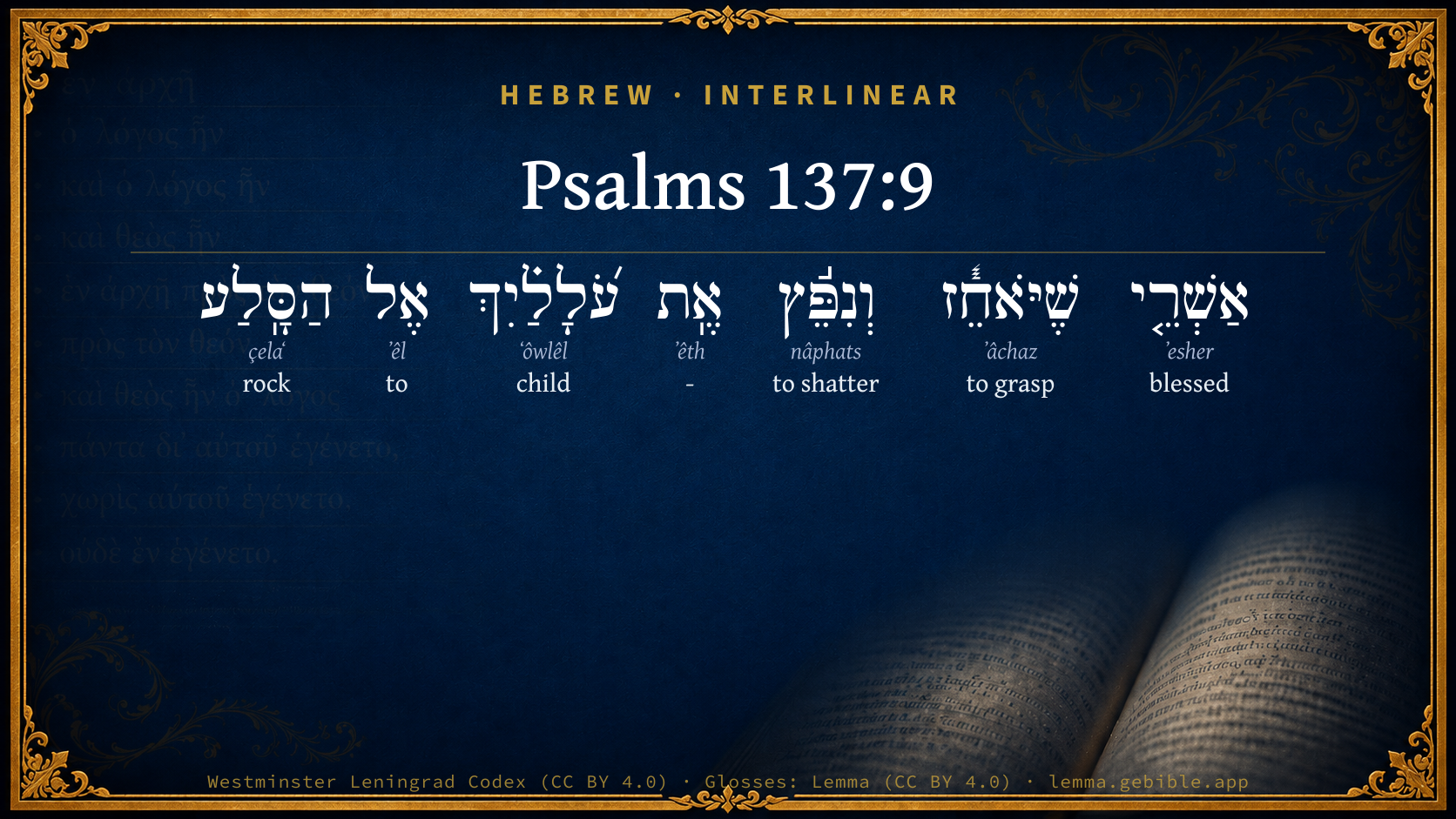
Hebrew (Westminster Leningrad Codex) Psalms 137:9 appears in the Hebrew Old Testament. The text above is from the Westminster Leningrad Codex. Each word links to its Strong’s number, a concise gloss, and parsing drawn from the Open Scriptures Hebrew Bible morphology. Click any word for its full Brown-Driver-Briggs (BDB) entry.
Download image
Cite this verse

Psalms 137:9 (World English Bible). Public Domain. Lemma interlinear Bible study tool, https://lemma.gebible.app/v/psalms/137/9.

Show BibTeX & RIS
BibTeX
RIS
English Translation
Happy shall he be, Who takes and dashes your little ones against the rock.
World English Bible · Public Domain
Download a study sheet

One document with this verse’s original text, its word-by-word gloss line, the meaning frame, cross-references with their text, attributed commentary, and full source and license credits — printable, and it pastes into notes with its structure intact.

This verse Autodidact and up

Study sheet (.html) Plain text (.txt)

A passage Seminary Student

Up to 50 verses in one chapter. A passage sheet keeps up to 6 commentary sources and 12 cross-references per verse, in the order this page ranks them, and says so on the sheet whenever that leaves anything out. Ask for a single verse and you get the Autodidact verse sheet above.

Everything on this page stays free to read, with no account — the sheet is a download of what is already on screen, not access to it.

Want to remove ads? Support Godless Engineer
Compare translations 3

The same verse in 3 English versions, stacked beneath the original-language interlinear above. Click any original word for its lexicon entry.

Each is an independent rendering of the whole verse — the interlinear is not word-aligned to these translations.

Highlighted words mark where these versions differ — a whole-verse word diff, not a word-by-word alignment.

  • World English Bible Public Domain
    Happy shall he be, Who takes and dashes your little ones against the rock.
  • King James Version Public Domain
    Happy shall he be, that taketh and dasheth thy little ones against the stones.
  • unfoldingWord Literal Text CC BY-SA 4.0
    The happinesses of the one who seizes and dashes your infants against the rock!

unfoldingWord Literal Text — © unfoldingWord, licensed CC BY-SA 4.0. Word-aligned USFM3 via Door43 (git.door43.org/unfoldingWord/en_ult).

Versions to compare (up to 4)

3 of 4 selected

Show all 18 translations

Every available English version of this verse, each an independent rendering of the whole verse.

  • World English Bible Public Domain
    Happy shall he be, Who takes and dashes your little ones against the rock.
  • Berean Standard Bible Public Domain
    Blessed is he who seizes your infants and dashes them against the rocks.
  • Majority Standard Bible Public Domain
    Blessed is he who seizes your infants and dashes them against the rocks.
  • King James Version Public Domain
    Happy shall he be, that taketh and dasheth thy little ones against the stones.
  • American Standard Version (1901) Public Domain
    Happy shall he be, that taketh and dasheth thy little ones Against the rock. Psalm 138 A `Psalm' of David.
  • Revised Version (1885) Public Domain
    Happy shall he be, that taketh and dasheth thy little ones against the rock.
  • Geneva Bible (1599) Public Domain
    Blessed shall he be that taketh and dasheth thy children against the stones.
  • Douay-Rheims (1899) Public Domain
    The moon and the stars to rule the night: for his mercy endureth for ever.
  • Young's Literal Translation Public Domain
    O the happiness of him who doth seize, And hath dashed thy sucklings on the rock!
  • Literal Standard Version CC BY-SA 4.0
    O the blessedness of him who seizes, and has dashed your sucklings on the rock!
  • Unlocked Literal Bible CC BY-SA 4.0
    May the person be blessed, whoever takes and dashes your little ones against a rock.
  • unfoldingWord Literal Text CC BY-SA 4.0
    The happinesses of the one who seizes and dashes your infants against the rock!
  • Darby Bible Public Domain
    Happy he that taketh and dasheth thy little ones against the rock.
  • World Messianic Bible Public Domain
    Happy shall he be, who takes and dashes your little ones against the rock.
  • Webster's Bible Public Domain
    Happy shall he be, that taketh and dasheth thy little ones against the stones.
  • Free Bible Version CC BY-SA 4.0
    Happy is the one who grabs your children and smashes them against the rocks!
  • Bible in Basic English Public Domain
    Happy is the man who takes your little ones, crushing them against the rocks.
  • JPS Tanakh (1917) Public Domain
    Happy shall he be, that taketh and dasheth thy little ones against the rock.

Literal Standard Version (2020), Covenant Press — licensed CC BY-SA 4.0. Text via the HelloAO Bible API (eBible.org). Unlocked Literal Bible (unfoldingWord) — licensed CC BY-SA 4.0. Text via the HelloAO Bible API (eBible.org). unfoldingWord Literal Text — © unfoldingWord, licensed CC BY-SA 4.0. Word-aligned USFM3 via Door43 (git.door43.org/unfoldingWord/en_ult). Free Bible Version, Dr. Jonathan Gallagher — licensed CC BY-SA 4.0. Text via the HelloAO Bible API (eBible.org).

Word by word

More ways to search: Search by grammar → Find every occurrence → Compare this word →

Practice this passage: Drill this verse → Learn its vocabulary →

About this verse

These counts appear in no published source. They are computed here, from the morphology-tagged text and Lemma’s own curated glosses. What Lemma adds →

7
words
7
distinct lemmas
Wisdom
section

Notable vocabulary

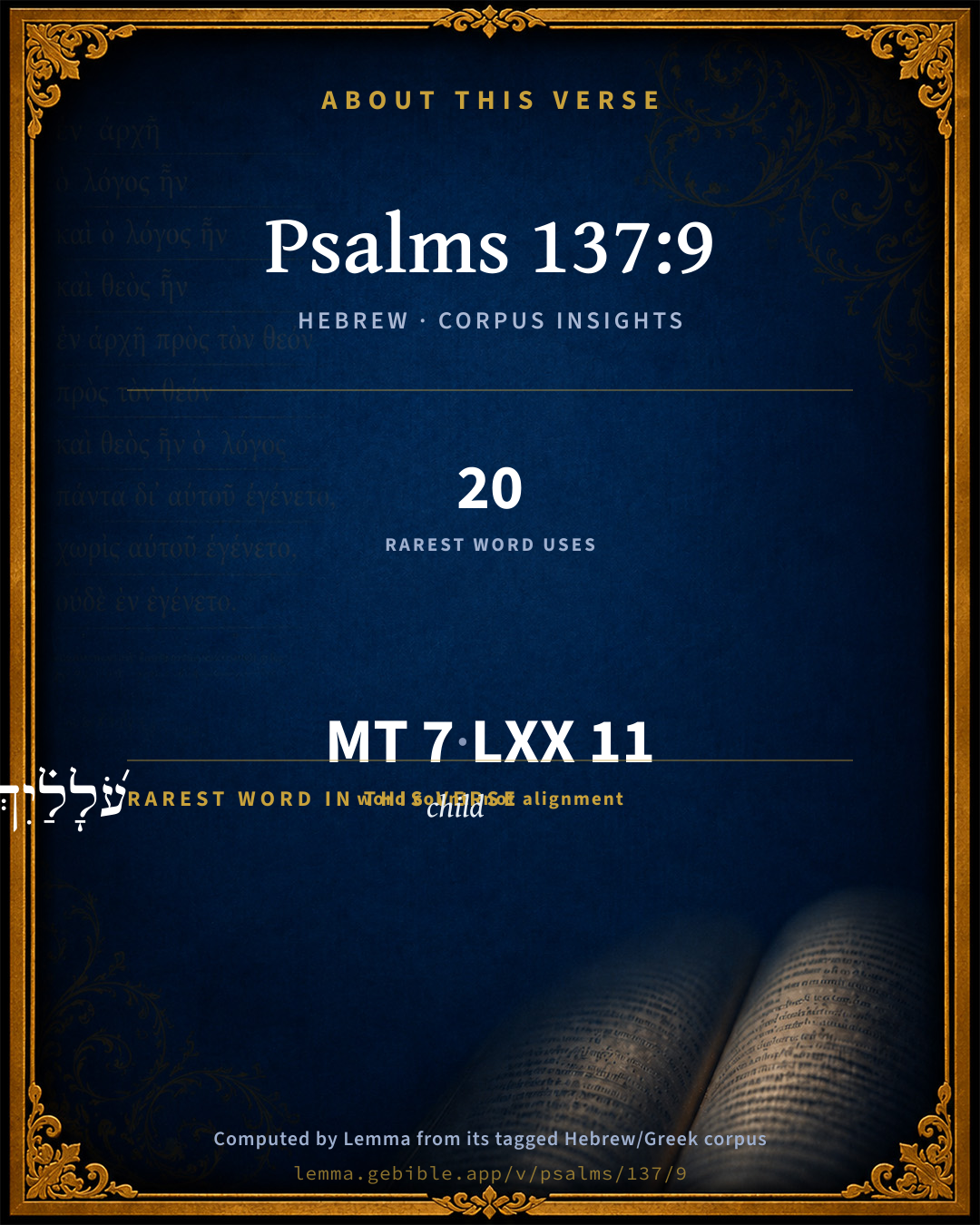
The rarest word here is עֹ֝לָלַ֗יִךְ child H5768 — appearing just 20 times in the whole Hebrew Bible.

Shared distinctive vocabulary

עֹ֝לָלַ֗יִךְ child H5768 occurs in 20 verses of the Hebrew Bible. Also found in:

Grammatical profile

  • 2 verbs
  • 3 nouns
  • 1 preposition
  • 1 particle

Verb forms

  • שֶׁיֹּאחֵ֓ז Qal · Imperfect
  • וְנִפֵּ֬ץ Piel · Sequential Perfect

Hebrew & Septuagint length

In English translation the verse runs 14 words from the Hebrew and 14 from the Septuagint (LXX English) — the same length.

A rough comparison of the two English renderings, which tokenize alike — not a word-level alignment.

Word counts can differ between the Hebrew and the Greek without any difference in meaning — e.g. the Hebrew direct-object marker אֵת has no separate Greek word, and Greek often adds the article ὁ.

In the original languages it is 7 Hebrew tokens and 11 Greek tokens — but the two are counted differently (Hebrew bundles its prefixes and suffixes into one token; the Greek is in lemma form), so that isn’t a like-for-like length.

Cross-references

5

Topical passages linked to Psalms 137:9 in the Treasury of Scripture Knowledge — connected by theme and wording, ordered by reader-vote popularity; previews shown in the World English Bible.

  • Isaiah 13:16 Their infants also shall be dashed in pieces before their eyes; their houses shall be rifled, and their wives ravished.
  • Hosea 13:16 Samaria will bear her guilt; For she has rebelled against her God. They will fall by the sword. Their infants will be dashed in pieces, And their pregnant women will be ripped open."
  • Nahum 3:10 Yet was she carried away. She went into captivity. Her young children also were dashed in pieces at the head of all the streets, and they cast lots for her honorable men, and all her great men were bound in chains.
  • 2 Kings 8:12 Hazael said, Why weeps my lord? He answered, Because I know the evil that you will do to the children of Israel: their strongholds will you set on fire, and their young men will you kill with the sword, and will dash in pieces their little ones, and rip up their women with child.
  • Hosea 10:14 Therefore a battle roar will arise among your people, And all your fortresses will be destroyed, As Shalman destroyed Beth Arbel in the day of battle. The mother was dashed in pieces with her children.

Cross-references courtesy of OpenBible.info (CC BY 4.0).

Hebrew and Greek witnesses Masoretic Hebrew ↔ Greek Septuagint

The same verse in the two great witnesses to the Old Testament, shown verse-for-verse.

You’re reading Greek Psalm 136 (Hebrew Psalm 137). The Septuagint counts the superscription, so verse numbers can differ from the Hebrew — chapter-level alignment, not verse-by-verse. Numbering follows Rahlfs.

These are two independent witnesses, not word-aligned to each other, and the Septuagint is shown in lemma (dictionary) form.

Hebrew Psalms 137:9 Masoretic · Westminster Leningrad Codex

אַשְׁרֵ֤י שֶׁיֹּאחֵ֓ז וְנִפֵּ֬ץ אֶֽת עֹ֝לָלַ֗יִךְ אֶל הַסָּֽלַע

Happy shall he be, Who takes and dashes your little ones against the rock.

World English Bible · Public Domain

Greek LXX Greek Psalm 136:9 Septuagint · lemma form

μακάριος ὅς κρατέω καί ἐδαφίζω ὁ νήπιος σύ πρός ὁ πέτρα

Blessed shall he be who shall seize and dash your infants against the rock.

LXX2012 (modern English Septuagint) · Public Domain

Hebrew: Westminster Leningrad Codex (CC BY 4.0). Greek: Septuagint (public domain); English from LXX2012 (modern English Septuagint) (Public Domain). How the Septuagint differs from the Hebrew →

Commentary

Notes on Psalms 137:9 from classic Christian and Jewish commentators (each source and its license shown beneath its notes). The classic Christian expositions comment on the surrounding passage and are grouped to its opening verse, so a note may address several verses; the Jewish commentaries on the Tanakh (Rashi and others) are per-verse, so they appear only where the commentator wrote on this verse.

Lemma curates 59 commentaries, every one of them public domain or Creative Commons licensed, each selected and text-cleaned for this edition rather than reprinted as found. About our sources →

Trapp's Complete Commentary

John Trapp

Psa 137:9 Happy [shall he be], that taketh and dasheth thy little ones against the stones.

Ver. 9. That taketh and dasheth thy little ones] So at the destruction of Troy (Horat. l. iv. Od. 6).

Sed palam captis gravis (heu nefas, heu)

Nescios fari pueros, Achivis

Ureret flammis, etiam latentes

Matris in alvo.

John Trapp, A Commentary or Exposition upon All the Books of the Old and New Testament (1647–1656) — public domain. Text from a community e-Sword module.

The Treasury of David

Charles H. Spurgeon

Ver. 9. Happy shall he be that taketh, etc. That is, so oppressive hast thou been to all under thy domination, as to become universally hated and detested; so that those who may have the last hand in thy destruction, and the total extermination of thy inhabitants, shall be reputed "happy" shall be celebrated and extolled as those who have rid the world of a curse so grievous. These prophetic declarations contain no excitement to any person or persons to commit acts of cruelty and barbarity; but are simply declarative of what would take place in the order of the retributive providence and justice of God, and the general opinion that should in consequence be expressed on the subject; therefore praying for the destruction of our enemies is totally out of the question. Adam Clarke.

Ver. 9. Happy shall he be, etc. With all possible might and speed oppose the very first risings and movings of the heart to sin; for these are the buds that produce the bitter fruit; and if sin be not nipped in the very bud, it is not imaginable how quickly it will shoot forth...Now these sins, though they may seem small in themselves, yet are exceedingly pernicious in their effects. These little foxes destroy the grapes as much or more than the greater, and therefore are to be diligently sought out, hunted, and killed by us, if we would keep our hearts fruitful. We should deal with these first streamings out of sin as the Psalmist would have the people of God deal with the brats of Babylon: Happy shall he be, that taketh and dasheth thy little ones against the stones. And without doubt most happy and successful will that man prove in his spiritual welfare, who puts on no bowels of pity even to his infant corruptions, but slays the small as well as the great; and so not only conquers his enemies by opposing their present force, but also by extinguishing their future race. The smallest children, if they live, will be grown men; and the first motions of sin, if they are let alone, will spread into great, open, and audacious presumptions. Robert South, 1633-1716.

Ver. 9. Against the stones. That elM signifies a rock, is undubitable, from the concurrent testimony of all the best Hebrew lexicographers. Hence it follows, because there is no rock, nor mountain, nor hill, either in tim city or in the province of ancient Babylonia, that the locality against which the malediction of this Psalm is hurled cannot be the metropolis of the ancient Assyrian empire, but must be apocalyptic Babylon, or Papal Rome, built upon seven hills, one of which is the celebrated Tarpeian Rock. But the eighth verse emphatically declares that the retributive justice of God will visit upon apocalyptic Babylon the same infliction which Assyrian Babylon, and also Pagan Rome, inflicted upon Jerusalem. As therefore Nebuchadnezzar as well as Titus "burnt the house of the Lord, and tim king's house, and all the houses of Jerusalem, and every great man's house burnt he with fire" (2Ki 25:9), so "the ten horns shall hate the whore, and shall make her desolate and naked, and shall eat her flesh, and burn her with fire; and she shall be utterly burned with fire" (Re 17:16 18:8). When the Canaanites had filled up the measure of their iniquity, Israel received a divine commission to exterminate the guilty nation. When Papal Rome shall have filled up the measure of her iniquity, then "a mighty angel will take up a stone, like a great millstone, and will cast it into the sea, saying, Thus with violence shall that great city Babylon be thrown down": "For her sins have reached unto heaven, and God hath remembered her iniquities. Reward her even as she rewarded you, and double unto her double according to her works: in the cup which she hath filled fill to her double" (Re 18:5-6). Then shall issue the divine proclamation: "Rejoice over her, thou heaven, and ye holy apostles and prophets; for God hath avenged you on her" (Re 18:20). John Noble Coleman, in "The Book of Psalms, with Notes, "1863.

Ver. 9. He that taketh and dasheth thy little ones against the stones.

My heroes slain, my bridal bed o'erturned,

My daughters ravished, and my city burn'd,

My bleeding infants dashed against the floor;

These have I yet to see, perhaps yet more. Homer's Iliad, Pope's Translation, Book 22, 89-91.

Psalms 137:9*

Ver. 9. Happy shall he be, that taketh and dasheth thy little ones against the stones. Fierce was the heart of the Jew who had seen his beloved city the scene of such terrific butchery. His heart pronounced like sentence upon Babylon. She should be scourged with her own whip of wire. The desire for righteous retribution is rather the spirit of the law than of the gospel; and yet in moments of righteous wrath the old fire will burn; and while justice survives in the human breast it will not lack for fuel among the various tyrannies which still survive. We shall be wise to view this passage as a prophecy. History informs us that it was literally fulfilled: the Babylonian people in their terror agreed to destroy their own offspring, and men thought themselves happy when they had put their own wives and children to the sword. Horrible as was the whole transaction, it is a thing to be glad of if we take a broad view of the world's welfare; for Babylon, the gigantic robber, had for many a year slaughtered nations without mercy, and her fall was the rising of many people to a freer and safer state. The murder of innocent infants can never be sufficiently deplored, but it was an incident of ancient warfare which the Babylonians had not omitted in their massacres, and, therefore, they were not spared it themselves. The revenges of providence may be slow, but they are ever sure; neither can they be received with regret by those who see God's righteous hand in them. It is a wretched thing that a nation should need an executioner; but yet if men will commit murders tears are more fitly shed over their victims than over the assassins themselves. A feeling of universal love is admirable, but it must not be divorced from a keen sense of justice.

The captives in Babylon did not make music, but they poured forth their righteous maledictions, and these were far more in harmony with their surroundings than songs and laughter could have been. Those who mock the Lord's people will receive more than they desire, to their own confusion: they shall have little enough to make mirth for them, and more than enough to fill them with misery. The execrations of good men are terrible things, for they are not lightly uttered, and they are heard in heaven. "The curse causeless shall not come; " but is there not a cause? Shall despots crush virtue beneath their iron heel and never be punished? Time will show.

Charles H. Spurgeon's The Treasury of David (1869–1885) — public domain. Psalms only. Text from a community e-Sword/MySword module.

J. A. Alexander on Psalms

Joseph Addison Alexander

9. (Psa 137:9) Happy he (who) shall seize and dash thy little ones against the stones. This revolting act was not uncommon in ancient warfare. See 2Ki 8:12, Hos 14:1, Nah 3:10, Isa 13:16; Isa 13:18. The more revolting, the stronger the description of the change awaiting Babylon. The day is coming when he shall be deemed fortunate who, according to the usages of war, requites thy own sanguinary cruelties. The word translated dash means really to dash in pieces, as in Psa 2:9. The act here meant is commonly expressed by a different Hebrew verb. Taketh and dasheth is equivocal, the first of these verbs being used in familiar English as a kind of auxiliary, whereas the corresponding verb in Hebrew denotes a distinct and independent act.

Joseph Addison Alexander, The Psalms Translated and Explained (1850) — public domain. Text from a community e-Sword module.

Geneva Bible (1599)

Geneva Bible translators

He alludeth to Isaiah’s prophecy, Isa. 13:16, promising good success to Cyrus and Darius, whom ambition moved to fight against Babylon, but God used them as his rods to punish his enemies.

Geneva Bible (1599) marginal notes — public domain. Text via Bolls.life.

Adam Clarke's Commentary

Verse 9. Happy - that taketh and dasheth thy little ones] That is, So oppressive hast thou been to all under thy domination, as to become universally hated and detested; so that those who may have the last hand in thy destruction, and the total extermination of thy inhabitants, shall be reputed happy - shall be celebrated and extolled as those who have rid the world of a curse so grievous. These prophetic declarations contain no excitement to any person or persons to commit acts of cruelty and barbarity; but are simply declarative of what would take place in the order of the retributive providence and justice of God, and the general opinion that should in consequence be expressed on the subject; therefore praying for the destruction of our enemies is totally out of the question. It should not be omitted that the Chaldee considers this Psalm a dialogue, which it thus divides: - The three first verses are supposed to have been spoken by the psalmist, By the rivers, c. The Levites answer from the porch of the temple, in Ps 137:4, How shall we sing, c. The voice of the Holy Spirit responds in Ps 137:5-6, If I forget thee, c. Michael, the prince of Jerusalem, answers in Ps 137:7, Remember, O Lord, &c. Gabriel, the prince of Zion, then addresses the destroyer of the Babylonish nation, in Ps 137:8-9, Happy shall be he that rewardeth thee, c. To slay all when a city was sacked, both male and female, old and young, was a common practice in ancient times. Homer describes this in words almost similar to those of the psalmist: -

Υἱας τ' ολλυμενους, ἑλκυσθεισας τε θυγατρας,

Και θαλαμους κεραΐζομενους, και νηπια τεκνα

Βαλλομενα προτι γαιῃ εν αινῃ δηΐοτητι,

Ἑλκομενας τε νυους ολοης ὑπο χερσιν Αχαιων.

Il. lib. xxii., ver. 62.

My heroes slain, my bridal bed o'erturned

My daughters ravished, and my city burned:

My bleeding infants dashed against the floor

These I have yet to see; perhaps yet more.

POPE.

These excesses were common in all barbarous nations, and are only prophetically declared here. He shall be reputed happy, prosperous, and highly commendable, who shall destroy Babylon.

ANALYSIS OF THE HUNDRED AND THIRTY-SEVENTH PSALM

When this Psalm was composed, the Jews were in captivity in Babylon, far from their own country, the temple, and the public exercises of religion; and the scoff and scorn of their enemies; and they contrast what they were with what they are. This Psalm has two parts: -

I. The complaint of Israel. Because of the insults of the Babylonians, they deplore their sad condition, long for the temple, and their return to Jerusalem, Ps 137:1-7.

II. An imprecation or prayer for vengeance, on their persecutors, Ps 137:7-9.

I. Their complaint arises from their captivity, and it is aggravated. -

1. From the place, Babylon: "By the rivers of Babylon." A place far from their country; who were aliens from the covenant made by God with Abraham, scorners of their religion, had laid waste their city and forced them to base and servile labour.

2. From the continuance of their captivity and misery: "There we sat down," c. Took up the seats allotted to us, and that for seventy years.

3. From the effects it produced: "Yea, we wept," &c.

4. From the cause which drew these tears. The remembrance of what they had enjoyed, (now lost,) the services of religion: "We wept when we remembered Zion," &c.

5. From the intenseness of their grief, which was so great that they could not even tune their harps: "We hung our harps," &c.

That which increased their grief was the joy their enemies manifested at it.

1. THERE, in a strange land, the place of our captivity.

2. "THEY that carried us away captive."

3. "They required of us a song." They quired of us mirth, saying,

4. O thou Jew or captive, come now, "sing us one of the songs of Zion."

To this sarcasm the captive Jews return a double answer.

"How shall we sing the Lord's song in a strange land?" You are aliens, and this is a strange land we cannot sing God's service there, which is destined to his honour, to you, or in this place without offending our God.

They reply by a protestation of their hope and constancy in religion, and accurse themselves if they do not continue in it.

1. "If I forget thee," c. Forget the worship and feasts I kept there.

2. "If I do not remember thee," &c. If I do not prefer and make mention of Jerusalem, then "let my tongue cleave," &c. Let me no more have the use of that excellent organ of God's glory. It would be unworthy of my religion, and a dishonour to my God to sing the songs of Zion thus circumstanced, and to scoffers and aliens.

II. This seems to be the sense of the first part of the Psalm. The second part has reference to the imprecations poured out against Edom and Babylon, both persecutors of God's people. The Babylonians carried them away captive, and the Edomites persecuted their brethren with the sword, Am 1:12.

1. Against Edom.

(1) "Remember, O Lord, the children of Edom,'' &c. How they carried themselves towards thy people on that day when thy anger smote against them, and the Babylonians carried us away.

(2) Remember how they added to our affliction, saying, "Rase it," &c.

2. Against Babylon. To her he turns his speech by an apostrophe but at the same time foretells her ruin: "O daughter of Babylon," c. Thou seemest to thyself to be most happy but thy ruin approaches. Shortly after, the Medes, led by Cyrus destroyed them.

(1) "Happy shall he be that rewardeth," &c. [See the notes.]

(2) "Happy shall he be that taketh and dasheth thy little ones," &c. [See the notes.]

Adam Clarke's Commentary on the Bible (1810–1826) — public domain. Text from a community e-Sword/MySword module.

Ellicott's Commentary for English Readers

(9) Little ones.—Literally, sucklings.

Stones.—Better, cliff or rock.

For this feature of barbarous cruelty with which ancient war was cursed see 2Ki_8:12; Isa_13:16; Hos_10:14, &c. and comp. Homer, Iliad, xxii. 63: “My bleeding infants dashed against the floor.”

A Bible Commentary for English Readers, edited by Charles John Ellicott (1878–1897) — public domain. Text from a community e-Sword module.

The Cambridge Bible for Schools and Colleges

gen. ed. J. J. S. Perowne

9. The barbarous customs of Oriental warfare spared neither women nor children in a war of extermination. Cp. Isa_13:16; Hos_10:14; Hos_13:16; Nah_3:10; 2Ki_8:12; Hom. Il. xxii. 63. The stern law of retaliation demanded that Babylon should be treated as she had treated Jerusalem. Cp. Isa_47:1-9; Jer_51:24; Jer_51:56.

the stones] The rock or crag.

The Cambridge Bible for Schools and Colleges (gen. ed. J. J. S. Perowne; Cambridge University Press, 1878–1918) — public domain. Text from a community e-Sword module.

John Gill's Exposition

Happy shall he be that taketh and dasheth thy little ones against the stones. That takes the infants from their mothers' breasts, or out of their arms, and dashes out their brains against a "rock", as the word (k) signifies; which, though it may seem a piece of cruelty, was but a just retaliation; the Babylonians having done the same to the Jewish children, and is foretold elsewhere should be done to theirs, Isa 13:16. Nor is this desired from a spirit of revenge, but for the glory of divine justice, and that such a generation of cruel creatures might be rooted out of the earth; see Rev 2:2. Some allegorically understand this of crushing and mortifying the first motions of sin in the heart; but such a sense seems to have no place here.

(k) "ad petram", V. L. Pagninus, Montanus, &c. "ad repem", Cocceius.

Next: Psalms Chapter 138

John Gill's Exposition of the Whole Bible (1746–1763) — public domain (CC PDM 1.0). Text via the HelloAO Bible API.

Albert Barnes' Notes on the Bible

Happy shall he be that taketh ... - Margin, as in Hebrew, rock. This refers to what was not uncommon in ancient warfare, as it is now among savage tribes - the indiscriminate slaughter of those of all ages, and of both sexes, in war. It was expressly foretold of Babylon that this would occur (see Isa 13:16, and the notes at that place), and there may be a reference here to that prediction, and the psalmist may mean to say that the man would be accounted happy, or would be happy, who wreaked vengeance on Babylon in carrying out that prophecy. The idea is, “This will certainly occur, for it is foretold, and happy or fortunate will he be who is the instrument in fulfilling it.” Compare 2Ki 8:12; Nah 3:10; Hos 13:16. See also Homer, II xxii. 63,373, following It is impossible to reconcile such barbarous customs with the idex of “honorable war,” or with the principles of war as carried on among “civilized” nations now.

It should be added, however, that there is much - very much - that is practiced in war by “civilized” nations still, which it is equally impossible to reconcile with any just notions of morality or humanity, and which in coming ages, and when people shall come to view things aright, will seem to the people of those times to be not less monstrous, strange, and barbarous. In regard to this passage, we are not necessarily to suppose that the author of the psalm approved of this, or desired it, or prayed for it. He looked forward to the fulfillment of a prediction; he saw that a just and terrible judgment would certainly come upon Babylon; he expressed that in the common language of the times, and states the manner in which it would occur; he described the feelings - the gratification - of those who would execute the divine purpose in the overthrow of Babylon; he referred to the estimate in which the conqueror would be held by people, and the glory of the achievement as giving him fame among people.

It must be admitted that the feelings of the author of the psalm appear to accord with this; that he considers it proper that the city should be destroyed; and that he regards its overthrow as a righteous judgment, and as a thing to be desired in the divine administration. It is true that he might approve of such an overthrow, and see it to be right - he might describe the feelings of those by whom it would be done, their joy, their exultation, and even their barbarity, without himself approving of their barbarity, or sympathizing with their feelings, or partaking of their spirit; but still it cannot in fairness be denied that there is an apparent approval of the act here referred to, which savors more of imprecation than forgiveness, and which is apparently prompted more by the spirit of revenge than by a desire of just punishment. On this subject, however, see the General Introduction, Section 6 (4); and the notes at Psa 109:10. A correct record may be made, whether of facts or of feelings, without any design of expressing either approbation or disapprobation on the part of the historian, the prophet, or the poet.

Albert Barnes' Notes on the Bible (1834–1885) — public domain. Text from a community e-Sword/MySword module.

Matthew Poole's English Annotations

As thou didst use our little ones. So this was but a just retaliation foretold here, as also Isa 13:6.

Matthew Poole's English Annotations on the Holy Bible (1683–1685) — public domain. Text from a community e-Sword/MySword module.

Whedon's Commentary on the Bible

Daniel D. Whedon

9. Dasheth thy little ones—The barbarity of this expression, which, however, is to be understood as predictive, must be considered in connexion with the customs of war in there ages, and the fact that it is only parallel to the previous expression, “rewardeth thee as thou hast served us.” It was simply retributive justice, according to the custom of the times, and was fulfilled by the Babylonians themselves, when, to save provision at the siege by Darius Hystaspes, just mentioned, they put to death all useless persons, including all women and children in the city, except one wife for each man, and her maid. All the prophets who have spoken of Babylon’s fall have mentioned her cruelty to the Hebrews, and the corresponding severity of her own doom. See Isaiah 47; Jeremiah 51; Lam_5:10-13 : and of Edom, Jer_49:13-22; Lam_4:21-22, and Obadiah’s prophecy. On the Vindictive Psalms, see Psalms 109.

Daniel D. Whedon (gen. ed.), Commentary on the Old and New Testaments (1874–1909) — public domain. Text from a community e-Sword module.

The Pulpit Commentary

Happy shall he be, that taketh and dasheth thy little ones against the stones; i.e. that brings on thee the worst calamities of war. (see 2Ki_8:12 Hos_10:14 Hos_13:16 Nah_3:10)

A horrible kind of happiness.

Can the sentiments of our text, and of these verses, and the many like them in these psalms, be justified? Are they not wicked, cruel, unchristian, and so to be utterly condemned by all good men? Such questions are continually asked. But let it be remembered

I OPPRESSION DRIVES EVEN WISE MEN MAD. These terrible utterances are the product of a cruelly oppressed and suffering people. Let us put ourselves in their place.

II THAT IT IS THE LANGUAGE OF THE OLD TESTAMENT, NOT OF THE NEW. Now, the Old Testament taught:

1. That God"s retributions, both to the good and evil, were given here and now, in temporal blessing or the reverse. They had no clear knowledge of a future life, still less of any judgment to come.

2. That the Divine character was to be known by these retributions, and God"s honor maintained, and the true religion upheld by them.

3. Hence they were told to invoke curses on the wicked, and they would feel it wrong not to do so. How else could God be glorified?

4. The prosperity of the wicked was a great trial to them. It seemed so to dishonor God and to imperil his truth in the world. Hence:

5. We are net justified in attributing these utterances to mere personal spite and revenge. Their motive was far other and higher.

III THAT ALL WAR IS THE PRACTICAL CARRYING OUT OF THE PRINCIPLES OF THE OLD TESTAMENT. Even with all the alleviations and mitigations of modern and more Christian days, war does the very things which in these psalms many think so wrong.

IV THAT IT IS POSSIBLE TO DO DREADFUL THINGS WITHOUT BEING POSSESSED OF A DREADFUL SPIRIT. Many men deem war to be at times necessary and just; and surely it can be so, and often has been; and they have urged such war as in the sight and under the fear of God. The magistrate is not to bear the sword in vain, but to remember that he is the minister of God.

V RECOGNIZE OUR INDEBTEDNESS TO THE GOSPEL OF CHRIST. And rejoice in it and spread it far and wide. For this gospel not only takes away all excuse for the vindictive spirit, but ever tends to lessen the occasions which provoke it. Let it but spread, and there shall be no more such horrible happiness as that which our text seems to contemplate and approve. S.C.

The Pulpit Commentary (1880–1919), ed. H.D.M. Spence-Jones & Joseph S. Exell — public domain. Text from a community e-Sword module.

Lesson kit

Teaching starters — assembled from the data on this page, not authored interpretation. Every prompt links to the verse data it draws on. Edit before teaching.

Psalms, in the Wisdom, opens this verse with 7 words (7 distinct Hebrew lemmas). Its most distinctive word is ʻôwlêl (“child”). A historical commentator’s framing appears above. Read the whole chapter for the surrounding context.

Discussion questions

  1. How does “child” (ʻôwlêl) shape what this verse is saying?
  2. 1 Samuel 15:3 shares the word «child» with this verse. How do the two illuminate each other?
  3. These translations render this verse differently. What is at stake in choosing one wording over another?
  4. The verb «שֶׁיֹּאחֵ֓ז» is Qal Imperfect. How does its form color the action?
  5. Reading how Trapp's Complete Commentary and The Treasury of David read this verse, where do the two commentators agree and where do they part?

Things to notice

Reading settings

Reading text

Shown beneath each verse's original-language words.

Old Testament
Old Testament edition

Read the OT as the Masoretic Hebrew (MT) or the Greek Septuagint (LXX).

English shown for the Greek Septuagint (in the Hebrew ↔ Greek comparison).

Comparing translations? Open the Compare panel on any verse page to stack up to four side by side.