
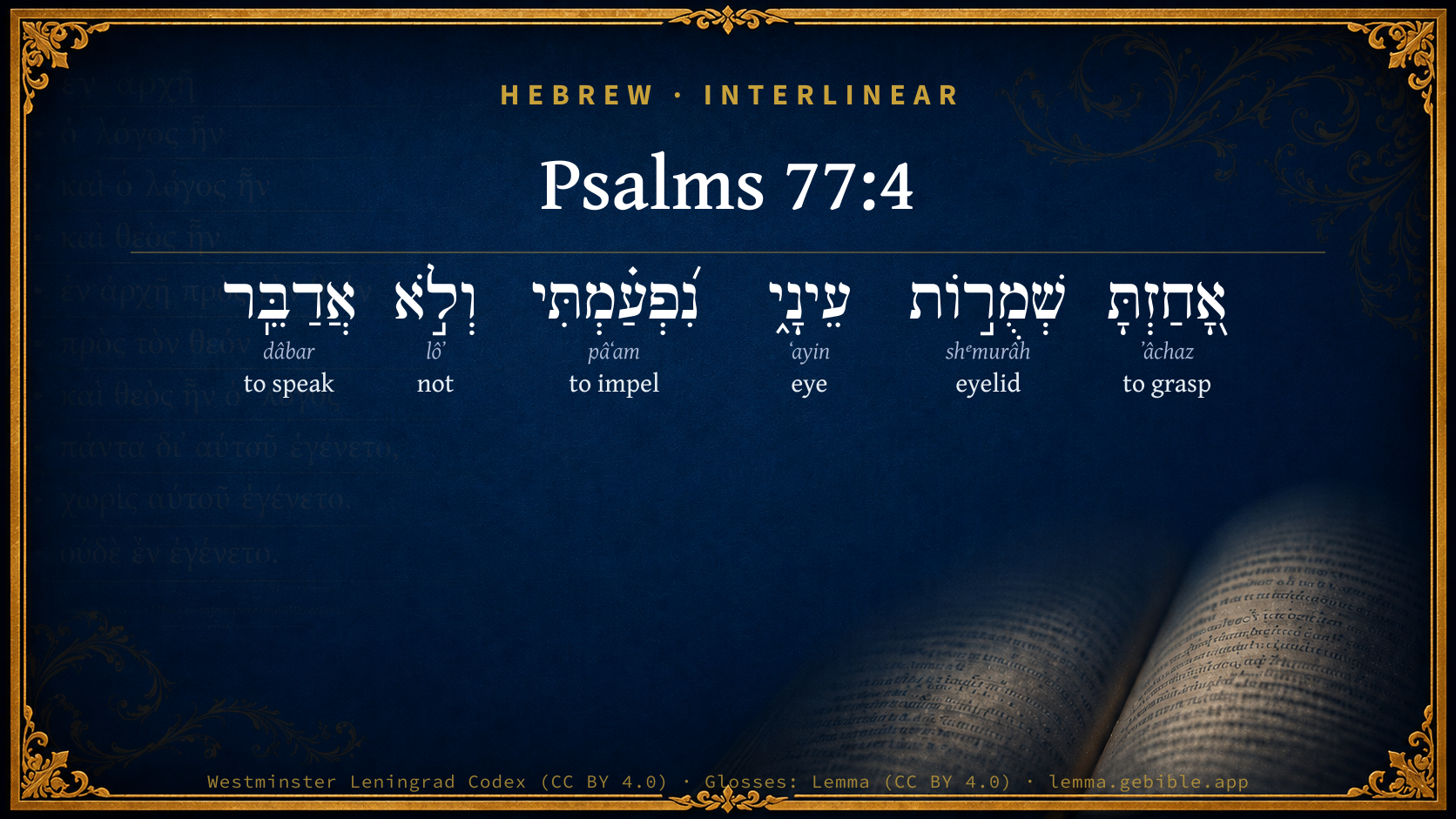
Psalms 77:4

Hebrew (Westminster Leningrad Codex) Psalms 77:4 appears in the Hebrew Old Testament. The text above is from the Westminster Leningrad Codex. Each word links to its Strong’s number, a concise gloss, and parsing drawn from the Open Scriptures Hebrew Bible morphology. Click any word for its full Brown-Driver-Briggs (BDB) entry.
Download image
Cite this verse

Psalms 77:4 (World English Bible). Public Domain. Lemma interlinear Bible study tool, https://lemma.gebible.app/v/psalms/77/4.

Show BibTeX & RIS
BibTeX
RIS
English Translation
You hold my eyelids open. I am so troubled that I can't speak.
World English Bible · Public Domain
Highlights
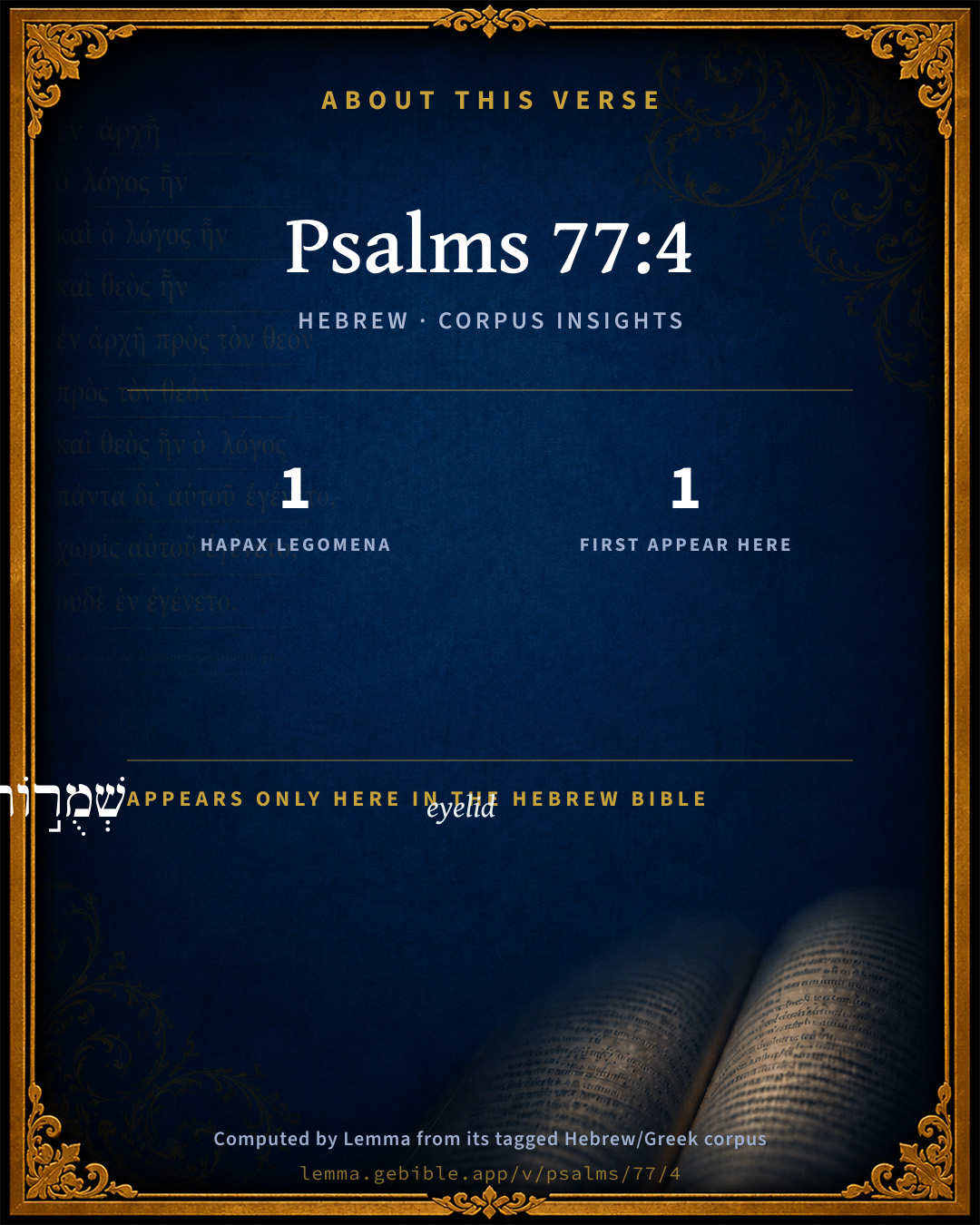
  • 1 hapax legomenon — only here in the Hebrew Bible
  • 1 first appearance in the Hebrew Bible
Full analysis ↓
Download a study sheet

One document with this verse’s original text, its word-by-word gloss line, the meaning frame, cross-references with their text, attributed commentary, and full source and license credits — printable, and it pastes into notes with its structure intact.

This verse Autodidact and up

Study sheet (.html) Plain text (.txt)

A passage Seminary Student

Up to 50 verses in one chapter. A passage sheet keeps up to 6 commentary sources and 12 cross-references per verse, in the order this page ranks them, and says so on the sheet whenever that leaves anything out. Ask for a single verse and you get the Autodidact verse sheet above.

Everything on this page stays free to read, with no account — the sheet is a download of what is already on screen, not access to it.

Want to remove ads? Support Godless Engineer
Compare translations 3

The same verse in 3 English versions, stacked beneath the original-language interlinear above. Click any original word for its lexicon entry.

Each is an independent rendering of the whole verse — the interlinear is not word-aligned to these translations.

Highlighted words mark where these versions differ — a whole-verse word diff, not a word-by-word alignment.

  • World English Bible Public Domain
    You hold my eyelids open. I am so troubled that I can't speak.
  • King James Version Public Domain
    Thou holdest mine eyes waking: I am so troubled that I cannot speak.
  • unfoldingWord Literal Text CC BY-SA 4.0
    You held the lids of my eyes; I was troubled and I did not speak.

unfoldingWord Literal Text — © unfoldingWord, licensed CC BY-SA 4.0. Word-aligned USFM3 via Door43 (git.door43.org/unfoldingWord/en_ult).

Versions to compare (up to 4)

3 of 4 selected

Show all 18 translations

Every available English version of this verse, each an independent rendering of the whole verse.

  • World English Bible Public Domain
    You hold my eyelids open. I am so troubled that I can't speak.
  • Berean Standard Bible Public Domain
    You have kept my eyes from closing; I am too troubled to speak.
  • Majority Standard Bible Public Domain
    You have kept my eyes from closing; I am too troubled to speak.
  • King James Version Public Domain
    Thou holdest mine eyes waking: I am so troubled that I cannot speak.
  • American Standard Version (1901) Public Domain
    Thou holdest mine eyes watching: I am so troubled that I cannot speak.
  • Revised Version (1885) Public Domain
    Thou holdest mine eyes watching: I am so troubled that I cannot speak.
  • Geneva Bible (1599) Public Domain
    Thou keepest mine eyes waking: I was astonied and could not speake.
  • Douay-Rheims (1899) Public Domain
    I remembered God, and was delighted, and was exercised, and my spirit swooned away.
  • Young's Literal Translation Public Domain
    Thou hast taken hold of the watches of mine eyes, I have been moved, and I speak not.
  • Literal Standard Version CC BY-SA 4.0
    You have taken hold of the watches of my eyes, || I have been moved, and I do not speak.
  • Unlocked Literal Bible CC BY-SA 4.0
    You held my eyes open; I was too troubled to speak.
  • unfoldingWord Literal Text CC BY-SA 4.0
    You held the lids of my eyes; I was troubled and I did not speak.
  • Darby Bible Public Domain
    Thou holdest open mine eyelids; I am full of disquiet and cannot speak.
  • World Messianic Bible Public Domain
    You hold my eyelids open. I am so troubled that I can’t speak.
  • Webster's Bible Public Domain
    \\77:3\\I remembered God, and was troubled: I complained, and my spirit was overwhelmed. Selah.
  • Free Bible Version CC BY-SA 4.0
    You stop me going to sleep; I'm so upset I can't even talk.
  • Bible in Basic English Public Domain
    You keep my eyes from sleep; I am so troubled that no words come.
  • JPS Tanakh (1917) Public Domain
    (77-5) Thou holdest fast the lids of mine eyes; I am troubled, and cannot speak.

Literal Standard Version (2020), Covenant Press — licensed CC BY-SA 4.0. Text via the HelloAO Bible API (eBible.org). Unlocked Literal Bible (unfoldingWord) — licensed CC BY-SA 4.0. Text via the HelloAO Bible API (eBible.org). unfoldingWord Literal Text — © unfoldingWord, licensed CC BY-SA 4.0. Word-aligned USFM3 via Door43 (git.door43.org/unfoldingWord/en_ult). Free Bible Version, Dr. Jonathan Gallagher — licensed CC BY-SA 4.0. Text via the HelloAO Bible API (eBible.org).

Word by word

More ways to search: Search by grammar → Find every occurrence → Compare this word →

Practice this passage: Drill this verse → Learn its vocabulary →

About this verse

These counts appear in no published source. They are computed here, from the morphology-tagged text and Lemma’s own curated glosses. What Lemma adds →

6
words
6
distinct lemmas
Wisdom
section

Notable vocabulary

1 hapax legomenon — a word that appears only here in the entire Hebrew Bible:

  • שְׁמֻר֣וֹת eyelid H8109

First appearance in Scripture

This word makes its first canonical appearance in the Hebrew Bible here:

  • שְׁמֻר֣וֹת eyelid H8109

Shared distinctive vocabulary

נִ֝פְעַ֗מְתִּי to impel H6470 occurs in 5 verses of the Hebrew Bible. Also found in:

Grammatical profile

  • 3 verbs
  • 2 nouns
  • 1 particle

Verb forms

  • אָ֭חַזְתָּ Qal · Perfect
  • נִ֝פְעַ֗מְתִּי Niphal · Perfect
  • אֲדַבֵּֽר Piel · Imperfect

Hebrew & Septuagint length

In English translation the verse runs 13 words from the Hebrew and 14 from the Septuagint (LXX English) — closely comparable.

A rough comparison of the two English renderings, which tokenize alike — not a word-level alignment.

Word counts can differ between the Hebrew and the Greek without any difference in meaning — e.g. the Hebrew direct-object marker אֵת has no separate Greek word, and Greek often adds the article ὁ.

Cross-references

5

Topical passages linked to Psalms 77:4 in the Treasury of Scripture Knowledge — connected by theme and wording, ordered by reader-vote popularity; previews shown in the World English Bible.

  • Job 7:13–15 When I say, 'My bed shall comfort me, My couch shall ease my complaint;'
  • Psalms 6:6 I am weary with my groaning; Every night I flood my bed; I drench my couch with my tears.
  • Job 2:13 So they sat down with him on the ground seven days and seven nights, and none spoke a word to him, for they saw that his grief was very great.
  • Esther 6:1 On that night the king couldn't sleep; and he commanded to bring the book of records of the chronicles, and they were read before the king.
  • Job 6:3 For now it would be heavier than the sand of the seas, Therefore have my words been rash.

Cross-references courtesy of OpenBible.info (CC BY 4.0).

Hebrew and Greek witnesses Masoretic Hebrew ↔ Greek Septuagint

The same verse in the two great witnesses to the Old Testament, shown verse-for-verse.

You’re reading Greek Psalm 76 (Hebrew Psalm 77). The Septuagint counts the superscription, so verse numbers can differ from the Hebrew — chapter-level alignment, not verse-by-verse. Numbering follows Rahlfs.

These are two independent witnesses, not word-aligned to each other, and the Septuagint is shown in lemma (dictionary) form.

Hebrew Psalms 77:4 Masoretic · Westminster Leningrad Codex

אָ֭חַזְתָּ שְׁמֻר֣וֹת עֵינָ֑י נִ֝פְעַ֗מְתִּי וְלֹ֣א אֲדַבֵּֽר

You hold my eyelids open. I am so troubled that I can't speak.

World English Bible · Public Domain

Greek LXX Greek Psalm 76:4 Septuagint · lemma form

μιμνήσκω ὁ θεός καί εὐφραίνω ἀδολεσχέω καί ὀλιγοψυχέω ὁ πνεῦμα ἐγώ διάψαλμα

All my enemies set a watch against me: I was troubled, and spoke not.

LXX2012 (modern English Septuagint) · Public Domain

On this verse, Keil & Delitzsch discusses the Septuagint’s reading. Read the note in Commentary ↓

Hebrew: Westminster Leningrad Codex (CC BY 4.0). Greek: Septuagint (public domain); English from LXX2012 (modern English Septuagint) (Public Domain). How the Septuagint differs from the Hebrew →

Commentary

Notes on Psalms 77:4 from classic Christian and Jewish commentators (each source and its license shown beneath its notes). The classic Christian expositions comment on the surrounding passage and are grouped to its opening verse, so a note may address several verses; the Jewish commentaries on the Tanakh (Rashi and others) are per-verse, so they appear only where the commentator wrote on this verse.

Lemma curates 59 commentaries, every one of them public domain or Creative Commons licensed, each selected and text-cleaned for this edition rather than reprinted as found. About our sources →

Trapp's Complete Commentary

John Trapp

Psa 77:4 Thou holdest mine eyes waking: I am so troubled that I cannot speak.

Ver. 4. Thou holdest mine eyes waking] Thou holdest the watches of mine eyes, that is, mine eyebrows, saith the Chaldee, so that I can neither sleep nor speak. Job complaineth of the like misery, Job 7:8 See Psa 38:10

That I cannot speak] Curae leves loquuntur, ingentes stupent.

John Trapp, A Commentary or Exposition upon All the Books of the Old and New Testament (1647–1656) — public domain. Text from a community e-Sword module.

Joseph Benson's Commentary

Psa 77:4. Thou holdest mine eyes waking — By those bitter and continual griefs, and those perplexing and distressing thoughts and cares, which thou excitest within me. I am so troubled that I cannot speak — The greatness of my sorrow so stupifies and confuses my mind, that I can scarcely open my mouth to declare my grief in proper terms; nor can any words sufficiently express the extremity of my misery: see Job 2:13.

Joseph Benson's Commentary on the Old and New Testaments (1811–1818) — public domain. Text from a community e-Sword module.

J. A. Alexander on Psalms

Joseph Addison Alexander

5. (Psa 77:4). Thou hast held fast my eyes; I am smitten and cannot speak. The word here rendered fast is properly a passive participle, meaning watched, kept, and here, from the connection, kept awake or open. This circumstance is added to enhance the description of his miserable state.

Joseph Addison Alexander, The Psalms Translated and Explained (1850) — public domain. Text from a community e-Sword module.

Tyndale Open Study Notes

Tyndale Open Resources

77:4-6 As the psalmist meditates at night, he feels so disturbed that he cannot sleep or speak. He has pleasant memories of the past, but he cannot look beyond the present moment into the future.

Tyndale Open Study Notes — © Tyndale Open Resources, licensed CC BY-SA 4.0. Text via the HelloAO Bible API.

Geneva Bible (1599)

Geneva Bible translators

Meaning, that his sorrows were as watchmen that kept his eyes from sleeping.

Geneva Bible (1599) marginal notes — public domain. Text via Bolls.life.

Adam Clarke's Commentary

Verse 4. Thou holdest mine eyes waking] Literally, thou keepest the watches of mine eyes - my grief is so great that I cannot sleep.

I am so troubled that I cannot speak.] This shows an increase of sorrow and anguish. At first he felt his misery, and called aloud. He receives more light, sees and feels his deep wretchedness, and then his words are swallowed by excessive distress. His woes are too big for utterance. "Small troubles are loquacious; the great are dumb." Curae leves loquuntur; ingentes stupent.

Adam Clarke's Commentary on the Bible (1810–1826) — public domain. Text from a community e-Sword/MySword module.

John Calvin's Commentaries

4. Thou hast held the watches of my eyes. This verse is to the same effect with the preceding. The Psalmist affirms that he spent whole nights in watching, because God granted him no relief. The night in ancient times was usually divided into many watches; and, accordingly, he describes his continued grief, which pre. vented him from sleeping, by the metaphorical term watches. When he stated a little before that he prayed to God with a loud voice, and when he now affirms that he will remain silent, there seems to be some appearance of discrepancy. This difficulty has already been solved in our exposition of Psalm 32:3, where we have shown that true believers, when overwhelmed with sorrow, do not continue in a state of unvarying uniformity, but sometimes give vent to sighs and complaints, while, at other times, they are silent as if their mouths were stopped. It is, therefore, not wonderful to find the prophet frankly confessing that he was so overwhelmed, and, as it were, choked, with calamities, as to be unable to open his mouth to utter even a single word.

John Calvin's Commentaries (1540-1563) — public domain. Text from the Calvin Translation Society English edition (1840s-50s) via the Christian Classics Ethereal Library (ccel.org). Calvin's coverage is partial (roughly two-thirds of the Bible); uncommented books and verses are honest gaps, never fabricated. The 19th-century editor's footnotes and remarks are omitted so the notes are faithfully Calvin's own voice.

Ellicott's Commentary for English Readers

(4) Thou holdest mine eyes waking.—Rather, Thou hast closed the guards of my eyes—i.e., my eyelids. The Authorised Version mistakes the noun. guards, for a participle, and mistranslates it by the active instead of the passive. For the verb hold in the sense of shut, see Neh_7:3, and Job_26:9, where God is described as veiling His throne in cloud, and so shutting it up, as it were, from the access of men.

I am so troubled.—The verb is used elsewhere of the awestruck state into which the mind is thrown by a mysterious dream (Gen_41:8; Dan_2:1; Dan_2:3), and once (Jdg_13:25) of inspiration, such as impelled the judges of old to become the liberators of their country. The parallelism here shows that it is used in the first connection. The poet has been struck dumb (the verb is rendered strike in the Lexicons) by a mysterious dream; he is too overawed to speak.

A Bible Commentary for English Readers, edited by Charles John Ellicott (1878–1897) — public domain. Text from a community e-Sword module.

The Cambridge Bible for Schools and Colleges

gen. ed. J. J. S. Perowne

4. Thou heldest open the lids of mine eyes:

I was perplexed, and could not speak.

4. The word rendered waking in A.V., watching in R.V., probably means the guards or lids of the eyes. The general sense is clear. In his agony of sorrow he was sleepless and speechless: it was God who withheld sleep from his eyes. He was ‘troubled,’ perplexed and agitated (Gen_41:8; Dan_2:3) by the riddle of Israel’s present rejection and humiliation, and in this perplexity he pondered (Psa_77:5) on the glorious record of God’s mercies to His people in the days of old.

4–9. In the vigils of the night he pondered on the history of the past, and asked himself with earnest questionings whether it were possible that God could have utterly cast off His people, and changed His character as a gracious and merciful God.

The Cambridge Bible for Schools and Colleges (gen. ed. J. J. S. Perowne; Cambridge University Press, 1878–1918) — public domain. Text from a community e-Sword module.

John Gill's Exposition

Thou holdest mine eyes waking,.... Or, "the watches", or rather "keepers of the eyes" (m); the eyebrows, which protect the eyes; these were held, so that he could not shut them, and get any sleep; so R. Moses Haccohen interprets the words, as Jarchi observes; and so the Targum,

"thou holdest the brows of my eyes;''

a person in trouble, when he can get some sleep, it interrupts his sorrow, weakens it at least, if it does not put a stop to it; wherefore it is a great mercy to have sleep, and that refreshing, Psa 127:1, but to have this denied, and to have wearisome nights, and be in continual tossing to and fro, is very distressing:

I am so troubled that I cannot speak; his spirits were so sunk with weariness, and want of sleep in the night, that he could not speak in the morning; or his heart was so full with sorrow, that he could not utter himself; or it was so great that he could not express it; or his thoughts were such that he dared not declare them; or he was so straitened and shut up in himself that he could not go on speaking unto God in prayer.

(m) "vigilias", Pagninus, Montanus, Vatablus, Tigurine version; "palpebras oculorum meorum", Musculus, Cocceius; "palpebras quasi custodias oculorum", Michaelis.

John Gill's Exposition of the Whole Bible (1746–1763) — public domain (CC PDM 1.0). Text via the HelloAO Bible API.

Albert Barnes' Notes on the Bible

Thou holdest mine eyes waking - literally, “Thou holdest the watchings of my eyes.” Gesenius (Lexicon) translates the Hebrew word rendered “waking,” “eyelids.” Probably that is the true idea. The eyelids are the watchers or guardians of the eyes. In danger, and in sleep, they close. Here the idea is, that God held them so that they did not close. He overcame the natural tendency of the eye to shut. In other words, the psalmist was kept awake; he could not sleep. This he traces to God. The idea is, that God so kept himself before his mind - that such ideas occurred to him in regard to God - that he could not sleep.

I am so troubled - With sad and dark views of God; so troubled in endeavoring to understand his character and doings; in explaining his acts; in painful ideas that suggest themselves in regard to his justice, his goodness, his mercy.

That I cannot speak - I am struck dumb. I know not what to say. I cannot find “anything” to say. He must have a heart singularly and happily free by nature from scepticism, or must have reflected little on the divine administration, who has not had thoughts pass through his mind like these. As the psalmist was a good man, a pious man, it is of importance to remark, in view of his experience, that such reflections occur not only to the minds of bad people - of the profane - of sceptics - of infidel philosophers, but they come unbidden into the minds of good people, and often in a form which they cannot calm down. He who has never had such thoughts, happy as he may and should deem himself that he has not had them, has never known some of the deepest stirrings and workings of the human soul on the subject of religion, and is little qualified to sympathize with a spirit torn, crushed, agitated, as was that of the psalmist on these questions, or as Augustine and thousands of others have been in after-times. But let not a man conclude, because he has these thoughts, that therefore he cannot be a friend of God - a converted man. The wicked man invites them, cherishes them, and rejoices that he can find what seem to him to be reasons for indulging in such thoughts against God; the good man is pained; struggles against them: endearours to banish them from his soul.

Albert Barnes' Notes on the Bible (1834–1885) — public domain. Text from a community e-Sword/MySword module.

Matthew Poole's English Annotations

Thou holdest mine eyes waking, by those sharp and continual griefs, and those perplexing and tormenting thoughts and cares, which from time to time thou stirrest up in me.

I am so troubled that I cannot speak; the greatness of my sorrows stupifies my mind, and makes me both lifeless and unable to speak; nor can any words sufficiently express the extremity of my misery.

Matthew Poole's English Annotations on the Holy Bible (1683–1685) — public domain. Text from a community e-Sword/MySword module.

The Treasury of David

Charles H. Spurgeon

Ver. 4. Thou holdest mine eyes waking. The fears which thy strokes excite in me forbid my eyelids to fall, my eyes continue to watch as sentinels forbidden to rest. Sleep is a great comforter, but it forsakes the sorrowful, and then their sorrow deepens and eats into the soul. If God holds the eyes waking, what anodyne shall give us rest? How much we owe to him who giveth his beloved sleep!

I am so troubled that I cannot speak. Great griefs are dumb. Deep streams brawl not among the pebbles like the shallow brooklets which live on passing showers. Words fail the man whose heart fails him. He had cried to God but he could not speak to man, what a mercy it is that if we can do the first, we need not despair though the second should be quite out of our power. Sleepless and speechless Asaph was reduced to great extremities, and yet he rallied, and even so shall we.

Whole Psalm. Whenever, and by whomsoever, the Psalm may have been written, it clearly is individual, not national. It utterly destroys all the beauty, all the tenderness and depth of feeling in the opening portion, if we suppose that the people are introduced speaking in the first person. The allusions to the national history may indeed show that the season was a season of national distress, and that the sweet singer was himself bowed down by the burden of the time, and oppressed by woes which he had no power to alleviate; but it is his own sorrow, not the sorrow of others under which he sighs, and of which he has left the pathetic record. J. J. Stewart Perowne.

Ver. 4. Thou holdest mine eyes waking. Thou art afflicted with want of sleep: --A complaint incident to distempered bodies and thoughtful minds. Oh, how wearisome a thing it is to spend the long night in tossing up and down in a restless bed, in the chase of sleep; which the more eagerly it is followed, flies so much the farther from us! Couldest thou obtain of thyself to forbear the desire of it, perhaps it would come alone: now that thou suest for it, like to some froward piece, it is coy and overly, and punishes thee with thy longing. Lo, he that could command a hundred and seven and twenty provinces, yet could not command rest. `On that night his sleep departed from him, 'Es 6:1, neither could be forced or entreated to his bed. And the great Babylonian monarch, though he had laid some hand on sleep, yet he could not hold it; for "his sleep brake from him, "Da 2:1. And, for great and wise Solomon, it would not so much as come within his view. "Neither day nor night seeth he sleep with his eyes." Ec 8:16. Surely, as there is no earthly thing more comfortable to nature than bodily rest (Jer 31:26); so, there is nothing more grievous and disheartening... Instead of closing thy lids to wait for sleep, lift up thy stiff eyes to him that "giveth his beloved rest, "Ps 127:2. Whatever be the means, he it is that holdeth mine eyes waking. He that made thine eyes, keeps off sleep from thy body, for the good of thy soul: let not thine eyes wake, without thy heart. The spouse of Christ can say, "I sleep, but my heart waketh, "So 5:2. How much more should she say, "Mine eyes wake, and my heart waketh also!" When thou canst not sleep with thine eyes, labour to see him that is invisible: one glimpse of that sight is more worth than all the sleep that thine eyes can be capable of. Give thyself up into his hands, to be disposed of at his will. What is this sweet acquiescence but the rest of the soul? which if thou canst find in thyself, thou shalt quietly digest the want of thy bodily sleep. Joseph Hall, in his "Balm of Gilead."

Ver. 4. I am so troubled that I cannot speak. He adds that he was so cut down and lifeless that he could not speak. Little griefs, as it is often said, are uttered, great ones strike us dumb. In great troubles and fears the spirit fails the exterior members, and flows back to its fountain; the limbs stand motionless, the whole body trembles, the eyes remain fixed, and the tongue forgets its office. Hence it is that Niobe was represented by the poets as turned into a stone. The history of Psammentius also, in Herodotus, is well known, how over the misfortunes of his children he sat silent and overwhelmed, but when he saw his friend's calamities he bewailed them with bitter tears. Mollerus.

Ver. 4. I am so troubled that I cannot speak. Sometimes our grief is so violent that it finds no vent, it strangles us, and we are overcome. It is with us in our desertions as with a man that gets a slight hurt; at first he walks up and down, but not looking betimes to prevent a growing mischief, the neglected wound begins to fester, or to gangrene, and brings him to greater pain and loss. So it is with us many times in our spiritual sadness; when we are first troubled, we pray and pour out our souls before the Lord; but afterwards the waters of our grief drown our cries and we are so overwhelmed, that if we might have all the world we cannot pray, or at least we can find no enlargement, no life, no pleasure in our prayers; and God himself seems to take no delight in them, and that makes us more sad, Ps 22:1. Timothy Rogers (1660-1729), in "A Discourse on Trouble of Mind, and the Disease of Melancholy."

Ver. 4. Troubled. Or, bruised: the Hebrew word probably signifieth an astonishment caused by some great blow received. John Diodati.

Ver. 4. I cannot speak. Words are but the body, the garment, the outside of prayer; sighs are nearer the heart work. A dumb beggar getteth an alms at Christ's gates, even by making signs, when his tongue cannot plead for him; and the rather, because he is dumb. Objection. I have not so much as a voice to utter to God; and Christ saith, "Cause me to hear thy voice" (Canticles 2:14). Answer. Yea, but some other thing hath a voice beside the tongue: "The Lord has heard the voice of my weeping" (Ps 6:8). Tears have a tongue, and grammar, and language, that our Father knoweth. Babes have no prayer for the breast, but weeping: the mother can read hunger in weeping. Samuel Rutherford.

Ver. 4. If through all thy discouragements thy condition prove worse and worse, so that thou canst not pray, but are struck dumb when thou comest into his presence, as David, then fall making signs when thou canst not speak; groan, sigh, sob, "chatter, "as Hezekiah did; bemoan thyself for thine unworthiness, and desire Christ to speak thy requests for thee, and God to hear him for thee. Thomas Goodwin.

Ver. 4.

I. A good man cannot rest on his bed until his soul rests

on God.

II. He cannot speak freely to others until God speaks

peace to his soul. G. R.

Ver. 4. Occupation for the sleepless, and consolation for the speechless.

Psalms 77:5*

Charles H. Spurgeon's The Treasury of David (1869–1885) — public domain. Psalms only. Text from a community e-Sword/MySword module.

Whedon's Commentary on the Bible

Daniel D. Whedon

4. Thou holdest mine eyes waking—Thou holdest the watches, or guards, of my eyes; that is, my eyelids. Sleep is God’s merciful gift, (Psa_127:2,) and wakefulness is here confessed as a judgment.

I cannot speak—But he could moan, as in Psa_77:3. The extremes of loud moaning and speechless silence indicate the paroxysm and excess of his sorrow.

Daniel D. Whedon (gen. ed.), Commentary on the Old and New Testaments (1874–1909) — public domain. Text from a community e-Sword module.

The Pulpit Commentary

Thou holdest mine eyes waking; literally, thou boldest the watches of mine eyes; i.e. preventedst me from obtaining any sleep. I am so troubled that I cannot speak; literally, I was perplexed and did not speak. The perplexity was probably caused by an inability to understand God"s ways. Why had he afflicted his people? Was the affliction always to continue? Was Israel cast off?

Occupations for sleepless nights.

Comparing ver. 3, we find that, lying awake, the psalmist had "remembered God," or, more precisely, had "thought upon God." It is true that the thought had only brought him trouble, but the occupation was good, whatever it brought him. Comp. Psa_4:4, "Commune with your own heart upon your bed, and be still;" Psa_63:6, "When I remember thee upon my bed, and meditate on thee in the night watches." As the cause of less of sleep is generally a physical condition, and often brain disease of some kind, men usually at such times take sombre, dreary, and distressing views. They are never so ready to "write bitter things against themselves as when they lie awake at night." It is well to see clearly that the views taken at such times are almost always untrue and unworthy, and can seldom be hopefully made the guide of conduct or the basis of important decisions. And proper correction of gloomy night views should be made when sunshine brings light and cheer into our souls once more.

I MOST PEOPLE, WHEN THEY LIE AWAKE, WORRY OVER THEIR CIRCUMSTANCES. And that is a very hopeless occupation. Only dark, depressing, anxious sides of things are likely to come to view in night seasons. It will be found that the fretting things are usually the things selected for thinking over. And, usually, it is imagination that is active, fashioning woes in the near future, and presenting all the issues that are unfolding as disastrous. It would be a lesson never to be forgotten by any man, if he could be told the fears he fashioned in the night seasons that never came to pass.

II MANY PEOPLE, WHEN THEY LIE AWAKE, THINK OVER THEIR SINS. And that is even a more hopeless occupation. A man wants light in which to see his sins truly. Brooding over the "things we have done which we should not have done, and the things left undone which we should have done," is sure to become morbid work. Souls do even get a kind of dreadful satisfaction in making themselves out to be as wicked as possible. And night estimates of sin are very seldom true ones. Besides, this going over of past sins is absolutely wrong, for it is dishonouring God by the untrustfulness which wilt not fully receive the truth, that all those sins are pardoned and put forever away. If God no longer "remembers" them, it must be wrong for us to do so.

III WISE PEOPLE, WHEN THEY LIE AWAKE SET THEIR THOUGHTS ON GOD. And that is the proper and hopeful occupation.

1. Even our circumstances seem to gain new shapings, settings, and relations, and become altogether more hopeful, when we can associate God with them.

2. Even our sins can be calmly reviewed, when we can see how God has dealt with them, and what he has done for us through sanctifying to us our very experience of them. R.T.

The Pulpit Commentary (1880–1919), ed. H.D.M. Spence-Jones & Joseph S. Exell — public domain. Text from a community e-Sword module.

John Wesley's Explanatory Notes

Waking - By continual grief.

John Wesley, Explanatory Notes Upon the Whole Bible (1754–1765) — public domain. Text via the GEBible commentary corpus.

Keil & Delitzsch

C. F. Keil & F. Delitzsch

He calls his eyelids the "guards of my eyes." He who holds these so that they remain open when they want to shut together for sleep, is God; for his looking up to Him keeps the poet awake in spite of all overstraining of his powers. Hupfeld and others render thus: "Thou hast held, i.e., caused to last, the night-watches of mine eyes," - which is affected in thought and expression. The preterites state what has been hitherto and has not yet come to a close. He still endures, as formerly, such thumps and blows within him, as though he lay upon an anvil (פּעם), and his voice fails him. Then silent soliloquy takes the place of audible prayer; he throws himself back in thought to the days of old (Psa 143:5), the years of past periods (Isa 51:9), which were so rich in the proofs of the power and loving-kindness of the God who was then manifest, but is now hidden. He remembers the happier past of his people and his own, inasmuch as he now in the night purposely calls back to himself in his mind the time when joyful thankfulness impelled him to the song of praise accompanied by the music of the harp (בּלּילה belongs according to the accents to the verb, not to נגינתי, although that construction certainly is strongly commended by parallel passages like Psa 16:7; Psa 42:9; Psa 92:3, cf. Job 35:10), in place of which, crying and sighing and gloomy silence have now entered. He gives himself up to musing "with his heart," i.e., in the retirement of his inmost nature, inasmuch as he allows his thoughts incessantly to hover to and fro between the present and the former days, and in consequence of this (fut. consec. as in Psa 42:6) his spirit betakes itself to scrupulizing (what the lxx reproduces with σκάλλειν, Aquila with σκαλεύειν) - his conflict of temptation grows fiercer. Now follow the two doubting questions of the tempted one: he asks in different applications, Psa 77:8-10 (cf. Psa 85:6), whether it is then all at an end with God's loving-kindness and promise, at the same time saying to himself, that this nevertheless is at variance with the unchangeableness of His nature (Mal 3:6) and the inviolability of His covenant. אפס (only occurring as a 3. praet.) alternates with גּמר (Psa 12:2). חנּות is an infinitive construct formed after the manner of the Lamed He verbs, which, however, does also occur as infinitive absolute (שׁמּות, Eze 36:3, cf. on Psa 17:3); Gesenius and Olshausen (who doubts this infinitive form, 245, f) explain it, as do Aben-Ezra and Kimchi, as the plural of a substantive חנּה, but in the passage cited from Ezekiel (vid., Hitzig) such a substantival plural is syntactically impossible. קפץ רחמים is to draw together or contract and draw back one's compassion, so that it does not manifest itself outwardly, just as he who will not give shuts (יקפּץ) his hand (Deu 15:7; cf. supra, Psa 17:10).

Keil & Delitzsch — Biblical Commentary on the Old Testament (1861–1891) — public domain (CC PDM 1.0). Text via the HelloAO Bible API. (Old Testament only.)

unfoldingWord translationNotes

Door43 World Missions Community

General Information:

After speaking about God, Asaph speaks to God in verse 4 and then returns to speaking about God.

You held my eyes open

"I said to God, 'You held my eyes open.'"

held my eyes open

Open eyes is a metonym for being unable to sleep. AT: "kept me from sleeping" (See: Metonymy)

the days of old, about times long past

If necessary, "days of old" and "times long past" can be combined. AT: "about things that happened a very long time ago" (See: Parallelism)

translationWords

trouble

time

unfoldingWord translationNotes — © Distant Shores Media and the Door43 World Missions Community, licensed CC BY-SA 4.0. Source: git.door43.org/Door43/en_tn.

Rashi

Rabbi Shlomo Yitzchaki (Rashi)

I remember God The kindness that He used to do for me in the days of my love.

I speak about those acts of kindness and the favors.

and my spirit becomes faint Pasmer in Old French, to faint or swoon.

Rashi on the Tanakh — English translations: “The Judaica Press complete Tanach with Rashi, translated by A. J. Rosenberg” (CC BY 4.0); “Pentateuch with Rashi's commentary by M. Rosenbaum and A.M. Silbermann, 1929-1934” (public domain); “The Metsudah Tanach series, Lakewood, N.J” (CC BY 4.0); and “The Book of Joshua, Metsudah Publications, 1997” (CC BY 4.0). Text via Sefaria.

Lesson kit

Teaching starters — assembled from the data on this page, not authored interpretation. Every prompt links to the verse data it draws on. Edit before teaching.

Psalms, in the Wisdom, opens this verse with 6 words (6 distinct Hebrew lemmas). Its most distinctive word is shᵉmurâh (“eyelid”). A historical commentator’s framing appears above. Read the whole chapter for the surrounding context.

Discussion questions

  1. How does “eyelid” (shᵉmurâh) shape what this verse is saying?
  2. This verse holds 1 word here found nowhere else in the Hebrew Bible. What might the rare word draw attention to?
  3. The word “eyelid” first appears here in Scripture. What is being introduced at this debut?
  4. Genesis 41:8 shares the word «to impel» with this verse. How do the two illuminate each other?
  5. These translations render this verse differently; the difference is in the English rendering, not the original. What questions does that raise?
  6. The verb «אָ֭חַזְתָּ» is Qal Perfect. How does its form color the action?
  7. Reading how Trapp's Complete Commentary and Joseph Benson's Commentary read this verse, where do the two commentators agree and where do they part?

Things to notice

  • 1 word in this verse appears nowhere else in the Hebrew Bible.
  • 1 word makes its first canonical appearance in Scripture here.
  • These translations choose different wording for 14 words in this verse.
  • 6 distinct Hebrew lemmas span 6 words in this verse.

Reading settings

Reading text

Shown beneath each verse's original-language words.

Old Testament
Old Testament edition

Read the OT as the Masoretic Hebrew (MT) or the Greek Septuagint (LXX).

English shown for the Greek Septuagint (in the Hebrew ↔ Greek comparison).

Comparing translations? Open the Compare panel on any verse page to stack up to four side by side.