
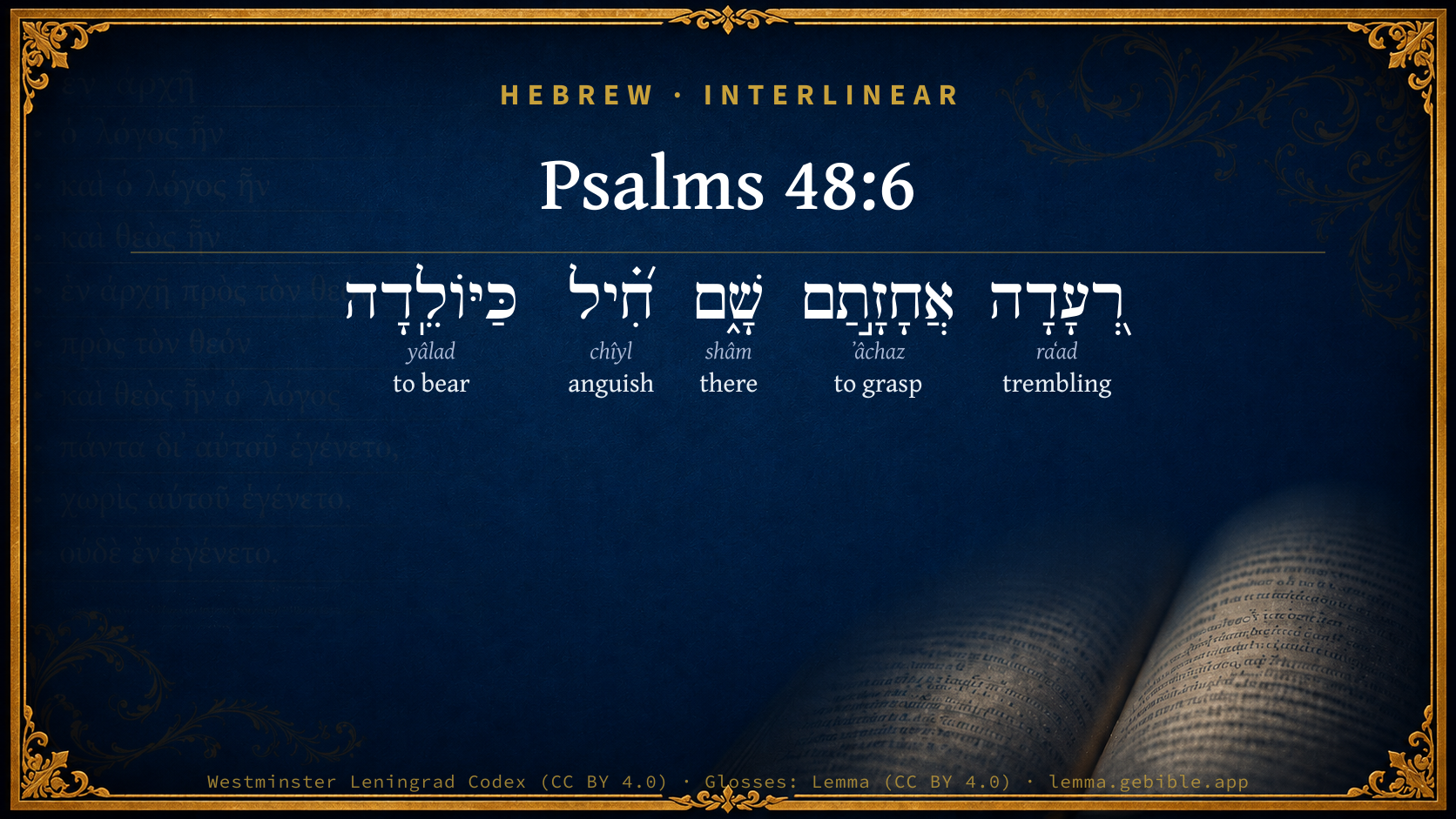
Psalms 48:6

Hebrew (Westminster Leningrad Codex) Psalms 48:6 appears in the Hebrew Old Testament. The text above is from the Westminster Leningrad Codex. Each word links to its Strong’s number, a concise gloss, and parsing drawn from the Open Scriptures Hebrew Bible morphology. Click any word for its full Brown-Driver-Briggs (BDB) entry.
Download image
Cite this verse

Psalms 48:6 (World English Bible). Public Domain. Lemma interlinear Bible study tool, https://lemma.gebible.app/v/psalms/48/6.

Show BibTeX & RIS
BibTeX
RIS
English Translation
Trembling took hold of them there, Pain, as of a woman in travail.
World English Bible · Public Domain
Download a study sheet

One document with this verse’s original text, its word-by-word gloss line, the meaning frame, cross-references with their text, attributed commentary, and full source and license credits — printable, and it pastes into notes with its structure intact.

This verse Autodidact and up

Study sheet (.html) Plain text (.txt)

A passage Seminary Student

Up to 50 verses in one chapter. A passage sheet keeps up to 6 commentary sources and 12 cross-references per verse, in the order this page ranks them, and says so on the sheet whenever that leaves anything out. Ask for a single verse and you get the Autodidact verse sheet above.

Everything on this page stays free to read, with no account — the sheet is a download of what is already on screen, not access to it.

Want to remove ads? Support Godless Engineer
Compare translations 3

The same verse in 3 English versions, stacked beneath the original-language interlinear above. Click any original word for its lexicon entry.

Each is an independent rendering of the whole verse — the interlinear is not word-aligned to these translations.

Highlighted words mark where these versions differ — a whole-verse word diff, not a word-by-word alignment.

  • World English Bible Public Domain
    Trembling took hold of them there, Pain, as of a woman in travail.
  • King James Version Public Domain
    Fear took hold upon them there, and pain, as of a woman in travail.
  • unfoldingWord Literal Text CC BY-SA 4.0
    Trembling seized them there, pain like childbearing.

unfoldingWord Literal Text — © unfoldingWord, licensed CC BY-SA 4.0. Word-aligned USFM3 via Door43 (git.door43.org/unfoldingWord/en_ult).

Versions to compare (up to 4)

3 of 4 selected

Show all 18 translations

Every available English version of this verse, each an independent rendering of the whole verse.

  • World English Bible Public Domain
    Trembling took hold of them there, Pain, as of a woman in travail.
  • Berean Standard Bible Public Domain
    Trembling seized them there, anguish like a woman in labor.
  • Majority Standard Bible Public Domain
    Trembling seized them there, anguish like a woman in labor.
  • King James Version Public Domain
    Fear took hold upon them there, and pain, as of a woman in travail.
  • American Standard Version (1901) Public Domain
    Trembling took hold of them there, Pain, as of a woman in travail.
  • Revised Version (1885) Public Domain
    Trembling took hold of them there; pain, as of a woman in travail.
  • Geneva Bible (1599) Public Domain
    Feare came there vpon them, and sorowe, as vpon a woman in trauaile.
  • Douay-Rheims (1899) Public Domain
    So they saw, and they wondered, they were troubled, they were moved:
  • Young's Literal Translation Public Domain
    Trembling hath seized them there, Pain, as of a travailing woman.
  • Literal Standard Version CC BY-SA 4.0
    Trembling has seized them there, || Pain, as of a travailing woman.
  • Unlocked Literal Bible CC BY-SA 4.0
    Trembling took hold of them there, pain as when a woman is in labor.
  • unfoldingWord Literal Text CC BY-SA 4.0
    Trembling seized them there, pain like childbearing.
  • Darby Bible Public Domain
    Trembling took hold upon them there; anguish, as of a woman in travail.
  • World Messianic Bible Public Domain
    Trembling took hold of them there, pain, as of a woman in travail.
  • Webster's Bible Public Domain
    \\48:5\\They saw it, and so they wondered; they were troubled, and hasted away.
  • Free Bible Version CC BY-SA 4.0
    They shook all over, and were in agonizing pain like a woman giving birth,
  • Bible in Basic English Public Domain
    Shaking came on them and pain, as on a woman in childbirth.
  • JPS Tanakh (1917) Public Domain
    (48-7) Trembling took hold of them there, pangs, as of a woman in travail.

Literal Standard Version (2020), Covenant Press — licensed CC BY-SA 4.0. Text via the HelloAO Bible API (eBible.org). Unlocked Literal Bible (unfoldingWord) — licensed CC BY-SA 4.0. Text via the HelloAO Bible API (eBible.org). unfoldingWord Literal Text — © unfoldingWord, licensed CC BY-SA 4.0. Word-aligned USFM3 via Door43 (git.door43.org/unfoldingWord/en_ult). Free Bible Version, Dr. Jonathan Gallagher — licensed CC BY-SA 4.0. Text via the HelloAO Bible API (eBible.org).

Word by word

More ways to search: Search by grammar → Find every occurrence → Compare this word →

Practice this passage: Drill this verse → Learn its vocabulary →

About this verse

These counts appear in no published source. They are computed here, from the morphology-tagged text and Lemma’s own curated glosses. What Lemma adds →

5
words
5
distinct lemmas
Wisdom
section

Notable vocabulary

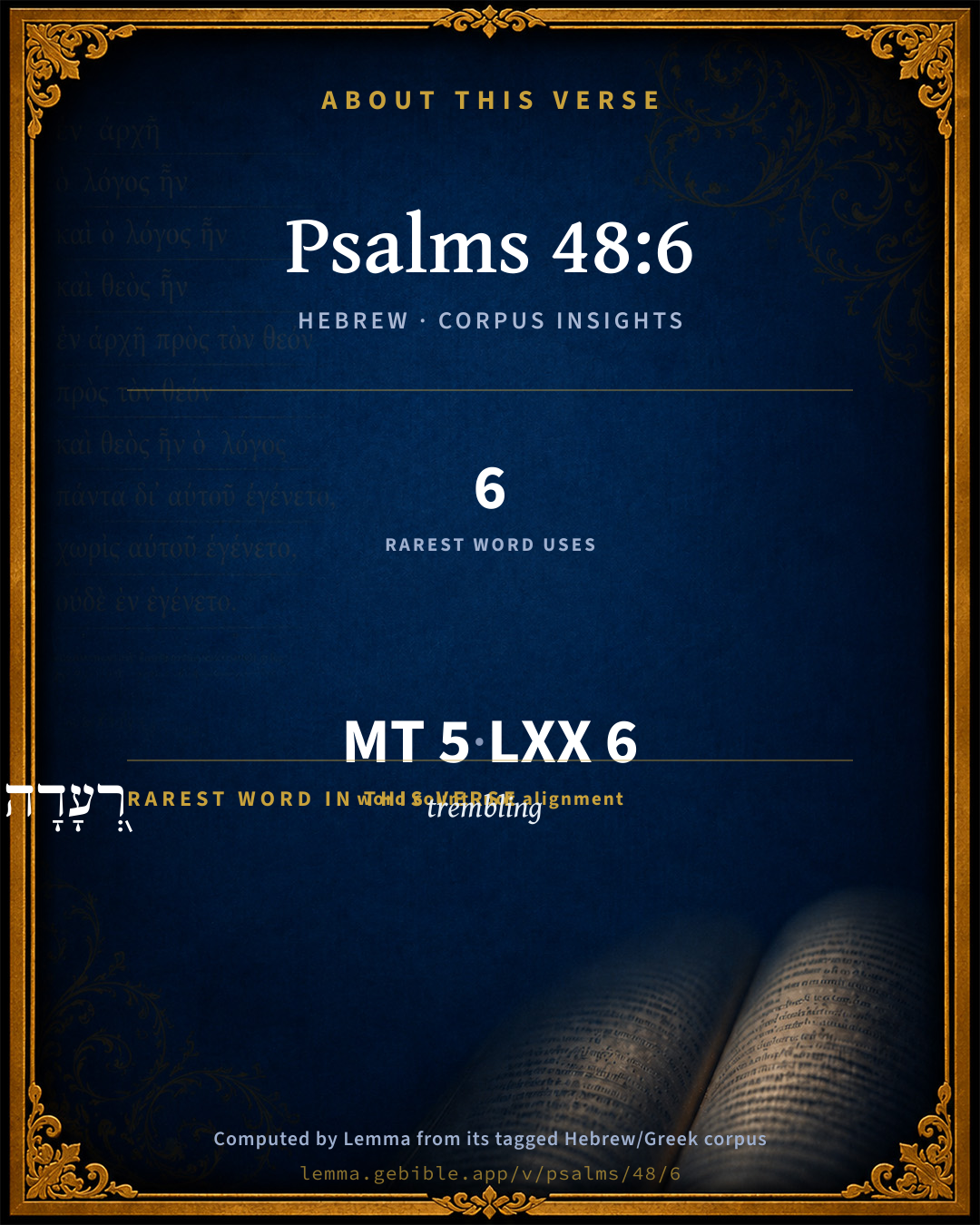
The rarest word here is רְ֭עָדָה trembling H7461 — appearing just 6 times in the whole Hebrew Bible.

Shared distinctive vocabulary

רְ֭עָדָה trembling H7461 occurs in 6 verses of the Hebrew Bible. Also found in:

Grammatical profile

  • 2 verbs
  • 2 nouns
  • 1 adverb

Verb forms

  • אֲחָזָ֣תַם Qal · Perfect
  • כַּיּוֹלֵֽדָה Qal · Participle Active

Hebrew & Septuagint length

In English translation the verse runs 13 words from the Hebrew and 15 from the Septuagint (LXX English) — closely comparable.

A rough comparison of the two English renderings, which tokenize alike — not a word-level alignment.

Word counts can differ between the Hebrew and the Greek without any difference in meaning — e.g. the Hebrew direct-object marker אֵת has no separate Greek word, and Greek often adds the article ὁ.

In the original languages it is 5 Hebrew tokens and 6 Greek tokens — but the two are counted differently (Hebrew bundles its prefixes and suffixes into one token; the Greek is in lemma form), so that isn’t a like-for-like length.

Cross-references

6

Topical passages linked to Psalms 48:6 in the Treasury of Scripture Knowledge — connected by theme and wording, ordered by reader-vote popularity; previews shown in the World English Bible.

  • Isaiah 13:6–8 Wail; for the day of Yahweh is at hand; as destruction from the Almighty shall it come.
  • Hosea 13:13 The sorrows of a travailing woman will come on him. He is an unwise son; For when it is time, he doesn't come to the opening of the womb.
  • Exodus 15:15–16 Then the chiefs of Edom were dismayed. Trembling takes hold of the mighty men of Moab. All the inhabitants of Canaan are melted away.
  • Isaiah 21:3 Therefore are my loins filled with anguish; pangs have taken hold on me, as the pangs of a woman in travail: I am pained so that I can't hear; I am dismayed so that I can't see.
  • Jeremiah 30:6–7 Ask now, and see whether a man does travail with child: why do I see every man with his hands on his loins, as a woman in travail, and all faces are turned into paleness?
  • Daniel 5:6 Then the king's face was changed in him, and his thoughts troubled him; and the joints of his loins were loosened, and his knees struck one against another.

Cross-references courtesy of OpenBible.info (CC BY 4.0).

Hebrew and Greek witnesses Masoretic Hebrew ↔ Greek Septuagint

The same verse in the two great witnesses to the Old Testament, shown verse-for-verse.

You’re reading Greek Psalm 47 (Hebrew Psalm 48). The Septuagint counts the superscription, so verse numbers can differ from the Hebrew — chapter-level alignment, not verse-by-verse. Numbering follows Rahlfs.

These are two independent witnesses, not word-aligned to each other, and the Septuagint is shown in lemma (dictionary) form.

Hebrew Psalms 48:6 Masoretic · Westminster Leningrad Codex

רְ֭עָדָה אֲחָזָ֣תַם שָׁ֑ם חִ֝֗יל כַּיּוֹלֵֽדָה

Trembling took hold of them there, Pain, as of a woman in travail.

World English Bible · Public Domain

Greek LXX Greek Psalm 47:6 Septuagint · lemma form

αὐτός ὁράω οὕτως θαυμάζω ταράσσω σαλεύω

Trembling took hold on them: there were the pangs as of a woman in travail.

LXX2012 (modern English Septuagint) · Public Domain

Hebrew: Westminster Leningrad Codex (CC BY 4.0). Greek: Septuagint (public domain); English from LXX2012 (modern English Septuagint) (Public Domain). How the Septuagint differs from the Hebrew →

Commentary

Notes on Psalms 48:6 from classic Christian and Jewish commentators (each source and its license shown beneath its notes). The classic Christian expositions comment on the surrounding passage and are grouped to its opening verse, so a note may address several verses; the Jewish commentaries on the Tanakh (Rashi and others) are per-verse, so they appear only where the commentator wrote on this verse.

Lemma curates 59 commentaries, every one of them public domain or Creative Commons licensed, each selected and text-cleaned for this edition rather than reprinted as found. About our sources →

Trapp's Complete Commentary

John Trapp

Psa 48:6 Fear took hold upon them there, [and] pain, as of a woman in travail.

Ver. 6. Fear took hold upon them there] By "so" in the former verse, and "there" in this, the shameful flight of these enemies is lively deciphered, and, as it were, pointed at with the finger. So Psa 14:5, "There were they in great fear: for God is in the generation of the righteous."

And pain as of a woman in travail] Their grief was no less than their fear; and it came upon them, Certo, cito, subito, suddenly, sorely, irresistibly, inevitably.

John Trapp, A Commentary or Exposition upon All the Books of the Old and New Testament (1647–1656) — public domain. Text from a community e-Sword module.

J. A. Alexander on Psalms

Joseph Addison Alexander

7. (Psa 48:6). Trembling seized them there, pain as of a travailing (woman). There, i.e. on the very spot of their anticipated triumph. See above, on Psa 14:5. Or on the spot from which they first obtained a sight of Jerusalem. This may have been Tekoa (2Ch 20:20), the lofty site of which commands an extensive prospect. See Robinson's Palestine, ii. 182. The comparison in the last clause is a common one in Scripture, to denote intense but transient pain. Compare Isa 13:8; Isa 21:3; Isa 42:14.

Joseph Addison Alexander, The Psalms Translated and Explained (1850) — public domain. Text from a community e-Sword module.

The Cambridge Bible for Schools and Colleges

gen. ed. J. J. S. Perowne

6. Trembling took hold of them there:

Pangs, as of a woman in travail.

Cp. Exo_15:14-15; and for the phrase though in a different connexion, Isa_33:14, “Trembling hath taken hold of the godless.”

The Cambridge Bible for Schools and Colleges (gen. ed. J. J. S. Perowne; Cambridge University Press, 1878–1918) — public domain. Text from a community e-Sword module.

John Gill's Exposition

Thou breakest the ships of Tarshish with east wind. This is either another simile, expressing the greatness of the dread and fear that shall now seize the kings of the earth; which will be, as Kimchi observes, as if they were smitten with a strong east wind, which breaks the ships of Tarshish; and to the same purpose is the note of Aben Ezra; who says, the psalmist compares the pain that shall take hold upon them to an east wind in the sea, which breaks the ships; for by Tarshish is meant, not Tartessus in Spain, nor Tarsus in Cilicia, or the port to which the Prophet Jonah went and took shipping; but the sea in general: or else this phrase denotes the manner in which the antichristian kings, and antichristian states, wilt be destroyed; just as ships upon the ocean are dashed to pieces with a strong east wind: or it may design the loss of all their riches and substance brought to them in ships; hence the lamentations of merchants, and sailors, and ship masters, Rev 18:15.

.

Psalms 48:8

psa 48:8

psa 48:8

psa 48:8As we have heard, so have we seen,.... These are the words of the people of God making their observations on the above things; and so Aben Ezra and Kimchi understand them of the people of Israel; and the former, referring them to the war of Gog and Magog, paraphrases them thus:

"the Israelites shall say in that day, as we have heard the prophets, who prophesied of the fall of Gog and Magog, so have we seen in the city of the Lord of hosts.''

The words may be understood, either of facts which have been reported and heard to have been done in time past, to which others will correspond, and will be seen to do to in the latter day; as, for instance, as it has been heard that God inflicted plagues upon Egypt; so it will be seen that he will pour out the vials of his wrath upon the great city, which is spiritually called Egypt and Sodom: as it has been heard that God brought his people Israel out of Egypt with a mighty hand; so it will be seen that he will deliver his people from the captivity and tyranny of the man of sin, and will call them out from Babylon a little before the destruction of it: as it has been heard that Pharaoh and his host were drowned in the Red sea; so it will be seen that Babylon shall be thrown down like a mill stone cast into the sea, and be found no more: as it has been heard that, literal Babylon is destroyed; so it will be seen that mystical Babylon will be destroyed also: and as it has been heard that the kings of the nations, at several times, have gathered themselves together against Jerusalem, without effect; so it will be seen treat the kings of the earth will assemble together against the church of Christ; but, as soon as they shall come up to her, and look upon her, they shall be astonished and flee with the utmost consternation, fear, and dread, and be utterly ruined: or else the sense is, as it has been heard, from the promises and prophecies delivered out from time to time, that God will grant his presence to his church and people, and will be the protection of them, and will destroy all his and their enemies; so it has been seen that these have been fulfilled, more or less, in all ages; in the latter day their accomplishment will be full and manifest, even

in the city of the Lord of hosts; of the hosts of heaven and earth, of all armies above and below; and therefore the church must be safe under his protection;

in the city of our God: the covenant God of his people; wherefore, as the former title declares his power, this shows his love and affection, and both together secure the happiness of the saints: wherefore it follows,

God will establish it for ever. Not only particular believers, of which the church consists, are established on the foundation, Christ; but the church itself is built on him, the Rock against which the gates of hell cannot prevail; yet as they are not always in a settled and constant condition, so neither is that, being sometimes tossed with the tempests of afflictions and persecutions, and sometimes in one place, and sometimes in another; but in the latter day it will be established on the top of the mountains; and which is a desirable thing by all the saints, and what they should, as many do, earnestly pray for; and which God will do in his own time; and then it shall be established for ever, and be a tabernacle that shall not be taken down; not one of its stakes shall be removed, nor any of its cords broken, Isa 2:2, Isa 33:20.

Selah; on this word; see Gill on Psa 3:2.

John Gill's Exposition of the Whole Bible (1746–1763) — public domain (CC PDM 1.0). Text via the HelloAO Bible API.

Albert Barnes' Notes on the Bible

Fear took hold upon them there - Trembling seized them; they were filled with sudden consternation. That is, as soon as they saw the city, or had a distinct view of it, they became alarmed.

And pain - Distress; anguish. The distress arising from disappointed hopes, and perhaps from the apprehension of their own safety. They were filled with dismay.

As of a woman in travail - This comparison is often used in the Scriptures to denote the severest kind of pain. Compare Jer 4:31; Jer 6:24; Jer 13:21; Jer 22:23; Jer 30:6; Jer 49:24; Mic 4:9-10; Isa 53:11.

Albert Barnes' Notes on the Bible (1834–1885) — public domain. Text from a community e-Sword/MySword module.

Matthew Poole's English Annotations

Partly at the tidings of Tirhakah’s coming against them, 2Ki 19:9, and partly for that terrible slaughter of their army there, 2Ki 19:35.

Matthew Poole's English Annotations on the Holy Bible (1683–1685) — public domain. Text from a community e-Sword/MySword module.

The Treasury of David

Charles H. Spurgeon

Ver. 6. Fear took hold upon them there. They were in Giant Despair's grip. Where they hoped to triumph, there they quivered with dismay. They did not take the city, but fear took hold on them. And pain, as of a woman in travail. They were as much overcome as a woman whose fright causes premature delivery; or, as full of pain as a poor mother in her pangsa strong expression, commonly employed by Orientals to set forth the extremity of anguish. When the Lord arises for the help of his church, the proudest of his foes shall be as trembling women, and their dismay shall be but the beginning of eternal defeat.

Ver. 6. Fear took hold upon them there, and pain, as of a woman in travail. Nothing is more unaccountable than panic. No man, no body of men can adequately guard against such terror. He who made the ears can easily make them to tingle. He who holds the winds in his fist, can easily make them whisper alarm, or roar dismay. This is specially to be expected when men so act as to have their own conscience against them. Job 15:21. But God can at any time so forsake men as that they shall be unmanned, and play the fool exceedingly. Le 26:36. Men have fought bravely several battles, and then played the coward. William S. Plumer.

Charles H. Spurgeon's The Treasury of David (1869–1885) — public domain. Psalms only. Text from a community e-Sword/MySword module.

The Pulpit Commentary

Fear took hold upon them there, and pain, as of a woman in travail. This description is wholly inapplicable to the destruction of Sennacherib"s host, unperceived until it was accomplished, (2Ki_19:35) but is sufficiently in agreement with the narrative of 2Ch_20:1-23.

The Pulpit Commentary (1880–1919), ed. H.D.M. Spence-Jones & Joseph S. Exell — public domain. Text from a community e-Sword module.

John Wesley's Explanatory Notes

Fear - At the tidings of Tirhakah's coming against them, 2 Kings xix, 9, and at that terrible slaughter of their army, ver. 35.

John Wesley, Explanatory Notes Upon the Whole Bible (1754–1765) — public domain. Text via the GEBible commentary corpus.

Rashi

Rabbi Shlomo Yitzchaki (Rashi)

They saw the Holy One, blessed be He, going forth and waging war against those nations, so they wondered.

they were bewildered Feront etourdis in French, were stunned, as (Jer. 23:32): “and their bewilderment (ובפחזותם).”

Rashi on the Tanakh — English translations: “The Judaica Press complete Tanach with Rashi, translated by A. J. Rosenberg” (CC BY 4.0); “Pentateuch with Rashi's commentary by M. Rosenbaum and A.M. Silbermann, 1929-1934” (public domain); “The Metsudah Tanach series, Lakewood, N.J” (CC BY 4.0); and “The Book of Joshua, Metsudah Publications, 1997” (CC BY 4.0). Text via Sefaria.

Lesson kit

Teaching starters — assembled from the data on this page, not authored interpretation. Every prompt links to the verse data it draws on. Edit before teaching.

Psalms, in the Wisdom, opens this verse with 5 words (5 distinct Hebrew lemmas). Its most distinctive word is raʻad (“trembling”). A historical commentator’s framing appears above. Read the whole chapter for the surrounding context.

Discussion questions

  1. How does “trembling” (raʻad) shape what this verse is saying?
  2. Exodus 15:15 shares the word «trembling» with this verse. How do the two illuminate each other?
  3. These translations render this verse differently; the difference is in the English rendering, not the original. What questions does that raise?
  4. The verb «אֲחָזָ֣תַם» is Qal Perfect. How does its form color the action?
  5. Reading how Trapp's Complete Commentary and J. A. Alexander on Psalms read this verse, where do the two commentators agree and where do they part?

Things to notice

Reading settings

Reading text

Shown beneath each verse's original-language words.

Old Testament
Old Testament edition

Read the OT as the Masoretic Hebrew (MT) or the Greek Septuagint (LXX).

English shown for the Greek Septuagint (in the Hebrew ↔ Greek comparison).

Comparing translations? Open the Compare panel on any verse page to stack up to four side by side.