
Song of Solomon 7:8

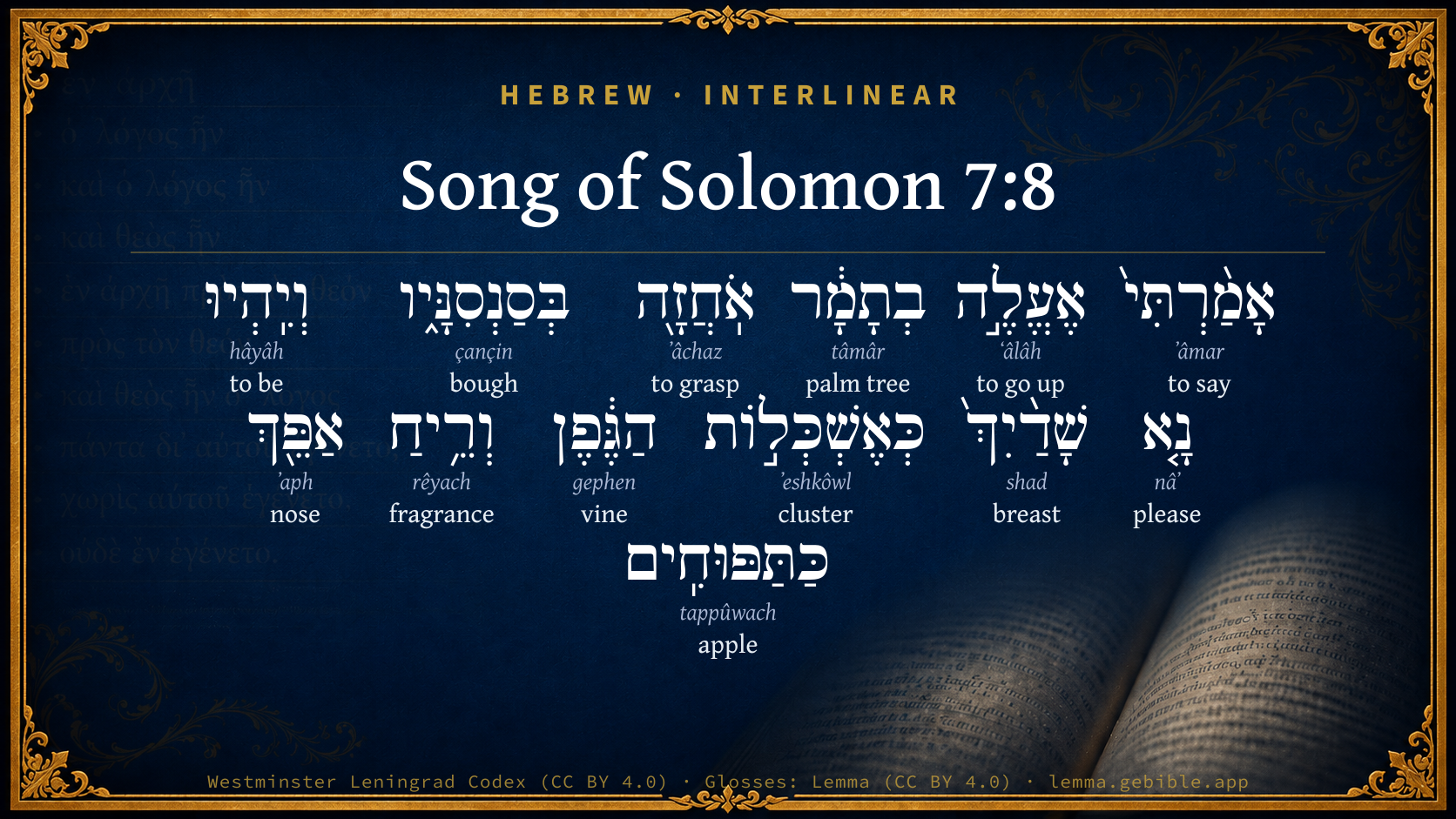
Hebrew (Westminster Leningrad Codex) Song of Solomon 7:8 appears in the Hebrew Old Testament. The text above is from the Westminster Leningrad Codex. Each word links to its Strong’s number, a concise gloss, and parsing drawn from the Open Scriptures Hebrew Bible morphology. Click any word for its full Brown-Driver-Briggs (BDB) entry.
Download image
Cite this verse

Song of Solomon 7:8 (World English Bible). Public Domain. Lemma interlinear Bible study tool, https://lemma.gebible.app/v/song-of-solomon/7/8.

Show BibTeX & RIS
BibTeX
RIS
English Translation
I said, "I will climb up into the palm tree. I will take hold of its fruit." Let your breasts be like clusters of the vine, The smell of your breath like apples, Beloved
World English Bible · Public Domain
Highlights
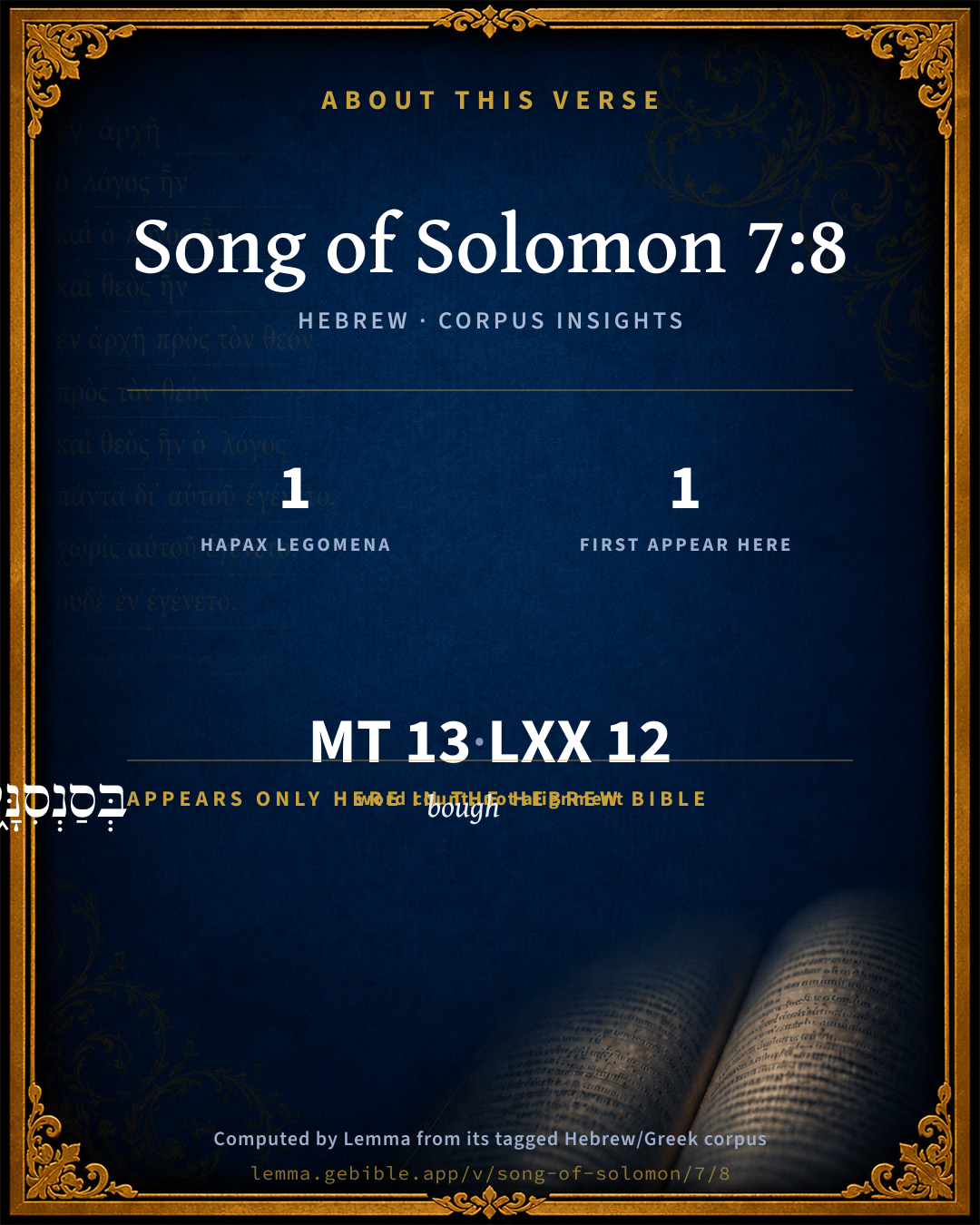
  • 1 hapax legomenon — only here in the Hebrew Bible
  • 1 first appearance in the Hebrew Bible
Full analysis ↓
Download a study sheet

One document with this verse’s original text, its word-by-word gloss line, the meaning frame, cross-references with their text, attributed commentary, and full source and license credits — printable, and it pastes into notes with its structure intact.

This verse Autodidact and up

Study sheet (.html) Plain text (.txt)

A passage Seminary Student

Up to 50 verses in one chapter. A passage sheet keeps up to 6 commentary sources and 12 cross-references per verse, in the order this page ranks them, and says so on the sheet whenever that leaves anything out. Ask for a single verse and you get the Autodidact verse sheet above.

Everything on this page stays free to read, with no account — the sheet is a download of what is already on screen, not access to it.

Want to remove ads? Support Godless Engineer
Compare translations 3

The same verse in 3 English versions, stacked beneath the original-language interlinear above. Click any original word for its lexicon entry.

Each is an independent rendering of the whole verse — the interlinear is not word-aligned to these translations.

Highlighted words mark where these versions differ — a whole-verse word diff, not a word-by-word alignment.

  • World English Bible Public Domain
    I said, "I will climb up into the palm tree. I will take hold of its fruit." Let your breasts be like clusters of the vine, The smell of your breath like apples, Beloved
  • King James Version Public Domain
    I said, I will go up to the palm tree, I will take hold of the boughs thereof: now also thy breasts shall be as clusters of the vine, and the smell of thy nose like apples;
  • unfoldingWord Literal Text CC BY-SA 4.0
    I said, “I will go up palm tree; I will grab hold of its fruit stalks.” And, please, let your breasts be like the clusters of the vine, and smell of your nose like apples,

unfoldingWord Literal Text — © unfoldingWord, licensed CC BY-SA 4.0. Word-aligned USFM3 via Door43 (git.door43.org/unfoldingWord/en_ult).

Versions to compare (up to 4)

3 of 4 selected

Show all 18 translations

Every available English version of this verse, each an independent rendering of the whole verse.

  • World English Bible Public Domain
    I said, "I will climb up into the palm tree. I will take hold of its fruit." Let your breasts be like clusters of the vine, The smell of your breath like apples, Beloved
  • Berean Standard Bible Public Domain
    I said, “I will climb the palm tree; I will take hold of its fruit.” May your breasts be like clusters of the vine, the fragrance of your breath like apples,
  • Majority Standard Bible Public Domain
    I said, “I will climb the palm tree; I will take hold of its fruit.” May your breasts be like clusters of the vine, the fragrance of your breath like apples,
  • King James Version Public Domain
    I said, I will go up to the palm tree, I will take hold of the boughs thereof: now also thy breasts shall be as clusters of the vine, and the smell of thy nose like apples;
  • American Standard Version (1901) Public Domain
    I said, I will climb up into the palm-tree, I will take hold of the branches thereof: Let thy breasts be as clusters of the vine, And the smell of thy breath like apples,
  • Revised Version (1885) Public Domain
    I said, I will climb up into the palm tree, I will take hold of the branches thereof: let thy breasts be as clusters of the vine, and the smell of thy breath like apples;
  • Geneva Bible (1599) Public Domain
    I saide, I will goe vp into the palme tree, I will take holde of her boughes: thy breastes shall nowe be like the clusters of the vine: and the sauour of thy nose like apples,
  • Douay-Rheims (1899) Public Domain
    I said: I will go up into the palm tree, and will take hold of the fruit thereof: and thy breasts shall be as the clusters of the vine: and the odour of thy mouth like apples.
  • Young's Literal Translation Public Domain
    I said, `Let me go up on the palm, Let me lay hold on its boughs, Yea, let thy breasts be, I pray thee, as clusters of the vine, And the fragrance of thy face as citrons,
  • Literal Standard Version CC BY-SA 4.0
    I said, “Let me go up on the palm, || Let me lay hold on its boughs,” || Indeed, let your breasts now be as clusters of the vine, || And the fragrance of your face as citrons,
  • Unlocked Literal Bible CC BY-SA 4.0
    I said, “I want to climb that palm tree; I will take hold of its branches.” May your breasts be like clusters of grapes, and may the fragrance of your nose be like apricots.
  • unfoldingWord Literal Text CC BY-SA 4.0
    I said, “I will go up palm tree; I will grab hold of its fruit stalks.” And, please, let your breasts be like the clusters of the vine, and smell of your nose like apples,
  • Darby Bible Public Domain
    I said, I will go up to the palm-tree, I will take hold of the boughs thereof; And thy breasts shall indeed be like clusters of the vine, And the fragrance of thy nose like apples,
  • World Messianic Bible Public Domain
    I said, “I will climb up into the palm tree. I will take hold of its fruit.” Let your breasts be like clusters of the vine, the smell of your breath like apples.
  • Webster's Bible Public Domain
    I said, I will go up to the palm tree, I will take hold of its boughs: now also thy breasts shall be as clusters of the vine, and the smell of thy nose like apples;
  • Free Bible Version CC BY-SA 4.0
    I tell myself, “I will climb the palm tree and take hold of the fruit.” May your breasts be like bunches of grapes on the vine, and your breath have the scent of apples!
  • Bible in Basic English Public Domain
    I said, Let me go up the palm-tree, and let me take its branches in my hands: your breasts will be as the fruit of the vine, and the smell of your breath like apples;
  • JPS Tanakh (1917) Public Domain
    (7-9) I said: 'I will climb up into the palm-tree, I will take hold of the branches thereof; and let thy breasts be as clusters of the vine, and the smell of thy countenance like apples;

Literal Standard Version (2020), Covenant Press — licensed CC BY-SA 4.0. Text via the HelloAO Bible API (eBible.org). Unlocked Literal Bible (unfoldingWord) — licensed CC BY-SA 4.0. Text via the HelloAO Bible API (eBible.org). unfoldingWord Literal Text — © unfoldingWord, licensed CC BY-SA 4.0. Word-aligned USFM3 via Door43 (git.door43.org/unfoldingWord/en_ult). Free Bible Version, Dr. Jonathan Gallagher — licensed CC BY-SA 4.0. Text via the HelloAO Bible API (eBible.org).

Word by word

More ways to search: Search by grammar → Find every occurrence → Compare this word →

Practice this passage: Drill this verse → Learn its vocabulary →

בְּסַנְסִנָּ֑יו
çançin
H5577
“in/at · boughs · his”
Preposition + Noun, Common, Masculine, Plural, Construct + Suffix, Personal, 3rd Person, Masculine, Singular
Part of Speech
Preposition + Noun
Type
Common
Gender
Masculine
Number
Plural
State
Construct
Full BDB Definition

Origin: from an unused root meaning to be pointed

TWOT: 1522

bough, fruit-stalk (of date tree)
  1. אָמַ֨רְתִּי֙ ʼâmar H559 “to say” Verb, Qal, Perfect, 1st Person, Common, Singular
  2. אֶעֱלֶ֣ה ʻâlâh H5927 “to go up” Verb, Qal, Cohortative, 1st Person, Common, Singular
  3. בְתָמָ֔ר tâmâr H8558 “in/at · palm tree” Preposition + Noun, Common, Masculine, Singular, Absolute
  4. אֹֽחֲזָ֖ה ʼâchaz H270 “to grasp” Verb, Qal, Cohortative, 1st Person, Common, Singular
  5. וְיִֽהְיוּ hâyâh H1961 “and · to be” Conjunction + Verb, Qal, Jussive, 3rd Person, Masculine, Plural
  6. נָ֤א nâʼ H4994 “please” Particle, Exhortation
  7. שָׁדַ֨יִךְ֙ shad H7699 “breasts · your” Noun, Common, Masculine, Dual, Construct + Suffix, Personal, 2nd Person, Feminine, Singular
  8. כְּאֶשְׁכְּל֣וֹת ʼeshkôwl H811 “like/as · clusters of” Preposition + Noun, Common, Masculine, Plural, Construct
  9. הַגֶּ֔פֶן gephen H1612 “the · vine” Particle, Definite Article + Noun, Common, Both, Singular, Absolute
  10. וְרֵ֥יחַ rêyach H7381 “and · fragrance of” Conjunction + Noun, Common, Masculine, Singular, Construct
  11. אַפֵּ֖ךְ ʼaph H639 “nose · your” Noun, Common, Masculine, Singular, Construct + Suffix, Personal, 2nd Person, Feminine, Singular
  12. כַּתַּפּוּחִֽים tappûwach H8598 “like/as the · apples” Preposition, Determined + Noun, Common, Masculine, Plural, Absolute

About this verse

These counts appear in no published source. They are computed here, from the morphology-tagged text and Lemma’s own curated glosses. What Lemma adds →

13
words
13
distinct lemmas
Wisdom
section

Notable vocabulary

1 hapax legomenon — a word that appears only here in the entire Hebrew Bible:

  • בְּסַנְסִנָּ֑יו bough H5577

First appearance in Scripture

This word makes its first canonical appearance in the Hebrew Bible here:

  • בְּסַנְסִנָּ֑יו bough H5577

Shared distinctive vocabulary

כַּתַּפּוּחִֽים apple H8598 occurs in 6 verses of the Hebrew Bible. Also found in:

Grammatical profile

  • 4 verbs
  • 8 nouns
  • 1 particle

Verb forms

  • אָמַ֨רְתִּי֙ Qal · Perfect
  • אֶעֱלֶ֣ה Qal · Cohortative
  • אֹֽחֲזָ֖ה Qal · Cohortative
  • וְיִֽהְיוּ Qal · Jussive

Hebrew & Septuagint length

In English translation the verse runs 34 words from the Hebrew and 37 from the Septuagint (LXX English) — closely comparable.

A rough comparison of the two English renderings, which tokenize alike — not a word-level alignment.

Word counts can differ between the Hebrew and the Greek without any difference in meaning — e.g. the Hebrew direct-object marker אֵת has no separate Greek word, and Greek often adds the article ὁ.

In the original languages it is 13 Hebrew tokens and 12 Greek tokens — but the two are counted differently (Hebrew bundles its prefixes and suffixes into one token; the Greek is in lemma form), so that isn’t a like-for-like length.

Cross-references

7

Topical passages linked to Song of Solomon 7:8 in the Treasury of Scripture Knowledge — connected by theme and wording, ordered by reader-vote popularity; previews shown in the World English Bible.

  • John 14:21–23 One who has my commandments, and keeps them, that person is one who loves me. One who loves me will be loved by my Father, and I will love him, and will reveal myself to him."
  • 2 Corinthians 2:14 Now thanks be to God, who always leads us in triumph in Christ, and reveals through us the sweet aroma of his knowledge in every place.
  • Song of Solomon 1:3 Your oils have a pleasing fragrance. Your name is oil poured forth, Therefore the virgins love you.
  • Song of Solomon 2:3 As the apple tree among the trees of the wood, So is my beloved among the sons. I sat down under his shadow with great delight, His fruit was sweet to my taste.
  • Song of Solomon 2:5 Strengthen me with raisins, Refresh me with apples; For I am faint with love.
  • Song of Solomon 4:16–5:1 Awake, north wind; and come, you south; Blow on my garden, that its spices may flow out. Let my beloved come into his garden, And taste his precious fruits. Lover
  • Jeremiah 32:41 Yes, I will rejoice over them to do them good, and I will plant them in this land assuredly with my whole heart and with my whole soul.

Cross-references courtesy of OpenBible.info (CC BY 4.0).

Hebrew and Greek witnesses Masoretic Hebrew ↔ Greek Septuagint

The same verse in the two great witnesses to the Old Testament, shown verse-for-verse.

These are two independent witnesses, not word-aligned to each other, and the Septuagint is shown in lemma (dictionary) form.

Hebrew Song of Solomon 7:8 Masoretic · Westminster Leningrad Codex

אָמַ֨רְתִּי֙ אֶעֱלֶ֣ה בְתָמָ֔ר אֹֽחֲזָ֖ה בְּסַנְסִנָּ֑יו וְיִֽהְיוּ נָ֤א שָׁדַ֨יִךְ֙ כְּאֶשְׁכְּל֣וֹת הַגֶּ֔פֶן וְרֵ֥יחַ אַפֵּ֖ךְ כַּתַּפּוּחִֽים

I said, "I will climb up into the palm tree. I will take hold of its fruit." Let your breasts be like clusters of the vine, The smell of your breath like apples, Beloved

World English Bible · Public Domain

Greek LXX Song of Solomon 7:8 Septuagint · lemma form

οὗτος μέγεθος σύ ὁμοιόω ὁ φοῖνιξ καί ὁ μαστός σύ ὁ βότρυς

I said, I will go up to the palm tree, I will take hold of its high boughs: and now shall your breasts be as clusters of the vine, and the smell of your nose of apples;

LXX2012 (modern English Septuagint) · Public Domain

On this verse, The Preacher's Complete Homiletical Commentary discusses the Septuagint’s reading. Read the note in Commentary ↓

Hebrew: Westminster Leningrad Codex (CC BY 4.0). Greek: Septuagint (public domain); English from LXX2012 (modern English Septuagint) (Public Domain). How the Septuagint differs from the Hebrew →

Commentary

Notes on Song of Solomon 7:8 from classic Christian and Jewish commentators (each source and its license shown beneath its notes). The classic Christian expositions comment on the surrounding passage and are grouped to its opening verse, so a note may address several verses; the Jewish commentaries on the Tanakh (Rashi and others) are per-verse, so they appear only where the commentator wrote on this verse.

Lemma curates 59 commentaries, every one of them public domain or Creative Commons licensed, each selected and text-cleaned for this edition rather than reprinted as found. About our sources →

Trapp's Complete Commentary

John Trapp

Son 7:8 I said, I will go up to the palm tree, I will take hold of the boughs thereof: now also thy breasts shall be as clusters of the vine, and the smell of thy nose like apples;

Ver. 8. I said, I will go up to the palm tree, &c.] I said it, and I will do it; for Christi dicere est facere, together with Christ’s word there goes forth a power, as it did. {Luk 5:17} David said he "would confess his sins," and "take heed to his ways," {Psa 32:5; Psa 39:1} and accordingly he did it. Shall Christ purpose and promise mercy to his people, and not perform it? Is he yea and nay? {2Co 1:19} Can he say and unsay? Doth not the constant experience of all ages fully confute any such fond conceit of him? The saints will not lie, {Isa 63:8} Christ cannot. {Tit 1:2} {a} He will not suffer his faithfulness to fail, nor alter the thing that is gone out of his lips. {Psa 89:33} All his sayings are the issue of a most faithful and right will, void of all insincerity and falsehood. Now when Christ promiseth to climb his palm tree, and to take hold of the boughs thereof, he meaneth that he will dwell most familiarly with his Church, even in the branches thereof, pruning and trimming it, and accepting the fruits of his Spirit in his spouse. Or thus, he will so join himself unto his Church, as he may cause her to be fruitful; he will lay hold on her boughs, which are very fit and apt to climb, so covertly and elegantly noting the work of spiritual generation. The effect follows.

Now also thy breasts shall be as clusters of the vine.] Whatsoever they have been heretofore, now at this time, and for ever hereafter, they shall be delightful to me, and nourishable to thy children, who shall "suck and be satisfied." {Isa 66:11} Albeit some interpreters of good note conceive that all this is nothing else but a figurative description of Christ’s perfect conjunction with his Church in the kingdom of heaven, and of the unspeakable pleasure which Christ will take in her for ever.

And the smell of thy nose like apples,] i.e., The breath that comes out of thy nostrils is sweet as spice apples. The breath that the Church draweth into her lungs, and sends out again, is the spirit of grace, without which she can as little live as we can without air. This sweet spirit is the joy of her heart and the breath of her nostrils, and thereby she draws many into her company. If that be true that one here noteth, that the fruit of the palm partaketh of the nature both of the grape, having a sweet and pleasant juice, and of the apple, for pleasant meat, it may well signify that the Word of God is both meat and drink to the soul.

{a} αφευδης

John Trapp, A Commentary or Exposition upon All the Books of the Old and New Testament (1647–1656) — public domain. Text from a community e-Sword module.

The Preacher's Complete Homiletical Commentary

Joseph S. Exell (gen. ed.)

Notes

Son_7:9. And the roof of thy mouth like the best wine for my beloved, that goeth down sweetly, causing the lips of those that are asleep to speak. ‘For my beloved,’ לְדוֹדִי le-dhodhi. Understood by ABEN EZRA, SANCTIUS, and many moderns, as a sudden interruption by the Bride. So ROSENMÛLLER, DELITZSCH, NOYES, &c. Spoken by the Bride, who takes up the king’s words to continue the description, shewing that she fully responded to his love. ZÖCKLER. Viewed by many as spoken, like the preceding, by the virgin-attendants, one speaking in the name of the rest, or the whole choir considered as one person. M. STUART. The virgins viewed, like the Bride, as both one and many, and claiming the Bride’s beloved for their own. So MERCER, AINSWORTH, and others. DURHAM. ‘For my special friends;’ or as personating the Bride in an abrupt expression of her love to the Bridegroom. Some, like the SEPTUAGINT, connect the expression with הוֹלֵךְ (holech) ‘that goeth,’ and either translate ‘that goeth pleasantly,’ as PISCATOR, JUNIUS and TREMELLIUS, PERCY, and BOOTHROYD; or, ‘that goeth towards my beloved,’ or, ‘that goeth down for my beloved,’ as DE WETTE, HAHN, and others; or, ‘for my friends;’ or, ‘sent to those whom I love;’ as PATRICK and WILLIAMS. EWALD would put the word in brackets, as probably an error of the transcribers, but long before the Masorites, as only wanting in one of Kennico’s MSS. (715), and that, perhaps, by oversight. HOUBIGANT conjectures לחכי ‘to my palate,’ as the original word. GLASSIUS supposes it to be used euphonically for לְדוֹדִיס as chap. Son_8:2; 2Ki_11:19. SEPTUAGINT. That goeth to my beloved. VULGATE. Worthy of my beloved to drink. So WICKLIFFE and the DOUAI VERSION. LUTHER. That enters my beloved. MARTIN. In favour of my beloved DIODATI. Which goes to my friend. DUTCH VERSION. To my beloved ones.

‘That goeth down sweetly,’ הוֹלֵךְ (לְדוֹדִי) לְמֵישָׁרִים holech (le-dhodhì) lemesharim. Literally: ‘That goeth to or for my beloved, to or in straightness, or straightly.’ מֵישָׁרִים the plural of מֵישָׁר (mes’ar) straight; with the prefix לְ to or for,—straightly or directly. So GESENIUS and EWALD. Smoothly, or ‘according to evenness.’ ZÖCKLER and DE WETTE. Smoothly, that is, pleasantly. WEISS. That goeth to him directly and ultroneously, as entirely belonging to him. SANCTIUS. Some connect לְמֵישָׁרִים, not with הוֹלֵךְ but with לְדוֹדִי ‘those whom I love for their uprightness.’ So WILLIAMS. Or, ‘whom I love uprightly,’ i.e., from the heart. So RASHI. SEPTUAGINT: Going to my beloved straightly (εἰς εὐθύτητα). VULGATE, perhaps reading למשתים: Worthy for my beloved to drink. LUTHER. Which enters my beloved smoothly. DIODATI. Which goes directly to my friend. CRANMER and GENEVA BIBLE. Which goeth straight to my well-beloved. DUTCH. Which goeth right to my beloved ones. MONTANUS and MERCER. Carrying itself rightly. MUNSTER. Going by straight ways. PAGNINUS Going directly. JUNIUS and TREMELLIUS. Most rightly. COCCEIUS. Flowing to my beloved most smoothly. AINSWORTH. So delicious that it goes down glibly. FRY. Moving to my beloved as it ougut; indicating the Bride’s desire that her conversation should be agreeable to her husband. WEISS. Like the choice wine poured on the altar of burnt offering, which mounts directly to heaven. DAVIDSON supplies a copula, and translates: For my beloved, and for the upright ones. THEODORET, using the Septuagint: For direction to the souls that love thee.

‘Causing the lips of those that are asleep to speak.’ דּוֹבֵב dobhebh, from דָּבַב to which the Tulmudists give the meaning of speaking; ‘making the lips of those who sleep to speak,’ i.e., in dreams. So MERCER, HENSTENBERG, DELITZSCH, &c. WILLIAMS. Causing to murmur. WEISS. To lisp. SANCTIUS. Inducing intoxication, and making the stammerers eloquent. PATRICK. Making men speak with the lips of the ancient, i.e. to utter excellent sayings. A. CLARKE. As wine causes the most backward to speak, so thy charms make the most taciturn eloquent in thy praise. FRY: Effervescing against the lips, &c. Others, however, give to דָּבַב the meaning of ‘to creep or flow over.’ So EWALD, GESENIUS, DE WETTE, &c. ‘Gliding over the lips of sleepers,’ that is, he who drinks is insensibly overtaken with sleep; the adjective being taken, as frequently, from the effect. ZÖCKLER, EWALD, NOYES. Flowing down. PERCY. ‘Those that are asleep.’ יְשֵׁנִים yeshenim, may be either ‘persons sleeping,’ or ‘old men;’ the former preferable, as from יָשִׁן to sleep, So GESENIUS and most. HAHN. Persons already sinking into slumber, as if, overcome by the sweetness of the wine, they were unable to remove the cup again from their lips. Some understand it figuratively of the dead. PATRICK. ‘Old men;’ those asleep or dead, or at the point of death. SEPTUAGINT, reading ושנים and שפתי: Reaching my lips and teeth. VULGATE. Suitable for the lips and teeth to ruminate. So WICKLIFF. BISHOP’S, and DOUAI VERSION. COVERDALE and MATTHEWS. The lips and teeth shall have their pleasure. CRANMER. Which bursteth forth from the lips of the ancient Elders. DUTCH, DIODATI, and MARTIN. Making the lips of the sleepers to speak. LUTHER. And speaks of what is afar off. MERCER. Awakening the slumbering senses, and refreshing the mind. VATABLUS. Who (viz., the friend who drinks it) speaks with the lips of them that sleep. CASTALIO: To my friend who (in consequence) babbles with sleeping lips. TARGUM abegorizing. As Elisha and Elijah raised the dead, and as Ezckiel prophesied, and awoke the dead in the valley of Dura RASHI. Even my fathers in the grave shall rejoice and give praise for their portion. RABBINS. Causing, by the Spirit, given in answer to the Church’s intercession, the lips of the nations who were asleep before to be opened, and to show forth the praises of the Lord. WEISS. Perhaps an allusion to the Israelites expecting silently the prayer made by the priests in the Temple, or by the leader in the synagogue, when the lips only moved: the daughters of Jerusalem thus intimating that, while the Church was requested to offer fervent prayer in their behalf, they would silently repeat it after her. AINSWORTH. Sinners awakened and quickened by the word preached (Eph_5:14); also others who from negligence tell asleep, and are enabled by this spiritual wine to speak (Isa_57:13; Isa_57:19).

THE KING’S RESOLUTION AND ANTICIPATION

Son_7:8-9

I said, I will go up to the palm tree:

I will take hold of the boughs thereof;

Now also thy breasts shall be as clusters of the vine,

And the smell of thy nose like apples;

And the roof of thy mouth like the best wine,

(For my beloved),

That goeth down sweetly,

Causing the lips of them that are asleep to speak.

‘I said,’ indicative of the king’s purpose, whether secret or expressed, in regard to Shulamite. The purpose—first, to make her his Bride and then to enjoy her fellowship as such (Pro_5:18-19). Christ’s doings in regard to His Church the result of a Divine purpose. His delights, prospectively, with the children of men, before the foundation of the world (Pro_8:31). His purpose to give Himself for sinners, to unite them to Himself as His Bride, and then throughout eternity to rejoice in their fellowship and love. ‘Father, I will that they also whom Thou hast given Me be with me where I am, that they may behold My glory which Thou hast given Me’ (Joh_17:24). ‘He loved the Church and gave Himself for it that He might sanctify and cleanse it by the washing of water by the Word; that He might present it to Himself a glorious Church.’ ‘He gave Himself for us that redeem us from all iniquity, and purify unto Himself a peculiar people.’ ‘This people have I formed for Myself’ (Eph_5:26; Tit_2:14; Isa_43:21). Having loved and given Himself for His Church, He will ‘rest’ and have delight ‘in His love’ (Zep_3:17). Christ said, I will go up to the palm tree—

(1) In the everlasting covenant when He engaged to be the Redeemer of the world.

(2) When in the fulness of time He gave Himself for His Church, and ‘for the joy that was set before Him, endured the cross despising the shame.’

(3) When He, according to His loving purpose, arrests the wanderer in his sins, and, as the good shepherd, lays the lost one ‘on his shoulders, and returns with it rejoicing.’

(4) When from time to time He lovingly manifests Himself to His saved one, comes in and sups with him and he with Him (Rev_3:20).

(5) When at death He receives the believer to Himself, that where He is he may be also (Joh_14:2). Christ’s resolution that of enjoying the fruit of the travail of His soul, and of putting His people also in possession of it. In His love He provided the feast, and with His people He sits down to it. Planted the tree when He ascended the cross, and eats the fruit of it now that He has ascended the throne. The happiness of the believing soul to yield itself to Christ as the palm tree, for His enjoyment of the fruits of it.

Anticipation connected with resolution. ‘Now also thy breasts shall be as clusters of the vine,’ &c. The loving fellowship of his beloved bride should be sweet and refreshing to him as the clusters of the vine, the fragrance of citrons, and the richest wine. A similar anticipation and desire already expressed on the part of the Bride in reference to her Beloved (chap. Son_2:5). A mutual ‘comfort of love’ between Christ and His people. ‘My soul desired the first ripe fruit.’ ‘I remember thee, the kindness of thy youth, the love of thine espousals.’ ‘I found Israel like grapes in the wilderness’ (Hos_9:10; Jer_3:2; Mic_7:1). This joy experienced by Christ in the first love of the New Testament, as well as that of the Old Testament, Church. His delight found in His people in proportion as He finds in them the graces of His Spirit (Psa_149:4; Jer_9:24). In the finished work of the first creation, God ‘rested and was refreshed;’ much more in that of the second. The redeemed Church to be to Him ‘for a name, for an everlasting sign that shall not be cut off.’—The spiritual breath of the regenerate soul sweet and fragrant to Christ. ‘The smell (or fragrance) of thy nose (or breath) like apples (or citrons)’. Such breath the love and longing, the aspirations and expressions, the penitence and gratitude, the confessions and thanksgivings, the sighs and groans, the prayers and praises, of the new and spirit-born nature. ‘To this man will I look, even to him who is poor and of a contrite spirit, and that trembleth at My word.’ ‘I dwell in the high and holy place; with him also that is of a contrite and humble spirit, to revive the spirit of the humble, and to revive the heart of the contrite ones’ (Isa_57:15; Isa_66:2). Marked contrast between the wholesome breath of a living soul and the noxious effluvium of a dead one. The fragrance of a humble and holy love breathed by a believer in proportion as he walks with Christ and posseses His spirit. The love and spiritual-mindedness of a pardoned soul the Saviour’s sweetest refreshment. Powerful motive to the cultivation of a holy, loving, and spiritual life.

The loving self-surrender of the Bride apparently indicated in the words, ‘for my beloved’ (Son_7:9). Probably the words of the Bride interjected while the Bridegroom was speaking and comparing her love, and the expression of it, to the best wine. The Bride hastens to assure him that that wine should be entirely for himself. He who was so worthy of her love, and who possessed such claims to it, should alone possess it. As his happy and favoured Bride she would love him with an undivided love. The warm and devoted affection of our heart the best gift we can offer; and, through grace, freely given to Him who is most worthy of it, and has the best right to it. That affection desired and prized by Him whom angels delight to honour. Our highest happiness to be permitted and enabled to render it. ‘O, what am I, to love such a One, or to be loved by that high and lofty one! I think the angels may blush to look upon Him. Hell (as I now think), and all the pains in it, laid on me alone, would not put me from loving. Woe, woe is me; I have a lover, Christ, and yet I want love for Him. I have a lovely and desirable Lord, who is loveworthy, and who beggeth my love and heart, and I have nothing to give Him.’—S. Rutherford. ‘For my Beloved,’ the appropriate motto of a loving believer’s life. To be inscribed on all we are and have.

Perhaps an intimation, in the conclusion of the verse, of the effects of the believer’s love to Christ on others as well as himself. The wine to which the Bride’s love, and the expression of it (‘the roof of thy mouth’) is compared, said, according to our English version, to cause the lips of them that are asleep (Margin, ‘the ancient’) to speak. The language obscure, though indicating some property or effect of the wine spoken of, and so of that which is compared to it. Perhaps the reference to its stimulating as well as refreshing virtue. The influence which Christ condescends to allow His people’s love to have upon Himself already stated (chap. Son_4:9; Son_6:5). Its influence on the world, asleep in the snare of Satan and under the power of sin, to be found, indirectly, in the success attending the efforts, prompted by love to Christ and love to souls for His sake, to reclaim the wanderer and rescue the perishing, by conveying to them the glad tidings of His love. Love to Christ the highest and strongest motive impelling believers to self-denying endeavours on behalf of a perishing world. ‘Lord, thou knowest that I love Thee,’ naturally followed by—‘Feed my lambs; feed my sheep.’ ‘Inasmuch as ye have done it unto one of the least of these, my brethren, ye have done it unto Me.’ Silent lips constantly being opened, from devotedness to Jesus, in the praise of redeeming love.

The Preacher's Complete Homiletical Commentary (gen. ed. Joseph S. Exell; Funk & Wagnalls, c. 1892) — public domain (pre-1929). A full-Bible homiletical/sermon-outline anthology covering 65 of 66 books (2 John is absent from the source module). Text from a community e-Sword module.

Adam Clarke's Commentary

Verse 8. I will go up to the palm tree] I will take hold on the boughs of this tree, and climb up by them, in order to gather the clusters of dates at the top. The rubric here in the old MS. interprets this of the cross of Christ.

Adam Clarke's Commentary on the Bible (1810–1826) — public domain. Text from a community e-Sword/MySword module.

Ellicott's Commentary for English Readers

(8) Boughs.—Heb. sansan; only here. Probably a form derived from the sound, like salsal, zalzal, &c, denoting the waving of the long feathery branches of the palm.

Smell of thy nose—i.e., “fragrance of thy breath,” ap = nose being used apparently because of the resemblance of its root, anap = breathe, with that of tappuach = apple.

A Bible Commentary for English Readers, edited by Charles John Ellicott (1878–1897) — public domain. Text from a community e-Sword module.

The Cambridge Bible for Schools and Colleges

gen. ed. J. J. S. Perowne

8. I said] I have said or thought = I am minded to climb up the palm tree to take hold of its branches.

now also thy breasts shall be, &c.] Better, as R.V., let thy breasts be as clusters of the vine.

the smell of thy nose] i.e. as R.V. paraphrases, giving the meaning correctly, the smell of thy breath like apples.

The Cambridge Bible for Schools and Colleges (gen. ed. J. J. S. Perowne; Cambridge University Press, 1878–1918) — public domain. Text from a community e-Sword module.

Haydock's Catholic Bible Commentary

Up. Christ shed his blood on the cross, and enabled his Church, composed of Jews and Gentiles, who were before barren, to produce a numerous progeny. (Calmet) --- Mouth. Hebrew and Septuagint, "nose."

George Leo Haydock (1774–1849), Haydock's Catholic Family Bible and Commentary, 1859 edition — public domain. Excludes Psalms (Douay-Rheims chapter numbering differs from Protestant) and Deuterocanonical books (Catholic canon only).

Matthew Poole's English Annotations

I said within myself, I resolved,

I will go up to the palm tree; I will climb up, that so I may

take hold, as it follows, of the boughs, which do not grow out of the sides, as in other trees, but only at the top of it.

I will take hold of the boughs thereof, partly to prune and dress them, and partly to gather the fruit; whereby is signified Christ’s care of his church, and his delight in her.

Of thy nose; of thy breath; which is oft called the breath of or in a man’s nostrils, Gen 7:22; Isa 2:22; Lam 4:20.

Like apples; either,

1. Common apples, which sometimes yield a very pleasant smell. Or,

2. Odoriferous apples. See Poole "Son 2:5".

Matthew Poole's English Annotations on the Holy Bible (1683–1685) — public domain. Text from a community e-Sword/MySword module.

Whedon's Commentary on the Bible

Daniel D. Whedon

8. Again we notice the King using a boldness of speech too great for that feeling of reverence which true love holds toward its object. “He comes too near, who needs to be denied.”

I said — That is, “I said” in thought; equivalent to purposed. The past tense, however, implies the present continuance of the purpose, as the connexion shows.

The smell of thy nose — Better, the fragrance of thy breath. It is compared to the sweet perfume of ripe apples.

Daniel D. Whedon (gen. ed.), Commentary on the Old and New Testaments (1874–1909) — public domain. Text from a community e-Sword module.

John Wesley's Explanatory Notes

I said - Within myself, I resolved. I will - Climb up, that so I may take hold of the boughs, which do not grow out of the sides, as in other trees, but only at the top of it. Take hold - Partly to prune and dress them, and partly to gather the fruit. The smell - Of thy breath; which is often called the breath of a man's nostrils.

John Wesley, Explanatory Notes Upon the Whole Bible (1754–1765) — public domain. Text via the GEBible commentary corpus.

Rashi

Rabbi Shlomo Yitzchaki (Rashi)

This, your stature, is like a palm tree We saw the beauty of your stature in the days of Nebuchadnezzar, when all the nations were kneeling and falling before the image, but you stood as erect as this palm tree.

and your breasts are like clusters [of dates] [This refers to] Daniel, Hananiah, Mishael and Azariah, who were like breasts for you to suckle from. They were like clusters [of dates], which shower liquid; so did they nurse lavishly and teach everyone that there is no fear like fear of You. Until this point, the nations praise Him. From here on are the words of the Shechinah to reveal Israel, who are among the nations.

Rashi on the Tanakh — English translations: “The Judaica Press complete Tanach with Rashi, translated by A. J. Rosenberg” (CC BY 4.0); “Pentateuch with Rashi's commentary by M. Rosenbaum and A.M. Silbermann, 1929-1934” (public domain); “The Metsudah Tanach series, Lakewood, N.J” (CC BY 4.0); and “The Book of Joshua, Metsudah Publications, 1997” (CC BY 4.0). Text via Sefaria.

Lesson kit

Teaching starters — assembled from the data on this page, not authored interpretation. Every prompt links to the verse data it draws on. Edit before teaching.

Song of Solomon, in the Wisdom, opens this verse with 13 words (13 distinct Hebrew lemmas). Its most distinctive word is çançin (“bough”). A historical commentator’s framing appears above. Read the whole chapter for the surrounding context.

Discussion questions

  1. How does “bough” (çançin) shape what this verse is saying?
  2. This verse holds 1 word here found nowhere else in the Hebrew Bible. What might the rare word draw attention to?
  3. The word “bough” first appears here in Scripture. What is being introduced at this debut?
  4. Proverbs 25:11 shares the word «apple» with this verse. How do the two illuminate each other?
  5. These translations render this verse differently. What is at stake in choosing one wording over another?
  6. The verb «אָמַ֨רְתִּי֙» is Qal Perfect. How does its form color the action?
  7. Reading how Trapp's Complete Commentary and The Preacher's Complete Homiletical Commentary read this verse, where do the two commentators agree and where do they part?

Things to notice

Reading settings

Reading text

Shown beneath each verse's original-language words.

Old Testament
Old Testament edition

Read the OT as the Masoretic Hebrew (MT) or the Greek Septuagint (LXX).

English shown for the Greek Septuagint (in the Hebrew ↔ Greek comparison).

Comparing translations? Open the Compare panel on any verse page to stack up to four side by side.