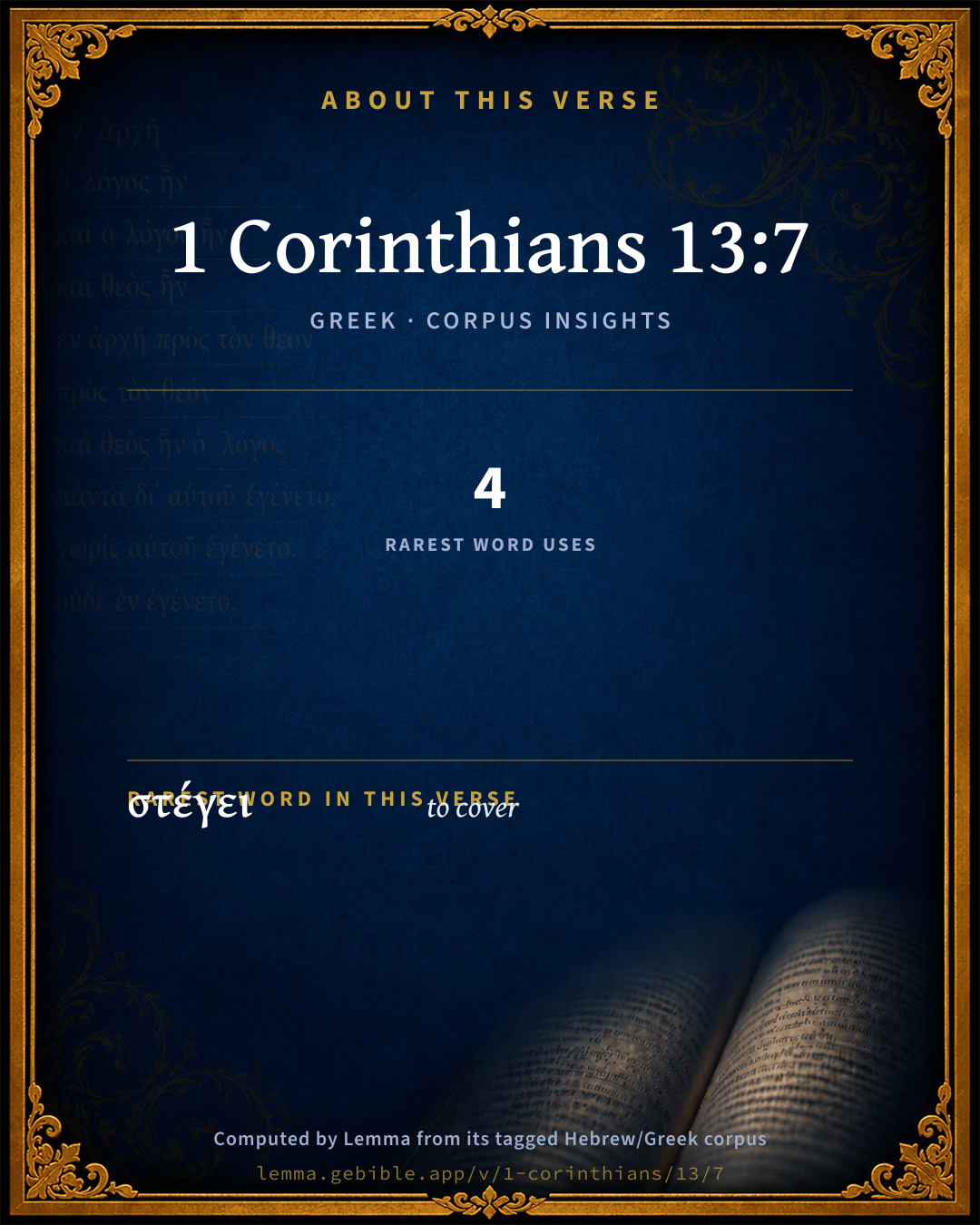
1 Corinthians 13:7

Greek (Tischendorf 8th ed.) 1 Corinthians 13:7 appears in the Greek New Testament. The text above is from the Tischendorf 8th edition. Each word links to its Strong’s number and a concise gloss. Click any word for its full Thayer’s Greek Lexicon entry.

Download image
Cite this verse

1 Corinthians 13:7 (World English Bible). Public Domain. Lemma interlinear Bible study tool, https://lemma.gebible.app/v/1-corinthians/13/7.

Show BibTeX & RIS
BibTeX
RIS
English Translation
bears all things, believes all things, hopes all things, endures all things.
World English Bible · Public Domain
Download a study sheet

One document with this verse’s original text, its word-by-word gloss line, the meaning frame, cross-references with their text, attributed commentary, and full source and license credits — printable, and it pastes into notes with its structure intact.

This verse Autodidact and up

Study sheet (.html) Plain text (.txt)

A passage Seminary Student

Up to 50 verses in one chapter. A passage sheet keeps up to 6 commentary sources and 12 cross-references per verse, in the order this page ranks them, and says so on the sheet whenever that leaves anything out. Ask for a single verse and you get the Autodidact verse sheet above.

Everything on this page stays free to read, with no account — the sheet is a download of what is already on screen, not access to it.

Want to remove ads? Support Godless Engineer
Compare translations 3

The same verse in 3 English versions, stacked beneath the original-language interlinear above. Click any original word for its lexicon entry.

Each is an independent rendering of the whole verse — the interlinear is not word-aligned to these translations.

Highlighted words mark where these versions differ — a whole-verse word diff, not a word-by-word alignment.

  • World English Bible Public Domain
    bears all things, believes all things, hopes all things, endures all things.
  • King James Version Public Domain
    Beareth all things, believeth all things, hopeth all things, endureth all things.
  • unfoldingWord Literal Text CC BY-SA 4.0
    It bears all things, believes all things, hopes all things, endures all things.

unfoldingWord Literal Text — © unfoldingWord, licensed CC BY-SA 4.0. Word-aligned USFM3 via Door43 (git.door43.org/unfoldingWord/en_ult).

Versions to compare (up to 4)

3 of 4 selected

Show all 19 translations

Every available English version of this verse, each an independent rendering of the whole verse.

  • World English Bible Public Domain
    bears all things, believes all things, hopes all things, endures all things.
  • Berean Standard Bible Public Domain
    It bears all things, believes all things, hopes all things, endures all things.
  • Majority Standard Bible Public Domain
    It bears all things, believes all things, hopes all things, endures all things.
  • King James Version Public Domain
    Beareth all things, believeth all things, hopeth all things, endureth all things.
  • American Standard Version (1901) Public Domain
    beareth all things, believeth all things, hopeth all things, endureth all things.
  • Revised Version (1885) Public Domain
    beareth all things, believeth all things, hopeth all things, endureth all things.
  • Geneva Bible (1599) Public Domain
    It suffreth all things: it beleeueth all things: it hopeth all things: it endureth all things.
  • Douay-Rheims (1899) Public Domain
    Beareth all things, believeth all things, hopeth all things, endureth all things.
  • Young's Literal Translation Public Domain
    all things it beareth, all it believeth, all it hopeth, all it endureth.
  • Literal Standard Version CC BY-SA 4.0
    it bears all things, it believes all, it hopes all, it endures all.
  • Unlocked Literal Bible CC BY-SA 4.0
    Love bears all things, believes all things, hopes all things, and endures all things.
  • unfoldingWord Literal Text CC BY-SA 4.0
    It bears all things, believes all things, hopes all things, endures all things.
  • Darby Bible Public Domain
    bears all things, believes all things, hopes all things, endures all things.
  • World Messianic Bible Public Domain
    bears all things, believes all things, hopes all things, and endures all things.
  • Webster's Bible Public Domain
    Beareth all things, believeth all things, hopeth all things, endureth all things.
  • Free Bible Version CC BY-SA 4.0
    Love never gives up, keeps on trusting, stays confident, and remains patient whatever happens.
  • Bible in Basic English Public Domain
    Love has the power of undergoing all things, having faith in all things, hoping all things.
  • Text-Critical English NT CC BY 4.0
    It bears all things, believes all things, hopes all things, and endures all things.
  • Tyndale New Testament (1534) Public Domain
    suffreth all thynge beleveth all thynges hopeth all thynges endureth in all thynges.

Literal Standard Version (2020), Covenant Press — licensed CC BY-SA 4.0. Text via the HelloAO Bible API (eBible.org). Unlocked Literal Bible (unfoldingWord) — licensed CC BY-SA 4.0. Text via the HelloAO Bible API (eBible.org). unfoldingWord Literal Text — © unfoldingWord, licensed CC BY-SA 4.0. Word-aligned USFM3 via Door43 (git.door43.org/unfoldingWord/en_ult). Free Bible Version, Dr. Jonathan Gallagher — licensed CC BY-SA 4.0. Text via the HelloAO Bible API (eBible.org).

Word by word

More ways to search: Search by grammar → Find every occurrence → Compare this word →

Practice this passage: Drill this verse → Learn its vocabulary →

About this verse

These counts appear in no published source. They are computed here, from the morphology-tagged text and Lemma’s own curated glosses. What Lemma adds →

8
words
5
distinct lemmas
Pauline Epistles
section

Notable vocabulary

The rarest word here is στέγει to cover G4722 — appearing just 4 times in the whole Greek New Testament.

Shared distinctive vocabulary

στέγει to cover G4722 occurs in 4 verses of the Greek New Testament. Also found in:

Repetition

A word recurs within this verse:

  • πάντα all G3956 ×4

Cross-references

27

Topical passages linked to 1 Corinthians 13:7 in the Treasury of Scripture Knowledge — connected by theme and wording, ordered by reader-vote popularity; previews shown in the World English Bible.

  • 1 Peter 4:8 And above all things be earnest in your love among yourselves, for love covers a multitude of sins.
  • 1 Corinthians 13:4 Love is patient and is kind; love doesn't envy. Love doesn't brag, is not proud,
  • 1 Peter 2:24 who his own self bore our sins in his body on the tree, that we, having died to sins, might live to righteousness; by whose stripes you were healed.
  • 2 Timothy 2:24 The Lord's servant must not quarrel, but be gentle towards all, able to teach, patient,
  • Proverbs 10:12 Hatred stirs up strife, But love covers all wrongs.
  • Galatians 6:2 Bear one another's burdens, and so fulfill the law of Christ.
  • 1 Corinthians 9:12 If others partake of this right over you, don't we yet more? Nevertheless we did not use this right, but we bear all things, that we may cause no hindrance to the Gospel of Christ.
  • Song of Solomon 8:6–7 Set me as a seal on your heart, As a seal on your arm; For love is strong as death. Jealousy is as cruel as Sheol; Its flashes are flashes of fire, A very flame of Yahweh.
  • 2 Timothy 2:3–10 You therefore must endure hardship, as a good soldier of Christ Jesus.
  • 2 Timothy 4:5 But you be sober in all things, suffer hardship, do the work of an evangelist, and fulfill your ministry.
  • James 1:12 Blessed is the man who endures temptation, for when he has been approved, he will receive the crown of life, which the Lord promised to those who love him.
  • Psalms 119:66 Teach me good judgment and knowledge, For I believe in your commandments.
  • 2 Thessalonians 1:4 so that we ourselves boast about you in the assemblies of God for your patience and faith in all your persecutions and in the afflictions which you endure.
  • Romans 15:1 Now we who are strong ought to bear the weaknesses of the weak, and not to please ourselves.
  • Matthew 10:22 You will be hated by all men for my name's sake, but he who endures to the end will be saved.
  • 2 Timothy 3:11 persecutions, and sufferings: those things that happened to me at Antioch, Iconium, and Lystra. I endured those persecutions. Out of them all the Lord delivered me.
  • Genesis 29:20 Jacob served seven years for Rachel. They seemed to him but a few days, for the love he had for her.
  • Luke 7:44–46 Turning to the woman, he said to Simon, "Do you see this woman? I entered into your house, and you gave me no water for my feet, but she has wet my feet with her tears, and wiped them with the hair of her head.
  • Job 13:15 Behold, he will kill me; I have no hope. Nevertheless, I will maintain my ways before him.
  • Luke 19:4–10 He ran on ahead, and climbed up into a sycamore tree to see him, for he was to pass that way.
  • Romans 8:24 For we were saved in hope, but hope that is seen is not hope. For who hopes for that which he sees?
  • 1 Corinthians 9:18–22 What then is my reward? That, when I preach the Gospel, I may present the Gospel of Christ without charge, so as not to abuse my authority in the Gospel.
  • 2 Corinthians 11:8–12 I robbed other assemblies, taking wages from them that I might serve you.
  • Hebrews 13:13 Let us therefore go forth to him outside of the camp, bearing his reproach.
  • Numbers 11:12–14 Have I conceived all this people? have I brought them forth, that you should tell me, Carry them in your bosom, as a nursing-father carries the sucking child, to the land which you swore to their fathers?
  • Luke 7:37–39 Behold, a woman in the city who was a sinner, when she knew that he was reclining in the Pharisee's house, she brought an alabaster jar of ointment.
  • Deuteronomy 1:9 I spoke to you at that time, saying, I am not able to bear you myself alone:

Cross-references courtesy of OpenBible.info (CC BY 4.0).

Commentary

Notes on 1 Corinthians 13:7 from classic Christian and Jewish commentators (each source and its license shown beneath its notes). The classic Christian expositions comment on the surrounding passage and are grouped to its opening verse, so a note may address several verses; the Jewish commentaries on the Tanakh (Rashi and others) are per-verse, so they appear only where the commentator wrote on this verse.

Lemma curates 59 commentaries, every one of them public domain or Creative Commons licensed, each selected and text-cleaned for this edition rather than reprinted as found. About our sources →

The Biblical Illustrator

Joseph S. Exell

1Co_13:7

Beareth … believeth … hopeth … endureth all things.

Loves labours

Notice--

I. The multitude of loves difficulties.

1. The difficulties of love are many, for the apostle sets forth the opposing armies as four times all things. You will have to contend with all things--

(1) Within yourself. Nothing in your original nature will help you. God has put within you a new life, but the old life seeks to smother it.

(2) In the persons whom you are called upon to love. The best of the saints will try your patience; and as for the ungodly, everything in them will oppose the drawings of your love.

(3) In the world, for the world lieth in the wicked one, and all its forces run against love.

(4) In hell. The prince of the power of the air leads the van, and the host of fallen spirits eagerly follow him. Speak of crusades against the Paynim, what a crusade is this against hate and evil! Yet we shrink not from the fray.

2. Though love has many difficulties, it overcomes them all, and that four times.

(1) By patience, which beareth all things. Let the injury be inflicted, we will forgive it.

(2) By faith: we trust in Christ, and look for Divine succour, and so we believe all things.

(3) By hope: we rest in expectation that gentleness will win, and that long-suffering will wear out malice.

(4) By perseverance: we abide faithful to our resolve to love, we will not be irritated into unkindness. Baffled often, love endureth all things.

3. Love conquers on all four sides. Love makes a hollow square.

(1) Does God seem to smite love with afflictions? She beareth all things.

(2) Do her fellow Christians treat her ill? She believes everything that is good about them, and nothing that is injurious.

(3) Do the wicked rise against her? She hopes that yet they may be brought to a better mind.

(4) Do all her spiritual foes attack her with temptations and insinuations? She turneth patience against them, and by Gods grace endureth all things.

4. Love conquers in all stages of her life.

(1) She begins in conversion, and the powers of evil are at once aroused to seek her destruction. Then she beareth all things.

(2) She gathers strength, and believing all things, confesses her faith, and her fellow Christians are confirmed.

(3) Advancing a little farther, though often disappointed, she hopes all things.

(4) And when infirmities and old age come, and she can do little else but sit still, she still perseveres, and accepts even death without complaining, for love endureth all things.

II. The triumph of loves labour. Her labours are fourfold.

1. In bearing all things. Bear might be translated cover. The two ideas may be blended, however. Love bears all things in silence, concealing injuries as much as possible even from herself.

(1) Think of this word covers.

(a) In reference to the brethren. It is not honourable to men or women to be common informers. Love stands in the presence of a fault, with a finger on her lip. She imitates the pearl oyster. A. hurtful particle intrudes itself and, unable to eject the evil, it covers it with a precious substance extracted out of its own life, by which it turns the intruder into a pearl. I would desire to keep ready for my fellow Christians a bath of silver, in which I could electroplate all their mistakes into occasions for love. As the dripping well covers with its own deposit all that is placed within its drip, so would love cover all within its range with love, thus turning even curses into blessings.

(b) As to bearing all, apply the text mainly to trials in dealing with the unconverted. Ignore any repulsiveness that there may be in them. Bear with their ignorance of the gospel, their hardness of heart, and their jests. Would you see the perfection of the charity that beareth all things? Behold your Divine Lord. Oh, what He has covered!

2. In believing all things. In reference--

(1) To our fellow Christians. True love believes good of others as long as it can, and when it is forced to fear that wrong has been done, gives the accused the benefit of many a doubt. When the thing is too clear, love says, Yes, but the friend must have been under very strong temptation, or else that the good man must have been mistaken. Loves blind eye is to the fault, and her bright is for the excellence. It is said that once, in the streets of Jerusalem, there lay a dead dog, and every one reviled it. One spoke of its currish breed, another of its lean and ugly form, etc.; but one passed by who said, What white teeth it has! Men said, as He went on His way, That is Jesus of Nazareth. Surely it is ever our Lords way to see good points wherever He can.

(2) To the unconverted. She does not believe that they are converted, but she believes that their conversion is possible, and expects that the word she speaks will be Gods instrument of salvation. Do you want a model of this? Look to your Divine Master once again. He had no faith in mans goodness, for He knew what was in man; but He had great faith in what could be done in men and for them, and for the joy that was set before Him in this He endured the Cross, despising the shame.

3. In hoping all things. Love never despairs.

(1) Hope all things about your brethren, and if you should be forced to see sad signs in them, yet, remember that some of the brightest believers have had their faults. Remember yourself, lest you also be tempted.

(2) As to the unconverted, you will never do anything with them unless you hope great things about them. When the good Samaritan found the poor man half dead, if he had not hoped about him he would never have poured in the oil and the wine, but would have left him there to die. Would you see a model of this? Our blessed Lord despaired of none, but went after those whom others would have given up.

4. In enduring all things. This is perhaps the hardest work of all, for many people can be affectionate and patient for a time, but the task is to hold on year after year. In reference--

(1) To our fellow Christians, love holds out under all rebuffs. If your brethren are angry without a cause, be sorry for them, but do not let them conquer you by driving you into a bad temper.

(2) To the unconverted. Our Lord said, I will make you fishers of men. If you go out fishing for souls you will have to endure all things, for some whom you have been seeking for a long time will grow worse instead of better.

III. The sources of loves energy. Loves art is learned at no other school but at the feet of Jesus, where the Spirit of love doth rest on those who learn of Him. Love wins these victories, for--

1. It is her nature. The nature of love is self-sacrifice.

2. She has four companions. Tenderness that beareth all things; faith that believeth all things; hope and patience which endureth all things.

3. She sucks her life from Christ. Love can bear, believe, hope, and endure because Christ has borne, believed, and hoped, and endured for her. (C. H. Spurgeon.)

The wide scope of love

Grief is near-sighted, and holds its trouble close up, but love is long-sighted, and takes the events of life, and looks at them in all points of view, and sees how they look against the east, and how against the west, how toward the north, and how toward the south, how above and how below, how against one background, and how against another. Love looks upon a thing all around, in its germs and in its fruits, in its presence and in its coming. It sympathises not with the limitation of grief, but with the largeness of that love of humanity which is in every event. (H. W. Beecher.)

The magnanimity of love

I. Beareth (covereth) all things--with a mantle of charity--as far as circumstances will admit.

II. Believeth all things.

1. To the advantage of its neighbour.

2. Until convinced by the clearest evidence.

III. Hopeth all things.

1. Good of others.

2. Or that can possibly alleviate the wrong.

3. Or contribute to its amendment.

IV. Endureth all things when there is no relief.

1. Without a murmur.

2. Without resentment.

3. Without reproach. (J. Lyth, D.D.)

Charity beareth all things

The real meaning of the word is concealeth. It does the very thing which it is always asking God to do, hides its face from, and shuts its eyes to, the sins of others. It is charity which applies to itself what it asks of God in the Miserere, and in the De profundis. It turns away its face from the sins of others, and in that deep of Gods love it buries and conceals them.

1. It is terrible to think what a keen eye we have for each others faults. It is sad to think how clever we are at ferreting them out, either for our own or for our neighbours amusement. Even the dead are sometimes not suffered to rest unmolested in their graves. True it is that they are out of the reach of the tongue of slander or uncharitableness, but the sin is not the less great for all that.

2. Now charity, so far from injuring the reputation of any person by exposing their faults, not only conceals them, but protects these very persons, and interposes a shield, as it were, between them and the attack of their enemies. The very meaning of the word protect is to hide or conceal, by interposing some object between one who would seek to injure another. No doubt, from time to time, cases will arise where faults have to be brought to light and plainly told. But we must make quite sure that it is our business to find them out, and when we do speak, to be careful that we are not gratifying any prejudice of our own.

3. But to bear all things, in the sense of concealing the faults of others, is indeed to have a Christ-like spirit. It is to resemble Him very closely. It is to walk very closely in His loving footsteps. When need arose our gentle Lord was stern and strong in His reproofs. But how often He passes over faults! How ready He is to make excuses for or to conceal or hide them! Let two instances alone suffice: first, in the case of the woman taken in the deadliest of deadly sins. Then, again, on the Cross. (J. B. Wilkinson, M.A.)

Charity willing to undergo all sufferings in the way of duty

I. Explain the doctrine. It implies that those that have Christian love--

1. Are willing not only to do, but also to suffer, for Christ (Luk_14:27).

2. Have the spirit to undergo all the sufferings to which their duty to Christ may expose them. They are willing to undergo all sufferings

(1) Of all kinds.

(a) Reproach and contempt (2Co_12:10).

(b) Hatred and ill-will (Mat_10:22).

(c) Losses in their outward possessions (Php_3:8); in their ease and comfort (2Co_6:4-5).

(d) Persecution (Heb_11:35-36):

(e) Death itself (Mat_10:39).

(2) Of all degrees, like pure gold, that will bear the trial of the hottest furnace.

II. Some reason or proof of the doctrine.

1. If we have not such a spirit, it is an evidence that we have never given ourselves unreservedly to Christ. It is necessary to our being Christians that we should give ourselves to Him, wholly, only, and for ever.

2. They that are truly Christians, so fear God, that His displeasure is far more terrible than all earthly afflictions and sufferings.

3. They that are truly Christians, have that faith whereby they see that which is more than sufficient to make up for the greatest sufferings (2Co_4:17; Heb_11:24-26).

4. If we are not willing to close with religion, notwithstanding all the difficulties attending it, we shall be overwhelmed with shame at last (Luk_14:28-33).

5. Without this spirit which the text implies, we cannot be said to forsake all for Christ. If there be any one kind or degree of temporal suffering that we have not a spirit to undergo for Christ, then there is something that we do not forsake for Him (Luk_14:26, etc.).

6. Without this spirit we cannot be said to deny ourselves in the sense in which the Scriptures require us to do it (Mat_16:24-25).

7. It is the character of all the true followers of Christ that they follow Him in all things.

8. It is the character of true Christians that they overcome the world (1Jn_5:4).

9. The sufferings in the way of duty are often, in the Bible, called temptations or trials, because by them God tries the sincerity of our characters as Christians (1Pe_1:6-7; 1Pe_4:12-13).

Conclusion:

1. How happy those persons are represented in the Scriptures to be who have a spirit to suffer, and do actually suffer, for Christ (Mat_5:10-12).

2. What glorious rewards God has promised hereafter to bestow on those that do willingly suffer for Christ (Mat_19:29; 2Ti_2:11-12).

3. How the Scriptures abound with blessed examples of those that have suffered for Christs sake! (Jon. Edwards.)

Charity believeth all things

Go tell a mother of the faults of her absent son. You must adduce the clearest evidence before she will yield her reluctant credence: and even then it is not yielded without many misgivings and conjectural qualifications in favour of her child. She demands whether you yourself witnessed the things of which you speak, or whether your informant were a truthful and unprejudiced person, or whether the report may not have originated in some unfriendly motive, or whether there be not some circumstance in connection with the facts that would give them a different aspect, or whether after all it were not some other child instead of her own. Rather than credit the report of her darlings culpability, she would believe a dozen persons in error, or even guilty of malicious falsehood. But, on the other hand tell her of the good and noble conduct of her boy; unexceptional deportment, his studious habits and proficiency in learning; and instantly you see the glad conviction beaming in her eye, and mantling all her features with sunny joy; and perhaps she adduces many confirmations of your encomium, and tells you the finest things concerning her son, and expatiates enthusiastically upon his rare and noble qualities. What is it but love that renders her so incredulous to what is said against him, and so ready to receive without abatement or qualification all that is uttered in his praise? And Christian love, operating in another sphere, differs nothing in this respect from natural maternal affection, powerfully inclining the heart to faith in the moral excellence of its object. The apostle tells us that faith worketh by love ; is it not equally true that love worketh by faith?(J. Cross, D.D.)

Charity believeth all things

If we really love a person we implicitly trust him. So, and in a far higher degree, if we really love God we cannot but believe in Him. True it is that the actions of our friends often perplex us, and even distress, but for all that we do not lose our love for them, and if our love be a rightly founded love, we do not lose our confidence in them. So must it be with God and us, our love and trust in Him must be so implicit and so unquestioning, that we must be ready with Job to say, Though He slay me, yet will I trust Him. It is just the want of this child-like trustful faith which makes us suspicious about our fellow-men, and which, at the same time, makes us cold and incredulous, or unbelieving in our religion. On the one hand we are always afraid of being imposed upon or unduly influenced, on the other we are afraid of believing too much, and so we are apt to be reserved, to hold back coldly, not only from our fellow-men, but from God. Limits, and rightly there must be somewhere, but to believe too much is always safer than to believe too little: and probably to be imposed upon many times is safer and more charitable than to hold back once when we ought to go forward. (J. B. Wilkinson, M.A.)

The faith of love

I. Operates in manifold directions.

1. There is a sense in which it finds exercise towards God. The heart that loves God is not tormented with the mysteries of His Providence. The lips of love say, Shall not the Judge of all the earth do right? In the midst of inscrutable events in individual or national life, the filial child of God believeth all things about His wisdom and love.

2. It finds frequent exercise in relation to the imperfections of friendship. Often in social life there is need for the best construction to be put upon some word or some action. Love so believes in the beloved that it eagerly puts that construction.

3. It finds exercise in relation to mankind generally. With the true enthusiasm of humanity, its views of men, its interpretations of men are inspired by a faith it is very unwilling to forego. And thus, as long and as far as possible, it believeth all things.

II. Is an unspeakable gain to men. For who cannot see that to have--

1. Unbroken repose in Gods government.

2. Ungrudging trust in friendship, and--

3. Unfaltering belief in humanity, exerts the highest influences on--

(1) Piety.

(2) Philanthropy? (U. R. Thomas.)

All the graces of Christianity connected

I. The manner in which they are connected.

1. They always go together. Where there is one, there are all, and where one is wanting, all are wanting.

2. They depend upon one another. One cannot be without the others. To deny one would in effect be to deny another, and so all.

3. They are, in some respects, implied one in another. Thus, e.g., humility is implied in faith, etc.

II. Some reasons of their being thus connected and dependent.

1. They are all from the same source (1Co_12:4; 1Co_12:6).

2. They are all communicated in the same work of the Spirit, namely, conversion. There is not one conversion of the soul to faith, and another conversion to love, etc.

3. That they all have the same root and foundation, namely, the knowledge of Gods excellence (Psa_9:10; 1Jn_3:6; 1Jn_4:7).

4. That they all have the same rule, namely, the law of God (Jam_2:10-11).

5. They have the same end, viz., God.

6. They are alike related to one and the same grace, namely, charity, or Divine love, as the sum of them all.

Conclusion:

1. The subject may aid us to understand in what sense old things are said to be done away, and all things become new, in conversion (2Co_5:17). A true convert, the moment he is converted, is possessed not of one or two, but of all holy principles, and all gracious dispositions.

2. Hence, also, they that hope they have grace in their hearts may try one grace by another; for all graces go together. If persons think they have faith, they should inquire whether their faith was accompanied with repentance, etc. And so persons should examine their love by their faith. (Jon. Edwards.)

Charity hopeth all things

I. The limitation. We must tie our hope to Gods promise, and limit one duty by another, our hope by our prayers. What God commands me to pray for, what He hath promised to give, may raise my hope, Some things there are which are not to be numbered amongst this all. Some things are as good as nothing; and my estate may be bettered in being without them. Some things are worse than nothing; and my estate will be far worse if I have them. Some things are indifferent, neither good nor evil; and a bare if may make it either good or evil to hope for them. Some things are evil in their own nature, and a great sin it is to hope for these. Some things appear evil to us, viz., affliction, poverty, disgrace: and these I am so far from hoping for, as that I may pray against them.

II. The extension.

1. All good things. For, to wait for the twilight with the adulterer; to catch at all opportunities which may be as steps to bring to the pinnacle of honour; to have our eyes still watching upon the prey, is not hope, but lust, or ambition, or covetousness.

2. Future, absent goods; goods at a distance. For when the object is present, hope is no more. Charity is patient (verse 4), draws in its breath, as it were, and stayeth, and defers, and prolongs itself (Rom_8:25).

3. Matters of difficulty. For hope loves to struggle with its object, and sometimes is increased by opposition, and made bolder by being frighted. But if the object be at hand and cheap, my hope is lazy and asleep; hope above hope, hope against hope (Rom_4:18), that, is hope indeed. The way of hope is hard and rugged. She passeth by the pomp of the world, and she treadeth dangerous paths. If a serpent be in the way, she feareth not; if a flower, some pleasing object, she gazeth not; but presses on forward, over riches and poverty, over honour and disgrace, over all relations and dependencies, and striveth forward to her object.

4. Good things, though hard to obtain, yet possible. For charity is not foolish and indiscreet: it ploughs not, the air, nor sows upon the rocks. What is easy and at hand cannot raise a hope and what is impossible overwhelms and swallows it. What is ready to fall into my bosom, I need not hope for: and what I cannot have doth scarce produce a wish, much less beget a hope. (A. Farindon, D.D.)

Charity hopeth all things

Suppose the matter is investigated. What will charity do now? She hopeth all things. May not some palliation be found which will relieve the case of its darker features? First appearances are often deceptive, circumstantial evidence is frequently fallacious, and even direct testimony cannot always be relied upon; and charity hopes that, though many things now look suspicious, some future discovery or explanation will make the innocence of the accused perfectly clear to all. People often form an unfavourable opinion of others from some error of their own, or from an ex-parte statement by a third person; and charity hopes that, when the other side comes to be heard, the opposing testimony may be sufficient to obliterate the false or passing impression already thus produced. Some speakers are always using superlatives; and charity hopes that the affair, having passed from tongue to tongue, a little embellished or exaggerated by every repetition, will be found less flagrant than at first represented. The world is largely given to lying, and defamation is one of the most prevalent vices of society, and envious tongues can never rest till they have blasted some overshadowing reputation or checked the career of some ambitious rival; and charity hopes that the allegation may turn out in the end to be altogether groundless, the despicable work of one of those depraved souls who are always trying to put out anothers light that their own may shine the brighter. Wrong-doing sometimes originates in ignorance or infirmity, in misinformation or misjudgment, where there is no evil motive, where the intention is even friendly and benevolent; and charity hopes that, while the deed itself wears a questionable aspect, it may yet be made to appear that the error was more in the head than in the heart, that it was rather an involuntary mistake than an intentional wrong, and that better information in the future will prevent its repetition. The sinner is not always incorrigible, the worst offenders have occasionally been reformed, and no one ought to be delivered over to Satan for the first or second delinquency; and charity hopes that, if the accused is really guilty, and guilty to the full extent of the finding, he is not yet quite past all power of recovery, but may by proper means be brought to repentance and plucked as a brand from the burning. In short, amidst all that is unfavourable and discouraging, charity hopes on, hopes ever; unwilling to abandon her efforts in behalf of the beloved delinquent, still pursuing him with prayers and tears and tender remonstrances. Who has not seen the Christian mother patiently bearing With the irregularities of a wild and wayward son, hoping to reclaim him from his wicked ways, even when all others have given him up in despair? Who has not seen the meek and long-suffering wife, after years of cruel annoyance and guilty provocation, planning, toiling, watching, night and day, in hope of recovering a debauched and abandoned husband out of the snare of evil habit and vicious companionship, and raising him up from his moral degradation to the dignity of a virtuous and sober life? (J. Cross, D.D.)

Charity hopes for others

As we build up ourselves, so must we edify others also, in our most holy faith; and as we hope for all things for ourselves, so must we reserve a hope for those also who are tied in the same link and bond of love. When we see a house tottering, we must not make our censure a wind to blow it down; but hope that even a broken beam, a loose rafter, nay, the very rubbish itself, may in time be made a sound part of the building. When I see my brother fall, I must lend him my hand to help him up. If my hand will not help him, I must lend him my pity and compassion and prayer. And when all the rest fail, I must give him my hope. Charity hath an eye abroad as well as at home; nor doth she nurse up hope for herself alone, but makes it as catholic as the Church, nay, as the world. Saith Cicero, Hope lasteth as long as life lasteth, nor can it expire but with the soul. And bow desperately soever we see our brother plunged in sin, yet we must hope well that his sickness is not unto death. And indeed why should we not hope well of every man, suppose he were a Judas, and by our Christian industry strive to recover his drooping soul, and to revive the flame of charity in his breast, which may warm him into a temperate hope? How know we but that the word of God through our ministry may of this stone raise up a child unto Abraham? Let our weak brother be lame hand and foot, sick in head and heart; yet as long as there is life in him, our charity must visit him, and our hope make us active to his recovery; otherwise, like unskilful physicians, we shall suffer him to die under our hands, and then pretend his disease was incurable. The priest and the Levite, who saw the man wounded on the way, and passed by on the other side, are not proposed as patterns of our imitation, but the Samaritan (Luk_10:30-35). How sinful soever a man be, yet if he come behind, and but touch the hem of Christs garment, the grace of God may cure him. Nay, were he dead in sin, who knows what God may do? (A. Farindon, D.D.)

The hopefulness of love

This quality of love follows as a consequence from the last-named element, viz., faith. While this hopefulfulness is again a source of the next quality--endurance. The hopefulness of love.

I. Is attested by

1. Its nature. For love will not let go any ground for expecting the best things concerning the admired, or for anticipating the best things concerning even the pitied. Unwilling to forebode ill, it is sanguine ever of good.

2. Its history. Love is always known to be declining when it is unhopeful. The infinite love is the God of hope.

II. Gives life and beauty to love. Whilst love is a source of hope, hope again feeds the lamp of love. It suggests the better explanation of what seems mysterious in human or in Divine procedure, and thus it endows love with an eye that never grows dim. (U. R. Thomas.)

Charity endureth all things

Like the storks of Delft that when the city was burning, having vainly tried, to carry off their callow young, resolutely remained and perished in the effort to protect them, charity first exhausts all her energies in the service of miserable man, and then sacrifices herself for those she could not save. Rather, like the Roman soldier who kept his place at the Herculanean Gate of Pompeii till the fiery storm entombed him where he stood, she maintains her position to the last, and will be found erect in full armour at her post when the worlds catastrophe shall fall. As J. A. James says, Her energies increase with the difficulty that requires them, says the writer just quoted; and, like a well-constructed arch, she becomes firmer by what she has to sustain. Charity is not a spark falling into the ocean, nor a snowflake descending into the voice, no; but a mass of gold cast into the furnace, and surviving the flame by which it is purified. Unchanged and unchangeable as her Lord, charity is superior to all adversity, to all hostility, to all the powers of earth and hell. Censures, slanders, curses, threatenings, cannot daunt her heroic spirit; nor losses, exiles, prisons, scourges, crosses, wear out her energies. She lies calm among the lions, and walks unharmed in flames. She smiles at the inquisitors engine, and triumphs at the martyrs stake. Wearing her fetters more proudly than royal lady ever wore her jewels, and glorying in her wreath of thorns more than oriental princes in their diadems, she lives on through a thousand tribulations, invincible to the last hour of life, exulting in the last agony of death, and serenely falling asleep on the bosom of her Beloved, to awake satisfied with His likeness in the glory of immortality. (J. Cross, D.D.)

The endurance of love

Though not wholly dissimilar from the virtue described in the word beareth, which suggested to us the tolerance of love, the characteristic here asserted is not precisely the same. This indicates the force of love to sustain quietly and to survive all persecutions and distresses inflicted by others. Indeed, our word endure embodies the thought very completely.

I. Love has to endure much This is strange, but it is true. Love is not requited with love, but often with misunderstanding and even with hatred. Error hates truth, selfishness hates love. Christs biography supplies the climax of the proof of this. But all loving bears witness to the same experience. Does not God endure much?

II. Love is able to endure much. The distresses and persecutions that seem to have force enough in them to blast and burn out all they oppose, have been again and again as harmless to love as the fiery furnace to the three Hebrew youths. Fierce fire cannot consume it; many waters cannot quench it. (U. R. Thomas.)

The Biblical Illustrator, edited by Joseph S. Exell (c. 1880s–1900s) — public domain. Text from a community e-Sword module.

Bengel's Gnomon

Johann Albrecht Bengel

1Co 13:7. Πάντα, all things) all things occurs four times, viz., those things, which are to be covered, or believed; and which are to be hoped for, and endured. These four steps beautifully follow one another.—στέγει, covers) conceals[119] in relation to itself and in relation to others στέγομεν, we cover, ch. 1Co 9:12, note.—πιστεύει, believes) as he covers the evil deeds of his neighbour, which are apparent, so he believes the good, which is not apparent.—ἐλπίζει, hopes) See the ground of hope [viz., “God is able to make him stand;” therefore, “he shall be holden up”], Rom 14:4; σταθήσεται; he likewise hope good for the future, and endures evils.—ὑπομένει, endures) until hope at some time springs up, 2Ti 2:25. Thus the praises of love describe as it were a kind of circle, in which the last and first mutually correspond to each other; it is long-suffering, it is kind; it hopeth all things, it endureth all things; and, that which is of far greater importance, it never faileth, pleasantly follows this fourth step.

[119] Bears, without speaking of what it has to bear.—ED.

Bengel's Gnomon of the New Testament — English translation (T&T Clark, Edinburgh, 1860) — public domain. Text from a community e-Sword module.

Meyer's Critical & Exegetical Commentary

Heinrich August Wilhelm Meyer

1Co_13:7. Πάντα] popular hyperbole. Grotius aptly says: Fert, quae ferri ullo modo possunt.

στέγει] as in 1Co_9:12 : all things she bears, holds out under them (suffert, Vulgate), without ceasing to love,all burdens, privation, trouble, hardship, toil occasioned to her by others. Other interpreters (Hammond, Estius, Mosheim, Bengel, al[2076]; Rückert hesitatingly) understand: she covers all up, i.e. excuses all wrong. Likewise correct from a linguistic point of view, according to classical usage; but why depart from 1Co_9:12?

πάντα-g0- πιστ-g0-.] Opposite of a distrustful spirit; bona fides towards ones neighbour in all points.

πάντα ἐλπίζει] opposite of that temperament, which expects no more good at all from ones neighbour for the future; good confidence as to the future attainment of her ends.

πάντα ὑπομένει] all things she stands out againstall sufferings, persecutions, provocations, etc., inflicted on her. This is the established conception of ὑπομονή in the N. T. (Mat_10:22, al[2077]; Rom_12:12; 2Co_1:6, al[2078]), according to which the endurance is conceived of as a holding of ones ground, the opposite of φεύγειν (Plato, Tim. p. 49 E, Theact. p. 177 B). Comp 2Ti_2:10.

Note further how the expressions rise as they follow each other in this verse, which is beautiful in its simplicity: if love encounter from others what may seem too hard to be endured, all things she bears; if she meet what may cause distrust, all things she trusts; if she meet what may destroy hope in ones neighbour, all things she hopes; if she encounter what may lead to giving way, against all she holds out.

[2076] l. and others; and other passages; and other editions.

[2077] l. and others; and other passages; and other editions.

[2078] l. and others; and other passages; and other editions.

Meyer — Critical and Exegetical Commentary on the New Testament — English translation by Peter Christie, edited by Frederick Crombie (T&T Clark, 1880) — public domain. Text from a community e-Sword module.

Hodge's Commentary on Romans, Ephesians & First Corinthians

Charles Hodge

1Co_13:7

Beareth all things, believeth all things, hopeth all things, endureth all things.

Beareth all things. This may either mean, bears in silence all annoyances and troubles, or covers up all things (as στέγω may have either meaning), in the sense of concealing or excusing the faults of others, instead of gladly disclosing them. The latter interpretation harmonizes better with what follows, but it is contrary to Pauls usage as to this word. See 1Co_9:12; 1Th_3:1, 1Th_3:5. With him the word always means to bear patiently. Further, love believes all things, is not suspicious, but readily credits what men say in their own defense. Hopeth all things, i.e. hopes for the best with regard to all men. It would be contrary to the context to understand the faith and hope here spoken of as referring to the truths and promises of the gospel. Endureth all things. The word (ὑπομένω) is properly a military word, and means to sustain the assault of an enemy. Hence it is used in the New Testament to express the idea of sustaining the assaults of suffering or persecution, in the sense of bearing up under them, and enduring them patiently. 2Ti_2:10. Heb_10:32; Heb_12:2. This clause, therefore, differs from that at the beginning of the verse; as that had reference to annoyances and troubles, this to suffering and persecutions.

Charles Hodge — Commentary on Romans (1835), First Corinthians (1857), and Ephesians (1856) — public domain. Text from a community e-Sword module.

Jamieson, Fausset & Brown

Robert Jamieson, A. R. Fausset & David Brown

Beareth all things--without speaking of what it has to bear. The same Greek verb as in Co1 9:12. It endures without divulging to the world personal distress. Literally said of holding fast like a watertight vessel; so the charitable man contains himself in silence from giving vent to what selfishness would prompt under personal hardship.

believeth all things--unsuspiciously believes all that is not palpably false, all that it can with a good conscience believe to the credit of another. Compare Jam 3:17, "easy to be entreated"; Greek, "easily persuaded."

hopeth--what is good of another, even when others have ceased to hope.

endureth--persecutions in a patient and loving spirit.

Jamieson, Fausset & Brown — Commentary Critical and Explanatory on the Whole Bible (1871) — public domain (CC PDM 1.0). Text via the HelloAO Bible API.

Adam Clarke's Commentary

Verse 7. (12.) Beareth all things] παντα στεγει, This word is also variously interpreted: to endure, bear, sustain, cover, conceal, contain. Bishop Pearce contends that it should be translated covereth all things, and produces several plausible reasons for this translation; the most forcible of which is, that the common translation confounds it with endureth all things, in the same verse. We well know that it is a grand and distinguishing property of love to cover and conceal the fault of another; and it is certainly better to consider the passage in this light than in that which our common version holds out; and this perfectly agrees with what St. Peter says of charity, 1Pe 4:8: It shall cover the multitude of sins; but there is not sufficient evidence that the original will fully bear this sense; and perhaps it would be better to take it in the sense of contain, keep in, as a vessel does liquor; thus Plato compared the souls of foolish men to a sieve, and not able, στεγειν δια απιστιαν τε και ληθην, to contain any thing through unfaithfulness and forgetfulness. See Parkhurst and Wetstein. Some of the versions have στεργει, loveth, or is warmly affectioned to all things or persons. But the true import must be found either in cover or contain. Love conceals every thing that should be concealed; betrays no secret; retains the grace given; and goes on to continual increase. A person under the influence of this love never makes the sins, follies, faults, or imperfections of any man, the subject either of censure or conversation. He covers them as far as he can; and if alone privy to them, he retains the knowledge of them in his own bosom as far as he ought.

(13.) Believeth all things] παντα πιστευει. Is ever ready to believe the best of every person, and will credit no evil of any but on the most positive evidence; gladly receives whatever may tend to the advantage of any person whose character may have suffered from obloquy and detraction; or even justly, because of his misconduct.

(14.) Hopeth all things.] παντα ελπιζει. When there is no place left for believing good of a person, then love comes in with its hope, where it could not work by its faith; and begins immediately to make allowances and excuses, as far as a good conscience can permit; and farther, anticipates the repentance of the transgressor, and his restoration to the good opinion of society and his place in the Church of God, from which he had fallen.

(15.) Endureth all things.] παντα υπομενει. Bears up under all persecutions and mal-treatment from open enemies and professed friends; bears adversities with an even mind, as it submits with perfect resignation to every dispensation of the providence of God; and never says of any trial, affliction, or insult, this cannot be endured.

Adam Clarke's Commentary on the Bible (1810–1826) — public domain. Text from a community e-Sword/MySword module.

John Calvin's Commentaries

7. Beareth all things, etc. By all these statements he intimates, that love is neither impatient nor spiteful. For to bear and endure all things is the part of forbearance to believe and hope all things is the part of candor and kindness. As we are naturally too much devoted to self, this vice renders us morose and peevish. The effect is, that every one wishes that others should carry him upon their shoulders, but refuses for his part to assist others. The remedy for this disease is love, which makes us subject to our brethren, and teaches us to apply our shoulders to their burdens. (Galatians 6:2.) Farther, as we are naturally spiteful, we are, consequently, suspicious too, and take almost everything amiss. Love, on the other hand, calls us back to kindness, so that we think favorably and candidly of our neighbors.

When he says all things, you must understand him as referring to the things that ought to be endured, and in such a manner as is befitting. For we are not to bear with vices, so as to give our sanction to them by flattery, or, by winking at them, encourage them through our supineness. Farther, this endurance does not exclude corrections and just punishments. The case is the same as to kindness in judging of things.

Love believeth all things — not that the Christian knowingly and willingly allows himself to be imposed upon — not that he divests himself of prudence and judgment, that he may be the more easily taken advantage of — not that he unlearns the way of distinguishing black from white. What then? He requires here, as I have already said, simplicity and kindness in judging of things; and he declares that these are the invariable accompaniments of love. The consequence will be, that a Christian man will reckon it better to be imposed upon by his own kindness and easy temper, than to wrong his brother by an unfriendly suspicion.

John Calvin's Commentaries (1540-1563) — public domain. Text from the Calvin Translation Society English edition (1840s-50s) via the Christian Classics Ethereal Library (ccel.org). Calvin's coverage is partial (roughly two-thirds of the Bible); uncommented books and verses are honest gaps, never fabricated. The 19th-century editor's footnotes and remarks are omitted so the notes are faithfully Calvin's own voice.

Ellicott's Commentary for English Readers

(7) Beareth all things.—The full thought of the original here is that love silently endures whatever it has to suffer.

A Bible Commentary for English Readers, edited by Charles John Ellicott (1878–1897) — public domain. Text from a community e-Sword module.

The Cambridge Bible for Schools and Colleges

gen. ed. J. J. S. Perowne

7. beareth all things] Suffers, Vulgate, and so Wiclif and Tyndale. See note on ch. 1Co_9:12, where the same word is used. Here it means to endure patiently indignities and affronts, save of course where the well-being of others requires that they should be repelled.

believeth all things] “Not that a Christian should knowingly and willingly suffer himself to be imposed upon; not that he should deprive himself of prudence and judgment, so that he may be the more easily deceived; but that he should esteem it better to be deceived by his kindness and gentleness of heart, than to injure his brother by needless suspicion.” Calvin. “It is always ready to think the best; to put the most favourable construction on anything; is glad to make all the allowance for human weakness which can be done without betraying the truth of God.” Dr Coke. Similarly Erasmus and Wesley.

hopeth all things] (1) Of man, of whom love will ever hope the best, and deem reformation possible in the most hardened offenders; and (2) of God, that He will bring good out of evil, and that all the evils of this life will issue ultimately in the triumph of good.

endureth all things] Sustains to the end, with unshaken confidence in the goodness of God, all the persecutions and afflictions of this life.

The Cambridge Bible for Schools and Colleges (gen. ed. J. J. S. Perowne; Cambridge University Press, 1878–1918) — public domain. Text from a community e-Sword module.

John Gill's Exposition

Charity never faileth,.... It may fail as to the exercise of it, as other graces do; it may be left, but not lost; the fervour of it may be remitted and abated; it may wax cold through the prevalence of sin; it may be greatly damped by the growth of error and heresy, which eat as do a canker; and may be much obstructed by an anxious and immoderate care and concern for worldly things; which are very pernicious to all the branches of vital religion and powerful godliness, and particularly love to God, Christ, and the brethren: but this grace never fails as to its principle; it is an immortal and an incorruptible seed; it lives throughout the most violent temptations, as in Peter; and under the greatest desertions and sorest afflictions, still there is an affection for God; Christ is he whom such a soul loves; and the saints are the excellent in the earth, in whom is all his delight: and it also continues as to its use, and will do so, when faith and hope will loose theirs, even in the other world; for faith will be changed into vision, and hope into enjoyment; but love will be the same, only act in a higher sphere, and to a greater degree, and in a perfect manner:

but whether there be prophecies, they shall fail; by which are meant, either the predictions of future events, not that they shall fail in their accomplishment, but they shall be no more, because they will all be accomplished; or else the gifts of explaining the prophecies of the Old Testament, and of preaching the doctrines of the Gospel, will be no more, because there will be no need of them in a state of perfection:

whether there be tongues they shall cease; not but that, in the resurrection, that member of the body, the tongue, will be restored as the rest, and be everlastingly employed in celebrating the perfections of God, in singing the hallelujahs of the Lamb, and in joining with angels and other saints in songs of praise to the eternal Three; but the gift of speaking with divers tongues will cease, indeed it has already; nor will there be any use for such an extraordinary gift in the other world; when probably, and as it is thought by some, there will be but one language, and that the Hebrew language; as the whole earth was of one language and speech before the confusion at Babel:

whether there be knowledge, it shall vanish away; that is, the word of knowledge, peculiarly given by the spirit to some persons only; or that peculiar gift of knowledge of divine things, by which some are qualified to be instructors of others; the present means both of communicating, and of obtaining and increasing knowledge by the preaching and hearing of the word, will be no more used: and besides, imperfect knowledge of every sort will disappear, it will become perfect; that knowledge which is in part will be done away, when perfect knowledge takes place; for so we are taught to explain it by the following words.

John Gill's Exposition of the Whole Bible (1746–1763) — public domain (CC PDM 1.0). Text via the HelloAO Bible API.

Trapp's Complete Commentary

John Trapp

7 Beareth all things, believeth all things, hopeth all things, endureth all things.

Ver. 7. Beareth all things] στεγει, tegit. Covereth faults with her large mantle, dissembleth injuries, swalloweth down whole many pills that would prove very bitter in the chewing. The Greek word is metaphora a tignis, say some, and signifies, that charity "beareth all things," as the cross main beam in a house supporteth the whole building. (Pareus a Lapide.)

Believeth all things] Is candid and ingenuous, yet not blind and blockish. No man may ravish me out of my wits, saith one; to conclude as Walter Mapes did of his Church of Rome, after he had related the gross simony {a} of the pope, Sit tamen Domina materque nostra Roma baculus in aqua fractus, et absit credere quae vidimus. If a Papist see one of their priests kissing a woman, he is by their canon law bid to believe that the priest is giving her counsel only. Their rule to their novices is, Tu et Asinus unum estote. You and an ass shall be one.

Endureth all things] Love, as it is a passion, so it is tried rather by passions than actions.

{a} The act or practice of buying or selling ecclesiastical preferments, benefices, or emoluments; traffic in sacred things. ŒD

John Trapp, A Commentary or Exposition upon All the Books of the Old and New Testament (1647–1656) — public domain. Text from a community e-Sword module.

Albert Barnes' Notes on the Bible

Beareth all things - Compare the note at 1Co 9:12. Doddridge renders this, “covers all things.” The word used here (στέγει stegei) properly means to “cover” (from στέγη stegē, a covering, roof; Mat 8:8; Luk 7:6); and then to “hide,” “conceal,” not to make known. If this be the sense here, then it means that love is disposed to hide or conceal the faults and imperfections of others; not to promulgate or blazon them abroad, or to give any undue publicity to them. Benevolence to the individual or to the public would require that these faults and errors should be concealed. If this is the sense, then it accords nearly with what is said in the previous verse. The word may also mean, to forbear, bear with, endure. Thus, it is used in 1Th 3:1, 1Th 3:5. And so our translators understand it here, as meaning that love is patient, long-suffering, not soon angry not disposed to revenge. And if this is the sense, it accords with the expression in 1Co 13:4, “love suffers long.” The more usual classic meaning is the former; the usage in the New Testament seems to demand the latter. Rosenmuller renders it, “bears all things;” Bloomfield prefers the other interpretation. Locke and Macknight render it “cover.” The “real” sense of the passage is not materially varied, whichever interpretation is adopted. It means, that in regard to the errors and faults of others, there is a disposition “not” to notice or to revenge them. There is a willingness to conceal, or to bear with them patiently.

All things - This is evidently to be taken in a popular sense, and to he interpreted in accordance with the connection. All universal expressions of this kind demand to be thus limited. The meaning must be, “as far as it can consistently or lawfully be done.” There are offences which it is not proper or right for a man to conceal, or to suffer to pass unnoticed. Such are those where the laws of the land are violated, and a man is called on to testify, etc. But the phrase here refers to private matters; and indicates a disposition “not” to make public or to avenge the faults committed by others.

Believeth all things - The whole scope of the connection and the argument here requires us to understand this of the conduct of others. It cannot mean, that the man who is under the influence of love is a man of “universal credulity;” that he makes no discrimination in regard to things to be believed; and is as prone to believe a falsehood as the truth; or that he is at no pains to inquire what is true and what is false, what is right and what is wrong. But it must mean, that in regard to the conduct of others, there is a disposition to put the best construction on it; to believe that they may be actuated by good motives, and that they intend no injury; and that there is a willingness to suppose, as far as can be, that what is done is done consistently with friendship, good feeling, and virtue. Love produces this, because it rejoices in the happiness and virtue of others, and will not believe the contrary except on irrefragable evidence.

Hopeth all things - Hopes that all will turn out well. This must also refer to the conduct of others; and it means, that however dark may be appearances; how much soever there may be to produce the fear that others are actuated by improper motives or are bad people, yet that there is a “hope” that matters may be explained and made clear; that the difficulties may he made to vanish; and that the conduct of others may be made to “appear” to be fair and pure. Love will “hold on to this hope” until all possibility of such a result has vanished and it is compelled to believe that the conduct is not susceptible of a fair explanation. This hope will extend to “all things” - to words and actions, and plans; to public and to private contact; to what is said and done in our own presence, and to what is said and done in our absence. Love will do this, because it delights in the virtue and happiness of others, and will not credit anything to the contrary unless compelled to do so.

Endureth all things - Bears up under, sustains, and does not complain. Bears up under all persecutions at the hand of man; all efforts to injure the person, property, or reputation; and hears all that may be laid upon us in the providence and by the direct agency of God; compare Job 13:15. The connection requires us to understand it principally of our treatment at the hands of our fellow-men.

Albert Barnes' Notes on the Bible (1834–1885) — public domain. Text from a community e-Sword/MySword module.

Matthew Poole's English Annotations

The charitable man beareth all injuries with patience; he

believeth all things that are good of his brother, so far is he from being credulous to his prejudice;

endureth all things that a good man ought to endure, that is, any evils done to himself. In the same sense Solomon saith, Pro 10:12; Love covereth all sins.

Matthew Poole's English Annotations on the Holy Bible (1683–1685) — public domain. Text from a community e-Sword/MySword module.

Whedon's Commentary on the Bible

Daniel D. Whedon

7. In rendering the clauses of this verse we must, with the apostle, keep the loved object in view; as, for instance, his dear Corinthian Church. The verses picture to the life, for example, the persistent love of a mother for an erring son—the most beautiful of all human loves. The all things four times said are, of course, to be limited by the law of truth and justice just given, and made appropriate to the verb which each follows in the clause.

Beareth all things—Rather covereth all things. Such is the strict meaning of the Greek word. To render it beareth gives the same sense as endureth in the last clause. The word covereth implies the idea expressed by Pope in his Universal Prayer:

“Teach me to feel another’s woe,

To hide the fault I see,

That mercy I to others show,

That mercy show to me.”

So does a mother seek to cover the faults of her child; so would Paul rather cover than expose the errors of his Corinthians.

Believeth all things— Favourable to the beloved object. Such is the temper of deep love, limited in action by the laws of truth.

Hopeth all things—All future good for its object.

Endureth all things—How often is it said of a mother in regard to a son, “She bears every thing from him.” Paul bore countless things from the Corinthians, and sought to correct their faults for their own sake.

Daniel D. Whedon (gen. ed.), Commentary on the Old and New Testaments (1874–1909) — public domain. Text from a community e-Sword module.

The Pulpit Commentary

Beareth all things. (see on 1Co_9:12) Endures wrongs and evils, and covers them with a beautiful reticence. Thus love "covereth all sins". (Pro_10:12; 1Pe_4:8) Believeth all things. Takes the best and kindest views of all men and all circumstances, as long as it is possible to do so. It is the opposite to the common spirit, which drags everything in deteriorem partem, paints it in the darkest colours, and makes the worst of it. Love is entirely alien from the spirit of the cynic, the pessimist, the ecclesiastical rival, the anonymous slanderer, the secret detractor. Hopeth all things. Christians seem to have lost sight altogether of the truth that hope is something more than the result of a sanguine temperament, that it is a gift and a grace. Hope is averse to sourness and gloom. It takes sunny and cheerful views of man, of the world, and of God, because it is a sister of love. Endureth all things. Whether the "seventy times seven" offences of a brother, (Luk_17:4) or the wrongs of patient merit, (2Ti_2:24) or the sufferings and self. denials and persecutions of the life spent in doing good. (2Ti_2:10) The reader need hardly he reminded that in these verses he has a picture of the life and character of Christ.

Love and the conduct of life.

We are born into, and we live in the midst of, a system, vast and incomprehensible. Man is related to a thousand circumstances, and his moral life depends upon the principles which govern these relationships. It is by a sublime and spiritual intuition, itself an evidence of a Divine commission and apostolate, that St. Paul discerns the truth that love, when it takes possession of the Christian"s nature, relates him anew and aright to "all things," i.e. to the whole system in which he finds himself, and of which indeed he forms a part.

I Love CONCEALETH ALL THINGS." The word is one which, perhaps, cannot be confidently interpreted. But it may and probably does mean "conceal "or "cover." And so rendered, how appropriate is it in this place! What so characteristic of true charity as the habit of covering up and concealing the faults and infirmities of our brethren? It is a difficult exercise, especially to an acute and candid mind; but because we see an error it is not necessary to publish it. There may be good done and harm avoided by hiding good men"s infirmities and the human defects which are to be found even in an excellent cause.

II Love "BELIEVETH ALL THINGS." There is no point at which the wisdom of this world and the wisdom which is of God come more violently into conflict than here. To worldly men it seems the height of folly to proceed in human life upon the principle of believing all things. This is, in their view, credulity which will make a man the prey of knaves and impostors. Now, the words of the text must not be taken literally. They commend a disposition opposed to suspicion. A suspicious man is wretched himself, and he is universally distrusted and disliked. Where there is reason to distrust a person, even charity will distrust. But, on the other hand, charity cultivates that strain of nobleness in character which prefers to think well of others, and to give credit rather than to question and disbelieve.

III LOVE "HOPETH ALL THINGS." Here again we have portrayed a feature of Christian character which it needs some spiritual discipline and culture to appreciate. A sanguine disposition is often distrusted, and not unjustly. But we may understand that temper of mind which leads us to hope good things of our fellow men, and to view with confident expectation the progress of the truth over their nature.

IV LOVE "ENDURETH ALL THINGS." This is to most men the hardest lesson of all. Many will cheerfully work from love, who find it no easy matter to suffer calumny, coldness, hatred, persecution, in a loving spirit and for Christ"s sake. But we need the spirit of Divine charity to overlook all the assaults of men, and to pray for those who despitefully use us. This can and may be done when the whole nature is inspired with love to God and love to man. T.

The Pulpit Commentary (1880–1919), ed. H.D.M. Spence-Jones & Joseph S. Exell — public domain. Text from a community e-Sword module.

John Wesley's Explanatory Notes

Love covereth all things - Whatever evil the lover of mankind sees, hears, or knows of any one, he mentions it to none; it never goes out of his lips, unless where absolute duty constrains to speak. Believeth all things - Puts the most favourable construction on everything, and is ever ready to believe whatever may tend to the advantage of any one character. And when it can no longer believe well, it hopes whatever may excuse or extenuate the fault which cannot be denied. Where it cannot even excuse, it hopes God will at length give repentance unto life. Meantime it endureth all things - Whatever the injustice, the malice, the cruelty of men can inflict. He can not only do, but likewise suffer, all things, through Christ who strengtheneth him.

John Wesley, Explanatory Notes Upon the Whole Bible (1754–1765) — public domain. Text via the GEBible commentary corpus.

Burkitt's Expository Notes on the New Testament

William Burkitt

Charity or love has strong shoulders to bear wrongs and injuries with patience, though very hard and grievous to be borne, without returning evil for evil: it will enable us to forbear one another in love, and not cease to be kind, notwithstanding provocations.

Believeth all things; that is, charity inclines a man to believe the best of his neighbour, till the contrary appears; it interprets every thing in the best sense, and makes the fairest construction of every man’s case and condition. Not that a charitable man is a credulous man, and can believe whatever he pleases; but he believeth all things, so far as either reality or probabilty, so far as truth or appearance of truth, will encourage him to do it. A charitable man is very willing to believe that things are meant as they are spoken, and intended as they are done.

Oh, how uncharitable then, and unjust, are they who believe all is ill, when they know nothing ill; and think and speak ill of them, in whom they never saw any thing but what was good!

It is not sufficient that we do not judge our neighbour maliciously, but we must not judge him ignorantly; it is an injurious and unworthy jealousy, when a person’s actions are fair, to suspect his intentions.

Hopeth all things; that is, it is the genius of charity, and the character of love, to hope the best of persons and things, so far as there is any ground of hope; yea, though they carry in them some cause and colour of suspicion: it inclines us still to hope the best concerning men’s intentions and actions; and if our brother be bad at present, not to despair of his amendment, but endeavour his reformation by all proper means.

Endureth all things; that is, it puts up with wrongs and injuries, without desiring, much less endeavouring, to revenge them; it causes us to endure provocation with much patience, and extinguishes all inclinations to revenge. Some will conceal their anger, but seek revenge: their malice is like slow poison, that does not discover violent symptoms, but destroys life insensibly. Others have such fierce passions, that they strike fire out of the least provocations; they inflame their resentments, by considering every circumstance that will exasperate their spirits: but charity beareth all things, endureth all things.

William Burkitt's Expository Notes on the New Testament (1700–1703) — public domain. Text from a community e-Sword module.

Godbey's Commentary on the New Testament

William B. Godbey

7. “It beareth all things,” i. e., flickers at nothing, remembering that Jesus bore the cross till He broke down under it, then the strong Cyrenean relieved him. So we have nothing to do but bear everything God permits to come on us; then we are certain to get help when we break down. “Believeth all things;” i. e., the true love of God which makes you a Christian, and without which you are a reprobate, does not simply believe the part of the Bible that suits you, leaving out the doctrine of Hell, but believes everything you read in the Bible whether you under stand it or not, remembering you are not saved by knowledge, but by faith. You are not responsible for not understanding everything in the Bible, but you are for not believing it. “He that believeth not shall be damned.” “Hopeth all things.” If you have the true love of God in your heart, you give up nobody to the devil. You know you have an Omnipotent Savior who can save the vilest of the vile. Consequently you “hope on, hope ever, despond none, despair never.” “Endureth all things.” Divine love endureth all things for Christ’s sake. Keep your eye on the great Exemplar, who for us endured all things, and the mighty host of martyrs who followed on in His track, sealing their faith with their blood. This verse settles the question as to perfect love in this chapter, as here we have four superlative complements in these four clauses, thus confirming, beyond the possibility of cavil, the perfection of the Divine love here described. This Divine agapee is first, love in regeneration and perfect love in sanctification, the four superlative complements in the seventh verse illustrating the fact of its use in the superlative degree throughout the chapter.

William B. Godbey, Commentary on the New Testament (1896–1900) — public domain. Text from a community e-Sword module.

McGarvey & Pendleton's Commentaries

J. W. McGarvey

beareth all things [it endures wrongs without complaint, and bears the adversities, troubles and vexations of life without murmuring ( Mat_17:24-27 ), and often without divulging its needy condition-- 1Co_9:12 ; Phi_4:11-12 ], believeth all things [It takes the kindest views of men's actions and circumstances. It sees things in their brightest, not their darkest, colors; and, as far as it consistently can, puts the best construction on conduct-- Pro_10:12 ; 1Pe_4:8 ; Gen_45:5 ; Luk_23:34 ], hopeth all things [though the object loved is confessedly sinful to-day, yet this supreme grace looks with eager, hopeful expectation for its repentance on the morrow-- 1Co_3:2-3 ; Luk_13:6-9 ; Luk_15:20 ; Luk_20:9-13 ], endureth all things . [The word "hupomenoo," translated "endureth," is a military term, and means to sustain an assault; hence it has reference to heavier afflictions than those sustained by the "beareth" of verse 7. It refers to gross ill-treatment, violence and persecution, and such grievances as provoke resistance, strife, etc. ( 2Ti_2:10 ; 2Ti_2:24 ; Heb_10:32 ; Heb_12:2 ; Mat_5:39 ; comp. Joh_18:22-23 ; with Act_23:2-5 ). The enduring is not simply that dogged persistency which bears up despite adversity, it is an endurance which forgives offense ( Luk_17:4 ). From love as it manifests itself in daily life Paul now rises to speak of love in its essence.]

J. W. McGarvey (with Philip Y. Pendleton), Commentaries on the New Testament (The Fourfold Gospel, 1914; Acts; and the epistles) — public domain. Text from a community e-Sword/MySword module.

The People's New Testament

B. W. Johnson

7. Beareth all things. Bears up in spite of all things evil, and is not overcome. This is the idea of “beareth.” Love bears up against the tide of evil, as the rock against the waves. Believeth all things. Is not distrustful and suspicious. Hopeth all things. Is hopeful instead of despondent, and hopes for the best. How hard for the loving mother to give up hope for her recreant son! Endureth all things. Endures patiently persecution and suffering. The cardinal quality of fortitude, hardihood, unyielding persistence is meant.

B. W. Johnson's The People's New Testament with Notes (1889–1891) — public domain. Electronic text from the Christian Classics Ethereal Library (CCEL) ThML edition.

Cambridge Greek Testament for Schools and Colleges

7. πάντα στέγει. Suffers, Vulgate, and so Wiclif and Tyndale. See note on ch. 1Co 9:12. Here it means to endure patiently indignities and affronts, save of course where the well-being of others requires that they should be repelled.

πάντα πιστεύει. ‘Not that a Christian should knowingly and willingly suffer himself to be imposed upon; not that he should deprive himself of prudence and judgment, so that he may be the more easily deceived; but that he should esteem it better to be deceived by his kindness and gentleness of heart, than to injure his brother by needless suspicion.’ Calvin. ‘It is always ready to think the best; to put the most favourable construction on anything; is glad to make all the allowance for human weakness which can be done without betraying the truth of God.’ Dr Coke. Similarly Erasmus and Wesley.

πάντα ἐλπίζει. (1) Of man, of whom love will ever hope the best, and deem reformation possible in the most hardened offenders; and (2) of God, that He will bring good out of evil, and that all the evils of this life will issue ultimately in the triumph of good.

πάντα ὑπομένει. Sustains to the end, with unshaken confidence in the goodness of God, all the persecutions and afflictions of this life.

Cambridge Greek Testament for Schools and Colleges (Cambridge University Press, 1896; 21 vols, various authors incl. Carr, Maclear, Plummer, Farrar, Lumby, Moule, M. R. James, Simcox) — public domain. Text from a community e-Sword module.

Alford’s Greek Testament

Henry Alford

7.] πάντα,—i.e. all things which can be borne with a good conscience. So Bengel, of all four: ‘videlicet, quæ tegenda vel credenda, quæ speranda et sufferenda sunt.’

στέγει] bears: see note, ch. 9:12. Hammond, Estius, Bengel (above),—‘covers:’ but the variation in sense from ch. 9 is needless.

πιστ.] viz. without suspicion of another.

ἐλπίζ.] viz., even against hope—hoping what is good of another, even when others have ceased to do so.

ὑπομ.] viz. persecutions and distresses inflicted by others, rather than shew an unloving spirit to them.

Henry Alford, The Greek Testament (1849–1861) — public domain. Text from a community e-Sword module.

International Critical Commentary

7. πάντα στέγει. The meaning of the verb is somewhat uncertain. It occurs only Ecclus. 8:17 in LXX, of the fool who will not be able to conceal the matter, λόγον στἐξαι: and only here, 9:12, and 1Th 3:1, 1Th 3:5 in N.T. ‘Covereth,’ and so ‘excuseth’ would make sense here, but not such good sense as the other meaning of the verb, ‘is proof against,’ and so ‘forbeareth, endureth,’ which seems to be the meaning in all four places in the N.T. The second meaning springs from the first. ‘To cover’ is ‘to protect,’ and ‘to protect’ is ‘to keep off’ rain, foes, troubles, etc., and therefore to be proof against them or endure them. See Lightfoot on 1Th 3:1, where the Vulg. has non sustinentes, v. 5, non sustinens, and in 9:12, omnia sustinemus, while here it has omnia suffert. The root is connected with tegere, ‘deck,’ ‘thatch.’

πάντα πιστεύει. This does not mean, as Calvin points out, that a Christian is to allow himself to be fooled by every rogue, or to pretend that he believes that white is black. But in doubtful cases he will prefer being too generous in his conclusions to suspecting another unjustly. While he is patient with (στέλει) the mischief which his neighbour undoubtedly does, he credits him with good intentions, which he perhaps does not possess.

This characteristic, with the next pair, forms a climax. When Love has no evidence, it believes the best. When the evidence is adverse, it hopes for the best. And when hopes are repeatedly disappointed, it still courageously waits. The four form a chiasmus, the second being related to the third as the first to the last. While στέγει refers to present trials, ὑπομένει covers the future also. It is that cheerful and loyal fortitude which, having done all without apparent success, still stands and endures, whether the ingratitude of friends or the persecution of foes. Throughout the Pauline Epistles it is assumed that the Christian is likely to be persecuted; 1Th 1:6, 1Th 1:3:3, 1Th 1:7; 2Th 1:4, 2Th 1:6; Rom 5:3, Rom 8:35, Rom 12:12, etc.

One result of all this is closely connected with the subject of the preceding and of the following chapter—the well-being of the Christian body, as a whole consisting of many unequally gifted members: praecipuus scopus est quam sit necessaria caritas ad conservandam ecclesiae unitatem (Calvin).

International Critical Commentary — older volumes (1896–1929), various authors — public domain. Text from a community e-Sword module.

Vincent's Word Studies in the New Testament

Marvin R. Vincent

Beareth [στεγει] . See on suffer, ch. 9 12. It keeps out resentment as the ship keeps out the water, or the roof the rain.

Endureth [υπομενει] . An advance on beareth : patient acquiescence, holding its ground when it can no longer believe nor hope.

"All my days are spent and gone; And ye no more shall lead your wretched life, Caring for me. hard was it, that I know, My children ! Yet one word is strong to loose, Although alone, the burden of these toils, For love in larger store ye could not have From any than from him who standeth here." SOPHOCLES, "Oedipus at Colonus," 613 - 618.

Marvin R. Vincent, Word Studies in the New Testament (1887–1900) — public domain. Text from a community e-Sword/MySword module.

Lesson kit

Teaching starters — assembled from the data on this page, not authored interpretation. Every prompt links to the verse data it draws on. Edit before teaching.

1 Corinthians, in the Pauline Epistles, opens this verse with 8 words (5 distinct Greek lemmas). Its most distinctive word is stégō (“to cover”). A historical commentator’s framing appears above. Read the whole chapter for the surrounding context.

Discussion questions

  1. What does “to cover” (stégō) contribute to the verse as a whole?
  2. 1 Corinthians 9:12 shares the word «to cover» with this verse. How do the two illuminate each other?
  3. “all” occurs 4× in this one verse. What is the effect of the repetition?
  4. The translations on this page render this verse differently — a whole-verse word diff, not a word-by-word alignment. What might account for the different wordings?
  5. Reading how The Biblical Illustrator and Bengel's Gnomon read this verse, where do the two commentators agree and where do they part?

Things to notice

  • These translations choose different wording for 8 words in this verse.
  • “all” occurs 4× in this single verse.
  • 5 distinct Greek lemmas span 8 words in this verse.

Reading settings

Reading text

Shown beneath each verse's original-language words.

Old Testament
Old Testament edition

Read the OT as the Masoretic Hebrew (MT) or the Greek Septuagint (LXX).

English shown for the Greek Septuagint (in the Hebrew ↔ Greek comparison).

Comparing translations? Open the Compare panel on any verse page to stack up to four side by side.