
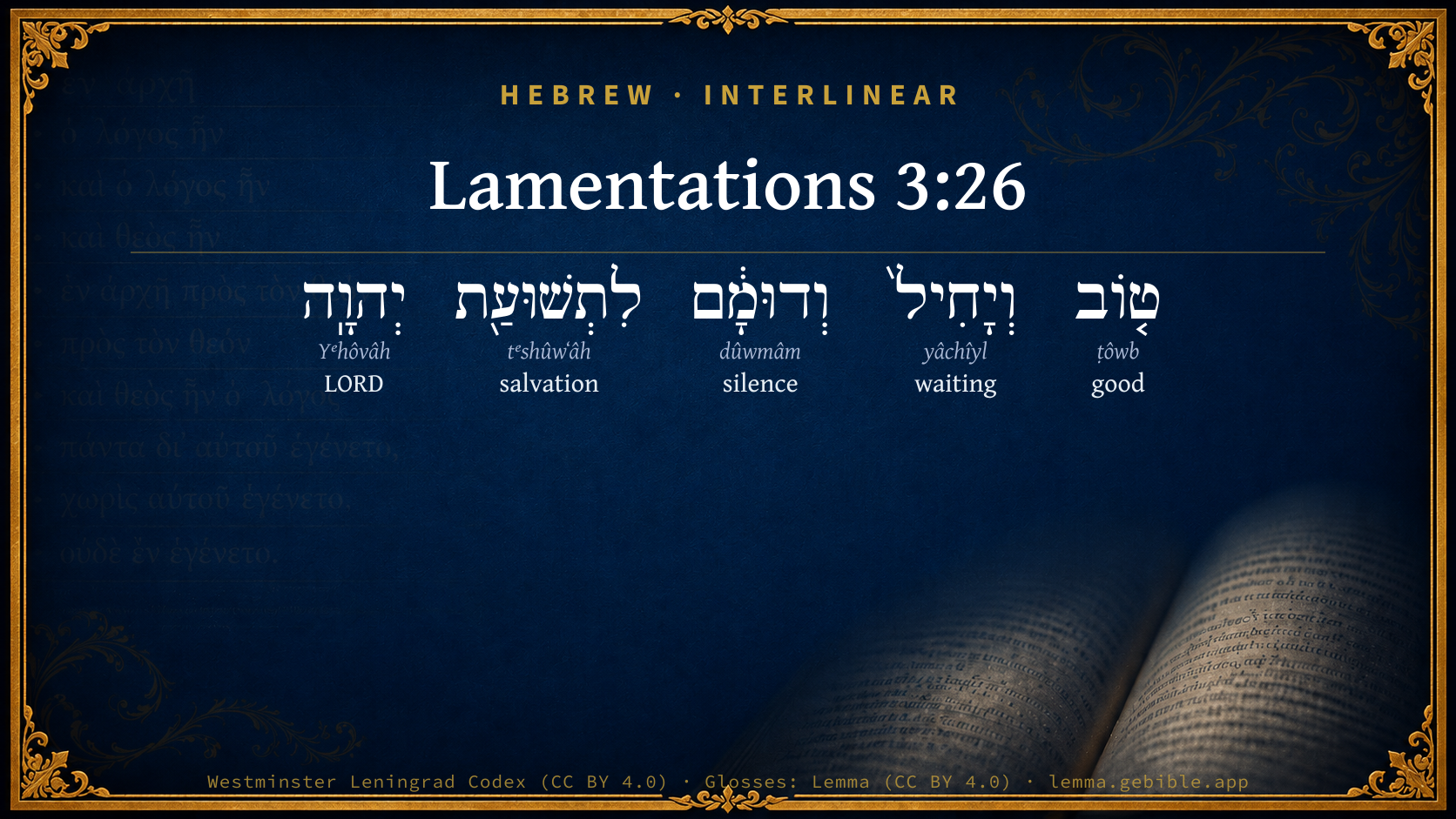
Lamentations 3:26

Hebrew (Westminster Leningrad Codex) Lamentations 3:26 appears in the Hebrew Old Testament. The text above is from the Westminster Leningrad Codex. Each word links to its Strong’s number, a concise gloss, and parsing drawn from the Open Scriptures Hebrew Bible morphology. Click any word for its full Brown-Driver-Briggs (BDB) entry.
Download image
Cite this verse

Lamentations 3:26 (World English Bible). Public Domain. Lemma interlinear Bible study tool, https://lemma.gebible.app/v/lamentations/3/26.

Show BibTeX & RIS
BibTeX
RIS
English Translation
It is good that a man should hope and quietly wait for the salvation of Yahweh.
World English Bible · Public Domain
Highlights
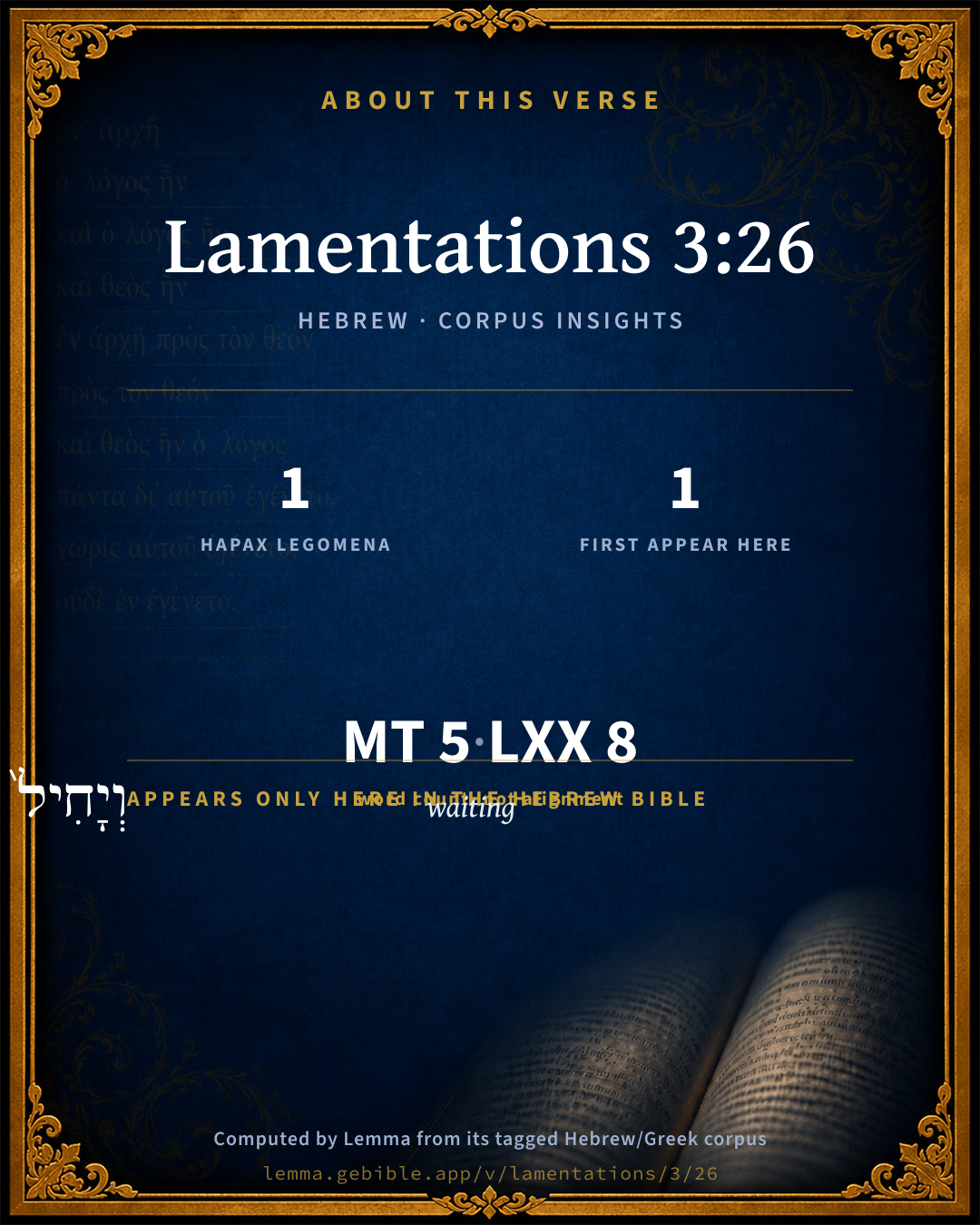
  • 1 hapax legomenon — only here in the Hebrew Bible
  • 1 first appearance in the Hebrew Bible
Full analysis ↓
Download a study sheet

One document with this verse’s original text, its word-by-word gloss line, the meaning frame, cross-references with their text, attributed commentary, and full source and license credits — printable, and it pastes into notes with its structure intact.

This verse Autodidact and up

Study sheet (.html) Plain text (.txt)

A passage Seminary Student

Up to 50 verses in one chapter. A passage sheet keeps up to 6 commentary sources and 12 cross-references per verse, in the order this page ranks them, and says so on the sheet whenever that leaves anything out. Ask for a single verse and you get the Autodidact verse sheet above.

Everything on this page stays free to read, with no account — the sheet is a download of what is already on screen, not access to it.

Want to remove ads? Support Godless Engineer
Compare translations 3

The same verse in 3 English versions, stacked beneath the original-language interlinear above. Click any original word for its lexicon entry.

Each is an independent rendering of the whole verse — the interlinear is not word-aligned to these translations.

Highlighted words mark where these versions differ — a whole-verse word diff, not a word-by-word alignment.

  • World English Bible Public Domain
    It is good that a man should hope and quietly wait for the salvation of Yahweh.
  • King James Version Public Domain
    It is good that a man should both hope and quietly wait for the salvation of the LORD.
  • unfoldingWord Literal Text CC BY-SA 4.0
    is good to wait and silent for the salvation of Yahweh.

unfoldingWord Literal Text — © unfoldingWord, licensed CC BY-SA 4.0. Word-aligned USFM3 via Door43 (git.door43.org/unfoldingWord/en_ult).

Versions to compare (up to 4)

3 of 4 selected

Show all 18 translations

Every available English version of this verse, each an independent rendering of the whole verse.

  • World English Bible Public Domain
    It is good that a man should hope and quietly wait for the salvation of Yahweh.
  • Berean Standard Bible Public Domain
    It is good to wait quietly for the salvation of the LORD.
  • Majority Standard Bible Public Domain
    It is good to wait quietly for the salvation of the LORD.
  • King James Version Public Domain
    It is good that a man should both hope and quietly wait for the salvation of the LORD.
  • American Standard Version (1901) Public Domain
    It is good that a man should hope and quietly wait for the salvation of Jehovah.
  • Revised Version (1885) Public Domain
    It is good that a man should hope and quietly wait for the salvation of the LORD.
  • Geneva Bible (1599) Public Domain
    It is good both to trust, and to waite for the saluation of the Lord.
  • Douay-Rheims (1899) Public Domain
    Teth. It is good to wait with silence for the salvation of God.
  • Young's Literal Translation Public Domain
    Good! when one doth stay and stand still For the salvation of Jehovah.
  • Literal Standard Version CC BY-SA 4.0
    [It is] good when one stays and stands still || For the salvation of YHWH.
  • Unlocked Literal Bible CC BY-SA 4.0
    It is good to wait silently for the salvation of Yahweh.
  • unfoldingWord Literal Text CC BY-SA 4.0
    is good to wait and silent for the salvation of Yahweh.
  • Darby Bible Public Domain
    It is good that one should both wait, and that in silence, for the salvation of Jehovah.
  • World Messianic Bible Public Domain
    It is good that a man should hope and quietly wait for the salvation of the LORD.
  • Webster's Bible Public Domain
    It is good that a man should both hope and quietly wait for the salvation of the LORD.
  • Free Bible Version CC BY-SA 4.0
    It is good to wait quietly for the Lord's salvation.
  • Bible in Basic English Public Domain
    It is good to go on hoping and quietly waiting for the salvation of the Lord.
  • JPS Tanakh (1917) Public Domain
    It is good that a man should quietly wait for the salvation of the LORD.

Literal Standard Version (2020), Covenant Press — licensed CC BY-SA 4.0. Text via the HelloAO Bible API (eBible.org). Unlocked Literal Bible (unfoldingWord) — licensed CC BY-SA 4.0. Text via the HelloAO Bible API (eBible.org). unfoldingWord Literal Text — © unfoldingWord, licensed CC BY-SA 4.0. Word-aligned USFM3 via Door43 (git.door43.org/unfoldingWord/en_ult). Free Bible Version, Dr. Jonathan Gallagher — licensed CC BY-SA 4.0. Text via the HelloAO Bible API (eBible.org).

Word by word

More ways to search: Search by grammar → Find every occurrence → Compare this word →

Practice this passage: Drill this verse → Learn its vocabulary →

About this verse

These counts appear in no published source. They are computed here, from the morphology-tagged text and Lemma’s own curated glosses. What Lemma adds →

5
words
5
distinct lemmas
Prophets
section

Notable vocabulary

1 hapax legomenon — a word that appears only here in the entire Hebrew Bible:

  • וְיָחִיל֙ waiting H3175

First appearance in Scripture

This word makes its first canonical appearance in the Hebrew Bible here:

  • וְיָחִיל֙ waiting H3175

Shared distinctive vocabulary

וְדוּמָ֔ם silence H1748 occurs in 3 verses of the Hebrew Bible. Also found in:

Grammatical profile

  • 2 nouns
  • 2 adjectives
  • 1 adverb

Hebrew & Septuagint length

In English translation the verse runs 16 words from the Hebrew and 13 from the Septuagint (LXX English) — closely comparable.

A rough comparison of the two English renderings, which tokenize alike — not a word-level alignment.

Word counts can differ between the Hebrew and the Greek without any difference in meaning — e.g. the Hebrew direct-object marker אֵת has no separate Greek word, and Greek often adds the article ὁ.

In the original languages it is 5 Hebrew tokens and 8 Greek tokens — but the two are counted differently (Hebrew bundles its prefixes and suffixes into one token; the Greek is in lemma form), so that isn’t a like-for-like length.

Cross-references

18

Topical passages linked to Lamentations 3:26 in the Treasury of Scripture Knowledge — connected by theme and wording, ordered by reader-vote popularity; previews shown in the World English Bible.

  • Psalms 37:7 Rest in Yahweh, and wait patiently for him. Don't fret because of him who prospers in his way, Because of the man who makes wicked plots happen.
  • Psalms 37:34 Wait for Yahweh, and keep his way, And he will exalt you to inherit the land. When the wicked are cut off, you shall see it.
  • Psalms 130:5 I wait for Yahweh. My soul waits. I hope in his word.
  • Genesis 49:18 I have waited for your salvation, Yahweh.
  • Hebrews 10:35 Therefore don't throw away your boldness, which has a great reward.
  • Isaiah 30:15 For thus said the Lord Yahweh, the Holy One of Israel, In returning and rest shall you be saved; in quietness and in confidence shall be your strength. You would not:
  • Hebrews 3:14 For we have become partakers of Christ, if we hold fast the beginning of our confidence firm to the end:
  • 1 Peter 1:13 Therefore, prepare your minds for action, be sober and set your hope fully on the grace that will be brought to you at the revelation of Jesus Christ--
  • Psalms 119:166 I have hoped for your salvation, Yahweh. I have done your commandments.
  • 2 Chronicles 20:17 You shall not need to fight in this [battle]: set yourselves, stand you still, and see the salvation of Yahweh with you, O Judah and Jerusalem; don't be afraid, nor be dismayed: tomorrow go out against them: for Yahweh is with you.
  • Psalms 119:174 I have longed for your salvation, Yahweh. Your law is my delight.
  • Psalms 52:9 I will give you thanks forever, because you have done it. I will hope in your name, for it is good, In the presence of your saints.
  • Psalms 54:6 With a free will offering, I will sacrifice to you. I will give thanks to your name, Yahweh, for it is good.
  • Psalms 73:28 But it is good for me to come close to God. I have made the Lord Yahweh my refuge, That I may tell of all your works.
  • Isaiah 30:7 For Egypt helps in vain, and to no purpose: therefore have I called her Rahab who sits still.
  • Galatians 4:18 But it is always good to be zealous in a good cause, and not only when I am present with you.
  • Psalms 92:1 It is a good thing to give thanks to Yahweh, To sing praises to your name, Most High;
  • Exodus 14:13 Moses said to the people, "Don't be afraid. Stand still, and see the salvation of Yahweh, which he will work for you today: for the Egyptians whom you have seen today, you shall never see them again.

Cross-references courtesy of OpenBible.info (CC BY 4.0).

Hebrew and Greek witnesses Masoretic Hebrew ↔ Greek Septuagint

The same verse in the two great witnesses to the Old Testament, shown verse-for-verse.

These are two independent witnesses, not word-aligned to each other, and the Septuagint is shown in lemma (dictionary) form.

Hebrew Lamentations 3:26 Masoretic · Westminster Leningrad Codex

ט֤וֹב וְיָחִיל֙ וְדוּמָ֔ם לִתְשׁוּעַ֖ת יְהוָֽה

It is good that a man should hope and quietly wait for the salvation of Yahweh.

World English Bible · Public Domain

Greek LXX Lamentations 3:26 Septuagint · lemma form

καί ὑπομένω καί ἡσυχάζω εἰς ὁ σωτήριον κύριος

is good, and shall wait for, and quietly expect salvation of the Lord.

LXX2012 (modern English Septuagint) · Public Domain

Hebrew: Westminster Leningrad Codex (CC BY 4.0). Greek: Septuagint (public domain); English from LXX2012 (modern English Septuagint) (Public Domain). How the Septuagint differs from the Hebrew →

Commentary

Notes on Lamentations 3:26 from classic Christian and Jewish commentators (each source and its license shown beneath its notes). The classic Christian expositions comment on the surrounding passage and are grouped to its opening verse, so a note may address several verses; the Jewish commentaries on the Tanakh (Rashi and others) are per-verse, so they appear only where the commentator wrote on this verse.

Lemma curates 59 commentaries, every one of them public domain or Creative Commons licensed, each selected and text-cleaned for this edition rather than reprinted as found. About our sources →

Trapp's Complete Commentary

John Trapp

Lam 3:26 [It is] good that [a man] should both hope and quietly wait for the salvation of the LORD.

Ver. 26. It is good that a man should both hope and quietly wait.] Heb., Be silent: not with a pythagoric or monastic silence, ut non liceat loqui locis et horis certis, but with a humble submission to God’s holy will, a patient and peaceable behaviour under his hand; waiting for a good use thereof, and a gracious issue in the best time - to frame the heart whereunto, Aurea his subnectitur sententia.

John Trapp, A Commentary or Exposition upon All the Books of the Old and New Testament (1647–1656) — public domain. Text from a community e-Sword module.

Tyndale Open Study Notes

Tyndale Open Resources

3:26 Those who are confident of God’s plan can wait quietly for him to grant salvation.

Tyndale Open Study Notes — © Tyndale Open Resources, licensed CC BY-SA 4.0. Text via the HelloAO Bible API.

Jamieson, Fausset & Brown

Robert Jamieson, A. R. Fausset & David Brown

quietly wait--literally, "be in silence." Compare Lam 3:28 and Psa 39:2, Psa 39:9, that is, to be patiently quiet under afflictions, resting in the will of God (Psa 37:7). So Aaron (Lev 10:2-3); and Job (Job 40:4-5).

Jamieson, Fausset & Brown — Commentary Critical and Explanatory on the Whole Bible (1871) — public domain (CC PDM 1.0). Text via the HelloAO Bible API.

Adam Clarke's Commentary

Verse 26. It is good that a man should both hope] Hope is essentially necessary to faith; he that hopes not, cannot believe; if there be no expectation, there can be no confidence. When a man hopes for salvation, he should not only wait for it, but use every means that may lead to it; for hope cannot live, if there be no exercise. If hope become impatient, faith will be impossible: for who can believe for his salvation when his mind is agitated? He must therefore quietly wait. He must expect, and yet be dumb, as the words imply; ever feeling his utter unworthiness; and, without murmuring, struggle into life.

Adam Clarke's Commentary on the Bible (1810–1826) — public domain. Text from a community e-Sword/MySword module.

John Calvin's Commentaries

It is, indeed, an abrupt phrase when he says, Good and he will wait; for these words are without a subject; but as it is a general statement, there is no ambiguity. The Prophet means that it is good to hope and to be silent as to the salvation, of God. Then the verbs in the future tense ought to be rendered its subjunctives, as though it was said, “It is good when any one hopes in the salvation of Jehovah, and is silent, that is, bears patiently all his troubles until God succors him.”

But; the Prophet here reminds us, that we are by no means to require that God should always appear to us, and that his paternal favor should always shine forth on our life. This is, indeed, a condition sought for by all; for the flesh inclines us to this, and hence we shun adversities. We, then, naturally desire God’s favor to be manifested to us; how? In reality, so that all things may go on prosperously, that no trouble may touch us, that we may be tormented by no anxiety, that no danger may be suspended over us, that no calamity may threaten us: these things, as I have said, we all naturally seek and desire. But in such a case faith would be extinguished, as Paul tells us in his Epistle to the Romans,

“For we hope not,” he says, “for what appears, but we hope for what, is hidden.” (Romans 8:24, 25.)

It is necessary in this world that the faithful should, as to outward things, be miserable, at one time exposed to want, at another subject to various dangers — at; one time exposed to reproaches and calumnies, at another harassed by losses: why so? because there would be no occasion for exercising hope, were our salvation complete. This is the very thing which the Prophet now teaches us, when he declares that it is good for us to learn in silence to wait for the salvation of God.

But to express more clearly his mind, he first says, He will wait, or hope. He teaches the need of patience, as also the Apostle does, in Hebrew 10:36; for otherwise there can be no faith. It hence appears, that where there is no patience, there is not even a spark of faith in the heart of man; how so? because this is our happiness, to wait or to hope; and we hope for what is hidden. But in the second clause he explains himself still more clearly by saying, and will be silent To be silent means often in Scripture to rest, to be still; and here it signifies no other thing than to bear the troubles allotted to us, with a calm and resigned mind. He is then said to be silent to God, who remains quiet even when afflictions supply occasion for clamoring; and hence this quietness is opposed to violent feelings; for when some trouble presses on us, we become turbulent, and are carried away by our fury, at one time we quarrel with God, at another we pour forth various complaints. The same thing also happens, when we see some danger, for we tremble, and then we seek remedies here and there, and that with great eagerness. But he who patiently bears his troubles, or who recumbs on God when dangers surround him, is said to be silent or to rest quietly; and hence the words of Isaiah, “In hope and silence;” for he there exhorts the faithful to patience, and shews where strength is, even when we trust in God, so as willingly to submit to His will, and to be ready to bear his chastisements, and then when we doubt not but that he will be ready to bring us help when we are in danger. (Isaiah 30:15.)

We now perceive what the Prophet means when he says, that it. is good if we wait and be silent as to the salvation of God; even because our happiness is hid, and we are also like the dead, as Paul says, and our life is hid in Christ. (Colossians 3:3.) As then it is so, we must necessarily be silent as to God’s salvation, and cherish hope within, though surrounded with many miseries. It follows, —

John Calvin's Commentaries (1540-1563) — public domain. Text from the Calvin Translation Society English edition (1840s-50s) via the Christian Classics Ethereal Library (ccel.org). Calvin's coverage is partial (roughly two-thirds of the Bible); uncommented books and verses are honest gaps, never fabricated. The 19th-century editor's footnotes and remarks are omitted so the notes are faithfully Calvin's own voice.

Ellicott's Commentary for English Readers

(26) Quietly wait.—Literally, wait in silence: i.e. abstain from murmurs and complaints.

A Bible Commentary for English Readers, edited by Charles John Ellicott (1878–1897) — public domain. Text from a community e-Sword module.

John Gill's Exposition

It is good that a man should both hope and quietly wait,.... This follows from the former; for if God is good to such, it must be good for them to hope and wait for him; it is both their duty and their interest: and it may be observed, that hope is the ground of patient waiting, and is here promised to it; where there is no hope of a thing, there will be no waiting for it, much less quietly: hope is of things unseen, future, difficult, and yet possible, or there would be no hope; and where there is that, there will be waiting; for "if we hope for that we see not, then do we with patience wait for it", Rom 8:25; here in the original text it is, "hope, and be silent" (z); or, "a good man will both hope" or "wait, and be silent" (a); that is, under the present dispensation, though an afflictive one; men should be still, as David exhorts, and be dumb, as he was; and hold their peace, as Aaron did, at such seasons: not that they should indulge a stoical apathy, or be insensible of their condition, and disregard the rod, and him that has appointed it, or be altogether silent and speechless; but should own the hand of God, and their deserts, cry to him for deliverance, be thankful it is no worse, and speak of the gracious dealings of God with them; yet should not murmur and complain, or charge God foolishly; but be resigned to his will, and wait the issue of Providence quietly, even wait

for the salvation of the Lord; for temporal deliverance from outward evils and present afflictions, and for spiritual and eternal salvation. The saints, under the Old Testament, waited for Christ, the author of salvation, appointed and promised by the Lord. He is come, and has obtained salvation, which is published in the Gospel. Sensible sinners are made acquainted with their need of it, and see the fulness and suitableness of it, and are earnestly desirous of knowing their interest in it; this is not immediately had; it is good to wait quietly for it, in an attendance on the word and ordinances; and this being come at, still the complete enjoyment is yet behind: saints are now heirs of it, are kept unto it; it is nearer them than when they believed; Christ will appear unto it, and it becomes them to wait patiently for it; which will be a salvation from the very being of sin; from the temptations of Satan; from all troubles inward and outward; from all troublesome persons and things; from all doubts, fears, darkness, and unbelief; and will consist in perfect happiness and glory, and is worth waiting for.

(z) "et expectet et silens", Pagninus, Montanus; "qui et expectat et silet", Piscator. (a) "Bonus ergo et expectabit et silens erit", Schmidt.

John Gill's Exposition of the Whole Bible (1746–1763) — public domain (CC PDM 1.0). Text via the HelloAO Bible API.

Matthew Poole's English Annotations

Good here either signifies honestum, what becomes men, and is their duty; or utile, what is profitable, and will turn to good account to them. Hoping and waiting differ but as the mother and daughter, hope being the mother of patience and waiting; or as the habit and act, hoping and waiting being ranch the same, flowing from a gracious power and habit given the soul to wait. Quietness is necessary to waiting, for all turbulency and impatience of spirit under sad providences is opposed to waiting. The salvation of the Lord refers to the outward man, in preserving or delivering us from dangers; or to the soul and inward man, in preserving us from, and delivering our souls out of, dangers they fear, or evils they are pressed with. Now for a man in the midst of all evils to hope in God, and, without turbulence or disorder in himself, to wait for a preservation from, or a delivery out of, any evils, is what becometh a man, (a child of God especially,) and will turn to a good account to them.

Matthew Poole's English Annotations on the Holy Bible (1683–1685) — public domain. Text from a community e-Sword/MySword module.

Whedon's Commentary on the Bible

Daniel D. Whedon

26. Hope and quietly wait, etc. — More literally, It is good both to wait and be silent=silently wait. Keil renders it: It is good that he should wait, and in silence too, for the help of God. The point is, that he should not only wait, but abstain from murmurings and repinings. This also prepares for the thought of the following verse, for he who has patiently submitted to sufferings in his youth will not readily sink in despair in old age, but will be likely to exercise himself in a calm waiting on God.

Daniel D. Whedon (gen. ed.), Commentary on the Old and New Testaments (1874–1909) — public domain. Text from a community e-Sword module.

The Pulpit Commentary

Should both hope and quietly wait; rather, should wait in silence. "Silence" is an expression of the psalmist"s (the Lamentations are psalms) for resignation to the will of God; comp. Psa_62:1 Psa_65:1, and see Authorized Version, margin. The thought of the verse is that of Psa_37:7.

The Pulpit Commentary (1880–1919), ed. H.D.M. Spence-Jones & Joseph S. Exell — public domain. Text from a community e-Sword module.

Rashi

Rabbi Shlomo Yitzchaki (Rashi)

It is good that one should wait quietly Heb. טוֹב וְיָחִיל וְדוּמָם. The “vav” of וְיָחִיל is superfluous like the “vav” of (Gen. 36:24): “Ayyah (וְאַיָּה) and Anah.” It is good that a man wait and remain silent and hope for the Lord’s salvation.

Rashi on the Tanakh — English translations: “The Judaica Press complete Tanach with Rashi, translated by A. J. Rosenberg” (CC BY 4.0); “Pentateuch with Rashi's commentary by M. Rosenbaum and A.M. Silbermann, 1929-1934” (public domain); “The Metsudah Tanach series, Lakewood, N.J” (CC BY 4.0); and “The Book of Joshua, Metsudah Publications, 1997” (CC BY 4.0). Text via Sefaria.

Lesson kit

Teaching starters — assembled from the data on this page, not authored interpretation. Every prompt links to the verse data it draws on. Edit before teaching.

Lamentations, in the Prophets, opens this verse with 5 words (5 distinct Hebrew lemmas). Its most distinctive word is yâchîyl (“waiting”). A historical commentator’s framing appears above. Read the whole chapter for the surrounding context.

Discussion questions

  1. How does “waiting” (yâchîyl) shape what this verse is saying?
  2. This verse holds 1 word here found nowhere else in the Hebrew Bible. What might the rare word draw attention to?
  3. The word “waiting” first appears here in Scripture. What is being introduced at this debut?
  4. Isaiah 47:5 shares the word «silence» with this verse. How do the two illuminate each other?
  5. These translations render this verse differently; the difference is in the English rendering, not the original. What questions does that raise?
  6. Reading how Trapp's Complete Commentary and Tyndale Open Study Notes read this verse, where do the two commentators agree and where do they part?

Things to notice

Reading settings

Reading text

Shown beneath each verse's original-language words.

Old Testament
Old Testament edition

Read the OT as the Masoretic Hebrew (MT) or the Greek Septuagint (LXX).

English shown for the Greek Septuagint (in the Hebrew ↔ Greek comparison).

Comparing translations? Open the Compare panel on any verse page to stack up to four side by side.