
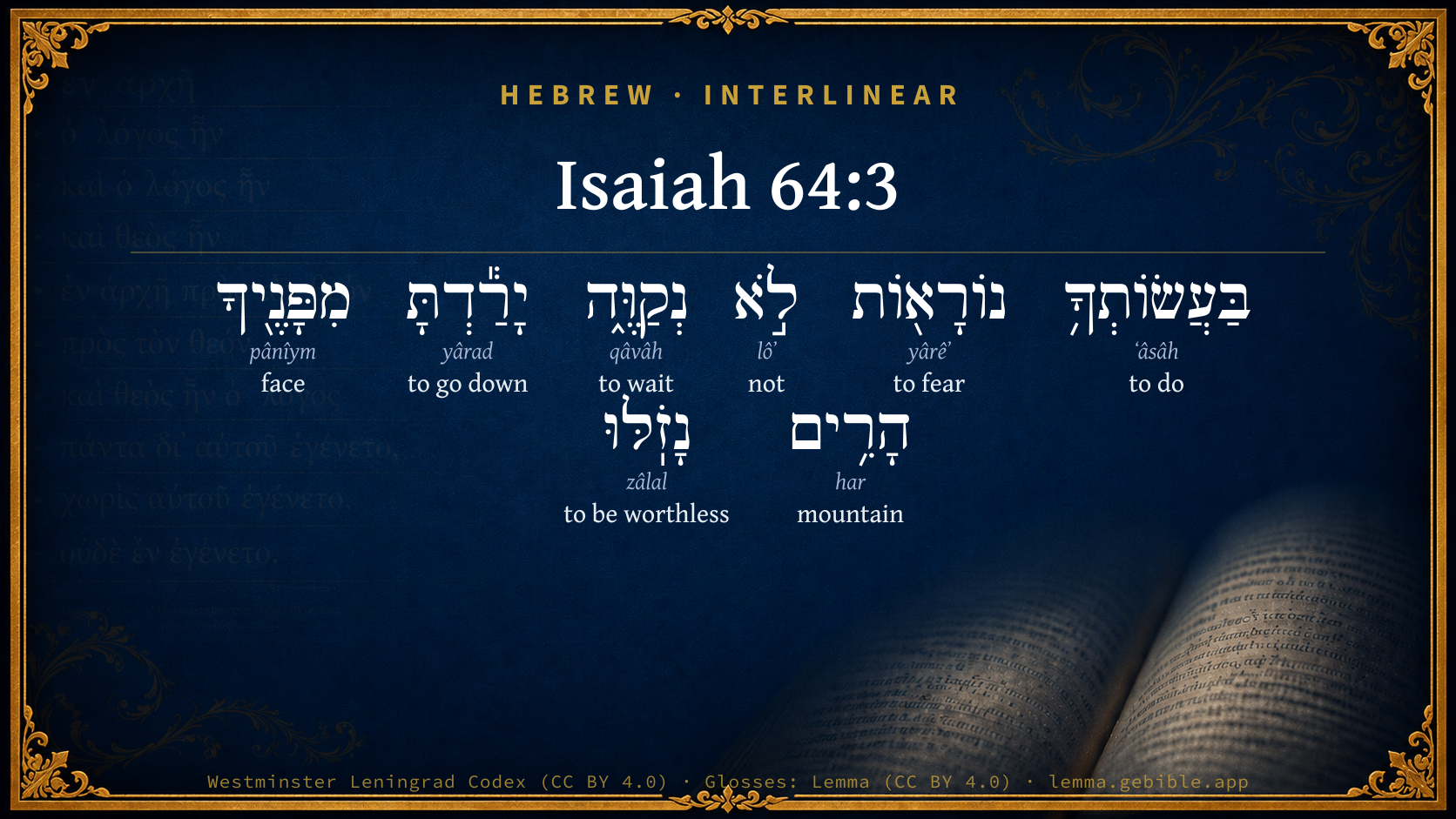
Isaiah 64:3

Hebrew (Westminster Leningrad Codex) Isaiah 64:3 appears in the Hebrew Old Testament. The text above is from the Westminster Leningrad Codex. Each word links to its Strong’s number, a concise gloss, and parsing drawn from the Open Scriptures Hebrew Bible morphology. Click any word for its full Brown-Driver-Briggs (BDB) entry.
Download image
Cite this verse

Isaiah 64:3 (World English Bible). Public Domain. Lemma interlinear Bible study tool, https://lemma.gebible.app/v/isaiah/64/3.

Show BibTeX & RIS
BibTeX
RIS
English Translation
When you did terrible things which we didn't look for, you came down, the mountains quaked at your presence.
World English Bible · Public Domain
Download a study sheet

One document with this verse’s original text, its word-by-word gloss line, the meaning frame, cross-references with their text, attributed commentary, and full source and license credits — printable, and it pastes into notes with its structure intact.

This verse Autodidact and up

Study sheet (.html) Plain text (.txt)

A passage Seminary Student

Up to 50 verses in one chapter. A passage sheet keeps up to 6 commentary sources and 12 cross-references per verse, in the order this page ranks them, and says so on the sheet whenever that leaves anything out. Ask for a single verse and you get the Autodidact verse sheet above.

Everything on this page stays free to read, with no account — the sheet is a download of what is already on screen, not access to it.

Want to remove ads? Support Godless Engineer
Compare translations 3

The same verse in 3 English versions, stacked beneath the original-language interlinear above. Click any original word for its lexicon entry.

Each is an independent rendering of the whole verse — the interlinear is not word-aligned to these translations.

Highlighted words mark where these versions differ — a whole-verse word diff, not a word-by-word alignment.

  • World English Bible Public Domain
    When you did terrible things which we didn't look for, you came down, the mountains quaked at your presence.
  • King James Version Public Domain
    When thou didst terrible things which we looked not for, thou camest down, the mountains flowed down at thy presence.
  • unfoldingWord Literal Text CC BY-SA 4.0
    When you did fearful things we did not expect, you came down; the mountains quaked from your face.

unfoldingWord Literal Text — © unfoldingWord, licensed CC BY-SA 4.0. Word-aligned USFM3 via Door43 (git.door43.org/unfoldingWord/en_ult).

Versions to compare (up to 4)

3 of 4 selected

Show all 18 translations

Every available English version of this verse, each an independent rendering of the whole verse.

  • World English Bible Public Domain
    When you did terrible things which we didn't look for, you came down, the mountains quaked at your presence.
  • Berean Standard Bible Public Domain
    When You did awesome works that we did not expect, You came down, and the mountains trembled at Your presence.
  • Majority Standard Bible Public Domain
    When You did awesome works that we did not expect, You came down, and the mountains trembled at Your presence.
  • King James Version Public Domain
    When thou didst terrible things which we looked not for, thou camest down, the mountains flowed down at thy presence.
  • American Standard Version (1901) Public Domain
    When thou didst terrible things which we looked not for, thou camest down, the mountains quaked at thy presence.
  • Revised Version (1885) Public Domain
    When thou didst terrible things which we looked not for, thou camest down, the mountains flowed down at thy presence.
  • Geneva Bible (1599) Public Domain
    When thou diddest terrible things, which we looked not for, thou camest downe, and the mountaines melted at thy presence.
  • Douay-Rheims (1899) Public Domain
    When thou shalt do wonderful things, we shall not bear them: thou didst come down, and at thy presence the mountains melted away.
  • Young's Literal Translation Public Domain
    In Thy doing fearful things -- we expect not, Thou didst come down, From Thy presence did mountains flow.
  • Literal Standard Version CC BY-SA 4.0
    In Your doing fearful things [that] we do not expect, || You came down, || Mountains flowed from Your presence.
  • Unlocked Literal Bible CC BY-SA 4.0
    Previously, when you did marvelous things that we had not expected, you came down, and the mountains trembled at your presence.
  • unfoldingWord Literal Text CC BY-SA 4.0
    When you did fearful things we did not expect, you came down; the mountains quaked from your face.
  • Darby Bible Public Domain
    When thou didst terrible things [which] we looked not for, thou camest down, and the mountains flowed down at thy presence.
  • World Messianic Bible Public Domain
    When you did awesome things which we didn’t look for, you came down, and the mountains quaked at your presence.
  • Webster's Bible Public Domain
    \\64:4\\For since the beginning of the world men have not heard, nor perceived by the ear, neither hath the eye seen, O God, besides thee, what he hath prepared for him that waiteth for him.
  • Free Bible Version CC BY-SA 4.0
    In the past you did things we weren't anticipating. You came down and the mountains trembled in your presence!
  • Bible in Basic English Public Domain
    The ear has not had news of, or the eye seen,... any God but you, working for the man who is waiting for him.
  • JPS Tanakh (1917) Public Domain
    (64-2) When Thou didst tremendous things which we looked not for — Oh that Thou wouldest come down, that the mountains might quake at Thy presence! —

Literal Standard Version (2020), Covenant Press — licensed CC BY-SA 4.0. Text via the HelloAO Bible API (eBible.org). Unlocked Literal Bible (unfoldingWord) — licensed CC BY-SA 4.0. Text via the HelloAO Bible API (eBible.org). unfoldingWord Literal Text — © unfoldingWord, licensed CC BY-SA 4.0. Word-aligned USFM3 via Door43 (git.door43.org/unfoldingWord/en_ult). Free Bible Version, Dr. Jonathan Gallagher — licensed CC BY-SA 4.0. Text via the HelloAO Bible API (eBible.org).

Word by word

More ways to search: Search by grammar → Find every occurrence → Compare this word →

Practice this passage: Drill this verse → Learn its vocabulary →

נָזֹֽלּוּ
zâlal
H2151
“to be worthless”
Verb, Niphal, Perfect, 3rd Person, Common, Plural
Part of Speech
Verb
Stem
Niphal
Form
Perfect
Person
3rd Person
Gender
Common
Number
Plural
Full BDB Definition

Origin: a primitive root [compare H2107 ]

TWOT: 553

to be worthless, be vile, be insignificant, be light - (Qal) - to be worthless, be insignificant - to make light of, squander, be lavish with - to shake, tremble, quake - (Niphal) to shake, quake
  1. בַּעֲשׂוֹתְךָ֥ ʻâsâh H6213 “in/at · to do · you” Preposition + Verb, Qal, Infinitive Construct + Suffix, Personal, 2nd Person, Masculine, Singular
  2. נוֹרָא֖וֹת yârêʼ H3372 “fearing” Verb, Niphal, Participle Active, Feminine, Plural, Absolute
  3. לֹ֣א lôʼ H3808 “not” Particle, Negative
  4. נְקַוֶּ֑ה qâvâh H6960 “to wait” Verb, Piel, Imperfect, 1st Person, Common, Plural
  5. יָרַ֕דְתָּ yârad H3381 “to go down” Verb, Qal, Perfect, 2nd Person, Masculine, Singular
  6. מִפָּנֶ֖יךָ pânîym H6440 “from · face(s) · your” Preposition + Noun, Common, Both, Plural, Construct + Suffix, Personal, 2nd Person, Masculine, Singular
  7. הָרִ֥ים har H2022 “mountains” Noun, Common, Masculine, Plural, Absolute

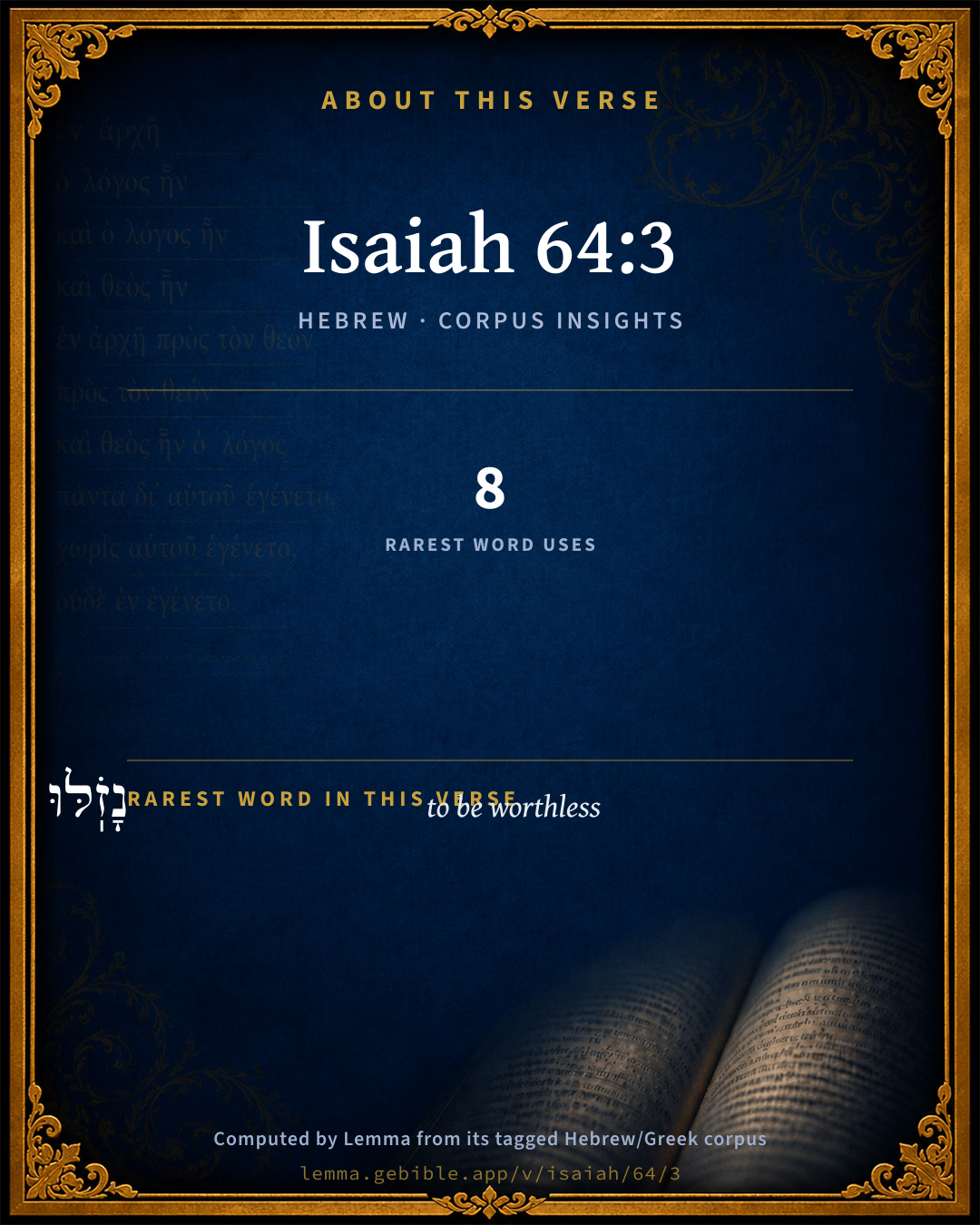
About this verse

These counts appear in no published source. They are computed here, from the morphology-tagged text and Lemma’s own curated glosses. What Lemma adds →

8
words
8
distinct lemmas
Prophets
section

Notable vocabulary

The rarest word here is נָזֹֽלּוּ to be worthless H2151 — appearing just 8 times in the whole Hebrew Bible.

Shared distinctive vocabulary

נָזֹֽלּוּ to be worthless H2151 occurs in 8 verses of the Hebrew Bible. Also found in:

Grammatical profile

  • 5 verbs
  • 2 nouns
  • 1 particle

Verb forms

  • בַּעֲשׂוֹתְךָ֥ Qal · Infinitive Construct
  • נוֹרָא֖וֹת Niphal · Participle Active
  • נְקַוֶּ֑ה Piel · Imperfect
  • יָרַ֕דְתָּ Qal · Perfect
  • נָזֹֽלּוּ Niphal · Perfect

Hebrew & Septuagint length

In English translation the verse runs 19 words from the Hebrew and 14 from the Septuagint (LXX English) — closely comparable.

A rough comparison of the two English renderings, which tokenize alike — not a word-level alignment.

Word counts can differ between the Hebrew and the Greek without any difference in meaning — e.g. the Hebrew direct-object marker אֵת has no separate Greek word, and Greek often adds the article ὁ.

Cross-references

15

Topical passages linked to Isaiah 64:3 in the Treasury of Scripture Knowledge — connected by theme and wording, ordered by reader-vote popularity; previews shown in the World English Bible.

  • Exodus 34:10 He said, "Behold, I make a covenant: before all your people I will do marvels, such as have not been worked in all the earth, nor in any nation; and all the people among which you are shall see the work of Yahweh; for it is an awesome thing that I do with you.
  • Deuteronomy 10:21 He is your praise, and he is your God, who has done for you these great and awesome things, which your eyes have seen.
  • Psalms 65:5–6 By awesome deeds of righteousness, you answer us, God of our salvation. You who are the hope of all the ends of the earth, Of those who are far away on the sea;
  • Psalms 66:3 Tell God, "How awesome are your deeds! Through the greatness of your power, your enemies submit themselves to you.
  • Psalms 66:5 Come, and see God's deeds-- Awesome work on behalf of the children of men.
  • Psalms 106:22 Wondrous works in the land of Ham, And awesome things by the Red Sea.
  • Habakkuk 3:3 God came from Teman, The Holy One from Mount Paran. Selah. His glory covered the heavens, And his praise filled the earth.
  • Deuteronomy 4:34 Or has God tried to go and take him a nation from the midst of [another] nation, by trials, by signs, and by wonders, and by war, and by a mighty hand, and by an outstretched arm, and by great terrors, according to all that Yahweh your God did for you in Egypt before your eyes?
  • Judges 5:4–5 Yahweh, when you went forth out of Seir, When you marched out of the field of Edom, The earth trembled, the sky also dropped, Yes, the clouds dropped water.
  • 2 Samuel 7:23 What one nation in the earth is like your people, even like Israel, whom God went to redeem to himself for a people, and to make him a name, and to do great things for you, and awesome things for your land, before your people, whom you redeem to you out of Egypt, [from] the nations and their gods?
  • Psalms 68:8 The earth trembled. The sky also poured down rain at the presence of the God of Sinai-- At the presence of God, the God of Israel.
  • Psalms 76:12 He will cut off the spirit of princes. He is feared by the kings of the earth.
  • Psalms 105:27–36 They performed miracles among them, And wonders in the land of Ham.
  • Isaiah 64:1 Oh that you would tear the heavens, that you would come down, that the mountains might quake at your presence,
  • Habakkuk 3:6 He stood, and shook the earth. He looked, and made the nations tremble. The ancient mountains were crumbled. The age-old hills collapsed. His ways are eternal.

Cross-references courtesy of OpenBible.info (CC BY 4.0).

Hebrew and Greek witnesses Masoretic Hebrew ↔ Greek Septuagint

The same verse in the two great witnesses to the Old Testament, shown verse-for-verse.

These are two independent witnesses, not word-aligned to each other, and the Septuagint is shown in lemma (dictionary) form.

Hebrew Isaiah 64:3 Masoretic · Westminster Leningrad Codex

בַּעֲשׂוֹתְךָ֥ נוֹרָא֖וֹת לֹ֣א נְקַוֶּ֑ה יָרַ֕דְתָּ מִפָּנֶ֖יךָ הָרִ֥ים נָזֹֽלּוּ

When you did terrible things which we didn't look for, you came down, the mountains quaked at your presence.

World English Bible · Public Domain

Greek LXX Isaiah 64:3 Septuagint · lemma form

ἀπό ὁ αἰών οὐ ἀκούω οὐδέ ὁ ὀφθαλμός ἐγώ ὁράω θεός πλήν σύ καί ὁ ἔργον σύ ὅς ποιέω ὁ ὑπομένω ἔλεος

whenever you shall work gloriously; trembling from you shall take hold upon the mountains.

LXX2012 (modern English Septuagint) · Public Domain

On this verse, Joseph Benson's Commentary discusses the Septuagint’s reading. Read the note in Commentary ↓

Hebrew: Westminster Leningrad Codex (CC BY 4.0). Greek: Septuagint (public domain); English from LXX2012 (modern English Septuagint) (Public Domain). How the Septuagint differs from the Hebrew →

Targum (Aramaic paraphrase)

1

The Targum is the ancient Jewish Aramaic paraphrase of the Hebrew Scriptures — an interpretive translation, not the Hebrew text itself. Onkelos (literal) and Pseudo-Jonathan (expansive) render the Torah, and Jonathan the Prophets. Coverage is partial: where no permissively-licensed English translation exists for a verse, only the Aramaic is shown. This is verse-level text, not a word-by-word alignment to the Hebrew.

  1. Targum Jonathan Prophets (Joshua–Malachi)
    וּמֵעַלְמָא לָא שְׁמַעְתְּ אוֹדֶן קַל גְבוּרָן לָא אֲצֵיתַת לְמִלוּל זִיעַ עַיִן לָא חָזַת מָא דַחֲזוֹ עַמָךְ שְׁכִינַת יְקָרָךְ יְיָ אֲרֵי לֵית בַּר מִנָךְ דְאַתְּ עֲתִיד לְמֶעְבַּד לְעַמָךְ צַדִיקַיָא דְמִן עַלְמָא דִמְסַבְּרִין לְפוּרְקָנָךְ:

    And since the world was, ear hath not heard the report of such mighty deeds, nor hearkened to the speech of rapture, nor hath eye seen, what Thy people saw, the Shekinah of Thy glory, O Lord; for there is none besides Thee, who will do such things for Thy righteous people, who were of old; who hope for Thy salvation.

    Targum Jonathan — Aramaic: “Mikraot Gedolot” (public domain). English: “Sefaria Community Translation” (CC0 1.0 (public-domain dedication)); “London "Chaldee Paraphrase," 1871” (public domain). Text via Sefaria.

Commentary

Notes on Isaiah 64:3 from classic Christian and Jewish commentators (each source and its license shown beneath its notes). The classic Christian expositions comment on the surrounding passage and are grouped to its opening verse, so a note may address several verses; the Jewish commentaries on the Tanakh (Rashi and others) are per-verse, so they appear only where the commentator wrote on this verse.

Lemma curates 59 commentaries, every one of them public domain or Creative Commons licensed, each selected and text-cleaned for this edition rather than reprinted as found. About our sources →

Trapp's Complete Commentary

John Trapp

Isa 64:3 When thou didst terrible things [which] we looked not for, thou camest down, the mountains flowed down at thy presence.

Ver. 3. When thou didst terrible things.] Or, As when thou didst &c.; as thou didst of old for our forefathers.

Which we looked not for.] See Deu 4:32-33, where God himself extolleth them.

John Trapp, A Commentary or Exposition upon All the Books of the Old and New Testament (1647–1656) — public domain. Text from a community e-Sword module.

The Biblical Illustrator

Joseph S. Exell

Isa_64:3

When Thou didst terrible things

Terrible things

A standing phrase for the marvels of the Exodus, the type of the great final deliverance (Deu_10:21; 2Sa Psa_106:22).

(Prof. T. K. Cheyne, D. D.)

Divine surprises

Isaiah pleads with God to return to His chosen people, and restore their former peace and prosperity. He makes use of the past as an argument for the future, and recites the wonderful acts of God in days gone by as an encouragement to expect that He would do the like again. If it were not that God is unchangeable, no inference could be drawn from His past behaviour toward us; but inasmuch as He is immutably the same, we may safely infer that what He has done He will de again.

I. Let us meditate upon the fact that THE DIVINE PRESENCE IS THE ONE HOPE OF THE PEOPLE OF GOD. The prophet shows that he believed this, for he commences the chapter by a most ardent cry to God that He would come into the midst of His people. A little before this (Isa_63:15) he had prayed, Look down from heaven; but it is the characteristic of true prayer that it grows as it proceeds: he begins by asking God to look down; but he gathers intensity of desire and confidence of faith, and here he cries, Come down. So eager is he that God should come, and come at once, that he speaks to Him as though addressing a warrior who lingered in his tent while a battle was raging, who would be so eager to rush to the help of his friends that he would not stay to remove the canvas or to lift the curtain, but would rend a way for himself through the canopy to come at once to the deliverance of those who called him to the rescue. It was through the open heavens that Christ went in where He now stands to plead for us, and by that open heaven the sacred Spirit descended to rest upon the Church. The impetuous character of the simile here used shows that the prophet looked upon the Divine visitation as the one thing needful for Israel. Is not this the prayer of every true heart that knows the need of the Church and the need of the age. We do not so much require more ministers, or more eloquent teachers, but more of the sacred presence. We do not want wealth in the Church, or magnificent buildings, but we crave above all things that the living God will refresh His people. The desire of the prophet in the present instance is abundantly justified by the history of Gods people in all times: for when the tribes were in Egypt what could set them free from the iron bondage?--what but the presence of God? So was it when their marchings were through the lone wilderness. The favour of God is the hope of all HIS people. First, we see this in the person of our Lord Jesus Christ. The world must have perished if God had not come down to it in the person of His dear Son. So, too, when the Lord Jesus comes to us by His Spirit our hope begins. And our hope of the perfection of our salvation still lies in the coming of Christ to us. Until our Lords glorious advent, the presence of the Holy Spirit in the Church is our only dependence for success in air that we attempt. The presence of God is essential to each one of us if we are to be saved.

II. WHEN THE LORD COMES HIS PRESENCE CREATES GREAT SURPRISES. When Thou didst terrible things that we looked not for, Thou earnest down. It has always been so. Even the most expectant among men have found their expectations far exceeded; while those who have been depressed, and have prophesied things, have been altogether taken aback to see the goodness of the Lord. How is it that we continue to be surprised at what God does? First, because our largest conceptions of God fall short of the truth. Besides, our experience of God is very brief. We have lived as yet only for a span, or a hands breadth. Besides that, our faith is shamefully weak, and does not look out for great things. Surprising mercies tend to rouse our gratitude. How much God is glorified by His people when He does things they looked not for. Their neighbours are surprised,

III. THE PRESENCE OF GOD DISSOLVES DIFFICULTIES. The mountains flowed down at Thy presence. Israel had enemies which were strong and powerful, nations and kings towered above them like great mountains, but whenever God came to help them the kingdoms dissolved, the people were conquered, and the mountains and hills were laid low. At this present time great systems of error oppose the Gospel of Jesus Christ. The Church only needs the Divine presence in the midst of her, and all the systems of error will flow down at His feet like glaciers which dissolve in the summer sun. Many hearts arc hard as granite rocks; you may pray for them, talk to them, preach to them, but all in vain. What is required is the presence of God, and then hearts of stone are turned to flesh. Within our own selves also we may see mountains of difficulty, but if we go to Christ, and so obtain Gods help, every mountain shall sink and every rock melt.

IV. WE MAY EXPECT TO SEE THE SAME RESULTS FROM THE DIVINE PRESENCE TO-DAY, and to-morrow, and as long as we live. God is the same. There are things to be done yet by God which will astonish us beyond measure. (C. H. Spurgeon.)

The Biblical Illustrator, edited by Joseph S. Exell (c. 1880s–1900s) — public domain. Text from a community e-Sword module.

Joseph Benson's Commentary

Isa 64:3-4. When thou didst terrible things — This may relate to what he did first in Egypt, and afterward in the wilderness; which we looked not for — Such things as we could not have expected; the mountains flowed down — See Exo 19:18; Deu 32:22; Psa 18:7, with the notes. But Lowth proposes another interpretation, which he thinks agrees better with what follows, namely, When thou shalt do terrible and unexpected things, when thou shalt come down, (and visibly interpose for the deliverance of thy people,) the mountains shall melt at thy presence. For since the beginning of the world, &c. — “The methods of thy dispensations, whereby thou wilt fulfil thy promises made to thy people, are beyond any thing we can think or conceive.” Bishop Lowth translates this verse, more agreeably both to the Hebrew and the LXX., thus: For “never have men heard, nor perceived, by the ear; nor hath eye seen a God besides thee, who doeth such things for those, that trust in him.” Some of the Jewish doctors have understood this passage of the blessings belonging to the days of the Messiah; and to them the apostle applies it, 1Co 2:9. Others extend it to the glories of the world to come. Of both these it may be truly said, that from the beginning of the world men have not, either by hearing or seeing; or, as the apostle adds, by any reasonings or conceptions of their own minds, come to the full knowledge of them. None have seen or heard, or can understand, but God himself; and so far as he has been, and is, pleased to reveal it by his Spirit, what the provision is, which is made for the present and future felicity of holy souls; or, as our translation here expresses it, of those that wait for him, namely, in the way of duty; that sincerely and earnestly desire, and live in the daily and ardent expectation of, the salvation he hath promised them. The apostle has it, that love him; to show that as none can wait for him who do not love him, so all that love him will wait for him.

Joseph Benson's Commentary on the Old and New Testaments (1811–1818) — public domain. Text from a community e-Sword module.

Keil & Delitzsch

C. F. Keil & F. Delitzsch

The following clause gives the reason for this; ו being very frequently the logical equivalent for kı̄ (e.g., Isa 3:7 and Isa 38:15). The justification of this wish, which is forced from them by the existing misery, is found in the incomparable acts of Jehovah for the good of His own people, which are to be seen in a long series of historical events. Isa 64:3 (4.). "For from olden time men have not heard, nor perceived, nor hath an eye seen, a God beside Thee, who acted on behalf of him that waiteth for Him." No ear, no eye has ever been able to perceive the existence of a God who acted like Jehovah, i.e., really interposed on behalf of those who set their hopes upon Him. This is the explanation adopted by Knobel; but he wrongly supplies נוראות to יעשׂה, whereas עשׂה is used here in the same pregnant sense as in Ps. 22:32; Psa 37:5; 52:11 (cf., gâmar in Psa 57:3; Psa 138:8). It has been objected to this explanation, that האזין is never connected with the accusative of the person, and that God can neither be heard nor seen. But what is terrible in relation to שׁמע in Job 42:5 cannot be untenable in relation to האזין. Hearing and seeing God are here equivalent to recognising His existence through the perception of His works. The explanation favoured by Rosenmller and Stier, viz., "And from olden time men have not heard it, nor perceived with ears, no eye has seen it, O God, beside Thee, what (this God) doth to him that waiteth for Him," is open to still graver objections. The thought is the same as in Psa 31:20, and when so explained it corresponds more exactly to the free quotation in Co1 2:9, which with our explanation there is no necessity to trace back to either Isa 42:15-16, or a lost book, as Origen imagined (see Tischendorf's ed. vii. of the N.T. on this passage). This which no ear has heard, no eye seen, is not God Himself, but He who acts for His people, and justifies their waiting for Him (cf., Hofmann, Die h. Schrift Neuen Testaments, ii. 2, 51). Another proof that Paul had no other passage than this in his mind, is the fact that the same quotation is met with in Clement's Epistle to the Corinthians (ch. 34), where, instead of "those that love Him," we have "those that wait for Him," a literal rendering of למחכּה־לו. The quotation by Paul therefore by no means leads us to take Elohim as a vocative or וגו יעשׂה as the object, although it must not be concealed that this view of the passage and its reference to the fulness of glory in the eternal life is an old rabbinical one, as Rashi expressly affirms, when he appeals to R. Jose (Joseph Kara) as bondsman for the other (see b. Sanhedrin 99a). Hahn has justly objected to this traditional explanation, which regards Elohim as a vocative, that the thought, that God alone has heard and perceived and seen with His eye what He intends to do to His people, is unsuitable in itself, and at variance with the context, and that if וגו יעשׂה was intended as the object, אשר (את) would certainly be inserted. And to this we may add, that we cannot find the words Elohim zūlâthekhâ (God beside Thee) preceded by a negation anywhere in chapters 40-66 without receiving at once the impression, that they affirm the sole deity of Jehovah (comp. Isa 45:5, Isa 45:21). The meaning therefore is, "No other God beside Jehovah has ever been heard or seen, who acted for (ageret pro) those who waited for Him." Mechakkēh is the construct, according to Ges. 116, 1; and ya‛ăsēh has tsere here, according to Kimchi (Michlol 125b) and other testimonies, just as we meet with תעסה four times (in Gen 26:29; Jos 7:9; Sa2 13:12; Jer 40:16) and ונעשׂה once (Jos 9:24), mostly with a disjunctive accent, and not without the influence of a whole or half pause, the form with tsere being regarded as more emphatic than that with seghol.

(Note: In addition to the examples given above, we have the following forms of the same kind in kal: ימּצה (with tiphchah) in Jer 17:17; תּראה (with tsakpeh) in Dan 1:13, compare תּגלּה (with athnach) in Lev 18:7-8, and תגלּה (with the smaller disjunctive tiphchah) in Lev 18:9-11; ינקּה (with athnach) in Nah 1:3; אזרה (with tsakeph) in Eze 5:12. This influence of the accentuation has escaped the notice of the more modern grammarians (e.g., Ges. 75, Anm. 17).)

Keil & Delitzsch — Biblical Commentary on the Old Testament (1861–1891) — public domain (CC PDM 1.0). Text via the HelloAO Bible API. (Old Testament only.)

Jamieson, Fausset & Brown

Robert Jamieson, A. R. Fausset & David Brown

When--Supply from Isa 64:2, "As when."

terrible things-- (Psa 65:5).

we looked not for--far exceeding the expectation of any of our nation; unparalleled before (Exo 34:10; Psa 68:8).

camest down--on Mount Sinai.

mountains flowed--Repeated from Isa 64:1; they pray God to do the very same things for Israel now as in former ages. GESENIUS, instead of "flowed" here, and "flow" in Isa 64:1, translates from a different Hebrew root, "quake . . . quaked"; but "fire" melts and causes to flow, rather than to quake (Isa 64:2).

Jamieson, Fausset & Brown — Commentary Critical and Explanatory on the Whole Bible (1871) — public domain (CC PDM 1.0). Text via the HelloAO Bible API.

Ellicott's Commentary for English Readers

(3) When thou didst terrible things . . .—The latter clause, “thou camest down . . .” is supposed by some critics to be an accidental repetition from Isa_64:1. By others it is taken as an intentional repetition, emphasising the previous assertion, after the manner of Hebrew poetry. The latter view seems to have most in its favour.

A Bible Commentary for English Readers, edited by Charles John Ellicott (1878–1897) — public domain. Text from a community e-Sword module.

The Cambridge Bible for Schools and Colleges

gen. ed. J. J. S. Perowne

3. The second part of the verse, being (in the original) verbally repeated from Isa_64:1, ought probably to be omitted as a copyist’s error. The passage gains in compactness by its excision. Isa_64:1-3 will then form a single sentence, the last clause of which runs: while thou doest terrible things which we hoped not for; i.e. surpassing all our expectations.

terrible things] A standing phrase, as Cheyne remarks, for the marvels of the Exodus, the type of the great final deliverance. Cf. Deu_10:21; 2Sa_7:23; Psa_106:22.

The Cambridge Bible for Schools and Colleges (gen. ed. J. J. S. Perowne; Cambridge University Press, 1878–1918) — public domain. Text from a community e-Sword module.

John Gill's Exposition

When thou didst terrible things, which we looked not for, thou camest down,.... Referring to the wonderful things God did in Egypt, at the Red sea, and in the wilderness, and particularly at Mount Sinai, things that were unexpected, and not looked for; then the Lord came down, and made visible displays of his power and presence, especially on Mount Sinai; see Exo 19:18,

the mountains flowed down at thy presence; not Sinai only, but others also; Kimchi says Seir and Paran; Jdg 5:4.

John Gill's Exposition of the Whole Bible (1746–1763) — public domain (CC PDM 1.0). Text via the HelloAO Bible API.

Albert Barnes' Notes on the Bible

When thou didst terrible things - In delivering the people from Egypt, and in conducting them to the promised land.

Which we looked not for - Which we had never before witnessed, and which we had no right to expect.

Thou camest down - As on Mount Sinai.

The mountains flowed down - (See the notes above). The reference is to the manifestations of smoke and fire when Yahweh descended on Mount Sinai (see Exo 19:18).

Albert Barnes' Notes on the Bible (1834–1885) — public domain. Text from a community e-Sword/MySword module.

Haydock's Catholic Bible Commentary

Bear. Exodus xx. 18. Hebrew, "expect." Judas [the Machabee] appeared victorious, when the nation was prostrate.

George Leo Haydock (1774–1849), Haydock's Catholic Family Bible and Commentary, 1859 edition — public domain. Excludes Psalms (Douay-Rheims chapter numbering differs from Protestant) and Deuterocanonical books (Catholic canon only).

Matthew Poole's English Annotations

When thou didst terrible things: this may relate to what he did among the Egyptians, though it be not recorded, and afterward in the wilderness.

Which we looked not for, viz. our forefathers, of whose race we are; before we expected them; or such things as we could never expect.

The mountains flowed down: q.d. Seeing thou hast made the mountains thus to melt, thou canst do the same again. This may allude either,

1. To those showers of rain that fell with that terrible thunder and lightning, and so ran violently down those mountains, and the adjacent, as is usual in such tempests. Or rather,

2. The running along of the fire upon the ground, Exo 9:23,24. It is possible it may allude to those mountains that do cast forth sulphurous matter, running down into the valleys and sea, like melted streams of fire. And kings, princes, and potentates may also metaphorically be understood by these mountains.

Matthew Poole's English Annotations on the Holy Bible (1683–1685) — public domain. Text from a community e-Sword/MySword module.

Whedon's Commentary on the Bible

Daniel D. Whedon

3. Thou didst terrible things — Examples were in the deliverance from Egypt, and in the entrance to Canaan.

We looked not for — That is, no one before ever witnessed such phenomena, and they were unexpected when they occurred.

Mountains flowed down — Trembled, shook, at thy presence. The reference is to the transactions accompanying the giving of the law at Sinai.

Daniel D. Whedon (gen. ed.), Commentary on the Old and New Testaments (1874–1909) — public domain. Text from a community e-Sword module.

The Pulpit Commentary

When thou didst terrible things. (comp. 2Sa_7:23 Psa_49:4 Psa_106:22) The phrase, as Mr. Cheyne remarks, is a "standing" one for the wonders of the Exodus. Which we looked not for; i.e. which transcended our utmost expectations. Thou earnest down. (see Exo_19:11, Exo_19:20)

The Pulpit Commentary (1880–1919), ed. H.D.M. Spence-Jones & Joseph S. Exell — public domain. Text from a community e-Sword module.

John Wesley's Explanatory Notes

Terrible things - This may relate to what he did among the Egyptians, tho' it be not recorded, and afterward in the wilderness. Looked not for - Such things as we could never expect. Mountains - Kings, princes, and potentates, may metaphorically be understood by these mountains.

John Wesley, Explanatory Notes Upon the Whole Bible (1754–1765) — public domain. Text via the GEBible commentary corpus.

J. A. Alexander on Isaiah

Joseph Addison Alexander

“In Thy doing fearful things (which) we expect not, (oh that) Thou wouldst descend, (that) the mountains from before Thee might flow down.” There are two very different constructions of this verse. The English Version makes it a direct historical statement of a past event: ‘When Thou didst terrible things which we looked not for, Thou camest down, the mountains flowed down at Thy presence.’ This seems to be the simplest possible construction; but it is attended by a serious grammatical difficulty, viz. the necessity of referring the future to past time, without anything in the connection to facilitate or justify the version. On the other hand, this word appears to be decisive of the future bearing of the whole verse, and in favor of the syntax which supposes the influence of the optative particle to be still continued through this verse, as well as that before it: ‘(Oh that) in doing terrible things, such as we expect not, Thou wouldst come down, etc.’

Joseph Addison Alexander, The Prophecies of Isaiah (1846–1847; New York: Scribner, 1870–1878) — public domain. Text from a community e-Sword module.

unfoldingWord translationNotes

Door43 World Missions Community

General Information:

The people of Israel continues speaking to Yahweh.

nor eye seen

Here the "eye" refers to the whole person. AT: "nor has anyone seen" (See: Synecdoche)

translationWords

God

unfoldingWord translationNotes — © Distant Shores Media and the Door43 World Missions Community, licensed CC BY-SA 4.0. Source: git.door43.org/Door43/en_tn.

Rashi

Rabbi Shlomo Yitzchaki (Rashi)

And whereof no one had ever heard like those awesome deeds performed for one of all the nations before that, and no eye had ever seen another god besides You, that the god would do for him who hoped for him what You did for him who hoped for You. I heard this from Rabbi Jose, and it pleased me. ([Manuscripts yield:] And whereof no one had ever heard like those awesome deeds performed for one of all the nations before that, neither had an eye seen God, besides your eyes, what He would do for one who hoped for Him. Another explanation is: No eye had seen that a god besides You should perform miracles for him who hoped for him, as You do for those who hope for You. From Rabbi Joseph I heard this. Our Rabbis, however, who stated (Ber. 34a): “None of the prophets prophesied except regarding the Messianic era, but the World to Come, ‘no eye saw etc.,’” expounded its meaning in the following manner: No prophet’s eye saw what the Holy One, blessed be He, will do for him who hopes for Him except Your eyes, You, O God.

Rashi on the Tanakh — English translations: “The Judaica Press complete Tanach with Rashi, translated by A. J. Rosenberg” (CC BY 4.0); “Pentateuch with Rashi's commentary by M. Rosenbaum and A.M. Silbermann, 1929-1934” (public domain); “The Metsudah Tanach series, Lakewood, N.J” (CC BY 4.0); and “The Book of Joshua, Metsudah Publications, 1997” (CC BY 4.0). Text via Sefaria.

Ibn Ezra

Rabbi Abraham ibn Ezra

לא שמעו ונו׳ Men have not heard, nor perceived by the ear, neither hath the eye seen, etc. יעשה What he will prepare. למחכה For him that will wait.

Ibn Ezra on the Tanakh — English translations: “Sefaria Community Translation” (CC0 1.0 (public-domain dedication)); “Yalkut, Sifsei Chachomim Chumash, Metsudah Publications, 2009” (CC BY 4.0); and “Commentary of Ibn Ezra on Isaiah - trans. by M. Friedlander, 1873” (public domain). Text via Sefaria.

Lesson kit

Teaching starters — assembled from the data on this page, not authored interpretation. Every prompt links to the verse data it draws on. Edit before teaching.

Isaiah, in the Prophets, opens this verse with 8 words (8 distinct Hebrew lemmas). Its most distinctive word is zâlal (“to be worthless”). A historical commentator’s framing appears above. Read the whole chapter for the surrounding context.

Discussion questions

  1. The word zâlal carries the sense “to be worthless.” How does it shape the verse?
  2. Deuteronomy 21:20 shares the word «to be worthless» with this verse. How do the two illuminate each other?
  3. The translations on this page render this verse differently — a whole-verse word diff, not a word-by-word alignment. What might account for the different wordings?
  4. The verb «בַּעֲשׂוֹתְךָ֥» is Qal Infinitive Construct. How does its form color the action?
  5. Reading how Trapp's Complete Commentary and The Biblical Illustrator read this verse, where do the two commentators agree and where do they part?

Things to notice

Reading settings

Reading text

Shown beneath each verse's original-language words.

Old Testament
Old Testament edition

Read the OT as the Masoretic Hebrew (MT) or the Greek Septuagint (LXX).

English shown for the Greek Septuagint (in the Hebrew ↔ Greek comparison).

Comparing translations? Open the Compare panel on any verse page to stack up to four side by side.