2 Timothy 2:10

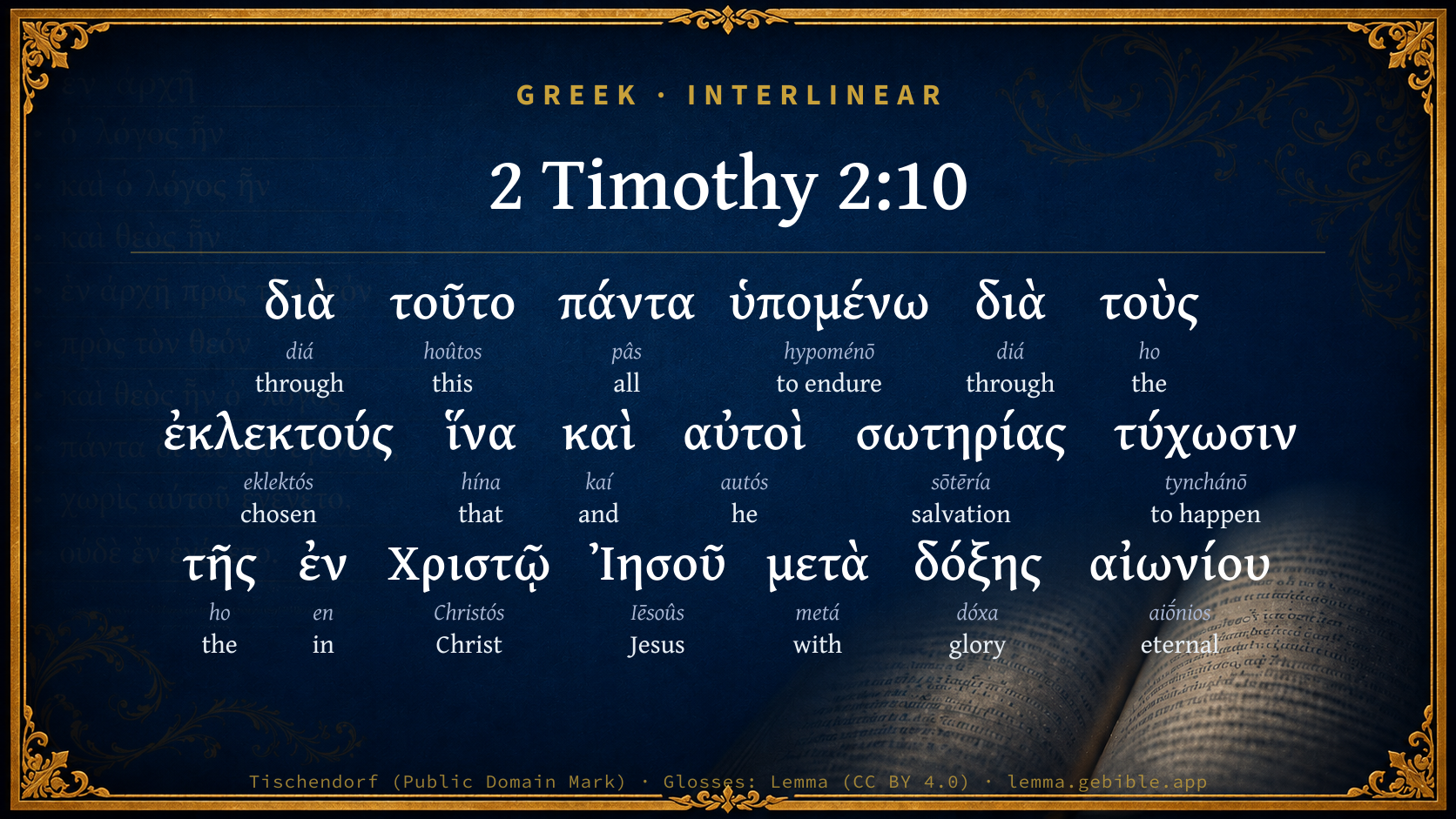
Greek (Tischendorf 8th ed.) 2 Timothy 2:10 appears in the Greek New Testament. The text above is from the Tischendorf 8th edition. Each word links to its Strong’s number and a concise gloss. Click any word for its full Thayer’s Greek Lexicon entry.
Download image
Cite this verse

2 Timothy 2:10 (World English Bible). Public Domain. Lemma interlinear Bible study tool, https://lemma.gebible.app/v/2-timothy/2/10.

Show BibTeX & RIS
BibTeX
RIS
English Translation
Therefore I endure all things for the chosen ones' sake, that they also may obtain the salvation which is in Christ Jesus with eternal glory.
World English Bible · Public Domain
Download a study sheet

One document with this verse’s original text, its word-by-word gloss line, the meaning frame, cross-references with their text, attributed commentary, and full source and license credits — printable, and it pastes into notes with its structure intact.

This verse Autodidact and up

Study sheet (.html) Plain text (.txt)

A passage Seminary Student

Up to 50 verses in one chapter. A passage sheet keeps up to 6 commentary sources and 12 cross-references per verse, in the order this page ranks them, and says so on the sheet whenever that leaves anything out. Ask for a single verse and you get the Autodidact verse sheet above.

Everything on this page stays free to read, with no account — the sheet is a download of what is already on screen, not access to it.

Want to remove ads? Support Godless Engineer
Compare translations 3

The same verse in 3 English versions, stacked beneath the original-language interlinear above. Click any original word for its lexicon entry.

Each is an independent rendering of the whole verse — the interlinear is not word-aligned to these translations.

Highlighted words mark where these versions differ — a whole-verse word diff, not a word-by-word alignment.

  • World English Bible Public Domain
    Therefore I endure all things for the chosen ones' sake, that they also may obtain the salvation which is in Christ Jesus with eternal glory.
  • King James Version Public Domain
    Therefore I endure all things for the elect's sakes, that they may also obtain the salvation which is in Christ Jesus with eternal glory.
  • unfoldingWord Literal Text CC BY-SA 4.0
    Because of this, I endure all things because of the elect so that they also may obtain salvation in Christ Jesus, with eternal glory.

unfoldingWord Literal Text — © unfoldingWord, licensed CC BY-SA 4.0. Word-aligned USFM3 via Door43 (git.door43.org/unfoldingWord/en_ult).

Versions to compare (up to 4)

3 of 4 selected

Show all 19 translations

Every available English version of this verse, each an independent rendering of the whole verse.

  • World English Bible Public Domain
    Therefore I endure all things for the chosen ones' sake, that they also may obtain the salvation which is in Christ Jesus with eternal glory.
  • Berean Standard Bible Public Domain
    For this reason I endure all things for the sake of the elect, so that they too may obtain the salvation that is in Christ Jesus, with eternal glory.
  • Majority Standard Bible Public Domain
    For this reason I endure all things for the sake of the elect, so that they too may obtain the salvation that is in Christ Jesus, with eternal glory.
  • King James Version Public Domain
    Therefore I endure all things for the elect's sakes, that they may also obtain the salvation which is in Christ Jesus with eternal glory.
  • American Standard Version (1901) Public Domain
    Therefore I endure all things for the elect's sake, that they also may obtain the salvation which is in Christ Jesus with eternal glory.
  • Revised Version (1885) Public Domain
    Therefore I endure all things for the elect’s sake, that they also may obtain the salvation which is in Christ Jesus with eternal glory.
  • Geneva Bible (1599) Public Domain
    Therefore I suffer all things, for the elects sake, that they might also obtaine the saluation which is in Christ Iesus, with eternall glorie.
  • Douay-Rheims (1899) Public Domain
    Therefore I endure all things for the sake of the elect, that they also may obtain the salvation, which is in Christ Jesus, with heavenly glory.
  • Young's Literal Translation Public Domain
    because of this all things do I endure, because of the choice ones, that they also salvation may obtain that `is' in Christ Jesus, with glory age-during.
  • Literal Standard Version CC BY-SA 4.0
    because of this I endure all things, because of the chosen ones, that they also may obtain salvation that [is] in Christ Jesus, with perpetual glory.
  • Unlocked Literal Bible CC BY-SA 4.0
    Therefore I endure all things for those who are chosen, so that they also may obtain the salvation that is in Christ Jesus, with eternal glory.
  • unfoldingWord Literal Text CC BY-SA 4.0
    Because of this, I endure all things because of the elect so that they also may obtain salvation in Christ Jesus, with eternal glory.
  • Darby Bible Public Domain
    For this cause I endure all things for the sake of the elect, that *they* also may obtain the salvation which [is] in Christ Jesus with eternal glory.
  • World Messianic Bible Public Domain
    Therefore I endure all things for the chosen ones’ sake, that they also may obtain the salvation which is in Messiah Yeshua with eternal glory.
  • Webster's Bible Public Domain
    Therefore I endure all things for the sake of the elect, that they may also obtain the salvation which is in Christ Jesus with eternal glory.
  • Free Bible Version CC BY-SA 4.0
    Despite all this I'm willing to keep on going for the sake of God's people so that they may gain the salvation of Christ Jesus that is eternal glory.
  • Bible in Basic English Public Domain
    But I undergo all things for the saints, so that they may have salvation in Christ Jesus with eternal glory.
  • Text-Critical English NT CC BY 4.0
    Therefore I endure everything for the sake of the chosen, so that they too may obtain the salvation that is in Christ Jesus, with eternal glory.
  • Tyndale New Testament (1534) Public Domain
    Herefore I suffre all thinges for the electes sakes that they myght also obtayne that saluacion which is in Christ Iesu with eternall glory.

Literal Standard Version (2020), Covenant Press — licensed CC BY-SA 4.0. Text via the HelloAO Bible API (eBible.org). Unlocked Literal Bible (unfoldingWord) — licensed CC BY-SA 4.0. Text via the HelloAO Bible API (eBible.org). unfoldingWord Literal Text — © unfoldingWord, licensed CC BY-SA 4.0. Word-aligned USFM3 via Door43 (git.door43.org/unfoldingWord/en_ult). Free Bible Version, Dr. Jonathan Gallagher — licensed CC BY-SA 4.0. Text via the HelloAO Bible API (eBible.org).

Word by word

More ways to search: Search by grammar → Find every occurrence → Compare this word →

Practice this passage: Drill this verse → Learn its vocabulary →

τύχωσιν
tynchánō
G5177
“to happen”
Verb, Aorist, Active, Subjunctive, 3rd person, Plural
Part of Speech
Verb
Tense
Aorist
Voice
Active
Mood
Subjunctive
Person
3rd person
Number
Plural
Full Thayer's Definition

Origin: probably for an obsolete tucho (for which the middle voice of another alternate teucho [to make ready or bring to pass] is used in certain tenses, akin to the base of G5088 through the idea of effecting

TDNT: 11:58,1

1. to hit the mark a. of one discharging a javelin or arrow 2. to reach, attain, obtain, get, become master of 3. to happen, chance, fall out a. to specify, to take a case, as for example 4. to meet one 5. of he who meets one or presents himself unsought, any chance, ordinary, common person 6. to chance to be
  1. διὰ diá G1223 “through” Preposition
  2. τοῦτο hoûtos G3778 “this” Demonstrative pronoun, Accusative, Singular, Neuter
  3. πάντα pâs G3956 “all” Adjective, Accusative, Plural, Neuter
  4. ὑπομένω hypoménō G5278 “to endure” Verb, Present, Active, Indicative, 1st person, Singular
  5. διὰ diá G1223 “through” Preposition
  6. τοὺς ho G3588 “the” Article, Accusative, Plural, Masculine
  7. ἐκλεκτούς eklektós G1588 “chosen” Adjective, Accusative, Plural, Masculine
  8. ἵνα hína G2443 “that” Conjunction
  9. καὶ kaí G2532 “and” Conjunction
  10. αὐτοὶ autós G846 “he” Personal pronoun, Nominative, Plural, Masculine
  11. σωτηρίας sōtēría G4991 “salvation” Noun, Genitive, Singular, Feminine
  12. τῆς ho G3588 “the” Article, Genitive, Singular, Feminine
  13. ἐν en G1722 “in” Preposition
  14. Χριστῷ Christós G5547 “Christ” Noun, Dative, Singular, Masculine
  15. Ἰησοῦ Iēsoûs G2424 “Jesus” Noun, Dative, Singular, Masculine
  16. μετὰ metá G3326 “with” Preposition
  17. δόξης dóxa G1391 “glory” Noun, Genitive, Singular, Feminine
  18. αἰωνίου aiṓnios G166 “eternal” Adjective, Genitive, Singular, Feminine

About this verse

These counts appear in no published source. They are computed here, from the morphology-tagged text and Lemma’s own curated glosses. What Lemma adds →

19
words
17
distinct lemmas
Pauline Epistles
section

Notable vocabulary

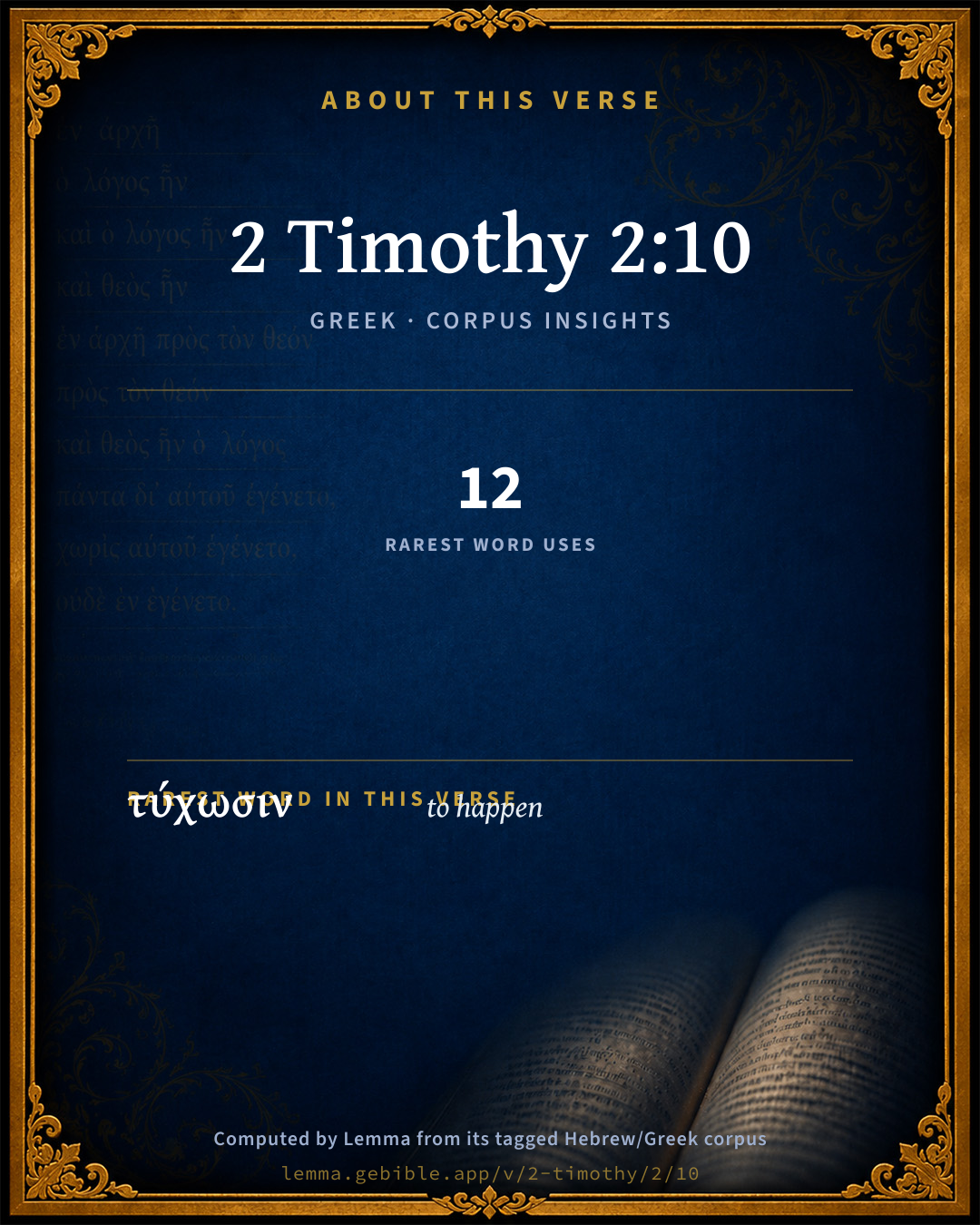
The rarest word here is τύχωσιν to happen G5177 — appearing just 12 times in the whole Greek New Testament.

Shared distinctive vocabulary

τύχωσιν to happen G5177 occurs in 12 verses of the Greek New Testament. Also found in:

Repetition

Words recur within this verse:

  • διὰ through G1223 ×2
  • τοὺς the G3588 ×2

Cross-references

22

Topical passages linked to 2 Timothy 2:10 in the Treasury of Scripture Knowledge — connected by theme and wording, ordered by reader-vote popularity; previews shown in the World English Bible.

  • Colossians 1:24 Now I rejoice in my sufferings for your sake, and fill up on my part that which is lacking of the afflictions of Christ in my flesh for his body's sake, which is the assembly;
  • 1 Peter 5:10 But may the God of all grace, who called you to his eternal glory by Christ Jesus, after you have suffered a little while, perfect, establish, strengthen, and settle you.
  • 2 Corinthians 1:6 But if we are afflicted, it is for your comfort and salvation. If we are comforted, it is for your comfort, which produces in you the patient enduring of the same sufferings which we also suffer.
  • 2 Timothy 2:3 You therefore must endure hardship, as a good soldier of Christ Jesus.
  • John 11:52 and not for the nation only, but that he might also gather together into one the children of God who are scattered abroad.
  • John 17:9 I pray for them. I don't pray for the world, but for those whom you have given me, for they are yours.
  • John 17:24 Father, I desire that they also whom you have given me be with me where I am, that they may see my glory, which you have given me, for you loved me before the foundation of the world.
  • Romans 2:7 to those who by patience in well-doing seek for glory and honor and incorruptibility, eternal life;
  • Romans 9:23 and that he might make known the riches of his glory on vessels of mercy, which he prepared beforehand for glory,
  • 1 Corinthians 9:22 To the weak I became as weak, that I might gain the weak. I have become all things to all men, that I may by all means save some.
  • 2 Corinthians 4:15 For all things are for your sakes, that the grace, being multiplied through the many, may cause the thanksgiving to abound to the glory of God.
  • 2 Corinthians 4:17 For our light affliction, which is for the moment, works for us more and more exceedingly an eternal weight of glory;
  • Ephesians 3:13 Therefore I ask that you may not lose heart at my troubles for you, which are your glory.
  • Colossians 1:27 to whom God was pleased to make known what are the riches of the glory of this mystery among the Gentiles, which is Christ in you, the hope of glory;
  • 1 Thessalonians 5:9 For God didn't appoint us to wrath, but to the obtaining of salvation through our Lord Jesus Christ,
  • 1 Timothy 1:13–14 although I was before a blasphemer, a persecutor, and insolent. However, I obtained mercy, because I did it ignorantly in unbelief.
  • 1 Peter 2:10 who in time past were no people, but now are God's people, who had not obtained mercy, but now have obtained mercy.
  • Proverbs 8:35 For whoever finds me, finds life, And will obtain favor from Yahweh.
  • Matthew 24:22 Unless those days had been shortened, no flesh would have been saved. But for the sake of the chosen ones, those days will be shortened.
  • Matthew 24:24 For there will arise false christs, and false prophets, and they will show great signs and wonders, so as to lead astray, if possible, even the chosen ones.
  • Matthew 24:31 He will send out his angels with a great sound of a trumpet, and they will gather together his chosen ones from the four winds, from one end of the sky to the other.
  • 2 Thessalonians 2:14 to which he called you through our Gospel, for the obtaining of the glory of our Lord Jesus Christ.

Cross-references courtesy of OpenBible.info (CC BY 4.0).

Commentary

Notes on 2 Timothy 2:10 from classic Christian and Jewish commentators (each source and its license shown beneath its notes). The classic Christian expositions comment on the surrounding passage and are grouped to its opening verse, so a note may address several verses; the Jewish commentaries on the Tanakh (Rashi and others) are per-verse, so they appear only where the commentator wrote on this verse.

Lemma curates 59 commentaries, every one of them public domain or Creative Commons licensed, each selected and text-cleaned for this edition rather than reprinted as found. About our sources →

The Biblical Illustrator

Joseph S. Exell

2Ti_2:10

I endure all things for the elects sake.

Gods chosen ones, whether already in the Church, or to be called into it afterwards. (Speakers Commentary.)

The visible church for the sake of the elect

If we were asked what was the object of Christian preaching and instruction, what the office of the Church, considered as the dispenser of the Word of God, I suppose we should not all return the same answer. Perhaps we might say that the object of Revelation was to enlighten and enlarge the mind, or to make us good members of the community. St. Paul gives us a reason in the text different from any of those which I have mentioned. He laboured more than all the apostles; and why? not to civilise the world, not to smooth the face of society, not to facilitate the movements of civil government, not to spread abroad knowledge, not to cultivate the reason, not for any great worldly object, but for the elects sake. And when St. Paul and St. Barnabas preached at Antioch to the Gentiles, As many as were ordained to eternal life, believed. When St. Paul preached at Athens, some mocked, others said, We will hear thee again, but certain men clave unto him. And when he addressed the Jews at Rome, some believed the things which were spoken, and some believed not. Such was the view which animated, first Christ Himself, then all His apostles, and St. Paul in particular, to preach to all, in order to succeed with some. Our Lord saw of the travail of tits soul, and was satisfied. St. Paul, as His servant and instrument, was satisfied in like manner to endure all things for the elects sake; or, as he says in another place, I am made all things to all men, that I might by all means save some. And such is the office of the Church in every nation where she sojourns: she attempts much, she expects and promises little. This is a great Scripture truth, which in this busy and sanguine day needs insisting upon. There are in every age a certain number of souls in the world, known to God, unknown to us, who will obey the truth when offered to them, whatever be the mysterious reason that they do and others do not. These we must contemplate, for these we must labour, these are Gods special care, for these are all things; of these and among these we must pray to be, and our friends with us, at the Last Day. In every nation, among many bad, there are some good; and, as nations are before the gospel is offered to them, such they seem to remain on the whole after the offer--many are called, few are chosen. And to spend and be spent upon the many called for the sake of the chosen few is the office of Christian teachers and witnesses. That their office is such seems to be evident from the existing state of Christian countries from the first. Christianity has raised the tone of morals, has restrained the passions, and enforced external decency and good conduct in the world at large. Still, on the whole, the great multitude of men have to all appearance remained, in a spiritual point of view, no better than before. Trade is still avaricious, not in tendency only, but in fact, though it has heard the gospel; physical science is still sceptical as it was when heathen. Lawyers, soldiers, farmers, politicians, courtiers, nay, shame to say, the priesthood, still savour of the old Adam. Human nature remains what it was, though it has been baptized; the proverbs, the satires, the pictures, of which it was the subject in heathen times, have their point still. The knowledge of the gospel then has not materially changed more than the surface of things. Our Saviours words, spoken of the apostles in the first instance, relate to the Church at large--I pray not for the world, but for them which Thou has given Me, for they are Thine. In like manner St. Paul says that Christ came, not to convert the world, but to purify unto Himself a peculiar people, zealous of good works; not to sanctify this evil world, but to deliver us out of this present evil world according to the will of God and our Father. This has been the real triumph of the gospel, to raise those beyond themselves anti beyond human nature, in whatever rank and condition of life, whose wills mysteriously co-operate with Gods grace, who, while God visits them, really fear and really obey God, whatever be the unknown reason why one man obeys Him and another not. It has laboured for the elect, and it has succeeded with them. This is, as it were, its token. An ordinary kind of religion, praiseworthy and respectable in its way, may exist under many systems; but saints are creations of the gospel and the Church. Not that such a one need in his lifetime seem to be more than other well-living men, for his graces lie deep, and are not known and understood till after his death, even if then. But in process of time, after death, their excellence perhaps gets abroad; and then they become a witness, a specimen of what the gospel can do. There are many reasons why Gods saints cannot be known all at once;--first, as 1 have said, their good deeds are done in secret. Next, good men are often slandered; they are mistaken by those, whom they offend by their holiness and strictness. Then, again, their intentions and aims are misunderstood. It is no triumph, then, for unbelievers that the gospel has not done what it never attempted. From the first it announced what was to be the condition of the many who heard and professed it--Many are called, few are chosen. Though we laboured ever so much, with the hope of satisfying the objector, we could not reverse our Saviours witness, and make the many religious and the bad few. We can but do what is to be done. We cannot destroy the personal differences which separate man and man; and to lay it as a fault to baptism, teaching, and other ministrations, that they cannot pass the bounds predicted in Gods Word, is as little reasonable as attempting to make one mind the same as another. There is nothing to hinder the poorest man from living the life of an angel, living in all the unearthly contemplative blessedness of a saint in glory, except so far as sin interferes with it. I mean, it is sin, and not poverty which is the hindrance. Such is the case with the poor; now, again, take the case of those who have a competency. They too are swallowed up in the cares or interests of life as much as the poor are. While want keeps the one from God by unsettling his mind, a competency keeps the other by the seductions of ease and plenty. The poor man says, I cannot go to Church or to the Sacrament of the Lords Supper, till I am more at ease in my mind; I am troubled, and my thoughts are not my own. The rich man does not make any excuses,--he comes; but his heart goeth after his covetousness. No; such a one may be far other than a mere man of the world,--he may be a religious man, in the common sense of the word; he may be exemplary in his conduct, as far as the social duties of life go; he may be really and truly, and not in pretence, kind, benevolent, sincere, and in a manner serious; but so it is, his mind has never been unchained to soar aloft, he does not look out with longing into the infinite spaces in which, as a Christian, he has free range. A sort of ordinary obedience suffices them as well as the poor. Alas! and is it so? is the superhuman life enjoined on us in the gospel but a dream? is there no meaning in our own case, of the texts about the strait gate and the narrow way, and Marys good part, and the rule of perfection, and the saying which all cannot receive save they to whom it is given? God grant to us a simple, reverent, affectionate, temper, that we may truly be the Churchs children, and fit subjects of her instructions! (J. H. Newman, M. A.)

Sufferings on behalf of the elect

The question doubtless arises, does St. Paul here, and also in Col_1:24, regard his own afflictions as a part of the redemptive suffering by which the elect should receive the gift of Christs salvation and inherit their eternal glory? This would, undoubtedly, contradict the whole tenor of his teaching elsewhere. Was Paul crucified for you? rings out (in 1Co_1:13) his own indignant disclaimer of any such position. Still he does assert his hope and conviction that direct and positive advantages may accrue to the elect of God from his own sufferings. The salvation is in Christ Jesus; still there are things lacking in the afflictions of the Lord which he and other saints are called upon to supplement, to fill up from another source. They are to be filled up in the persons of the members of Christs suffering body. Because these bitter sorrows effectuate or tend to produce a closer resemblance to Christ, because they may lead to a more intense consecration on the part of the elect of God, he willingly endures them all. We take it that these θλίψευς of Christ are not His atoning or sacrificial agonies, but all the contumely and repression which He endured for us and with us, and also which He endured for us and with us, and also which He, in sublime sympathy, continues to suffer in His body the Church, and which will not be completed until the last battle has been fought and the last enemy overcome. Thus the Lord dignifies every patiently borne cross, every holy death, as part of His own affliction for the sake of the elect. (H. R. Reynolds, D. D.)

The redemptive end of affliction

I. Afflictions are the more willingly sustained when they further the liberty of the Gospel.

1. For when the Word runs the plots of the wicked are prevented.

2. The wandering sheep gathered.

3. The body of Christ perfected.

4. The kingdom of God enlarged.

II. A grown Christian can suffer all kinds of afflictions.

1. For experience have taught him that afflictions are good for him.

2. Many acts make a habit; whence it falls out that tribulation worketh patience.

3. He believeth that though sorrows be bitter at the entrance, they shall be sweet in the end.

4. The Lord assisteth him, by whose strength he can do and suffer all things.

III. There be an elect people. Now concerning the elect, two things are not unworthy of our consideration--the one, their number, the other their prerogatives. For their number absolutely taken is great. The prerogatives are many, and all excellent, which are proper to the elect, for they be the objects of Gods love. The redeemed of His Son; temples of the Spirit; and co-heirs with Christ of all things.

IV. All the goodness of our sufferings is in respect of their ground and end.

V. Of the two, a true christian man had rather save souls than prosper in this world. For such know, that to save a soul is more worth than to win the world; and that they shall shine as the sun for ever and ever. (J. Barlow, D. D.)

A noble purpose

A mans purpose in life should be like a river which was born of a thousand little rills in the mountains; and when at last it has reached its manhood in the plain, though, ii you watch it, you shall see little eddies that seem as if they had changed their minds, and were going back again to the mountains, yet all its mighty current flows, changeless, to the sea. If you build a dam across it, in a few hours it will go over it with a voice of victory. If tides check it at its mouth, it is only that when they ebb it can sweep on again to the ocean. So goes the Amazon or Orinoco across a continent--never losing its way or changing its direction for the thousand streams that fall into it on the right hand and on the left, but only using them to increase its force, and bearing them onward in its resistless channel. (H. W. Beecher.)

Supporting others

A curious old tree that supports other trees is described in a South American journal. It is stated that in Columbus there is a china tree that grew up very tall. Several years ago the top was taken off, leaving the main trunk of the tree about twenty feet high. On the top it has become somewhat decayed, but is making up for lost life by supporting a young forest. There are several different shrubs growing on its top, among others an evergreen three or four feet in height, a blackberry bush, which has put on leaves and flowers, and a water-oak which is about two inches in circumference. It is said that the spectacle is a very remarkable one, and arboriculturists take great interest in it. The old tree is a type of many lives. When God has withdrawn one of His children from active service, he is frequently able to continue his usefulness in another way, by supporting others, lifting them nearer to Heaven and sustaining them with his own stalwart spiritual growth.

Enduring for the elects sake

An ordinary person may rest in his bed all night, but a surgeon will be called up at all hours; a farming-man may take his ease at his fireside, but if he becomes a shepherd he must be out among the lambs, and bear all weathers for them; even so doth Paul say, Therefore I endure all things for the elects sake, that they may also obtain the salvation which is in Christ Jesus with eternal glory. (C. H. Spurgeon.)

Suffering to help others

Suppose that by some painful operation you could have your right arm made a little longer; I do not suppose you would care to go under the operation; but if you foresaw that by undergoing the pain you would be enabled to reach and save drowning men who else would sink before your eyes, I think you would willingly bear the agony, and pay a heavy fee to the surgeon to be thus qualified for the rescue of your fellows. Reckon, then, that to acquire soul-winning power you will have to go through fire and water, through doubt and despair, through mental torment and soul distress. (C. H. Spurgeon.)

The believers salvation obtained by Christ and connected with glory

I. Let us consider the nature of this salvation.

1. It is a salvation from the condemnation of a broken law.

2. It is a salvation from the power and dominion of sin.

3. It is a salvation from the bondage of Satan.

4. It is a salvation from the temporary triumphs of the grave.

II. Let us inquire in what respects this salvation is in Christ Jesus. Because it was with His Son Christ Jesus that God was pleased to enter into covenant, respecting human redemption, before the world was.

III. Let us glance at the eternal glory with which this salvation is connected.

1. The persons of the saints will then be glorious. The body will be no longer subject to hunger and thirst, to pain and weariness, or to disease and decay. And then in respect to the soul, it will be formed after the Divine image, in righteousness and true holiness, made to partake, so far as a finite creature is capable, of the image of God.

2. The mansions of which the redeemed shall take possession will be glorious.

3. The society to which they will be admitted will be glorious.

4. The employments of the believer will be glorious. (Essex Congregational Remembrancer.)

That they may also obtain salvation.--Rather, that they also may; they as well as we. (Speakers Commentary.)

Salvation in Christ

Having Christ we have salvation also, while without receiving Christ Himself we can not have the salvation. Having the fountain we have its issuing streams. Cut off from the fountain the streams will not flow to us. Christ offers Himself to be the Bridegroom of the soul. The mistake is that of seeking the salvation instead of seeking the Saviour. Just the same mistake that the affianced would make if she should seek to have the possessions of him to whom she was engaged made over to her from him, without their union in wedlock, instead of accepting his offer of himself, and having the hymeneal bond completed by which he and all he has would become hers. (W. E. Boardman.)

Salvation

I. The nature of salvation.

1. Salvation is the great and constant theme of the whole Bible,

2. Salvation is a word of pleasing import.

3. Salvation is a full and complete deliverance from all past guilt and condemnation.

4. Salvation is a glorious deliverance from all the miseries of sin and the bondage of Satan.

5. Salvation is a deliverance from the envenomed sting of death.

6. This salvation is a deliverance from the resurrection of damnation, the horrors of the judgment, and the miseries of the lost in hell. Now for the peculiar characteristics of this salvation.

(1) It is free.

(2) Suitable.

(3) Present.

(4) Gracious.

(5) Eternal.

II. The author and source of salvation. It is Christ Jesus.

III. Let us point out its method. Some persons try to mystify the plan. But it is simple. The way is easy. Some want to purchase the gift of salvation, but it is not to be bought. It is here--Look unto Me, and be ye saved, all ye ends of the earth. Turn your eyes from the world and sin, and, by faith, look to Christ! (R. Key.)

Heaven, or the final happiness of the righteous

Let us attend to what notices we can gain from the scriptures of truth of the heavenly state, as coming under the notion of salvation and glory. Each of these sometimes is put alone for the whole of it; but being here joined together, they make the description of it more complete; the former directly signifies the negative part, a deliverance from all evil, and the latter the positive, the possession of the highest and greatest good our nature is capable of. And how significantly and emphatically is this salvation with eternal glory said to be in Christ Jesus? It is in Him, as possession purchased, in whose right we can only obtain it. It is in Him as an inheritance kept in truth, and to be conveyed by Him to the appointed heirs. It is in Him as the grand Exemplar in His human nature of the complete and final happiness of the saints. It is in Him both as a beatific object, and as a perpetual medium through which the blessed will see and enjoy God.

I. The Christian shall obtain instantly on his arrival at heaven, and everlastingly possess, a complete salvation, a perfect freedom from all manner of evil.

1. In heaven there will be a perfect and eternal salvation from all sin.

2. The salvation of heaven will be an absolute and perpetual deliverance from the temptations of Satan. In heaven, too, all wicked men, as well as evil angels, shall cease from troubling or tempting; for there shall be none of them there, no more than any matter of temptation in that blessed world.

3. This salvation will be a deliverance from all natural weaknesses; from slowness of apprehension, errors of judgment, slipperiness of memory, levity of will, a rashness or tardiness in resolving, and a heaviness in acting.

4. It will be a deliverance from all the diseases and pains which attend our mortal frame, together with the great variety of disagreeable accidents our life on earth is continually liable to.

5. It will be a deliverance from all Gods wrath and anger.

6. It is a deliverance from all relative and sympathising sufferings and sorrows.

7. It will be a deliverance from death. But it is time now to say somewhat--

II. Of the positive felicity of the heavenly world, of which the less will suffice, as several of its ingredients are easily understood from the evils and miseries which they stand in opposition to, and because we can have but a general idea of this part, rather knowing what heaven is not, than what in particular it is. However, what belongs to this state is all great, excellent and glorious. It is glory itself. Now, the glory which continues the heavenly happiness is both objective and subjective, and these reciprocally influencing each other and inseparably concurring to form it. There is a glory without, objects of unspeakable lustre and glory which will be exhibited and presented to the saints in heaven to converse with. And there will be a glory within themselves. All the parts and powers of their nature will be rendered inexpressibly glorious, as by an elevation of them into a fitness to converse with the glorious objects before them, so by an actual exercise on them and the most satisfying gratification by them. Hence the frequent expression in Scripture of their happiness in heaven is their being glorified. And it is the glory of God either way, as it is often called. He realms all the glory of heaven; He is the principal object Himself of the saints beatific converse, and He forms all the other objects, as well as themselves, glorious. And here we may observe that all these glories will be revealed in a propitious and amiable light. God will manifest Himself to His saints as their own God, and all His perfections and operations are arrayed in love. No room will be left for terror and dismay from the full blaze of His Majesty above, as but a few beams of it breaking in on some of His people here have oppressed their souls with the most dreadful apprehensions. Again, the revelation of heavenly glories will be made to the blessed in a measure exactly suited to their faculties and capacities. There will be no deficiency to cause an uneasy and an unsatisfied craving; no excess to overpower and exhaust the spirits.

1. There will be a perfect knowledge in heaven: a knowledge in the very best manner of the best and noblest things. This knowledge will in a great measure be intuitive, and so consequently very comprehensive, easy, clear, and satisfying.

2. In heaven there will be a perfect rectitude, and regular harmony in all the powers of the soul. As the understanding clearly and steadily beholds the beauties of holiness, the soul will naturally take and keep a correspondent impress, and be satisfied with this Divine likeness.

3. In consequence of this, the active powers will be fully and most delightfully employed in the incessant praises of God and of the Lamb, and in whatever unknown services may be assigned them, all noble and pleasurable. (J. Hubbard.)

The Biblical Illustrator, edited by Joseph S. Exell (c. 1880s–1900s) — public domain. Text from a community e-Sword module.

Bengel's Gnomon

Johann Albrecht Bengel

2Ti 2:10. Διὰ τοῦτο, for this cause) because the Gospel runs forward, while I am bound.—σωτηρίας—μετὰ δόξης, salvation—with glory) There is an exquisite propriety in the words: σωτηρία, salvation, viz. the deliverance from evil, is the privilege of those receiving faith: δόξα, glory, viz. the abundance of good things, is the privilege of those reaching the goal, Act 2:47; Rom 8:24; Rom 8:21: [comp. Psa 84:12.]

Bengel's Gnomon of the New Testament — English translation (T&T Clark, Edinburgh, 1860) — public domain. Text from a community e-Sword module.

Meyer's Critical & Exegetical Commentary

Heinrich August Wilhelm Meyer

2Ti_2:10. Διὰ τοῦτο] Bengel: quia me vincto evangelium currit. Heydenreich wrongly refers it at the same time to the reward to which 2Ti_2:8 alludes. The knowledge that the gospel is unfettered in its influence enables Paul to endure all things for the sake of the ἐκλεκτοί. Διὰ τοῦτο cannot be referred to what follows (Wiesinger), because of the διὰ τοὺς ἐκλεκτούς; it would be another thing if ἵνα κ.τ.λ. were joined immediately with ὑπομένω; but even in that case the abrupt transition would still be an objection.

πάντα ὑπομένω] ὑπομένειν does not denote suffering pure and simple, but the willing, stedfast endurance of it.

By adding to πάντα ὑπομένω the words διὰ τοὺς ἐκλεκτούς, explained by the succeeding clause, Paul declares that he patiently endured everything for the sake of the ἐκλεκτοί, because he knows that the gospel is not boundis not made ineffectualby his bonds. Were it otherwise, were the gospel hindered in its influence by his suffering, then he would not endure for the sake of the ἐκλεκτοί. Hofmann has no grounds, therefore, for thinking that the connection of διὰ τοῦτο with the sentence following it would give an impossible sense. It is wrong to supply καί before διὰ τ. ἐκλ. (Heydenreich), as if these words furnished an additional reason to that contained in διὰ τοῦτο.

οἱ ἐκλεκτοί] This name is given to believers, inasmuch as the deepest ground of their faith is the free choice of God (2Ti_1:9). Heydenreich leaves it indefinite whether Christians already converted are meant here, or those elected to be future confessors of Christianity; so, too, Matthies; de Wette, on the other hand, understands only the latter, whereas Grotius and Flatt think only of the former. The words themselves do not prove that Paul had any such distinction in mind; καὶ αὐτοί does not necessarily imply a contrast with present believers (de Wette), but may be quite well used in relation to the apostle himself, who was conscious of the σωτηρία attained in Christ (Wiesinger, van Oosterzee). Comp. especially Col_1:24, where the apostle places his suffering in relation to the ἐκκλησία, as the σῶμα τοῦ Χριστοῦ, of which the ἐκλεκτοί are members.[28] In how far the apostle bears his afflictions διὰ τοὺς ἐκλ., is told by the words: ἵνα καὶ αὐτοὶ σωτηρίας τύχωσι τῆς ἐν Χρ. Ἰησοῦ. The question how the apostle might expect this result from his πάντα ὑπομένειν, cannot be answered, by saying, with Heinrichs: as he hoped to be freed from his sufferings; the result was to be effected not by a release, but by the patient endurance of the suffering, inasmuch as this bore testimony to the genuineness and strength of his faith, not, as van Oosterzee thinks, because the apostle stedfastly continued to preach. The apostles suffering for the gospel was itself a preaching of the gospel. We must, of course, reject the notion that Paul regarded his sufferings as making atonement for sin, like those of Christ.

The addition μετὰ δόξης αἰωνίου points to the future completion of the salvation. It directs special attention to an element contained in the σωτηρία, and does not contrast the positive with the negative conception (Heydenreich).

[28] Hofmann rightly remarks: The apostle names those towards whom he has to fulfil his calling, for the elects sake, because this designation denotes the heaviness of his responsibility, if he did not help those destined for salvation to that for which God ordained them.

Meyer — Critical and Exegetical Commentary on the New Testament — English translation by Peter Christie, edited by Frederick Crombie (T&T Clark, 1880) — public domain. Text from a community e-Sword module.

Expositor's Greek Testament

ed. W. Robertson Nicoll

2Ti 2:10 . διὰ τοῦτο : The knowledge that others had been, and were being, saved through his ministry was regarded by St. Paul as no small part of his reward. Thus, the Churches of Macedonia were his “crown,” as well as his “joy” (Phi 4:1 , 1Th 2:19 ). He had already in sight his “crown of righteousness”. This consideration suggests that we should refer διὰ τοῦτο to what follows rather than to what immediately precedes ( ὁ λόγος … δέδεται ). So Alf., who cites in illustration Rom 4:16 , 2Co 13:10 , 1Ti 1:16 , Phm 1:15 . On this view, we have completely displayed the conformity of Jesus Christ and of St. Paul to the conditions of success exemplified in the soldier, the athlete, and the field-labourer.

πάντα ὑπομένω : as Love does, 1Co 13:7 . Ellicott rightly points out that Christian endurance is active, not passive: pain is felt as pain, but is recognised as having a moral and spiritual purpose.

διὰ τοὺς ἐκλεκτούς : St. Paul was much sustained by the thought that his labours and sufferings were, in the providence of God, beneficial to others ( 2Co 1:6 ; 2Co 12:15 ; Eph 3:1 ; Eph 3:13 ; Phi 2:17 ; Col 1:24 ; Tit 1:1 ). “The elect” are those who, in the providence of God’s grace, are selected for spiritual privileges with a view directly to the salvation of others, as well as of themselves. The absolute phrase as here is found in Mat 24:22 ; Mat 24:24 = Mar 13:20 ; Mar 13:22 ; οἱ ἐκλεκτοὶ αὐτοῦ in Mat 24:31 = Mar 13:27 (?), Luk 18:7 ; ἐκλεκτοὶ θεοῦ in Rom 8:33 , Col 3:12 , Tit 1:1 ; ὁ ἐκλεκτὸς ἐν Κυρίῳ in Rom 16:13 .

καὶ αὐτοί : they also (as well as I). It would be no Paradise to St. Paul “to live in Paradise alone”. Compare his supreme expression of selflessness in Rom 9:3 .

σωτηρίας μετὰ δόξης αἰωνίου : Salvation may be enjoyed in part in this life; it will be consummated in eternal glory. See ref., and 2Co 4:17 .

The Expositor's Greek Testament, edited by W. Robertson Nicoll (1897–1910) — public domain. Text from a community e-Sword module.

Jamieson, Fausset & Brown

Robert Jamieson, A. R. Fausset & David Brown

Therefore--Because of the anxiety I feel that the Gospel should be extended; that anxiety being implied in Ti2 2:9.

endure--not merely "I passively suffer," but "I actively and perseveringly endure," and "am ready to endure patiently all things."

the elect's sakes--for the sake of the Church: all the members of Christ's spiritual body (Col 1:24).

they . . . also--as well as myself: both God's elect not yet converted and those already so.

salvation . . . glory--not only salvation from wrath, but glory in reigning with Him eternally (Ti2 2:12). Glory is the full expansion of salvation (Act 2:47; Rom 8:21-24, Rom 8:30; Heb 9:28). So grace and glory (Psa 84:12).

Jamieson, Fausset & Brown — Commentary Critical and Explanatory on the Whole Bible (1871) — public domain (CC PDM 1.0). Text via the HelloAO Bible API.

Adam Clarke's Commentary

Verse 10. For the elect's sake] For the sake of the Gentiles, elected by God's goodness to enjoy every privilege formerly possessed by the Jews, and, in addition to these, all the blessings of the Gospel; the salvation of Christ here, and eternal glory hereafter.

Adam Clarke's Commentary on the Bible (1810–1826) — public domain. Text from a community e-Sword/MySword module.

John Calvin's Commentaries

10 Wherefore I endure all things for the sake of the elect From the elect he shews, that his imprisonment is so far from being a ground of reproach, that it is highly profitable to the elect. When he says that he endures for the sake of the elect, this demonstrates how much more he cares for the edification of the Church than for himself; for he is prepared, not only to die, but even to be reckoned in the number of wicked men, that he may promote the salvation of the Church.

In this passage Paul teaches the same doctrine as in Colossians 1:24, where he says, that he

“fills up what is wanting in the sufferings of Christ, for his body, which is the Church.”

Hence the impudence of the Papists is abundantly refuted, who infer from these words that the death of Paul was a satisfaction for our sins; as if he claimed anything else for his death, than that it would confirm the faith of the godly, for he immediately adds an exposition, by affirming that the salvation of believers is found in Christ alone. But if any of my readers wishes to see a more extended illustration of this subject, let him consult my Commentary on the chapter which I have just now quoted — the first of the Epistle to the Colossians.

With eternal glory This is the end of the salvation which we obtain in Christ; for our salvation is to live to God, which salvation begins with our regeneration, and is completed by our perfect deliverance, when God takes us away from the miseries of this mortal life, and gathers us into his kingdom. To this salvation is added the participation of heavenly, that is, divine glory; and, therefore, in order to magnify the grace of Christ, he gave to salvation the name of “eternal glory.”

John Calvin's Commentaries (1540-1563) — public domain. Text from the Calvin Translation Society English edition (1840s-50s) via the Christian Classics Ethereal Library (ccel.org). Calvin's coverage is partial (roughly two-thirds of the Bible); uncommented books and verses are honest gaps, never fabricated. The 19th-century editor's footnotes and remarks are omitted so the notes are faithfully Calvin's own voice.

Ellicott's Commentary for English Readers

(10) Therefore I endure all things for the elect’s sakes.—Better rendered, For this cause I endure, &c.—that is, I endure all things in order that the “word of God,” which, unlike its preacher, I have just declared to be confined by no bonds—in order that that “word” may be widely spread and disseminated: for this reason do I, as a faithful soldier at my post, bear up with quiet, patient courage against suffering; and I do it for the elect’s sakes, that is, for those whom, in His infinite mercy, God has been pleased to choose as His people, for those who, in His unfathomable love, are yet to be brought into the one fold. And this brave and steadfast endurance on the part of St. Paul contributed to the furtherance of God’s projects for gathering these elect in this wise—(1) His endurance, his patient, gallant witness in suffering, would serve as an example to many, not only to the generation then living, but to countless men and women yet unborn; and (2) his faithful, true preaching, now that his voice was hushed, in such writings as this Epistle to Timothy, would help, through the ages to come, to draw countless others, in accordance with the divine counsels, into fellowship with Christ. The question has been often asked, whether those “elect” or whom the Apostle endured these things were, when he wrote these words, believers. This point has already been touched upon; it may, however, be here answered, with some certainty, that the “elect” here spoken of include both believers and unbelievers. The first—the believer—would in all ages be built up by the contemplation of the steadfastness under suffering of St. Paul; the second—the unbeliever—would be won to the faith by the divinely-inspired arguments and exhortations which the brave old man ceaselessly spoke or wrote down in prison just as when free. How could one like St. Paul, who was conscious that he himself had won the “salvation,” not patiently endure all things, if such an endurance could help the elect to obtain that salvation which delivered those who obtained it from the misery of sin and death, and which besides—O blessed thought!—had the sure prospect of eternal glory?

A Bible Commentary for English Readers, edited by Charles John Ellicott (1878–1897) — public domain. Text from a community e-Sword module.

The Cambridge Bible for Schools and Colleges

gen. ed. J. J. S. Perowne

10. Therefore I endure all things] Therefore, because ‘pains bring gains’; therefore, because (2Ti_2:3-9) as with Christ, so with His Church;

‘If the cross we meekly bear,

Then the crown we shall wear.’

Bengel and others do not go far back enough, trying wrongly to find the reason in the last clause alone. Alford seeing this turns ‘therefore’ into ‘for this reason,’ and joins it to what follows ‘that they may obtain,’ alleging the Apostle’s usage of the phrase in favour of this. But the passages he quotes, 1Ti_1:16, and Phm_1:15, have both got other particles connecting with the preceding. And here we have none except ‘therefore’ itself. And St Paul just as frequently uses ‘therefore’ for the past; cf. Eph_5:17 ‘wherefore be ye not foolish,’ Eph_6:13 ‘wherefore take up the whole armour of God.’

The Greek word rendered ‘endure’ is our Lord’s word in His charge to the Seventy, Mat_10:22, and in His discourse of the last things, Mat_24:13; Mar_13:13 ‘He that endureth to the end the same shall be saved.’ St Paul has used the verb before twice only, cf. Rom_12:12 ‘rejoicing in hope, patient in tribulation,’ 1Co_13:7 ‘Charity … hopeth all things, endureth all things’; both which noble passages fully bear out the significance assigned to the word by Ellicott on 1 Thess. 1:13 ‘It does not mark merely the endurance, the “sustinentiam” Vulg., or even the “patientiam” (Clarom.), but the “perseverantiam” the brave patience with which the Christian contends against the various hindrances, persecutions and temptations that befall him in his conflict with the inward and outward world.’ It occurs again 2Ti_3:10.

for the elects’ sakes] For the sake of the Church; see note on Tit_1:1, where the words used at first for ‘Christians’ are discussed. The general purport is as in Col_1:24, where Lightfoot paraphrases’ I cannot choose but rejoice in my sufferings. Yes, I Paul the persecutor, I Paul the feeble and sinful, am permitted to supplement—I do not shrink from the word—to supplement the afflictions of Christ. My flesh is privileged to suffer for His body—His spiritual body, the Church’; and explains that this supplementing of Christ’s sufferings is ‘not in their sacrificial efficacy but their ministerial utility.’ ‘The Church is built up by repeated acts of self-denial in successive individuals and successive generations.’ So we see the old fire of the first captivity is burning up still more ardently as the end draws near. ‘The salvation which is in Christ Jesus’ is for him at hand; the faith is kept. What still he can, that he will, do and bear, that their salvation also may be assured; and that Timothy his son will surely also both practise and preach.

sakes] R.V. gives ‘sake,’ perhaps better as the interest of the whole Church ‘the one body’ was one and the same. Otherwise, the plural may still be used, as e.g. in ‘for all your sakes.’ ‘Sake’ is the same as the German ‘sache,’ ‘res,’ ‘thing,’ ‘account,’ ‘cause at law.’ Cf. the phrase ‘for old sake’s sake.’

that they may also obtain] The ‘also’ is intended in the English of a.d. 1611 to qualify ‘they’ as well as the verb; in the more precise English of a.d. 1881 R.V. writes ‘they also.’ So the looser use of ‘also’ has been altered Mat_26:71, ‘this fellow was also with Jesus,’ into ‘this man also was with Jesus.’ The more exact use two verses later ‘thou also art one of them,’ shews that the A.V. translators exercised a literary freedom in the matter. The O.T. revisers have left Zec_8:21 ‘I will go also.’ The N.T. revisers who have altered Mar_2:28, Joh_5:19, 1Co_9:8 have not ventured to alter Joh_12:26; Joh_14:3.

with eternal glory] The thought is the same as in 2Co_4:17; the affliction, light and for the moment, worketh glory, an eternal weight of glory.

The Cambridge Bible for Schools and Colleges (gen. ed. J. J. S. Perowne; Cambridge University Press, 1878–1918) — public domain. Text from a community e-Sword module.

John Gill's Exposition

Therefore I endure all things for the elects' sakes,.... There is a certain number of persons whom God has chosen in Christ from everlasting unto salvation, who shall certainly be saved; for these Jesus Christ suffered and died; and on their account is the Gospel sent, preached, and published to the world; for their sakes are ministers fitted and qualified for their work, and have their mission and commission to perform it, and suffer what they do in the execution of it; and since it was for the sake of such, whom God had loved and chosen, that the apostle endured all his reproaches, afflictions, and persecutions, he was the more cheerful under them; and the consideration of it was a support unto him:

that they may also obtain; as well as himself, and other chosen vessels of salvation, who were called by grace already; for the apostle is speaking of such of the elect, who were, as yet, in a state of nature:

the salvation which is in Christ Jesus with eternal glory; salvation is only by Christ Jesus, and in him; and this is only for the elect of God; and it is published in the Gospel, that they might obtain it; and in all ages they do obtain it, or enjoy it: the thing itself is obtained by Christ for them, through his obedience, sufferings, and death; and it is published in the everlasting Gospel, that they might come to the knowledge of it; and in the effectual calling it is brought near by the Spirit of God, and applied unto them; and they have now both a meetness for it, and a right unto it, and shall fully enjoy it in heaven; for it has "eternal glory", or "heavenly glory", as the Vulgate Latin and Ethiopic versions read, "annexed to it"; or rather the full enjoyment of it will consist in an eternal and heavenly glory, which will be put upon the saints, both in soul and body, and remain to all eternity.

John Gill's Exposition of the Whole Bible (1746–1763) — public domain (CC PDM 1.0). Text via the HelloAO Bible API.

Trapp's Complete Commentary

John Trapp

10 Therefore I endure all things for the elect’s sakes, that they may also obtain the salvation which is in Christ Jesus with eternal glory.

Ver. 10. That they may also obtain] viz. By my pains in preaching, though bound, and by example of my patience in suffering bonds, &c.

John Trapp, A Commentary or Exposition upon All the Books of the Old and New Testament (1647–1656) — public domain. Text from a community e-Sword module.

Albert Barnes' Notes on the Bible

Therefore I endure all things for the elect’s sakes; - see the notes at 2Co 1:6. The sense is, What I suffer is in the cause of the church, spoken of here, as it is often, as chosen, or elected; see the notes at Eph 1:4.

That they may also obtain the salvation, ... - Their salvation, though they, were elected, could not be secured without proper efforts. The meaning of the apostle here is, that he was willing to suffer if he might save others; and any one ought to be willing to suffer in order to secure the salvation of the elect - for it was an object for which the Redeemer was willing to lay down his life.

Albert Barnes' Notes on the Bible (1834–1885) — public domain. Text from a community e-Sword/MySword module.

Haydock's Catholic Bible Commentary

The elect. By the elect, we need not always understand those predestinated to eternal glory, but chosen or called to the true faith; and this must rather be the meaning of St. Paul in this place, who could not distinguish between those predestinated to glory and others. (Witham) --- Therefore I announce it with full liberty, suffering willingly all I have to endure for the sake of the elect.

George Leo Haydock (1774–1849), Haydock's Catholic Family Bible and Commentary, 1859 edition — public domain. Excludes Psalms (Douay-Rheims chapter numbering differs from Protestant) and Deuterocanonical books (Catholic canon only).

Matthew Poole's English Annotations

Therefore I endure all things; that is, all things which I do endure, reproach, imprisonment, &c., for he had not yet resisted to blood.

For the elect’s sakes; as for Christ’s sake, to imitate his example, and testify my love to him; so for the sake of those whom God hath chosen to eternal life, that they, seeing my patience and constancy, may be confirmed in the faith of the gospel, and by that means may obtain eternal life, salvation, with eternal glory, which is to be had in Christ.

Matthew Poole's English Annotations on the Holy Bible (1683–1685) — public domain. Text from a community e-Sword/MySword module.

Whedon's Commentary on the Bible

Daniel D. Whedon

10. Therefore—The commentators seem to miss the inference indicated by this connective. Bengel and Huther interpret it: The word of God is not bound, therefore I endure, etc. But Alford clearly shows that this is neither the inference nor a valid one. But Alford equally misses by making the therefore indicate a reason about to be given, namely, the elect’s sake.

But clearly therefore connects back with 2Ti_2:8, my gospel, as embracing the two memorable facts of the incarnation and resurrection. Christ was born and raised according to my irrepressible gospel, therefore do I endure all things for the elect’s sakes. And then he runs the antithesis of the born and raised, the incarnation and the exaltation, through every verse to 18. And thus 2Ti_2:8 is keynote to the whole paragraph, and 2Ti_2:9 is no interruption between 8 and 10.

For the elect’s sakes—Those elect in consequence of faith; but whose future obtain the salvation is dependent upon the three ifs of the three following verses.

Daniel D. Whedon (gen. ed.), Commentary on the Old and New Testaments (1874–1909) — public domain. Text from a community e-Sword module.

The Pulpit Commentary

Sake for sakes, A.V; also may for may also, A.V Therefore (dia touto); for this cause. Some (Wiesinger, Alford, etc.) refer this to what follows, viz. "that the elect may obtain the salvation," etc., after the model of 1Ti_1:16 and Phm_1:15, where dia touto clearly refers to the words which follow. But the interposition of the words, dia touv, is strongly adverse to this view. It seems, therefore, rather to refer collectively to all the considerations which he had just been urging upon Timothy, perhaps especially the last, of the resurrection of Christ, which he now again enforces by his own example of willing suffering in order that the elect may obtain the eternal salvation which is in Jesus Christ adding, in vers. 11 and 12, the encouragement to suffering derived from the "faithful saying." I endure (uJpomenw); the exact force of which is seen in the substantive uJpomonh, patience, so frequently attributed to the suffering saints of God.

The Pulpit Commentary (1880–1919), ed. H.D.M. Spence-Jones & Joseph S. Exell — public domain. Text from a community e-Sword module.

John Wesley's Explanatory Notes

Therefore - Encouraged by this, that "the word of God be not bound." I endure all things - See the spirit of a real Christian? Who would not wish to be likeminded? Salvation is deliverance from all evil; glory, the enjoyment of all good.

John Wesley, Explanatory Notes Upon the Whole Bible (1754–1765) — public domain. Text via the GEBible commentary corpus.

Fairbairn on Ezekiel, Jonah & the Pastoral Epistles

Patrick Fairbairn

Ver. 10. For this reason I endure all things for the sake of the elect, in order that they also may obtain the salvation that is in Christ Jesus with eternal glory. The connection between this and the preceding cannot be taken so close, as with Bengel, “Because through my chains the gospel runs, therefore I endure.” He, no doubt, has in view the diffusion of the word, because it was in connection with that his sufferings had come upon him; but in the present passage that circumstance rather lies in the background, recognised and felt, yet not distinctly exhibited; for he has a more special point which he wishes to bring into notice in relation to the preaching or diffusion of the word, viz. the salvation of God’s elect. This was the aim of his preaching, yet not of his preaching merely, but also of his sufferings; for these, too, had an important bearing on the contemplated issue. We must therefore connect the διὰ τοῦτο at the commencement with what follows, as is usual in similar constructions, where these words stand related to a succeeding ἵνα, as at 1Ti 1:16, “For this reason I obtained mercy, that in me first,” etc. (διὰ τοῦτο ἠλεήθην, ἵνα ἐν ἐμοὶ πρώτῳ), and so again at Phm 1:15. The explanation of Chrysostom is quite to the point: “For what cause do I suffer these things? For the benefit of others, that they may obtain eternal life. What, then, do you promise? He did not say simply, for the sake of some persons, but for the sake of the elect. If God chose them, we ought to suffer all things for them, in order that they also may obtain salvation. When he says, that they also, he means to say, as also we; for God chose us also; and as for us God suffered, so also we for them.” Under the name of the elect the apostle may certainly be regarded as having primarily in view those who belonged to that number in his own day; for them he was called more immediately to think and act, yet by no means exclusively. His apostolic work, as well in suffering as in preaching and writing, he knew well was for all countries and for all time; and the elect of this present age are in many ways reaping the benefit of his self-denying and devoted labours. Nor is it unimportant to mark how he heightens the good he sought for them—not their salvation merely, but the salvation that is in Christ Jesus, and that with eternal glory: so that if their salvation has to be made good through trial and suffering, its connection with Christ, and with the mass of glory laid up with Him in eternity, justifies, and unspeakably more than justifies, the sacrifice. So in 1Pe 5:10 the present suffering condition of believers generally is, in like manner, connected with their call to God’s eternal glory.

Patrick Fairbairn — An Exposition of Ezekiel (1851), Jonah (1849), and The Pastoral Epistles (1874) — public domain. Text from a community e-Sword module.

Scofield Reference Notes

C. I. Scofield

salvation

(See Scofield "Rom 1:16").

The Scofield Reference Bible (1917 edition), notes by C. I. Scofield — public domain. Text from a community e-Sword module.

Burkitt's Expository Notes on the New Testament

William Burkitt

St. Paul having acquainted Timothy in the foregoing verses with his sufferings, even unto bonds, here he lets him understand and know, why, and for whose sake, he did so cheerfully endure all these things, namely, for the elects sake. Though the rest of the world rejected the gospel, yet the elect would be confirmed by his example, and obtain that salvation which in and through Jesus Christ was offered and tendered to them.

Here note, That there is a certain election of God, which hath infallibly chosen to salvation all those who make their calling and election sure, by perseverance in holiness and good works.

Note, 2. That the faithful ministers of Christ do think no sufferings to much, or too dear, for the sake of God’s elect, (for the sake of believing Christians, who are a chosen generation) so that their sufferings may but further their eternal glory, happiness and salvation.

To encourage yet again to a patient enduring of all sorts of afflictions, he assures Timothy, that if we be rendred comformable to Christ in his sufferings, we shall be also in his glory: If we suffer for him, we shall reign with him: if we be dead with him, dead to sin, and dead to the world, we shall also live with him, in conformity to his resurrection; but if for fear of suffering we disown him, he will also deny us; if we believe not, if we be unfaithful and forsake him, yet he will be true to his word, he will not forsake his own cause, but make good his threatenings, his own veracity stands firm, and is as much engaged to execute the threatening, as to fulfil the promise.

William Burkitt's Expository Notes on the New Testament (1700–1703) — public domain. Text from a community e-Sword module.

Godbey's Commentary on the New Testament

William B. Godbey

ARGUMENT 3

THE ELECT

10. “Therefore I suffer all things for the sake of the elect, in order that they indeed may receive the salvation which is in Christ Jesus with eternal glory.” The Greek, eklectoi, is really double election. It is from ek, out, and lego, to select. Hence, means “selected out of the select.” God chose the seed of Abraham in the old dispensation to be his holy peculiar people chosen out of all nations the honored custodians of the Divine oracles, to prepare the world to receive his Incarnate Son, and preach him to all nations. While they failed by unfaithfulness and missed their blessing, the elect few—e.g., old Simeon, Anna, Zacharias and Elisabeth, Joseph and Mary, and the shepherds on the plains—proved true, and received the blessing. So now the entire Christian Church are the chosen people of God, honored and blessed as the custodians and propagators of his truth, and the recipients of their returning King. But like their predecessors, they are proving unfaithful. But the sanctified, corresponding with the inspired Word, eklectoi, “the elect out of the elect,” are going to verify Paul’s prayer in this passage; i.e., “receive the salvation which is in Christ Jesus with eternal glory;” i.e., enter the glorified transfiguration, joining with angels and archangels in the coronation of their Lord, King of kings; i.e., King of the nations, Satan, their present king, having been taken out of the world.

William B. Godbey, Commentary on the New Testament (1896–1900) — public domain. Text from a community e-Sword module.

The People's New Testament

B. W. Johnson

10. Therefore I endure. Since the work goes on, I endure cheerfully. For the elect's sakes. All came upon him on account of his devotion to the church. He suffered that others, God's chosen ones, might obtain salvation.

B. W. Johnson's The People's New Testament with Notes (1889–1891) — public domain. Electronic text from the Christian Classics Ethereal Library (CCEL) ThML edition.

Cambridge Greek Testament for Schools and Colleges

10. αἰωνίου. The Vulgate Latin, with f, arm, aeth, and the margin of the Harclean Syriac, seem to bear witness to a reading οὐρανίου.

10. διὰ τοῦτο, wherefore, sc. because the work is going on, although the worker is bound in chains.

πάντα ὑπομένω, I endure all things; in the spirit of that charity of which he had himself said, πάντα ὑπομένει (1Co 13:7).

διὰ τοὺς ἐκλεκτούς, for the elect’s sake, sc. for the sake of all those whom it is God’s purpose to bring to a knowledge of the Truth; cp. Rom 8:33; Col 3:12; Tit 1:1. The uncertainty implied in the words which follow ἵνα καὶ αὐτοὶ σωτηρίας τύχωσιν shews that it is not in reference to an election to final salvation that St Paul uses the word ἐκλεκτοί; in his Epistles and also in 1 and 2 Peter, the words κλητοί and ἐκλεκτοί are continually used of the whole body of believers, ‘chosen’ and ‘Called’ by God to the privileges of the Gospel. See esp. Lightfoot on Col 3:12 and Hort on 1Pe 1:1.

ἵνα καὶ αὐτοὶ σωτηρίας τύχωσιν κ.τ.λ., in order that they too, sc. as well as I, may obtain the salvation &c. The Apostle’s personal confidence is worthy of careful notice; cp. 2Ti 4:8.

τῆς ἐν Χρ. Ἰη. μετὰ δόξης αἰωνίου. The consummation of this salvation which is in Christ Jesus is eternal glory. In 2Co 4:17 he speaks of αἰώνιον βάρος δόξης as the issue of ‘our light affliction which is for the moment.’

Cambridge Greek Testament for Schools and Colleges (Cambridge University Press, 1896; 21 vols, various authors incl. Carr, Maclear, Plummer, Farrar, Lumby, Moule, M. R. James, Simcox) — public domain. Text from a community e-Sword module.

Alford’s Greek Testament

Henry Alford

10.] For this reason (what reason? ‘quia me vincto evangelium currit,’ says Bengel: and with this agree Huther, De W., al. But neither 1) is this sound logic, nor 2) is it in accordance with the Apostle’s usage of διὰ τοῦτο … ἵνα. 1) The fact, that the word of God is not bound, is clearly not the reason why he suffers these things for the elect: nor can we say with Huther, that the consciousness of this fact is that in which he endures all. De W. takes the predominant idea to be, the dispersion and success of God’s word, in and by which the Apostle is encouraged to suffer. But this would certainly, as Wolf says, render the connexion ‘dilutior et parum cohærens.’ 2) In 1Ti 1:16, διὰ τοῦτο ἠλεήθην … ἵνα, and Phm 1:15, διὰ τοῦτο ἐχωρίσθη … ἵνα, the reference of δ. τ. is evidently to what follows: cf. also Rom 4:16, 2Co 13:10. I would therefore refer the words to the following, and consider them, as in the above instances, as a marked way of indicating the reason presently to be given: ‘for this purpose, … that;’ so Chrys., Thdrt., Wolf, Wiesinger, al.) I endure all things (not merely suffer (obj.): but readiness and persistence (subj.) are implied in the word, and the universal πάντα belongs to this subj. meaning—‘I am enduring, ready to bear, all things’) for the sake of the elect (see reff., especially Tit 1:1. The Apostle does not, as De W., refer merely to those elect of God who are not yet converted, but generally to the whole category, both those who are already turned to him, and those who are yet to be turned: cf. the parallel declaration in Col 1:24, ἀνταναπληρῶ τὰ ὑστερήματα τῶν θλίψεων τοῦ χριστοῦ … ὑπὲρ τοῦ σώματος αὐτοῦ, ὅ ἐστιν ἡ ἐκκλησία), that they also (as well as ourselves, with reference to what is to follow, the certainty that we, who suffer with Him, shall reign with Him:—De W. (see above) says, ‘those yet unconverted, as well as those already converted:’ and the mere καὶ αὐτοί might seem to favour this view; but it manifestly is not so) may obtain the salvation which is in (as its element and condition of existence) Christ Jesus with eternal glory (salvation here, in its spiritual presence and power—χάριτί ἐστε σεσωσμένοι, Eph 2:5: and glory hereafter, the full development and expansion of salvation, Rom 8:21). Faithful is the saying (see on reff.: another of those current Christian sayings, probably the utterances originally of the Spirit by those who spoke προφητείας in the Church,—and, as in 1Ti 3:16, bearing with it so much of balance and rhythmical arrangement, as to seem to be a portion of some hymn): for (Chrys., Œc., al., regard this γάρ as rendering a reason why the λόγος is πιστός, understanding πιστ. ὁ λ. of what has gone before, viz. the certainty that ὁ ζωῆς οὐρανίου τυχών, καὶ αἰωνίου τεύξεται. But this is most unnatural. The γάρ is not merely explicative, as Grot., Huther, al., but as in 1Ti 4:9, renders a reason for the πιστός,—in the assertion of the fact in well-known words: for the fact is so, that if &c.) if we died with Christ (on account of the aorist, pointing to some one definite event, the reference must be to that participation in Christ’s death which takes place at baptism in all those who are His, and which those who follow Him in sufferings emphatically shew that they then did really take on them: see Rom 6:3, Rom 6:4, Rom 6:8: Col 2:12. Certainly, if the aor. stood alone, it might be taken proleptically, looking back on life from that future day in which the συνζήσομεν will be realized: but coupled as it is with the present ὑπομένομεν and the future ἀρνησόμεθα, we can hardly take it otherwise than literally as to time, of an event already past, and if so, strictly as in the parallel Rom 6:8, where the reference is clear), we shall also live with Him (hereafter in glory): if we endure (with Him: the συν must be supplied, cf. εἴπερ συνπάσχομεν, Rom 8:17), we shall also reign with Him (see Rom 5:17; Rom 8:17. In the former pair, death and life are opposed: in this, subjection (ὑπο-μ.) and dominion. See the interesting anecdote of Nestor, quoted from the martyrology by Grotius): if we shall deny (Him), He also will deny us (see Mat 10:33): if we disbelieve (not, His Resurrection, as Chrys.: εἰ ἀπιστοῦμεν ὅτι ἀνέστη, οὐδὲν ἀπὸ τούτου βλάπτεται ἐκεῖνος: nor His Divinity, as Œc.(2) ὅτι θεὸς ἐστί, but Him, generally. Ellic.’s note (which see) has convinced me that ἀπιστία seems always in the N. T. to imply not ‘untrueness,’ ‘unfaithfulness,’ but definitely ‘unbelief:’ see note on Rom 3:3, in Vol. II. edn. 5), He remains faithful (to His own word cited above): for He cannot deny Himself (i.e. if we desert faith in Him, He will not break faith with us; He having declared that whosoever denies Him shall be denied by Him, and we having pledged ourselves to confess Him,—we may become unbelieving, and break our pledge, but He will not break His: as He has said, it shall surely be. See Rom 3:3. Chrys. gives a curious explanation: ἀληθής ἐστι, βέβαιός ἐστιν, ἄν τε εἴπωμεν, ἄν τε μὴ εἴπωμεν … ἐκεῖνος γὰρ ὁ αὐτὸς μένει καὶ ἀρνουμένων καὶ μὴ ἀρνουμένων. ἀρνήσασθαι γὰρ ἑαυτὸν οὐ δύναται, τουτέστι, μὴ εἶναι. ἡμεις λέγομεν ὅτι οὐκ ἔστιν, εἰ καὶ μὴ τὸ πρᾶγμα οὕτως ἔχει. οὐκ ἔχει φύσιν μὴ εἶναι, οὐ δυνατόν· τουτέστιν, εἰς τὸ μὴ εἶναι αὐτὸν χωρῆσαι. ἀεὶ μένει, ἀεὶ ἔστιν αὐτοῦ ἡ ὑπόστασις, μὴ τοίνυν ὡς χαριζόμενοι αὐτῷ, οὕτω διακεώμεθα, ἢ ὡς καταβλάπτοντες. But manifestly there is no such motive as this last brought forward, nor is the assertion ἐκεῖνος μένει, but ἐκ. πιστὸς μένει. Mack proposes another alternative,—‘If we fall from the faith and forfeit our own salvation, He still carries forward His own gracious will, in saving mankind by the Gospel.’ But that given above seems best to suit the context).

Henry Alford, The Greek Testament (1849–1861) — public domain. Text from a community e-Sword module.

International Critical Commentary

10. διὰ τοῦτο] cf. Col 4:3 διʼ ὃ καὶ δέδεμαι. πάντα ὑπομένω in the power of Love; cf. 1:7, 1Co 13:7.

διὰ τοὺς ἐκλεκτούς] both (a) those already called whose faith will be strengthened and their salvation helped by the example of my endurance; cf. Col 1:24, 2Co 1:5, 2Co 1:6; and (b) those objects of God’s Love who will be drawn to Christ by it; cf. 4:17. This power of endurance was the fact of St. Paul’s life which most impressed his contemporaries; cf. Clem. Rom 1:5, ὑπομονῆς γενόμενος μέγιστος ὑπογραμμός.

δόξης αἰωνίου] Chrys. has an interesting contrast between the temporary glory of Nero and the eternal glory won by St. Paul.

International Critical Commentary — older volumes (1896–1929), various authors — public domain. Text from a community e-Sword module.

Vincent's Word Studies in the New Testament

Marvin R. Vincent

Therefore [δια τουτο] . Because I know that God is carrying on his work.

That they may also [ινα και αυτοι] . More correctly, they also may, etc. Also, as well as myself.

Obtain the salvation [σωτηριας τυχωσιν] . The phrase N T. o. Paul has peripoihsiv swthriav obtaining of salvation, 1Th 5:9. Which is in Christ Jesus. The phrase salvation which is in Christ Jesus, N. T. For other collocations with in Christ Jesus in Pastorals, see 1Ti 1:14; 1Ti 3:13; 2Ti 1:1, 9, 13; 2Ti 2:3, 15.

With eternal glory [μετα δοξης αιωνιου] . The phrase eternal glory ony here and 1Pe 5:10. Paul has aijwnion barov doxhv eternal weight of glory, 2Co 4:17. Glory here is the eternal reward of Christians in heaven.

Marvin R. Vincent, Word Studies in the New Testament (1887–1900) — public domain. Text from a community e-Sword/MySword module.

Lesson kit

Teaching starters — assembled from the data on this page, not authored interpretation. Every prompt links to the verse data it draws on. Edit before teaching.

2 Timothy, in the Pauline Epistles, opens this verse with 19 words (17 distinct Greek lemmas). Its most distinctive word is tynchánō (“to happen”). A historical commentator’s framing appears above. Read the whole chapter for the surrounding context.

Discussion questions

  1. What does “to happen” (tynchánō) contribute to the verse as a whole?
  2. How does Luke 20:35, which shares the word «to happen», read alongside this verse?
  3. What does the repetition of “through” (2× in this one verse) do in this verse?
  4. These translations render this verse differently; the difference is in the English rendering, not the original. What questions does that raise?
  5. Compare how The Biblical Illustrator and Bengel's Gnomon read this verse. Where do they agree or differ?

Things to notice

  • These translations choose different wording for 9 words in this verse.
  • “through” occurs 2× in this single verse.
  • 17 distinct Greek lemmas span 19 words in this verse.

Reading settings

Reading text

Shown beneath each verse's original-language words.

Old Testament
Old Testament edition

Read the OT as the Masoretic Hebrew (MT) or the Greek Septuagint (LXX).

English shown for the Greek Septuagint (in the Hebrew ↔ Greek comparison).

Comparing translations? Open the Compare panel on any verse page to stack up to four side by side.