Zechariah 6:14

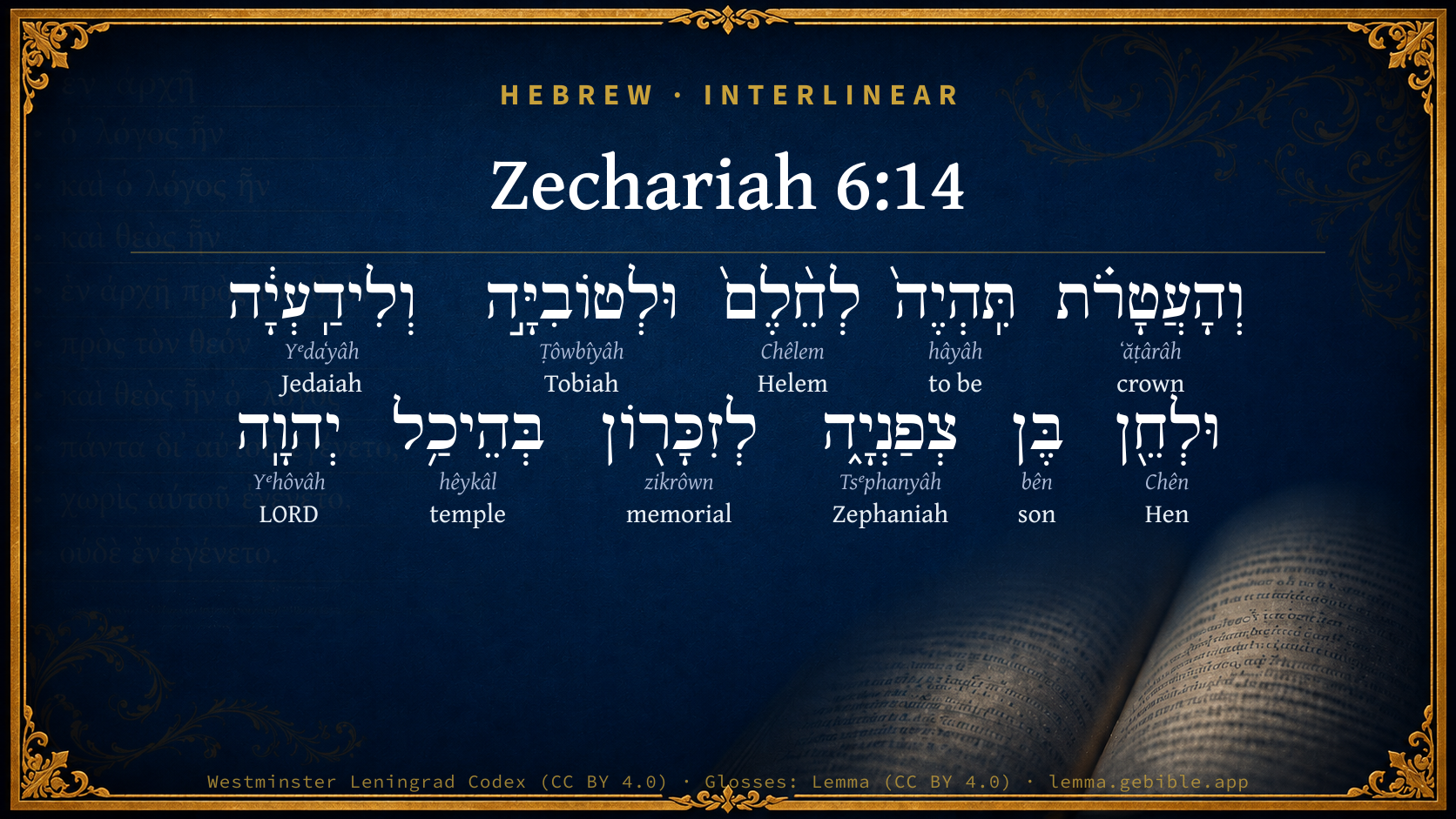
Hebrew (Westminster Leningrad Codex) Zechariah 6:14 appears in the Hebrew Old Testament. The text above is from the Westminster Leningrad Codex. Each word links to its Strong’s number, a concise gloss, and parsing drawn from the Open Scriptures Hebrew Bible morphology. Click any word for its full Brown-Driver-Briggs (BDB) entry.
Download image
Cite this verse

Zechariah 6:14 (World English Bible). Public Domain. Lemma interlinear Bible study tool, https://lemma.gebible.app/v/zechariah/6/14.

Show BibTeX & RIS
BibTeX
RIS
English Translation
The crowns shall be to Helem, and to Tobijah, and to Jedaiah, and to Hen the son of Zephaniah, for a memorial in the temple of Yahweh.
World English Bible · Public Domain
Highlights Full analysis ↓
Download a study sheet

One document with this verse’s original text, its word-by-word gloss line, the meaning frame, cross-references with their text, attributed commentary, and full source and license credits — printable, and it pastes into notes with its structure intact.

This verse Autodidact and up

Study sheet (.html) Plain text (.txt)

A passage Seminary Student

Up to 50 verses in one chapter. A passage sheet keeps up to 6 commentary sources and 12 cross-references per verse, in the order this page ranks them, and says so on the sheet whenever that leaves anything out. Ask for a single verse and you get the Autodidact verse sheet above.

Everything on this page stays free to read, with no account — the sheet is a download of what is already on screen, not access to it.

Want to remove ads? Support Godless Engineer
Compare translations 3

The same verse in 3 English versions, stacked beneath the original-language interlinear above. Click any original word for its lexicon entry.

Each is an independent rendering of the whole verse — the interlinear is not word-aligned to these translations.

Highlighted words mark where these versions differ — a whole-verse word diff, not a word-by-word alignment.

  • World English Bible Public Domain
    The crowns shall be to Helem, and to Tobijah, and to Jedaiah, and to Hen the son of Zephaniah, for a memorial in the temple of Yahweh.
  • King James Version Public Domain
    And the crowns shall be to Helem, and to Tobijah, and to Jedaiah, and to Hen the son of Zephaniah, for a memorial in the temple of the LORD.
  • unfoldingWord Literal Text CC BY-SA 4.0
    And the crowns will be for Helem and for Tobijah and for Jedaiah and for Hen the son of Zephaniah, as a memorial in the temple of Yahweh.

unfoldingWord Literal Text — © unfoldingWord, licensed CC BY-SA 4.0. Word-aligned USFM3 via Door43 (git.door43.org/unfoldingWord/en_ult).

Versions to compare (up to 4)

3 of 4 selected

Show all 18 translations

Every available English version of this verse, each an independent rendering of the whole verse.

  • World English Bible Public Domain
    The crowns shall be to Helem, and to Tobijah, and to Jedaiah, and to Hen the son of Zephaniah, for a memorial in the temple of Yahweh.
  • Berean Standard Bible Public Domain
    The crown will reside in the temple of the LORD as a memorial to Helem, Tobijah, Jedaiah, and the gracious son of Zephaniah.
  • Majority Standard Bible Public Domain
    The crown will reside in the temple of the LORD as a memorial to Helem, Tobijah, Jedaiah, and the gracious son of Zephaniah.
  • King James Version Public Domain
    And the crowns shall be to Helem, and to Tobijah, and to Jedaiah, and to Hen the son of Zephaniah, for a memorial in the temple of the LORD.
  • American Standard Version (1901) Public Domain
    And the crowns shall be to Helem, and to Tobijah, and to Jedaiah, and to Hen the son of Zephaniah, for a memorial in the temple of Jehovah.
  • Revised Version (1885) Public Domain
    And the crowns shall be to Helem, and to Tobijah, and to Jedaiah, and to Hen the son of Zephaniah, for a memorial in the temple of the LORD.
  • Geneva Bible (1599) Public Domain
    And the crownes shall be to Helem, and to Tobijah, and to Iedaiah, and to Hen the sonne of Zephaniah, for a memoriall in the Temple of the Lord.
  • Douay-Rheims (1899) Public Domain
    And the crowns shall be to Helem, and Tobias, and Idaias, and to Hem, the son of Sophonias, a memorial in the temple of the Lord.
  • Young's Literal Translation Public Domain
    And the crown is to Helem, and to Tobijah, and to Jedaiah, and to Hen son of Zephaniah, for a memorial in the temple of Jehovah.
  • Literal Standard Version CC BY-SA 4.0
    And the crown is to Helem, and to Tobijah, and to Jedaiah, and to Hen son of Zephaniah, for a memorial in the temple of YHWH.
  • Unlocked Literal Bible CC BY-SA 4.0
    The crown will given to Heldai, Tobijah, Jedaiah, and for Hen son of Zephaniah as a memorial in the temple of Yahweh.
  • unfoldingWord Literal Text CC BY-SA 4.0
    And the crowns will be for Helem and for Tobijah and for Jedaiah and for Hen the son of Zephaniah, as a memorial in the temple of Yahweh.
  • Darby Bible Public Domain
    And the crowns shall be for Helem, and for Tobijah, and for Jedaiah, and for Hen the son of Zephaniah, for a memorial in the temple of Jehovah.
  • World Messianic Bible Public Domain
    The crowns shall be to Helem, to Tobijah, to Jedaiah, and to Hen the son of Zephaniah, for a memorial in the LORD’s temple.
  • Webster's Bible Public Domain
    And the crowns shall be to Helem, and to Tobijah, and to Jedaiah, and to Hen the son of Zephaniah, for a memorial in the temple of the LORD.
  • Free Bible Version CC BY-SA 4.0
    The crown will be kept in the Temple of the Lord as a memorial to Heldai, Tobijah, Jedaiah, and Joshua the son of Zephaniah.
  • Bible in Basic English Public Domain
    And the crown will be for grace to Heldai and Tobijah and Jedaiah and the son of Zephaniah, to keep their memory living in the house of the Lord.
  • JPS Tanakh (1917) Public Domain
    And the crowns shall be to Helem, and to Tobijah, and to Jedaiah, and to Hen the son of Zephaniah, as a memorial in the temple of the LORD.

Literal Standard Version (2020), Covenant Press — licensed CC BY-SA 4.0. Text via the HelloAO Bible API (eBible.org). Unlocked Literal Bible (unfoldingWord) — licensed CC BY-SA 4.0. Text via the HelloAO Bible API (eBible.org). unfoldingWord Literal Text — © unfoldingWord, licensed CC BY-SA 4.0. Word-aligned USFM3 via Door43 (git.door43.org/unfoldingWord/en_ult). Free Bible Version, Dr. Jonathan Gallagher — licensed CC BY-SA 4.0. Text via the HelloAO Bible API (eBible.org).

Word by word

More ways to search: Search by grammar → Find every occurrence → Compare this word →

Practice this passage: Drill this verse → Learn its vocabulary →

לְחֵ֨לֶם֙
Chêlem
H2494
“to/for · Helem”
Preposition + Noun, Proper
Part of Speech
Preposition + Noun
Type
Proper
Full BDB Definition

Origin: from H2492

TWOT: None

Helem = "strength" or " dream" - a returned exile in the time of Zechariah; also spelled 'Heldai'
  1. וְהָעֲטָרֹ֗ת ʻăṭârâh H5850 “and · the · crowns” Conjunction + Particle, Definite Article + Noun, Common, Feminine, Plural, Absolute
  2. תִּֽהְיֶה֙ hâyâh H1961 “to be” Verb, Qal, Imperfect, 3rd Person, Feminine, Singular
  3. וּלְטוֹבִיָּ֣ה Ṭôwbîyâh H2900 “and · to/for · Tobiah” Conjunction + Preposition + Noun, Proper
  4. וְלִידַֽעְיָ֔ה Yᵉdaʻyâh H3048 “and · to/for · Jedaiah” Conjunction + Preposition + Noun, Proper
  5. וּלְחֵ֖ן Chên H2581 “and · to/for · Hen” Conjunction + Preposition + Noun, Proper
  6. בֶּן bên H1121 “son of” Noun, Common, Masculine, Singular, Construct
  7. צְפַנְיָ֑ה Tsᵉphanyâh H6846 “Zephaniah” Noun, Proper
  8. לְזִכָּר֖וֹן zikrôwn H2146 “to/for · memorial” Preposition + Noun, Common, Masculine, Singular, Absolute
  9. בְּהֵיכַ֥ל hêykâl H1964 “in/at · temple of” Preposition + Noun, Common, Masculine, Singular, Construct
  10. יְהוָֽה Yᵉhôvâh H3068 “LORD” Noun, Proper

About this verse

These counts appear in no published source. They are computed here, from the morphology-tagged text and Lemma’s own curated glosses. What Lemma adds →

11
words
11
distinct lemmas
Prophets
section

Notable vocabulary

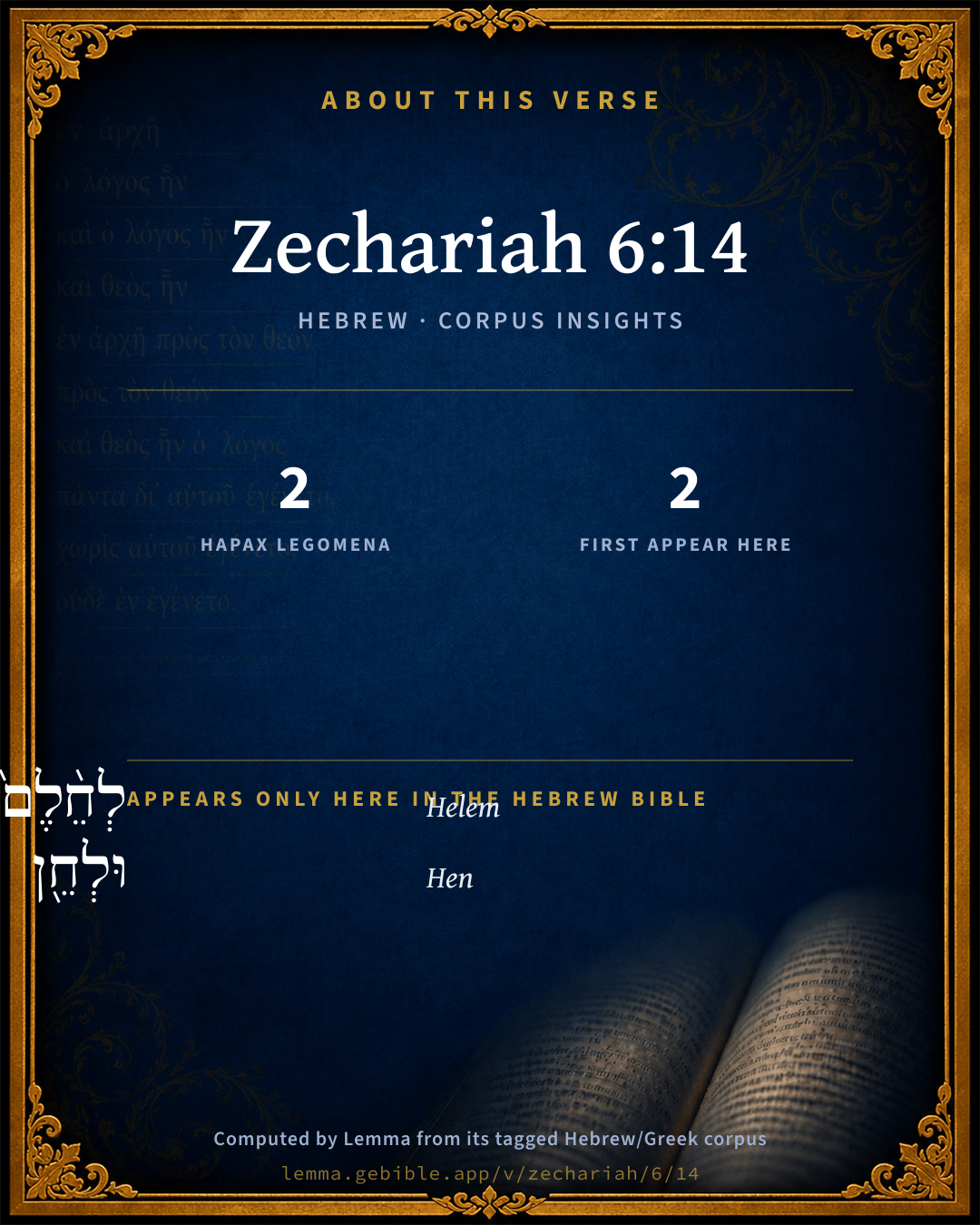
2 hapax legomena — words that appear only here in the entire Hebrew Bible:

  • לְחֵ֨לֶם֙ Helem H2494
  • וּלְחֵ֖ן Hen H2581

First appearance in Scripture

These words make their first canonical appearance in the Hebrew Bible here:

  • לְחֵ֨לֶם֙ Helem H2494
  • וּלְחֵ֖ן Hen H2581

Shared distinctive vocabulary

צְפַנְיָ֑ה Zephaniah H6846 occurs in 10 verses of the Hebrew Bible. Also found in:

Grammatical profile

  • 1 verb
  • 10 nouns

Verb forms

  • תִּֽהְיֶה֙ Qal · Imperfect

Hebrew & Septuagint length

In English translation the verse runs 27 words from the Hebrew and 44 from the Septuagint (LXX English) — the Septuagint runs noticeably longer here. See the side-by-side →

A rough comparison of the two English renderings, which tokenize alike — not a word-level alignment.

Word counts can differ between the Hebrew and the Greek without any difference in meaning — e.g. the Hebrew direct-object marker אֵת has no separate Greek word, and Greek often adds the article ὁ.

Cross-references

12

Topical passages linked to Zechariah 6:14 in the Treasury of Scripture Knowledge — connected by theme and wording, ordered by reader-vote popularity; previews shown in the World English Bible.

  • Exodus 12:14 This day shall be to you for a memorial, and you shall keep it a feast to Yahweh: throughout your generations you shall keep it a feast by an ordinance forever.
  • Matthew 26:13 Most assuredly I tell you, wherever this Gospel is preached in the whole world, what this woman has done will also be spoken of as a memorial of her."
  • Mark 14:9 Most assuredly I tell you, wherever this Gospel may be preached throughout the whole world, that which this woman has done will also be spoken of for a memorial of her."
  • Exodus 28:12 You shall put the two stones on the shoulder-pieces of the ephod, to be stones of memorial for the children of Israel: and Aaron shall bear their names before Yahweh on his two shoulders for a memorial.
  • Exodus 28:29 Aaron shall bear the names of the children of Israel in the breastplate of judgment on his heart, when he goes in to the holy place, for a memorial before Yahweh continually.
  • Numbers 16:40 to be a memorial to the children of Israel, to the end that no stranger, who isn't of the seed of Aaron, comes near to burn incense before Yahweh; that he not be as Korah, and as his company: as Yahweh spoke to him by Moses.
  • Numbers 31:54 Moses and Eleazar the priest took the gold of the captains of thousands and of hundreds, and brought it into the tent of meeting, for a memorial for the children of Israel before Yahweh.
  • Joshua 4:7 then you shall tell them, Because the waters of the Jordan were cut off before the ark of the covenant of Yahweh; when it passed over the Jordan, the waters of the Jordan were cut off: and these stones shall be for a memorial to the children of Israel forever.
  • 1 Samuel 2:30 Therefore Yahweh, the God of Israel, says, I said indeed that your house, and the house of your father, should walk before me forever: but now Yahweh says, Be it far from me; for those who honor me I will honor, and those who despise me shall be lightly esteemed.
  • Zechariah 6:10 "Take of them of the captivity, even of Heldai, of Tobijah, and of Jedaiah; and come the same day, and go into the house of Josiah the son of Zephaniah, where they have come from Babylon.
  • Acts 10:4 He, fastening his eyes on him, and being frightened, said, "What is it, Lord?" He said to him, "Your prayers and your gifts to the needy have gone up for a memorial before God.
  • 1 Corinthians 11:23–26 For I received from the Lord that which also I delivered to you, that the Lord Jesus on the night in which he was betrayed took bread.

Cross-references courtesy of OpenBible.info (CC BY 4.0).

Hebrew and Greek witnesses Masoretic Hebrew ↔ Greek Septuagint

The same verse in the two great witnesses to the Old Testament, shown verse-for-verse.

Here the Septuagint runs noticeably longer than the Hebrew — LXX2012 (modern English Septuagint) 44 words vs World English Bible 27. A rough length comparison of the two English translations, not a word-level alignment — read both below.

These are two independent witnesses, not word-aligned to each other, and the Septuagint is shown in lemma (dictionary) form.

Hebrew Zechariah 6:14 Masoretic · Westminster Leningrad Codex

וְהָעֲטָרֹ֗ת תִּֽהְיֶה֙ לְחֵ֨לֶם֙ וּלְטוֹבִיָּ֣ה וְלִידַֽעְיָ֔ה וּלְחֵ֖ן בֶּן צְפַנְיָ֑ה לְזִכָּר֖וֹן בְּהֵיכַ֥ל יְהוָֽה

The crowns shall be to Helem, and to Tobijah, and to Jedaiah, and to Hen the son of Zephaniah, for a memorial in the temple of Yahweh.

World English Bible · Public Domain

Greek LXX Zechariah 6:14 Septuagint · lemma form

ὁ δέ στέφανος εἰμί ὁ ὑπομένω καί ὁ χρήσιμος αὐτός καί ὁ ἐπιγιγνώσκω αὐτός καί εἰς χάρις υἱός σοφονίας καί εἰς ψαλμός ἐν οἶκος κύριος

And the crown shall be to them that wait patiently, and to the useful men of the captivity, and to them that have known it, and for the favor of the son of Sophonias, and for a psalm in the house of the Lord.

LXX2012 (modern English Septuagint) · Public Domain

On this verse, Adam Clarke's Commentary discusses the Septuagint’s reading. Read the note in Commentary ↓

Hebrew: Westminster Leningrad Codex (CC BY 4.0). Greek: Septuagint (public domain); English from LXX2012 (modern English Septuagint) (Public Domain). How the Septuagint differs from the Hebrew →

Targum (Aramaic paraphrase)

1

The Targum is the ancient Jewish Aramaic paraphrase of the Hebrew Scriptures — an interpretive translation, not the Hebrew text itself. Onkelos (literal) and Pseudo-Jonathan (expansive) render the Torah, and Jonathan the Prophets. Coverage is partial: where no permissively-licensed English translation exists for a verse, only the Aramaic is shown. This is verse-level text, not a word-by-word alignment to the Hebrew.

  1. Targum Jonathan Prophets (Joshua–Malachi)
    וְתִשְׁבַּחְתָּא תְּהֵי לְחֵלָם וּלְטוֹבִיָה וְלִידַעְיָה וּלְחֵן בַּר צְפַנְיָה לְדָכְרָנָא בְּהֵיכְלָא דַיָי:

    (no public-domain English translation for this verse)

    Targum Jonathan — Aramaic: “Mikraot Gedolot” (public domain). English: “Sefaria Community Translation” (CC0 1.0 (public-domain dedication)); “London "Chaldee Paraphrase," 1871” (public domain). Text via Sefaria.

Commentary

Notes on Zechariah 6:14 from classic Christian and Jewish commentators (each source and its license shown beneath its notes). The classic Christian expositions comment on the surrounding passage and are grouped to its opening verse, so a note may address several verses; the Jewish commentaries on the Tanakh (Rashi and others) are per-verse, so they appear only where the commentator wrote on this verse.

Lemma curates 59 commentaries, every one of them public domain or Creative Commons licensed, each selected and text-cleaned for this edition rather than reprinted as found. About our sources →

Trapp's Complete Commentary

John Trapp

Zec 6:14 And the crowns shall be to Helem, and to Tobijah, and to Jedaiah, and to Hen the son of Zephaniah, for a memorial in the temple of the LORD.

Ver. 14. And the crowns shall be to Helem … for a memorial] Or monument of their incredulity, saith Calvin, and for their full conviction. {See Trapp on "Zec 6:10"} Or their liberality, say others, and peradventure with some inscription or remembrance of their names (here recorded) for honour’s sake. But best of all those that say these duties were for a memorial in the temple of the Messiah that was shortly to be expected, and was presently promised. The poor Jews at this day are said to have a crown hanging in their synagogues, against the coming of their long-looked-for Messiah. And that he comes not all this while they say it is for their sins, which are many and bony, or mighty (σοφον φαρμακον). But now seeing he stays so long, he shall be, say they, a forerunner of the end of the world, and shall gather by his power all nations into one fold, according to that which here followeth.

John Trapp, A Commentary or Exposition upon All the Books of the Old and New Testament (1647–1656) — public domain. Text from a community e-Sword module.

Joseph Benson's Commentary

Zec 6:14-15. And the crowns — The two crowns before mentioned, made of the gold and silver brought from Babylon, Zec 6:11; shall be to Helem and to Tobijah, &c. — Of these persons we know no more, with any certainty, than their names. For a memorial in the temple of the Lord — Namely, of this transaction, of the pious liberality of those men, who had presented the gold and silver of which they were made, and especially of the Messiah’s certain and speedy coming. And they that are far off shall come and build, &c. — Though this verse, in its literal sense, may refer to the Jews who lived in distant parts, and other artificers, coming to Jerusalem to assist in building the material temple, yet, in its mystical and ultimate meaning, it refers to the conversion of the Gentiles to Christ, and to that true temple, the Christian Church, in helping to erect, enlarge, and beautify which, thousands and myriads of the Gentiles have co-operated, and still more, in ages to come, will co-operate. And ye shall know that the Lord of hosts hath sent me unto you — And the event of things, which, if not prevented by your disobedience, will be agreeable to my predictions, shall prove to you, beyond all doubt, that I was divinely inspired, and commissioned to declare these things to you: that is, the prediction, as far as it was intended to be understood literally, shall be accomplished in your days; and, in its mystical sense also, it shall be fulfilled in its season: the Gentiles shall come in and be united with you as brethren, and will help you to build the spiritual temple; if ye will diligently obey the voice of the Lord — For I must again desire you to observe, that the accomplishment of these promises depends on the condition of your obedience: for if you rebel and obey not, you shall even be cast out of God’s church, shall be deprived of his protection and care, and the Gentiles shall be taken to be his peculiar people in your place.

Joseph Benson's Commentary on the Old and New Testaments (1811–1818) — public domain. Text from a community e-Sword module.

Tyndale Open Study Notes

Tyndale Open Resources

6:14 The symbolic crown that united kingship and priesthood was placed in the Temple as a memorial to the donors of gold and silver. It was also a permanent reminder of Jeshua’s coronation as priest-king and a visual aid for priests in teaching this new development. • Josiah was honored for his role as broker for the meeting between Zechariah and the three former exiles.

Tyndale Open Study Notes — © Tyndale Open Resources, licensed CC BY-SA 4.0. Text via the HelloAO Bible API.

Geneva Bible (1599)

Geneva Bible translators

That they may acknowledge their infirmity, which looked that all things should have been restored incontinently: and of this their infidelity these two crowns shall remain as tokens, Acts 1:16.

Who was also called Heldai.

He was also called Joshiash.

Geneva Bible (1599) marginal notes — public domain. Text via Bolls.life.

Jamieson, Fausset & Brown

Robert Jamieson, A. R. Fausset & David Brown

the crowns shall be to Helem . . . a memorial--deposited in the temple, to the honor of the donors; a memorial, too, of the coronation of Joshua, to remind all of Messiah, the promised antitypical king-priest, soon to come. Helem, the same as Heldai above. So Hen (that is, "favor") is another name for Josiah (that is, "God founds") above. The same person often had two names.

Jamieson, Fausset & Brown — Commentary Critical and Explanatory on the Whole Bible (1871) — public domain (CC PDM 1.0). Text via the HelloAO Bible API.

Adam Clarke's Commentary

Verse 14. And the crowns shall be] One of my MSS. has אטרות ataroth, crowns, corrected into עטרת atereth, crown; and so the Septuagint, Syriac, and Arabic. The Chaldee has, "And praise shall be," &c. The meaning appears to be this, that the crown made for Joshua should be delivered to the persons mentioned here and in Zec 6:10, to be laid up in the temple of the Lord, as a memorial of this typical transaction.

Adam Clarke's Commentary on the Bible (1810–1826) — public domain. Text from a community e-Sword/MySword module.

John Calvin's Commentaries

They who think that the crowns were deposited with these four men, pervert the meaning of the Prophet; for they were, on the contrary, placed in God’s temple to be a memorial to them. It hence appears; that, as I have already said, they were not required to supply the gold, because they excelled all others in piety and holiness, but because it was necessary to condemn their want of faith, inasmuch as they thought that their hope was disappointed, as God did not immediately fulfill what he had promised. Let then these crowns, saith the Spirit, be a memorial to them, that is, that whenever they look on these crowns they may check themselves and know that their expectations are very unreasonable, and that they themselves are too hasty when they wish all prophecies to be accomplished in one day; and also that the whole people may know that they had complained without reason, as these suspended crowns shall be a memorial and a testimony. We now then see more clearly why the Prophet had been ordered to take gold and silver from these four men: it was, that he might make crowns, which were afterwards to be deposited in God’s temple. At length he adds —

John Calvin's Commentaries (1540-1563) — public domain. Text from the Calvin Translation Society English edition (1840s-50s) via the Christian Classics Ethereal Library (ccel.org). Calvin's coverage is partial (roughly two-thirds of the Bible); uncommented books and verses are honest gaps, never fabricated. The 19th-century editor's footnotes and remarks are omitted so the notes are faithfully Calvin's own voice.

Ellicott's Commentary for English Readers

(14) The crowns.—Better, the crown. (See Note on Zec_6:11.) The verb is in the singular.

For a memorial—viz., of their piety.

A Bible Commentary for English Readers, edited by Charles John Ellicott (1878–1897) — public domain. Text from a community e-Sword module.

The Cambridge Bible for Schools and Colleges

gen. ed. J. J. S. Perowne

14. Helem] This may of course be another name borne by the person who in Zec_6:10 is called Heldai. The conjecture, however, that Helem is a copyist’s error for Heldai, the difference between the two Hebrew words being slight, is not improbable.

to Hen] Rather (as in R. V. margin), to the favour, or kindness of the son of Zephaniah, i.e. the crown suspended in the Temple shall be a lasting memorial, not only of the zeal and piety of these offerers of gifts from a far off land, but also of the kindness shewn them by Josiah the son of Zephaniah, who had received them into his house, Zec_6:10. “He that receiveth a righteous man in the name of a righteous man shall receive a righteous man’s reward.” Mat_10:41.

The Cambridge Bible for Schools and Colleges (gen. ed. J. J. S. Perowne; Cambridge University Press, 1878–1918) — public domain. Text from a community e-Sword module.

John Gill's Exposition

And they that are afar off shall come,..... Into the temple; not the material temple; nor is this a prophecy which was fulfilled in Herod, a stranger, repairing that, as Kimchi suggests; but into the spiritual temple, the church; and is a prophecy of the calling of the Gentiles, who are said to be "afar off", Eph 2:12, from God; from having his image on them; from subjection to his law; from the knowledge and fear of him; and from communion with him: from Christ; from the knowledge of his person, righteousness, and salvation by him; from love to him, faith in him, and fellowship with him; from the Spirit of God, and from the people of God, and from any solid hope of eternal life: now these being called by grace, and brought to Christ under the drawings of the Father's love, shall come to his church, and join themselves to his people:

and build in the temple of the Lord; upon the foundation Christ; and be useful in building up others, either by private conversation, or by public preaching the word; it is not said, they shall "build the temple of the Lord"; that is Christ's work; but "build in" it:

and ye shall know that the Lord of hosts hath sent me unto you; that is, the Prophet Zechariah, who was sent to the Jews to declare these things to them; or, as the Targum adds, "to prophesy unto you": which they would fully know, and be assured of, when these things should have their accomplishment:

and this shall come to pass, if ye will diligently obey the voice of the Lord your God; not that the fulfilment of the above predictions depended upon their obedience; but when they should in the latter day obey the Gospel of Christ, or "the word of the Lord" their "God", as the Targum paraphrases it; then this would come to pass, that they should know that the prophet had his mission from the Lord.

Next: Zechariah Chapter 7

John Gill's Exposition of the Whole Bible (1746–1763) — public domain (CC PDM 1.0). Text via the HelloAO Bible API.

Albert Barnes' Notes on the Bible

And the crowns shall be to Helem - There is no ground apparent to us, why the name “Helem” appears instead of “Holdai” , or “Hen” for “Josiah:” yet the same person must have been called both Hen and Josiah, since the father’s name is the same in both places. They cannot both be intended as explanations of the former names, since Helem stands insulated in Hebrew, its meaning conjectural. Perhaps then they were the own names of the individuals, and the names compounded with the name of God, honorable names which they had taken.

For a memorial in the temple of the Lord - They brought a passing gift, but it should be for a lasting memorial in their behalf. It is a renewal of the well-known term of the law. The two stones, engraven with the names of the children of Israel, upon the shoulders of the Ephod, were to the end, that Aaron should “bear their names before the Lord upon his two shoulders for a memorial” Exo 28:12, Exo 28:22; Exo 39:7; continually, it is added of the “breastplate with its twelve precious stones Exo 28:29; the atonement money of the children of Israel was to be appointed for the service of the tabernacle of the congregation, that it may be a memorial for the children of Israel before the Lord, to make atonement for their souls; “to make an atonement for their souls before the Lord” Exo 30:16. They were to “blow with the trumpets over their burnt-offerings, and over the sacrifice of their peace-offerings, that they may be to you for a memorial before your God” Num 10:10.

When Midian had been smitten before Israel, and not one of Israel had been slain, they brought all the gold which had accrued to them, and “Moses and Eleazar took the gold, and brought it into the tabernacle, a memorial for the children of Israel before the Lord” Num 31:50, Num 31:54. So the angel said to Cornelius, “thy prayers and thy alms are come up for a memorial before God” Act 10:4, Act 10:31. Rup.: “This is what we look for, that to all the saints and friends of God, whom these signify, those crowns which they made of their gold and silver for the Lord Jesus, shall be an everlasting memorial in that heavenly temple of the Lord.” The tradition of the Jews, that this was literally, observed , can hardly be without foundation. Cyril: “These their offerings shall be for grace to those who dedicated them and an occasion of doxology. For the piety of princes becomes to the rest a path to the love of God. But when Christ is crowned by us, then shall also the multitude of the Gentiles haste to the knowledge of Him.”

Albert Barnes' Notes on the Bible (1834–1885) — public domain. Text from a community e-Sword/MySword module.

Haydock's Catholic Bible Commentary

Helem. Septuagint, "the crown shall be for those who expect him." (Haydock) --- Hem. Septuagint, "for grace." Hebrew chen. (St. Jerome) --- Thus proper names are frequently interpreted. (Haydock) --- The crowns were not to be worn, but to be deposited in the temple, 1 Machabees i. 23. (Calmet) --- The names of those four who had contributed towards their making, were to be inscribed upon them. Helem and Hem are the same with Holdai and Josias. (Menochius) --- The Jews say Hem or Daniel, and his three companions, brought gifts. (St. Jerome)

George Leo Haydock (1774–1849), Haydock's Catholic Family Bible and Commentary, 1859 edition — public domain. Excludes Psalms (Douay-Rheims chapter numbering differs from Protestant) and Deuterocanonical books (Catholic canon only).

Matthew Poole's English Annotations

The crowns; those two crowns before mentioned, made of the gold and silver brought from Babylon, Zec 6:11.

Shall be to Helem, & c.: these persons we know no more of with any certainty but their names.

For a memorial, of their incredulity, say some, of their liberality, say others; but these crowns were certainly to be memorials of the Messiah’s certain and speedy coming, and to be reserved in the temple as a memorial of this solemn typical inauguration of Joshua, or Messiah in him.

Matthew Poole's English Annotations on the Holy Bible (1683–1685) — public domain. Text from a community e-Sword/MySword module.

The Pulpit Commentary

The crowns shall be... for a memorial. The crown was to be taken from Joshua"s head and deposited in the temple as a memorial of this prophecy, and of the zeal of those who had come from far to bring offerings to the Lord, and likewise of the hospitality of Josiah, who had received them into his house. That such "gifts" were dedicated in the temple is well known. (see RAPC Jdt 16:19 2Ma 5:16 9:16; Josephus, "Bell. Jud:," 2:17:3; "Ant.," 17:6. 3; 19:6. 1; Philo, "Legat. ad Cal.," 2, p. 592) Helem is the same as Heldai (ver. 10), whether he bore both names, or whether, as is probable, this is a mere mistake of a copyist. To Hen. The Authorized Version considers this as a proper name. In this case it would be another name for Josiah. But it is really an appellative, and the rendering should be, "for the kindness of the son of Zephaniah." The crown would be also a memorial of his kindness in receiving and entertaining these exiles. (comp. Mat_10:41) The LXX explains the names as in ver. 10, though not quite in the same way, Estai toiv upomenousi kai toiv crhsimoiv authv kai toiv epegnwkosin auth eiv carita uiou Sofonion kai eiv qalmoou , "The crown shall be to them that endure, and to its good men, and to those that have understood it, both for a favour to the son of Sophonias, and for a psalm in the house of the Lord."

The Pulpit Commentary (1880–1919), ed. H.D.M. Spence-Jones & Joseph S. Exell — public domain. Text from a community e-Sword module.

John Wesley's Explanatory Notes

The crowns - The two crowns before mentioned. Helem - These persons we know no more of than their names. A memorial - Of the Messiah's certain and speedy coming.

John Wesley, Explanatory Notes Upon the Whole Bible (1754–1765) — public domain. Text via the GEBible commentary corpus.

unfoldingWord translationNotes

Door43 World Missions Community

The crown will given

This can be stated in active form. AT: "You will give the crown" (See: Active or Passive)

Heldai, Tobijah, Jedaiah ... Hen

These are the names of men. See how you translated these in Zechariah 6:10. (See: How to Translate Names)

for Hen son of Zephaniah as a memorial

Some modern versions interpret this phrase as "as a memorial to the generosity of the son of Zephaniah" or "as a memorial to the one who is gracious, the son of Zephaniah." Also, some modern versions interpret the name "Hen" as meaning the name "Josiah."

those who are far off

This refers to the Israelites who remain in Babylon. (See: Assumed Knowledge and Implicit Information)

so you will know

The word "you" is plural and refers to the people of Israel. (See: Forms of You)

truly listen to the voice of Yahweh your God

Here to "listen" means to obey and the word "voice" represents the words that Yahweh speaks. AT: "truly obey what Yahweh your God says" (See: Metonymy)

translationWords

crown

temple

memorial

Zephaniah

know

Yahweh of hosts

send

voice

God

unfoldingWord translationNotes — © Distant Shores Media and the Door43 World Missions Community, licensed CC BY-SA 4.0. Source: git.door43.org/Door43/en_tn.

Rashi

Rabbi Shlomo Yitzchaki (Rashi)

And the crowns shall be for Helem, etc. This is a transposed verse. It should be understood as: And the crowns shall be in the Temple of the Lord as a good memorial for Helem and for Tobijah, who donated the silver and the gold. Those crowns were hanging in the windows in the height of the Temple, as we learned in tractate Middoth (36a, 3:8).

for Helem That is Heldai.

Rashi on the Tanakh — English translations: “The Judaica Press complete Tanach with Rashi, translated by A. J. Rosenberg” (CC BY 4.0); “Pentateuch with Rashi's commentary by M. Rosenbaum and A.M. Silbermann, 1929-1934” (public domain); “The Metsudah Tanach series, Lakewood, N.J” (CC BY 4.0); and “The Book of Joshua, Metsudah Publications, 1997” (CC BY 4.0). Text via Sefaria.

Lesson kit

Teaching starters — assembled from the data on this page, not authored interpretation. Every prompt links to the verse data it draws on. Edit before teaching.

Zechariah, in the Prophets, opens this verse with 11 words (11 distinct Hebrew lemmas). Its most distinctive word is Chêlem (“Helem”). The Greek Septuagint runs longer here. A historical commentator’s framing appears above. Read the whole chapter for the surrounding context.

Discussion questions

  1. The word Chêlem carries the sense “Helem.” How does it shape the verse?
  2. This verse holds 2 words here found nowhere else in the Hebrew Bible. What might the rare words draw attention to?
  3. 2 words here appear for the first time in Scripture. What is being introduced at this debut?
  4. 2 Kings 25:18 shares the word «Zephaniah» with this verse. How do the two illuminate each other?
  5. Compared with the Hebrew, the Septuagint runs longer here. What questions does that raise?
  6. The translations on this page render this verse differently — a whole-verse word diff, not a word-by-word alignment. What might account for the different wordings?
  7. The verb «תִּֽהְיֶה֙» is Qal Imperfect. How does its form color the action?
  8. Reading how Trapp's Complete Commentary and Joseph Benson's Commentary read this verse, where do the two commentators agree and where do they part?

Things to notice

  • 2 words in this verse appear nowhere else in the Hebrew Bible.
  • 2 words make their first canonical appearance in Scripture here.
  • These translations choose different wording for 4 words in this verse.
  • 11 distinct Hebrew lemmas span 11 words in this verse.

Reading settings

Reading text

Shown beneath each verse's original-language words.

Old Testament
Old Testament edition

Read the OT as the Masoretic Hebrew (MT) or the Greek Septuagint (LXX).

English shown for the Greek Septuagint (in the Hebrew ↔ Greek comparison).

Comparing translations? Open the Compare panel on any verse page to stack up to four side by side.